

Competitive Flexible Procedure: The Complete Supplier Guide 2026
The Competitive Flexible Procedure is one of the most significant changes introduced by the Procurement Act 2023. It replaces Competitive Dialogue, the Negotiated Procedure, and the Innovation Partnership as the single flexible route for complex UK public contracts. This guide explains exactly how it works, what suppliers can expect at each stage, and how to position yourself to win.
Evie
Procurement Specialist
The Procurement Act 2023 introduced a sweeping overhaul of how UK public bodies buy goods, works, and services. Much of the attention has rightly focused on headline changes: the new open and direct award procedures, the Central Digital Platform, KPI reporting, and the debarment register. But one reform has been comparatively under-discussed, despite being critical for suppliers bidding on complex, high-value contracts: the Competitive Flexible Procedure.
If you have ever bid for a contract under the old Competitive Dialogue or Negotiated Procedure, you will be working under fundamentally different rules from February 2025 onwards. If you have never used those routes before but operate in sectors like defence, major infrastructure, complex IT, or specialist professional services, the Competitive Flexible Procedure (CFP) is the route you are most likely to encounter for your biggest opportunities.
This guide explains what the CFP is, how it works in practice, what happened to the old procedures it replaced, and — most importantly — how you as a supplier can prepare for and succeed in a CFP competition.
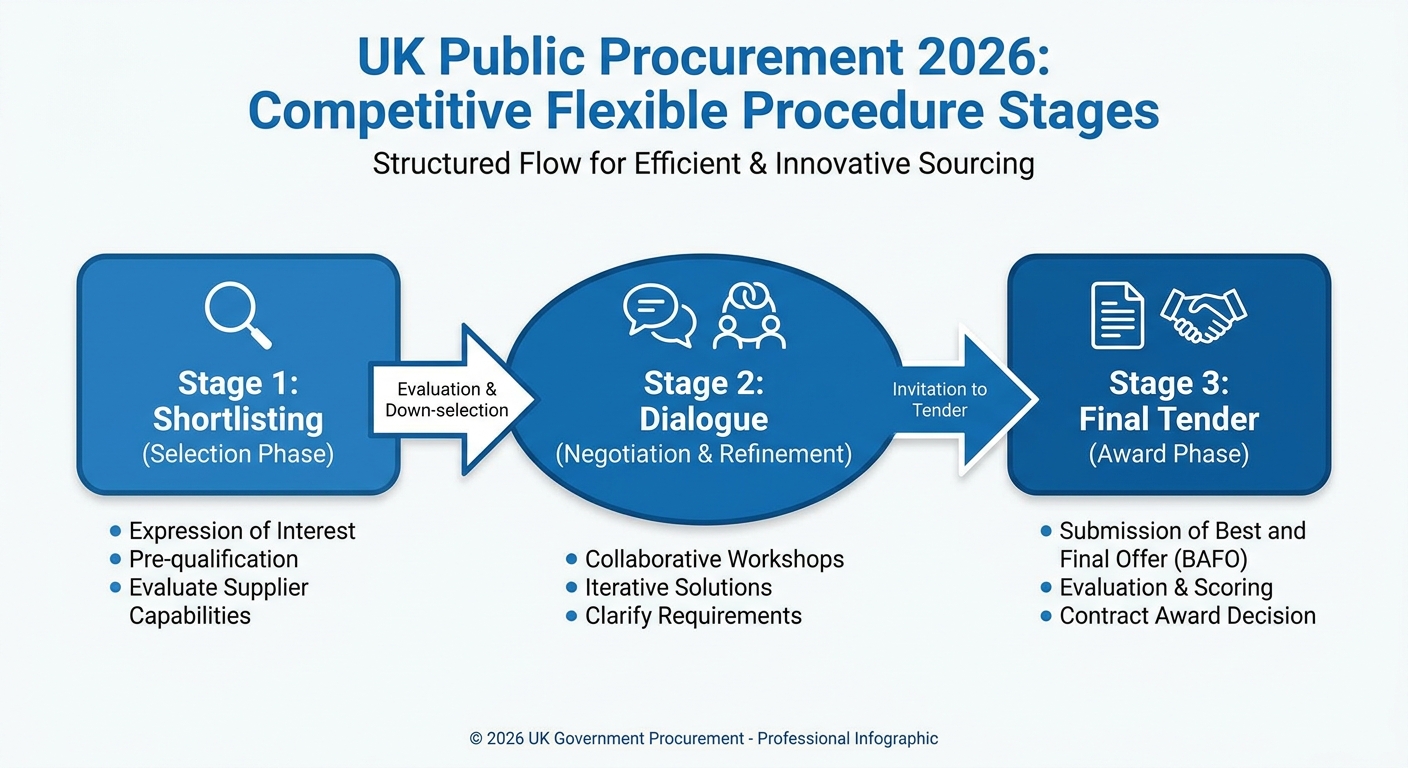
Overview of the Competitive Flexible Procedure stages under UK Procurement Act 2023 — shortlisting, dialogue, and final tender submission flowchart
What Is the Competitive Flexible Procedure?
The Competitive Flexible Procedure is a new procurement route created by the Procurement Act 2023. It is designed to give contracting authorities substantial flexibility in how they design and run competitive procurement processes for complex or innovative requirements where the standard Open Procedure is not suitable.
Under the Act, there are broadly four main procurement procedures available to UK contracting authorities:
- Open Procedure — the default route; all interested suppliers receive the full tender documents and submit a single bid
- Limited Tender Procedure — a more restricted version where the authority invites a specific set of suppliers without open competition (tightly constrained grounds)
- Competitive Flexible Procedure — for complex or innovative requirements, allowing multi-stage competition with dialogue, negotiation, and iterative refinement
- Direct Award — used only in defined circumstances, such as genuine urgency or sole-source situations
The CFP is the successor to what was previously three separate procedures under the Public Contracts Regulations 2015: the Restricted Procedure (with some caveats), Competitive Dialogue, the Negotiated Procedure with Prior Publication, and the Innovation Partnership. Rather than maintaining four distinct procedures each with its own rules, the Act collapsed them into a single flexible framework — hence the name.
The underlying logic is sound: rather than prescribe rigid step-by-step rules for every conceivable scenario, the Act gives contracting authorities a toolkit. They must follow minimum requirements but can otherwise design the competition to suit their specific need. For suppliers, this creates both opportunity and risk. Understanding the rules — and the legitimate variations within them — is essential.
Why the Old Procedures Were Replaced
The Restricted Procedure, Competitive Dialogue, and Negotiated Procedure under the Public Contracts Regulations 2015 each served a purpose. But they were widely criticised for being unnecessarily rigid, overlapping, and difficult to apply consistently.
Competitive Dialogue in particular was notorious for being time-consuming and expensive for all parties. It required extensive dialogue with shortlisted suppliers before any final tender could be issued, with strict rules about what could and could not be discussed. Authorities often used it reluctantly because the process — though useful for genuinely complex requirements — became unwieldy.
The Negotiated Procedure came with an exhaustive list of justification grounds that were frequently misapplied or stretched beyond their intent. The Innovation Partnership was rarely used in practice, partly because its rules were poorly understood.
The Competitive Flexible Procedure addresses these problems by:
- Removing the exhaustive list of prescribed grounds for use
- Allowing authorities to design multi-stage processes that fit the requirement rather than the other way around
- Permitting genuine negotiation of final tenders in ways the old rules restricted
- Giving explicit legislative space for iterative dialogue, prototypes, and solution development
- Reducing procedural formality around stage transitions
The trade-off is that the CFP requires more careful procurement design upfront and stronger governance during the process. For suppliers, it means you can expect more variation in how different authorities run their CFP competitions. The core statutory requirements remain constant; everything else is authority discretion.
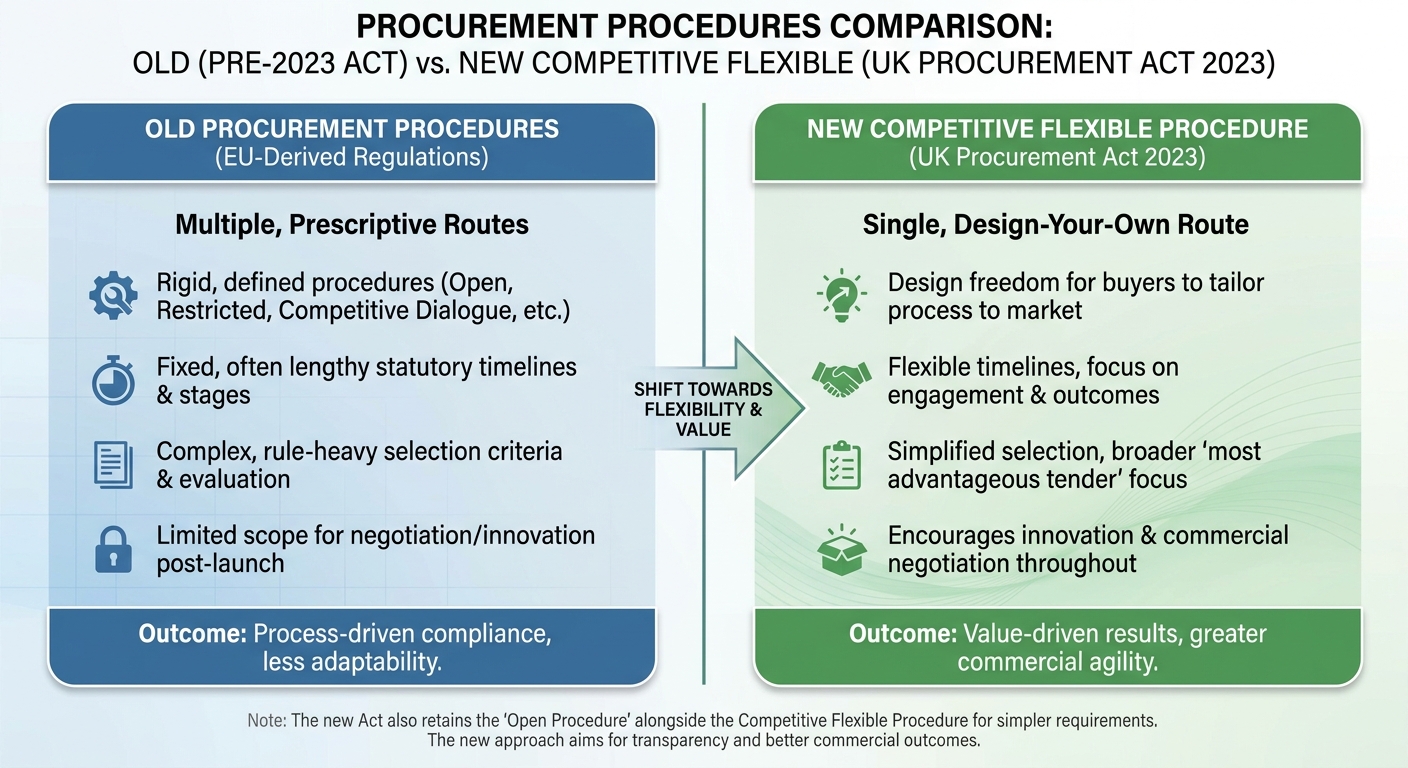
Comparison of old UK procurement procedures versus the new Competitive Flexible Procedure under Procurement Act 2023 — what changed
When Can a Contracting Authority Use the CFP?
This is one of the most significant liberalisations introduced by the Act. Under the old regime, using Competitive Dialogue or the Negotiated Procedure required demonstrating specific grounds — the requirement was inherently complex, the need for prior dialogue was established, innovation was required, and so on. Authorities had to justify their choice of procedure.
Under the Procurement Act 2023, contracting authorities can use the Competitive Flexible Procedure whenever they consider it appropriate. There is no exhaustive list of qualifying grounds. The authority simply needs to design a process that is proportionate, treats suppliers equally, and complies with the general principles of the Act.
In practice, the CFP is most commonly used for:
- Complex IT and technology contracts where technical solutions are not yet defined
- Major construction and infrastructure projects involving significant design development
- Defence and security procurements requiring classified solution development
- Managed services where transformation requires detailed due diligence
- Health and social care commissioning involving complex service redesign
- Innovation-led contracts where multiple competing technical approaches need development
That said, there is nothing in the Act preventing an authority from using CFP for a less complex requirement if they believe the flexibility is warranted. You may encounter CFP competitions across a surprisingly wide range of contract types. The important thing is to recognise the procedure when you see it and respond appropriately.
How the Competitive Flexible Procedure Works: Stage by Stage
Despite the procedural flexibility, most CFP competitions follow a broadly similar structure. The Act requires certain minimum elements; the rest is authority discretion. Here is what a typical CFP looks like in practice.
Stage 1: Publication of the Tender Notice
Every CFP begins with a tender notice published on the Find a Tender service. This notice is more detailed than an equivalent Open Procedure notice because the authority must explain how the competition will work.
The tender notice for a CFP must include:
- A description of the requirement (which may be high-level at this stage)
- The procedure being used (Competitive Flexible Procedure must be stated)
- The selection criteria for shortlisting suppliers
- A clear description of the stages of the competition
- The award criteria that will ultimately be applied
- Any minimum standards, qualification requirements, or exclusion grounds
- The indicative timeline
Critically, the award criteria must be set out in the tender notice or accompanying documents. Unlike the old Competitive Dialogue where award criteria could sometimes be finalised mid-process, the Procurement Act 2023 requires that the basis on which contracts will be awarded is established and published before suppliers invest in competition. This is a significant improvement for suppliers — you know the scoring framework going in.
Stage 2: Selection and Shortlisting
The CFP always involves a selection stage before suppliers are invited to participate in dialogue or submit full tenders. This is analogous to the old pre-qualification questionnaire (PQQ) or Selection Questionnaire (SQ) stage.
At this stage, the authority assesses:
- Exclusion grounds — mandatory grounds (criminal convictions, certain regulatory failures) and discretionary grounds (past performance, integrity issues)
- Technical and professional ability — relevant experience, qualifications, accreditations
- Economic and financial standing — turnover thresholds, insurance levels, financial health
- Selection questions — case studies, references, descriptions of relevant work
The Act retains the concept of a selection questionnaire but streamlines how it works. The standard selection questions are published on the Find a Tender service and authorities are expected to use them rather than inventing bespoke questions. There are limits on what financial thresholds can be demanded and restrictions on how exclusion grounds can be applied to SMEs.
At the end of the selection stage, the authority shortlists a defined number of suppliers to proceed to dialogue. The tender notice must specify the maximum and minimum number of suppliers to be shortlisted (the Act requires a minimum of three for CFP). If fewer than three acceptable candidates come forward, the authority may proceed with fewer but must document why.
Stage 3: Invitation to Participate in Dialogue (ITPD)
This is where the CFP diverges sharply from the Open Procedure. Shortlisted suppliers receive an Invitation to Participate in Dialogue — sometimes called an ITPD or initial submission request.
The ITPD asks suppliers to submit an initial response to the requirement. Depending on how the authority has structured the competition, this might be:
- A high-level conceptual solution
- An outline methodology
- A proposed approach to key challenge areas
- Technical demonstrations or presentations
- A preliminary commercial proposal
The initial submission is not the final bid. Its purpose is to begin the dialogue process — a structured engagement between the authority and each shortlisted supplier about how the requirement could best be met.
Dialogue sessions are typically conducted separately with each supplier. Suppliers must be treated equally, which means each receives the same information and each has equivalent opportunities to engage. However, the content of dialogue sessions is not shared between suppliers — your solution development happens in confidence.
The Act explicitly permits negotiations on any aspect of the proposal during dialogue, including commercial terms. This is an important liberalisation from the old Competitive Dialogue rules, which had stricter constraints on what could be discussed at each stage.
Stage 4: Iterative Dialogue and Development
For complex requirements, the dialogue phase may go through several iterations. The authority can progressively refine the specification based on what emerges from supplier dialogue. Suppliers can develop, refine, and in some cases fundamentally revise their proposed solutions.
This iterative quality is one of the key advantages of the CFP for genuinely complex procurements. Under the old Competitive Dialogue, there were pressures (both formal and informal) to move quickly through stages. The CFP explicitly anticipates an iterative process.
During this phase, the authority should be:
- Clarifying and developing the specification
- Testing assumptions about technical approaches
- Exploring commercial models and pricing structures
- Assessing implementation risk and mitigation strategies
- Developing the evaluation framework if it needs refining
Suppliers should treat each dialogue session as an opportunity to demonstrate both the quality of their solution and the quality of their team. The evaluators are forming views throughout the process, not just when they score the final tender. How you engage in dialogue — the sharpness of your thinking, the quality of your questions, your responsiveness — matters.
The authority closes dialogue when they believe the requirements are sufficiently defined to permit a final tender. They must notify all remaining suppliers simultaneously that dialogue is concluded and issue the Invitation to Submit Final Tenders.
Stage 5: Invitation to Submit Final Tenders (ISFT)
When dialogue closes, all remaining shortlisted suppliers receive the Invitation to Submit Final Tenders. This is the document against which your final bid is evaluated.
The ISFT will include:
- The finalised specification
- The evaluation criteria and scoring methodology
- The commercial terms and model contract (or final draft contract)
- Any final clarifications or changes arising from the dialogue process
- The submission deadline and format requirements
In most cases, the ISFT is the first time the full specification is issued in final form. The dialogue process will have shaped it significantly. Suppliers who engaged well in dialogue will have contributed to defining what the authority actually needs — and will therefore find the ISFT closely aligned with the solution they have been developing.
Final tenders are evaluated against the published award criteria. The authority is not permitted to change the award criteria at this stage — they were fixed in the original tender notice. This protects suppliers who invested in the process in good faith.
Stage 6: Evaluation and Award
Final tenders are evaluated, and a preferred bidder is selected. The Act requires the authority to assess against the most advantageous tender (MAT) standard — the combination of price and quality that offers the best overall value. Pure lowest-price selection is not permitted.
Before formally awarding the contract, the authority publishes a Contract Award Notice and enters a mandatory standstill period of eight working days. During this period, unsuccessful tenderers can request a debrief and, if they believe there has been a serious breach of procurement law, issue proceedings in the courts.
After the standstill period, the contract is formally awarded and a Contract Details Notice is published on the Find a Tender service.

Supplier team preparing competitive flexible procedure bid, reviewing documents and strategy in professional UK office environment
Key Differences From the Old Procedures
If you have bid under the old PCR 2015 framework, here are the most significant practical changes under the CFP:
Award criteria are set at the start, not during dialogue. Under the old Competitive Dialogue, there was flexibility to finalise evaluation criteria mid-process. Under the CFP, criteria must be in the original notice. This makes early engagement with the pipeline — before the notice is published — even more valuable. Genuine negotiation is explicitly permitted. The old Competitive Dialogue had theoretical constraints on what could be negotiated. The CFP gives contracting authorities explicit authority to negotiate any aspect of the proposal, including commercial terms. For suppliers, this means the final tender can look quite different from initial positions — you should be prepared to flex. No prescribed dialogue stages. The old procedures often had rigid stage gates. The CFP allows the authority to define as many or as few rounds as they consider necessary. Some competitions may involve a single dialogue round followed by final tenders; others may run four or five iterative cycles. The specification can be developed during the process. For innovation-led or genuinely novel requirements, the authority can allow the specification itself to evolve based on what dialogue reveals. This is explicitly contemplated by the Act in a way the old procedures were not. Debrief rights are strengthened. Unsuccessful suppliers have clearer rights to a debrief under the Act. Authorities must provide written debriefs within 30 days of a request. The Act specifies minimum content, including scores and reasons.Supplier Strategy: How to Win Under the CFP
Winning a Competitive Flexible Procedure competition requires a different mindset than an Open Procedure bid. The process is longer, more relationship-intensive, and demands sustained engagement over months rather than a single submission effort. Here is how to approach it.
Get on the Pipeline Early
Because award criteria must be published upfront, your opportunity to influence the evaluation framework lies before the tender notice is published. Pre-market engagement — attending market days, responding to Prior Information Notices, participating in supplier days — is not merely optional. It is where the real competition often begins.
Contracting authorities are legally permitted (and encouraged) to engage with the market before running a procurement. They use this to test their thinking, understand what is possible, and shape their requirements. Suppliers who engage substantively in pre-market dialogue are better placed to understand what the authority actually needs, and their input may shape the evaluation criteria that all suppliers are then scored against.
Start tracking pipelines on the Find a Tender service and sector-specific portals well in advance. For major CFP contracts, lead times from Prior Information Notice to contract award can be 18 to 24 months or more. You cannot enter this process six weeks before the final tender deadline.
Invest in the Selection Stage
The selection stage for a CFP competition tends to be more demanding than an Open Procedure PQQ. Because the authority is committing to an intensive multi-month dialogue process, they want to shortlist suppliers who can genuinely compete — not just firms that meet minimum thresholds.
Selection questions in CFP competitions often probe:
- Relevant experience with genuinely comparable complex contracts
- The quality and depth of the team you intend to field
- Your approach to collaboration and knowledge sharing
- Financial robustness over the period of the dialogue and the contract itself
- Evidence of innovation or solution development capability
Write your selection responses with the same rigour you would apply to a final tender. A vague or thin response at selection stage will cost you your place in the competition before dialogue even begins.
Treat Dialogue as a Bidding Event
This is the most important strategic insight for CFP competitions. Dialogue sessions are not just information-gathering exercises. They are opportunities to demonstrate the quality of your organisation and build the evaluators' confidence in your team.
Bring your best people to dialogue sessions. Senior client-facing staff, your proposed contract lead, your technical experts. The evaluators will be assessing not just what you say but how you think. Well-prepared, insightful questions signal that you understand the client's problem. Thoughtful responses to their questions signal that you can solve it.
Keep detailed records of every dialogue session. Note what the authority told you, what you committed to, and what questions were left open. This intelligence is what shapes your final tender — and in complex procurements, the final tender is substantially shaped by what happened in dialogue.
Manage the Commercial Conversation
CFP competitions often involve detailed commercial negotiation during dialogue. This is unfamiliar territory for many bid teams, who are accustomed to submitting a price and waiting to see if they have won.
In CFP dialogue, you may be asked to:
- Present and justify your pricing model
- Explain your cost assumptions and profit margin expectations
- Discuss how risk allocation affects your price
- Explore alternative commercial structures
This requires your bid team to include commercially literate people who can engage credibly with these conversations. A purely technical bid team — however brilliant — will struggle in the commercial dialogue sessions.
Prepare your commercial position before entering dialogue. Know your walk-away price. Know which commercial risks you are genuinely able to price and which would require significant risk premium. Know what contract terms matter most to your organisation. This preparation prevents you from committing to positions in dialogue that become problems at final tender stage.
Write the Final Tender to the Dialogue You Had
By the time you reach the Invitation to Submit Final Tenders, you should have a deep understanding of what the authority actually wants. Your final tender should reflect that understanding explicitly and specifically.
Generic bids — submissions that could have been written without any dialogue — will underperform against competitors who have used the dialogue to sharpen their understanding and demonstrate alignment with the client's specific needs.
Use the client's language. Reference specific concerns they raised in dialogue. Show that your solution addresses the precise challenges they described. This is not flattery — it is evidence that you listened, understood, and responded.
At the same time, do not simply tell the client what you heard them say. Bring your own thinking, your own solutions, your own innovations. The dialogue should have informed your approach; your final tender should demonstrate that approach at its best.
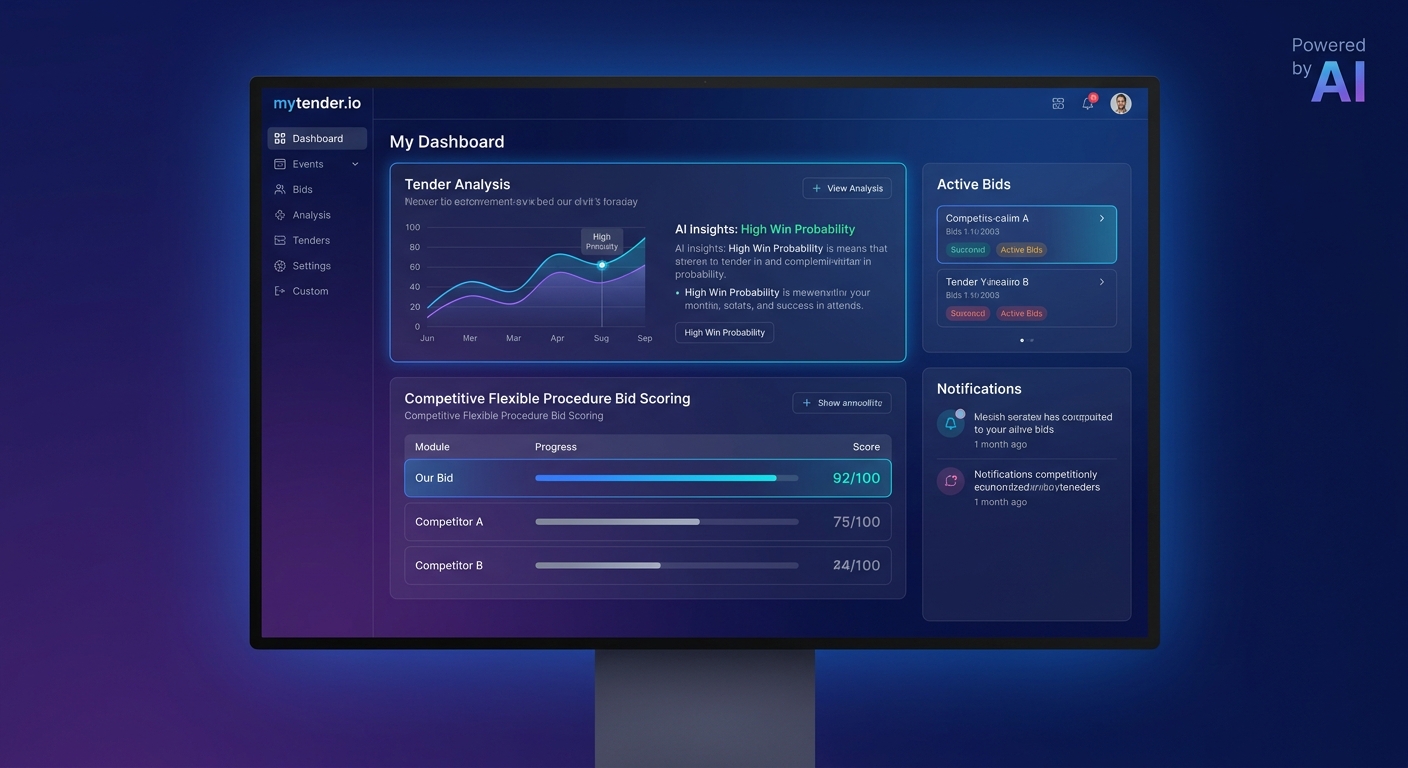
AI-powered bid writing software helping suppliers prepare Competitive Flexible Procedure responses — mytender.io dashboard with tender analysis
How AI Tools Can Help You Win CFP Competitions
CFP competitions are demanding precisely because they require sustained, high-quality written output across multiple stages. The selection response, the initial dialogue submission, any interim presentations or written materials, and then the final tender — all of it needs to be well-written, well-structured, and aligned with the evaluation criteria.
This is where AI-powered bid writing tools like mytender.io provide genuine competitive advantage. Unlike a standard open procedure bid where you are producing a single submission in a compressed timeframe, CFP competitions play out over months. AI tools help you maintain consistency and quality across that extended period.
Specifically, mytender.io can help with:
Content generation across stages. As the specification evolves through dialogue, your written materials need to track. mytender.io helps you produce and revise written content quickly as requirements change, without starting from a blank page each time. Company knowledge retrieval. CFP competitions require you to draw on relevant experience across your organisation. mytender.io's content library makes it easy to retrieve the right case studies, CVs, accreditations, and evidence quickly — and to tailor them specifically to each question and evaluation criterion. Criterion-by-criterion structuring. Experienced evaluators score complex bids against detailed mark schemes. mytender.io helps you structure responses so that every mark-earning element is explicitly addressed, reducing the risk of leaving points on the table through poor presentation. Win theme development. In a CFP competition, your win themes — the core reasons why your solution is the best — need to run consistently through every piece of written material over the entire competition lifecycle. AI tools help you maintain that consistency. Quality assurance. Long bids produced under time pressure by large teams are prone to inconsistency, repetition, and gaps. mytender.io helps identify where responses are thin, where claims need evidencing, and where the narrative breaks down.The combination of deep dialogue preparation and high-quality written output — both supported by intelligent AI tooling — is what distinguishes consistently successful bidders in CFP competitions.
Common Supplier Mistakes in CFP Competitions
Having worked with suppliers across many complex procurement exercises, there are recurring mistakes that cost bids their place in competitions.
Treating dialogue as a formality. Some bid teams go through dialogue sessions without genuinely engaging — presenting their standard pitch, deflecting probing questions, and waiting for the ISFT. This is a critical error. The authority is forming views about each supplier throughout the process. Teams that engage genuinely outperform those that do not. Failing to track specification changes. Complex requirements evolve through dialogue. Suppliers who do not carefully track what changed — and update their final tender accordingly — find themselves submitting responses to an out-of-date specification. This is avoidable with good programme management. Putting the wrong people in dialogue. Junior bid team members who lack authority to commit to positions, or technical people who cannot articulate solutions clearly to non-technical evaluators, are a liability in dialogue sessions. Senior, commercially aware people who can think on their feet are essential. Over-relying on corporate content. Final tenders in CFP competitions need to be tailored to the specific dialogue that took place, not assembled from corporate boilerplate. Evaluators who spent months in dialogue with your team know what a generic response looks like. It signals disengagement. Underinvesting in commercial preparation. Suppliers who arrive at commercial dialogue sessions without a clear commercial framework are quickly exposed. Prepare your pricing, understand your cost model, and know your commercial positions before you sit down with the client's commercial team. Missing the standstill window. If you are unsuccessful and believe there has been a procedural irregularity, act within the eight working day standstill period. Claims raised after contract award face significantly higher legal hurdles.The CFP and SMEs: Opportunities and Challenges
One concern frequently raised about complex procedures like the CFP is that they disadvantage small and medium-sized enterprises. The process is long, resource-intensive, and requires sustained engagement that large suppliers can absorb more easily.
There is some truth to this. A CFP competition for a £50 million IT transformation contract will require a serious investment of bid team time — potentially six to twelve months of sustained effort before a final tender is submitted. For a small firm, that represents a significant proportion of total capacity.
However, the Procurement Act 2023 includes several provisions specifically designed to protect SME access to complex procurements:
- Limits on financial standing thresholds — authorities cannot demand turnover significantly above the contract value, preventing the exclusion of smaller firms on financial grounds alone
- Prompt payment requirements throughout supply chains — reducing cash flow risk for SMEs subcontracting under larger prime contractors
- Debrief rights — ensuring smaller firms can learn from unsuccessful bids and improve
For SMEs, the strategic response is to be selective. The CFP is not suited to every opportunity. Focus on CFP competitions where you have genuine relevance, differentiated capability, and a realistic prospect of winning. Invest your dialogue time where it matters most.
Consortium and subcontracting arrangements are also relevant here. SMEs who cannot comfortably lead a CFP competition can participate as specialist subcontractors or consortium members within a larger bid. This allows access to major contract opportunities without the full burden of leading the process.
Debriefs Under the Competitive Flexible Procedure
The Procurement Act 2023 significantly strengthens debrief rights compared to the previous regime. If you are unsuccessful in a CFP competition, you have the right to request a written debrief within 30 days of being notified of the decision.
The authority must provide, as a minimum:
- Your scores against each award criterion
- The scores of the winning tender (without identifying the winner)
- The reasons for the decision
- The relative advantages of the winning tender
This is more prescriptive than the old PCR 2015 regime, where debrief quality was variable. Use the debrief. Not to challenge the decision reflexively, but to understand where your bid underperformed and why.
In a CFP competition, a good debrief will tell you specifically which dialogue commitments you failed to translate into the final tender, which evaluation criteria you underscored on, and how the winning solution compared to yours. This intelligence is invaluable for the next competition.
If you believe the procurement was conducted unlawfully — the authority changed the award criteria, failed to treat suppliers equally, or failed to follow the statutory requirements — you can bring a challenge during the standstill period. Getting specialist procurement legal advice quickly is essential if you are considering this route.
Timelines: What to Expect
CFP competitions vary enormously in duration depending on complexity. However, a rough indicative timeline for a major CFP competition might look like:
| Stage | Indicative Duration |
|---|---|
| Prior Information Notice (if used) | Published 3–18 months before tender notice |
| Tender Notice to shortlisting deadline | 4–8 weeks |
| Shortlisting evaluation | 2–4 weeks |
| Initial dialogue submission | 4–6 weeks |
| Dialogue rounds | 3–12 months |
| Invitation to Submit Final Tenders | 6–12 weeks submission period |
| Evaluation | 4–8 weeks |
| Standstill period | 8 working days |
| Contract award | Following standstill |

UK government contract award success — business team winning competitive flexible procedure procurement competition
Practical Checklist: Preparing for Your First CFP Competition
If you are approaching a CFP competition for the first time, use this checklist to prepare:
Pre-competition preparation:- [ ] Monitor the Find a Tender pipeline for Prior Information Notices in your sector
- [ ] Attend market engagement events and supplier days
- [ ] Submit responses to market soundings to influence requirement definition
- [ ] Ensure your organisation is registered on the Central Digital Platform with a valid PPON
- [ ] Assemble relevant case studies of comparable complex contracts
- [ ] Prepare CVs for your proposed key personnel
- [ ] Confirm financial standing evidence (accounts, insurance certificates, bank references)
- [ ] Draft selection responses with the same rigour as final tender answers
- [ ] Designate a senior dialogue lead with authority to engage substantively
- [ ] Prepare your initial solution concept before the first dialogue session
- [ ] Develop a commercial framework with defined pricing assumptions and walk-away positions
- [ ] Set up a dialogue log to track every exchange, commitment, and specification change
- [ ] Send senior, commercially capable people to every session
- [ ] Ask genuine, insightful questions that demonstrate your understanding
- [ ] Take detailed notes and circulate them internally after each session
- [ ] Track specification changes and update your solution accordingly
- [ ] Build the tender structure around the published evaluation criteria
- [ ] Reference dialogue specifically — show you heard and responded
- [ ] Apply quality assurance across all sections before submission
- [ ] Verify you have addressed every question with evidence, not just assertion
- [ ] Request a written debrief within 30 days regardless of outcome
- [ ] Record the intelligence from the debrief for future competitions
- [ ] If unsuccessful, identify two or three specific improvements to make
How mytender.io Supports CFP Bidders
Complex, multi-stage procurement competitions are where the gap between good bid teams and great ones is most visible. The length of the process, the volume of written material, and the need for sustained consistency across months of work create real challenges even for experienced bidders.
mytender.io is designed specifically for this environment. The platform's AI-powered content generation helps bid writers produce high-quality responses quickly at every stage of the competition. The content library stores and retrieves relevant experience, CVs, accreditations, and case studies intelligently — matching them to specific questions and criteria rather than requiring manual searching.
For CFP competitions in particular, mytender.io helps with:
- Gap analysis — identifying where a draft response is thin, vague, or failing to address evaluation criteria directly
- Consistency checking — ensuring win themes, pricing messages, and key commitments are consistent across a long submission
- Rapid revision — when the specification changes late in dialogue and multiple sections need updating simultaneously
- Evidence matching — finding the right past performance examples from your library to support specific claims
The firms winning major CFP competitions are not necessarily the largest. They are the most prepared, the most consistently excellent, and the most strategically focused. AI-powered bid support is becoming a genuine differentiator in that competition.
If you are managing your first CFP bid or looking to improve your win rate on complex procurements, explore what mytender.io can do for your bid team.
Conclusion
The Competitive Flexible Procedure represents a meaningful improvement on the procedures it replaced. For contracting authorities, it provides genuine flexibility to design procurement processes that fit complex requirements. For suppliers, it offers clearer rules, stronger debrief rights, and an explicit framework for the dialogue-based competition that major contracts demand.
Success in CFP competitions requires suppliers to think differently. The dialogue stage is a bidding event. Pre-market engagement is a competitive activity. Commercial preparation matters as much as technical content. The final tender must reflect the specific dialogue that took place, not a generic product pitch.
The firms that recognise this — and invest accordingly in the people, processes, and tools needed to compete at this level — will win a disproportionate share of the major public sector contracts being awarded under the new regime.
The Competitive Flexible Procedure is here to stay. The question is whether your organisation is ready for it.
---
mytender.io helps businesses win more tenders with AI-powered bid writing, content libraries, and quality assurance tools designed for the full complexity of modern public procurement. Start your free trial today.Tags
Ready to Transform Your Tender Writing?
See how MyTender's AI can help you write winning tenders in a fraction of the time.