

AI Due Diligence in Tender Responses: How to Prove Your Bid Is Safe, Accurate and Buyer-Ready
A practical guide for suppliers facing AI due diligence in tenders: what buyers are checking, how to evidence safe AI use, and how to answer clarification questions without losing confidence.
mytender.io Research Team
Tender Writing & Bid Management Specialists
AI Due Diligence in Tender Responses: How to Prove Your Bid Is Safe, Accurate and Buyer-Ready
AI disclosure is no longer the end of the conversation. It is the start of buyer due diligence.
That is the shift bid teams need to understand in 2026. Public sector buyers are increasingly comfortable with suppliers using AI to support tender preparation. The Cabinet Office position is clear: AI use in bid writing is not prohibited. In many cases, disclosure questions are included for transparency, not as scored evaluation criteria.
But that does not mean buyers are relaxed about risk.
If a supplier says it used AI, the evaluator may want reassurance that the response is accurate, evidence-backed, secure, specific to the contract and properly reviewed by humans. If a supplier says it will use AI in delivery, the questions become sharper again: data protection, bias, auditability, cyber controls, service resilience, human oversight and accountability.
The practical challenge is this: many bid teams know how to answer the disclosure question, but not how to prepare for what comes next.

Bid team preparing AI due diligence evidence for a public sector tender response
A one-line answer such as yes, we used AI for drafting, can be technically honest and commercially weak. It leaves the buyer to imagine the process. Did you paste confidential documents into a public chatbot? Did anyone check the answer? Are the case studies real? Was the AI used only for bid preparation, or is it part of the actual service? Can you prove the difference?
This guide explains how to prepare for AI due diligence in tender responses. It covers what buyers are really checking, how to build a simple evidence pack, how to answer clarification questions, and how a controlled platform such as mytender.io helps bid teams use AI without creating avoidable procurement risk.
Why AI due diligence is rising in public sector procurement
The UK tendering environment has changed quickly. The Procurement Act 2023 has placed more emphasis on transparency, supplier performance, lifecycle contract management and published information across the procurement process. Buyers are expected to make decisions that are fair, proportionate and defensible. At the same time, generative AI has moved from novelty to everyday bid-room tool.
Those two trends naturally meet in due diligence.
Buyers do not want to ban useful technology. They also do not want to award a contract based on a polished submission that contains unverified claims, hidden data risks or delivery promises the supplier cannot stand behind. This is especially true where the contract involves sensitive data, vulnerable users, critical services, public money, operational continuity or regulated environments.
The latest procurement guidance around AI use points in the same direction. AI can help suppliers prepare bids, and buyers should not automatically penalise that. However, contracting authorities are also encouraged to understand whether AI has been used, whether confidential information has been protected, and whether outputs have been checked.
That makes AI due diligence less about suspicion and more about assurance.
For bid teams, this is good news if they are prepared. A supplier with clear controls can turn AI due diligence into a trust signal. Instead of hoping the evaluator ignores AI use, the supplier can show that it has a mature, secure and accountable way of working.
The poor response is defensive. The strong response is operational.
The distinction buyers care about: bid preparation or service delivery
The first due diligence question is usually not whether AI was used. It is where AI was used.
There is a major difference between AI used to help prepare a tender response and AI used as part of the service being offered under the contract.
AI used in bid preparation might include summarising tender documents, creating a compliance matrix, searching a bid library, improving readability, drafting from approved evidence, checking response structure or helping the team identify gaps. In this case, the key risks are accuracy, confidentiality, human review and source evidence.
AI used in service delivery is different. If the proposed solution uses AI to triage cases, process service-user data, automate decisions, recommend actions, analyse security events, prioritise repairs, assess risk, forecast demand or generate client-facing outputs, the buyer must understand the operational model. The due diligence may cover data protection impact assessments, model governance, human intervention, explainability, bias testing, cyber security, change control, resilience and legal accountability.
Confusing these two categories creates unnecessary evaluation risk.
A supplier might use AI safely to write the bid, while delivering the service manually. Another supplier might not use AI in the bid response at all, but propose an AI-enabled delivery model. A third might do both. Each position needs a different answer.
A simple internal classification helps:
| AI use category | What it means | Buyer concern | Evidence to prepare |
|---|---|---|---|
| Bid preparation only | AI helped the bid team structure, draft or review the submission | Accuracy, confidentiality, human sign-off | AI use statement, approved tools list, review process, evidence trail |
| Delivery support | AI supports staff during contract delivery but does not make final decisions | Oversight, reliability, accountability | Operating model, human controls, data handling, escalation routes |
| Delivery decisioning | AI influences decisions affecting users, service levels, eligibility, risk or outcomes | Bias, explainability, legal compliance, auditability | DPIA, model governance, testing, monitoring, appeal or review process |
| No AI use | AI was not used in preparation or delivery | Consistency and truthfulness | Clear confirmation and normal quality assurance evidence |
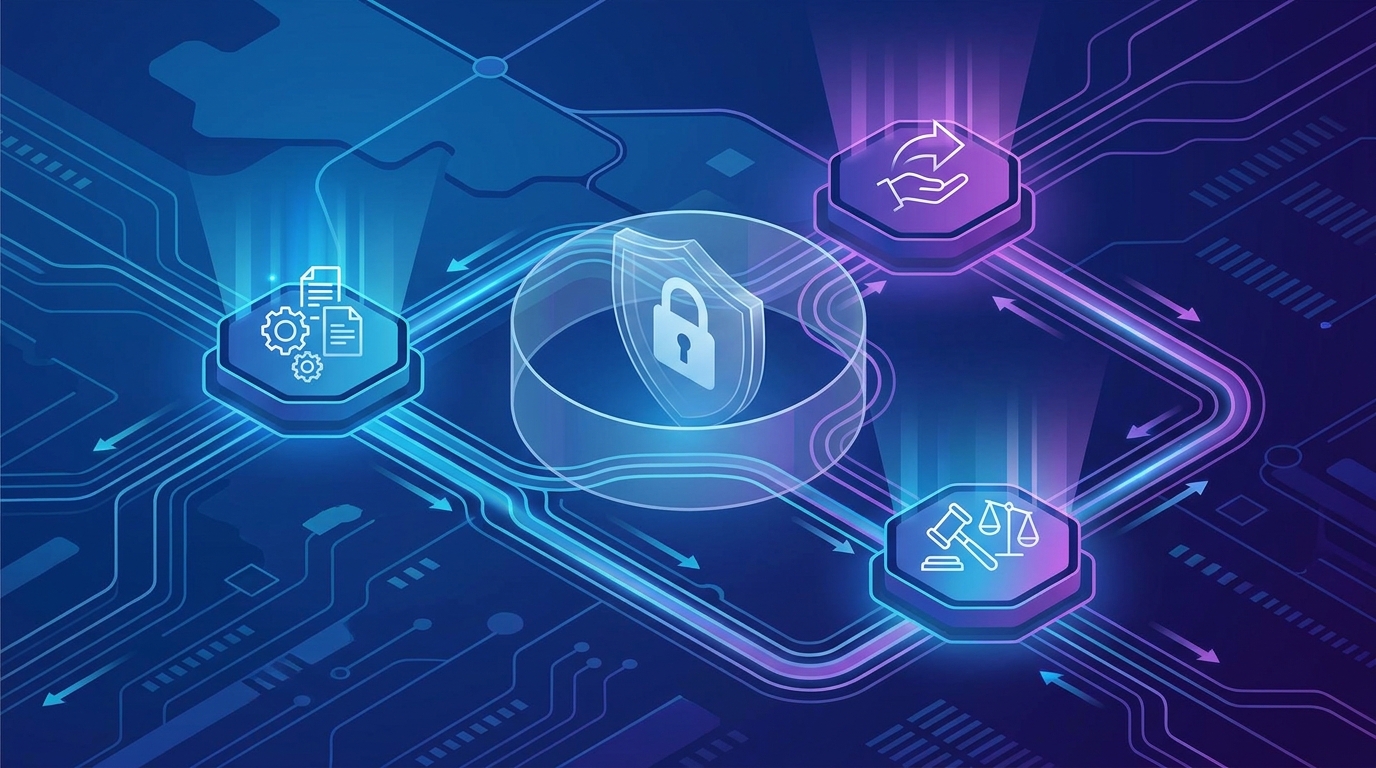
Map showing the difference between AI used for bid preparation, delivery support and delivery decisioning
This is also where a purpose-built bid platform helps. In mytender.io, AI is part of a tender-writing workflow: analysing requirements, retrieving relevant knowledge, creating first drafts and supporting review. That is materially different from a team improvising with unmanaged consumer tools and no audit trail.
What buyers are likely to check after an AI disclosure
Most AI due diligence sits under five buyer questions.
The first is: did the supplier protect our information?
Tender documents often contain non-public information. They may include site data, TUPE schedules, contract volumes, service issues, security requirements, personal data, financial assumptions, drawings or sensitive operational context. Buyers want to know that this information was not uploaded into tools that retain prompts, train public models or expose content outside approved environments.
The second is: can we trust the facts in the response?
AI can produce fluent but unsupported statements. It can summarise old content as if it is current. It can turn weak evidence into confident language. Buyers therefore care about human review, source traceability and whether the supplier can prove the claims it has made.
The third is: is the response specific to our requirement?
AI-generated bid content often fails because it is generic. It describes best practice but does not answer the actual question, reflect the scoring criteria, address the site conditions or connect evidence to the buyer's priorities. Due diligence may therefore focus on how the supplier tailored the response and avoided boilerplate.
The fourth is: who is accountable?
A buyer cannot contract with a language model. It contracts with the supplier. Every commitment in the tender must have a human owner inside the business. If AI assisted the draft, the supplier must still own the answer, the method, the evidence, the price and the delivery promise.
The fifth is: does AI create risk during delivery?
If AI is part of the proposed solution, the buyer may ask about governance. This can include model selection, data flows, retention, access control, monitoring, explainability, bias mitigation, incident management, business continuity and human override.
The good news is that suppliers do not need a huge legal pack for every tender. They need proportionate evidence that matches the risk level.
For a straightforward AI-assisted bid response, a concise assurance note may be enough. For an AI-enabled public service, a more formal evidence pack is sensible.
Build an AI due diligence evidence pack before the tender asks for it
The best time to prepare AI due diligence material is before the clarification question arrives.
Under deadline pressure, teams tend to answer too narrowly. They scramble for screenshots, copy policy language, ask IT for a security statement, chase subject matter experts and risk sending a response that sounds improvised. A small pre-built evidence pack solves that.
For most suppliers, the pack should include eight items.
1. A plain-English AI use statement
This is the core explanation of how AI may be used during bid preparation. It should be clear enough for procurement, legal, operations and evaluators to understand.
A strong version might say:
AI-assisted tools may be used to support tender document analysis, requirement extraction, first-draft preparation, bid-library retrieval, readability improvements and quality review. AI outputs are not submitted without human review. All factual claims, case studies, performance metrics, accreditations, pricing assumptions and delivery commitments are checked and approved by responsible members of our team before submission. We remain fully accountable for the accuracy and commitments contained in our tender response.
Notice what this does. It avoids panic, avoids overclaiming and makes the human accountability point immediately.
2. An approved tools list
The buyer may not ask for this, but your team needs it internally. The list should explain which AI tools are approved for which tasks. It should also separate secure bid systems from general-purpose writing assistants.
For example:
| Tool type | Approved use | Restrictions |
|---|---|---|
| Secure tender-writing platform | Tender pack analysis, bid library search, first drafts, compliance review | Use approved workspace and access permissions |
| Enterprise productivity AI | Rewriting non-confidential text, meeting-note summaries, grammar support | Do not upload restricted tender documents unless approved |
| Public AI tools | Public information research, non-confidential brainstorming | Do not enter buyer documents, personal data, pricing, private policies or customer evidence |
| Specialist delivery AI | Contract-specific service workflows | Requires solution governance and buyer-specific assurance |
3. A data handling rule
This should state what data can and cannot be entered into AI systems. The wording should be specific.
Do not write: use AI responsibly.
Write: confidential buyer documents, pricing, personal data, customer names, TUPE information, security schedules, unpublished contract data and proprietary methodologies must not be entered into unapproved public AI systems.
The difference matters. People can follow the second instruction.
4. A human review workflow
A workflow is more convincing than a slogan. It should show how a draft moves from AI-assisted creation to accountable submission.
A practical flow is:
- Tender documents are reviewed and requirements are extracted.
- Relevant internal evidence is selected from approved sources.
- AI may assist with structure and first-draft wording.
- The answer owner checks question coverage and buyer tailoring.
- Subject matter experts verify technical accuracy and evidence.
- Commercial owners check assumptions, pricing links and delivery commitments.
- The bid lead signs off the final response before submission.
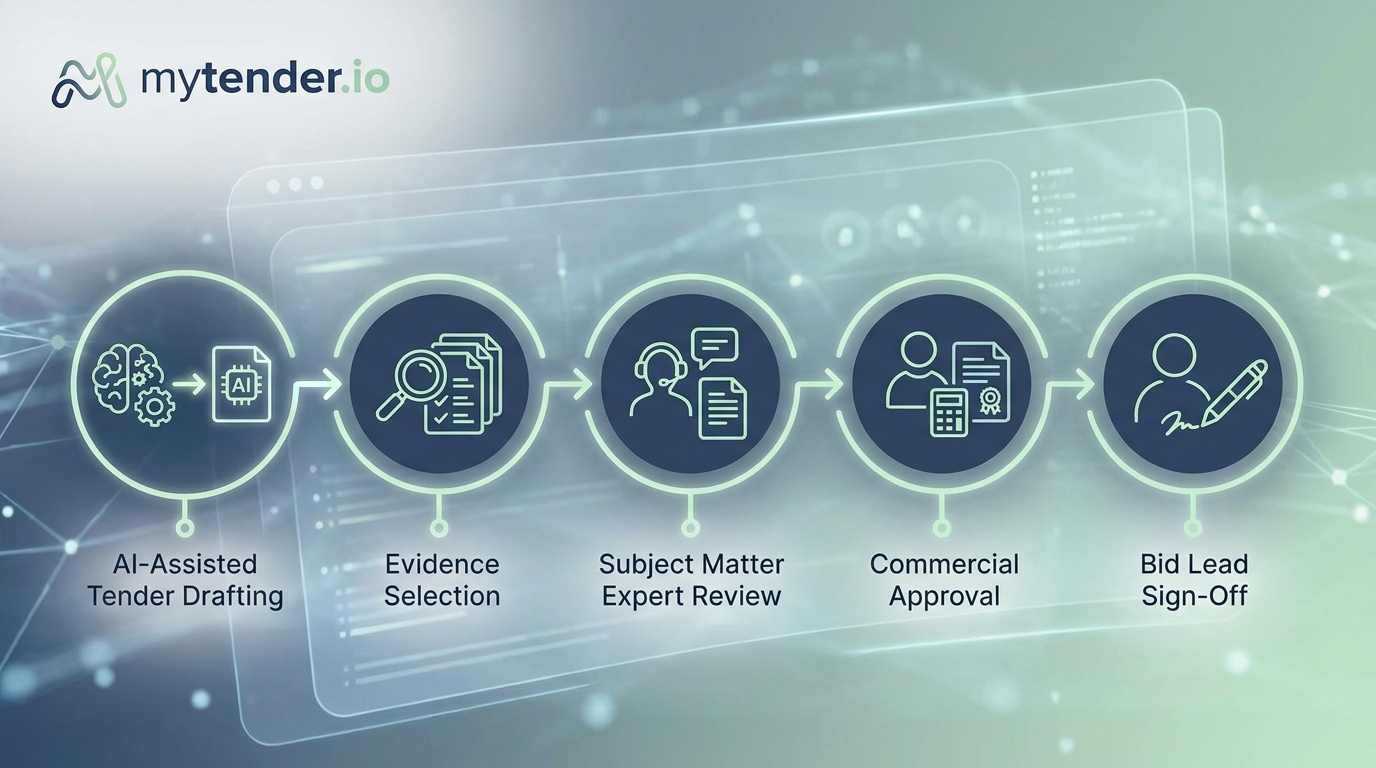
Workflow showing AI-assisted drafting moving through evidence selection, SME review, commercial approval and bid lead sign-off
This is the heart of AI due diligence. The buyer does not need to believe the AI. They need to believe the controlled process around it.
5. An evidence traceability rule
The pack should explain how the team traces important claims back to source material. This is vital for social value commitments, carbon reduction claims, case studies, certifications, contract performance, mobilisation timescales and technical methods.
A simple rule works well: any material claim in the tender response must be traceable to an approved source or a named subject matter expert.
That rule prevents AI from inventing certainty. It also improves bid quality because it forces the team to turn generic statements into proof.
6. A disclosure answer template
Bid teams should have pre-approved wording for common AI disclosure questions. This saves time and reduces inconsistency across submissions.
The template should cover:
- whether AI was used
- what it was used for
- what it was not used for
- how outputs were checked
- how confidentiality was protected
- who remains accountable
Avoid sounding evasive. If AI was used, say so calmly. The risk is not transparency. The risk is unsupported transparency.
7. A clarification response bank
After disclosure, buyers may ask follow-up questions. Prepare answers in advance for likely scenarios.
Examples include:
- Please confirm whether any confidential tender documents were uploaded to public AI tools.
- Please explain how AI-generated content was verified before submission.
- Please confirm whether AI will be used during delivery of the contract.
- Please explain how you prevent AI-generated inaccuracies or hallucinations.
- Please provide your governance controls for AI-assisted tender preparation.
- Please explain how data entered into your AI tools is stored and protected.
You do not need every answer to be long. You need it to be consistent, factual and backed by a real process.
8. A service-delivery AI appendix, if relevant
If AI forms part of the proposed solution, create a separate appendix. Do not bury delivery risk inside the bid-writing disclosure answer.
The appendix may include:
- where AI is used in the service
- what data it processes
- whether decisions are automated or advisory
- how humans review or override outputs
- how accuracy is monitored
- how bias or unfair outcomes are mitigated
- what logs or audit trails are retained
- how incidents are managed
- how the client can challenge or review outputs
- how the system changes over the life of the contract
This is not only a compliance exercise. It can improve the score by showing that the supplier has thought beyond the demo.
How to answer common AI due diligence questions
The best answers are short, direct and operational. They do not lecture the buyer about AI. They explain the control.
Here are practical examples bid teams can adapt.
Question: Did you use AI to prepare this tender response?
Suggested answer:
Yes. We used secure AI-assisted tools to support tender document review, response structuring, bid-library retrieval, drafting support and quality checking. AI was not used as an unchecked author of the submission. All final responses were reviewed, fact-checked and approved by our bid team and relevant subject matter experts. We remain fully accountable for the accuracy, evidence and commitments contained in this tender.
Question: Was any confidential buyer information uploaded into public AI systems?
Suggested answer:
No. Our process prohibits confidential buyer documents, personal data, pricing information, security-sensitive material and non-public procurement information from being entered into unapproved public AI tools. AI-assisted work on tender materials is carried out through approved systems and subject to internal access, security and review controls.
Question: How did you verify AI-assisted content?
Suggested answer:
AI-assisted content was treated as draft material only. Each response was checked against the tender requirements, source evidence, internal policies, case studies, performance data and subject matter expert input. Factual claims, accreditations, metrics, delivery commitments and commercial assumptions were reviewed by accountable members of our team before final submission.
Question: Will AI be used to deliver the contract?
Suggested answer if AI is not used in delivery:
No. AI was used only to support the preparation and review of this tender response. It does not form part of the proposed service delivery model for this contract.
Suggested answer if AI is used in delivery:
Yes. AI will support defined elements of the proposed service, as described in our technical response. Its role is to support staff decision-making and operational analysis, not to replace accountable human oversight. We have set out the relevant data handling, monitoring, escalation, human review and governance controls in our response.
Question: How do you prevent hallucinations or unsupported claims?
Suggested answer:
Our process does not permit AI-generated claims to be used without verification. Material statements must be traceable to approved internal evidence, source documents or named subject matter expert confirmation. Where evidence is missing, the answer is either revised, marked for follow-up or removed before submission.
These answers work because they are not trying to make AI sound magical. They make the process sound controlled.
The evidence problems AI can expose in a bid team
AI due diligence often reveals an uncomfortable truth: the main weakness is not the AI tool. It is the evidence base.
If a bid library is out of date, AI will find old content faster. If policies are duplicated across SharePoint, AI may pull the wrong version. If case studies are vague, AI may turn vague material into smoother but still weak answers. If nobody owns social value delivery data, AI cannot create credible commitments. If past performance metrics are scattered in spreadsheets, AI may help draft the paragraph but not prove the claim.
This is why serious AI adoption in tender writing must include evidence hygiene.
Bid teams should routinely ask:
- Which answers are approved for reuse?
- Which case studies can be named externally?
- Which performance metrics are current?
- Which policies are expired or under review?
- Which accreditations need renewal dates checked?
- Which claims require operations approval before reuse?
- Which commitments are safe to make across multiple tenders?
- Which sector-specific examples are strongest for construction, FM, healthcare, technology or waste contracts?
AI can make this work faster, but it cannot make ungoverned evidence reliable.
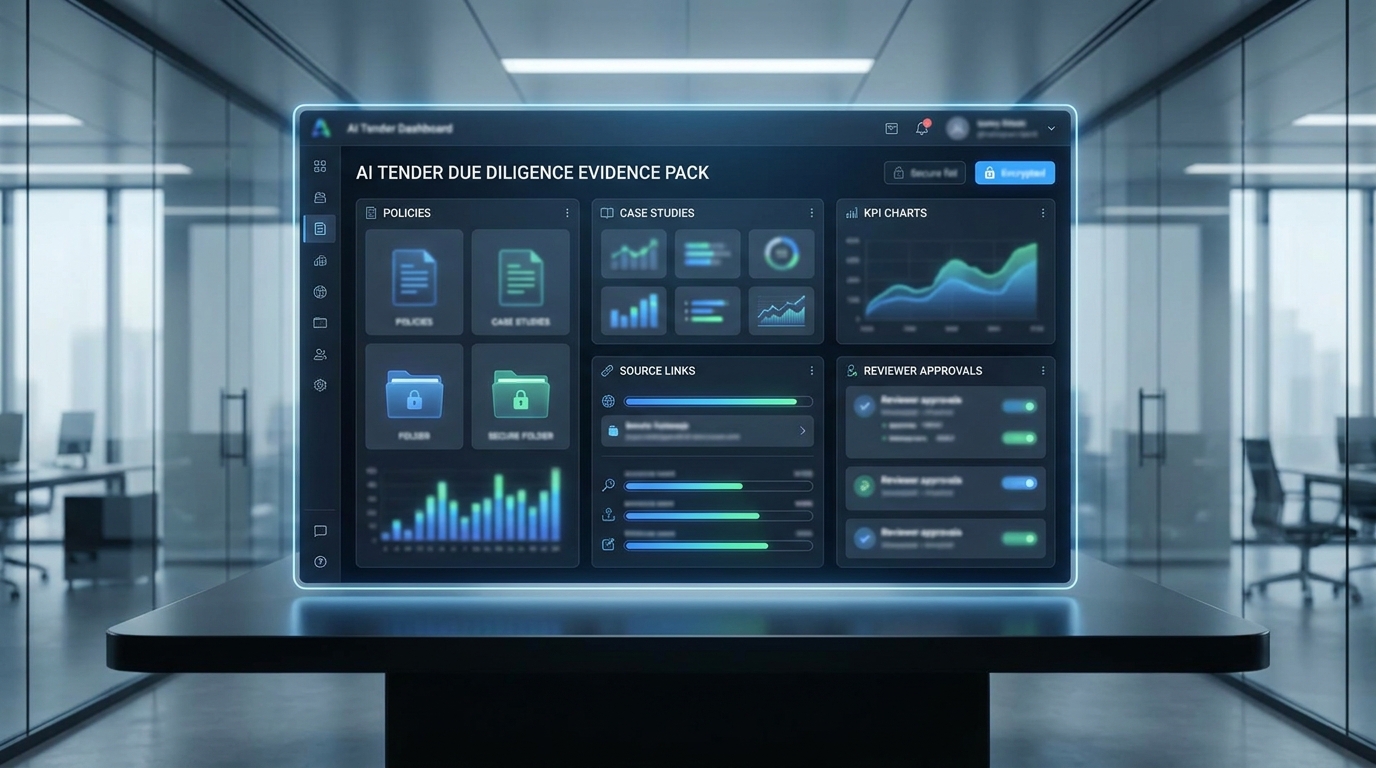
Evidence pack for AI-assisted tender responses showing policies, case studies, KPIs, source links and reviewer approvals
This is one of the reasons mytender.io focuses on connected knowledge, not just generation. The strongest first draft is not the one with the most impressive language. It is the one grounded in the right evidence, mapped to the tender requirement and ready for human review.
Why generic AI content loses marks even when it is compliant
A response can be compliant on AI use and still score poorly.
That is because evaluators are not awarding marks for safe tooling alone. They are awarding marks for answering the question better than competitors. AI due diligence protects confidence, but the answer still needs substance.
Generic AI content usually fails in four ways.
First, it mirrors the question without adding proof. It says the supplier has robust governance, experienced staff and a proactive approach. That may be true, but it does not show the evaluator why they should believe it.
Second, it ignores the scoring criteria. If the question asks for mobilisation risk controls, the answer talks about general project management. If the question asks for local social value, the answer gives a national corporate policy. If the question asks for contract-specific innovation, the answer lists generic technology features.
Third, it lacks buyer context. Public sector buyers care about their users, estates, communities, statutory duties, local priorities and operational constraints. An answer that could be submitted unchanged to ten authorities is unlikely to win top marks.
Fourth, it overpromises. AI can make ambitious commitments sound easy. Evaluators, especially experienced ones, can spot when an answer has no delivery owner, no timeline, no baseline and no measurement method.
The solution is not to write less with AI. It is to force AI into a better workflow.
Use AI to extract every requirement. Use it to find relevant evidence. Use it to structure the answer around the scoring criteria. Use it to identify missing proof. Use it to improve clarity. Then use human expertise to decide what is true, relevant, differentiated and deliverable.
That is the difference between AI-generated bid writing and AI-assisted bid management.
How mytender.io supports safer AI tender responses
mytender.io is built for bid teams that need speed and control at the same time.
The platform helps teams move away from unmanaged AI use by bringing tender analysis, knowledge retrieval, first-draft generation, collaboration and compliance review into a dedicated workflow. Instead of a writer copying sensitive extracts into a public chatbot, the team can work from structured tender documents, approved knowledge sources and review stages.
The practical benefits are straightforward.
Tender documents can be broken down into requirements so the team knows what must be answered. Relevant historical content can be surfaced from the knowledge base instead of recreated from memory. First drafts can be generated from material the business actually owns. Reviewers can focus on evidence, tailoring and compliance rather than hunting for the latest version of a policy. Bid leads can see progress and gaps before the deadline becomes a crisis.
This matters for AI due diligence because the process is easier to explain.
A controlled tender-writing platform gives you a better answer to the buyer's implied question: how do you know this AI-assisted response is safe to rely on?
You know because the source material is managed. You know because the workflow includes review. You know because the final submission is owned by humans. You know because the tool is purpose-built for bids, not casual general-purpose prompting.
That does not remove the need for judgement. It makes good judgement easier to apply under pressure.
A practical AI due diligence checklist for bid teams
Before submitting an AI-assisted tender response, run this checklist.
Disclosure and classification
- Have we identified whether AI was used for bid preparation, service delivery or both?
- Have we answered the buyer's AI question directly?
- Have we avoided vague wording that could look evasive?
- Have we separated bid-writing AI from delivery AI where relevant?
Data security
- Were confidential tender documents kept out of unapproved public AI tools?
- Were personal data, pricing and sensitive operational details handled correctly?
- Are approved tools documented?
- Can we explain how access is controlled?
Evidence and accuracy
- Can every major claim be traced to a source?
- Are case studies real, current and permitted for use?
- Are performance metrics verified?
- Are policies and accreditations current?
- Have social value and carbon commitments been approved by delivery owners?
Human review
- Has each response been reviewed by an answer owner?
- Have subject matter experts checked technical content?
- Has commercial leadership approved price-linked assumptions?
- Has the bid lead completed final quality review?
Buyer tailoring
- Does the response answer the full question and all sub-requirements?
- Does it reflect the scoring criteria?
- Does it mention the buyer's specific context where appropriate?
- Does it explain how commitments will be delivered, measured and reported?
Clarification readiness
- Can we answer how AI was used?
- Can we answer what tools were used?
- Can we confirm what data was not entered into public systems?
- Can we explain how hallucinations were prevented?
- Can we explain whether AI will be used in delivery?
If the team cannot answer these questions internally, the submission is not ready for AI due diligence.
The commercial upside: trust, speed and better win rates
Handled badly, AI creates risk. Handled well, it creates an advantage.
The advantage is not simply faster writing. Faster writing is useful, but it is not enough. The real advantage is a bid operation that can understand requirements quickly, retrieve the best evidence, draft earlier, review more thoroughly and submit a response that feels specific, controlled and credible.
That matters because bid teams are under pressure from every side. Tender packs are larger. Procurement rules are more transparent. Buyers want stronger evidence. Social value and sustainability commitments are more measurable. Contract performance can follow suppliers into future opportunities. Deadlines are still tight. Internal experts are still busy.
AI can relieve that pressure, but only if it is governed.
The best bid teams will not be the ones using the most AI. They will be the ones using AI in the most controlled, evidence-led and buyer-relevant way.
They will disclose confidently. They will protect data. They will keep humans accountable. They will trace claims back to proof. They will answer clarification questions without scrambling. They will use AI to improve the bid, not disguise weak evidence.
That is the standard buyers are moving towards.
And it is exactly the standard bid teams should want for themselves.
Final takeaway
AI due diligence is not something to fear. It is something to prepare for.
If your team uses AI to help with tender responses, the goal is not to hide it or over-explain it. The goal is to show that the process is safe, accurate and accountable.
A strong AI due diligence response says: yes, we use modern tools; yes, we protect your information; yes, humans check the work; yes, our claims are backed by evidence; and yes, we remain responsible for every commitment in this bid.
That is a far stronger message than pretending AI has no place in modern tender writing.
For teams that want faster first drafts, stronger evidence control and a clearer review process, mytender.io gives bid teams a safer way to bring AI into the tender workflow without losing the governance buyers increasingly expect.
Tags
Ready to Transform Your Tender Writing?
See how MyTender's AI can help you write winning tenders in a fraction of the time.