

Writing the Mobilisation Plan for a Council Waste Contract Takeover: What Evaluators Actually Need to See
The mobilisation plan section is where most waste tenders are won or lost. Here's what council evaluators look for — and how to write a response that actually convinces them you can take over the contract without a missed bin on day one.
mytender.io Research Team
Tender Writing & Bid Management Specialists
Writing the Mobilisation Plan for a Council Waste Contract Takeover
You've spent weeks on the pricing. Your method statements are solid. And then the mobilisation plan — the section worth 20-30% of the quality score — gets three days of rushed effort and a copy-paste from the last submission.
That's the pattern. And it's the pattern that loses contracts.
Councils know what a bad mobilisation looks like. They've lived through them: missed bins on day one, staff who didn't know who they worked for, vehicles that weren't ready. The mobilisation plan section exists precisely so they can filter out bidders who aren't ready to take over without making the news.
This guide covers what council evaluators actually need to see — and what most bidders fail to give them.
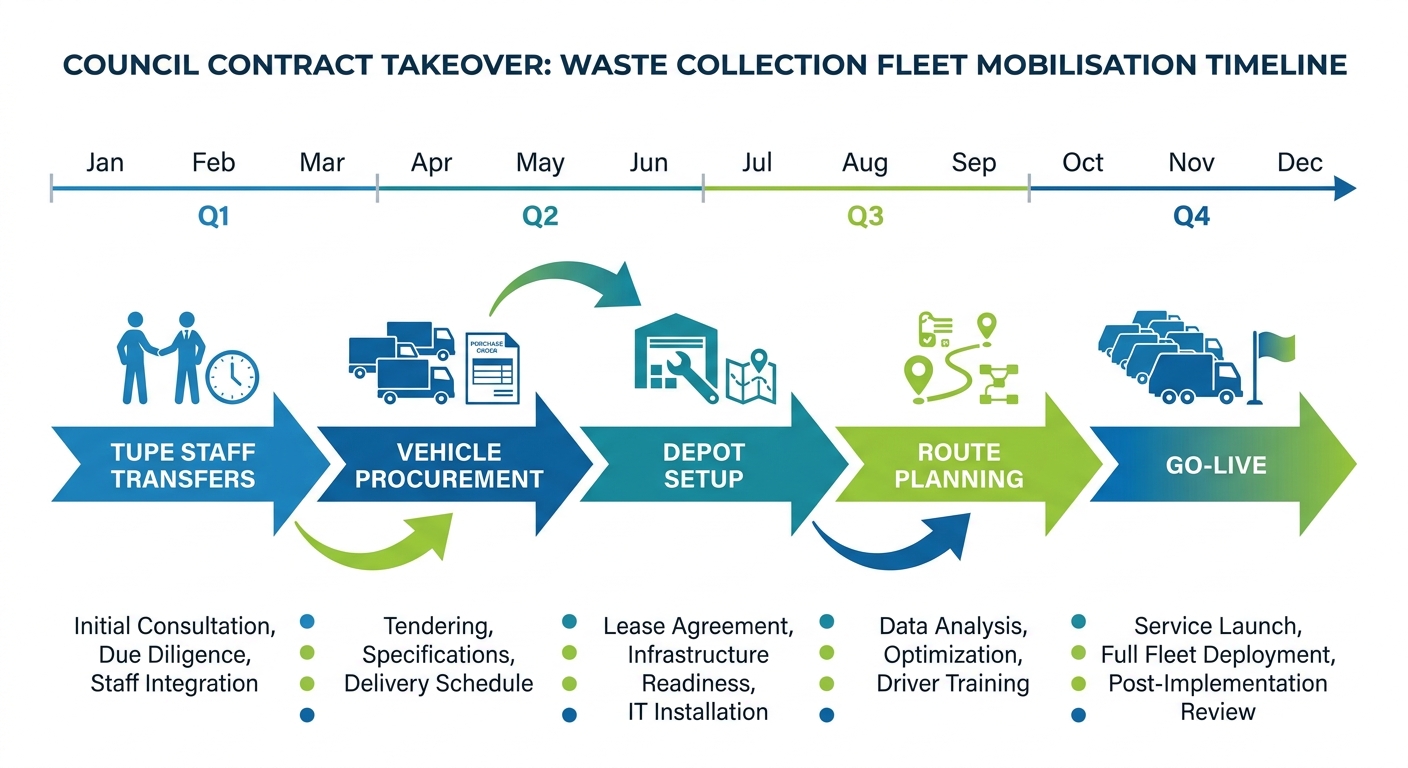
A waste contract mobilisation timeline showing the key phases from contract award to go-live
Why Mobilisation Plans Make or Break Waste Tenders
Waste contracts are operational. Unlike many public sector procurements, day one matters in a very visible, resident-facing way. A missed bin round generates complaints to councillors within hours. A botched TUPE transfer lands the council in employment tribunal territory.
That's the context evaluators bring to this section. They're not reading your mobilisation plan hoping to tick a box. They're trying to answer one question: if we award this contract tomorrow, can this bidder be ready to run it without embarrassing us?
Your job is to answer that question with evidence, not assertion.
The Phases Evaluators Expect to See
Most councils want a mobilisation plan structured around three phases. If yours isn't structured this way, restructure it before you submit.
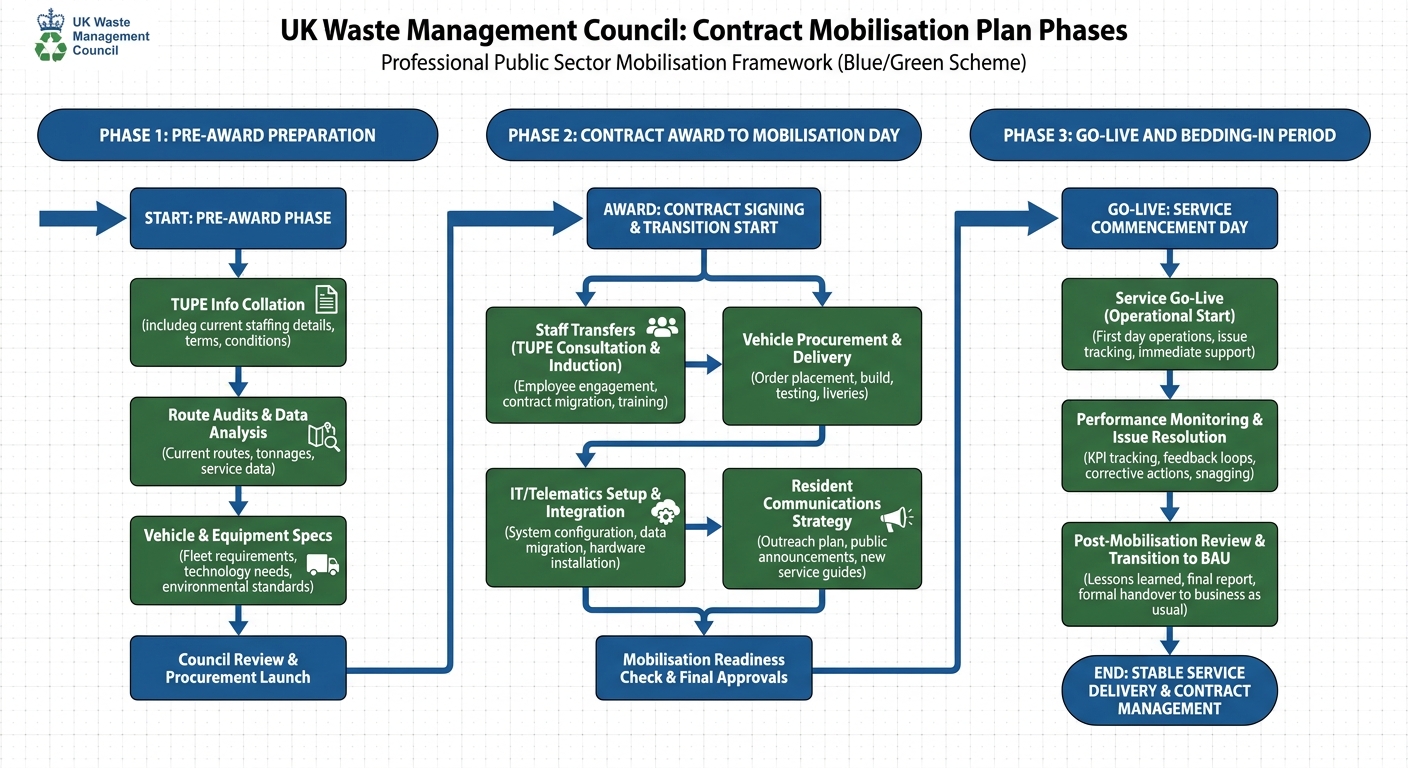
Mobilisation phases diagram showing pre-award preparation, contract award to go-live, and bedding-in period
This covers everything you've done before the contract is formally awarded. Route auditing, vehicle specification, depot scoping, and TUPE data collection all belong here.
Evaluators want to see that you've already started. A bidder who says "we'll begin route planning after award" is telling the evaluator they have no idea how tight the mobilisation window actually is. A 3-6 month mobilisation on a complex council contract is tight. Pre-award prep is how you survive it.
Phase 2: Award to Go-LiveThis is the meat of the plan. Every task should have an owner, a start date, a completion date, and a dependency. TUPE transfers, vehicle procurement, depot fit-out, IT and telematics installation, staff inductions, resident communications — all of it needs to appear, in sequence, with realistic timelines.
Evaluators read this phase looking for two things: completeness (have you thought of everything?) and realism (are the timelines believable?). Gaps and overoptimism both score badly.
Phase 3: Go-Live and Bedding-InMost bidders end their mobilisation plan at go-live. That's a missed opportunity. Evaluators want to know what happens in the first four to eight weeks of the contract when things inevitably go wrong. How do you manage a missed round? Who's on the escalation path for resident complaints? What's your performance reporting cadence in the early weeks?
A post-go-live plan shows maturity. It signals that you've run contracts before and you know the first month is where the wheels fall off if you're not paying attention.
The TUPE Section Most Bidders Get Wrong
TUPE is the mobilisation section that causes the most marks to be lost. Not because it's complicated — it's not, once you've done it a few times — but because bidders write it as a compliance exercise rather than an operational plan.
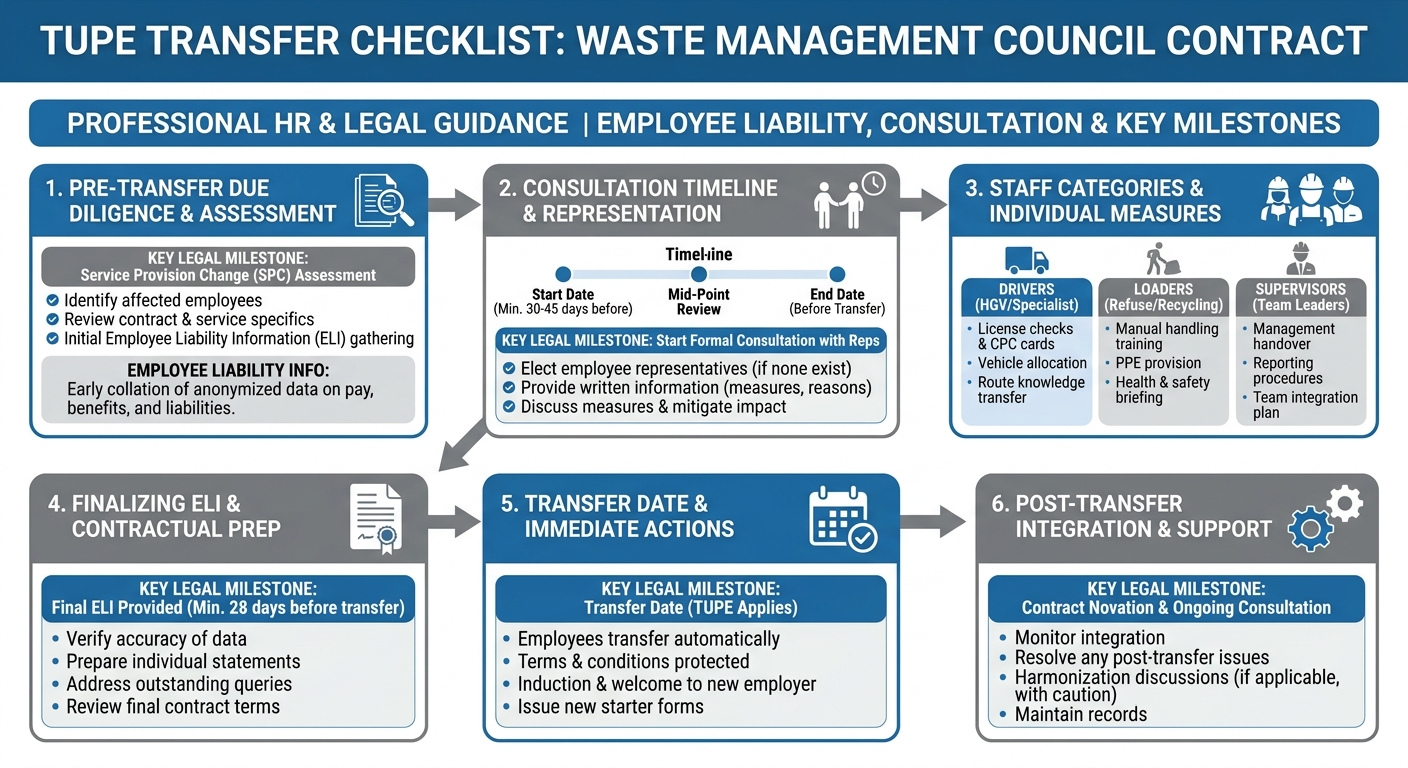
TUPE transfer checklist for waste management staff: ELI provision, consultation timeline, staff categories and roles
Evaluators want to see four things in the TUPE section:
1. That you've requested and received ELI (Employee Liability Information)If you're bidding on a contract and haven't asked for the ELI yet, that's a red flag. The ELI tells you who's transferring, on what terms, and what you're inheriting. You can't write a credible mobilisation plan without it.
If the incumbent hasn't provided ELI at the time of writing (which happens), say so explicitly and explain how your plan will adapt once you receive it. Don't pretend you have information you don't.
2. That you understand who's in scopeDrivers and loaders are obvious. But what about the supervisors? The admin staff who process route data? The mechanics maintaining the fleet? Define your scope clearly. Evaluators on waste contracts have seen bidders surprised by TUPE scope on day one.
3. That your consultation timeline is realistic20 working days of collective consultation if 20 or more employees are affected. If your mobilisation window is 12 weeks, that consultation has to start very early. Map it out. If it doesn't fit, you have a problem worth flagging now rather than post-award.
4. That you have a plan for staff retentionTransferring staff are often anxious and sometimes approached by the outgoing contractor to leave rather than transfer. Your plan should cover induction, communication with transferring staff before day one, and any retention measures. This isn't a nice-to-have: high attrition on day one is an operational crisis.
Route Planning and Fleet: Show Your Working
This is where the operational reality of your bid shows up. Councils don't just want to know that you'll have vehicles and routes ready. They want to know how you'll design them.
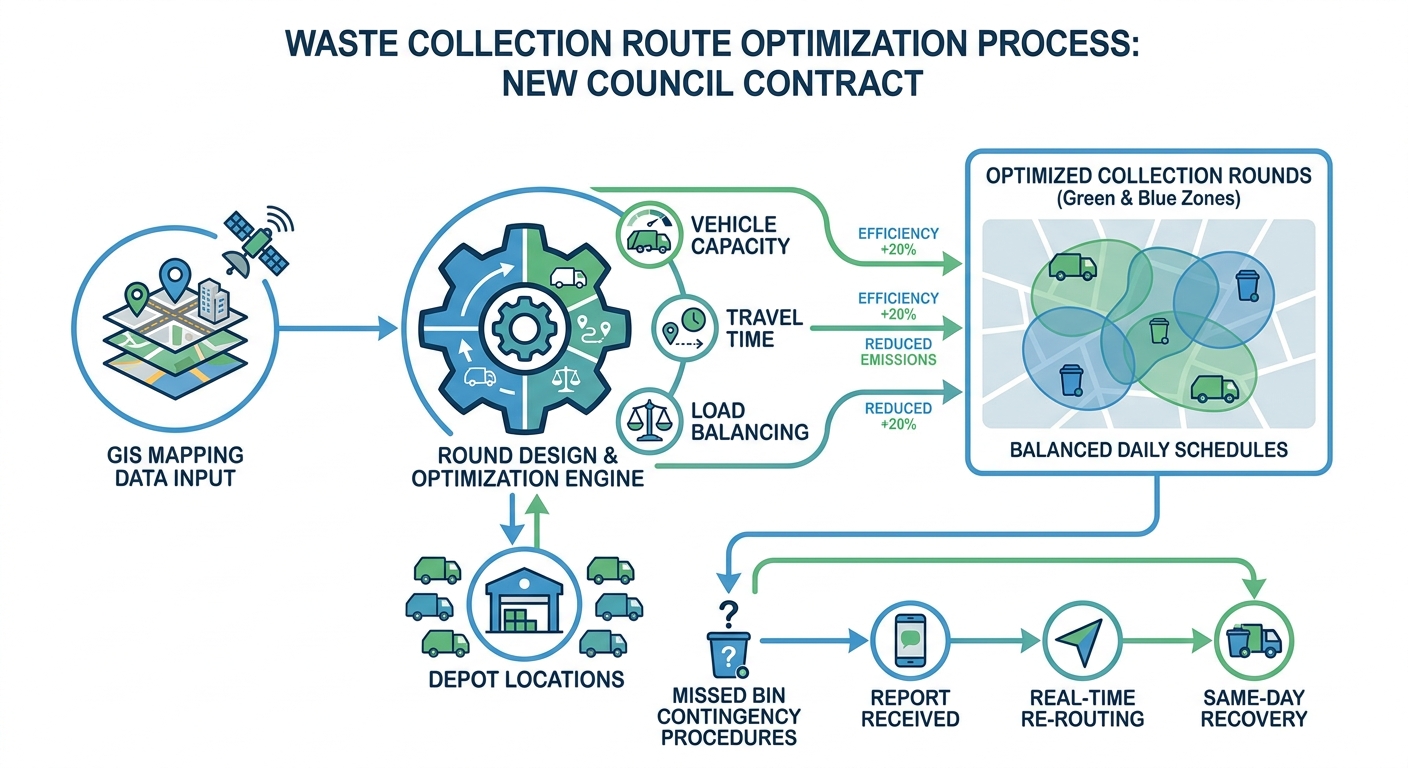
Route optimisation diagram for council waste collection showing round design factors: vehicle capacity, travel time, load balancing and depot locations
If you're procuring vehicles for this contract rather than redeploying existing fleet, your timeline for vehicle delivery needs to be in the plan — with contingency. Lead times on specialist waste vehicles (rear-loaders, food waste vehicles, side-loaders for kerbside sort) can be 6-12 months. If your mobilisation window is 16 weeks, you'd better have existing fleet to bridge the gap or a very clear explanation of how you've already secured the vehicles.
Evaluators on larger contracts will probe this. If your bid scores well and you reach the interview stage, "where are the vehicles coming from?" is a question you'll face.
Route optimisationCouncils publish round data as part of the ITT. Use it. A mobilisation plan that references the actual round structure, vehicle capacity utilisation, and proposed changes (if any) signals that you've read the brief and done the analysis.
If you're proposing to redesign rounds, explain why and what the resident impact will be. Councils are acutely sensitive to any route changes that could generate complaints.
Depot readinessWhether you're using an existing depot or establishing a new one, evaluators want to know it will be ready on day one. Planning permissions, lease arrangements, wash-out facilities, weighbridge access, parking capacity — all of it needs to appear in the plan with a delivery date and a risk note.
Resident and Stakeholder Communications
This section is underweighted by most bidders. It typically represents 10-15% of the mobilisation score, and most responses get a line or two.
Councils have been burned by contract transitions where residents didn't know the service provider had changed, where bin day changes weren't communicated, where the call centre scripts weren't updated. Your communications plan should address all of it.
Structure your answer around three audiences:
Residents: When will they be notified of the new service provider? How (letter, council website update, social media, bin tag)? What happens if their collection day changes? Council staff: The waste management team, the call centre, the elected members — all need briefing. Who does this, when, and in what format? Elected members: Councillors field resident complaints. If they find out about a service change from an angry constituent rather than a proper briefing, that's a relationship problem for the council.A communications plan that covers all three audiences, with realistic timing, will stand out from the one-paragraph responses most of your competitors submit.
What the Scoring Matrix Usually Looks Like
It varies by council, but most mobilisation plan scoring in waste contracts follows something like this:
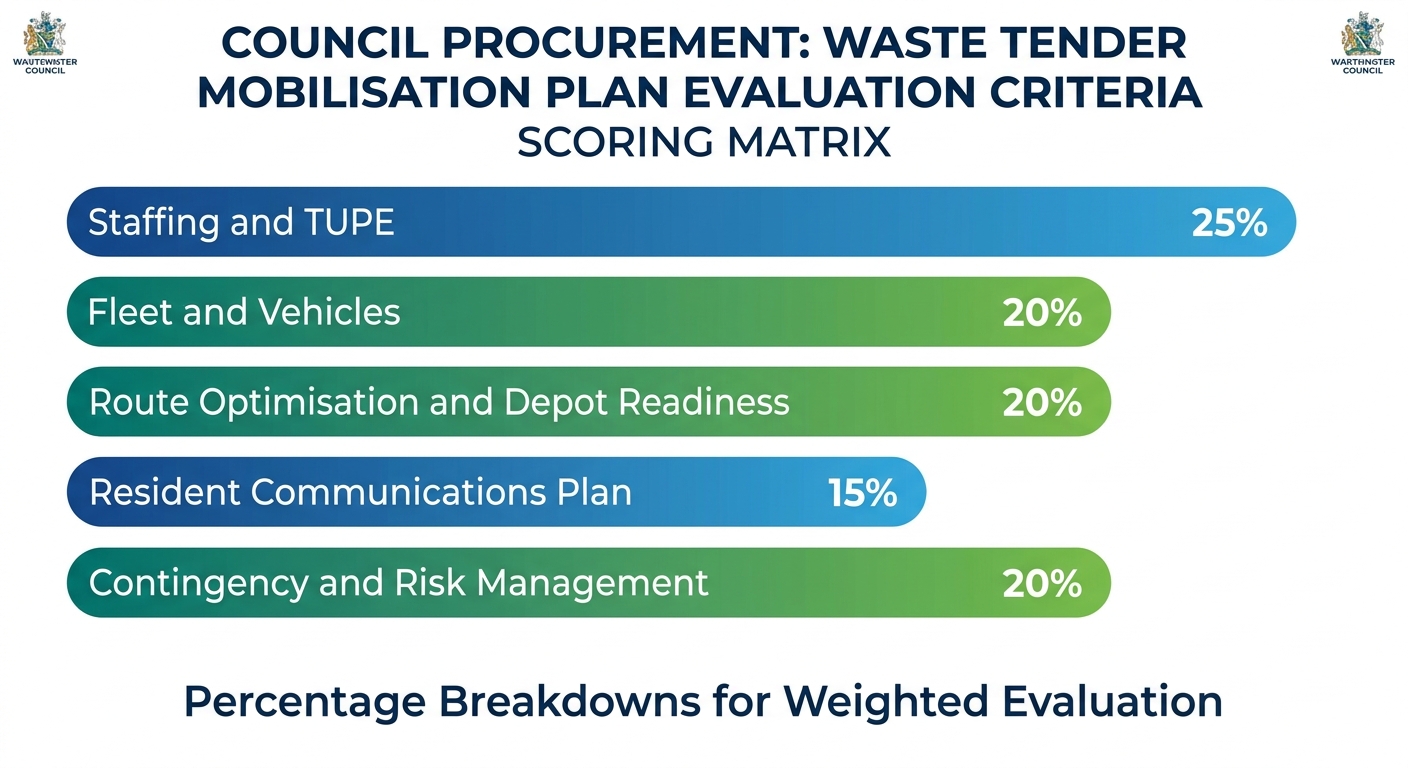
Scoring matrix showing mobilisation plan evaluation criteria: staffing and TUPE, fleet and vehicles, route optimisation and depot readiness, resident communications, contingency and risk management
- Staffing and TUPE (20-25%): Completeness, realism, evidence of pre-planning
- Fleet and vehicles (15-20%): Availability timeline, capacity match, contingency
- Route and depot readiness (15-20%): Operational detail, timing
- Resident communications (10-15%): Audience coverage, timing, channel mix
- Contingency and risk management (15-20%): Identified risks, mitigation plans, escalation
The contingency section is the one where you can genuinely differentiate. Most bidders identify generic risks ("vehicle breakdown", "staff absence"). The ones who score well identify contract-specific risks (a specific depot planning risk, the known incumbent vehicle age, the TUPE scope uncertainty) and show a credible mitigation.
The Biggest Mistakes Bidders Make
Writing the plan for the wrong audienceMobilisation plans written by operations teams often read as internal project plans. They're technically correct but don't address the evaluator's question: why should we trust you with this contract? Reframe everything through the lens of what the council cares about: continuity, resident satisfaction, zero embarrassment.
Vague timelines"We will procure vehicles within the mobilisation period" tells the evaluator nothing. "Vehicles ordered within 5 working days of contract award; scheduled delivery week 8; interim fleet available from week 6 if required" tells them you have a plan.
Ignoring the word countIf the ITT gives you 1,500 words for the mobilisation plan, use them. This isn't a section to skim. Every word limit in a waste tender is an opportunity that your competitors are probably not fully exploiting.
Copying from a previous bid without adaptingCouncil evaluators often sit on multiple procurement panels. They read a lot of mobilisation plans. A generic plan that clearly wasn't written for their contract — one that doesn't reference their depot, their round structure, their specific TUPE context — will score in the middle at best.
Making It Credible with Evidence
Assertion doesn't score. "We have extensive experience of complex mobilisations" doesn't mean anything. What scores is specific, evidenced claims.
For each major section of the mobilisation plan, ask yourself: what evidence exists that we can do this? Previous contract takeovers at a similar scale. Named individuals who have led mobilisations before. Templates and processes from previous contracts. Relationships with vehicle suppliers that guarantee delivery lead times.
Where you can reference previous work, do it. Not as a boast, but as a specific example that demonstrates the capability you're claiming.
A Note on Mobilisation Periods That Are Too Short
This happens. A council publishes an ITT with a 10-week mobilisation period for a contract that realistically needs 20 weeks to mobilise properly. You have two choices.
You can pretend the timeline is fine and submit a plan that doesn't add up. Evaluators with operational experience will see through it.
Or you can write a plan that acknowledges the timeline is tight, explains exactly how you'd make it work (pre-award preparation, existing depot capacity, fleet available from current contracts), and identifies the specific risks if the timeline slips. This approach often scores better because it demonstrates honesty and operational maturity.
Using AI to Structure and Draft Your Mobilisation Plan
The mobilisation plan is one of the sections where AI assistance genuinely helps — not because AI writes better than an experienced bid manager, but because mobilisation plans are structurally complex. There are a lot of interdependent tasks, timelines, and stakeholders to keep track of.
mytender.io pulls in your previous mobilisation plans and tender content from your bid library, which means when you're drafting a new plan you're not starting from scratch. You're adapting content that's already been through the evaluator and scored well, rather than reinventing the wheel under deadline pressure.That matters in waste tendering, where the operational details are complex and the margin for vague answers is small.
The Plan Councils Actually Want
A good mobilisation plan for a council waste contract takeover tells a story. It starts before the contract is awarded. It covers every operational dependency, in sequence, with realistic timing and named owners. It takes TUPE seriously as an operational challenge, not a legal formality. It plans for the first month of the contract, not just day one. And it backs everything up with evidence from previous contracts.
That's not a long list of things to get right. But most bidders don't get all of them right. And in a competitive waste tender, that's the difference.
If you want to see what live council waste contracts are available in your region, the Tender Finder matches opportunities to your sector and geography. Free to use.
Tags
Ready to Transform Your Tender Writing?
See how MyTender's AI can help you write winning tenders in a fraction of the time.