

Utilities Decarbonisation Tender Evidence: How to Prove Net Zero Delivery in 2026 Bids
A practical guide for utilities, energy, water, grid, telecoms and infrastructure suppliers on turning carbon, resilience and delivery data into stronger tender evidence.
mytender.io Research Team
Tender Writing & Bid Management Specialists
Utilities Decarbonisation Tender Evidence: How to Prove Net Zero Delivery in 2026 Bids
Utilities tenders are no longer judged only on technical competence, operational resilience and price.
Those things still matter. In water, energy, telecoms, grid services, metering, environmental services and infrastructure maintenance, buyers still need suppliers who can keep assets running, manage safety, protect service continuity and deliver at scale. But in 2026, a strong utilities bid also needs to prove something else: that the supplier can help the buyer decarbonise without turning the contract into a risky experiment.
That is a harder task than writing another paragraph about commitment to net zero.
Most evaluators have read that sentence hundreds of times. They are not short of supplier ambition. They are short of credible evidence. They want to know what has already been measured, what has already changed, what will happen during mobilisation, what is contractually controllable, what sits in the supply chain, and how performance will be reported after award.

Utilities bid team reviewing decarbonisation evidence across energy, water and infrastructure assets
This guide is for bid teams, commercial directors, sustainability leads and operational managers writing utilities and infrastructure tender responses. It explains how to turn carbon, resilience and delivery data into tender evidence that evaluators can score. It also shows where mytender.io can help by connecting requirements, evidence libraries and approved source material so the final response is specific rather than generic.
Why utilities decarbonisation evidence matters now
The UK public procurement environment has changed sharply over the last two years.
The Procurement Act 2023 has pushed public buyers towards a fuller view of value, performance and lifecycle accountability. The move from Most Economically Advantageous Tender language to Most Advantageous Tender thinking has made quality, public benefit, resilience, transparency and long-term outcomes more visible in evaluation models. At the same time, buyers are publishing and monitoring more contract information, including key performance indicators on higher-value contracts.
In practical terms, this means utilities suppliers are being judged not only on whether they can deliver the work, but on whether they can prove the work will support the buyer's wider duties and strategy.
For utilities and infrastructure contracts, decarbonisation sits directly in that zone. It is not a nice-to-have environmental paragraph. It affects fleet choices, plant, materials, energy use, site operations, logistics, subcontractors, asset strategy, waste, capital planning, outage windows, maintenance regimes and reporting.
That creates a scoring problem for suppliers.
A bid can lose marks even when the business is genuinely doing good work, because the response does not translate that work into evidence. The sustainability team may have carbon reports. Operations may have fuel data. Fleet may know the transition plan. Procurement may have supplier questionnaires. Finance may hold lifecycle cost assumptions. Contract managers may have examples of energy savings or reduced site visits. But if that material is scattered, the final tender answer becomes vague.
A utilities evaluator is not looking for a slogan. They are looking for a controlled delivery model.
The difference between net zero ambition and tender evidence
Net zero ambition is easy to state. Tender evidence is harder because it has to survive scrutiny.
A weak answer says the supplier is committed to achieving net zero, supports the buyer's sustainability objectives and will work collaboratively to identify carbon reduction opportunities throughout the contract.
That sounds fine until every other bidder says the same thing.
A stronger answer explains the baseline, the intervention, the measurement method, the owner, the reporting rhythm and the risk controls. It might say that the supplier will baseline contract emissions during mobilisation using agreed activity data, prioritise controllable sources such as fleet mileage and temporary power, report progress quarterly through the contract review pack, and escalate blockers where buyer decisions affect carbon outcomes.
The difference is not just style. It is credibility.
Tender evidence normally needs five ingredients:
- a specific source of data
- a relevant previous result or tested method
- a clear link to the buyer's requirement
- a named governance process
- a realistic delivery pathway
If one of those ingredients is missing, the answer becomes easier to doubt.
This matters because decarbonisation is full of claims that sound impressive but are difficult to evaluate. Buyers see phrases like carbon neutral, low carbon, sustainable, green fleet, circular economy and climate positive. Some are meaningful. Some are marketing. The tender response has to remove that uncertainty.
Do not make the evaluator guess what the claim means. Define it. Evidence it. Show how it will be controlled.

Evidence map showing carbon baselines, fleet data, supply chain records and contract KPIs feeding a utilities tender response
Start with the buyer's decarbonisation risk
Most utilities bids make a basic sequencing mistake. They start with the supplier's sustainability policy.
The better place to start is the buyer's risk.
A water company, local authority, NHS trust, university, housing provider or central government department may all ask for decarbonisation, but the operational risk is not the same. The answer should change with the contract.
For an energy infrastructure contract, the buyer may care about outage planning, embodied carbon in equipment, grid constraints, temporary generation, specialist labour travel and safe delivery around live assets.
For a water or wastewater contract, the buyer may care about process emissions, chemical use, sludge transport, pumping efficiency, leakage, site access, biodiversity and regulatory performance.
For street lighting, highways or public realm maintenance, the buyer may care about LED replacement, route optimisation, night working, traffic management, plant choices and resident disruption.
For telecoms and digital infrastructure, the buyer may care about energy consumption, hardware lifecycle, data centre choices, field engineer travel and responsible disposal.
For facilities-related utilities management, the buyer may care about metering, building controls, heat networks, plant replacement, demand reduction and behavioural change.
A generic net zero answer cannot handle those differences.
A useful opening might read like this:
The main decarbonisation challenge in this contract is not policy alignment. It is reducing emissions while maintaining statutory service continuity across dispersed operational sites. Our approach therefore focuses on the emissions sources we can control directly during mobilisation and year one: fleet movements, planned maintenance routing, temporary power, materials selection and subcontractor reporting.
That kind of framing is stronger because it shows the bidder has understood the contract. It also creates a clear route for evidence.
The six evidence areas utilities bidders should prepare
Utilities and infrastructure suppliers should not wait until the tender arrives to build evidence. The highest scoring answers usually come from teams that maintain a living evidence library.
For decarbonisation questions, six evidence areas matter most.
1. Carbon baseline and emissions methodology
Buyers want to know whether your carbon figures are real.
A baseline should explain what is included, what is excluded, how activity data is collected and how conversion factors are applied. It does not need to overwhelm the evaluator with technical detail, but it does need to be clear enough to trust.
For utilities tenders, the response should normally cover:
- Scope 1 emissions from owned or controlled fuel use
- Scope 2 emissions from purchased electricity
- relevant Scope 3 categories such as subcontractors, purchased goods, waste, business travel and downstream activity
- contract-specific activity data where available
- how estimates will be refined after mobilisation
- how carbon data will be checked before being reported
The tender answer should also avoid overclaiming. If a full contract-specific baseline cannot be completed until award, say so and explain the mobilisation method. Evaluators usually prefer a credible staged approach over a confident but unsupported number.
A good answer might say that the supplier will establish a contract carbon baseline within the first 90 days, using tendered service volumes, mobilisation asset data, fleet allocation, expected subcontractor activity and buyer-held consumption data. It should then explain how the baseline will be validated and used to prioritise reductions.
That is much stronger than saying emissions will be monitored.
2. Fleet, plant and travel evidence
For many utilities contracts, fleet and plant are the most visible carbon sources the supplier can control.
This is also where vague promises are common. Bidders often say they will use low-emission vehicles where possible. That is too soft. It tells the buyer nothing about what will actually happen.
Better evidence includes:
- current fleet composition
- vehicle replacement plans
- electric or alternative fuel suitability by role
- depot charging constraints
- route optimisation methods
- grey fleet reduction
- anti-idling controls
- driver training
- plant hire standards
- temporary power hierarchy
- previous fuel reduction results
The best answers are honest about operational constraints. Utilities work often involves emergency response, remote sites, specialist equipment, standby capability and long shifts. A bidder who pretends every vehicle can be electrified immediately may sound less credible than one who explains a phased transition based on route profile, payload, charging access and service risk.
The tender response should connect fleet decisions to service continuity. Buyers do not want decarbonisation commitments that undermine response times or resilience. They want a plan that cuts emissions while protecting the contract.
3. Materials, assets and embodied carbon
Utilities contracts can involve significant embodied carbon in pipes, cables, lighting columns, mechanical and electrical equipment, control panels, civils materials, meters, pumps and replacement assets.
This evidence is often underused in bids because it sits outside the bid team's normal writing process. It may be held by design, procurement, engineering or supply chain teams. Pulling it into the response can create a real advantage.
Useful evidence includes:
- product environmental declarations where available
- lower-carbon material options
- reuse, refurbishment and repair examples
- design standardisation that reduces waste
- supplier engagement on embodied carbon
- whole-life cost and whole-life carbon comparisons
- asset condition data used to avoid premature replacement
- packaging reduction and responsible disposal routes
The answer should be practical. Do not promise the lowest-carbon material in every case if specification, safety, warranty or availability constraints may prevent it. Instead, show the decision framework. Explain how technical, commercial, carbon and operational factors are balanced.
In 2026, evaluators are increasingly alert to lifecycle evidence. A cheaper asset with higher energy use, shorter life or harder maintenance may not be the most advantageous option. Utilities bidders should show how they help buyers make those trade-offs clearly.
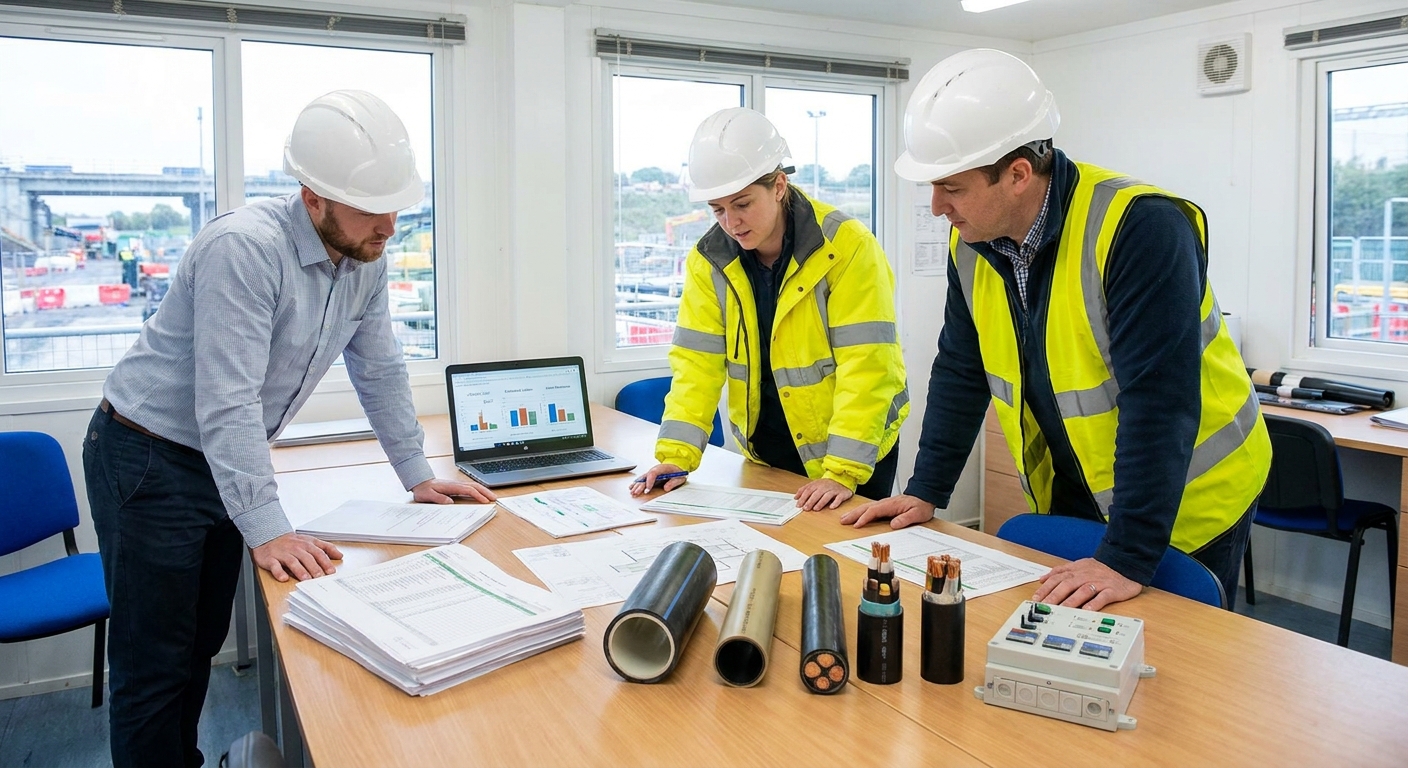
Engineers comparing lower-carbon utility materials, lifecycle cost and asset resilience before a tender submission
4. Operational efficiency and demand reduction
Some of the strongest decarbonisation evidence comes from operational efficiency.
For utilities and infrastructure contracts, this might include reducing site visits through remote monitoring, improving pumping efficiency, optimising maintenance schedules, reducing leakage, upgrading controls, improving insulation, preventing rework, reducing energy consumption or using data to target interventions.
This evidence is powerful because it connects carbon, cost and service quality.
A buyer may be sceptical of a broad sustainability statement, but they will listen to a clear example where a supplier reduced engineer visits, cut energy use, improved uptime and saved money. That is exactly the kind of joined-up value the Most Advantageous Tender environment is meant to surface.
The tender response should show:
- the problem identified
- the intervention made
- the measured result
- the operational impact
- the relevance to the buyer's estate or network
- how the approach would be adapted for this contract
This is where case studies matter. A short, specific operational example is often more persuasive than a page of policy language.
5. Supply chain and subcontractor reporting
Utilities contracts rarely sit entirely inside one organisation. Specialist subcontractors, material suppliers, plant providers, hauliers, installers, surveyors, designers and waste partners all influence carbon outcomes.
That makes supply chain evidence essential.
A credible response should explain how suppliers are selected, briefed, measured and improved. It should also recognise proportionality. A large strategic supplier may be able to provide detailed emissions data. A small local specialist may need a simpler reporting template and support.
Evidence might include:
- supplier sustainability questionnaires
- carbon reporting clauses
- preferred low-carbon product frameworks
- subcontractor onboarding packs
- prompt payment and local supply chain commitments
- supplier performance reviews
- escalation for missing data
- examples of collaborative improvement
This is also a social value issue. Public sector buyers increasingly want decarbonisation and community value to reinforce each other, not compete. A good utilities response should show how local suppliers, apprenticeships, green skills and community benefits fit into the delivery model without weakening carbon control.
6. Governance, KPIs and contract reporting
The final evidence area is governance.
This is where decarbonisation moves from tender language into contract management. It is also where many bids fall down. They set targets but do not explain how the targets will be managed.
A strong utilities tender response should define the reporting rhythm. It should say which carbon and sustainability indicators will appear in contract review packs, who owns them, how exceptions are handled and how improvement actions are agreed.
Example KPIs might include:
- contract carbon baseline completed by an agreed mobilisation milestone
- percentage of planned visits optimised through route planning
- fleet emissions per service activity
- percentage of subcontractor spend with carbon data submitted
- reduction in diesel generator use
- waste diverted from landfill
- number of low-carbon asset recommendations implemented
- energy reduction from agreed efficiency projects
- social value outcomes connected to green skills
Not every KPI will suit every contract. The point is to show control. If the buyer awards the contract, how will they know whether the decarbonisation plan is working?
How to write a high-scoring decarbonisation answer
A high-scoring answer is not just a list of green initiatives. It is a logical argument.
The structure should feel like this:
- We understand the buyer's specific decarbonisation risk.
- We have relevant evidence from similar work.
- We know which emissions sources are controllable in this contract.
- We will baseline and prioritise during mobilisation.
- We will deliver practical interventions without compromising service continuity.
- We will report performance through contract governance.
- We will improve over time using evidence, not slogans.
That flow gives the evaluator confidence.
Here is a useful section structure for bid teams:
Opening paragraph
Start with the buyer's requirement and the operational context. Avoid opening with your company-wide sustainability policy unless the question specifically asks for it.
Evidence paragraph
Bring in relevant proof. Use one or two examples, not a long list. Quantify where you can. If the tender is for water assets, do not lead with an office recycling example. If it is for energy infrastructure, do not rely only on corporate travel policy.
Delivery method
Explain the contract-specific method. Cover mobilisation, baseline, interventions, roles and decision-making.
Governance paragraph
Show how the buyer will see progress. Mention reporting cadence, review forums, escalation and KPI ownership.
Continuous improvement paragraph
Explain how the plan will adapt. Decarbonisation is rarely completed on day one. Evaluators will trust a controlled improvement model more than a perfect promise.
That structure works because it mirrors how evaluators think. It also prevents the common problem where sustainability answers sound detached from service delivery.
What not to do in a utilities decarbonisation response
Some bid habits weaken credibility immediately.
The first is claiming carbon neutrality without explaining the boundary. Carbon neutral what? The company? The contract? Scope 1 and 2 only? Including offsets? Including supply chain? Evaluators cannot score a claim they cannot define.
The second is relying too heavily on offsets. Offsetting may form part of a wider strategy, but it is rarely a strong answer to a contract delivery question. Buyers want to see actual reductions in activity, fuel, waste, energy and materials.
The third is using policy language as a substitute for delivery. A carbon reduction plan is useful, especially where required, but it is not the same as a contract-specific method statement.
The fourth is ignoring mobilisation. Many carbon decisions are locked in early: fleet allocation, subcontractor selection, site compounds, reporting templates, asset surveys and logistics routes. If the mobilisation plan does not mention decarbonisation, the sustainability answer feels less believable.
The fifth is promising innovation without explaining adoption. Innovation is only valuable if the contract can use it. If you mention sensors, digital twins, AI, route optimisation, low-carbon materials or remote monitoring, explain the conditions needed for deployment.
The sixth is writing as if the buyer owns no part of the outcome. Some reductions need buyer decisions, access to data, budget approval, specification flexibility or operational cooperation. A mature answer explains shared responsibilities without sounding evasive.
Turning existing documents into tender-ready evidence
The fastest route to better decarbonisation answers is not always creating new material. Often, it is finding what already exists and making it usable.
Most utilities suppliers already have useful source documents:
- Carbon Reduction Plans
- ESG reports
- fleet transition plans
- environmental management system documents
- ISO 14001 audit outputs
- project case studies
- contract review packs
- waste transfer and recycling records
- supplier questionnaires
- asset lifecycle assessments
- energy efficiency reports
- route optimisation data
- social value reports
- lessons learned logs
- mobilisation plans
The problem is that these documents were not written for tender scoring. They may be too technical, too broad, too outdated or too detached from the buyer's question.
Bid teams need to convert them into reusable evidence blocks. A good evidence block includes:
- the claim it supports
- the source document
- the date
- the contract or sector relevance
- the metric or result
- any limitation
- the best tender use case
For example, a fleet transition plan is not just a fleet document. It can support answers on decarbonisation, mobilisation, risk management, social value, innovation, resilience and cost control. A contract review pack is not just operational admin. It can support KPI, governance, continuous improvement and performance management questions.
This is exactly where specialist bid technology helps. mytender.io can help teams organise approved material, retrieve relevant evidence, draft first responses from trusted sources and check whether answers are grounded in the tender pack. The aim is not to replace the sustainability lead or operations director. It is to stop valuable evidence disappearing into SharePoint while the bid writer starts from a blank page.

AI-supported bid library connecting approved sustainability documents to utilities tender questions
How mytender.io helps utilities bid teams prove their claims
Utilities bids are difficult because the evidence is multidisciplinary. A single decarbonisation answer may need input from sustainability, operations, fleet, procurement, commercial, engineering, health and safety, social value and contract management.
That is exactly the situation where generic AI tools struggle.
A generic model can write a fluent answer. It may even sound polished. But if it is not grounded in your real evidence, it can create risk. It may invent a capability, overstate a metric, miss a buyer requirement or flatten a strong operational example into vague language.
mytender.io is designed for bid teams who need speed and control at the same time.
The platform helps by:
- analysing tender documents and pulling out the decarbonisation, sustainability, social value and reporting requirements
- connecting answers to approved content and previous submissions
- helping teams reuse evidence from past successful bids without copying irrelevant boilerplate
- giving bid managers a faster first draft that subject-matter experts can review
- supporting compliance checks against the tender requirements
- making it easier to maintain a living evidence library
- helping teams reduce drafting time so experts spend more time on strategy and proof
For utilities suppliers, that means the bid team can move faster without losing credibility. Instead of asking a blank AI chat to write a net zero answer, they can build a response around verified data, past performance and the exact wording of the tender.
That is the difference between AI-assisted writing and AI-assisted bidding.
Example: turning a weak answer into a stronger answer
Here is the kind of weak answer evaluators see often:
We are committed to supporting the authority's net zero targets and will work collaboratively to reduce emissions throughout the contract. Our sustainability policy sets out our commitment to carbon reduction, waste minimisation and continuous improvement. We will use low-emission vehicles where possible and encourage our supply chain to follow sustainable practices.
The problem is not that the answer is wrong. The problem is that it is almost impossible to score highly. It gives no baseline, no contract controls, no evidence and no governance.
A stronger version would be:
The principal controllable emissions sources in this contract are engineer travel, plant use, materials selection, subcontractor activity and avoidable repeat visits. During mobilisation, our contract manager and sustainability lead will create a contract carbon baseline using allocated fleet data, planned work volumes, subcontractor returns and buyer-held asset information. We will then agree a year-one reduction plan focused on route optimisation, remote triage, low-carbon plant hierarchy and lower-carbon material options where technically compliant. Progress will be reported quarterly through the contract review pack, with exceptions escalated where service continuity, specification constraints or buyer approvals affect delivery.
That is not longer for the sake of being longer. It is more useful. It tells the buyer what will happen after award.
Build a decarbonisation evidence matrix
One of the simplest ways to improve utilities tender answers is to build a decarbonisation evidence matrix before writing.
The matrix should connect four things:
- the buyer requirement
- the relevant emissions or sustainability risk
- the evidence source
- the response point
For example:
- Requirement: reduce site travel. Risk: excessive engineer mileage and repeat visits. Evidence: route optimisation case study, first-time fix data, remote triage process. Response point: planned scheduling, remote diagnostics and parts availability reduce travel without weakening response times.
- Requirement: support local social value. Risk: generic commitments with no delivery route. Evidence: green skills apprenticeship plan, local supplier onboarding records. Response point: decarbonisation delivery creates training and local supply chain opportunities.
- Requirement: report carbon performance. Risk: inconsistent subcontractor data. Evidence: supplier reporting template, contract review pack, escalation procedure. Response point: carbon data is treated as a managed contract input, not an annual afterthought.
- Requirement: lower embodied carbon. Risk: technical non-compliance or higher whole-life cost. Evidence: material comparison, asset lifecycle model, engineering approval process. Response point: lower-carbon options are assessed through technical, commercial and operational criteria.
This matrix does not need to be pretty. It needs to be useful. It prevents the bid writer from making unsupported claims and helps reviewers see what evidence still needs to be found.
The role of social value in utilities decarbonisation bids
Decarbonisation and social value are often written as separate sections. In utilities tenders, that can be a mistake.
The strongest responses show how the two reinforce each other.
A grid upgrade, water efficiency programme, street lighting replacement or estate energy project can create local employment, apprenticeships, SME participation, community education, skills development and supply chain opportunities. Those benefits should not be bolted on at the end. They should be designed into the delivery model.
Examples include:
- apprenticeships linked to low-carbon engineering skills
- local supplier engagement for installation, maintenance or materials
- community education on energy or water efficiency
- work placements around green infrastructure
- supplier development sessions on carbon reporting
- volunteering connected to biodiversity or community resilience
- targeted recruitment into future utilities roles
The key is evidence. A buyer will not give full credit for saying the contract will create green jobs unless the response explains how many, for whom, through which partners, by when, and how outcomes will be verified.
Public sector buyers increasingly expect social value commitments to be measurable and contract-managed. Treat them the same way you treat carbon commitments: baseline, target, owner, evidence, reporting.

Community skills workshop linked to a utilities decarbonisation and green infrastructure contract
A practical checklist before submission
Before submitting a utilities decarbonisation response, ask ten hard questions.
- Have we identified the buyer's specific decarbonisation risks, not just our policy position?
- Have we explained which emissions sources are controllable within this contract?
- Have we used real evidence from similar contracts, projects or operations?
- Have we defined any carbon claims clearly enough for an evaluator to trust?
- Have we explained the mobilisation baseline and first 90 days?
- Have we linked carbon reduction to service continuity and resilience?
- Have we covered supply chain data and subcontractor controls?
- Have we connected decarbonisation to social value where relevant?
- Have we shown how progress will be reported through contract governance?
- Have we avoided claims that cannot be evidenced by the delivery team?
If the answer to any of those questions is no, the response probably needs more work.
The best bids are not the ones with the most sustainability language. They are the ones where the buyer can see the delivery system.
Final thought: evidence beats ambition
Utilities decarbonisation is complex. It involves operational constraints, safety requirements, supply chain maturity, buyer decisions, infrastructure age, regulation, cost pressure and real-world delivery risk.
That is exactly why evidence matters.
A tender response does not need to pretend decarbonisation is simple. In fact, it is often more persuasive when it acknowledges the complexity and then shows a controlled way through it.
For utilities and infrastructure suppliers, the opportunity is clear. Buyers need partners who can maintain essential services while reducing carbon, improving resilience and creating wider public value. The suppliers who win will be the ones who turn their operational knowledge into clear, evidenced, contract-ready answers.
mytender.io helps bid teams do that faster. It brings tender requirements, evidence libraries, past submissions and AI-assisted drafting into one workflow, so teams can spend less time searching for proof and more time shaping the winning strategy.
In 2026, net zero ambition gets you into the conversation. Evidence wins the score.
Tags
Ready to Transform Your Tender Writing?
See how MyTender's AI can help you write winning tenders in a fraction of the time.