
Two Stage Tendering Explained: UK Contractor Guide 2026
Master two-stage tendering with our comprehensive 2026 guide. Understand when it applies, how to win Stage 1, negotiate effectively in Stage 2, and use AI tools to give your bid the competitive edge.
Evie
Procurement Specialist
Two-stage tendering has quietly become the preferred procurement route for complex, high-value construction projects across the UK. Once reserved for major infrastructure schemes, it now shapes how hospitals, schools, housing developments, and commercial fit-outs are procured. Yet many contractors still approach it with the mindset of a traditional single-stage tender — and that misalignment is costing them work.
The first stage of a restricted or two stage procedure usually starts with selection. Our PQQ guide explains how to pass it.
In 2026, understanding two-stage tendering is no longer optional for contractors who want to compete seriously for substantial projects. The Procurement Act 2023, which came fully into force in February 2025, has accelerated adoption of collaborative procurement models, with two-stage tendering sitting at the heart of how government and major clients are choosing to procure complex construction work. This guide gives you everything you need to understand the process, prepare effectively, and win more.
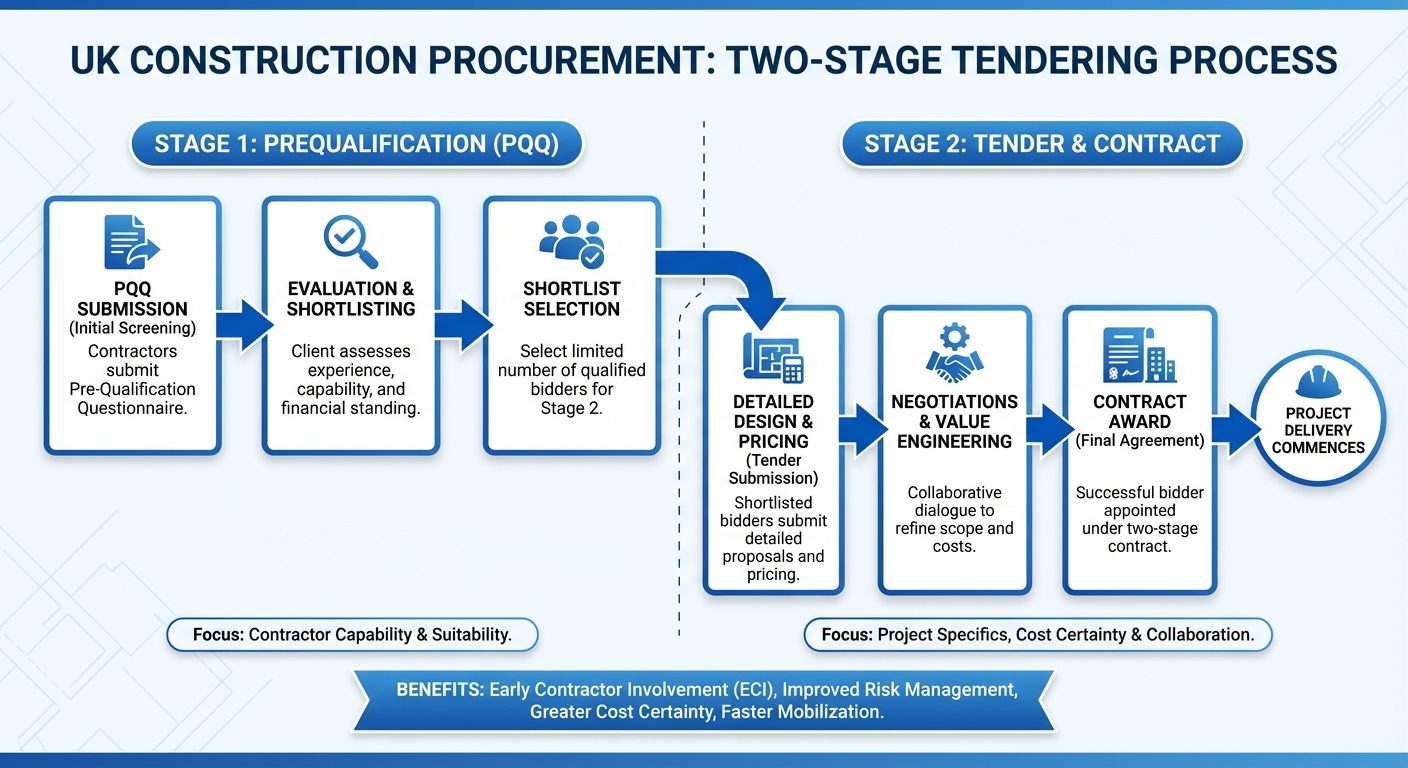
Two-stage tendering process flow diagram showing Stage 1 prequalification and Stage 2 detailed negotiation
What Is Two-Stage Tendering?
Two-stage tendering splits the procurement process into two distinct phases rather than requiring contractors to provide a fully priced tender before any design work is done. In Stage 1, contractors compete on the basis of preliminaries, overhead and profit percentages, methodology, and team capability. The client selects a preferred contractor — or a shortlist — to proceed to Stage 2, where the design is developed collaboratively and a lump sum price is agreed before the contract is awarded.
The fundamental logic is straightforward. For complex projects, particularly those involving significant design development, ground risk, specialist systems integration, or phased delivery, asking contractors to price a complete scheme before the design is mature enough creates enormous problems. Contractors either over-price to protect themselves from unknown risks, or under-price to win work and then fight for variations. Neither outcome serves clients well. Two-stage tendering addresses this by bringing the preferred contractor into the design process early, allowing risks to be properly identified, costs to be built from the bottom up, and solutions to be collaboratively developed.
Early Contractor Involvement (ECI) is a closely related concept. In some procurement structures, Stage 2 is explicitly framed as an ECI period during which the contractor contributes buildability advice, supply chain engagement, and cost planning to the developing design. This is particularly common in healthcare, education, and complex refurbishment projects where specialist knowledge is needed to make design decisions effectively.
Two-stage tendering should not be confused with a negotiated contract. There is still genuine competition at Stage 1, and the client retains the right to go back to the market if Stage 2 negotiations fail to produce an acceptable price. The competitive discipline remains; it is simply applied differently.
Why Two-Stage Tendering Is Growing
The shift towards two-stage tendering reflects broader changes in how sophisticated clients think about construction procurement. Several converging factors are driving its growth in 2026.
The failure of single-stage procurement on complex projectsThe construction industry has accumulated decades of painful evidence about what happens when complex projects are procured on a single-stage, fully designed basis. Contractors price risks they cannot properly assess. Designs change after contract award, generating claims and disputes. Build programmes slip because the contractor had no input into sequencing assumptions. The resulting adversarial dynamic damages relationships, inflates final costs, and produces worse buildings.
The Government's Construction Playbook, updated in 2022 and still actively referenced by public sector clients, explicitly recommends collaborative procurement models for projects above certain complexity and value thresholds. Two-stage tendering is the most common mechanism for delivering that collaboration.
The Procurement Act 2023 and the shift to MATThe Procurement Act 2023 replaced the old Most Economically Advantageous Tender (MEAT) evaluation framework with the Most Advantageous Tender (MAT) standard. This is not just a name change. MAT explicitly allows and encourages contracting authorities to weight factors like innovation, collaboration, sustainability, and community benefit more heavily in their evaluation models.
Two-stage tendering aligns naturally with MAT principles because it creates space to evaluate contractors on the quality of their collaborative approach, not just on price. Stage 1 evaluations typically weight technical approach, team capability, and cultural fit alongside commercial competitiveness. This rewards contractors who invest in understanding client needs and can articulate a credible delivery vision — precisely the skills that AI-assisted bid writing can help develop and present effectively.
Market conditions favouring risk managementConstruction tender price inflation of 3.5–5% through 2026 and 2027 reflects genuine market pressures around labour availability, material costs, and supply chain capacity. In this environment, single-stage tendering on complex projects is increasingly untenable. Contractors cannot confidently price unknown quantities, and clients cannot confidently evaluate wildly variable bids. Two-stage tendering manages this dynamic by separating the competition for the opportunity from the competition on price.
How the Two-Stage Tendering Process Works
Understanding the mechanics of two-stage tendering helps you calibrate your effort and strategy at each phase.
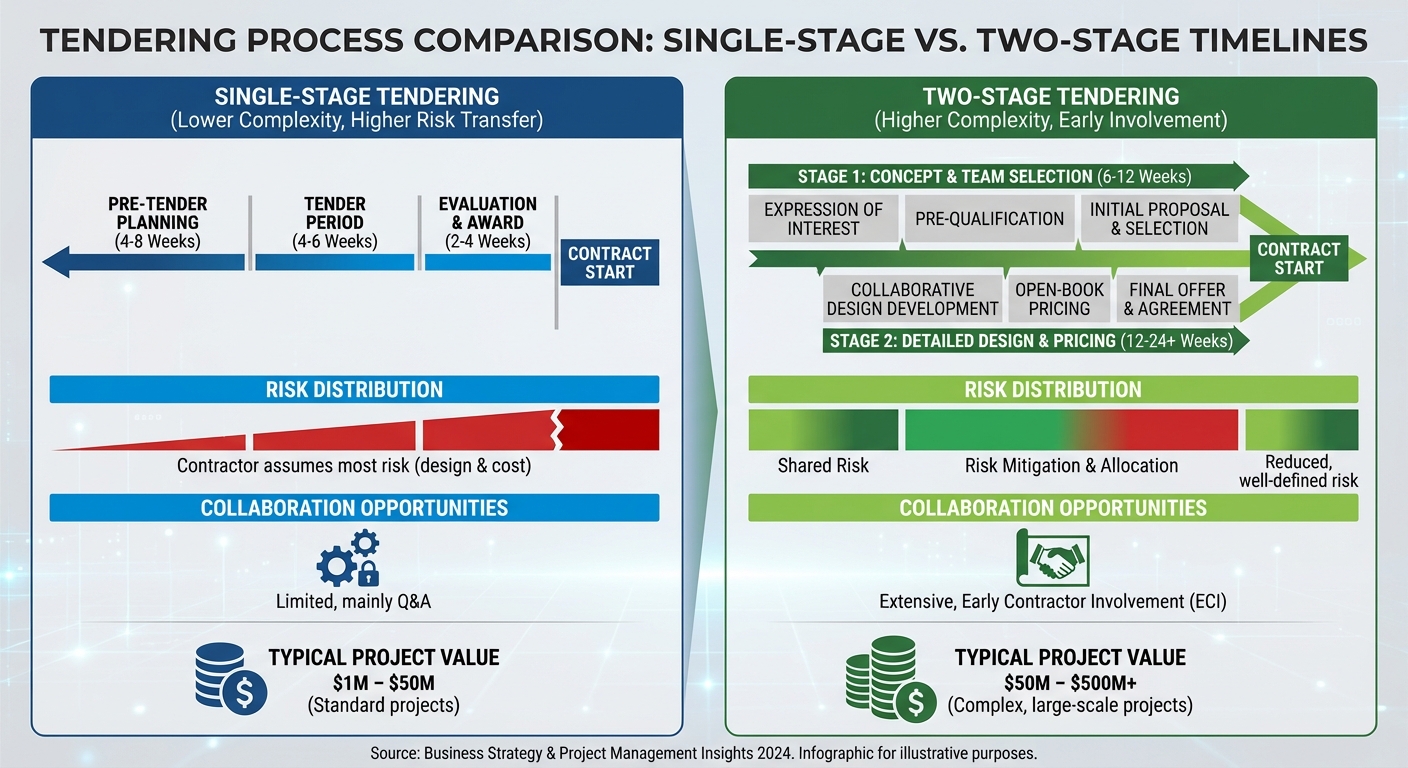
Comparison of single-stage versus two-stage tendering timelines and risk profiles
Stage 1: The Competition
Stage 1 is where contractor selection happens. Depending on the client's approach, this may follow a Prior Information Notice (PIN), an open market advertisement, or selection from an approved framework. Under the Procurement Act 2023, contracting authorities must publish contract notices on the central digital platform, giving contractors better visibility of upcoming two-stage opportunities.
The Stage 1 submission typically includes:
Preliminary schedule and method statement. You are not pricing a full scope at this point. Instead, you submit a preliminaries breakdown — site management, supervision, temporary works, welfare facilities, plant and equipment — along with overhead and profit percentages that will be applied to the eventual Stage 2 price. This is the commercial framework clients use to compare bidders. Methodology and programme. A detailed narrative explaining how you would approach the project: sequencing, critical interfaces, specialist subcontractor strategy, logistics, and key risks and opportunities. The quality of this section often determines who progresses to Stage 2, so generic methodology statements are immediately recognisable and penalised. Team CVs and resource plan. Clients want to know who will actually deliver the project. Senior management CVs matter, but so does the proposed site team. For significant projects, clients may interview shortlisted contractors to test whether the proposed team members understand the project specifically. Relevant experience. Case studies demonstrating successful delivery of comparable projects. For public sector clients, social value delivery and community outcomes are increasingly prominent in case study expectations. Design input capability. Evidence of your ability to contribute constructively to the design process during Stage 2. This might include examples of value engineering contributions, buildability advice that improved previous projects, or specialist supply chain relationships that could benefit the current scheme.Stage 1 evaluation criteria typically weight price (the commercial framework) at 30–40% and quality (methodology, team, experience) at 60–70%. This means that strong technical and cultural fit can outweigh a slightly higher preliminaries percentage. The most common mistake contractors make at Stage 1 is focusing disproportionately on sharpening the commercial numbers while producing undifferentiated quality responses.
The Bridge: Due Diligence and Selection
Following Stage 1 evaluation, the client selects a preferred contractor (sometimes two, if they want a competitive tension through Stage 2). Before Stage 2 begins, there is typically a period of due diligence — financial standing checks, reference calls, and potentially an interview or presentation.
This is also when the Stage 2 scope and process are formally agreed. The client and preferred contractor should establish:
- The design development programme and key milestones
- The cost reporting format and frequency
- The target cost or employer's budget (if one exists)
- The subcontractor procurement strategy and the extent of competitive tendering requirements
- The open-book accounting arrangements that will apply to Stage 2 costs
- The conditions under which the client would return to the market
Getting these parameters agreed clearly at the outset of Stage 2 is critical. Ambiguity about process creates problems later.
Stage 2: Collaborative Development and Price Negotiation
Stage 2 is where the real work happens. The preferred contractor and the client's design team work together to develop the design, identify and price risks, engage the supply chain, and ultimately agree a lump sum contract price.
Design development and buildability inputYour team should be actively engaged with the design team from the start of Stage 2, not waiting passively for drawings to price. Identify design interfaces that affect programme. Flag specification choices that have significant cost implications. Suggest alternative approaches where you have better market knowledge. This is the value of early contractor involvement, and clients expect to see it delivered.
Document your contributions carefully. In any subsequent dispute about whether fair value was achieved in Stage 2, evidence of genuine collaboration strengthens your position considerably.
Subcontractor procurementFor major work packages, you will typically need to competitively tender to specialist subcontractors and demonstrate that the prices obtained represent market value. The extent of this requirement should have been agreed at Stage 1 selection, but clients will often want to see the competitive process and understand how you evaluated and selected subcontractors.
AI tools are transforming how contractors manage subcontractor enquiries at Stage 2. Platforms like mytender.io help generate consistent, comprehensive enquiry packages and can analyse returned quotes to identify anomalies, missing items, or scope gaps that could create post-contract disputes.
Cost reporting and transparencyOpen-book cost management is standard in two-stage procurement. The client's quantity surveyor will typically review your cost plan in detail, and you should expect challenge on rates, allowances, and assumptions. Prepare for this scrutiny by ensuring your cost plan is fully evidenced and traceable to market rates rather than internal schedule rates.
Regular cost reporting during Stage 2 keeps all parties aligned and reduces the risk of a late surprise that undermines the Stage 2 price agreement.
The Stage 2 price agreementThe culmination of Stage 2 is agreement of a lump sum contract price. This may incorporate a target cost mechanism with pain/gain sharing, or it may be a straightforward fixed price contract. The commercial structure should match the risk profile of the project and the quality of information available at contract award.
If agreement cannot be reached — typically because the emerging Stage 2 price exceeds the client's budget or the risk profile has changed materially — the client may either renegotiate the scope, seek additional funding, or return to the market. This outcome is relatively rare but contractors should be aware of the risk, particularly if their Stage 2 preliminaries percentage proves difficult to justify at greater scrutiny.
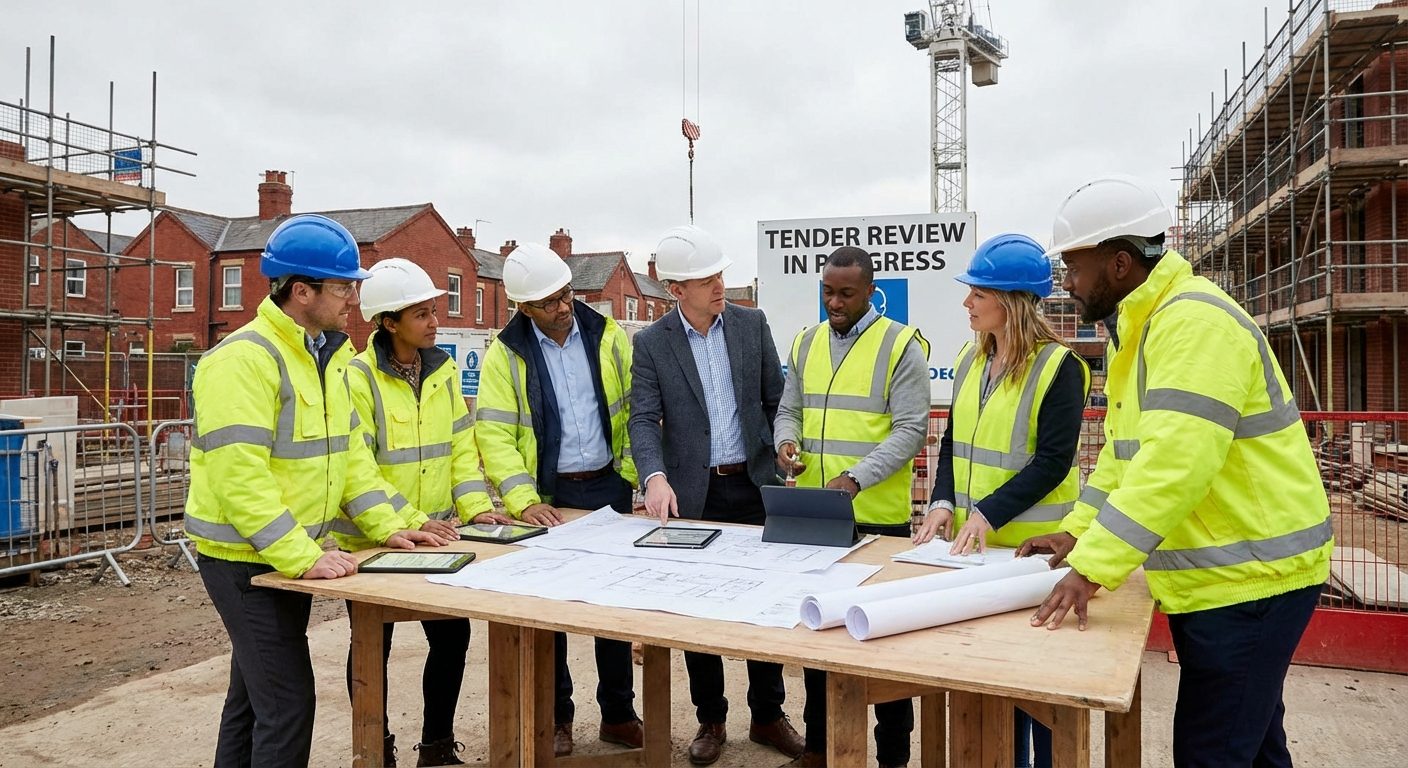
Early contractor involvement in UK construction showing collaborative design team meeting
Winning Stage 1: A Strategic Approach
Stage 1 is a quality competition as much as a commercial one. The following strategies give contractors a genuine advantage.
Invest in project-specific intelligence before the submission
Before writing a single word of your Stage 1 response, gather intelligence about the project and the client. Visit the site if possible. Research the client's recent procurement history on Contracts Finder and the central digital platform. Speak to architects, engineers, or other consultants involved if appropriate. Review any published pre-procurement engagement materials.
This intelligence should shape every section of your response. References to specific site conditions, neighbourhood context, or client priorities signal that your response was written for this project, not pulled from a library. Evaluators notice the difference immediately.
Make your methodology genuinely distinctive
Generic methodology is the most common failure in Stage 1 submissions. Sentences like "we will adopt a collaborative approach to programme management" or "our team will engage proactively with the supply chain" appear in virtually every submission and carry no weight.
Distinctive methodology connects your proposed approach to the specific challenges and opportunities of this project. If the project involves a complex phasing requirement, explain exactly how you would manage it. If there is a known ground condition risk, address it directly. If the programme is unusually tight, show how your proposed sequencing and resource plan would deliver it.
Mytender.io's AI-assisted bid writing capability is particularly valuable here. The platform draws on your company's library of project case studies, method statements, and lessons learned to generate project-specific methodology content that incorporates genuine technical substance. Rather than starting from a blank page or adapting a generic template, bid writers can develop a high-quality first draft and focus their time on project-specific refinement.
Present your team compellingly
The people named in your Stage 1 submission are often the deciding factor. Clients are buying a team, not just a company. CVs should tell a story of relevant experience and individual capability, not simply list job titles and qualifications.
For your proposed project manager, site manager, and other key roles, tailor CVs to highlight experience directly comparable to this project. If the project is a phased hospital refurbishment, a project manager with NHS estate experience will resonate more than one with an impressive commercial portfolio. Be prepared for Stage 2 to hold you to the team you proposed; substituting personnel without client approval is a significant relationship risk.
Get the commercial framework right
Your Stage 1 preliminaries and overhead/profit percentages will be scrutinised carefully. They need to reflect genuine cost and commercial reality whilst remaining competitive. The temptation to sharpen numbers aggressively to win Stage 1 should be resisted: if Stage 2 proves that your commercial framework is unsustainable, the Stage 2 negotiation becomes extremely difficult.
A better approach is to price the preliminaries thoroughly and accurately, then ensure your quality submission is strong enough to support your commercial position. Clients who understand two-stage procurement know that the cheapest Stage 1 package is not necessarily the best value.
Navigating Stage 2 Successfully
Stage 2 is where contractor relationships are built or damaged. The way you conduct yourself in the Stage 2 process shapes the client's confidence in your organisation and sets the tone for the project itself.
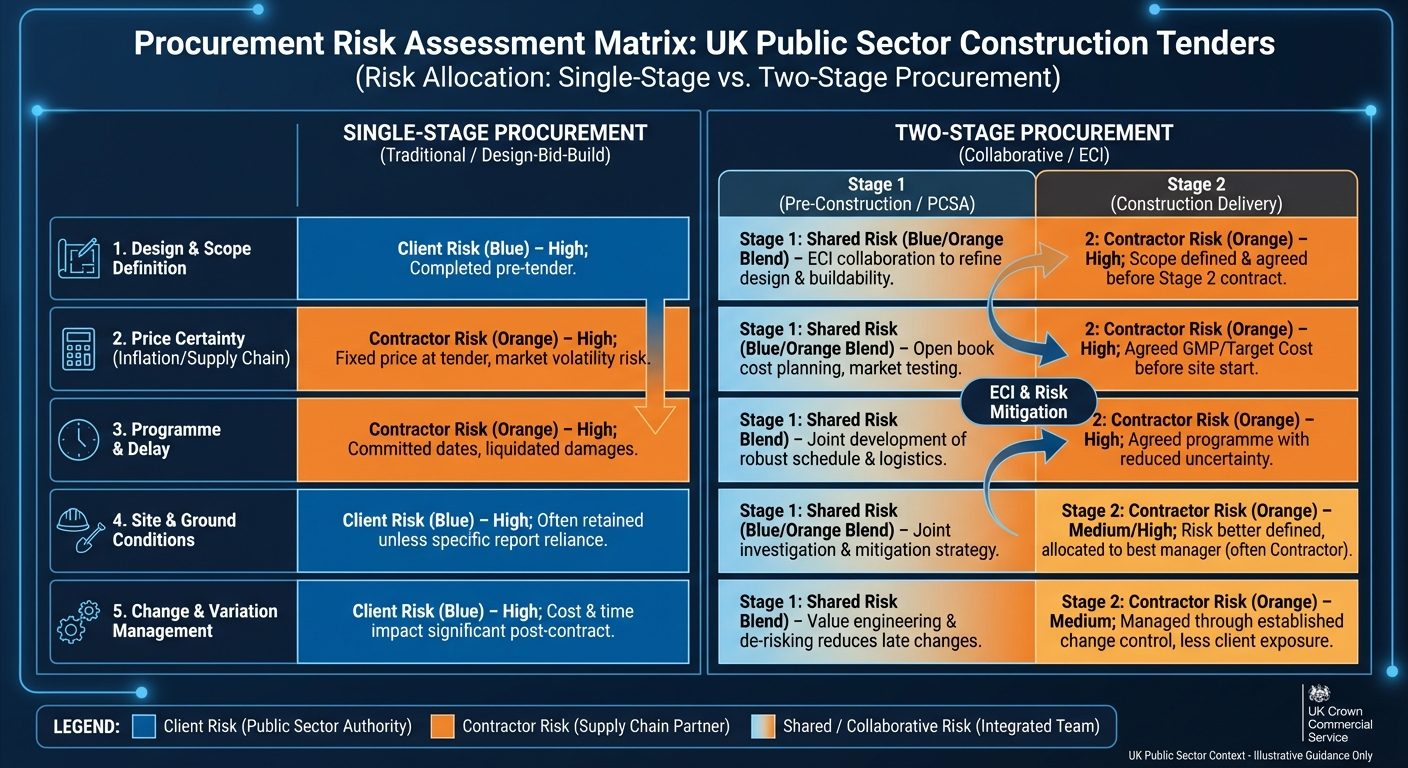
Risk allocation matrix for two-stage tendering in UK public procurement
Manage expectations carefully at the outset
One of the most common Stage 2 failures is a gradual divergence between the client's expectation of where the price is heading and the contractor's developing cost plan. This often results in a difficult conversation late in Stage 2 where the contractor presents a price materially above the client's budget, and the trust built during the collaborative period is damaged.
Proactive cost transparency avoids this. Share your developing cost plan regularly, flag risks as they emerge, and have difficult conversations early rather than late. A client who understands why the cost is where it is — even if it is above initial expectations — can make informed decisions about scope adjustment or budget revision. A client who is surprised by a final Stage 2 price loses confidence in the process and in you.
Use AI tools to manage document complexity
Stage 2 generates significant document management demands. Design drawings and specifications evolve continuously. Subcontractor enquiry packages need to be comprehensive and consistent. Cost plan updates must be clearly annotated and traceable.
AI-powered procurement platforms have transformed how forward-thinking contractors manage this complexity. Mytender.io provides a centralised repository for all tender and project knowledge, enabling bid managers and commercial teams to access and cross-reference documents efficiently. When subcontractor enquiries are generated from evolving specifications, the platform ensures consistency and captures any scope gaps automatically.
Protect your commercial position
Open-book does not mean unlimited exposure. Your Stage 2 price should reflect a fair return for the risk you are taking, with appropriate contingency for items that cannot be fully defined at the time of contract award. Be prepared to explain and justify your risk allowances clearly rather than obscuring them in headline numbers.
It is legitimate and appropriate to identify items that remain genuinely uncertain at Stage 2 price agreement and agree how these will be managed in the contract — whether through provisional sums, schedule of rates, or target cost mechanisms. Attempting to incorporate all uncertainties in a fixed lump sum often either inflates the price unnecessarily or creates a contested contract.
Understand when to walk away
If Stage 2 reaches an impasse — the client's budget is fixed at a level that genuinely cannot deliver the scheme, or the risk allocation proposed is unacceptable — walking away is sometimes the right decision. Proceeding to contract on terms that make profitable delivery impossible serves nobody. The reputational damage of a troubled project far outweighs the short-term cost of a failed Stage 2 negotiation.
That said, before walking away, exhaust every legitimate avenue: scope reduction, specification value engineering, alternative procurement routes for high-risk elements, and phased delivery. Clients and contractors who have invested in Stage 2 together generally want to reach agreement, and creative problem-solving often unlocks a solution.
Two-Stage Tendering Under the Procurement Act 2023
The Procurement Act 2023 has changed the formal framework within which public sector two-stage tendering operates, and contractors need to understand the implications.
The Competitive Flexible ProcedureThe Act replaced the old Competitive Dialogue and Innovation Partnership procedures with the Competitive Flexible Procedure (CFP), which gives contracting authorities much greater discretion to design procurement processes that suit their specific needs. Two-stage tendering sits comfortably within the CFP framework, and public sector clients are using it with increasing confidence.
Under the CFP, clients can negotiate with shortlisted tenderers during the process — something the old Restricted Procedure did not permit. This creates opportunities for contractors to refine and improve their Stage 2 proposals in response to client feedback before final price submission, adding collaborative value that simply was not possible under previous regulations.
Transparency and publication requirementsThe Act introduced enhanced transparency requirements that affect two-stage procurement. Contract notices, award notices, and contract details above certain thresholds must be published on the central digital platform. For contractors, this creates a richer intelligence picture of the market: you can track what contracts have been awarded, at what values, and to whom.
More significantly, contracting authorities must publish pipeline notices for contracts above £2 million where their annual spend exceeds £100 million. This forward visibility allows contractors to plan their business development activities more strategically and prepare for specific two-stage opportunities well in advance.
The social value dimensionSocial value requirements have become more prominent under the MAT framework. In construction procurement specifically, clients are looking for evidence of local employment commitments, apprenticeship creation, supply chain development, and community engagement. For two-stage tenders, these commitments can be refined and strengthened during Stage 2 as the contractor engages with local supply chain and develops a social value delivery plan.
Contractors who treat social value as a genuine business commitment — rather than a compliance exercise — consistently outperform those who offer generic promises. Mytender.io's platform helps teams develop and evidence social value commitments that are credible, measurable, and aligned to client priorities.
Common Mistakes in Two-Stage Tendering
Understanding the most common failures helps you avoid them.
Underestimating Stage 1 quality requirements. Because Stage 1 does not require a full price, some contractors treat it as a lighter-touch exercise. In practice, the quality of Stage 1 submissions often determines whether you access the most valuable projects, and the effort invested pays dividends. Losing momentum in Stage 2. The collaborative nature of Stage 2 can create a false sense of security. Some contractors become passive, waiting for design information to price rather than actively driving progress. Clients notice this and it damages the relationship before the project has started. Poor subcontractor management. Stage 2 often reveals weaknesses in how contractors manage their supply chain. Enquiries that are incomplete, inconsistent, or poorly coordinated produce unreliable prices that undermine the Stage 2 cost plan. Systematic use of AI-assisted enquiry management reduces these risks significantly. Commercial framework drift. If your Stage 2 cost plan is growing significantly above your Stage 1 commercial framework, you need to address this explicitly and early. Hoping the gap will close rarely works. Failing to document contributions. Your Stage 2 design input and value engineering contributions should be documented as they happen. This evidence becomes important if the Stage 2 negotiation becomes difficult or if questions arise later about whether the process delivered fair value.How AI Is Transforming Two-Stage Tender Management
Artificial intelligence is fundamentally changing how contractors prepare and manage two-stage tenders, with significant implications for competitiveness and efficiency.
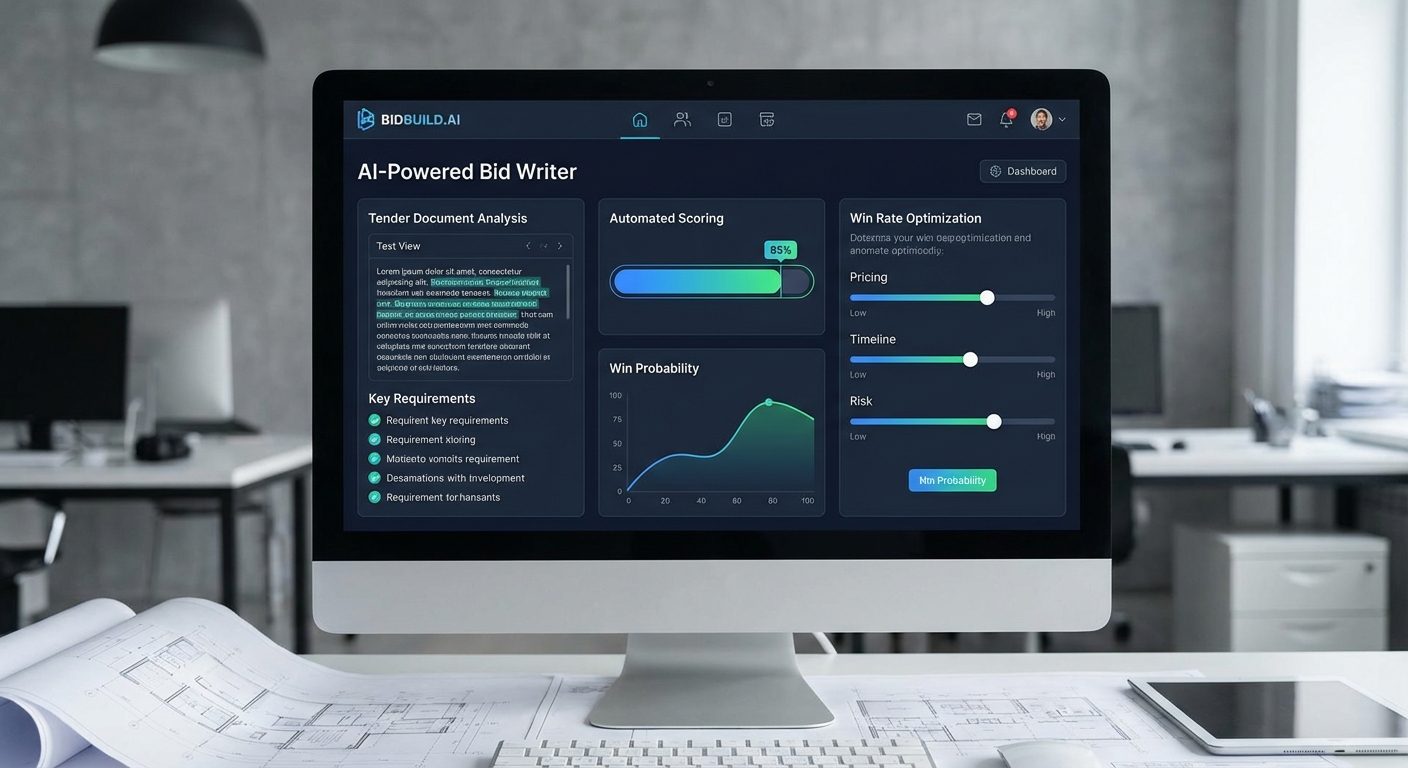
AI-powered bid writing software for construction tender management
The most immediate impact is on Stage 1 quality. Producing a genuinely differentiated, project-specific Stage 1 submission takes substantial effort — research, writing, coordination, and review. AI-assisted bid writing platforms like mytender.io dramatically reduce the time required to produce high-quality first drafts, freeing bid teams to focus on differentiation and review rather than generation.
Mytender.io works by drawing on your company's existing knowledge base — previous bids, case studies, method statements, lessons learned — to generate content that is genuinely informed by your organisation's experience. Unlike general-purpose AI tools that produce generic text, mytender.io produces output that reflects your specific capabilities and delivery approach. The result is Stage 1 content that reads like it was written by an experienced bid writer who knows your business deeply.
In Stage 2, AI tools support cost plan management, document consistency, and subcontractor engagement. Automated cross-referencing of design documents against enquiry packages identifies gaps before they create commercial problems. Pattern recognition across historical cost data helps bid managers identify rates and allowances that may need refreshing based on current market conditions.
Win rate analysis is another area where AI delivers measurable value. By analysing the characteristics of successful and unsuccessful tenders, mytender.io helps contractors understand which types of project and which types of client they perform best with — enabling smarter opportunity selection and more focused business development.
Practical Tips for Specific Sectors
Two-stage tendering is used across a wide range of sectors, each with its own nuances.
Healthcare and NHSNHS two-stage tenders are typically complex, politically sensitive, and heavily weighted on quality. Infection control, patient safety, phasing to maintain clinical operations, and stakeholder engagement all feature prominently in evaluation criteria. Early contractor involvement is particularly valued because of the specialist knowledge contractors can contribute to design decisions in clinical environments.
For NHS Stage 1 submissions, case study selection is critical. Recent, comparable NHS estate projects with measurable outcomes carry far more weight than generic healthcare experience. Given the NHS's focus on social value, evidence of local employment and training outcomes from previous NHS contracts is particularly compelling.
EducationEducation sector two-stage tenders, whether for new schools, college campuses, or university facilities, tend to emphasise programme certainty — clients need to plan around academic years — and disruption management where works are adjacent to operating facilities. DfE-funded projects follow specific requirements under the department's Construction Framework.
HousingResidential two-stage tendering is growing, particularly for mixed-use regeneration schemes and large housing association programmes. Here, the Stage 2 process often involves significant design development around unit types, specifications, and tenure mix. Understanding the housing association client's financial model — grant funding, sales values, affordable housing obligations — helps you contribute constructively to cost management during Stage 2.
Commercial and Fit-outHigh-value commercial fit-out and office refurbishment increasingly uses two-stage procurement, particularly where the base build is ongoing and the fit-out programme needs to be integrated with it. Supply chain relationships with specialist MEP and fit-out contractors are particularly valuable in Stage 2 for these projects.
Measuring Your Two-Stage Tendering Performance
Contractors who take two-stage tendering seriously measure and improve their performance systematically.
Key metrics to track include:
Stage 1 conversion rate — what proportion of Stage 1 submissions lead to Stage 2 selection? If this is below 30%, your Stage 1 quality or commercial framework may need attention. Stage 2 conversion rate — what proportion of Stage 2 processes result in contract award? Below 80% suggests problems with Stage 2 management, cost plan accuracy, or client relationship. Stage 2 programme — how long does your Stage 2 process typically take compared to the client's expectations? Protracted Stage 2 periods damage client relationships and create uncertainty. Cost plan accuracy — how does your Stage 2 price compare to your Stage 1 commercial framework on a like-for-like basis? Significant variations suggest weaknesses in your Stage 1 cost intelligence or Stage 2 cost management. Client satisfaction — do clients who proceed to contract award through two-stage processes subsequently invite you to future opportunities? Repeat two-stage invitations are the strongest indicator that your process is working well.Regular review of these metrics, supported by win/loss feedback where available, drives continuous improvement in both Stage 1 quality and Stage 2 management. Mytender.io's analytics capabilities help contractors track performance patterns across their tender pipeline and identify the specific factors that distinguish their winning submissions.
Looking Ahead: Two-Stage Tendering in 2027 and Beyond
The trajectory is clear. Two-stage tendering will continue to grow as the preferred procurement route for complex construction projects. Several factors point in this direction.
The Procurement Act 2023 framework actively encourages collaborative procurement models and gives contracting authorities the flexibility to design processes that reflect project complexity. As more procurement teams become familiar with the Act's provisions, two-stage approaches will extend into project types and value bands where single-stage tendering previously dominated.
Government commitments to infrastructure investment — in housing, health, transport, and energy — will generate a substantial pipeline of projects that are naturally suited to two-stage procurement. Contractors who have developed strong two-stage capabilities will be disproportionately well-positioned to access these opportunities.
Digital transformation will continue to accelerate. The central digital platform is improving visibility of opportunities, and AI tools are making high-quality bid preparation more accessible to contractors of all sizes. Smaller and medium-sized contractors who previously lacked the bid resource to compete seriously for two-stage opportunities are increasingly using AI platforms to level the playing field.
Sustainability requirements will become more demanding. Net zero commitments, embodied carbon reporting, and biodiversity net gain obligations are already shaping construction tenders and will become more prominent over the coming years. Two-stage procurement's collaborative model is better suited to developing genuinely substantive sustainability responses than single-stage tendering.
Conclusion
Two-stage tendering is no longer a specialist procurement route for the largest projects. It is the dominant model for complex, high-value construction procurement and is growing in scope and frequency. For UK contractors in 2026, mastering the two-stage process — from intelligence-led Stage 1 preparation through collaborative Stage 2 management — is essential for accessing the best opportunities in the market.
The fundamentals are straightforward: invest in Stage 1 quality, contribute genuinely in Stage 2, manage costs transparently, and build the client relationships that generate repeat opportunities. The challenge is executing consistently across a busy tender pipeline while maintaining the standards that win work.
This is precisely where AI-powered bid management platforms make a measurable difference. Mytender.io helps construction contractors produce better Stage 1 submissions faster, manage the document complexity of Stage 2 more efficiently, and learn from every tender to continuously improve win rates. If you are competing seriously for two-stage opportunities and not yet using AI assistance in your bid preparation, you are working harder than you need to — and your competitors may already be ahead of you.
Two-stage tendering rewards preparation, collaboration, and commercial intelligence. With the right tools and approach, it is also one of the most effective routes to building sustained, profitable relationships with the clients who are investing in the built environment for decades to come.
---
Ready to improve your two-stage tender win rate? Mytender.io helps UK contractors produce compelling Stage 1 submissions, manage Stage 2 complexity, and build the knowledge base that makes every tender better than the last. Book a demo to see how leading contractors are using AI to win more work.Tags
Ready to Transform Your Tender Writing?
See how MyTender's AI can help you write winning tenders in a fraction of the time.