

TUPE in FM Tenders: How to Handle the Section Bid Teams Hate Most
A practical guide for facilities management bidders on writing stronger TUPE responses, pricing workforce risk, and proving mobilisation confidence in 2026 tenders.
mytender.io Research Team
Tender Writing & Bid Management Specialists
TUPE in FM Tenders: How to Handle the Section Bid Teams Hate Most
TUPE is where many facilities management bids stop sounding confident.
The service delivery section is clear. The innovation section has good examples. The social value section has numbers. Then the TUPE question arrives, and the response turns into a cautious page of employment-law language that says very little.
Evaluators notice.
In FM, TUPE is not a side issue. It affects cost, mobilisation, morale, service continuity, union engagement, pension exposure, site knowledge and day-one performance. If your answer treats it as a legal checkbox, you make the buyer nervous.
The best TUPE responses do something different. They show that you understand the people behind the contract, the risk behind the data, and the operational pressure of taking over a live service without dropping standards.

Facilities management bid team reviewing TUPE workforce transfer information
Why TUPE Matters So Much In FM Tenders
Facilities management contracts are people-heavy.
Cleaning, security, catering, grounds maintenance, helpdesk, M&E, caretaking, portering and front-of-house services often depend on staff who already know the buildings, routines, tenants, plant, access rules and local issues. When a contract changes hands, many of those people may transfer to the incoming supplier under TUPE.
That creates two realities for the buyer.
First, the legal process has to be handled properly. Poor consultation, bad data handling, unclear employee communications or mishandled pension obligations can create claims and disruption.
Second, the service still has to work on day one. Toilets need cleaning. Doors need securing. PPM schedules need continuing. Helpdesk tickets still come in. The buyer cannot tell residents, pupils, staff or patients that the service is bumpy because the contractor is still working through HR paperwork.
That is why TUPE questions are often scored hard. The evaluator is not looking for a solicitor's essay. They are looking for evidence that your team can protect the workforce and protect the service at the same time.
The 2026 Context: More Transparency, More Workforce Scrutiny
FM bidders are writing TUPE answers in a tougher environment than a few years ago.
The Procurement Act 2023 regime is now live for new procurements. Buyers are putting more emphasis on transparency, supplier performance, payment practice, exclusion risks and contract management. In parallel, public bodies are under political pressure to think harder about outsourcing, insourcing, local jobs and workforce treatment.
For FM suppliers, that means a thin TUPE answer is more exposed.
Buyers want to see that you have a practical plan for workforce continuity. They also want confidence that the commercial model is not built on optimistic assumptions about labour savings that may never be lawful, deliverable or acceptable.
The strongest bidders now connect TUPE to:
- mobilisation governance
- cost modelling
- service continuity
- employee engagement
- social value
- equality and inclusion
- union or staff representative communication
- risk management
- contract performance reporting
That is the shift. TUPE is no longer a paragraph in the HR section. It is a test of whether the whole bid is credible.
What Evaluators Are Really Asking
Most TUPE questions are badly worded.
They may ask you to "describe your approach to TUPE" or "explain how you will manage employee transfer". That sounds broad, so bidders answer broadly.
But the hidden evaluator questions are more specific:
- Have you understood the employee liability information?
- Have you priced the workforce correctly?
- Do you know what can and cannot be changed?
- Have you planned consultation properly?
- Will the workforce trust you quickly enough to keep the service stable?
- Do you have named people responsible for the transfer?
- Can you handle missing or late information?
- What happens if the incumbent is unhelpful?
- How will you reassure the buyer before day one?
- What proof do you have from previous transfers?
If your response does not answer those questions, it probably will not score well.
Start With The Data, Not The Policy
The weakest TUPE responses start with a generic policy.
"We comply with all TUPE legislation and have extensive experience managing employee transfers."
That sentence is not wrong. It just does not earn many marks.
A stronger response starts with the data available for this contract. Even if the employee liability information is incomplete at tender stage, you can show how you will test it, model it and convert it into a transfer plan.
Good ELI review covers:
- employee numbers by site and service line
- role titles and actual duties
- contracted hours and working patterns
- pay rates, allowances and overtime
- pension arrangements
- length of service
- holiday entitlement
- sickness history
- grievances or disciplinaries
- collective agreements
- union recognition
- training and vetting records
- security clearance requirements
- live absence, maternity or long-term health cases
The point is not to dump this list into the answer. The point is to show the evaluator that you know what matters.
For example:
"Within five working days of preferred bidder notification, our HR transition lead will validate the ELI against the staffing model used in our price submission. Any variance in hours, role coverage, pension assumptions or site allocation will be logged in the mobilisation risk register, assigned to HR, finance or operations, and raised through the mobilisation governance meeting until resolved."
That is much better than saying you will "review the information carefully". It tells the buyer who acts, when they act, what they check, where the issue is logged, and how it is controlled.
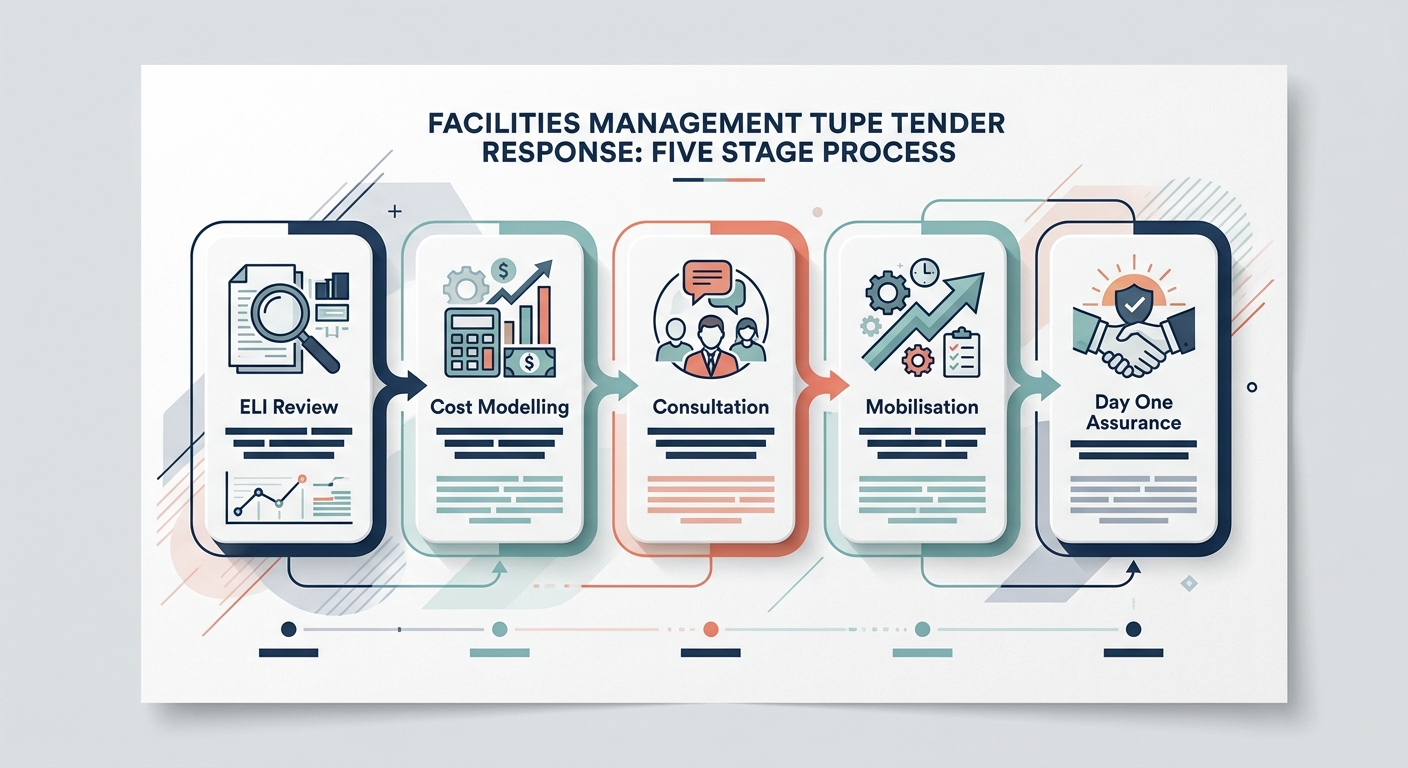
Five-stage TUPE tender response process for FM contracts
Build The Response Around A Five-Stage Process
A clear process helps evaluators score you.
It also stops the response becoming a blur of HR language. For most FM tenders, a five-stage structure works well.
Stage 1: ELI Review And Assumption Testing
Start with how you will review employee liability information and test the assumptions behind your solution.
This is where finance and operations need to be visible. TUPE is not only an HR workstream. If employee data changes the labour model, supervision ratio, pension cost, shift pattern or training burden, it affects the bid.
Your answer should explain:
- who reviews the ELI
- how findings are compared with the proposed operating model
- how gaps are escalated
- how assumptions are recorded
- how the buyer is kept informed
Do not overpromise certainty if the data is thin. Evaluators know ELI can be imperfect. What they want is a controlled method for dealing with uncertainty.
Stage 2: Workforce Mapping
Workforce mapping connects people to the service model.
In FM, transferred staff may not map neatly to the new specification. A cleaner might cover more than one building. A caretaker may carry informal site knowledge that is not captured in the job description. A security officer may also manage deliveries, visitor access and local incident routines.
Your bid should show how you will map:
- people to sites
- duties to the specification
- shift patterns to service hours
- supervisors to reporting lines
- skills to training needs
- local knowledge to mobilisation planning
This is where many bidders miss marks. They talk about the transfer as if people move from one payroll to another and the job is done.
The better answer says: we will understand how the current service really works, then protect what works and improve what does not.
Stage 3: Consultation And Communication
TUPE consultation is a legal process, but it is also a trust process.
Transferred employees are often anxious. They may have been through several contractor changes already. They may worry about pay, pensions, uniforms, managers, rotas, overtime, travel, holiday approval and whether the new supplier sees them as a cost problem.
If your answer ignores that human reality, it feels thin.
A good consultation plan includes:
- a named HR lead
- a named operational sponsor
- introductory briefings for affected staff
- written FAQs
- a confidential route for individual questions
- representative or union engagement where applicable
- manager drop-in sessions
- clear communication on what changes and what does not
- a day-one welcome plan
- follow-up check-ins after transfer
The language matters. Do not write as if staff are assets being moved around a spreadsheet. Write as if the people transferring are central to service continuity, because they are.
Stage 4: Mobilisation Controls
TUPE should sit inside the mobilisation plan, not beside it.
The evaluator needs to see that HR milestones align with operational milestones. If staff consultation, vetting, uniform ordering, induction, system access and site familiarisation all sit on different plans, day one gets messy.
Your answer should connect TUPE to:
- mobilisation governance meetings
- risk register ownership
- site readiness checks
- induction and training
- DBS or security checks where relevant
- IT and helpdesk access
- uniform and ID badge issue
- payroll setup
- health and safety briefings
- toolbox talks
- escalation routes
This is especially important on multi-site FM contracts. One missing access badge can be annoying. Fifty missing access badges across schools, hospitals or council buildings can damage confidence immediately.

Facilities management mobilisation control room coordinating a TUPE transfer
Stage 5: Day-One Assurance And Hypercare
The transfer does not end at midnight on the contract start date.
The buyer wants to know how you will support the workforce and the service after go-live. That usually means a hypercare period, with extra management presence and faster escalation.
Strong answers define:
- who is on site on day one
- which managers are visible to staff and the buyer
- how attendance is checked
- how service-critical roles are covered
- what happens if transferred staff do not attend
- how payroll or HR queries are triaged
- when the first staff pulse check happens
- when the first buyer assurance report is issued
The best bidders make this concrete. "Our mobilisation director will chair daily 8:30am hypercare calls for the first 10 working days, reviewing attendance, priority service issues, employee queries and buyer actions" is more persuasive than "we will provide enhanced support after transfer".
The Pricing Problem: TUPE Risk Has To Show Up Somewhere
Many TUPE failures start in the commercial model.
The bid team writes a reassuring answer. The price assumes everything transfers smoothly, all roles match the new model, sickness is normal, overtime is low, pensions are simple and the incumbent data is complete.
Then the real information arrives.
The labour cost is higher than expected. A supervisor covers duties that were not in the specification. Pension exposure is bigger. There are long-serving staff on protected terms. The rota depends on overtime. Several employees work across multiple contracts. A union representative expects early engagement. The priced solution suddenly looks fragile.
Evaluators may not see your full pricing model, but they can sense when the TUPE answer and the commercial strategy do not line up.
A credible bid explains how TUPE assumptions are controlled. You do not need to expose sensitive pricing detail, but you should show that workforce risk has been considered properly.
What To Say About Cost Without Giving Too Much Away
You can write:
"Our commercial model includes a TUPE assumption register covering headcount, hours, role mix, pension position, allowances and shift pattern dependencies. During mobilisation, HR and finance will jointly validate these assumptions against final ELI and report any material variance through the mobilisation board. This ensures workforce risk is visible early and managed without compromising day-one service continuity."
That sentence does three useful things.
It reassures the buyer that the price is not detached from the workforce. It shows that finance is involved. It gives a governance route for variance.
It does not reveal your margin, internal rates or negotiating position.
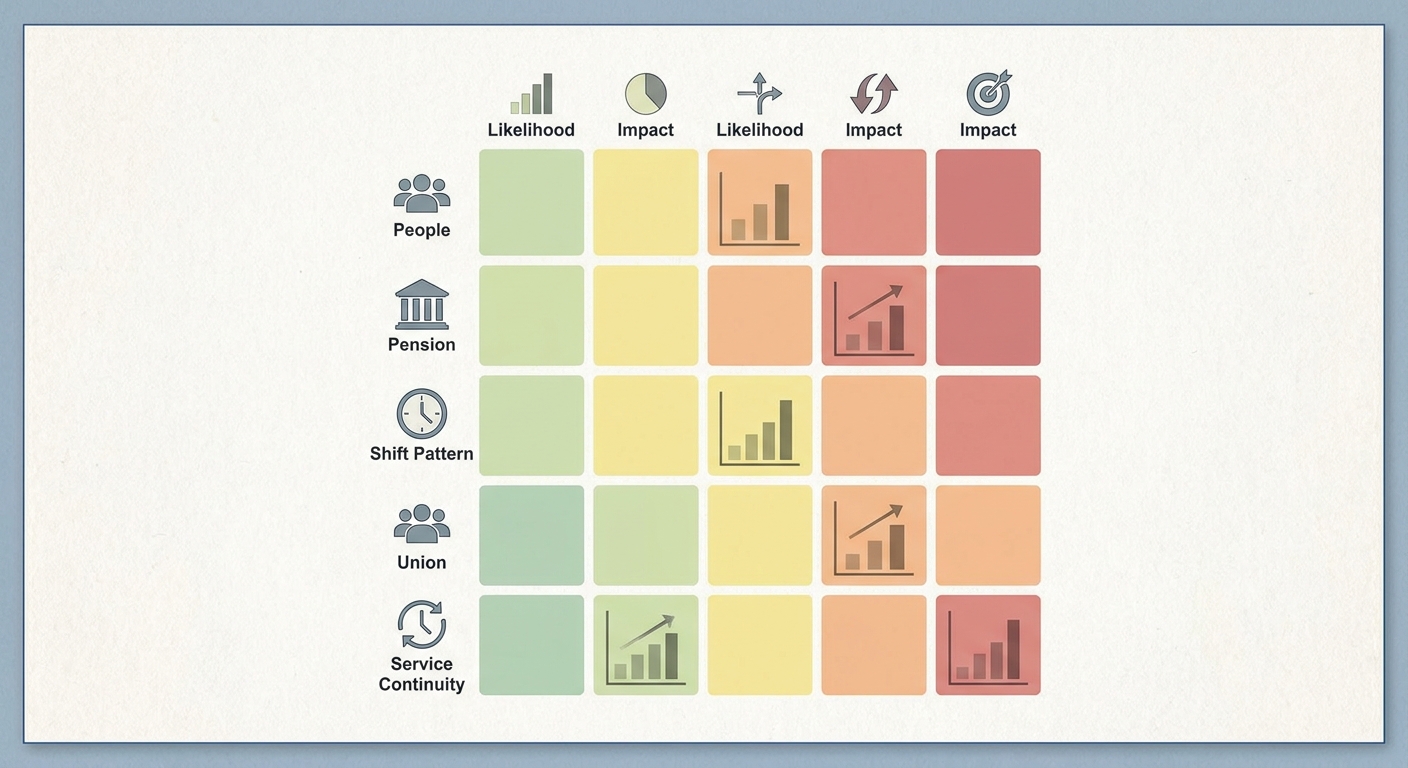
Common TUPE Risks In FM Bids
Every contract is different, but the same risk themes appear again and again.
Incomplete Or Late ELI
Employee liability information may arrive late, be incomplete or be too high level to support detailed planning.
Your response should explain how you work with incomplete data. That might include assumption logs, clarification questions, sensitivity checks, mobilisation risk scoring and early escalation to the buyer.
Do not pretend the risk does not exist. Acknowledging it calmly makes you sound experienced.
Hidden Working Patterns
The formal rota may not show how the service actually works.
In cleaning, staff may flex hours around building use. In security, one person may carry informal knowledge of local incidents. In hard FM, engineers may know asset quirks that never appear in the CAFM record.
A good TUPE response explains how you will capture operational reality from transferring staff during mobilisation, not just import job titles into a spreadsheet.
Pension And Protected Terms
Public sector FM contracts can carry pension complexity.
Do not make vague promises here. Say who reviews the pension position, how assumptions are validated, and how the finance team will treat any variance. If specialist advice is used, mention it.
Union Or Representative Engagement
Some FM workforces are unionised or have established employee representatives.
An evaluator will want to know that you can engage professionally and early. Your tone should be calm, respectful and practical. Avoid language that makes consultation sound like an obstacle.
Service Continuity Gaps
The biggest buyer fear is operational disruption.
If payroll setup fails, staff may lose trust. If inductions are late, compliance slips. If uniforms and badges are delayed, the transfer looks chaotic. If managers are invisible, rumours fill the gap.
Your answer should show day-one controls for the services the buyer cares about most.
Risk matrix for TUPE issues in facilities management tender responses
How To Turn TUPE Experience Into Scoring Evidence
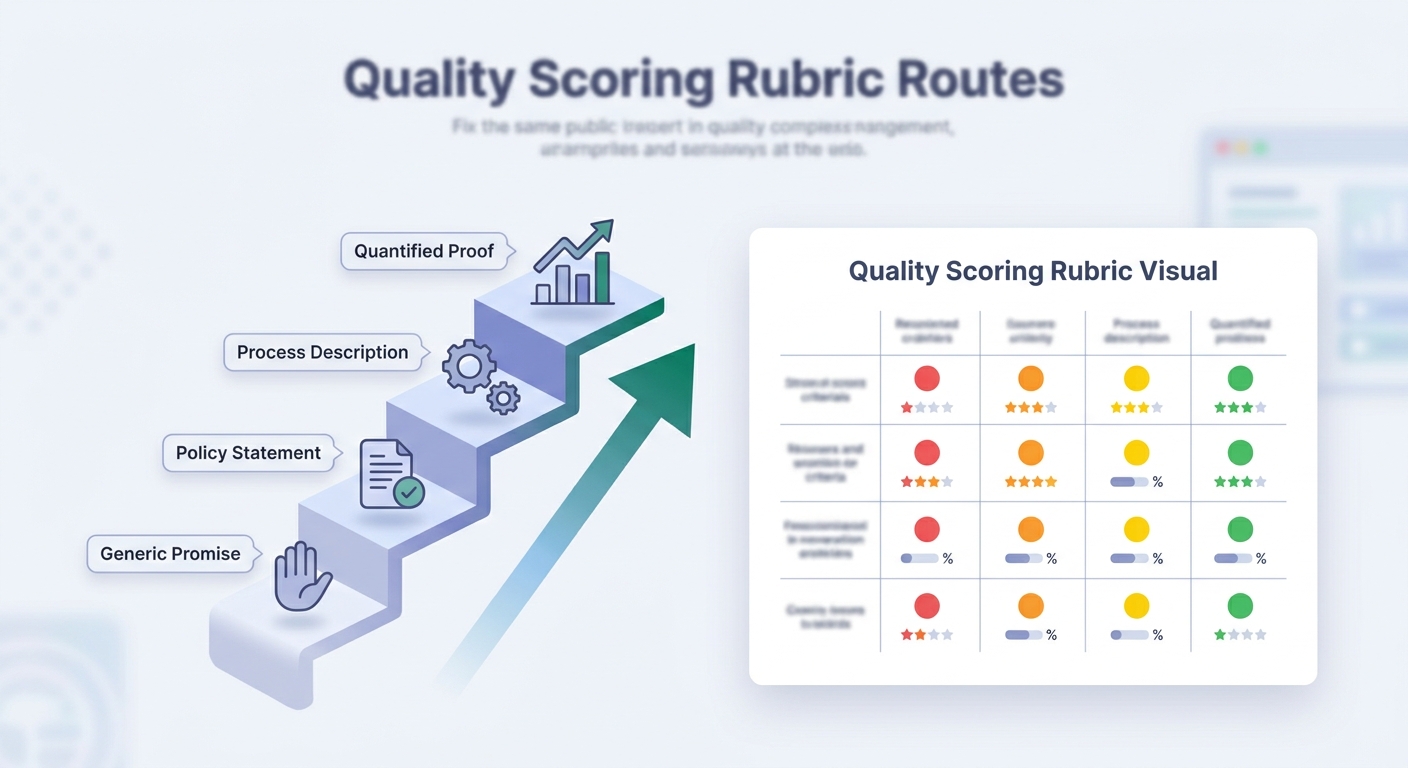
Evaluators do not score experience because you say you have it. They score it because you prove it.
Most bidders underuse their previous TUPE transfers. They write "we have successfully managed hundreds of employee transfers" but give no detail.
A stronger proof point looks like this:
"On a 2025 multi-site local authority FM mobilisation, we transferred 186 employees across cleaning, caretaking and security services. Our HR team completed 14 group consultation sessions, resolved 37 individual queries before transfer, issued all day-one documents 10 working days before go-live, and achieved 98% attendance across critical roles in the first week."
That is scoreable.
It gives scale, service mix, actions and outcome. It also sounds real.
Build a small evidence bank for TUPE answers. For each relevant transfer, capture:
- contract type and sector
- number of transferring employees
- service lines affected
- number of sites
- consultation approach
- employee query volumes
- union or representative engagement
- key risks resolved
- attendance at go-live
- payroll accuracy
- buyer feedback
- retention after 30, 60 and 90 days
This is exactly the kind of reusable bid intelligence that should sit in your bid library. If your team is still hunting through old submissions for TUPE examples at 9pm, mytender.io can help surface and adapt your strongest previous answers much faster.
The Structure Of A High-Scoring TUPE Answer
Here is a practical structure you can use.
1. Open With The Buyer Risk
Start by showing that you understand why TUPE matters for this contract.
For example:
"We recognise that workforce continuity is central to the safe mobilisation of this contract. The transferring employees hold site knowledge, user relationships and service routines that must be protected from the first day of transfer."
That is stronger than opening with legal compliance.
2. Name The Accountable Team
Who owns the transfer?
Do not hide behind "the company". Name the roles:
- mobilisation director
- HR transition lead
- finance lead
- operations lead
- site managers
- payroll contact
- employee relations specialist
You do not always need personal names in the tender response, but you do need role clarity.
3. Explain The Process
Use a staged process. Keep it simple.
Tender evaluators are often reading many responses in a short period. A clear process gives them something to mark.
4. Connect HR To Operations
This is the part many answers miss.
Explain how the TUPE plan interacts with site surveys, rotas, training, uniforms, equipment, CAFM access, helpdesk workflows, PPE and service commencement.
The buyer should feel that your HR and operations teams are working from one mobilisation plan.
5. Show Evidence
Use a short, relevant proof point.
If the tender is for council buildings, do not use a vague national example. Use a local authority, education, housing, NHS or multi-site public estate example if you have one.
6. Close With Assurance
End by explaining how the buyer will know the transfer is under control.
That might include weekly mobilisation reports, risk register updates, staff query trackers, readiness dashboards, day-one attendance reports and 30-day stabilisation reviews.
Evaluator scoring framework for TUPE answers in FM tenders
What A Weak TUPE Answer Sounds Like
Weak TUPE answers usually share the same problems.
They overstate experience and understate detail. They talk about compliance without describing delivery. They treat staff as a legal liability, not as the workforce that keeps the service running. They make the buyer do too much inference.
Watch for phrases like:
- "We have extensive experience"
- "We will comply with all relevant legislation"
- "We will communicate regularly"
- "We will ensure a smooth transition"
- "Our HR team will manage the process"
Those phrases are fine as part of an answer. They are not enough on their own.
Replace them with specifics:
- how many employees you have transferred before
- how quickly you validate ELI
- which role chairs TUPE mobilisation meetings
- what gets tracked in the risk register
- how staff questions are logged and resolved
- how payroll readiness is checked
- what day-one assurance the buyer receives
The difference is simple. A weak answer asks the evaluator to trust you. A strong answer gives them reasons to trust you.
Writing For Soft FM, Hard FM And Integrated FM
TUPE does not look identical across every FM contract.
Your answer should reflect the service mix.
Soft FM
Soft FM transfers often involve cleaning, security, catering, grounds maintenance, mailroom, reception or porterage teams.
The response should focus on workforce confidence, shift continuity, site routines, public-facing service standards, vetting, uniforms, supervision and local management visibility.
Cleaning-heavy contracts need particular care around hours, pay rates, holiday cover, materials handling, site keys, lone working and early-morning access. Security contracts need stronger coverage of licences, vetting, incident logs, assignment instructions and escalation protocols.
Hard FM
Hard FM transfers often involve engineers, maintenance managers, compliance teams and specialist subcontractor interfaces.
The response should focus on technical competence, asset knowledge, statutory compliance, PPM continuity, CAFM access, van stock, permits, call-out arrangements and critical plant familiarity.
For hard FM, transferring staff may hold knowledge that is not written down anywhere. Say how you will capture that knowledge before go-live.
Integrated FM
Integrated FM is harder because TUPE cuts across multiple service lines.
The buyer will worry about fragmentation. Your response needs a single governance model, with separate workstream detail underneath it.
Do not write five disconnected mini-plans. Show one mobilisation board, one risk register, one employee query tracker, one buyer reporting rhythm and clear service-line leads.
The Procurement Act Angle: Performance Evidence Will Matter More
Under the current procurement regime, buyers are thinking more carefully about supplier performance, transparency and contract management.
That affects TUPE answers indirectly.
If a buyer can see a future where poor mobilisation creates reportable performance issues, they will score risk more cautiously. If your answer shows strong governance and measurable assurance, you reduce that fear.
Think beyond the transfer date. Explain how workforce stability will be monitored during the first 90 days.
Useful measures include:
- attendance in critical roles
- payroll query volume and closure time
- training completion
- staff retention
- buyer complaints linked to transfer
- service failures linked to resourcing
- open HR issues
- union or representative actions
- employee pulse feedback
This gives the buyer a bridge from tender promise to contract management.
How AI Can Help Without Making The Answer Generic
AI can make TUPE answers worse if it produces bland compliance copy.
It can also make them much better if it helps the bid team find the right evidence, structure the response and adapt previous transfer plans to the current contract.
The difference is the source material.
If the tool only sees the tender question, it will write a generic answer. If it can see your previous TUPE responses, mobilisation plans, risk registers, case studies and buyer feedback, it can help you build a much stronger first draft.
For FM bid teams, useful AI support includes:
- finding relevant TUPE case studies from old bids
- comparing the tender's ELI questions with your standard transfer checklist
- drafting a staged response from your approved process
- checking whether the answer mentions finance, HR and operations
- flagging missing day-one controls
- adapting proof points for soft FM, hard FM or integrated FM
- keeping language consistent across mobilisation, HR and risk sections
That is where mytender.io is useful. It does not replace the judgement of your HR and operations teams. It helps the bid team turn their knowledge into a clearer, more complete answer before the deadline takes over.
A Practical TUPE Tender Response Checklist
Before submission, test your TUPE answer against this checklist.
- Does the opening explain the buyer's real risk?
- Have you named the roles responsible for the transfer?
- Have you explained how ELI will be reviewed and validated?
- Have you connected TUPE assumptions to the commercial model?
- Have you shown how workforce mapping affects service delivery?
- Have you described consultation in human, practical terms?
- Have you explained representative or union engagement if relevant?
- Have you linked TUPE milestones to the mobilisation plan?
- Have you covered payroll, pensions, uniforms, badges and system access?
- Have you explained day-one and hypercare support?
- Have you included a relevant proof point from a previous transfer?
- Have you shown how the buyer will receive assurance?
If the answer cannot pass that test, it is probably still too generic.
The Biggest Mistake: Writing TUPE In Isolation
The TUPE section should not be written after the rest of the bid is finished.
It touches too many things.
If HR writes the TUPE answer alone, it may be legally sound but operationally thin. If operations write it alone, it may miss consultation, pensions and employee relations risk. If finance is not involved, the commercial model may not match the workforce reality.
The best process brings HR, operations, finance and the bid lead together early.
You do not need a long meeting. You need answers to a few sharp questions:
- What assumptions have we made about transferring staff?
- What information is missing?
- Which risks could change price or delivery?
- Which previous transfer is most relevant?
- What day-one failure would worry the buyer most?
- What proof can we give that we have handled this before?
Those answers should shape the tender response.
Final Thoughts
TUPE is not the section to bluff.
FM buyers know that workforce transfers can make or break mobilisation. They have seen clean-looking bids fall apart when staff lose trust, payroll misses details, supervisors are unclear, or the incoming supplier treats local knowledge as an afterthought.
A strong TUPE answer does not need to be dramatic. It needs to be specific, joined-up and human.
Show how you review the data. Show how you price the risk. Show how you communicate with people. Show how HR, operations and finance work together. Show how the buyer will know the service is safe on day one.
That is what earns confidence.
If you want to see live FM opportunities while your team improves its bid library, the Tender Finder is free to use. It is a useful way to spot the next contract early enough to prepare the TUPE evidence properly, not the night before submission.
Tags
Ready to Transform Your Tender Writing?
See how MyTender's AI can help you write winning tenders in a fraction of the time.