
Tender Interview Preparation: How to Turn an AI-Assisted Written Bid Into a Winning Buyer Q&A in 2026
A practical guide for bid teams on preparing for tender interviews, clarification presentations and buyer Q&A, especially when AI has helped shape the written bid.
mytender.io Research Team
Tender Writing & Bid Management Specialists
Tender Interview Preparation: How to Turn an AI-Assisted Written Bid Into a Winning Buyer Q&A in 2026
The written tender is no longer the finish line.
For many suppliers, especially in facilities management, construction, technology, healthcare, professional services and local government contracts, the decisive moment now comes after the submission. The buyer has read the response. The score is close. The panel has questions. The procurement team wants reassurance that the supplier understands the requirement, can deliver the promised method, and has not hidden behind polished generic wording.
That is where the tender interview, clarification presentation or moderation Q&A can win or lose the contract.

Bid team rehearsing a tender interview with evidence packs, scoring criteria and buyer questions on screen
This matters more in 2026 because bid teams are using AI more widely. AI can help structure a response, analyse specifications, summarise requirements, create first drafts and identify compliance gaps. Used well, it gives teams more time to improve evidence and strategy. Used badly, it creates fluent answers that collapse under questioning.
Buyers know this. Evaluators are becoming better at spotting answers that sound strong but lack operational depth. Some are asking direct questions about AI use. Others are not asking about AI at all, but are using interviews and technical Q&A to test whether the supplier can explain the bid in plain English.
A tender interview is not a performance of enthusiasm. It is a proof session.
The panel is testing whether the written bid is real. They want to see whether the people in the room understand the service, own the commitments, know the risks, can explain the evidence, and will still be credible once the contract is live. If your team has used AI to accelerate the written response, that makes preparation even more important, not less.
This guide explains how to prepare for tender interviews and buyer Q&A in 2026, how to defend an AI-assisted bid without sounding defensive, and how mytender.io helps bid teams connect written answers, source evidence and live panel responses.
Why tender interviews are becoming more important
Tender interviews are not new. What has changed is their role.
Under the Procurement Act 2023 environment, buyers have more flexibility in how they design procedures, evaluate quality, run dialogue, request clarification and assess the most advantageous tender. The precise route depends on the procurement, but the trend is clear: buyers want stronger assurance before award. They are not relying only on beautifully written submissions.
That is sensible. Public contracts are under more scrutiny. Contract performance, payment practices, transparency notices, KPIs and supplier conduct are increasingly visible. A buyer that awards to a supplier with a glossy response but weak delivery capability can inherit operational problems, reputational risk and formal performance issues later.
The interview gives the buyer a chance to test confidence before that happens.
For suppliers, this creates both risk and opportunity. The risk is that a strong written score is undermined by vague answers, internal contradiction or a team that cannot explain its own commitments. The opportunity is that a well-prepared team can lift evaluator confidence beyond the written response. They can show judgement, ownership, delivery maturity and buyer-specific understanding.
That is especially valuable when scores are close. In a crowded framework competition or high-value service tender, several suppliers may look competent on paper. The panel session is often where the evaluator decides which one feels safest to appoint.
Tender interviews are therefore not an afterthought. They are part of the bid strategy from day one.
The AI factor: fluent bids now need live proof
AI has changed the shape of bid writing.
A team can now produce a first draft faster than ever. It can compare the response against evaluation criteria, pull material from a bid library, summarise lengthy tender documents and suggest ways to improve readability. That is a genuine productivity gain. It is also one reason more written bids now sound polished.
The problem is that polish has become less distinctive.
If every supplier can produce clean, confident prose, evaluators will look harder for proof. They will ask how the mobilisation actually works. They will ask who owns a risk. They will ask where the social value numbers came from. They will ask what happens if a subcontractor fails. They will ask why the proposed KPI is realistic. They will ask the operations lead to explain a method that may have been drafted by the bid team.
That is where weak AI use is exposed.
A generic AI-assisted answer often has three flaws. First, it sounds broader than the supplier's real capability. Second, it describes a method without showing how the business will resource it. Third, it blends evidence from previous bids so smoothly that nobody can trace the source. Those flaws may not be obvious in the written response, but they become painfully obvious in a live Q&A.
A good AI-assisted bid is different. It uses AI to organise the thinking, not replace it. The evidence still comes from the business. The commitments are still owned by named people. The response can still be traced back to source documents, case studies, policy owners and operational decisions. When the buyer asks a question, the team can answer without hiding behind the wording.
That is the standard to prepare for.
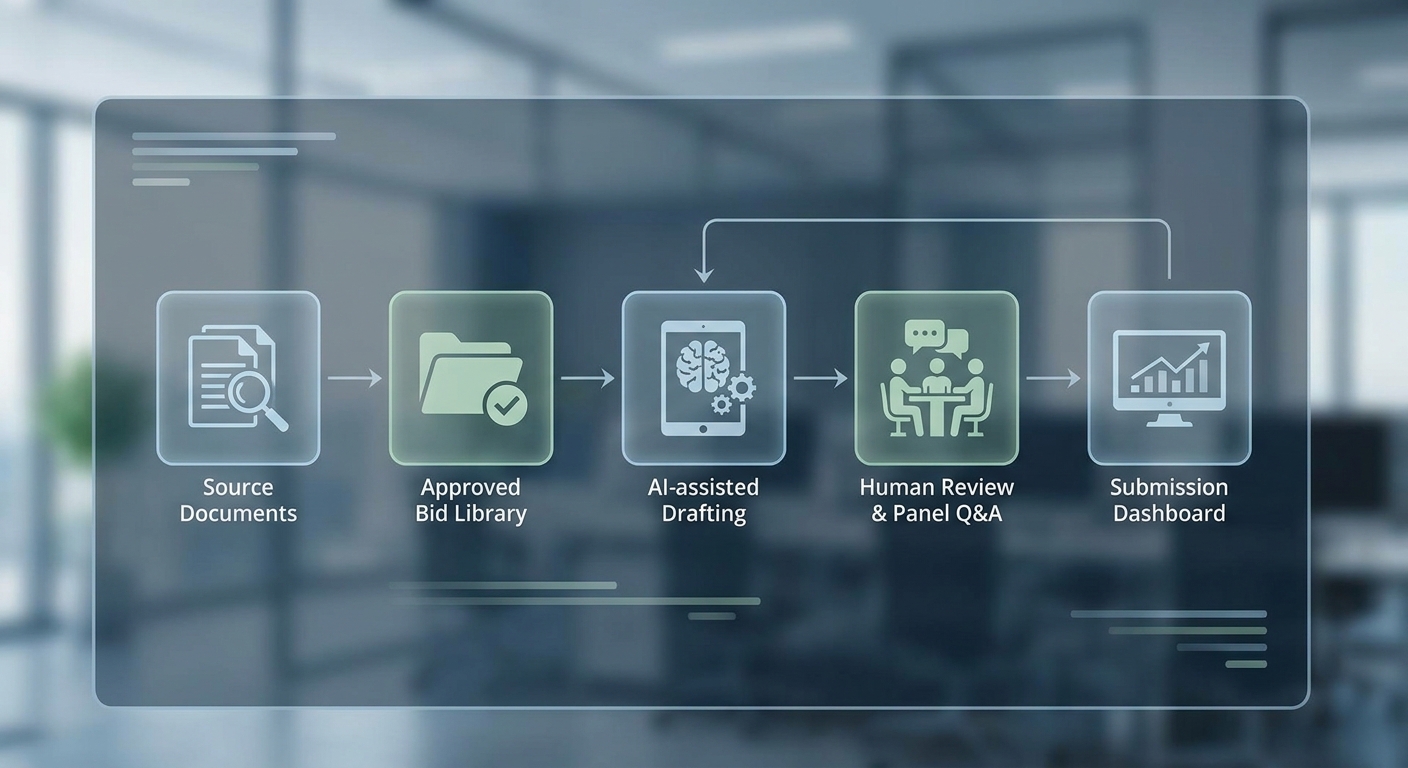
Evidence chain showing AI-assisted bid drafting connected to verified source material and live panel answers
The safest question to ask during preparation is simple: if the panel asked us to explain this sentence without notes, could the right person do it?
If the answer is no, the bid is not interview-ready.
Start preparing before submission
The biggest mistake is treating the tender interview as a separate workstream that starts after the submission deadline.
By then, the written bid may already contain commitments that nobody has rehearsed. The operations lead may have seen only their own section. The commercial lead may not know how the social value commitments were framed. The subject matter expert may disagree with a phrase that has already been submitted. The account director may not know which buyer pain points the response emphasised.
That is how teams walk into a panel session with a strong document and a weak story.
Interview preparation should begin while the bid is being written. Every major answer should be drafted with a second question in mind: how would we defend this live?
This changes the writing process in useful ways. It forces the team to avoid claims they cannot evidence. It highlights promises that need operational sign-off. It identifies risks that should be acknowledged rather than buried. It makes the response more buyer-specific because the team has to imagine a real evaluator challenging it.
A practical approach is to create a live Q&A log during the bid. Whenever the team writes a major claim, add the likely panel question beside it. For example:
| Written claim | Likely buyer question | Evidence owner |
|---|---|---|
| We can mobilise within six weeks | What makes six weeks realistic for our estate? | Operations director |
| We will increase local supply chain spend | Which suppliers have you already identified? | Social value lead |
| Our AI-supported knowledge base improves quality | How do you stop inaccurate content being reused? | Bid manager |
| We reduce service disruption during transition | What happens if incumbent data is incomplete? | Mobilisation manager |
| We use KPIs to drive continuous improvement | Which KPI would you change first if performance dips? | Contract manager |
Build the interview strategy around evaluator confidence
A tender interview is not a chance to repeat the bid. The evaluator has already read it. Repetition wastes time and irritates panels.
The better strategy is to identify what confidence the buyer still needs.
That usually falls into five areas.
The first is understanding. Does the supplier genuinely understand the buyer's context, or has it simply responded to the published questions? In an FM tender, this might mean understanding estate complexity, user disruption, statutory compliance and workforce continuity. In construction, it might mean phasing, design responsibility, health and safety, resident communication or supply chain risk. In professional services, it might mean stakeholder handling, knowledge transfer and measurable outcomes.
The second is deliverability. Can the supplier deliver what it has promised with the people, systems, governance and budget available? Evaluators are wary of answers that make everything sound easy. They prefer suppliers who can explain the hard parts and show how they control them.
The third is evidence. Are the claims backed by relevant proof? A panel may ask for examples, data, lessons learned, customer outcomes or details from a comparable contract. If the team cannot produce them verbally, the written evidence loses weight.
The fourth is accountability. Who owns the promise after award? Buyers want to see the people who will run the contract, not only the people who wrote the bid. A confident answer names roles, decision routes and escalation points.
The fifth is fit. Does the supplier's approach fit the buyer's culture, priorities and constraints? A technically correct answer can still fail if it feels generic or misaligned.
Every preparation session should come back to those five areas. If an answer does not improve buyer confidence, cut it.
Map the panel's likely questions
Good teams do not rehearse random questions. They predict the questions most likely to matter.
Start with the evaluation criteria. High-weighted areas deserve the most preparation. If mobilisation is worth 15% and social value is worth 10%, do not spend half the rehearsal on the company history. If price is tight and quality scores are close, expect questions on value for money, assumptions and risk transfer.
Then read the specification for tension points. Tender documents often reveal buyer anxiety without saying it directly. Look for repeated phrases, detailed service standards, unusual appendices, strict reporting requirements, tight mobilisation dates, complex TUPE information, challenging KPIs, legacy system references and heavy governance language. Those are clues.
Then review clarification questions issued during the tender. If several suppliers asked about the same issue, the buyer may raise it at interview. If your team asked a question that exposed ambiguity, be ready to explain how your solution handles the uncertainty.
Then review your own bid for vulnerable claims. These are the sentences that sound impressive but need evidence. Examples include:
- We will deliver a seamless transition
- Our approach is low risk
- We have deep sector experience
- We will provide proactive account management
- We will use data to drive improvement
- We will create measurable social value
- Our AI-enabled process improves quality
- We will maintain service continuity from day one
None of those claims is wrong. The problem is that panels have heard them before. They will ask what they mean in practice.
Finally, consider the competitive field. If the incumbent is bidding, expect questions around transition and risk. If large nationals are competing, SMEs may need to prove capacity and resilience. If specialist challengers are competing, larger suppliers may need to prove focus and senior attention. If AI tools are part of your positioning, expect questions about governance, data security and human review.
This mapping should produce a focused question bank, not a 100-question monster nobody can use. The best preparation usually centres on 20 to 30 high-value questions.
Prepare evidence-led answers, not scripted speeches
The temptation is to write perfect answers and ask the team to memorise them.
Do not do that. It sounds wooden, collapses when the question is phrased differently, and makes credible people sound like they are reading from a compliance manual.
The better method is to prepare answer structures.
For each likely question, agree four things:
- The direct answer
- The evidence point
- The delivery owner
- The buyer-specific implication
For example, if the panel asks how you will manage mobilisation risk, the answer should not start with a long description of your project methodology. It should start directly.
We manage mobilisation risk through a gated six-week plan, with go-no-go checks at discovery, data validation, workforce consultation, system readiness and service launch. The evidence is our last three comparable mobilisations, where the same governance structure protected service continuity. The mobilisation manager owns the plan, with weekly escalation to the contract sponsor. For your estate, the critical early action is data validation because the asset list and incumbent handover information will drive resourcing and first-month priorities.
That is not a script. It is a structure. It answers the question, proves the point, names ownership and relates the answer to the buyer.
The same pattern works for AI-related questions.
If the panel asks whether AI was used in the bid, a weak answer is either evasive or overexcited. A stronger answer is calm and governed.
Yes, we used AI-supported tools to help analyse the tender pack, organise the compliance matrix and draft from approved source material. We did not use AI to invent evidence or make unchecked commitments. Each answer was reviewed by the relevant operational owner, and significant claims were traced back to current policies, contract examples or named subject matter experts. That matters because the response you have read is not just well written; it is deliverable by the team here today.
That answer does not apologise for AI. It shows control.

Tender interview answer framework moving from direct answer to evidence, owner and buyer-specific implication
Decide who should answer what
Panel confidence can drop quickly when the wrong person answers.
If a commercial question is answered by someone who does not understand pricing assumptions, the buyer worries. If a technical question is answered entirely by the sales lead, the buyer worries. If every answer is taken by the most senior person in the room, the buyer may wonder whether the delivery team has real ownership.
Before the interview, allocate answer ownership.
This does not mean people can only answer in their lane. It means the team knows who leads on each topic. A typical split might look like this:
- Bid lead: overall proposition, compliance, response logic and evidence chain
- Account director: buyer relationship, governance, escalation and strategic fit
- Operations lead: mobilisation, delivery model, staffing and continuity
- Contract manager: performance management, KPIs, reporting and improvement
- Commercial lead: pricing assumptions, value for money and risk allocation
- Social value lead: commitments, local delivery, measurement and reporting
- Technical lead: systems, data, cyber security, integration and innovation
The strongest teams also rehearse handovers. A good handover is brief and intentional. For example: I will cover the governance point, then I will bring in Sarah on how that works during mobilisation. That tells the panel the team is coordinated.
Bad handovers look like panic. People interrupt each other, repeat points, contradict details, or stare at the same senior person for rescue.
Rehearsal should expose that early.
Rehearse the difficult questions properly
Most rehearsals are too polite.
The team runs through the presentation, asks a few predictable questions, praises itself for being prepared and moves on. Then the real panel asks a sharp question and everyone suddenly discovers the weak spots.
A useful rehearsal should feel slightly uncomfortable.
Ask the questions the buyer might actually ask:
- Your mobilisation plan looks ambitious. What would slip first if incumbent data is poor?
- Your social value commitments are strong. Which ones are already funded and which depend on contract margin?
- You say your AI-supported process improves quality. How do you prevent inaccurate or outdated library content being reused?
- You have included subcontractors. How will you monitor their payment, cyber compliance and performance?
- Your price is not the lowest. What exactly are we buying that reduces risk over the contract term?
- You mention lessons learned. Give us one example where a previous mobilisation went wrong and what changed afterwards.
- You say you will report KPIs monthly. What would you do in month two if a KPI is already below target?
- If we awarded tomorrow, what is the first decision you would need from us?
Those questions are not hostile. They are realistic.
The point is to practise judgement, not perfection. Evaluators do not expect suppliers to pretend every risk has disappeared. They expect suppliers to understand the risks and have credible controls.
In fact, the most trustworthy answer sometimes starts with a controlled admission. For example: The highest mobilisation risk is incomplete incumbent data. We cannot remove that risk entirely before award, so our plan deals with it in the first ten working days through asset validation, staff consultation, priority service mapping and a daily issue log with named buyer escalation.
That is much stronger than saying we are confident there will be no issues.
Turn the written bid into a live evidence pack
The interview team should not have to hunt through the full submission during preparation.
Create a short evidence pack that translates the written bid into live-use material. This is not another glossy document. It is an internal preparation tool.
A useful evidence pack includes:
- the top five win themes
- the highest-weighted evaluation criteria
- the buyer's main pain points
- the 20 to 30 likely questions
- one-page answer structures for the highest-risk topics
- named evidence owners
- source references for major claims
- comparable contract examples
- mobilisation assumptions
- social value commitments and measurement method
- KPI definitions and escalation routes
- AI use and evidence governance explanation, if relevant
The pack should be short enough to use under pressure. If it becomes a 90-page rehearsal bible, nobody will absorb it.
This is where a structured bid platform helps. In mytender.io, teams can connect tender requirements, draft answers, approved knowledge sources and review comments in one workflow. That makes it easier to build the interview evidence pack because the team is not trying to reconstruct the logic from scattered files, email threads and old SharePoint folders.
The goal is not simply to know what the bid says. The goal is to know why it says it, who owns it and how to explain it.

Tender interview evidence pack linking win themes, question bank, source evidence and speaker ownership
Prepare for presentation and Q&A as different skills
Some tender interviews include a formal presentation. Others are mostly Q&A. Many combine both.
The presentation and the Q&A need different preparation.
The presentation should create clarity. It should not dump the whole bid into slides. It should remind the panel of the problem, show the supplier's answer, prove why the team can deliver, and make the evaluator's decision feel safer. Ten slides of company history will not do that.
A strong presentation usually covers:
- What we heard in the requirement
- The outcomes we will protect
- The delivery model
- The mobilisation plan
- The evidence from comparable work
- The risks and controls
- The people who will own delivery
- The added value or innovation
- The reporting and improvement rhythm
- Why this is the safest appointment
Keep the language plain. Panels remember clear operational judgement more than clever slogans.
The Q&A is different. It is not about controlling the message. It is about responding well under uncertainty. The team needs to listen properly, answer the question asked, avoid rambling, and know when to pass to the right owner.
One useful rule is answer first, context second. If the panel asks whether the six-week mobilisation is realistic, do not start with a five-minute history of your mobilisation methodology. Say yes, but only because three controls are in place. Then explain the controls.
Another useful rule is do not fill silence. When a question is difficult, take a breath, answer carefully and stop. Over-answering often creates new problems.
How to handle questions about AI use
AI questions are becoming more common, and bid teams need a confident position.
The worst answer is pretending AI was not used when it clearly shaped the response. The second worst answer is making AI sound like the hero of the bid. Buyers are not appointing an AI tool. They are appointing a supplier.
A good answer explains AI as part of a governed process.
The core message should be:
- AI helped us work faster and organise information
- the evidence came from approved sources
- humans reviewed and owned the response
- sensitive data was handled inside approved systems
- no unsupported claims were created by AI
- the delivery team stands behind every commitment
If the tender documents asked for AI disclosure, answer directly against that requirement. If they did not, still prepare a calm explanation in case the panel asks.
Avoid jargon. The buyer does not need a lecture on language models. They need assurance that their data is safe and the bid is real.
A strong answer might sound like this:
We used AI-supported bid tools in a controlled way. The tools helped us break down the specification, map requirements and create first drafts from approved internal knowledge. Every answer was reviewed by the person responsible for delivery, and every material claim was checked against current evidence. We did not use AI to generate commitments the business had not approved. That is why the people here can explain the response without relying on the document.
That answer turns AI from a risk into a governance signal.
What to do when you do not know the answer
Every panel eventually asks something the team did not predict.
The instinct is to improvise. Be careful. A confident guess can damage trust faster than a cautious answer.
If you do not know, say so professionally and explain how you would resolve it. For example:
I do not want to guess at that number. The right source is our mobilisation resource model, and we would confirm it immediately after this session. The principle is that we would not reduce day-one supervision below the agreed safe operating level, even if that meant resequencing non-critical improvement work.
That answer is not weak. It shows integrity and judgement.
The same applies to commercial, legal or technical questions. If the answer requires formal confirmation, do not invent it. Panels are often more reassured by a supplier that knows its limits than by one that answers everything too easily.
However, do not overuse this. If the team cannot answer core delivery questions, preparation has failed.
Use the interview to strengthen the contract relationship
A tender interview is part of the buyer's first experience of working with the proposed delivery team.
That means tone matters. Panels notice whether the supplier listens, whether colleagues respect each other, whether the team is honest about risk, whether commercial answers are evasive, whether operational people are confident, and whether the supplier seems interested in the buyer's real world rather than only the score.
Do not treat the interview as theatre. Treat it as the first contract governance meeting.
That mindset changes behaviour. The team becomes more practical. Answers become more specific. Risks are handled maturely. The buyer can imagine the supplier in a mobilisation meeting, a performance review or an escalation call.
This is particularly important for long-term service contracts. Buyers are not only buying the written solution. They are buying a working relationship. The interview is where they test what that relationship may feel like.
Common tender interview mistakes
The same mistakes appear again and again.
The first is over-presenting. Suppliers use too many slides, speak too fast and leave little time for discussion. The panel learns that the team can broadcast, but not necessarily listen.
The second is generic confidence. Phrases such as seamless, proactive, innovative and best practice are harmless in moderation, but they do not answer hard questions. Replace them with examples, controls and ownership.
The third is speaker imbalance. One person dominates, usually the sales lead or managing director. That may feel safe internally, but it can make the delivery team look decorative.
The fourth is contradiction. The presentation says mobilisation is six weeks, the operations lead says eight would be safer, and the commercial lead implies the resource model assumes four. That destroys confidence.
The fifth is weak evidence recall. The bid references case studies and KPIs, but nobody can explain them live. This is especially damaging when AI has helped assemble the content because it suggests the written answer was not truly owned.
The sixth is evasive AI language. If asked about AI, some teams become vague. That makes buyers more nervous. A simple governed explanation is better.
The seventh is ignoring the buyer's question. Nervous teams answer the question they rehearsed rather than the question asked. Panels notice.
The fix for all seven is disciplined preparation.
A practical seven-day preparation plan
When the interview invitation arrives, time is usually short. A simple plan helps.
Day one: confirm the rules. Check the format, timing, attendees, scoring method, slide limits, submission deadline for materials, permitted attendees and whether clarification answers can affect scoring.
Day two: map the question bank. Use the specification, scoring criteria, written response, clarifications and known buyer concerns to create the 20 to 30 likely questions.
Day three: assign answer owners. Decide who leads each topic, where handovers are needed, and which evidence points support each answer.
Day four: build the evidence pack. Pull together win themes, proof points, source references, case studies, mobilisation assumptions, KPI logic and AI governance notes.
Day five: rehearse the presentation. Cut repetition from the written bid. Make slides clearer. Tighten transitions between speakers.
Day six: run a hostile Q&A. Ask the difficult questions properly. Capture weak answers. Fix contradictions. Practise concise responses.
Day seven: final calibration. Do not rewrite everything. Confirm timings, roles, evidence, logistics and the first 60 seconds. The team should feel focused, not exhausted.
If the interview is sooner than seven days, compress the plan but keep the order. Do not jump straight to slide design.
How mytender.io helps teams prepare
mytender.io is built around the reality that bid writing is not just writing.
A winning bid needs requirement analysis, source evidence, compliance control, collaboration, review, drafting, improvement and final assurance. Tender interviews add another layer: the team must be able to explain the bid live.
That is hard when knowledge is scattered. If the specification is in one folder, the bid library in another, evidence in old submissions, review comments in email, and AI drafts in disconnected tools, interview preparation becomes a reconstruction exercise. The team wastes time figuring out where claims came from instead of preparing better answers.
mytender.io helps by keeping the process connected. Teams can analyse tender documents, organise requirements, draft from approved knowledge, review responses and maintain stronger evidence discipline. That makes it easier to turn the final bid into an interview pack because the logic is already visible.
For AI-assisted bids, that matters. The value of AI is not just faster prose. It is faster access to the right evidence, better structuring, stronger compliance checking and more time for human judgement. The interview is where that judgement becomes visible.
A good platform will not answer the panel for you. It gives your people the confidence to answer well.

mytender.io-style bid preparation dashboard connecting tender response, AI governance and interview Q&A readiness
The tender interview readiness checklist
Before the panel session, check the following:
- Can every major written claim be traced to current evidence?
- Does each answer have a named delivery owner?
- Have the highest-weighted scoring areas had the most rehearsal time?
- Can the team explain AI use in one calm, governed answer?
- Are mobilisation assumptions clear and defensible?
- Are social value commitments measurable and funded?
- Are KPI promises linked to contract management routines?
- Can the commercial lead explain value without sounding defensive?
- Has the team practised difficult questions, not only friendly ones?
- Do handovers between speakers feel intentional?
- Has anyone checked for contradictions between the slides and the submitted bid?
- Can the team answer the first question without opening the full submission?
If any answer is no, fix that before polishing the slide design.
Final thought: the best interview proves the bid was never just words
The point of a tender interview is not to act confident. It is to make the buyer confident.
That confidence comes from substance: a clear understanding of the requirement, evidence that matches the promise, people who own delivery, controls that handle risk, and a team that can explain its thinking without hiding behind polished copy.
AI does not change that principle. It raises the bar. If AI helped create the written bid, the live team must be even clearer about source evidence, human review and operational ownership.
The suppliers who win in 2026 will not be the ones with the slickest AI-generated prose. They will be the ones who use AI to prepare better, think harder, prove more clearly and answer the panel with calm authority.
That is what turns a good written bid into a winning appointment.
Tags
Ready to Transform Your Tender Writing?
See how MyTender's AI can help you write winning tenders in a fraction of the time.