
How to Prioritise Your Bid Workload Under a Tight Tender Deadline (2026)
When the deadline is close and the to-do list is impossible, most bid managers try to do everything. That's the wrong move. Here's how to triage your workload and protect your score.
mytender.io Research Team
Tender Writing & Bid Management Specialists
How to Prioritise Your Bid Workload Under a Tight Tender Deadline
The ITT landed two weeks later than expected. Your best writer is on leave. The technical lead keeps pushing back the method statement review. And you've just found a section on sustainability that nobody picked up.
Sound familiar? This is the default state for most bid teams on most submissions.
The instinct is to push harder, stay later, and try to do everything. That instinct is wrong. When time collapses, trying to do everything at once is how you end up doing nothing well. The bid managers who consistently submit strong responses under pressure aren't working harder than everyone else; they're prioritising differently.

Bid manager at desk managing tight tender deadline
This guide covers how to triage your workload when the clock is running down, which sections to protect at all costs, and where it's actually fine to cut corners.
Why Most Bid Teams Get Prioritisation Wrong
There's a psychological pull toward the things that feel urgent but aren't actually important. Formatting. Checking word counts. Tweaking the executive summary for the fourth time. These feel like progress because they're quick, completeable tasks. But they don't move the score.
Meanwhile, the method statement for the largest-weighted section is sitting half-finished because it needs input from someone who hasn't replied to three emails.
The real challenge with tender deadline management isn't time, strictly speaking. It's knowing the difference between tasks that directly affect your score and tasks that feel like they do but don't.
The First Thing to Do: Build a Weighted Workload Map
Before you prioritise anything, you need to know what you're actually prioritising against. The answer is the scoring matrix.
Pull out the evaluation criteria. Write down every section you need to complete. Next to each section, note:
- Its weighting (what percentage of the total score it represents)
- Your current completion status (draft, not started, needs review)
- Who owns it (you, SME, technical lead, commercial)
- The risk (what happens if this section is weak or missing)
If a section is worth 20% of the score and it's not started, that's your number one priority. Full stop. A section worth 5% that needs a light edit can wait.
This sounds obvious. You'd be surprised how rarely it gets done explicitly. Most bid teams operate from a task list that treats all sections as roughly equal, then panic when they realise three days before submission that the highest-weighted section is still at 40%.
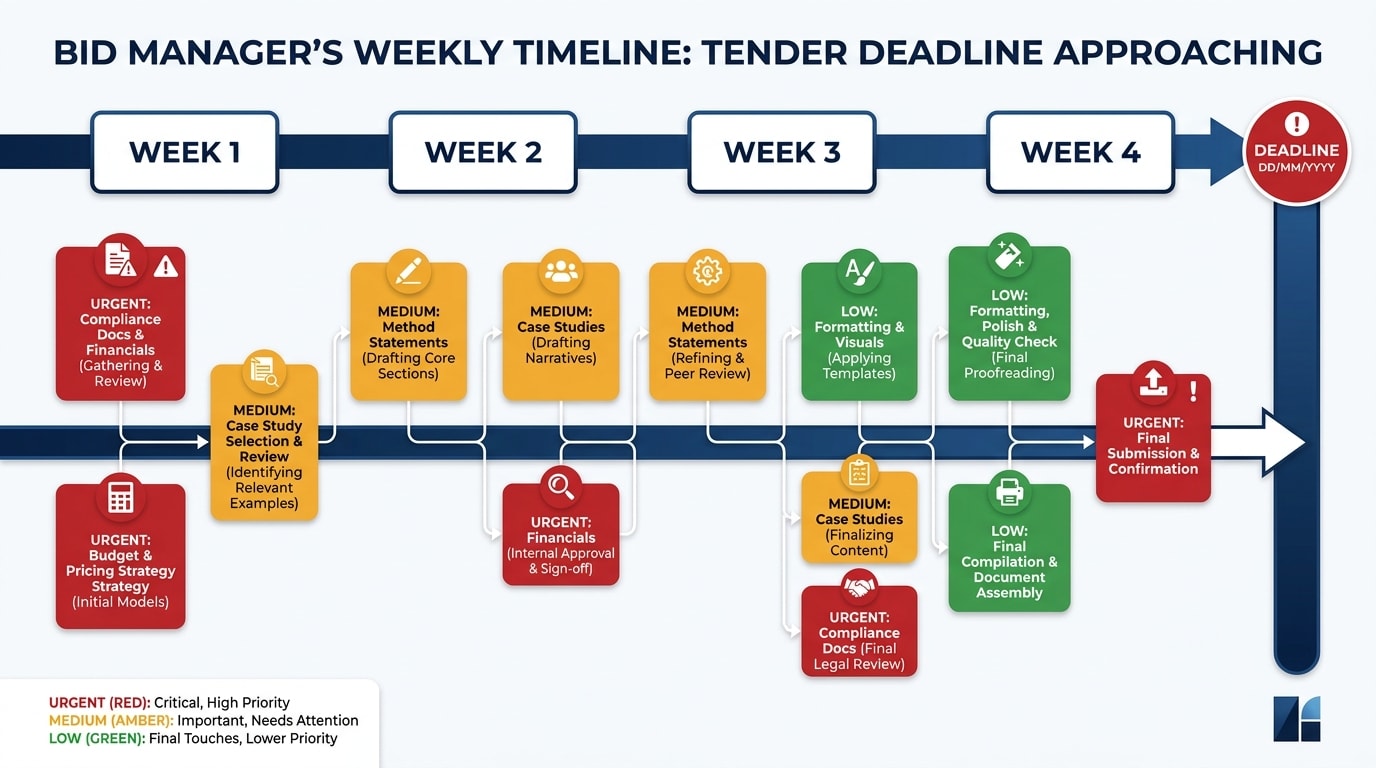
Weekly bid timeline showing colour-coded priorities approaching deadline
The Priority Matrix for Bid Writing
Once you have your weighted map, apply a simple two-axis framework.
Axis 1: Score impact. How much will getting this section right (or wrong) affect the final score? High-weighted sections with clear evaluator criteria have high score impact. Generic compliance declarations have low impact. Axis 2: Effort required. How much work does this actually take? Some high-impact sections are largely template-based if your library is good. Others need original thinking, technical input, and multiple review cycles.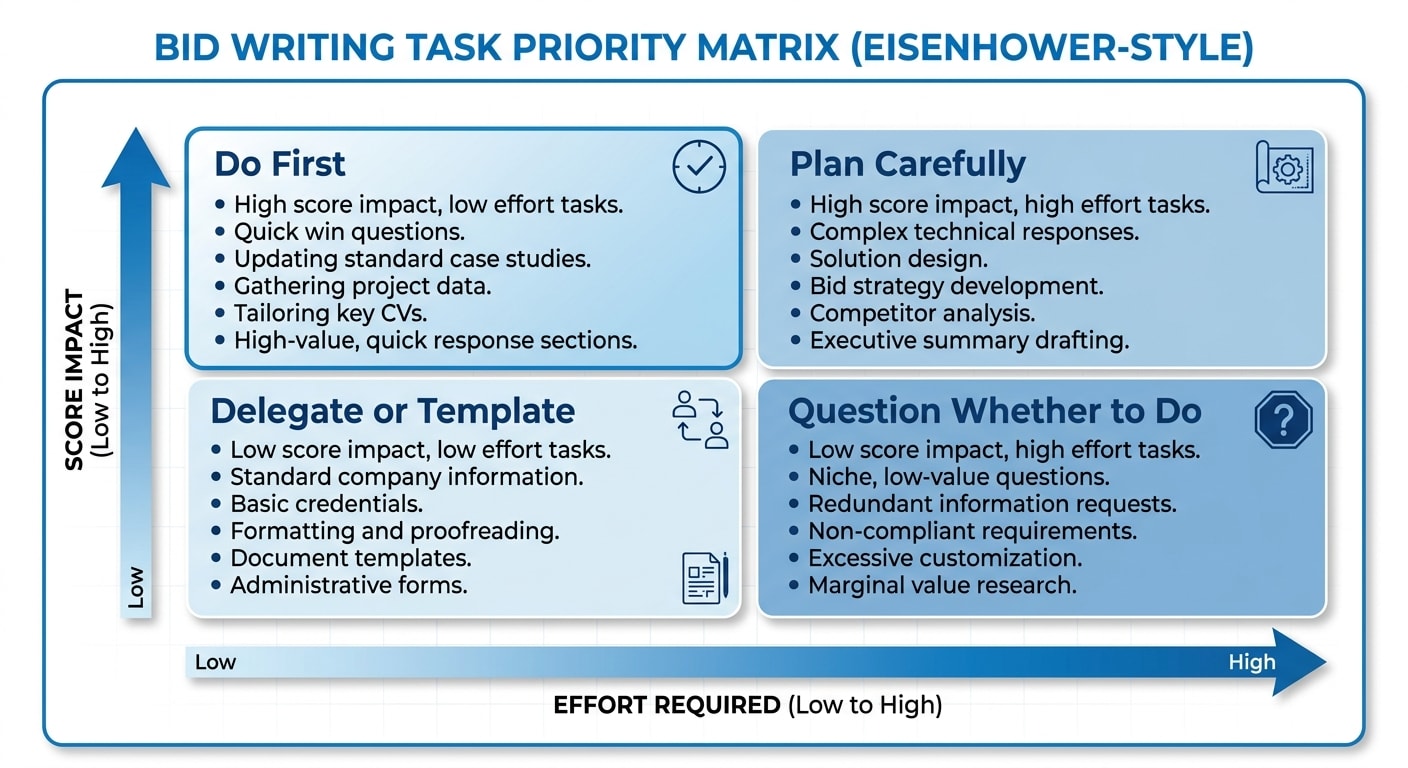
Priority matrix for bid writing tasks showing effort vs score impact
This gives you four categories:
Do first (high impact, lower effort). These are often your case studies, where you have strong evidence and the format is familiar. Or method statement sections where you've done similar work before and the template is 70% there. Get these done early and get them done well; they're your quick wins. Plan carefully (high impact, higher effort). These are the sections that will define your score. Social value commitments. Detailed method statements for complex services. Mobilisation plans. TUPE analysis. These need the most time, the right people, and structured reviews. Schedule them early in the bid cycle, not late. Delegate or template (lower impact, lower effort). Organisational information, company overview, standard policy statements. Your library should handle most of these. Assign them to a junior team member or use your template directly. Don't spend senior writing time here. Question whether to do at all (lower impact, higher effort). If a section is genuinely low-weighted and requires significant original work you don't have time for, that's worth a conversation. Can you use a strong template? Can you write a good-enough response in 30 minutes rather than a perfect one in three hours? Sometimes a solid B is the right call when it protects time for the section that needs an A.Where the Score Actually Lives
When you're under pressure, it helps to have a clear view of where most public sector tenders concentrate their marks.
In most contracts over £500k, the technical quality section carries between 40% and 60% of the available score. Pricing is typically 20 to 40%. Social value is now commonly 10 to 20%, sometimes higher in local authority contracts. Everything else (financial standing, accreditations, company information) is largely pass/fail.
That means your scoring battle is almost entirely in technical quality, with a secondary fight in social value. Price is important, but most buyers use a mechanism that narrows the price range across credible bidders; you don't win on price alone.
If time is genuinely short, this is your triage logic: protect the technical quality sections first, protect social value second, and use templates for everything else.
How to Handle Sections You Can't Complete Properly
Sometimes you genuinely cannot write every section to the standard you'd want. That's a real situation, and the answer isn't to panic; it's to make deliberate decisions.
Option 1: Use a strong template with light customisation. If your library has a case study or policy statement that's close to what's needed, using it with targeted edits is better than a rushed original. It won't be perfect, but it will be coherent and compliant. Option 2: Write the structure and fill in later. If you're waiting on input from a technical lead, create the section structure now: headings, paragraph prompts, word allocation. When the input arrives, you're inserting content rather than building from blank. This also makes it easier for the SME to contribute, because they're filling in a shape rather than writing freehand. Option 3: Be honest about what you can and can't do. If a section requires genuine expertise you don't have access to in the time available, a straightforward, clearly-written response that answers the question at face value beats a complex answer that's wrong or inconsistent. Evaluators can tell the difference between a gap in delivery capability and a gap in bid writing time. The former costs you the contract. The latter just costs you some marks.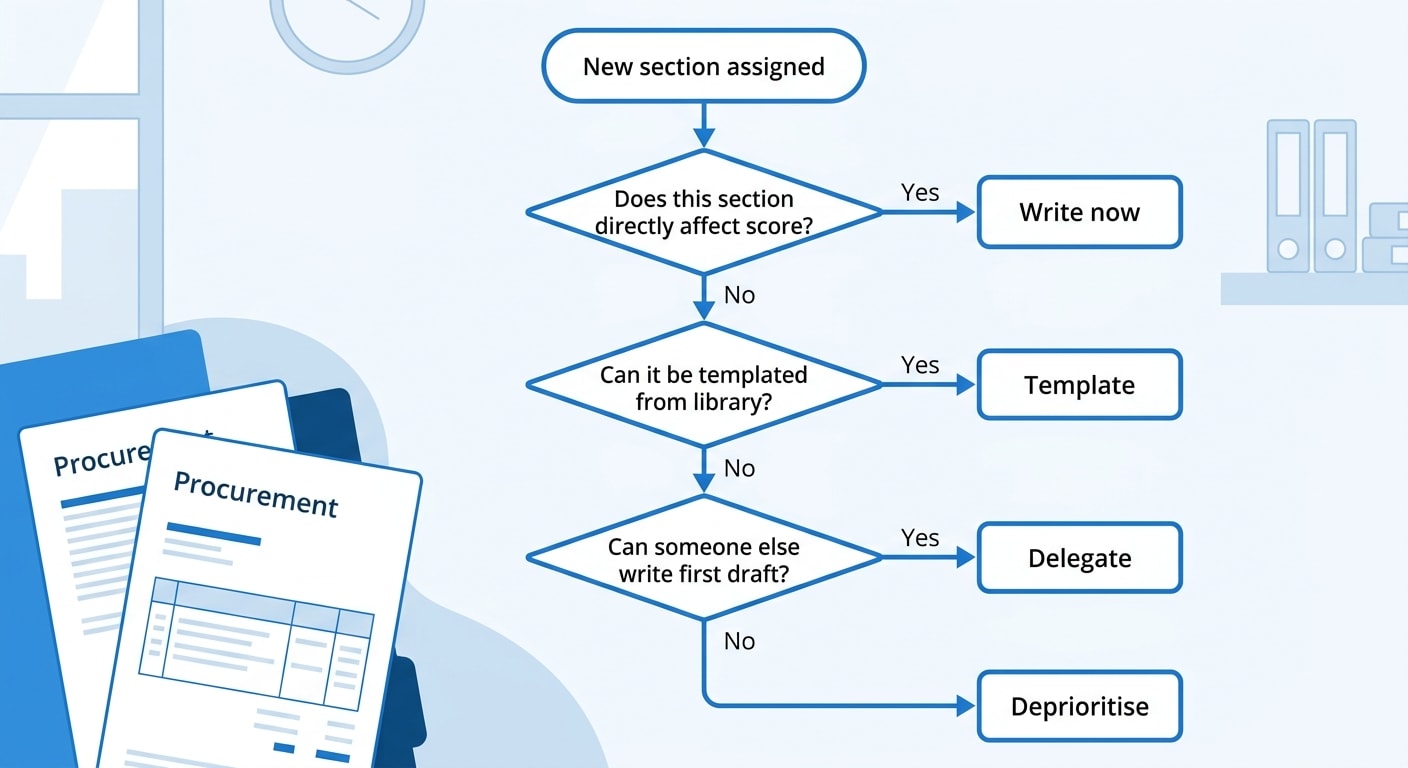
Flowchart for bid manager decision process under workload pressure
Managing Other People Under Deadline
One of the hardest parts of tender deadline management isn't managing your own workload; it's managing everyone else's.
Technical leads are busy. SMEs have day jobs. The person who holds the case studies you need hasn't replied in four days. Meanwhile, the deadline doesn't move.
A few things that work in practice:
Give people a specific, bounded task. "Can you review the method statement?" is too open. "Can you spend 30 minutes on pages 4 and 5 of the attached and tell me if the delivery process is accurate?" is actionable. The more specific the request, the faster the response and the more useful it is. Create escalation triggers early. Decide upfront: if you haven't had a first draft from the technical lead by day 8 of a 20-day bid cycle, you escalate to their manager. Don't wait until day 17 to have that conversation. Use a shared tracker everyone can see. A simple spreadsheet with section names, owners, status, and due date is enough. When it's visible to everyone, including senior stakeholders, the social pressure to update it tends to produce better response times than email alone. Accept partial input if that's what you're getting. If someone gives you half the information you need, write the section with what you have and flag the gaps clearly. Getting something in front of people tends to unlock further input better than waiting for the whole thing.The One Thing Not to Sacrifice
If you're cutting corners somewhere, don't cut them on compliance.
A technically brilliant response that misses a mandatory requirement is a disqualified submission. Word count over-runs, missing appendices, wrong file formats, late portal uploads: these kill bids entirely regardless of quality. Compliance checking needs to happen regardless of how tight the deadline is.
Build it in as a hard-scheduled task in the final 24 hours. One person, dedicated, checking every mandatory requirement against the final submission document. Not the bid manager (too close to the content), but someone who can read the instructions fresh and tick off each item.
What Good Prioritisation Actually Looks Like
The difference between bid teams that consistently submit strong work under pressure and those that don't usually comes down to one thing: they've been through this before and they've built a system.
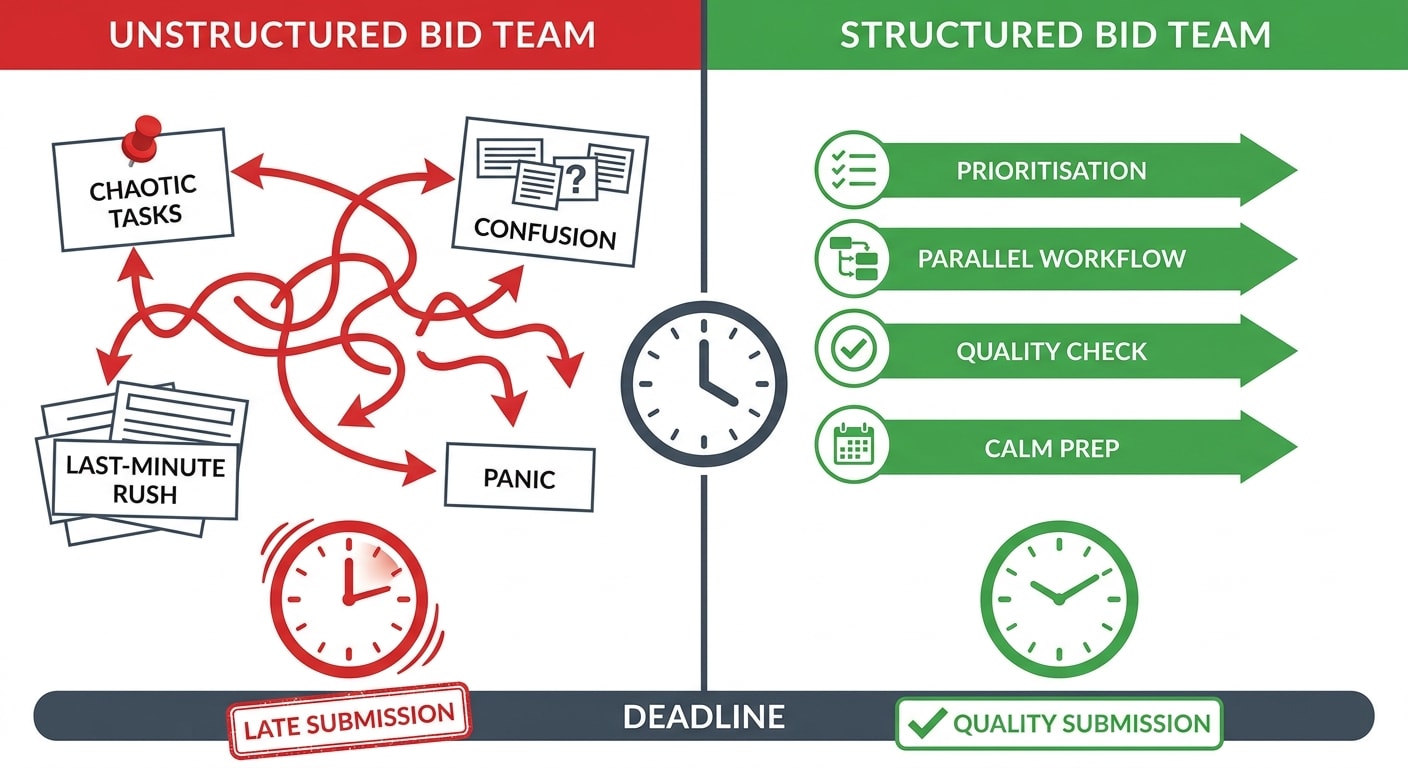
Comparison of structured versus unstructured bid teams under deadline pressure
Not a complex system. A simple one:
- A go/no-go framework so time isn't wasted on bids that shouldn't be run
- A weighted section map that gets built in the first 24 hours after the ITT drops
- Clear ownership assigned before writing starts
- A library of templates and case studies that means 40 to 60% of content is already 70% done
- A compliance checklist that runs in the final day regardless of everything else
If any of these don't exist in your current process, that's the gap. A single rushed submission where you feel the chaos is a signal. Two or three of them in a row means something structural needs to change.
Using AI to Protect Time for the Sections That Matter
One of the practical uses of AI in bid writing isn't generating answers to complex technical questions; it's handling the scaffolding work that eats time without adding score.
First drafts of lower-weighted sections. Reformatting responses to fit word limits. Summarising supplier policies into bid-ready paragraphs. Generating a structured outline for a method statement that an SME then fills in.
These are the tasks that consume hours in a crunch. Tools like mytender.io are built specifically for this: they hold your existing content in a structured library, help you retrieve relevant case studies and method statements quickly, and support first-draft generation on lower-priority sections so your writing time is concentrated where it changes the score.
The goal isn't to automate the bid. It's to automate the parts that don't need human judgement, so you have more of your capacity for the parts that do.
A Note on Bid Volume
This guide assumes you're managing a single tender under pressure. In practice, many bid teams are managing three or four simultaneously, each at different stages.
The same prioritisation logic applies at the portfolio level. Which submission is due first? Which has the highest contract value? Which do you have the strongest win probability on? These factors should determine where your senior writing capacity goes that week.
Running multiple bids in parallel without a portfolio-level view is how teams end up with four mediocre submissions instead of two strong ones. The bids you put your best effort into are the ones most likely to win. Spreading effort evenly is rarely the right call.
The Bottom Line
Tight tender deadlines aren't going away. The answer isn't to write faster or work longer. It's to be deliberate about where your time goes.
Map your workload against the scoring criteria. Identify the sections where quality directly affects your score. Protect those sections. Use templates and light-touch approaches for everything else. Keep compliance as a non-negotiable.
That's not a secret. But most bid teams, under pressure, revert to trying to do everything. The ones who hold the line on prioritisation are the ones who submit better work when it counts.
If you want to see live opportunities that match your sector and build the kind of bid library that makes deadline crunches less brutal, the Tender Finder is free to explore.
Tags
Ready to Transform Your Tender Writing?
See how MyTender's AI can help you write winning tenders in a fraction of the time.