
Supply Chain Resilience in Public Procurement: Complete Tender Writing Guide 2026
Master supply chain resilience requirements in UK public sector tenders. Evidence sovereign capability, regional networks, risk mitigation, and business continuity planning to win more contracts in 2026.
Evie
Procurement Specialist
Public sector procurement in 2026 has shifted dramatically. Supply chain resilience—once a technical footnote in tender submissions—is now a strategic priority for awarding authorities. Geopolitical instability, energy volatility, and lessons from recent supply shocks have fundamentally changed what buyers expect.
If your tender responses still treat supply chain management as a compliance box-tick, you're leaving points on the table. Modern procurement teams demand evidence of sovereign capability, regional diversification, crisis resilience, and long-term operational security. This guide shows you exactly how to address these requirements and position your organisation as a low-risk, high-capability partner.
Why Supply Chain Resilience Matters in 2026 Procurement
The National Procurement Policy Statement (NPPS), effective February 2025, and the full implementation of the Procurement Act 2023 have embedded supply chain resilience as a core evaluation criterion. Buyers aren't just asking "can you deliver?"—they're asking "can you deliver when everything goes wrong?"
Three factors are driving this shift:
Geopolitical fragility. Energy supply disruptions, trade restrictions, and regional conflicts have exposed vulnerabilities in global supply chains. Public sector bodies can no longer afford single-source dependencies on unstable regions. Regulatory pressure. The Procurement Act 2023 mandates consideration of economic security and national resilience. Tenders increasingly require evidence of UK-based or regionally diversified supply networks. Operational continuity. Recent supply chain failures—semiconductor shortages, PPE crises, construction material delays—have cost public bodies millions in project overruns. Buyers now demand quantifiable resilience strategies.According to a 2026 Cabinet Office report, 73% of public sector procurement teams now weight supply chain resilience at 15-25% of total tender scores. If you're not addressing this directly and comprehensively, you're conceding a quarter of available points before evaluation even begins.
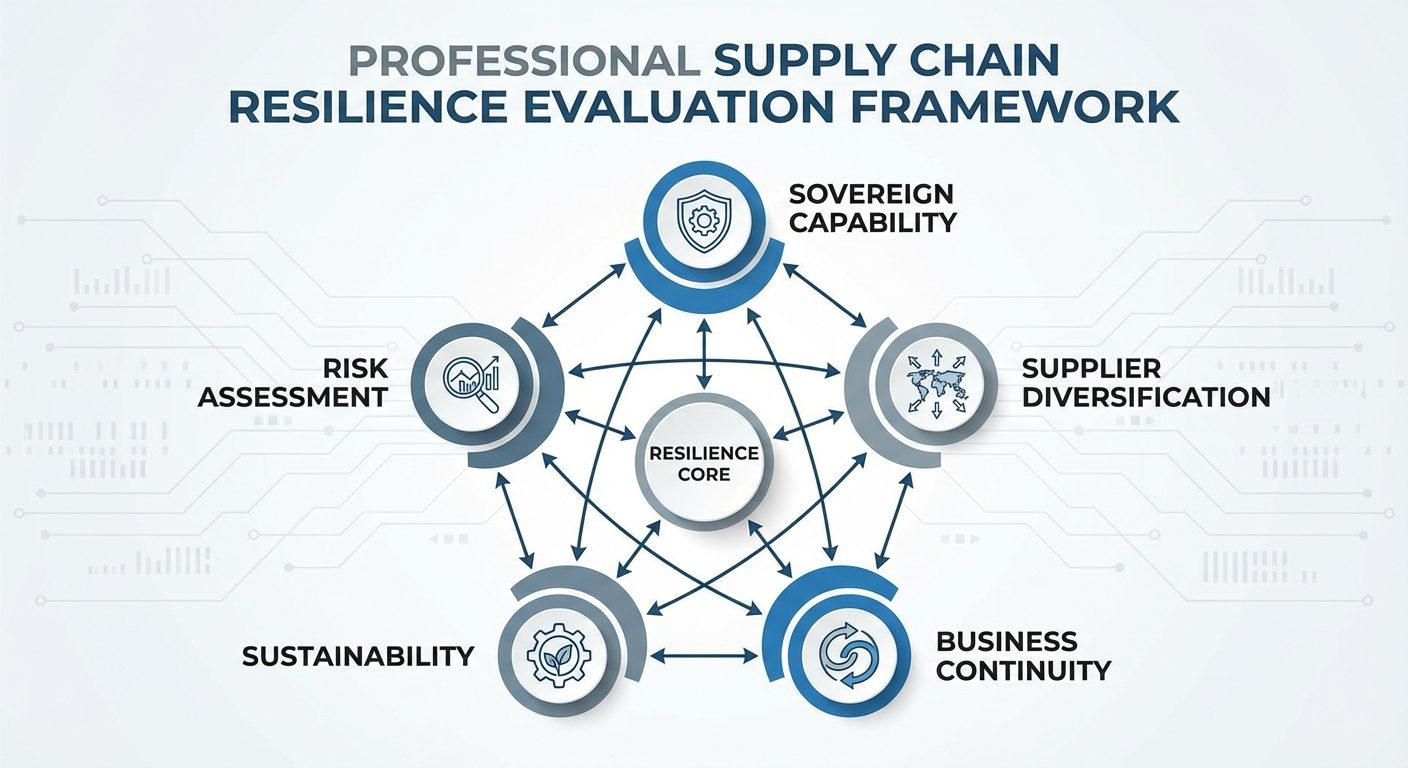
Supply chain resilience evaluation framework showing risk assessment and mitigation strategies
The Five Pillars of Supply Chain Resilience in Public Tenders
Awarding authorities evaluate supply chain resilience across five interconnected pillars. Your tender response must address all five with specific, measurable evidence.
1. Sovereign Capability and Local Supply Networks
Buyers want to see how much of your supply chain operates within UK borders or allied regions. This isn't about protectionism—it's about reducing exposure to geopolitical risk and supporting local economic growth.
What buyers look for:- Percentage of critical components sourced domestically
- Geographic distribution of tier-1 and tier-2 suppliers
- Evidence of regional manufacturing or assembly capacity
- Commitments to UK-based workforce development
Map your supply chain geographically and calculate the percentage of value delivered by UK-based suppliers. Be specific: "68% of our core materials are sourced from UK manufacturers within a 150-mile radius of our primary facility."
If you rely on international suppliers, demonstrate mitigation strategies. Example: "For semiconductor components sourced from Taiwan, we maintain 90-day buffer stock and have established secondary sourcing agreements with EU manufacturers."
Highlight any investments in domestic capability. If you've recently onshored production, expanded UK facilities, or partnered with British suppliers, quantify the investment and timeline. Buyers reward forward-looking commitment to sovereign capability.
2. Supplier Diversification and Multi-Sourcing Strategy
Single points of failure kill tender submissions. Awarding authorities want evidence that you can maintain delivery even if a key supplier fails, faces sanctions, or experiences disruption.
What buyers look for:- Number of alternative suppliers for critical inputs
- Geographic and ownership diversification of supply base
- Evidence of tested contingency sourcing
- Speed of supplier substitution in crisis scenarios
For every critical component or service in your delivery model, identify at least two qualified alternative suppliers. Don't just list names—demonstrate you've pre-qualified them and can activate them within defined timeframes.
Example: "Our primary steel supplier (UK-based) is complemented by two pre-qualified alternatives: one in Germany (rail-certified) and one in Poland (framework-approved). We conduct quarterly capacity audits and maintain standing purchase agreements enabling 72-hour activation."
Include evidence of past supplier transitions. If you've successfully substituted suppliers during previous disruptions, describe the scenario, response time, and outcome. Buyers value proven track records over theoretical plans.
3. Risk Assessment and Monitoring Systems
Modern procurement teams expect real-time visibility into supply chain health. Generic risk registers won't cut it—you need to demonstrate active monitoring, early warning systems, and proactive intervention.
What buyers look for:- Formal supply chain risk assessment methodology
- Frequency and scope of supplier health monitoring
- Early warning indicators and escalation protocols
- Evidence of risk-driven decision-making
Describe your risk assessment framework in concrete terms. Example: "We conduct monthly financial health checks on all tier-1 suppliers using Dun & Bradstreet credit ratings, quarterly operational audits, and weekly delivery performance tracking via our ERP system."
Demonstrate predictive capability, not just reactive response. If you monitor geopolitical risk indices, commodity price volatility, or supplier capacity utilisation, explain how these inputs inform procurement decisions.
Show how risk data drives action. Example: "In Q3 2025, our monitoring system flagged increasing lead times from a key logistics provider. We activated our secondary logistics partner two weeks before the primary provider entered administration, avoiding any delivery delays."
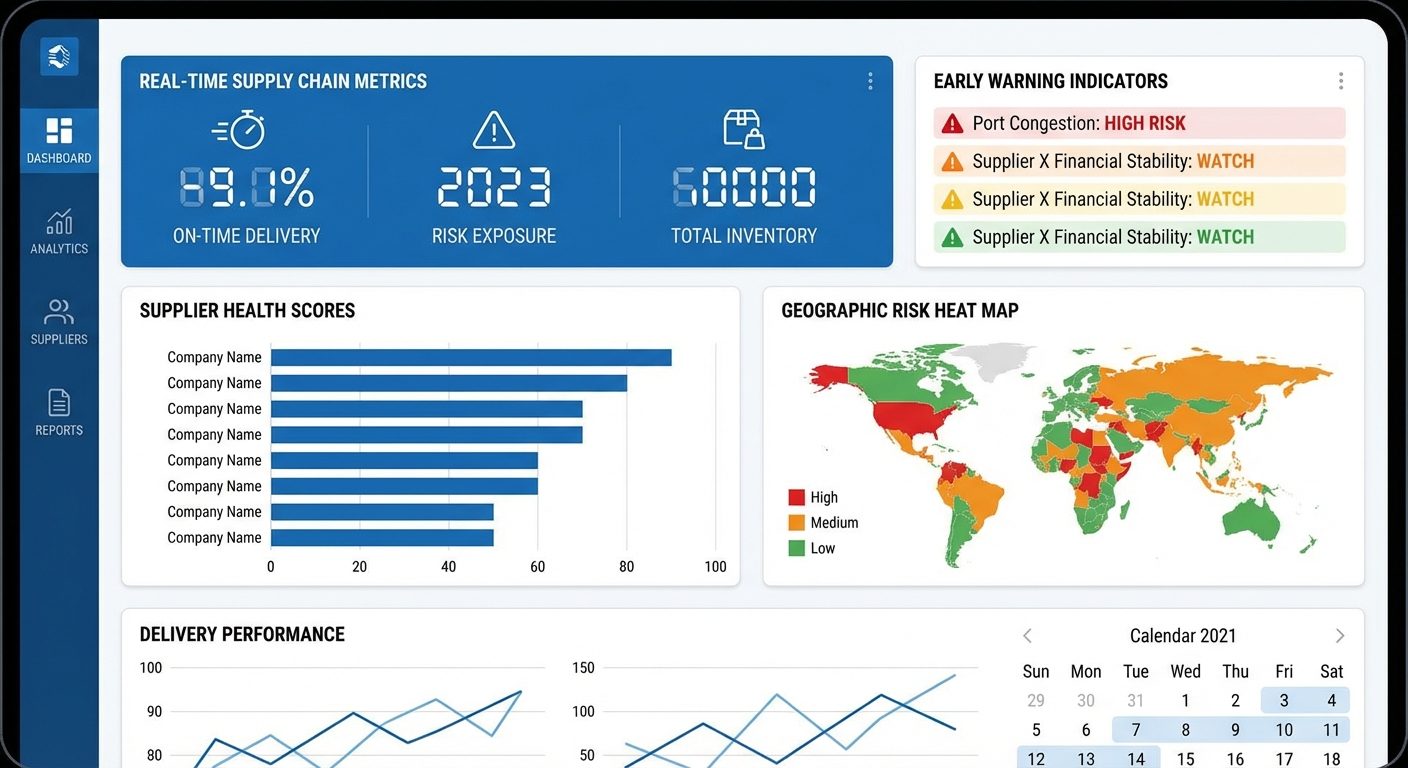
Supply chain risk monitoring dashboard showing real-time tracking and early warning indicators
4. Business Continuity and Crisis Response Planning
Buyers need confidence that your operation can withstand shocks without compromising public service delivery. This means demonstrating plans, not just processes.
What buyers look for:- Documented business continuity plans specific to supply chain disruption
- Evidence of crisis simulation exercises
- Recovery time objectives (RTO) for critical supply chain components
- Redundancy in logistics, warehousing, and distribution
Provide specific recovery time objectives for key scenarios. Example: "In the event of primary warehouse disruption, our secondary facility can assume 100% operational capacity within 48 hours. For critical medical supplies, we maintain geographically distributed stock enabling same-day redirection."
Describe recent crisis simulations. If you've conducted supply chain disruption exercises—testing communication protocols, alternative routing, or emergency supplier activation—detail the scenario, participants, findings, and improvements implemented.
Address logistics resilience explicitly. Multiple warehouses, alternative transport modes, and backup delivery partners demonstrate operational redundancy. Quantify your buffer capacity: "We maintain inventory coverage equivalent to 45 days of peak demand across three geographically distributed facilities."
5. Sustainability and Circular Economy Integration
Resilience and sustainability are increasingly intertwined. Buyers recognize that over-reliance on virgin materials, long-haul logistics, and linear supply chains creates both environmental and operational risk.
What buyers look for:- Evidence of circular economy principles in supply chain design
- Strategies to reduce Scope 3 emissions (supply chain emissions)
- Local sourcing to minimize transport vulnerability
- Supplier engagement on sustainability performance
Demonstrate how sustainability enhances resilience. Example: "Our shift to UK-sourced recycled steel reduced carbon emissions by 34% while simultaneously reducing supply chain exposure to international shipping disruptions and price volatility."
Quantify circular economy initiatives. If you remanufacture, refurbish, or source recycled materials, provide specific metrics: "42% of our IT equipment is remanufactured, reducing both embodied carbon and dependency on new component supply chains."
Show supplier collaboration on sustainability. If you conduct supplier sustainability audits, set emissions reduction targets, or incentivize local sourcing, describe the framework and results. Buyers value leadership that cascades resilience requirements through the supply chain.
How to Structure Supply Chain Resilience Responses in Tender Submissions
Generic supply chain descriptions lose points. Buyers reward structured, evidence-based responses that address their specific concerns.
Use the STAR Framework (Situation, Task, Action, Result)
For each resilience pillar, structure your response as a mini case study:
Situation: Describe a real or plausible supply chain risk scenario. Task: Explain what needed to be achieved to maintain delivery. Action: Detail the specific measures you took or have in place. Result: Quantify the outcome—time saved, disruption avoided, cost mitigated.Example: "In 2024, our primary IT hardware supplier faced a 6-week production shutdown due to factory fire (Situation). We needed to maintain scheduled deployments for three NHS trusts (Task). We activated our pre-qualified European alternative supplier and redistributed stock from our Amsterdam warehouse (Action). All deployments completed on schedule with zero delays and £47,000 in avoided liquidated damages (Result)."
Provide Quantified Evidence
Every claim should be supported by data:
- "We maintain relationships with 12 alternative suppliers" beats "We have diverse suppliers"
- "Average supplier activation time: 36 hours" beats "We can quickly switch suppliers"
- "98.7% on-time delivery over 24 months" beats "We have strong delivery performance"
Include Visual Supply Chain Maps
If the tender allows appendices, include a visual map showing:
- Geographic distribution of key suppliers
- Alternative sourcing routes for critical components
- Regional capacity vs. demand allocation
- Transport and logistics redundancy
Visual evidence signals sophistication and transparency—both highly valued in public procurement.
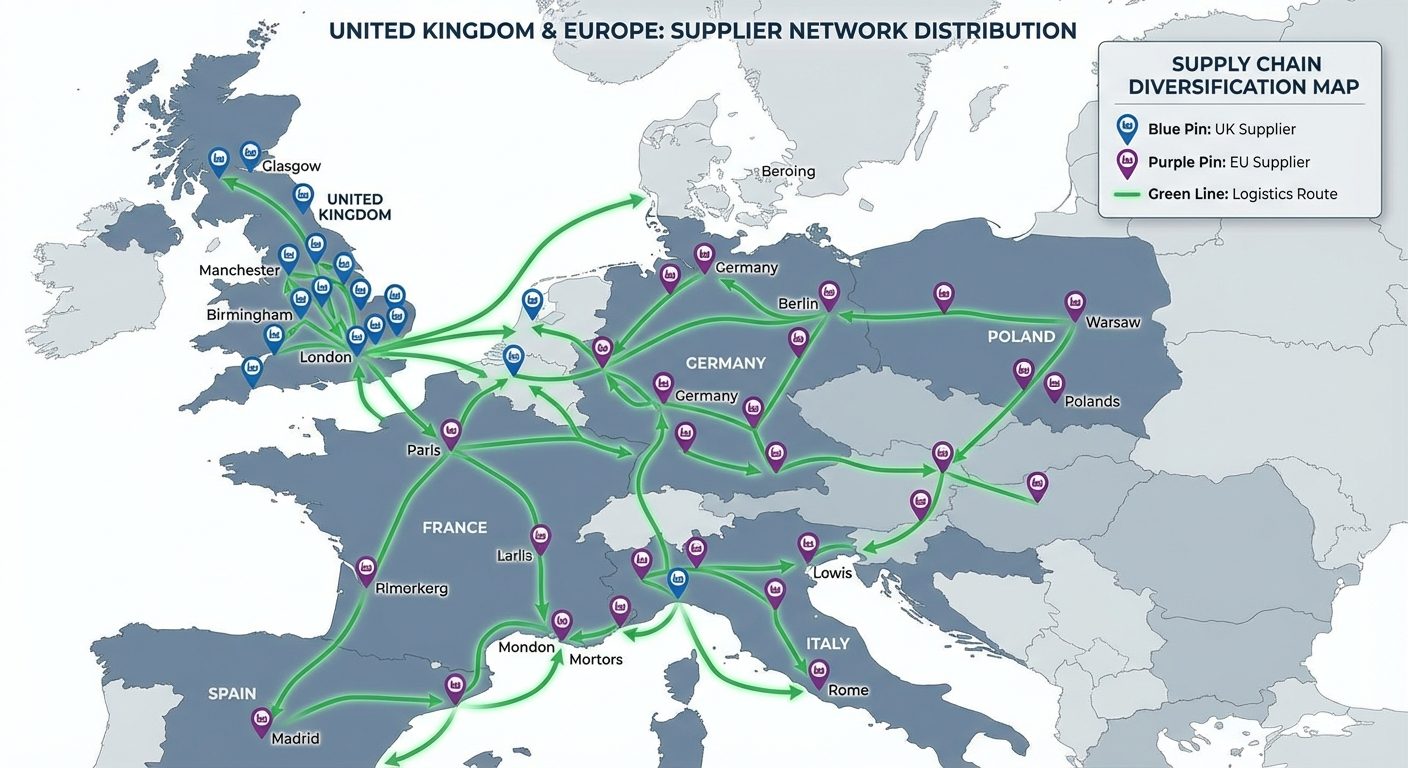
Supply chain geographic diversification map showing UK and regional supplier networks
Common Supply Chain Resilience Mistakes to Avoid
Even experienced bid teams make these errors:
Confusing compliance with resilience. Describing your ISO 28000 certification or supply chain policies is not the same as demonstrating active resilience. Buyers want evidence of capability and action, not process documents. Over-relying on Tier-1 supplier commitments. Stating "our suppliers have robust continuity plans" outsources risk without demonstrating control. Show how you monitor, audit, and verify supplier resilience—don't assume it. Ignoring Tier-2 and Tier-3 visibility. Supply chain disruptions often originate deep in the supply network. Buyers increasingly expect visibility beyond direct suppliers. If a critical component depends on a single raw material source three tiers down, that's a risk you need to address. Generic risk registers. Listing "geopolitical instability" or "supplier failure" as risks without specific mitigation measures wastes space. Every risk should have a quantified probability, impact assessment, and detailed mitigation plan. Underestimating regional sourcing expectations. In 2026, local economic benefit isn't just social value—it's resilience strategy. If you can't demonstrate significant UK or regional sourcing, explain why and show how you're increasing it over time.Sector-Specific Supply Chain Resilience Requirements
Different sectors prioritize different resilience dimensions. Tailor your response accordingly:
Construction and Infrastructure
Buyers prioritize:
- UK-based materials sourcing (especially critical materials like steel, concrete, timber)
- Regional subcontractor networks to reduce transport dependencies
- Alternative logistics for heavy materials (road, rail, water)
- Contingency plans for skilled labour shortages
Healthcare and Medical Supplies
Buyers prioritize:
- Pharmaceutical and PPE supply chain visibility
- Multi-country sourcing to reduce single-region dependency
- Cold chain and controlled environment resilience
- Emergency stock buffers for critical items
IT and Digital Services
Buyers prioritize:
- Sovereign capability in data hosting and security infrastructure
- Hardware supply chain diversification (especially semiconductors)
- Software licensing continuity and escrow arrangements
- Cybersecurity supply chain risk management
Facilities Management and Environmental Services
Buyers prioritize:
- Local service delivery capacity (regional depots, locally employed staff)
- Equipment maintenance and parts availability
- Fuel and energy supply contingencies
- Seasonal demand surge capacity
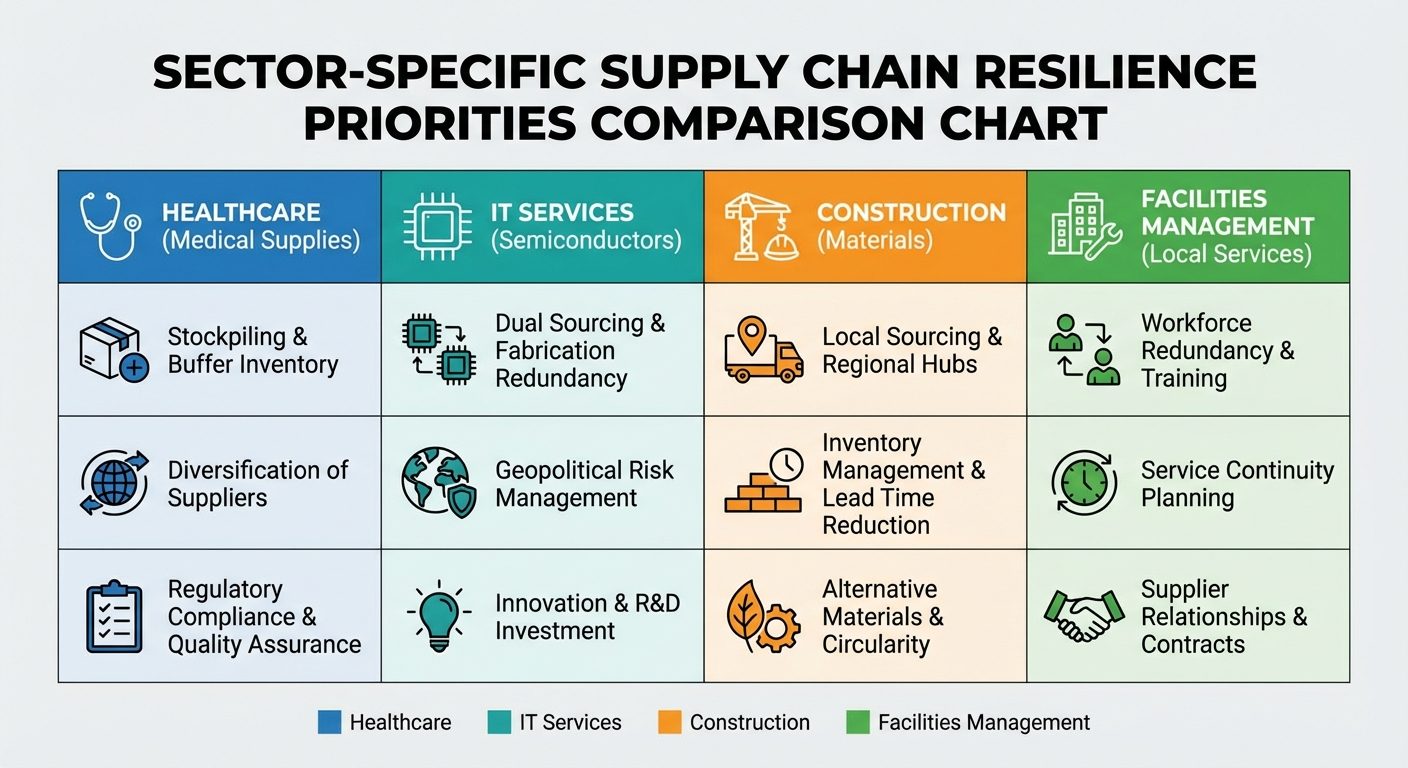
Sector-specific supply chain resilience priorities showing healthcare, IT, construction, and FM requirements
How MyTender Helps You Demonstrate Supply Chain Resilience
Writing comprehensive supply chain resilience responses is time-intensive. You need to gather supplier data, map geographic dependencies, quantify risks, and structure evidence—all while maintaining narrative coherence and responding to other tender sections.
MyTender's AI-powered platform streamlines this process:
Automated supply chain analysis. Upload your supplier database and MyTender maps geographic dependencies, identifies single points of failure, and highlights diversification gaps—giving you instant visibility into resilience weaknesses. Evidence structuring. MyTender converts raw supply chain data into structured tender responses using the STAR framework, ensuring every claim is backed by quantified evidence and aligned with evaluation criteria. Risk scenario generation. The platform suggests plausible supply chain disruption scenarios relevant to your sector and helps you craft evidence-based mitigation responses that demonstrate preparedness. Supplier diversification recommendations. Based on your supply chain structure and the tender's geographic requirements, MyTender identifies potential alternative suppliers and suggests pre-qualification strategies. Compliance checking. MyTender cross-references your supply chain response against Procurement Act 2023 requirements, NPPS guidelines, and sector-specific resilience frameworks—flagging gaps before submission.The Competitive Advantage of Supply Chain Excellence
As public sector procurement teams become more sophisticated in evaluating supply chain resilience, the performance gap between well-prepared and generic responses widens. Organizations that invest in supply chain visibility, diversification, and evidence-based demonstration win more tenders and command higher evaluation scores.
This isn't about inventing resilience for tender purposes. It's about systematically building a genuinely resilient supply chain and then communicating that capability effectively to procurement decision-makers. The organizations winning in 2026 are those that recognize supply chain resilience as both operational imperative and competitive differentiator.
Next Steps: Strengthening Your Supply Chain Resilience Posture
If your organization hasn't yet prioritized supply chain resilience, start with these actions:
Conduct a supply chain mapping exercise. Identify all tier-1 suppliers, their geographic locations, and your dependency level on each. Extend mapping to tier-2 for critical components. Quantify single points of failure. For every critical input, determine whether you have a qualified alternative source and how quickly you could activate it. Establish supplier health monitoring. Implement monthly financial health checks and quarterly operational audits for key suppliers. Use credit monitoring services and industry intelligence platforms. Document crisis scenarios and responses. Create specific business continuity plans for likely disruption scenarios (supplier failure, logistics disruption, geopolitical shock). Test these plans annually. Build your evidence library. Maintain a repository of resilience evidence: supplier diversity data, geographic maps, risk assessments, crisis response case studies, monitoring reports. This becomes your tender response foundation.Public sector buyers in 2026 demand supply chain resilience as a baseline capability, not a value-add. Organizations that can demonstrate genuine, evidence-based resilience will win more contracts, achieve higher evaluation scores, and build lasting competitive advantage in an increasingly risk-conscious procurement landscape.
Ready to strengthen your supply chain resilience posture and win more public sector contracts? Discover how MyTender's AI-powered platform helps you map dependencies, quantify risks, and generate evidence-based tender responses that meet 2026 resilience requirements. Start your free trial today.Tags
Ready to Transform Your Tender Writing?
See how MyTender's AI can help you write winning tenders in a fraction of the time.