

Supplier Performance KPIs: How to Turn Contract Data Into Tender Evidence That Wins Marks
Public sector buyers are asking harder questions about performance, KPIs and delivery risk. Here is how to turn contract data into tender evidence evaluators actually trust.
mytender.io Research Team
Tender Writing & Bid Management Specialists

Bid team reviewing supplier performance KPI evidence for a public sector tender
A weak tender says: we deliver excellent service.
A strong tender says: here is the last contract where we hit 98.6% of planned visits, closed 94% of issues inside SLA, reduced complaints by 31%, and used the learning to change our mobilisation checklist.
That difference matters more in 2026 than it did a few years ago. Public sector buyers are under more pressure to prove contracts are performing. The Procurement Act 2023 has pushed transparency, contract management and supplier performance further into the open. Evaluators are reading bids with one eye on award and the other on what happens after go-live.
So your evidence cannot be decorative. It has to reduce perceived risk.
This guide shows how to turn supplier performance KPIs into tender evidence that wins marks, without drowning the evaluator in charts.
Why supplier performance evidence is becoming a bid issue
For years, bid teams treated KPIs as an operational appendix. Useful after contract award, but not central to winning the work.
That is changing.
Buyers now have stronger reasons to ask whether your claims are backed by performance data. Above-threshold public contracts are more exposed to transparency notices, KPI reporting and post-award scrutiny. Even when a specific tender does not ask for formal KPI history, evaluators still want confidence that you can manage the contract you are promising to deliver.
That confidence comes from proof.
Not generic proof. Not a paragraph saying you have a quality management system. Real performance evidence from similar contracts.
In practical terms, supplier performance evidence helps evaluators answer five questions:
- Have you delivered this service before?
- Did you measure performance properly?
- Did you hit the standards you promised?
- What happened when you missed them?
- Can we trust your mobilisation, staffing and improvement claims?
The fifth question is the big one. Tender evaluation is not just about awarding the best-written answer. It is about choosing the supplier least likely to embarrass the buyer once the contract is live.
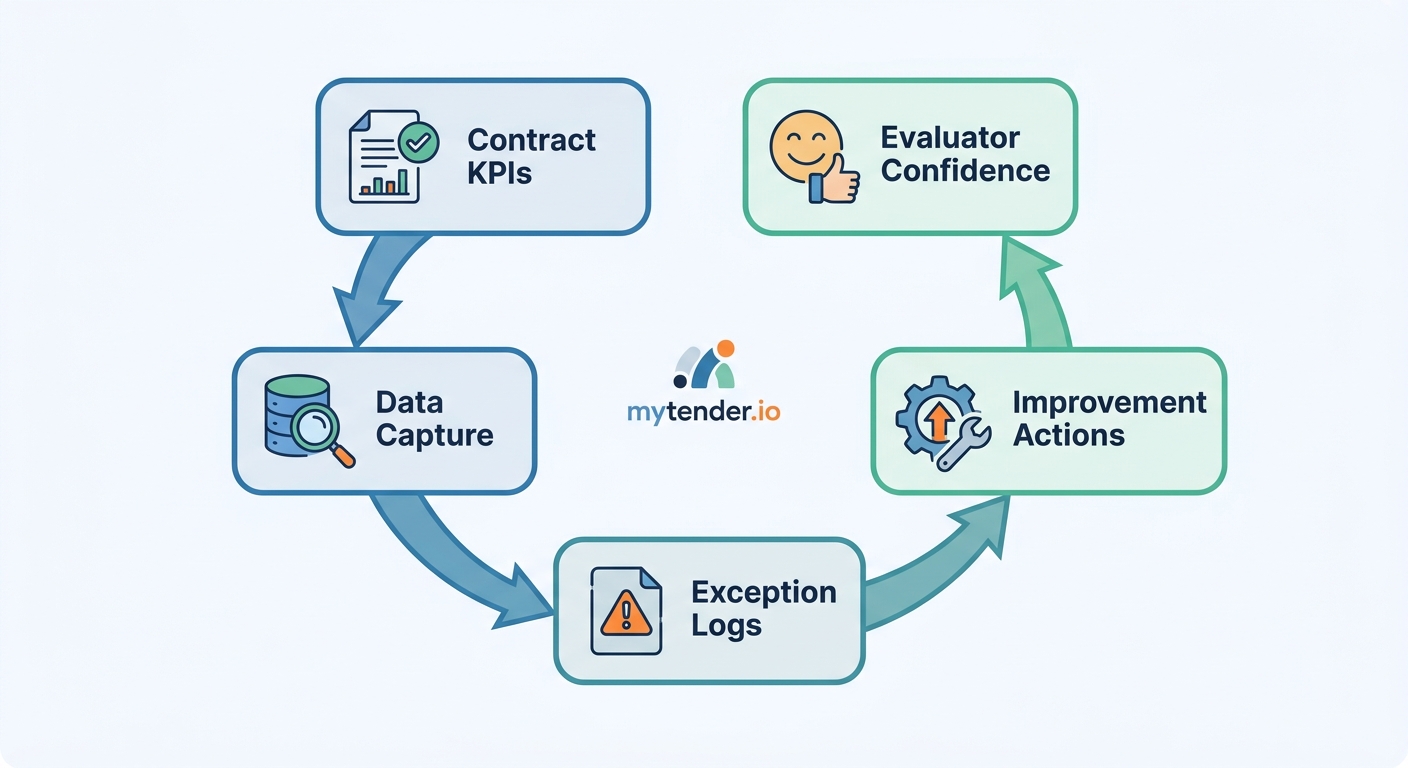
Tender KPI evidence loop showing how operational data becomes evaluator confidence
The mistake most bidders make with KPIs
Most bidders include KPIs too late.
They write the answer first, then sprinkle a few numbers into the final draft because the scoring guidance asks for evidence. That produces the sort of bid evaluators forget within minutes.
The better approach is the opposite. Start with the performance evidence, then build the answer around it.
For example, do not write a mobilisation answer and then add a line saying your last mobilisation was successful. Start by asking:
- Which similar contract did we mobilise?
- What was the mobilisation window?
- How many sites, staff, routes, users or assets were involved?
- What were the go-live KPIs?
- What issues came up in the first 30 days?
- What did we change as a result?
Now you have the spine of the answer.
The same applies to social value, service delivery, risk management, innovation, account management, complaints, quality assurance and supply-chain control. If the question is about delivery, the answer should be anchored in delivery data.
What counts as good tender evidence?
Good evidence is specific, relevant and easy to verify.
A useful rule: if the evaluator could swap your company name for a competitor's and the sentence still works, it is not strong evidence.
Weak evidence sounds like this:
> We have extensive experience delivering high-quality services for public sector clients.
Better evidence sounds like this:
> On a three-year borough-wide cleaning contract covering 42 public buildings, we achieved an average monthly audit score of 96.8% across the first 12 months, with all critical failures closed within 24 hours.
The second version gives the evaluator something to trust. It shows scale, relevance, timeframe, metric and outcome.
Strong tender evidence usually contains six parts:
- Context: the contract, sector, scale and similarity to the tender.
- Metric: the KPI or measure used.
- Baseline: where performance started, if relevant.
- Result: what happened, with a number.
- Action: what your team did to cause or improve the result.
- Learning: how that performance informs this bid.
Leave out the learning and the evidence feels backward-looking. Add the learning and it becomes a reason to award you the contract.
The KPI framework bid teams should use
Not every KPI belongs in every tender answer. The trick is to choose the few that match the evaluator's concern.
A construction buyer does not need the same evidence as a waste services buyer. An NHS trust evaluating patient transport has different risk triggers from a council evaluating grounds maintenance. Still, most public sector tenders fall into a useful performance evidence framework.
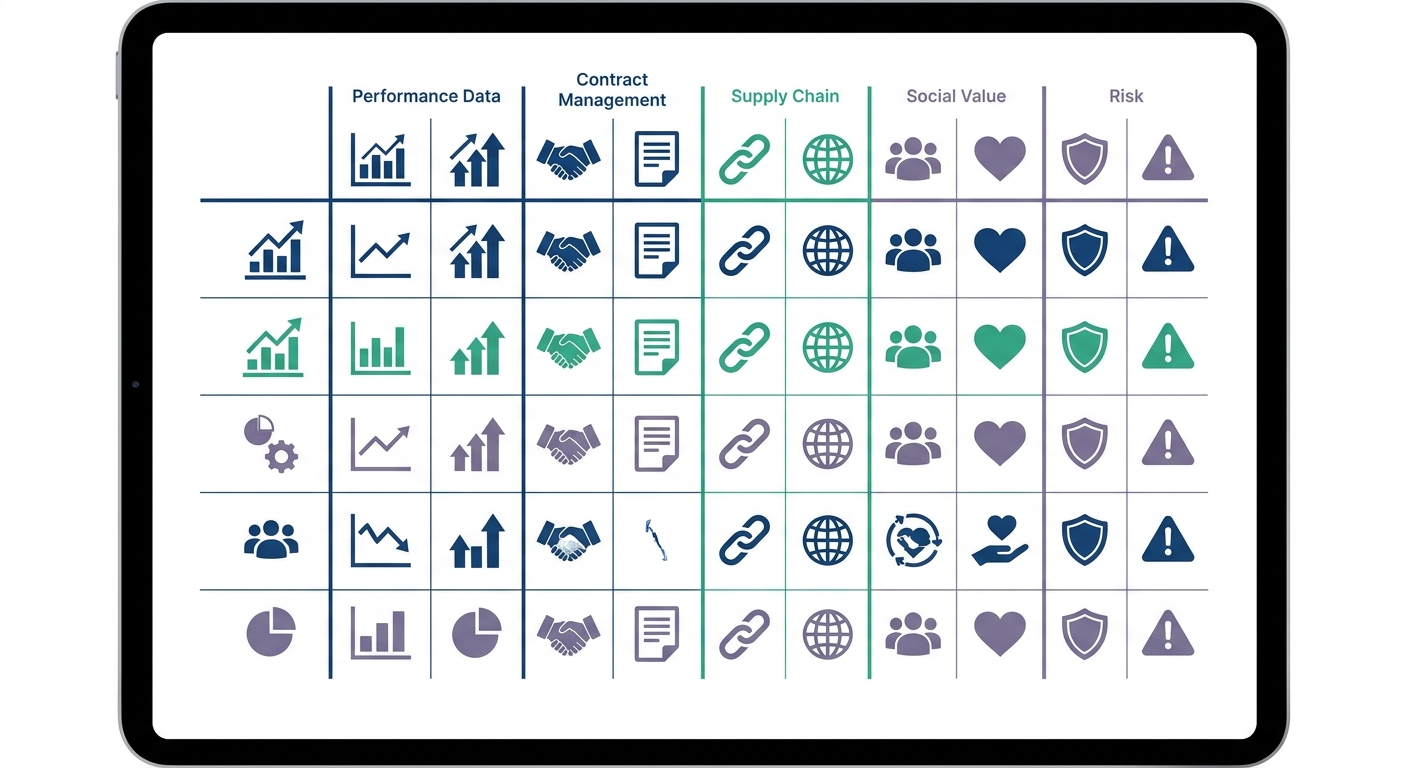
Framework matrix for supplier performance evidence in public sector tenders
1. Delivery KPIs
These show whether you did the core job.
Examples include:
- planned works completed on time
- service visits completed first time
- missed collections or missed appointments
- response and resolution times
- defect closure rates
- audit pass rates
- availability, uptime or service continuity
Use delivery KPIs when the tender question is really asking: can you run the service without creating problems for us?
For FM, that might mean PPM completion, reactive response times and audit scores. For waste, missed bins, route completion and contamination reduction. For construction, programme adherence, defect rates and health and safety performance.
2. Quality KPIs
These show whether delivery was good, not just completed.
Examples include:
- quality audit scores
- right-first-time measures
- customer satisfaction
- complaint volumes and resolution times
- rework rates
- inspection outcomes
- independent accreditations or audit findings
Quality KPIs are especially useful when the tender includes method statements, continuous improvement, resident experience, stakeholder management or contract governance.
Be careful with satisfaction scores. They can be powerful, but only if you explain who was surveyed, how often, and what changed because of the feedback.
3. Commercial and compliance KPIs
These show whether the contract was controlled.
Examples include:
- invoice accuracy
- payment performance
- change-control cycle time
- savings delivered against baseline
- budget variance
- reporting timeliness
- audit closure
- statutory compliance completion
These KPIs matter when buyers are worried about governance. Under the current procurement regime, that is a lot of buyers.
A bidder that can show clean reporting, fast issue closure and disciplined change control feels safer than one that only talks about account management meetings.
4. Risk and resilience KPIs
These show whether you can recover when things go wrong.
Examples include:
- business continuity test results
- incident response times
- near-miss reporting and closure
- supply-chain substitution time
- staff absence cover rates
- escalation closure
- lessons-learned completion
Risk evidence is underused in bids. That is a gift if you can use it well.
Most bidders write risk answers as a list of possible problems and mitigations. Strong bidders show where those mitigations have already worked.
5. Social value and sustainability KPIs
These show whether promises became outcomes.
Examples include:
- apprenticeships started and completed
- local employment outcomes
- SME or VCSE spend
- volunteer hours delivered
- carbon reduction against baseline
- waste diverted from landfill
- training hours delivered
- community investment outcomes
Social value evidence has to be local and measurable. A vague statement about supporting communities will not carry much weight. A contract-specific outcome, with dates and verification, will.
The most credible social value evidence also explains the delivery mechanism. Evaluators want to know how you made the outcome happen, not just that the number appeared in a report.
How to write KPI evidence into an answer
A KPI by itself is not an answer. It is a fact.
Your job is to turn that fact into a story the evaluator can score.
Use this structure:
- Claim: what you will do on this contract.
- Evidence: where you have done it before.
- Mechanism: how your process produced the result.
- Application: how that learning applies to the buyer's contract.
Here is a simple example.
Weak version:
> We operate a robust complaints process and resolve issues quickly.
Better version:
> We will operate a 24-hour complaint triage process, with daily review during mobilisation and weekly trend analysis once the service is stable. On our current city-centre FM contract, this approach reduced repeat complaints by 38% in six months. The key change was categorising complaints by root cause, not just by location, which allowed us to change supervisor checks rather than repeatedly fixing the same symptoms. We will apply the same root-cause model here, with complaint themes reviewed at each monthly contract meeting.
That paragraph does more work. It gives the promise, the proof, the method and the relevance.
It also sounds like it was written by someone who has actually delivered a contract.
Build a bid evidence library before the deadline
If you wait until the tender lands, you are too late.
Good KPI evidence is scattered across contract review packs, monthly reports, dashboards, CRM notes, QHSE systems, finance records and account managers' heads. During a live bid, nobody has time to hunt properly. That is why so many answers default to vague claims.
A bid evidence library fixes this.
At minimum, create evidence cards for your best contracts. Each card should capture:
- contract name and sector
- buyer type and contract value band
- service scope and scale
- mobilisation timeline
- three to five headline KPIs
- before-and-after improvements
- named challenges and how they were solved
- client testimonial or reference status
- documents that verify the claim
- approved wording for tender use
The approved wording matters. It stops every bid writer reinventing the same case study under deadline pressure.
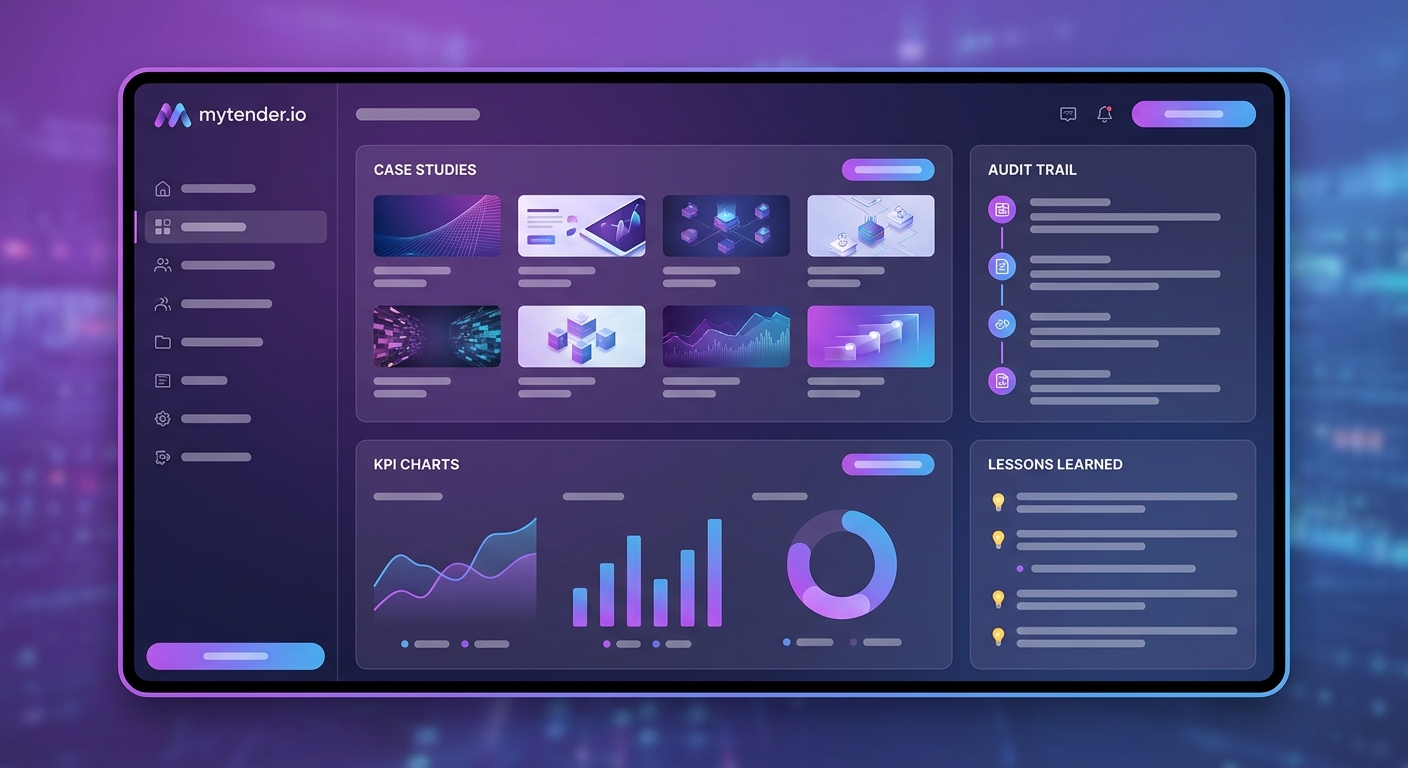
Bid evidence library dashboard for KPI-backed tender case studies
A good library is not just a folder of PDFs. It is a searchable bank of proof.
For bid teams using mytender.io, this is exactly where AI helps. The value is not writing generic paragraphs faster. The value is finding the right evidence, matching it to the question, and turning it into a response that still sounds like your organisation.
How to avoid misleading evidence
Be careful. KPI evidence can hurt you if it is stretched too far.
There are three common traps.
Trap 1: using irrelevant contract evidence
A national private-sector contract is not always a good proxy for a local authority contract. A 20-site FM contract is not the same as a 400-site estate. A pilot project is not the same as full service delivery.
You can still use imperfect evidence, but be honest about the gap. Explain what is transferable and what you have changed for this opportunity.
Evaluators do not expect identical case studies every time. They do expect you to understand the difference.
Trap 2: quoting a number without the denominator
A 50% reduction sounds impressive until the evaluator realises it means two incidents became one.
Where possible, include the base number, timeframe and scale. For example:
> We reduced missed collections from 214 per month to 91 per month across 86,000 households in the first two quarters.
That is much stronger than:
> We reduced missed collections by 57%.
Percentages are fine. Naked percentages are not.
Trap 3: hiding failure
This sounds counterintuitive, but failure evidence can be persuasive if handled well.
A credible answer might say:
> In month one, we missed the target for call answer times because resident queries were 42% above forecast. We added two temporary call handlers, changed the IVR routing, and introduced daily issue categorisation. By month three, average answer time had fallen below target and repeat calls had reduced by 18%.
That kind of example shows maturity. It tells the evaluator you know contracts are messy, and you know how to recover.
Never invent failure for drama. But if there was a real issue and a real fix, it can make your answer more believable.
Where KPI evidence fits in the tender response
Supplier performance evidence does not belong in one section only.
Use it wherever the question asks for confidence.
Method statements
Use KPIs to prove the method works. If you describe a planned maintenance regime, show completion rates and defect reduction from a similar contract.
Mobilisation plans
Use KPIs from previous go-lives: training completion, asset readiness, route validation, helpdesk setup, first-month incidents, or handover milestones.
Contract management
Use reporting, governance, action closure and escalation metrics. This is where you prove the contract will not drift after award.
Social value
Use outcomes, not promises. Show what was delivered, how it was measured, and how you will localise the approach.
Risk management
Use incident recovery and business continuity evidence. Evaluators trust risk responses more when they include lived examples.
Continuous improvement
Use trend data. Show the baseline, intervention and result. This is one of the easiest places to win marks because many bidders stay abstract.
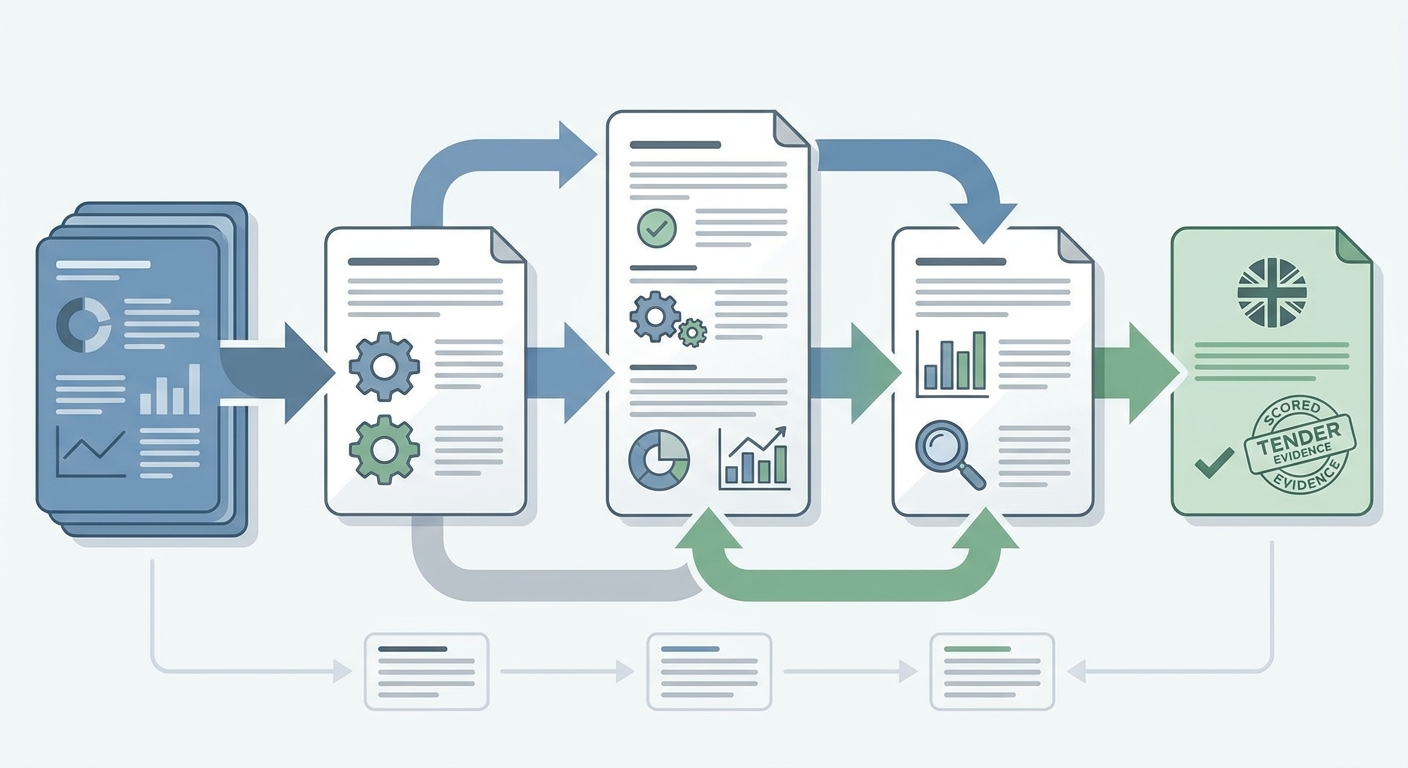
Process map for turning operational performance data into scored tender evidence
A practical KPI evidence checklist
Before you submit, check every major claim against this list.
For each evidence point, can you answer:
- What contract did this come from?
- How similar is it to the buyer's requirement?
- What was the KPI definition?
- What was the timeframe?
- What was the denominator or scale?
- Who measured it?
- Can the claim be verified?
- What action caused the result?
- What lesson are you applying to this tender?
If the evidence cannot pass those questions, either strengthen it or cut it.
Weak evidence creates doubt. No evidence is sometimes better than suspicious evidence.
What to do if your KPI data is messy
Most organisations do not have perfect data. That is normal.
The wrong response is to pretend everything is neat. The right response is to build a minimum viable evidence set.
Start with three contracts you would be proud to talk about in an interview. For each one, gather:
- the monthly contract report
- the mobilisation plan and go-live review
- KPI dashboard exports
- complaints or issue logs
- improvement plans
- client feedback
- any audit results
Then create five evidence cards per contract. Not fifty. Five good cards beat a hundred half-finished snippets.
Prioritise the evidence that maps to common tender questions: mobilisation, service delivery, quality, risk and social value.
Once the library exists, improve it after each submission. Add evaluator feedback, interview questions, clarifications and debrief comments. The library should get sharper every month.
The role of AI in KPI-backed tender writing
AI is useful here, but only if the evidence is good.
A general AI tool can make weak claims sound smoother. That is dangerous. Smooth unsupported answers still lose marks.
The better use of AI is evidence retrieval and response assembly. You want a system that can search previous bids, contract reports, case studies and approved language, then suggest the most relevant proof for the question in front of you.
That is where specialist bid platforms are more useful than blank-page copilots. The hard part is not producing words. It is finding the right proof, using it accurately, and keeping the response aligned to the scoring criteria.
This is also where bid libraries become a strategic asset. If your organisation captures KPI evidence properly, every future tender starts with better material.
The bottom line
Supplier performance KPIs are not just operational reporting. They are bid fuel.
They help evaluators trust your claims, believe your mobilisation plan, score your method statements, and choose you over a bidder who sounds polished but unproven.
The best tender teams in 2026 will not be the ones with the most adjectives. They will be the ones with the best evidence.
If you want to find live opportunities where your performance evidence can give you an edge, the Tender Finder is free to use. It is a useful way to spot tenders early, before the evidence scramble starts.
Tags
Ready to Transform Your Tender Writing?
See how MyTender's AI can help you write winning tenders in a fraction of the time.