

Supplier Onboarding in Public Sector Tenders: How to Prove You Can Start Strong in 2026
A practical 2026 guide to supplier onboarding evidence for public sector tenders. Learn how to prove mobilisation readiness, compliance control, data security, TUPE preparation, subcontractor management and first-month delivery confidence.
mytender.io Research Team
Tender Writing & Bid Management Specialists
A buyer does not worry about your glossy case study at 9am on day one. They worry about whether your team can actually start.
That is the quiet pressure behind supplier onboarding questions in public sector tenders. The authority may call it mobilisation, implementation, transition, readiness, contract commencement, service take-on, due diligence or day-one delivery. The concern is the same: can you move from preferred bidder to safe, compliant, working supplier without creating a mess?
For many bid teams, this section gets treated as admin. They recycle a generic mobilisation plan, add a few dates, mention a kick-off meeting, and hope the evaluator moves on. That is a mistake.
Supplier onboarding is now one of the easiest places to win or lose confidence. Under the Procurement Act 2023, buyers have more transparency around supplier performance, more reasons to care about poor delivery histories, and more pressure to show that contracts start properly. A vague onboarding answer says, without meaning to, that the hard thinking will happen after award.
A strong answer says something different. It shows the buyer that you have already mapped the risk, sequenced the work, assigned owners, protected compliance, and prepared the evidence they will need before service begins.

Supplier onboarding readiness framework for public sector tenders
This guide is for bid managers, commercial leads and operational owners who need to write better onboarding responses in 2026. It explains what evaluators are really looking for, how to structure the evidence, and how to avoid the fluffy mobilisation language that scores badly because it sounds like everybody else.
Why supplier onboarding is getting harder to fake
Supplier onboarding used to be a fairly simple story in many tenders. You named a mobilisation manager. You attached a Gantt chart. You promised weekly meetings. If the technical response was strong enough, that was often enough.
That is changing.
Public sector buyers are dealing with tighter budgets, more public scrutiny, more complex supply chains and more visible contract performance data. They do not just want a supplier that can write a persuasive response. They want a supplier that can survive the first 30, 60 and 90 days without creating operational risk.
Three trends are driving this.
First, the Procurement Act 2023 has increased the importance of supplier performance evidence. Authorities are expected to think more carefully about supplier capability, exclusions, KPIs, notices and delivery risk. Even when the specific onboarding question is not explicitly about the Act, the evaluation mindset has shifted. Buyers are more alert to whether promises can be monitored.
Second, onboarding now touches more functions than it used to. A new supplier may need to satisfy finance, legal, information governance, cyber security, safeguarding, HR, estates, operations, social value, sustainability and contract management before day one. If your response treats onboarding as one project meeting and a mobilisation tracker, it looks thin.
Third, bid teams are using more AI, more recycled content and more shared templates. Evaluators can spot generic mobilisation language quickly. Phrases like seamless transition, robust implementation and dedicated team do not prove anything. They are noise unless they are backed by named artefacts, timings, decision points and measurable controls.
The opportunity is simple. Most suppliers still answer onboarding questions badly. If you can turn your onboarding plan into credible evidence, you can gain marks without inventing anything new.
What evaluators are really asking
A supplier onboarding question rarely says exactly what it means. The wording might be polite, but the underlying concerns are practical and specific.
The evaluator wants to know:
- Who is accountable for the transition from award to live service?
- What happens first after contract award, and what depends on the buyer?
- Which risks could delay commencement, and how will you control them?
- How will you complete compliance checks before staff, systems or subcontractors touch the service?
- How will you protect service continuity if there is an incumbent supplier?
- How will you prove readiness before go-live?
- What will the authority see in the first month that reassures them the contract is under control?
A good response answers those questions directly, even if the tender wording is vague.
A weak response gives a timeline but no judgement. It says week one is kick-off, week two is planning, week three is training, week four is go-live. That may look tidy, but it tells the evaluator almost nothing about competence.
A better response shows how the supplier moves through gates. Discovery. Due diligence. Compliance confirmation. Resource allocation. Systems set-up. Knowledge transfer. Go-live readiness review. Stabilisation. Each stage has a purpose, an owner, an output and a decision point.
That difference matters. Timelines describe activity. Gates prove control.
The seven-part onboarding evidence model
The simplest way to strengthen an onboarding response is to split it into seven evidence areas. You do not need all seven in every tender, but most serious public sector bids will touch at least five.
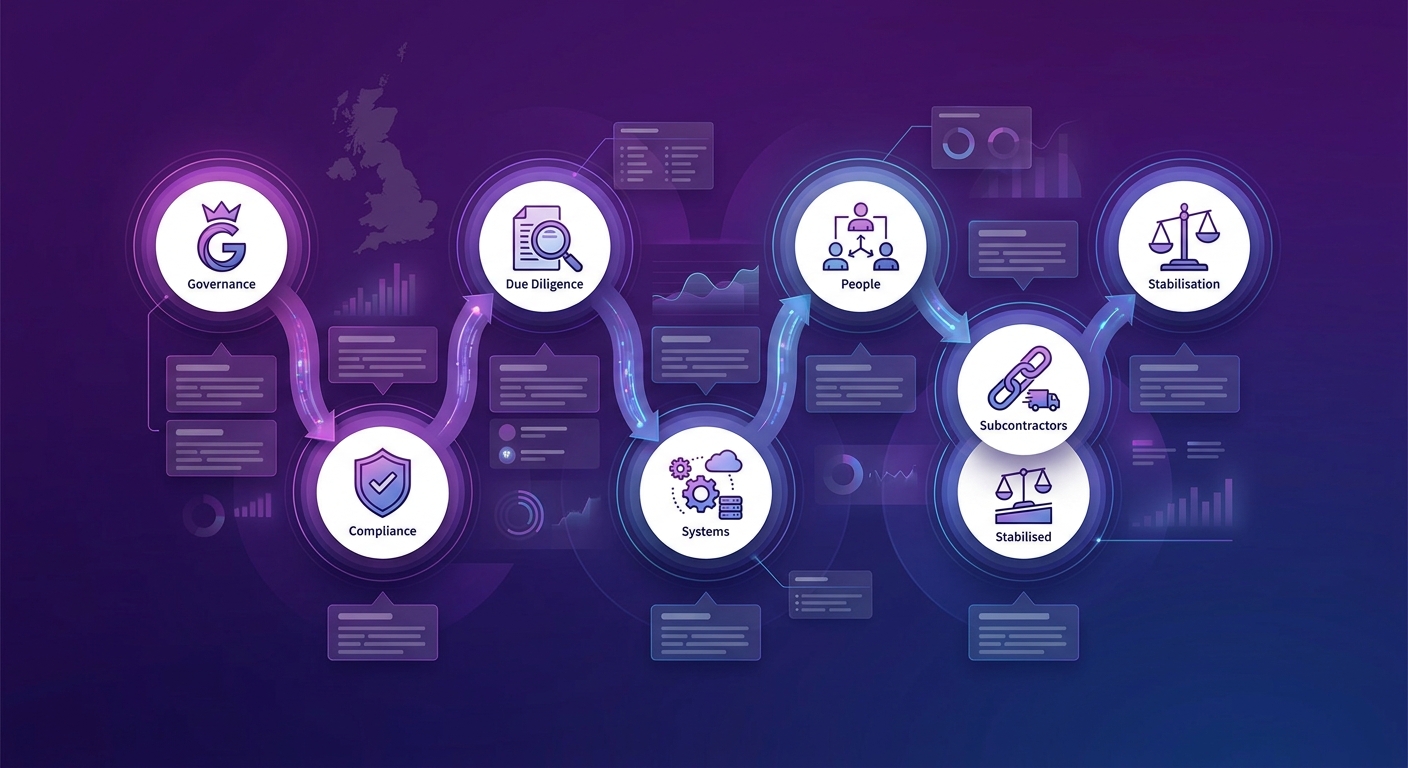
Seven-part supplier onboarding evidence model
1. Governance and accountability
Start with control. Who owns mobilisation? Who has authority to unblock decisions? Who attends the buyer meetings? Who reports risk? Who signs off go-live?
Avoid writing that you will appoint a dedicated mobilisation manager and leave it there. Every serious supplier says that. Instead, explain the governance structure in working terms.
For example:
- Contract sponsor owns executive escalation and buyer relationship health.
- Mobilisation lead owns the transition plan, risk register and readiness pack.
- Workstream owners manage HR, systems, compliance, operations, finance and subcontractors.
- Contract manager takes over after go-live but attends mobilisation from the start.
- Buyer-side decision owners are confirmed at the first mobilisation meeting.
This shows the evaluator that mobilisation is not a side project. It is a controlled handover into contract delivery.
You should also explain cadence. Weekly mobilisation boards may be enough for low-risk contracts. Daily stand-ups may be needed during the final two weeks before a complex service transfer. For major contracts, a joint mobilisation board with issue logs, action owners and decision records is stronger than a vague promise of regular communication.
The key is to show that the authority will not have to chase you for progress.
2. Due diligence and discovery
Onboarding fails when suppliers bid on assumptions and only discover reality after award. The best responses are honest about this.
You do not need to say the buyer's data is poor. You do need to show how you will validate it.
Your due diligence section should cover the information you need to confirm before committing resources or finalising the mobilisation baseline. Depending on the contract, that may include:
- Asset registers, site lists, volumes, routes or service schedules.
- Incumbent performance data, complaints, backlog and open issues.
- Staff lists, TUPE data, training records and right-to-work status.
- System access requirements, data flows and integration points.
- Subcontractor dependencies and third-party licences.
- Health and safety files, risk assessments and local operating procedures.
- Buyer-side approval routes for policies, staff, vehicles, uniforms or communications.
A strong answer explains how you will convert discovery into decisions. For example, you might produce a mobilisation assumptions log within five working days of award, then review it with the authority to agree which assumptions are confirmed, which need more evidence, and which create delivery risk.
That is much better than pretending everything will be obvious on day one.
3. Compliance before commencement
Compliance is often where onboarding answers become too broad. Suppliers list certificates and policies instead of explaining how compliance will be checked before service starts.
The evaluator needs to know that nobody will be deployed, granted access or allowed to represent the contract until the right checks are complete.
Your response should distinguish between company-level compliance and contract-level readiness.
Company-level compliance might include insurance, accreditations, financial standing, cyber certifications, modern slavery statements, health and safety policies and environmental management systems. These prove you are an eligible supplier.
Contract-level readiness is different. It proves that this specific contract can start safely. It might include site inductions, DBS checks, role-specific training, PPE allocation, data protection briefings, vehicle checks, method statements, permits, safeguarding controls or system permissions.
Do not blur them together. Many bids lose credibility because they say the supplier is ISO certified when the question is actually asking how the contract team will be onboarded.
A useful phrase is: company compliance qualifies us to contract; contract readiness confirms we can start.
That distinction helps evaluators trust the rest of your plan.
4. People, TUPE and training
If people transfer, change role, need clearance or need training, onboarding becomes human before it becomes operational.
TUPE-heavy contracts need a specific answer. It is not enough to say you have experience managing TUPE transfers. You need to explain the sequence: information request, employee liability review, consultation planning, individual meetings, payroll set-up, pension arrangements, training needs analysis, cultural induction and day-one support.
Even where TUPE does not apply, people readiness matters. The buyer wants to know that named roles will be filled, supervisors will understand the contract, front-line teams will know what good looks like, and absence or vacancy risk will not derail the start.
A strong tender response includes:
- A role mobilisation matrix showing required roles, named leads, recruitment status and contingency cover.
- A training matrix tied to the contract specification, not a generic learning catalogue.
- A communication plan for transferring staff, new starters and buyer-side stakeholders.
- Evidence of previous mobilisation outcomes, such as staff retained, induction completion rates or first-month service stability.
- A clear escalation route for workforce issues before go-live.
Do not overpromise a frictionless people transfer. Evaluators know TUPE and onboarding can be messy. They are more reassured by a supplier that can name the mess and manage it than by one that pretends it will not exist.
Building the onboarding timeline around gates, not dates
A date-led mobilisation plan looks neat, but it can be brittle. Public sector onboarding depends on buyer approvals, incumbent cooperation, data access, site availability and compliance checks. If one of those slips, the plan needs to adapt.
That is why the best tender responses use gate-based onboarding.
A gate is a decision point. It proves that a stage is complete enough to move forward. It also gives the authority a shared language for risk.

Gate-based supplier onboarding timeline
A typical gate model might look like this:
Gate 1: Award-to-kick-off
Purpose: move from commercial award to controlled mobilisation.
Evidence:
- Named mobilisation team confirmed.
- Draft mobilisation plan issued.
- Buyer decision owners identified.
- Information request submitted.
- Initial risk register created.
This gate should happen fast. For most contracts, within two to five working days of award.
Gate 2: Discovery baseline
Purpose: replace bid assumptions with validated delivery information.
Evidence:
- Contract assumptions log reviewed.
- Site, asset, people, data and volume information checked.
- Known gaps and buyer dependencies agreed.
- Delivery model updated where needed.
- Critical path confirmed.
This is where many suppliers lose control because they hide uncertainty. Do the opposite. Show the authority how you will surface uncertainty early.
Gate 3: Readiness build
Purpose: prepare people, systems, subcontractors and operating controls.
Evidence:
- Staff checks complete or tracked with owners.
- Training plan underway.
- System access and data protection controls set.
- Subcontractor onboarding complete.
- Site arrangements and method statements approved.
- Reporting templates agreed.
This is the most operational stage. The best tender answers make it feel real by naming the artefacts the buyer will see.
Gate 4: Go-live assurance
Purpose: prove that the contract is safe to start.
Evidence:
- Go-live checklist completed.
- Open risks reviewed with authority.
- Business continuity controls confirmed.
- First-week schedule issued.
- Buyer sign-off recorded.
- Stabilisation support agreed.
This gate matters because it stops mobilisation becoming a hopeful countdown. If something material is not ready, the authority should know before day one, not after.
Gate 5: Stabilisation and benefits capture
Purpose: move from start-up to controlled delivery.
Evidence:
- Daily or weekly performance review in the first month.
- Issue log and response times tracked.
- Early KPI data reviewed.
- Lessons learned captured.
- Contract management rhythm agreed for steady state.
Do not stop your onboarding answer at go-live. Buyers care about the first month because that is when hidden weaknesses show. Stabilisation evidence is a quick way to sound more credible than suppliers who only write about launch.
What to include in a supplier onboarding pack
One of the strongest promises you can make is that the buyer will receive a structured onboarding pack. It gives your response a concrete output and helps the evaluator picture the process.
The pack does not need to be huge. It needs to be useful.
A good supplier onboarding pack includes:
- Mobilisation plan with milestones, gates, workstreams and dependencies.
- RACI matrix showing supplier and buyer responsibilities.
- Risk and issue register with mitigation owners.
- Compliance tracker for checks, approvals, certificates and contract-specific controls.
- Staff onboarding and training matrix.
- Subcontractor onboarding tracker, if relevant.
- Data and systems access plan.
- Communication plan for buyer stakeholders, users, staff and subcontractors.
- Go-live readiness checklist.
- First 30-day stabilisation plan.
This is not just an attachment list. Each artefact should solve a buyer worry.
The RACI matrix reduces confusion. The compliance tracker proves nothing is being assumed. The risk register shows the buyer what might go wrong and who is handling it. The stabilisation plan shows you are thinking beyond day one.
If you use AI to help draft onboarding packs, be careful. AI can speed up the first version, but onboarding evidence must be grounded in the specific contract. A generic AI-generated checklist will not know the buyer's estate, staff transfer risk, approval route or system constraints. Use AI for structure. Use your delivery team for truth.
That is also where a purpose-built bid platform can help. mytender.io helps bid teams pull previous mobilisation evidence, organise contract-specific proof and avoid rewriting the same onboarding sections from scratch.
How to write the tender response
The best onboarding answers are practical. They avoid grand claims. They show how work gets done.
Here is a simple structure that works for most tender responses.
Open with the buyer's risk, not your credentials
Do not start with a company history. Start with the risk the buyer needs managed.
Weak opening:
We have extensive experience delivering mobilisation projects across the public sector.
Better opening:
The highest-risk period for this contract is the handover from award to the end of month one, because service continuity depends on accurate site data, completed compliance checks and clear accountability between the authority, incumbent and incoming delivery team.
The second version tells the evaluator you understand the situation.
Explain the model before the timeline
A timeline without a model feels like decoration. Before you show dates, explain how you control mobilisation.
For example:
Our onboarding method uses five gates: award-to-kick-off, discovery baseline, readiness build, go-live assurance and stabilisation. Each gate has named outputs, supplier and authority owners, and a go or no-go decision point.
That sentence gives the evaluator a frame for everything that follows.
Use proof from previous starts
Onboarding evidence becomes much stronger when you include previous results. You might use:
- Number of sites mobilised within a deadline.
- Staff transferred with no payroll interruption.
- Training completion before go-live.
- First-month KPI achievement.
- System users onboarded.
- Compliance checks completed before access was granted.
- Incidents avoided or issues resolved during mobilisation.
Keep it specific and honest. If you cannot name the customer, describe the contract type and scale. For example: a multi-site local authority cleaning contract across 42 buildings, mobilised in six weeks with 96% staff retention through TUPE.
Show buyer dependencies clearly
This is delicate, but important. Some onboarding tasks depend on the authority. Evaluators know this. They will not mark you down for being clear if you phrase it constructively.
Use wording like:
To keep mobilisation on schedule, we will confirm authority-side dependencies at the kick-off meeting, including site access, incumbent data, system permissions, decision owners and approval timescales. These will be logged in the shared mobilisation tracker so both parties can see impact and ownership.
That sounds collaborative rather than defensive.
Avoid claiming zero risk
Zero-risk mobilisation is not credible. Controlled-risk mobilisation is.
Do not write that you will ensure a seamless transition with no disruption. Write that you will identify critical risks early, assign owners, agree escalation thresholds and maintain continuity plans for the services most exposed to disruption.
Evaluators trust controlled realism.
Sector examples: what onboarding evidence looks like
Supplier onboarding is not one-size-fits-all. The core model stays the same, but the evidence changes by sector.

Sector-specific supplier onboarding evidence examples
Facilities management
FM onboarding is usually about continuity, people, sites and assets. A strong response will include site surveys, asset verification, PPM schedule validation, helpdesk set-up, subcontractor onboarding, TUPE planning and first-month KPI monitoring.
Evidence that works well:
- Site mobilisation tracker by building.
- Asset register validation plan.
- PPM criticality review.
- TUPE consultation and payroll readiness plan.
- CAFM or helpdesk configuration checklist.
- Out-of-hours escalation process.
The evaluator wants to know that service users will not feel the supplier change unless the service improves.
Construction and minor works
Construction onboarding is about competence, safety, design responsibility, programme control and supply chain readiness.
Evidence that works well:
- Pre-construction mobilisation programme.
- CDM duty holder responsibilities.
- Competence evidence for key roles.
- Design information release schedule.
- Subcontractor pre-start checks.
- Site logistics and permit plan.
- Long-lead materials tracker.
The buyer is looking for control before site activity begins. If your first section is about the programme but not safety or competence, the answer feels incomplete.
Healthcare and regulated services
Healthcare onboarding adds safeguarding, clinical governance, data protection and service continuity. The buyer will be sensitive to patient impact, information governance and staff suitability.
Evidence that works well:
- DBS and right-to-work tracker.
- Mandatory training matrix.
- Clinical or safeguarding governance route.
- Data protection impact assessment support.
- Incident escalation pathway.
- Service continuity plan for vulnerable users.
Do not bury safeguarding in a generic compliance paragraph. Treat it as a core readiness workstream.
Technology and data services
Technology onboarding is usually about access, integration, information security and user adoption.
Evidence that works well:
- Implementation discovery checklist.
- Data migration or integration plan.
- Access control model.
- Security assurance pack.
- User onboarding plan.
- Support and hypercare model.
- Rollback plan, if relevant.
The buyer wants confidence that implementation will not expose data, disrupt users or create shadow processes.
Waste and environmental services
Waste onboarding is route-led and compliance-led. The buyer needs to know that collections, transfer points, vehicles, permits, crew training and resident communications are ready.
Evidence that works well:
- Route validation plan.
- Vehicle and depot readiness tracker.
- Permit and licence register.
- Crew induction matrix.
- Communications plan for service changes.
- First-week missed-collection monitoring.
Operational visibility matters. A map, route table or escalation tracker will often say more than another paragraph.
Common mistakes that make onboarding answers weak
Most onboarding answers fail for predictable reasons.
Mistake 1: Reusing a mobilisation plan without adapting it
Evaluators can tell when a plan has been reused. The giveaways are generic milestones, irrelevant workstreams, no buyer dependencies and no reference to the actual service.
Fix it by mapping every stage to the tender's risk. If the contract involves TUPE, show TUPE. If it involves data access, show data. If it involves sites, show sites. If it involves subcontractors, show subcontractors.
Mistake 2: Confusing onboarding with contract management
Contract management starts once the service is live. Onboarding is the route to safe commencement. They overlap, but they are not the same.
A response that jumps straight to monthly meetings and KPI reporting has skipped the hard part: how the supplier gets ready.
Fix it by separating mobilisation governance from steady-state governance. Then show how one hands over to the other.
Mistake 3: Writing about intentions instead of artefacts
We will work closely with the authority is not evidence. A shared mobilisation tracker, weekly action log and named escalation path are evidence.
We will ensure compliance is not evidence. A compliance tracker with checks, owners, due dates and sign-off is evidence.
We will communicate regularly is not evidence. A stakeholder communication plan is evidence.
If a sentence cannot be converted into a visible output, it probably needs strengthening.
Mistake 4: Ignoring buyer responsibilities
Some suppliers avoid mentioning buyer dependencies because they worry it sounds critical. The result is a plan that pretends the supplier controls everything.
That is not credible. Buyers know they have responsibilities too.
Fix it by presenting dependencies as shared mobilisation controls. Be clear, practical and polite.
Mistake 5: Stopping at day one
A supplier can technically go live and still fail onboarding. The first month is when missed assumptions, staff confusion, system problems and user complaints surface.
Fix it by including a stabilisation period. Explain what you will monitor, how often you will report, and when the contract moves into steady state.
How to evidence AI-supported onboarding without creating risk
More bid teams are using AI to help with mobilisation plans, onboarding packs and implementation schedules. That is sensible, but it needs control.
AI can help you:
- Turn the specification into a first-draft onboarding checklist.
- Compare the tender requirements against previous mobilisation plans.
- Identify missing workstreams.
- Draft role matrices and communication plans.
- Summarise buyer dependencies.
- Create first-draft risk registers.
AI should not be trusted to invent contract-specific facts. It should not assume TUPE applies. It should not guess DBS requirements, system access rules, data migration scope or buyer approval routes.
If a tender asks whether AI was used, be transparent and calm. Public procurement guidance does not ban suppliers from using AI to support bid preparation, but it does expect human review, accuracy and confidentiality. Your internal process should make that easy to explain.
A good working rule is simple: AI can draft structure; humans own evidence.
For bid teams, the practical challenge is not just writing the answer. It is keeping the evidence current. Old mobilisation examples, expired certificates, outdated training matrices and stale case studies create risk. A content library that connects onboarding proof to real delivery outcomes is much stronger than a folder of old bid answers.
A practical onboarding checklist for your next tender
Before you submit your next onboarding response, run it through this checklist.
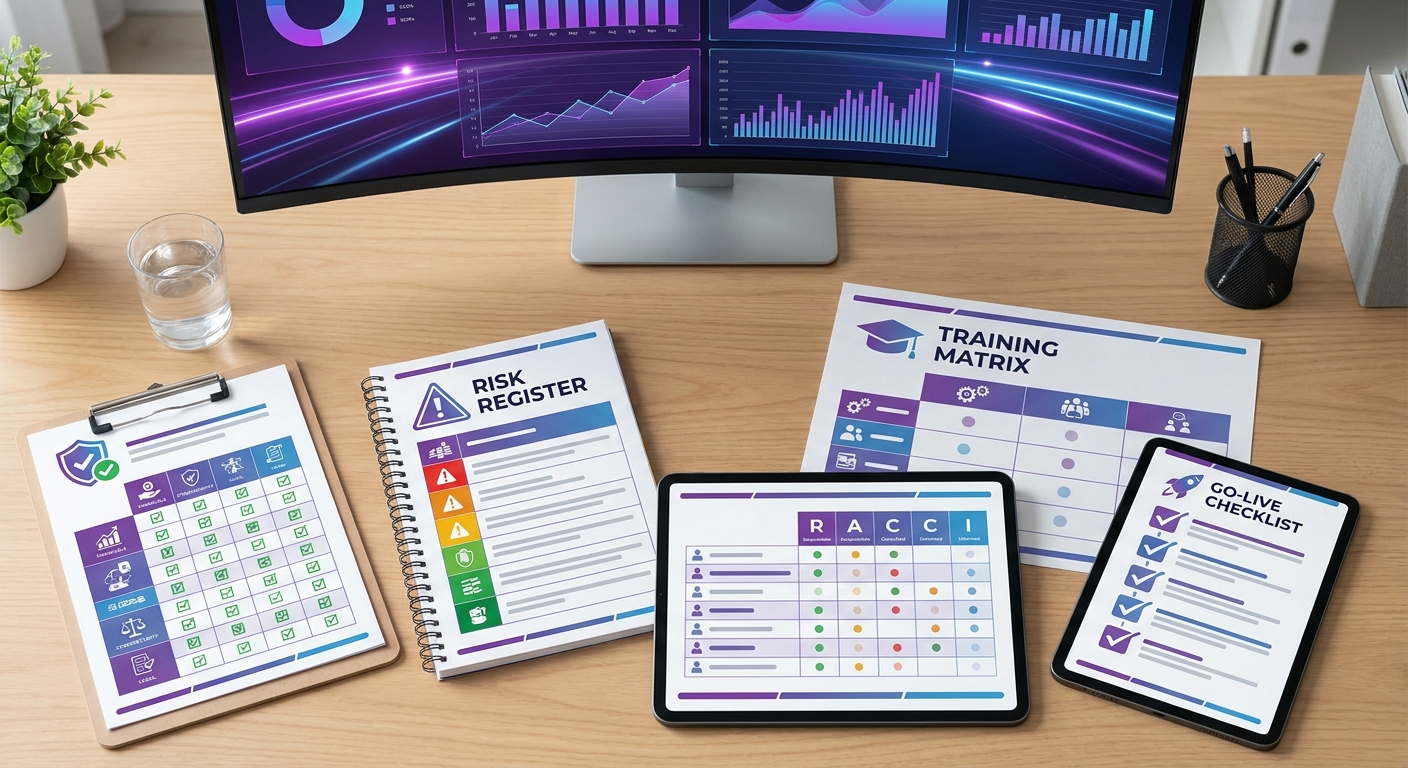
Public sector supplier onboarding checklist
Strategy and risk
- Have you identified the buyer's highest-risk transition points?
- Have you explained why your onboarding model fits this contract?
- Have you separated assumptions from confirmed information?
- Have you included buyer dependencies constructively?
Governance
- Have you named roles, responsibilities and escalation routes?
- Have you shown how mobilisation governance hands over to contract management?
- Have you included a meeting cadence and reporting structure?
- Have you explained how risks and decisions will be logged?
Compliance
- Have you separated company compliance from contract readiness?
- Have you listed the checks required before staff, systems or subcontractors go live?
- Have you shown how evidence will be tracked and signed off?
- Have you included data protection, cyber security or safeguarding where relevant?
People and supply chain
- Have you covered TUPE, recruitment, training or clearance requirements?
- Have you shown contingency for vacancies or delayed checks?
- Have you explained subcontractor onboarding and approval?
- Have you included communication for staff and stakeholders?
Go-live and stabilisation
- Have you included a go-live readiness review?
- Have you shown what happens in the first week and first month?
- Have you included early KPI monitoring or issue management?
- Have you explained when the service moves into steady state?
If the answer is yes to most of these, your response is likely stronger than the average. If it is no, the section probably reads like a promise rather than a plan.
How mytender.io helps bid teams strengthen onboarding evidence
Supplier onboarding sections are difficult because they sit between bid writing and delivery. The best material often lives outside the bid team: mobilisation plans from old contracts, compliance trackers, training matrices, TUPE lessons, contract handover notes, service commencement reviews and operational risk registers.
That evidence is valuable, but only if the bid team can find it quickly.
mytender.io helps teams bring that knowledge into the bid process. Instead of starting with a blank page, bid writers can draw from approved content, past winning responses and real operational evidence, then adapt it to the contract in front of them.The goal is not to make every onboarding answer longer. It is to make it more specific.
A short, evidenced answer beats a long generic one. A readiness gate beats a vague milestone. A compliance tracker beats a promise. A named mobilisation owner beats a job title copied from last year's bid.
That is where good bid systems earn their keep. They help teams reuse the truth, not just reuse words.
Final thoughts
Supplier onboarding is one of those tender sections that looks ordinary until something goes wrong. Then it becomes the section everyone wishes they had taken more seriously.
For evaluators, onboarding is a test of delivery maturity. It shows whether you understand the jump from bid promise to live contract. It reveals whether your operations team has shaped the response. It exposes whether your compliance claims are practical or decorative.
For suppliers, it is a chance to build confidence before the contract even starts.
Do not waste it on a generic mobilisation plan. Show the buyer the first 90 days. Show the gates. Show the artefacts. Show the checks. Show what you will need from them. Show how you will know the service is ready.
If you want to find live public sector opportunities where stronger onboarding evidence can make a real difference, the Tender Finder is free to use. Start with the tenders that fit your delivery strengths, then build the evidence before the deadline starts breathing down your neck.
Tags
Ready to Transform Your Tender Writing?
See how MyTender's AI can help you write winning tenders in a fraction of the time.