

Subcontracting and Consortium Bidding in Public Sector Tenders: Complete Guide 2026
Master subcontracting, consortium bidding, and joint venture strategies for UK public sector tenders. Learn how to structure partnerships, manage risk, and win larger contracts through collaborative bidding in 2026.
Evie
Procurement Specialist
Not every contract is designed for a single organisation to deliver alone. Major public sector programmes—infrastructure builds, regional healthcare transformations, multi-site FM contracts—routinely demand capabilities that exceed what any one company can offer. Subcontracting and consortium bidding exist precisely for this reason: they let organisations pool expertise, share risk, and access contracts that would otherwise be unreachable.
Yet collaborative bidding remains one of the most misunderstood areas of UK public procurement. Teams assemble too late, governance structures are vague, risk allocation is an afterthought, and the tender response reads like five separate companies stapled together rather than a cohesive delivery partner.
This guide covers everything you need to structure, manage, and win subcontracting and consortium bids in 2026—including the specific requirements introduced by the Procurement Act 2023.

Team of procurement professionals reviewing consortium tender documents in a modern office
Subcontracting vs Consortium Bidding vs Joint Ventures: What's the Difference?
Before diving into strategy, let's clarify the three main collaborative bidding structures. They're often conflated, but they carry fundamentally different legal, financial, and operational implications.
Subcontracting
A prime contractor holds the contract with the contracting authority and subcontracts specific work packages to other organisations. The prime bears full contractual responsibility—if a subcontractor fails to deliver, the prime is liable.
Key characteristics:- Single contract between the contracting authority and the prime
- Prime contractor manages and is accountable for all subcontractors
- Subcontractors have no direct contractual relationship with the buyer
- The prime retains profit margin on subcontracted work
- Simplest structure from the buyer's perspective
Consortium Bidding
Two or more organisations form a consortium to bid collectively. They submit a joint tender, typically with one organisation acting as lead partner. The consortium may or may not form a separate legal entity.
Key characteristics:- Joint tender submission with agreed roles and responsibilities
- Lead partner coordinates the bid and usually manages the contract
- Each partner contributes distinct capabilities or capacity
- Risk and reward shared according to the consortium agreement
- May involve joint and several liability (each partner liable for the whole)
Joint Ventures (JVs)
A joint venture creates a new legal entity specifically to bid for and deliver a contract. Partners invest capital, share ownership, and operate through the JV company.
Key characteristics:- Separate legal entity (typically a limited company or LLP)
- Partners are shareholders/members of the JV entity
- The JV itself holds the contract with the contracting authority
- Independent governance, management, and financial reporting
- Most formal and complex structure
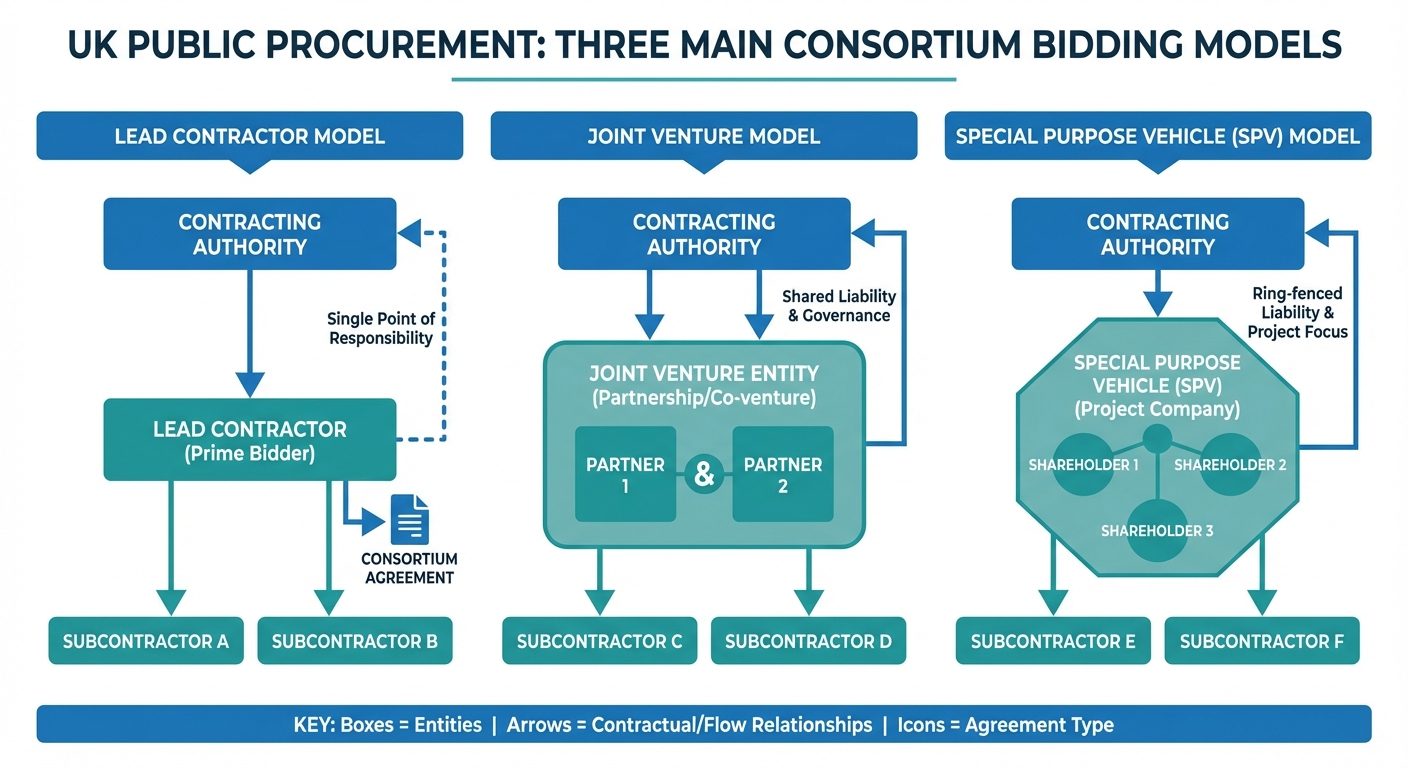
Infographic showing the three main consortium bidding models: Lead Contractor, Joint Venture, and Special Purpose Vehicle
The Procurement Act 2023: What Changed for Collaborative Bidding
The Procurement Act 2023, fully in force since February 2025, introduced several provisions that directly affect subcontracting and consortium arrangements. Understanding these changes is essential for structuring compliant bids.
Subcontracting Transparency Requirements
Under Section 29 of the Act, contracting authorities must now publish details of subcontracting arrangements for contracts above threshold values. This means:
- Named subcontractors must be identified in the tender submission where known
- Subcontracting plans must describe how supply chain management will be handled
- Payment terms to subcontractors must comply with the 30-day payment requirement
- Changes to subcontractors during contract delivery must be reported through the central platform
For bidders, the practical implication is straightforward: you can no longer treat subcontracting as a vague intention. Buyers expect specific detail about who your subcontractors are, what they'll deliver, and how you'll manage them.
Consortium and Group Bidding Provisions
The Act explicitly addresses consortium bidding through its provisions on "group of suppliers." Key points:
- Consortia can bid as a group without necessarily forming a separate legal entity
- Each member's capabilities can be aggregated to meet selection criteria (turnover, experience, certifications)
- The contracting authority can require the consortium to form a legal entity before contract award if necessary for proper performance
- Joint and several liability can be imposed, meaning each partner is individually responsible for the entire contract
SME Access Requirements
The Act strengthens obligations to facilitate SME participation. For collaborative bidding, this means:
- Contracting authorities must consider whether contracts can be structured to allow consortium bids from smaller providers
- Lot strategies should enable SMEs to participate through partnerships or as specialist subcontractors
- Pipeline visibility through the central digital platform helps SMEs identify teaming opportunities earlier
These provisions create real opportunities for SMEs willing to invest in consortium relationships—but only if you approach them strategically.
When to Subcontract vs When to Form a Consortium
Choosing the right structure isn't just a legal decision—it fundamentally shapes your bid strategy, risk profile, and operational model. Here's a decision framework:
Choose Subcontracting When:
- You hold 70%+ of the required capabilities and need specialists for defined work packages
- The buyer expects a single point of accountability (most common in central government contracts)
- Speed matters—subcontracting arrangements can be established quickly without complex governance
- You want to retain commercial control over pricing and margin
- The subcontracted elements are commoditised or readily available in the market
- The contract value doesn't justify the overhead of a formal consortium structure
Choose a Consortium When:
- No single partner can credibly demonstrate the full range of required capabilities
- The buyer explicitly invites or encourages consortium bids (check the contract notice)
- Partners bring genuinely complementary strengths—not just capacity but distinct expertise
- The contract is large enough to justify consortium governance overhead (typically £5m+)
- Risk is too concentrated for a single prime to bear alone
- Innovation requires collaboration—the best solution emerges from combining different perspectives
Choose a Joint Venture When:
- The contract is long-term and high-value (typically 5+ years, £50m+)
- Partners need to invest significant capital before delivery begins
- The buyer requires a dedicated delivery entity with its own management team
- Tax efficiency or liability separation justifies the setup cost
- Both/all partners want genuine equity stake in delivery and outcomes
The critical mistake is defaulting to the simplest structure without analysing what the contract actually demands. A major IT transformation bid with distinct infrastructure, application development, and service management components probably needs a consortium—not a prime with subcontractors trying to cover everything.
Building Your Subcontracting Strategy
If you're the prime contractor managing subcontractors, your tender response must demonstrate robust supply chain management. Here's how to build a subcontracting strategy that scores well and delivers reliably.
Step 1: Map the Delivery Requirements
Break the contract into distinct work packages and assess each against your in-house capabilities. Be honest about gaps. A credible prime that acknowledges the need for specialist support scores better than one that claims to do everything themselves.
Create a capability matrix:
| Work Package | In-House Capability | Subcontract Required | Critical/Non-Critical |
|---|---|---|---|
| Core service delivery | Full | No | Critical |
| Specialist installation | Partial | Yes — specialist trade | Critical |
| Transport and logistics | None | Yes — logistics partner | Non-critical |
| Training and handover | Full | No | Non-critical |
Step 2: Select and Pre-Qualify Subcontractors
Don't name subcontractors you haven't vetted. Under the Procurement Act 2023, you'll be held to your subcontracting commitments, and any subcontractor failure reflects directly on you.
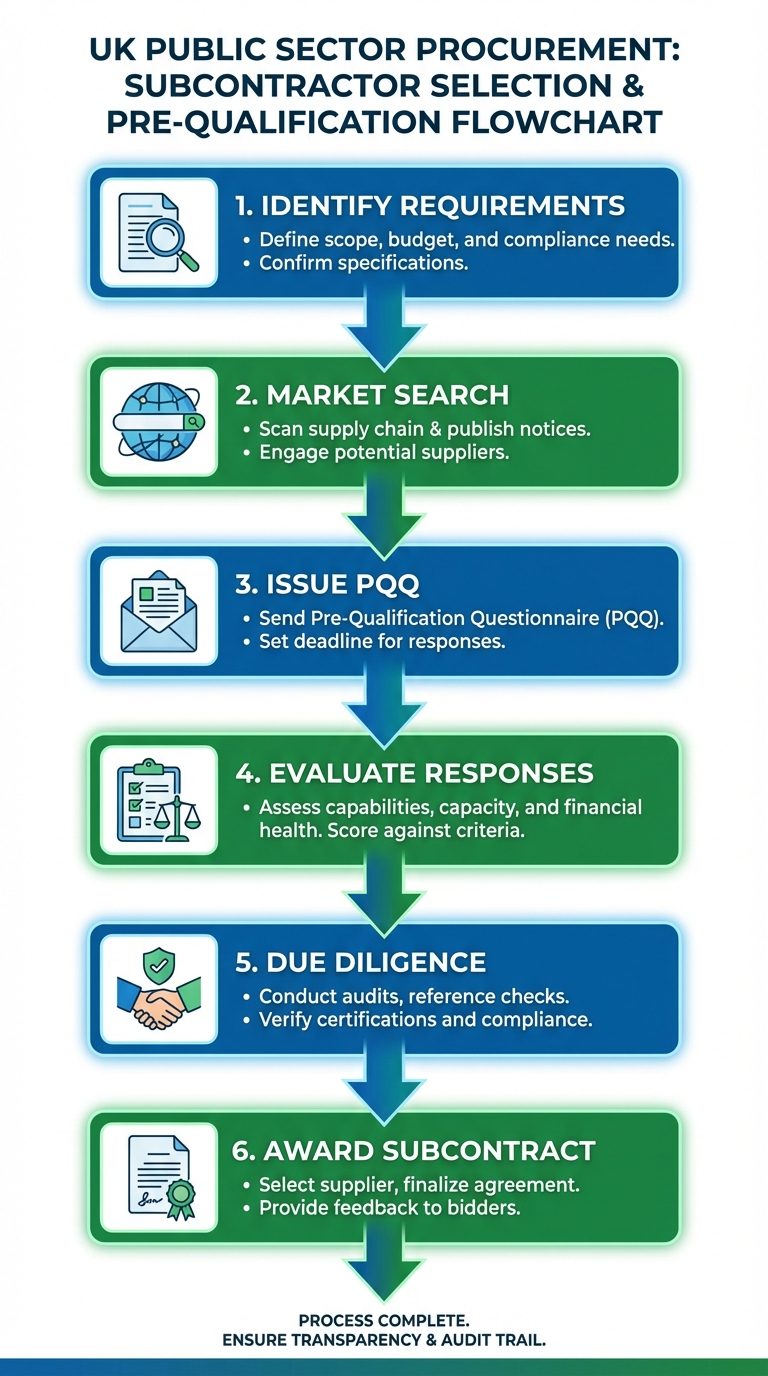
Subcontractor selection and pre-qualification process flowchart showing six stages from requirements to award
- Financial stability — credit checks, filed accounts, cash flow evidence
- Technical competence — relevant experience, qualifications, certifications
- Capacity — can they actually deliver alongside their existing commitments?
- Insurance — professional indemnity, public liability, employers' liability at appropriate levels
- Compliance — health and safety record, environmental management, equality and diversity
- References — verified track record on similar public sector contracts
- Cultural fit — aligned values, communication style, and approach to partnership
Step 3: Structure Clear Subcontract Agreements
Your subcontract must be back-to-back with the main contract. This means:
- Scope mirrors the relevant work package from the main contract
- Performance standards match or exceed main contract KPIs
- Payment terms comply with the 30-day requirement under the Procurement Act
- Termination provisions allow you to replace the subcontractor if performance fails
- Intellectual property rights are clearly assigned or licensed
- Data protection obligations flow down (critical for contracts handling personal data)
- Insurance requirements are proportionate and verified
Step 4: Demonstrate Subcontractor Management in Your Tender
Buyers want to see active management, not passive hope. Your tender response should describe:
Governance: Monthly performance reviews, quarterly business reviews, annual strategy sessions. Name the individuals responsible for subcontractor relationship management. Performance monitoring: Specific KPIs for each subcontractor, reporting frequency, escalation triggers. Show your performance management framework with clear remediation processes. Risk management: Identify the top risks associated with each subcontractor and your mitigation strategies. Include contingency plans for subcontractor failure—alternative suppliers, step-in arrangements, performance bonds. Continuous improvement: How you'll work with subcontractors to drive efficiency, quality, and innovation over the contract term. Joint improvement workshops, shared savings mechanisms, and innovation incentives demonstrate partnership maturity.Building a Winning Consortium Bid
Consortium bids demand far more coordination than subcontracting. You're not just managing suppliers—you're integrating partners into a single coherent offering. Here's how to do it well.
Forming the Consortium: Partner Selection
The most common cause of consortium failure isn't poor delivery—it's poor partner selection. Choose partners based on complementary capabilities, not convenience.
Essential partner selection criteria:- Capability gap fill — Does this partner bring something genuinely unavailable in-house?
- Track record — Have they delivered comparable work for similar public sector clients?
- Financial resilience — Can they sustain their share of delivery costs, including pre-contract investment?
- Cultural compatibility — Will their team integrate effectively with yours?
- Strategic alignment — Do they share your long-term objectives for this client/sector?
- Existing relationships — Have you worked together before? Prior collaboration significantly de-risks execution.
- Partners who want to join primarily for revenue access rather than genuine capability contribution
- Organisations with a history of consortium disputes or partnership breakdowns
- Partners whose financial position makes them vulnerable to acquisition or insolvency during the contract term
- Companies with conflicting interests (e.g., also bidding independently or with a competitor consortium)
The Consortium Agreement
Before writing a word of the tender, establish a consortium agreement. This is the foundational document that governs everything about how you'll work together. It should cover:
Roles and responsibilities:- Lead partner designation and authority
- Each partner's specific deliverables and work packages
- Decision-making authority for different categories (operational, commercial, strategic)
- Named individuals from each partner with their roles
- Revenue share model (fixed percentage, work-package based, or hybrid)
- Cost allocation for bid preparation (who pays what, and when)
- Profit/loss sharing mechanism
- Invoicing and cash flow management
- Insurance responsibilities
- Consortium board composition and meeting frequency
- Voting rights and quorum requirements
- Dispute resolution escalation process
- Information sharing and confidentiality obligations
- What happens if a partner wants to leave
- Provisions for partner replacement
- Intellectual property ownership upon dissolution
- Non-compete obligations during and after the consortium term
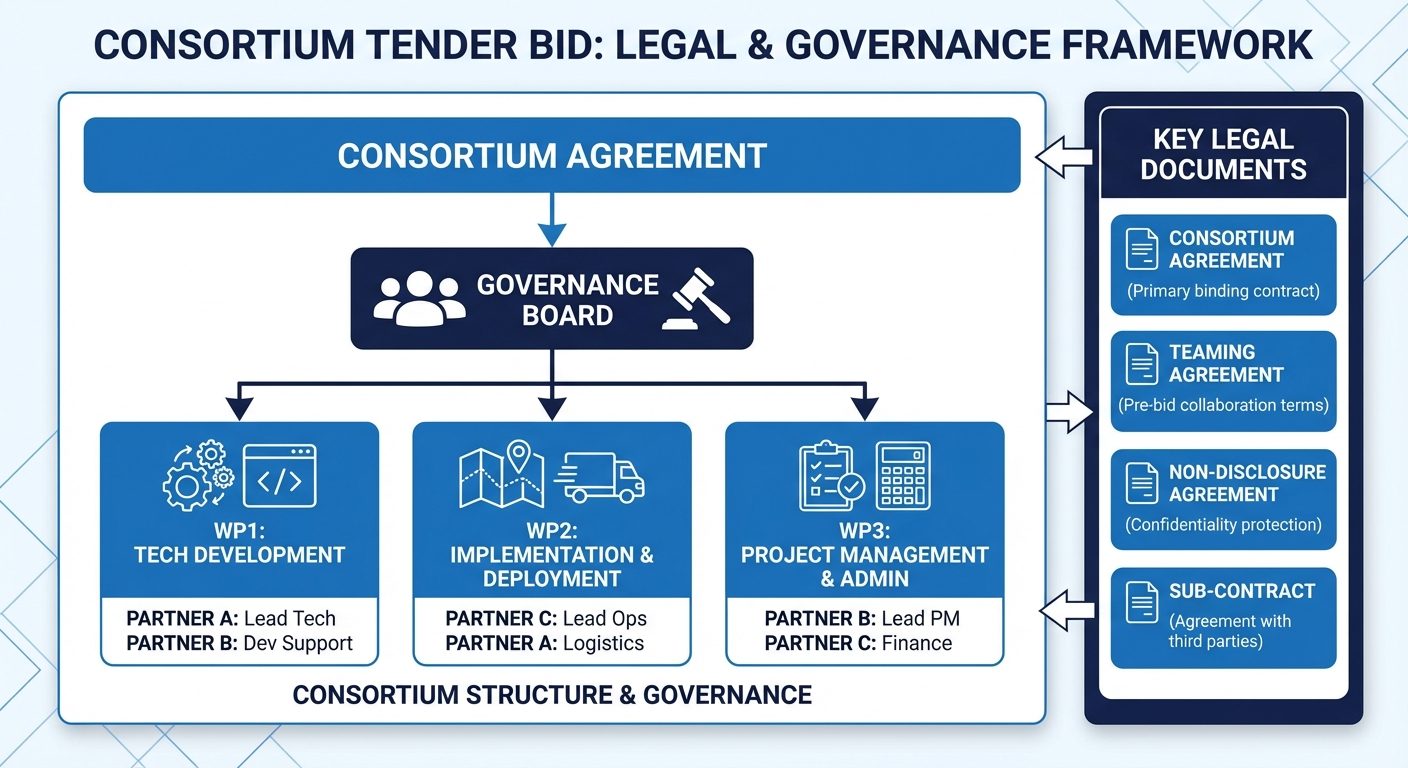
Infographic showing consortium governance structure with Consortium Agreement, Governance Board, and work packages
Writing a Cohesive Consortium Tender Response
The biggest weakness in consortium bids is obvious fragmentation. Evaluators can immediately spot a response where three different companies each wrote their section independently and nobody integrated the result. This destroys credibility.
Establish a single editorial voice:- Appoint one bid manager to own the entire response
- Create a bid style guide covering tone, terminology, formatting, and structure
- All content should read as though one organisation wrote it
- Use "we" and "our consortium" consistently—never "Company A will..." and "Company B will..."
- Show how partners' capabilities combine to create value greater than the sum of parts
- Describe integration points explicitly: shared systems, joint processes, unified reporting
- Provide evidence of integrated delivery from previous collaborations
- Include joint case studies where partners have worked together, not separate company references
- Buyers know consortia carry coordination risk. Don't ignore it.
- Describe your governance model proactively—board structure, escalation paths, dispute resolution
- Provide evidence of stable, long-term partnerships
- Offer contractual safeguards: joint and several liability, performance bonds, parent company guarantees
- Provide an integrated organogram showing how personnel from different partners work together
- Name key individuals and their reporting lines—make it clear this is one team
- Describe how you'll manage culture integration, particularly for co-located teams
- Include joint training plans and shared communication platforms
Risk Allocation in Collaborative Bids
Risk allocation is where consortium bids succeed or fail—both in winning the tender and delivering the contract. Getting it wrong leads to disputes, finger-pointing, and ultimately contract failure.
Principles of Effective Risk Allocation
Allocate risk to the partner best placed to manage it. This sounds obvious but is routinely violated. A technology partner shouldn't own construction programme risk. A facilities manager shouldn't own clinical negligence risk. Each partner should own the risks they can actually influence and mitigate. Define risk boundaries precisely. Vague risk allocation causes disputes. Instead of "Partner A manages delivery risks," specify: "Partner A manages all risks associated with software development, integration testing, and user acceptance testing, including schedule slippage up to 15 working days. Delays exceeding 15 working days trigger the consortium escalation protocol." Account for shared risks. Some risks don't sit neatly with one partner—reputational risk, regulatory change, force majeure. Establish how shared risks are governed and who has authority to make decisions that affect all partners. Build in contingency. Every risk allocation should include a response plan for the scenario where the risk materialises and the responsible partner cannot contain it. Step-in rights, backup resource pools, and financial reserves prevent single-partner failure from collapsing the entire delivery.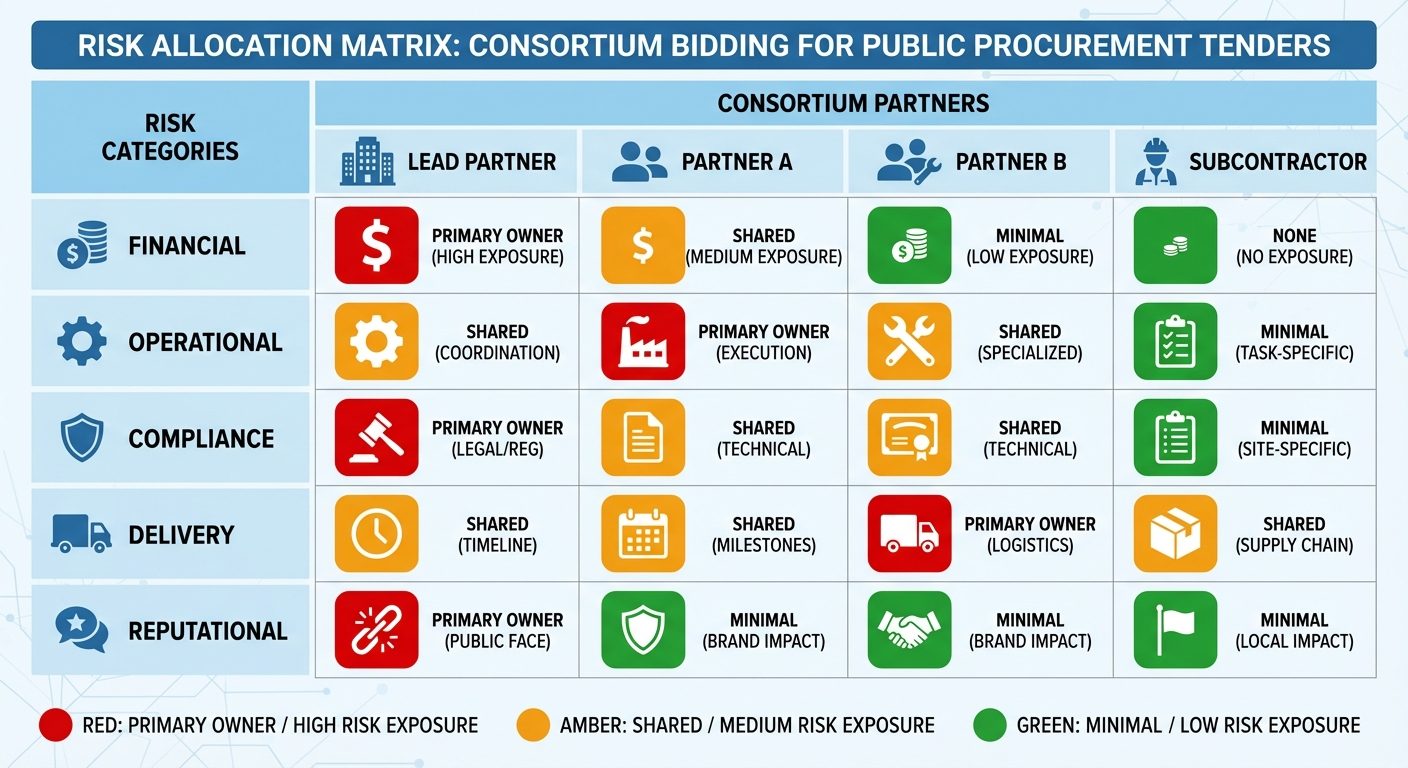
Risk allocation matrix for consortium bidding showing risk categories mapped against consortium partners
Risk Allocation in Your Tender Response
Evaluators award high scores to bids that demonstrate sophisticated risk management—not just lists of risks, but evidence that partners have genuinely negotiated and agreed allocation. In your response:
Show the allocation process, not just the outcome. Describe how you identified risks, assessed probability and impact, and agreed ownership. This demonstrates maturity. Quantify where possible. "We maintain a consortium risk reserve of £500,000 funded proportionally by partners" is far more compelling than "We have contingency measures in place." Include your risk register. Provide a sample or summary of your consortium risk register showing key risks, owners, mitigation actions, and residual risk ratings. This is concrete evidence that you've done the work. Address interface risks explicitly. The highest-risk areas in any consortium are the interfaces between partners. Describe how you'll manage handover points, shared dependencies, and coordination activities.Financial Structuring for Consortium Bids
Financial structure in consortium bids is complex because you're balancing commercial interests of multiple organisations while presenting a coherent, competitive price to the buyer.
Pricing Models
Work-package pricing: Each partner prices their own deliverables. Simple and transparent, but can lead to boundary disputes and margin stacking. Integrated pricing: The consortium develops a single price model with shared cost assumptions. More coherent but requires trust and open-book accounting between partners. Hybrid approach: Core activities priced by the responsible partner; shared/overhead costs allocated by agreed formula (typically revenue share, headcount, or FTE proportion). Most common in practice.Payment and Cash Flow
Establish payment waterfall early. The contracting authority pays the lead partner (or the JV entity), who distributes to consortium members. Define:- Payment milestones aligned with work-package delivery
- Maximum payment processing time between lead partner receipt and downstream payment
- Interest provisions for late internal payments
- Retentions and their release triggers
Financial Evaluation Considerations
Buyers assess consortium financial standing differently from single-bidder evaluation:
- Aggregated turnover — Consortium members' turnovers can be combined to meet minimum thresholds
- Individual financial health — Each member's financial stability may be assessed independently
- Joint and several liability — The buyer may require this, making each partner liable for the entire contract value
- Parent company guarantees — May be requested from consortium members' parent organisations
- Performance bonds — Typically 5-10% of contract value, which the consortium must secure
Sector-Specific Considerations
Different sectors have distinct expectations and norms for collaborative bidding. Tailor your approach accordingly.
Construction and Infrastructure
Consortium bidding is standard practice in construction. Buyers expect to see established supply chain relationships and integrated programme management.
Key considerations:- CDM compliance across all partners and subcontractors (Construction Design and Management Regulations)
- Joint programming showing how different trades/packages integrate on shared timelines
- Skills and workforce planning across the consortium, including apprenticeship commitments
- BIM collaboration — shared Building Information Modelling protocols and data exchange standards
- Modern Slavery compliance through the entire supply chain, with evidence of due diligence
IT and Digital Transformation
Technology consortia typically form around complementary capabilities: infrastructure, application development, service management, and change management.
Key considerations:- Architecture governance — how partners' technology components integrate
- Agile delivery at scale — coordinating sprints and releases across multiple partner teams
- Intellectual property — particularly important when partners contribute proprietary technology
- Data sovereignty — ensuring data remains in compliant locations across all partners' systems
- Cybersecurity — attack surface expands with consortium boundaries; demonstrate unified security posture
Healthcare
NHS and healthcare commissioning increasingly favours alliance-style contracts that sit between traditional contracting and full consortium models.
Key considerations:- Clinical governance — clear accountability for clinical outcomes across partners
- Information governance — NHS Digital Standards compliance across all consortium members
- Safeguarding — all staff across the consortium must meet relevant DBS and training requirements
- CQC registration — relevant partners must be registered or demonstrate a clear registration pathway
- Patient pathway integration — show how the consortium delivers seamless patient experience
Facilities Management
FM consortia typically combine hard and soft services providers, or national reach with local delivery capability.
Key considerations:- TUPE transfers — consortium bids involving staff transfers require careful coordination
- Social value commitments — how the consortium collectively delivers against social value requirements
- Local supply chain — demonstrating use of local subcontractors and SMEs within the consortium model
- Mobilisation — coordinating multi-partner mobilisation is complex; show a detailed joint mobilisation plan
Common Mistakes in Collaborative Bidding
Having reviewed hundreds of consortium and subcontracting bids, these are the patterns that consistently lose points or lead to delivery failure.
Mistake 1: Assembling Too Late
Effective consortium bids need months of preparation—agreeing governance, aligning commercial models, developing integrated solutions, and writing cohesive responses. Teams that assemble six weeks before submission deadline produce fragmented, unconvincing bids.
Fix: Start consortium development at the Pipeline stage. Use early market engagement events to identify potential partners. Begin governance discussions before the ITT is even published.Mistake 2: Unclear Decision-Making Authority
When nobody has clear authority to make binding decisions for the consortium, everything takes too long and nothing is decided properly. Bid development stalls. Delivery descends into committee paralysis.
Fix: The consortium agreement must explicitly define decision-making authority for different categories: bid decisions (pricing, scope, commitments), operational decisions (day-to-day delivery), and strategic decisions (contract variations, partner changes). Name the individuals, not just the roles.Mistake 3: Ignoring Cultural Differences
Every organisation has different ways of working—different approval processes, communication styles, quality standards, and management approaches. Pretending these differences don't exist guarantees friction.
Fix: Invest in joint team building before the bid. Develop shared ways of working. Create a consortium operating manual that addresses practical matters: meeting protocols, document management, escalation routes, and communication tools.Mistake 4: Inadequate Financial Planning
Consortium bids frequently underestimate the cost of coordination—consortium management overhead, joint governance, shared systems, and integration activities. This leads to either uncompetitive pricing (margin stacked on margin) or unsustainable delivery (no budget for coordination).
Fix: Model coordination costs explicitly. Typically 3-8% of contract value for consortium management, governance, and integration. Agree how these costs are shared and funded. Don't bury them in individual partner prices.Mistake 5: Writing Separate Sections and Stapling Them Together
The single most obvious sign of a weak consortium bid. Different fonts, inconsistent terminology, contradictory approaches, and a response that reads like three separate bids bolted together.
Fix: Appoint a single bid manager with editorial authority. Hold joint writing workshops. Circulate drafts across all partners for integration review. Read the complete submission as an evaluator would—if you can identify which company wrote which section, rewrite it.Mistake 6: Failing to Evidence Previous Collaboration
Buyers assess consortium credibility partly on whether partners have successfully worked together before. A consortium of strangers is inherently riskier than one with proven collaborative history.
Fix: Prioritise partners you've worked with before. If this is a new partnership, describe how you're mitigating the novelty—joint workshops, integrated test projects, secondments between organisations. Even informal collaboration (joint conference presentations, shared thought leadership) provides some evidence of relationship.How AI Tools Are Transforming Consortium Bid Management
Managing a consortium bid involves coordinating vast amounts of information across multiple organisations—past performance evidence, capability statements, compliance certifications, pricing models, and risk registers. The sheer volume of coordination required is one reason why consortium bids historically take so long and cost so much to prepare.
AI-powered bid management platforms like mytender.io are changing this dynamic:
Automated capability mapping. Upload capability statements from all consortium partners and the AI maps them against tender requirements, identifying gaps and overlaps instantly. What previously took days of manual analysis happens in minutes. Integrated content generation. Instead of each partner writing independently, the AI generates unified draft responses that draw on all partners' evidence libraries. The output reads as one voice because it was authored by one system. Compliance cross-checking. The AI validates that all consortium members' certifications, insurance, and accreditations meet tender requirements—flagging gaps before they become submission errors. Risk identification. By analysing the tender specification against the consortium's combined delivery model, the AI identifies interface risks and coordination challenges that human reviewers might miss. Version control and collaboration. Multi-partner bid development generates enormous document volumes. AI-powered platforms manage version control, track contributions, and ensure consistency across the complete submission. Evidence matching. The AI scans all partners' case study libraries to find the strongest evidence for each tender requirement, then synthesises joint references that demonstrate collaborative capability.For consortium bids specifically, the productivity gain is even greater than for single-bidder submissions because the coordination overhead—the hardest part of collaborative bidding—is precisely what AI handles most effectively.
Building Long-Term Consortium Relationships
The most successful consortium bidders don't form partnerships for individual tenders. They build enduring relationships that generate pipeline, improve win rates, and reduce bid costs over time.
The Consortium Development Cycle
Year 1: Foundation. Identify complementary partners, establish initial governance, and bid together for the first time. Win or lose, the experience builds understanding. Year 2: Refinement. Improve governance based on experience. Develop joint capability statements and marketing materials. Establish framework-level teaming agreements that enable rapid bid assembly. Year 3+: Maturity. The consortium becomes a recognised brand in its target market. Partners invest jointly in capability development, thought leadership, and market positioning. Bid costs decrease as templates, processes, and relationships mature.Maintaining Healthy Partnerships
- Regular partnership reviews outside of active bids—assess relationship health, identify emerging issues, plan strategic development
- Honest debrief after every bid—win or lose, what worked and what didn't in the consortium process
- Invest in personal relationships—the people managing the partnership need to know and trust each other
- Rotate roles where appropriate—allowing different partners to lead on different bids prevents power imbalances
- Share intelligence—market insight, pipeline information, and sector trends benefit all partners
Next Steps: Starting Your Collaborative Bidding Journey
Whether you're considering subcontracting for the first time or building a mature consortium capability, these actions will set you on the right path:
Audit your capability gaps. Honestly assess which contract requirements you consistently struggle to meet alone. These gaps define your partnership requirements. Map your network. Which organisations in your sector offer complementary capabilities? Who have you worked with successfully in the past? Who do you encounter repeatedly at industry events? Start small. A subcontracting arrangement on a mid-value contract is lower risk than launching a consortium for a £100m programme. Build partnership capability incrementally. Invest in governance templates. Develop standard consortium agreement templates, teaming agreement frameworks, and subcontract terms. Having these ready reduces the time from opportunity identification to bid submission. Build your evidence library. Document every collaborative delivery—joint case studies, integrated performance data, partnership outcomes. This evidence is gold in future consortium bids. Engage early with buyers. Use early market engagement events to signal consortium intent and test whether your proposed partnership structure aligns with the buyer's expectations.Public sector procurement in 2026 increasingly demands collaborative delivery. Organisations that master subcontracting and consortium bidding don't just access larger contracts—they build resilient, diversified business models that sustain growth through changing market conditions.
Ready to streamline your consortium bid management? Discover how mytender.io's AI-powered platform helps multi-partner teams coordinate evidence, generate unified responses, and manage complex bids. Start your free trial today.Tags
Ready to Transform Your Tender Writing?
See how MyTender's AI can help you write winning tenders in a fraction of the time.