

Social Value in Waste Tenders: What Councils Actually Reward in 2026
Councils do not reward vague promises in waste tenders. Learn how to turn local jobs, carbon reduction, reuse, education and reporting into scored social value evidence.
mytender.io Research Team
Tender Writing & Bid Management Specialists
Social Value in Waste Tenders: What Councils Actually Reward in 2026
Waste tenders are full of social value promises.
Local jobs. Cleaner streets. Community education. Lower emissions. Apprenticeships. Better reporting. Support for local charities. Every bidder says some version of it.
That is the problem.
Most social value answers in waste management tenders sound worthy, but they do not feel deliverable. They read like a list of good intentions bolted onto the end of the technical solution. Evaluators can see it instantly.
A council does not need another paragraph saying you care about the community. It needs to know what will change, who benefits, how you will measure it, and whether your operations team can actually deliver it once the bins start moving.
The best waste bidders treat social value as part of the service model, not a decorative extra.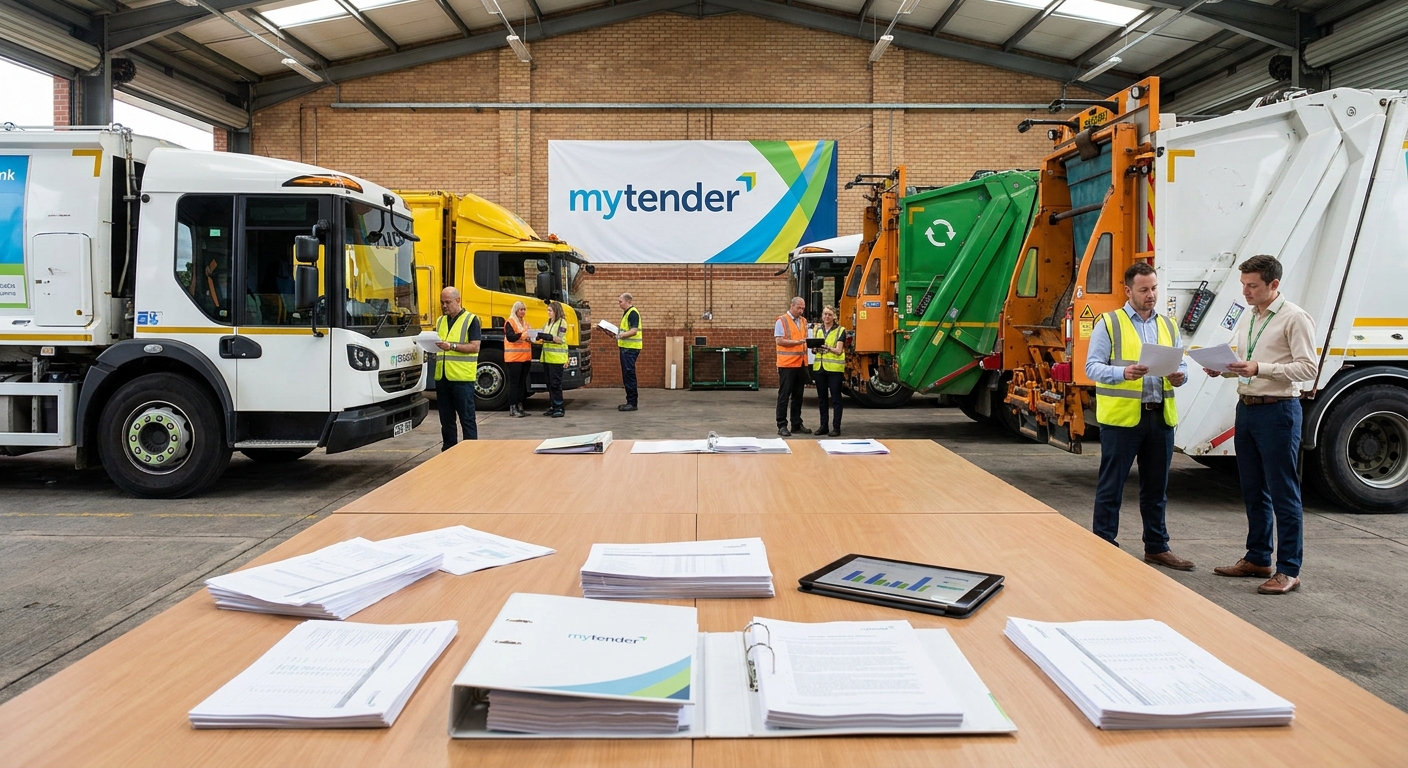
Waste management bid team reviewing a council tender with recycling operations and social value planning
Why Social Value Is Sharper in 2026
The Procurement Act has made public procurement more transparent, more outcomes-focused and less forgiving of vague claims.
The shift to Most Advantageous Tender matters here. Councils are still under cost pressure, but price alone is not the whole story. Evaluators are looking for the bid that gives the authority the best overall outcome, including social, environmental and economic benefit.
At the same time, contract performance is becoming more visible. Larger public contracts now carry stronger expectations around KPIs, reporting and supplier performance notices. That changes the tone of social value.
A promise made in the tender is not just a nice line in a method statement. It can become a contract commitment that gets monitored.
For waste and environmental services, this is especially important because the service is visible. Residents see missed collections. Councillors hear complaints. Local press notices fly-tipping, contamination and recycling performance. Social value is not abstract in this sector. It lands on streets, estates, schools and household waste sites.
What Councils Actually Reward
Councils reward social value that solves a local problem.
That sounds obvious, but most bidders miss it. They write from their company ESG strategy, not from the authority's needs.
A strong answer starts with the borough, district or county in front of you. What are its recycling targets? Where are the deprived wards? Is youth unemployment high? Are contamination rates a problem? Is the authority trying to reduce fleet emissions? Does it have a reuse strategy? Has it declared a climate emergency?
Your social value answer should feel like it belongs to that place.

Framework diagram showing the social value themes councils reward in waste tenders
Councils tend to reward five things in waste tenders:
- Local economic benefit that is specific, costed and tied to the contract.
- Environmental improvement beyond basic legal compliance.
- Community behaviour change that reduces contamination and improves participation.
- Workforce development that creates real skills, not token placements.
- Transparent reporting that lets the authority prove progress.
The weighting will vary. A London borough may care heavily about air quality, community engagement and estate-level contamination. A county council may care more about household waste recycling centres, reuse partnerships and rural collection efficiency.
The principle is the same. Show the evaluator that your commitments are built around their local outcomes.
The Weak Answer: Generic ESG in Tender Clothing
A weak social value answer usually has three features.
First, it is broad. It says the bidder will support local employment, reduce carbon and engage communities, but it does not say where, when or by how much.
Second, it is detached from operations. The answer talks about company values, but the mobilisation plan, route design, depot model, subcontractor strategy and contract management approach do not mention social value again.
Third, it avoids measurement. The commitments are easy to say and hard to audit.
Here is the kind of sentence evaluators skim past:
> We are committed to delivering meaningful social value through local employment, environmental stewardship and community engagement throughout the life of the contract.
Nothing in that sentence is wrong. That is exactly why it is weak. It is so safe that it tells the evaluator nothing.
A better version would be:
> During mobilisation, we will reserve 12 interview slots for residents from the authority's three priority wards, delivered with the council's employment team and reported monthly through the contract dashboard. Our contract manager will own the commitment, with HR support from week two of mobilisation.
That is still not perfect, but it gives the evaluator something to score. It has a number, a target group, a delivery route, an owner and a reporting mechanism.
Start With the Local Baseline
Do not start writing social value until you have built a local baseline.
You do not need a 40-page research pack. You need enough context to make the answer feel anchored.
Look for:
- The council plan and climate strategy.
- Waste strategy, recycling performance and contamination priorities.
- Social value policy or TOMs framework, if used.
- Local economic priorities, especially unemployment, skills and deprived wards.
- Air quality management areas and fleet decarbonisation targets.
- Community groups, reuse charities and schools programmes already active locally.
- Previous waste contract notices, award notices and committee papers.
This turns the answer from generic into local.
For example, if the authority has a published priority around youth employment, do not simply promise apprenticeships. Explain which roles are suitable, when recruitment starts, what training provider you will use, how supervisors will protect service reliability, and how you will report retention.
If contamination is the issue, do not promise a vague education campaign. Explain how your crews will record contamination hotspots, how that data will trigger targeted resident communications, and how you will measure reduction by round or estate.
Local evidence makes the commitment believable.Build Commitments You Can Actually Deliver
Social value is dangerous when the bid team writes cheques the operations team cannot cash.
Waste contracts are operationally tight. Rounds are timed. Depots are constrained. Vehicle availability matters. Absence, traffic, disposal queues and contamination all create pressure.
That does not mean you should be timid. It means your commitments need to be operationally designed.
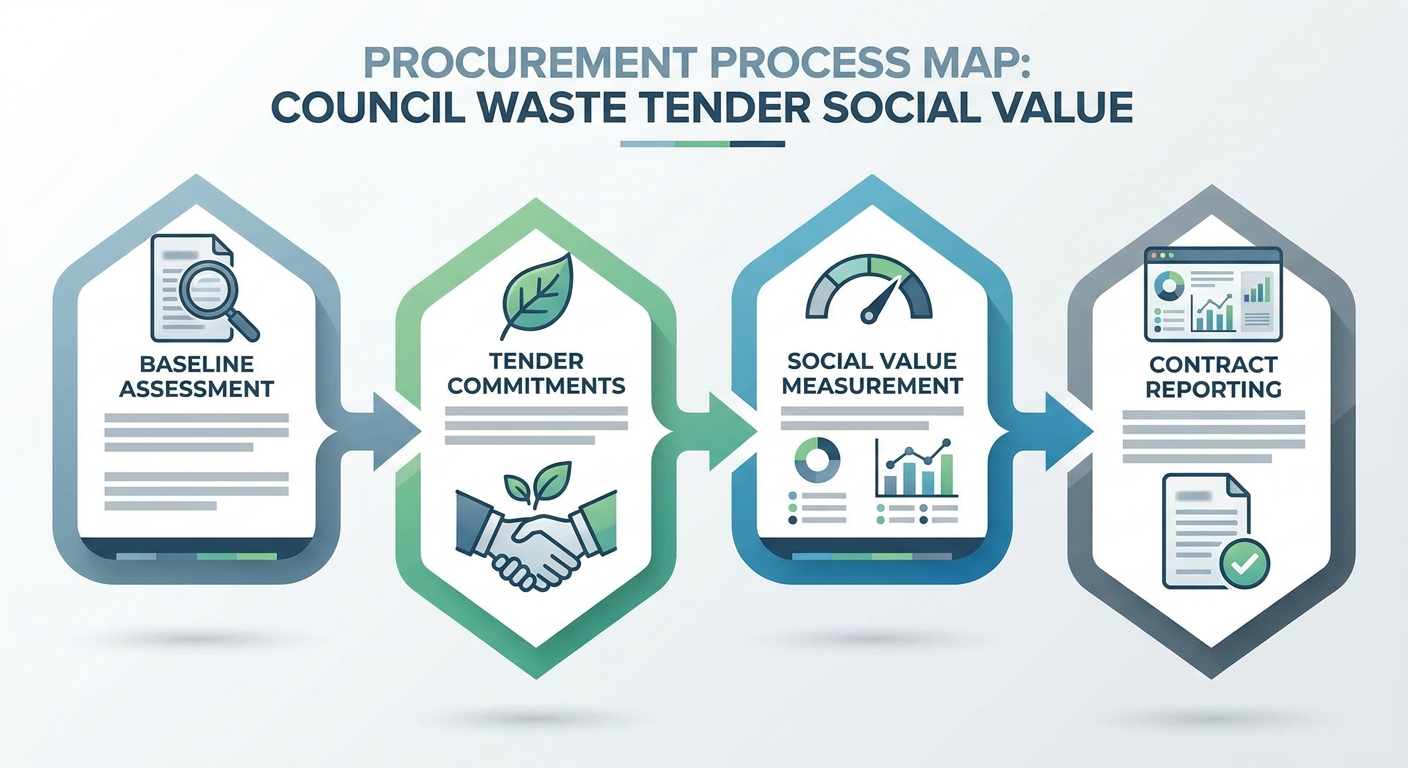
Process map showing how to turn social value promises into deliverable waste contract commitments
A good commitment has six parts:
- Outcome: what changes for the authority or community.
- Action: what you will do.
- Volume: how much you will do.
- Owner: who is responsible.
- Timing: when it happens.
- Evidence: how it will be measured and reported.
If one of those parts is missing, the evaluator has to guess. Do not make them guess.
Take community education. A weak answer says you will run school workshops. A stronger answer says you will deliver 24 curriculum-linked recycling sessions per year, prioritising schools in low-participation areas, with pre and post-session quizzes, teacher feedback and a termly summary shared with the council.
That feels like a service. Not a slogan.
Local Jobs: Make the Numbers Defensible
Local employment is one of the most common social value themes in waste tenders. It is also one of the easiest to overpromise.
Councils like local jobs because they are politically and economically visible. But evaluators know that waste contracts often transfer existing staff under TUPE. If most roles transfer, promising a large number of new local jobs can look naïve.
The better answer distinguishes between:
- TUPE-protected roles.
- Vacancies created during mobilisation.
- Apprenticeships and trainee roles.
- Supervisor development pathways.
- Local supply chain spend.
- Volunteering or community hours.
If TUPE applies, say so. Then explain where additional opportunities genuinely exist.
For example, new roles may come from contamination teams, customer contact support, data analysts, reuse partnerships, HGV apprenticeship pipelines or seasonal bring-site support.
A credible local jobs commitment might say:
> We expect the core collection workforce to transfer under TUPE. Our additional local employment commitments therefore focus on vacancies, apprenticeships, reuse roles and supervisor progression rather than assuming wholesale new recruitment.
That sentence earns trust. It shows the bidder understands the contract.
Carbon and Fleet Commitments: Go Beyond Vehicle Badges
Every waste bidder now talks about electric vehicles, HVO, route optimisation and carbon reduction.
The weaker answers stop there.
A council evaluator wants to know how the fleet plan links to service risk, depot constraints, charging, maintenance, resilience and emissions reporting. A zero-emission promise is only impressive if it survives Monday morning operations.
Strong carbon answers cover:
- Baseline emissions for the proposed service model.
- Vehicle technology by route type, not just headline fleet mix.
- Charging or fuelling arrangements.
- Contingency plans for vehicle downtime.
- Route optimisation assumptions.
- Driver behaviour and telematics.
- Reporting frequency and methodology.
Waste contracts are full of trade-offs. A smaller electric vehicle may suit dense urban rounds but not long rural collections. HVO may be useful during transition but needs supply assurance. Route optimisation can reduce mileage, but only if assisted collections, access constraints and disposal points are properly modelled.
Do not pretend the trade-offs do not exist. Explain how you manage them.
Reuse and Circular Economy: The Marks Are in the Detail
Reuse is attractive because it links environmental benefit with community value.
Furniture, electricals, textiles, bikes, paint and bulky waste all create opportunities. But again, vague claims do not score well.
A strong reuse answer explains the operating model.
Who identifies reusable items? Are crews trained? Where are items stored? Which partners receive them? How is quality checked? How do you avoid cherry-picking? What data is reported? How are safeguarding and liability handled for donated goods?
Councils reward answers that turn reuse into a managed pathway.
This is especially useful where the authority has social aims around low-income households, community organisations or local repair schemes. If you can show that reusable items are diverted from disposal and directed into credible local channels, the social and environmental value becomes tangible.
Community Engagement: Target Behaviour, Not Awareness
Waste communication often defaults to awareness campaigns.
Awareness is not the same as behaviour change.
If contamination is high in flats above shops, a borough-wide recycling leaflet will not fix it. If food waste participation is low in a particular estate, a generic social media post will not move the number. If residents are confused by collection changes during mobilisation, the answer needs a communications plan tied to the rollout.
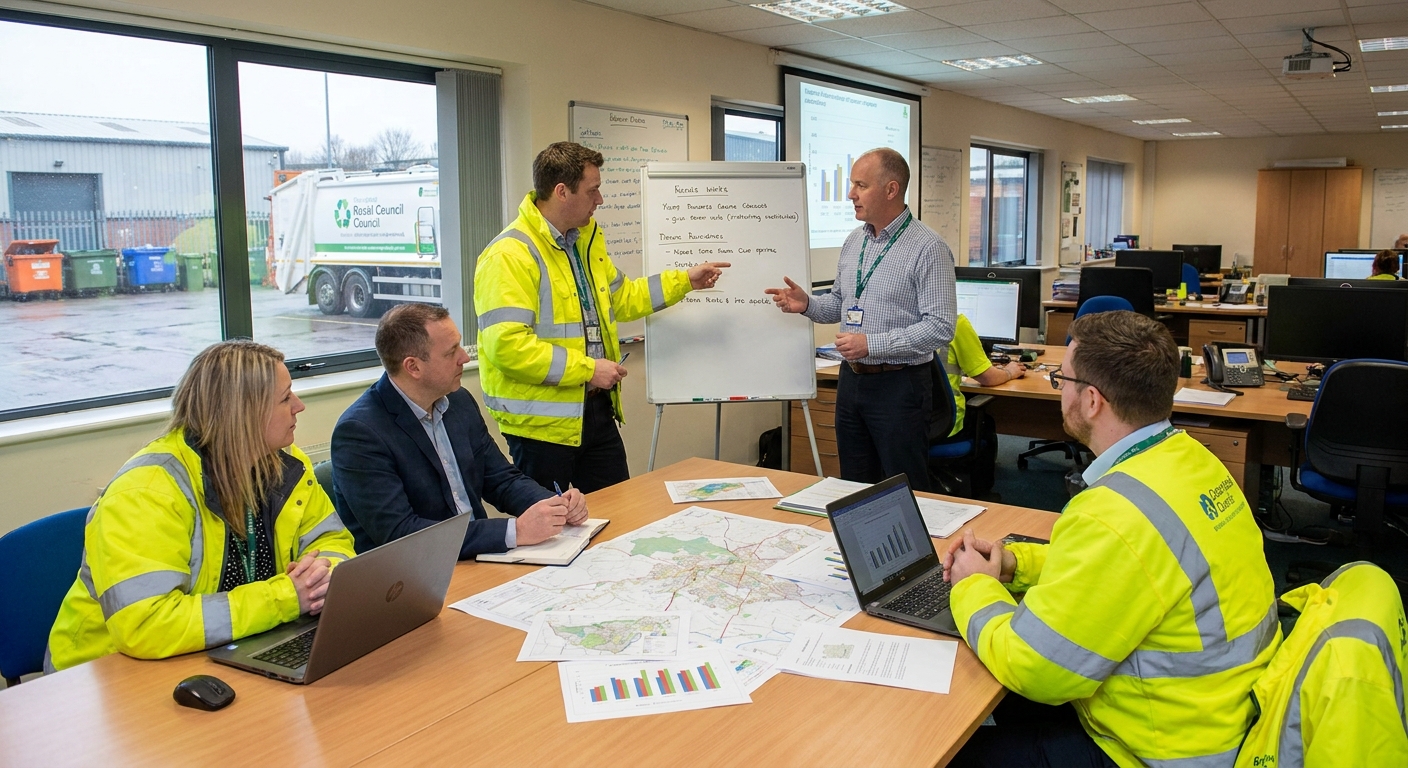
Waste and recycling operations team planning local employment and community engagement for a council contract
Good community engagement answers are targeted.
They identify the behaviour, audience, intervention and metric.
Examples:
- Reducing contamination on named high-risk rounds through crew-tagging, resident letters and follow-up visits.
- Increasing food waste participation in low-performing streets using starter packs and door-knocking.
- Supporting schools in areas with low recycling participation through practical sorting activities.
- Improving bulky waste reuse by changing booking scripts and collection crew prompts.
The point is not to sound busy. The point is to change the operational result.
Supply Chain Social Value: Use Local Partners Carefully
Local supply chain spend can be persuasive, especially for depot services, vehicle maintenance, PPE, signage, training, community engagement and reuse partnerships.
But do not pad the answer with a long list of possible local suppliers. Evaluators know when a bidder has done a quick directory search.
Instead, show a controlled approach:
- Which categories are suitable for local sourcing.
- How you will identify and onboard suppliers.
- How you will protect quality, safety and continuity.
- How much spend is realistically addressable.
- How local spend will be reported.
If you already have local partners, name the type of partner and evidence the relationship where appropriate. If not, explain the mobilisation process and be honest about due diligence.
Local does not beat safe, compliant and reliable. The best answer balances all three.
Reporting: The Part Most Bidders Underwrite
Social value reporting is where many bids fall apart.
The answer promises outcomes, but the contract management section only reports missed collections, complaints, recycling tonnage and health and safety. Social value vanishes after award.
That is a scoring mistake.
In 2026, performance transparency is a bigger theme across public procurement. Councils need commitments they can manage. Your answer should make their life easier.
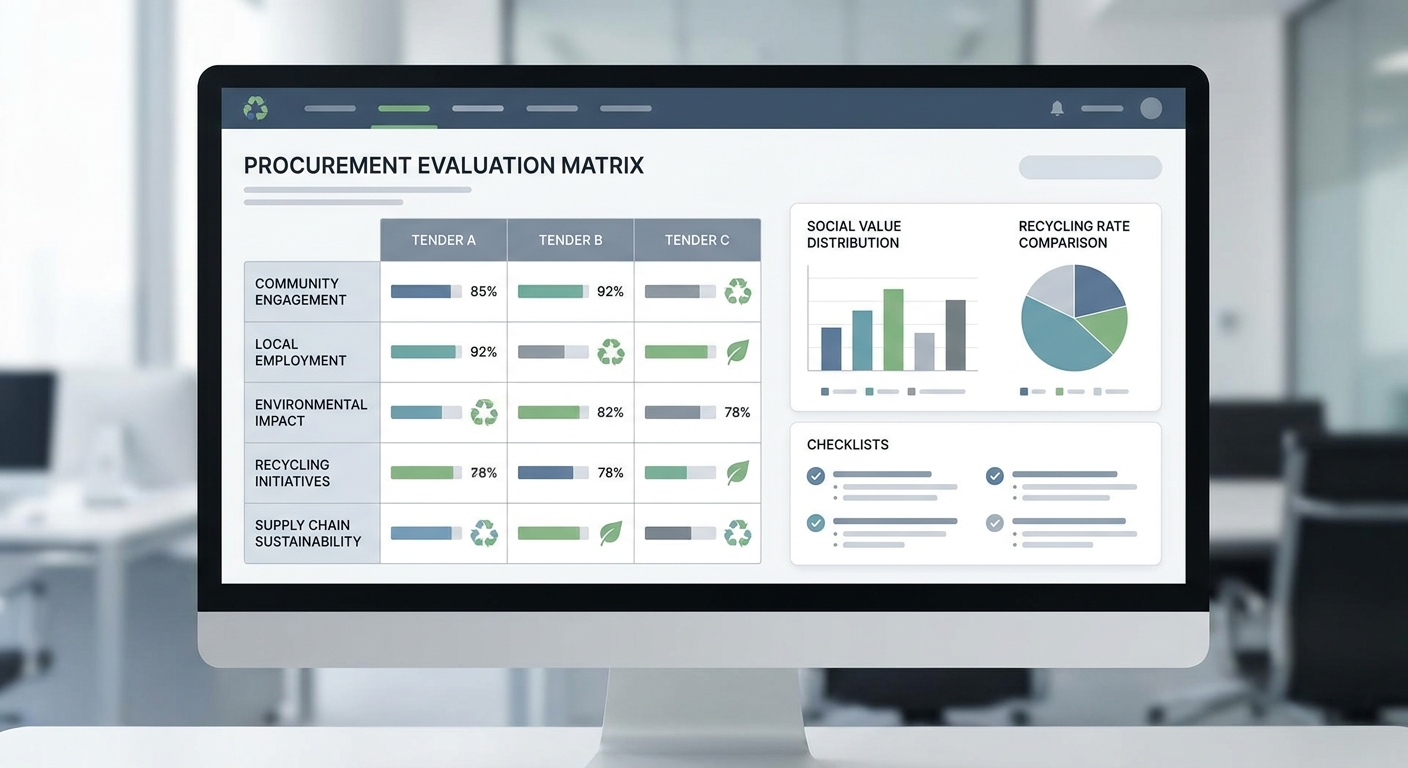
Dashboard style evaluation matrix for waste tender social value scoring and contract reporting
A strong reporting model includes:
- A mobilisation social value plan.
- Named owner and governance route.
- Monthly dashboard or contract meeting section.
- Evidence attachments, not just narrative updates.
- RAG status for each commitment.
- Corrective action if delivery slips.
- Annual review and refresh with the authority.
This is where mytender.io can help bid teams avoid losing commitments across files. If your bid library holds previous social value commitments, contract evidence, local examples and KPI reports in one place, the next waste tender becomes much easier to evidence.
The key is not the tool. It is the discipline: every claim needs a proof route.
How to Structure the Social Value Answer
Most waste tender social value questions are not asking for a philosophy. They are asking for a delivery plan.
Use a structure that makes scoring easy.
1. Start With the Authority's Priorities
Open with two or three lines showing you understand the local context.
Example:
> The authority's waste strategy prioritises higher recycling participation, reduced contamination and stronger local economic benefit. Our social value plan is therefore built around targeted behaviour change, local skills pathways and transparent monthly reporting.
That is much stronger than opening with your corporate values.
2. Group Commitments by Outcome
Do not scatter promises across the answer.
Group them under clear outcomes, such as:
- Local employment and skills.
- Carbon reduction and air quality.
- Reuse and circular economy.
- Community education and behaviour change.
- Local supply chain and voluntary sector partnerships.
Each outcome should include actions, targets, timing and evidence.
3. Connect to Mobilisation
Social value should start during mobilisation, not six months after go-live.
Explain what happens in weeks 1 to 12. For example, partner engagement, recruitment planning, baseline data capture, route risk review, school programme planning, dashboard setup and community communications.
If social value is absent from mobilisation, evaluators may doubt it will happen.
4. Show Governance
Name the role, not just the organisation.
Say whether the contract manager, social value lead, depot manager, HR partner or community engagement officer owns each activity. Explain how progress is reviewed.
This is especially important in waste because operational managers are busy. If social value has no owner, it will be the first thing dropped when service pressure hits.
5. End With Measurement
Close each commitment with the evidence route.
For example:
- Number of local residents interviewed, recruited and retained.
- Apprenticeship starts, completion and progression.
- Tonnes diverted to reuse routes.
- Estimated carbon saved by route changes or fleet transition.
- Contamination reduction by target area.
- Community sessions delivered and feedback received.
- Local supply chain spend by category.
Measurement turns a promise into a contract-ready commitment.
A Practical Example: Food Waste Participation
Imagine a council asks how you will support increased recycling and reduce residual waste.
A weak answer says:
> We will run education campaigns to encourage residents to use food waste caddies and recycle correctly.
A stronger answer might say:
> In the first 90 days, we will use route data, crew feedback and council participation data to identify the 10 lowest-performing food waste areas. We will then deliver targeted interventions, including starter caddy checks, resident letters, estate walkabouts where relevant and crew-reported barriers. We will report participation changes monthly and agree follow-up actions with the council.
The second answer works because it is operational. It uses data, targets an audience, includes interventions and creates a reporting loop.
It also gives the evaluator confidence that the bidder understands how waste behaviour changes in the real world.
A Practical Example: Local Skills
Local skills commitments often fail because they sound detached from the actual workforce model.
A weak answer says:
> We will create apprenticeships and training opportunities for local people.
A stronger answer says:
> Subject to TUPE completion and vacancy profiling, we will create two LGV driver apprenticeship pathways in year one, prioritising residents referred through the council's employment service. Apprentices will be mentored by named supervisors, reviewed quarterly and offered progression into permanent driver roles where vacancies exist.
Again, the stronger answer is not more flowery. It is more controlled.
It handles TUPE, gives a number, names the pathway, explains referral, sets review frequency and links to progression.
What to Avoid
There are a few traps worth calling out.
Do not promise everything. A tight set of credible commitments usually scores better than a bloated menu.
Do not copy your corporate ESG page. Evaluators have read that answer before.
Do not rely on national initiatives unless you can show local delivery.
Do not treat volunteering as the main social value offer. Staff volunteering can help, but it rarely compensates for weak operational commitments.
Do not forget cost. If the commitment requires budget, staff time or partner funding, make sure it is built into the commercial model.
Do not ignore contract duration. A seven-year waste contract can support deeper commitments than a two-year extension.
Most importantly, do not create commitments the delivery team has not approved. That is how bids win marks and contracts lose trust.
The Bid Library Angle
Social value answers improve dramatically when the bid team has a proper evidence library.
For waste tenders, useful evidence includes:
- Previous local employment outcomes.
- Apprenticeship completion data.
- Reuse tonnage and partner case studies.
- Community engagement calendars and feedback.
- Fleet emissions data.
- Route optimisation outcomes.
- Contamination reduction examples.
- Contract review dashboards.
- Letters from councils, partners or community organisations.
The goal is not to paste old answers into new bids. The goal is to reuse proof.
If you can quickly find evidence that a similar commitment worked elsewhere, your answer becomes more credible and easier to write under deadline pressure.
The Evaluator Test
Before submitting, read your social value answer like an evaluator.
Ask five questions:
- Can I see the local problem this commitment solves?
- Is the action specific enough to manage after award?
- Is there a number, date, owner or reporting route?
- Does the commitment connect to the waste service model?
- Would I believe this bidder can deliver it on a wet Tuesday in February?
That last question matters. Waste contracts are practical. Evaluators trust answers that understand the grit of delivery.
The Bottom Line
Social value in waste tenders is not about sounding virtuous.
It is about proving that your service will leave the authority, residents and environment better off in ways that can be seen, measured and managed.
The strongest bidders do three things well. They localise the answer. They design commitments around the operating model. They report progress in a way the council can use.
Do that, and social value stops being a compliance chore. It becomes a scoring advantage.
If you want to find live waste and environmental services opportunities, the mytender.io Tender Finder is free to use. It is a useful way to see what councils are asking for now, before the next deadline lands.
Tags
Ready to Transform Your Tender Writing?
See how MyTender's AI can help you write winning tenders in a fraction of the time.