

Social Value in Tenders: The Complete Guide to Writing Compelling Social Value Statements (2026)
Social value now accounts for up to 20% of tender scores in UK public sector procurement. Discover how to write winning social value statements, measure your impact, and use AI to outperform competitors on this critical evaluation criterion.
Evie Thompson
Procurement Strategy Specialist @ mytender.io
Social Value in Tenders: The Complete Guide to Writing Compelling Social Value Statements (2026)
There is a question that sits uncomfortably in most bid team meetings: how much weight does social value actually carry, and are we doing enough to win on it?
The honest answer is: more than most suppliers realise, and probably not enough. Social value is now mandatory in all central government procurements above £5 million, carries a minimum 10% weighting (and frequently 20% or more in local authority and NHS tenders), and has become one of the most differentiating criteria on the scorecard. Yet the majority of social value responses submitted by suppliers are vague, unquantified, and indistinguishable from one another.
That gap — between what evaluators expect and what most suppliers deliver — is the opportunity. If you learn to write social value well, you will consistently outscore competitors who treat it as a compliance exercise. This guide explains exactly how.
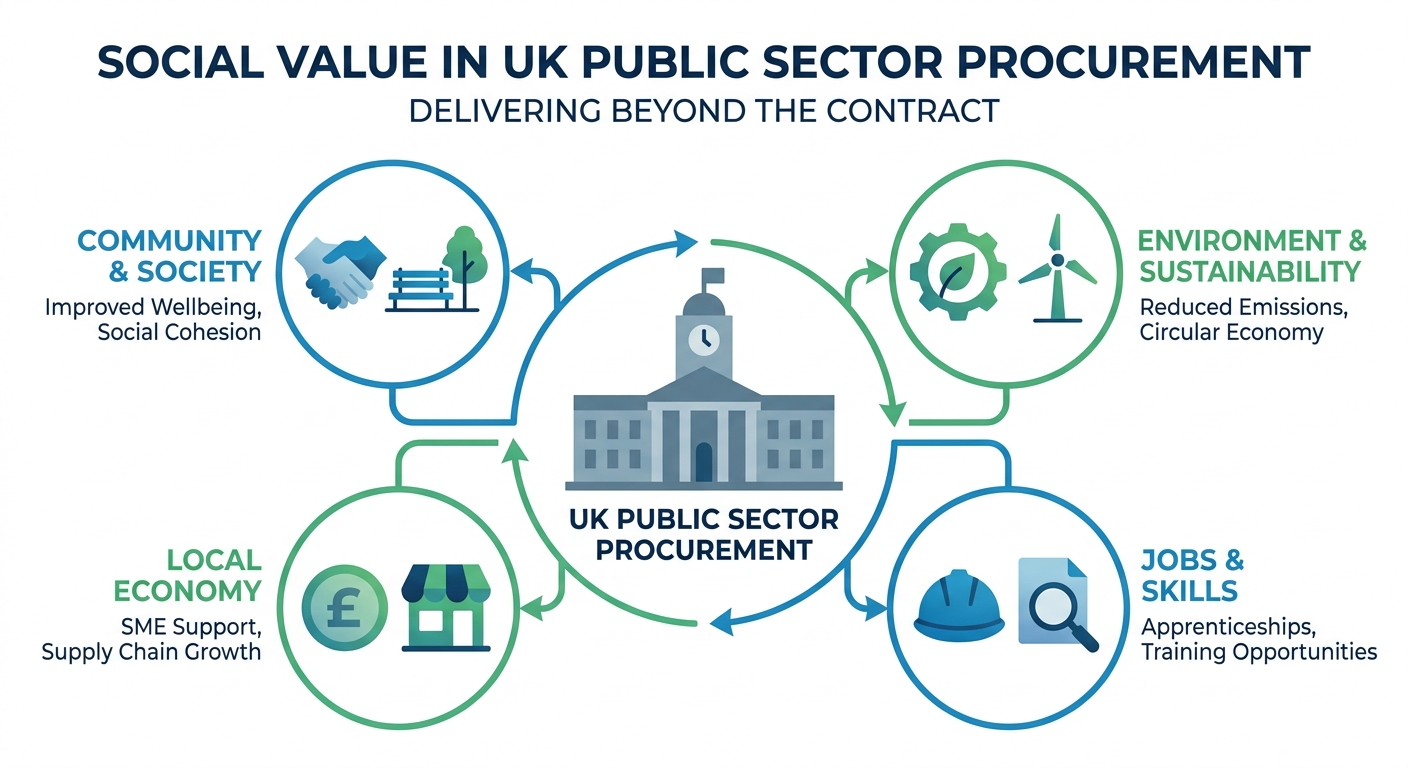
Professional infographic showing social value in UK public sector procurement with community, environment, jobs and economy icons
What Social Value Actually Means in Procurement
Social value in procurement refers to the wider economic, social, and environmental benefits that a contract can generate beyond the direct delivery of the service itself. It's the idea that when public money is spent, it should do more than just buy a service — it should create jobs, support local communities, reduce carbon emissions, and generate positive outcomes for society.
The legal foundation in the UK is the Public Services (Social Value) Act 2012, which requires public authorities to consider the social value of what they are procuring before starting the procurement process. But it was the introduction of the Social Value Model in January 2021 — and its mandatory application across central government — that transformed social value from a vague obligation into a scored, evaluated criterion with real commercial consequences.
The Procurement Act 2023, which came into force in February 2025, has accelerated this further. The new Act places greater emphasis on value for money in its broadest sense, explicitly including social, environmental, and economic outcomes. Buyers are now expected to define social value criteria with far greater precision, and suppliers are expected to respond in kind.
If you bid for public sector contracts and haven't updated your approach to social value since 2021 or earlier, you are almost certainly leaving score points on the table.
The Social Value Model: The Five Themes That Shape Every Response
The government's Social Value Model organises social value commitments around five strategic themes. Understanding this structure is the foundation of any effective response, because most central government buyers — and an increasing number of local authorities and NHS trusts — use this framework explicitly.
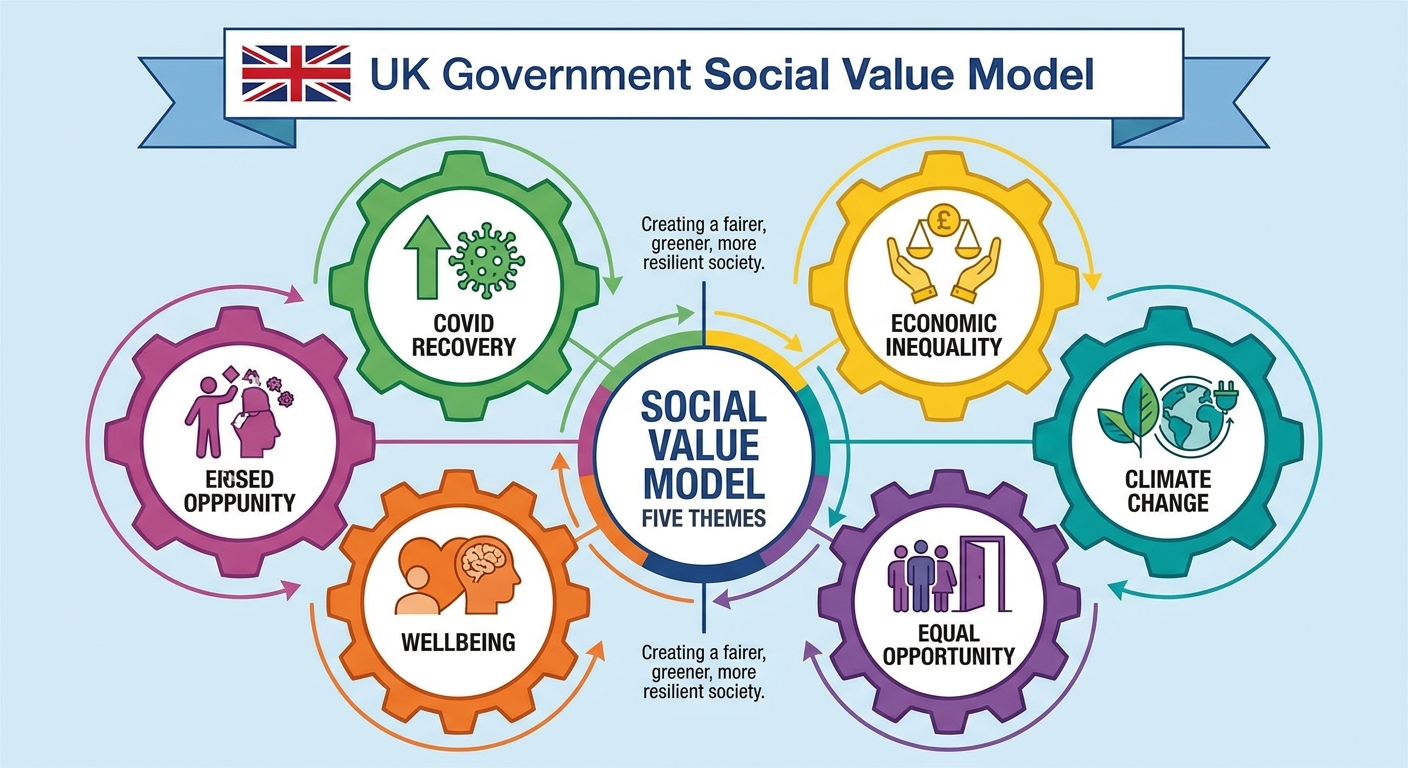
UK government Social Value Model five themes diagram covering economic inequality climate change equal opportunity wellbeing
Theme 1: COVID-19 Recovery
Help local communities to manage and recover from the impact of COVID-19. Despite the pandemic receding from immediate headlines, this theme remains in the model and evaluators still want to see commitments around economic recovery, mental health support, and rebuilding community resilience. In practice, this often overlaps with Theme 4 (equal opportunity) and Theme 5 (wellbeing).
Theme 2: Tackling Economic Inequality
Create new businesses, new jobs, and new skills. This is frequently the highest-weighted theme and the one where suppliers can make the most concrete commitments. It includes apprenticeships, graduate roles, support for SMEs and voluntary organisations in the supply chain, and skills development programmes.
Theme 3: Fighting Climate Change and Reducing Waste
Effective stewardship of the environment. Carbon reduction commitments, net zero pathways, sustainable supply chains, reduction of single-use plastics, electric vehicle fleets — this theme has grown enormously in importance as public bodies pursue their own net zero targets.
Theme 4: Equal Opportunity
Reduce the disability employment gap and tackle workforce inequality. Commitments around inclusive recruitment, support for care leavers, veteran employment, disability confidence, and diversity and inclusion programmes all fall here.
Theme 5: Wellbeing
Improve health and wellbeing (physical and mental) and create a fairer, more inclusive society. Employee wellbeing programmes, community engagement, mental health first aid training, volunteering hours — this theme rewards suppliers who demonstrate genuine investment in people.
Each theme contains specific policy outcomes (POs) and model award criteria (MACs) that buyers select from when designing their evaluation framework. A buyer might choose three MACs from Theme 2 and two from Theme 3, weight them at 15% of the total score, and ask you to respond to each in turn.
The practical implication: always read the evaluation criteria with this framework in mind. Match your response structure to the MACs explicitly listed in the tender documents, not to generic themes.
Why Most Social Value Responses Fail
Before getting to what good looks like, it's worth being precise about what bad looks like — because most poor social value responses share the same failure modes.
Vague commitments without numbers. "We are committed to supporting local communities" scores nothing. "We will employ 12 local apprentices within the first 18 months of contract, generating an estimated £180,000 of social value using the TOMS framework" scores well. Generic content copied between bids. Evaluators read dozens of responses. They can spot boilerplate. A response that doesn't reference the specific community, the specific contract, or the specific buyer's own social value strategy will be downgraded — often severely. No measurement methodology. Buyers want to know how you will track and report on your commitments. If you can't explain how you'll measure it, they won't trust that you'll deliver it. Commitments not proportionate to contract value. A £500,000 cleaning contract promising 20 apprenticeships is implausible. A £50 million facilities management contract promising 2 is embarrassing. Evaluators benchmark your commitments against contract value, duration, and the local labour market. Ignoring the buyer's own social value priorities. Most public bodies have published social value strategies, local plans, or sustainability frameworks. Failing to reference these — and tailor your response accordingly — is a wasted opportunity. No evidence of delivery on previous contracts. Promises without proof carry less weight than promises backed by case studies, testimonials, or third-party verification from prior contracts.The Anatomy of a High-Scoring Social Value Response

Business professionals writing and reviewing tender documents social value statement with laptop and checklist
A strong social value response has four components: commitments, measurement, accountability, and evidence. Strip any one of those out and your score drops.
1. Specific, Quantified Commitments
Every commitment should answer three questions: what, how many, and when.
Weak: "We will support local employment."
Strong: "We will recruit a minimum of 4 full-time employees from within a 15-mile radius of the contract delivery location within the first 6 months of mobilisation, working with [specific local employment programme] to source candidates."
The specificity signals that you've thought this through. It also makes the commitment monitorable — which matters to evaluators who have to report on social value delivery.
For quantification, the most widely used methodologies are:
- TOMS (Theme, Outcomes, Measures) — developed by the Social Value Portal, widely used in local government
- HACT social value bank — commonly used in housing and construction
- Outcomes Star — used in health and social care contexts
- Open social value — the government's preferred framework for central contracts
Stating which methodology you'll use to calculate and report social value isn't just good practice — it's increasingly required by buyers.
2. A Clear Measurement Framework
This is the part most suppliers skip. Buyers have been burned by suppliers who made elaborate commitments at bid stage and then couldn't report meaningfully on delivery. To avoid that, they now ask explicitly: how will you measure this?
Your measurement section should cover:
- Leading indicators — inputs and activities (e.g., number of apprentices started, volunteering hours committed)
- Lagging indicators — outcomes and impact (e.g., apprentices who completed and gained employment, tonnes of CO₂ avoided)
- Reporting frequency — quarterly is standard for most contracts
- Who is responsible — name a Social Value Lead or equivalent
- What tool or platform — TOMS, Social Value Portal, or equivalent
3. Accountability and Governance
Buyers need to know that someone owns this. Your response should name or describe:
- A dedicated social value lead (with seniority — this shouldn't sit with a junior administrator)
- A reporting cadence and format
- How performance will be escalated if commitments are at risk
- Any incentive or contractual mechanism tied to delivery
Some buyers are now including social value KPIs as contractual obligations — not just evaluation criteria. Showing that you understand this and have governance to match is a differentiator.
4. Evidence From Similar Contracts
Case studies from previous contracts are gold. A brief paragraph explaining what you committed to, what you delivered, and what the measured outcome was — ideally with a quote from a buyer or a link to a published social value report — is worth far more than another page of forward-looking commitments.
If you're bidding for a contract in a new sector or location where you don't have direct experience, use transferable evidence. A facilities management company without NHS experience can still reference social value delivery on a similar-value local authority contract.
Tailoring to the Buyer: The Most Underused Advantage
The single highest-impact thing most suppliers can do to improve their social value scores is to research and reference the specific buyer's priorities. This takes maybe 45 minutes of preparation and routinely adds 15–20% to the quality of the response.
Every NHS trust, local authority, and government department publishes strategy documents. Most have a social value strategy or a sustainability plan. Many have a local economic strategy or a community investment plan. These documents tell you exactly what the organisation cares about.
When you reference those priorities explicitly — when you show that you've read their Carbon Net Zero by 2030 commitment and can explain how your contract delivery will contribute to it — you are demonstrating organisational alignment, not just contract compliance. That's a different conversation with a very different score.
Practical research checklist before writing your social value response:
- Read the buyer's social value strategy (Google "[Buyer name] social value strategy")
- Check for a local economic strategy — particularly for local authorities
- Look up their net zero commitment — most public bodies have a published target
- Find their current supplier diversity commitments — many publish SME and VCSE spend targets
- Check for any recent news — a hospital trust that just announced a mental health initiative will welcome social value commitments that complement it
Calculating the Right Level of Commitment
One of the most common questions bid writers ask is: how much should we commit? Commit too little and you're uncompetitive. Commit too much and you can't deliver it, which will damage your relationship and your reputational scoring on future bids.
The answer depends on three variables: contract value, contract duration, and your organisation's operational capacity.
A useful rule of thumb used by experienced bid consultants is to target social value equivalent to approximately 1–3% of the total contract value, expressed as a monetised figure using an accepted framework (TOMS, HACT, etc.). For a £2 million contract over 3 years, that's £20,000–£60,000 of social value per year — achievable through a combination of apprenticeships, volunteering hours, and local supply chain spend.
But percentage-based targets aren't the whole picture. Some commitments are intrinsically valuable regardless of their monetised equivalence: a commitment to hire 100% of the contract workforce from the local authority area, for example, or a pledge to use only local subcontractors above a certain threshold.
The best approach is a portfolio of commitments — a mix of quantified monetary social value (meeting the framework threshold) and specific, meaningful initiatives (demonstrating genuine engagement).
Social Value Measurement: What Gets Measured Gets Done
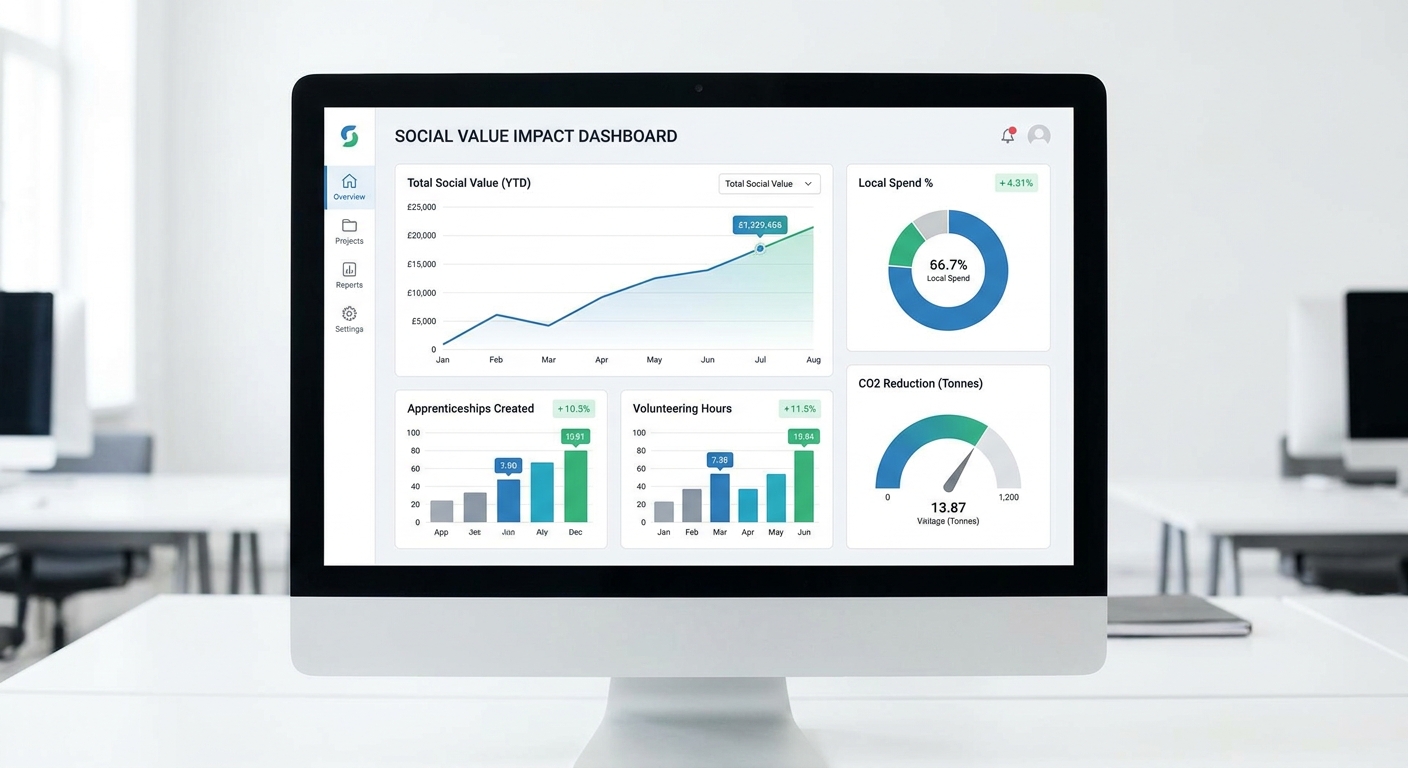
Data dashboard showing social value measurement KPIs including apprenticeships local spend volunteering hours CO2 reduction
Measurement isn't just about satisfying contract managers. Organisations that measure their social value delivery consistently outperform those that don't — because measurement creates accountability, identifies what's working, and generates the case study evidence you need to win the next bid.
The most widely used measurement tool in UK public procurement is the Social Value Portal and its TOMS framework. TOMS assigns a monetary value (using the Treasury Green Book discount methodology) to a range of social value activities, allowing buyers and suppliers to compare and aggregate commitments across diverse contract types.
Key TOMS metrics you'll encounter most frequently:
| Activity | Typical TOMS Value |
|---|---|
| Apprenticeship started | £12,000–£18,000 |
| Full-time local employment created | £20,000+ |
| Volunteering hours (employee time) | £15/hour |
| Supply chain spend with SMEs (% of contract value) | Variable |
| Tonnes CO₂ equivalent avoided | £70–£120/tonne |
| Supported internship completed | £6,000–£9,000 |
Beyond TOMS, a growing number of buyers — particularly in the NHS and housing sector — use HACT's social value bank, which offers particularly granular valuations for health and wellbeing outcomes. If you're bidding in those sectors, familiarise yourself with both frameworks.
Social Value and the Procurement Act 2023: What's Changed
The Procurement Act 2023 has embedded social value considerations more deeply into the procurement lifecycle than ever before. Several changes are directly relevant to how you approach social value in bids.
Broader value for money definition. The Act explicitly defines value for money to include social, environmental, and economic considerations — not just price and quality in the narrow sense. This gives buyers more confidence to weight social value heavily without legal challenge. Pipeline notices and strategic procurement. Buyers are now publishing pipeline notices — advance notification of contracts they intend to procure. This gives suppliers earlier sight of upcoming opportunities, including the buyer's stated strategic priorities. Reading these notices carefully gives you a head start on social value preparation. Transparency and reporting obligations. Contracting authorities must publish more information about contract performance, including how social value commitments are being delivered. This creates stronger incentives for suppliers to deliver what they promise. VCSE and SME considerations. The Act contains specific provisions to encourage procurement from small businesses and voluntary, community, and social enterprises (VCSEs). Commitments to involve VCSEs in your supply chain — or to support local SMEs — now land with more political weight behind them. Early market engagement. The Act encourages buyers to engage with potential suppliers before formal procurement begins. If you participate in market engagement events, you can learn the buyer's social value priorities before the ITT is published — and shape your response accordingly.Using AI to Strengthen Social Value Responses
This is where the gap between modern bid teams and traditional approaches is widest. AI bid writing tools — mytender.io included — can materially improve social value responses in several ways.
Tailoring to buyer context at scale. An AI system with access to your previous bid content can generate a draft social value response that pulls in relevant case studies, matches commitment language to the buyer's strategy, and adapts tone and specificity to the evaluation criteria — in minutes rather than hours. Identifying gaps. AI tools can review your draft response against the model award criteria and flag where you haven't addressed a specific theme, where your commitments lack quantification, or where your measurement methodology is missing. Evidence mining. If your organisation has delivered contracts before, you likely have social value data scattered across project reports, KPI logs, and contract manager communications. AI tools can help synthesise this into coherent case study evidence. Consistency across bids. One of the biggest challenges for organisations bidding across multiple lots or frameworks is ensuring that social value commitments are consistent, escalating appropriately with contract value, and not inadvertently contradicting each other. AI tools can enforce this consistency across your bid library. Quality scoring. mytender.io's scoring engine can evaluate a social value response against the specific criteria, flag weak language, identify missing components, and suggest improvements before submission.The key point is that AI doesn't replace the need for genuine, deliverable commitments. It helps you express those commitments more precisely, more persuasively, and more consistently than most bid teams can manage manually under deadline pressure.
A Practical Social Value Writing Framework
For any social value question, use this structure:
1. Open with alignment (1–2 sentences) State that you understand the buyer's social value priorities and that your response is directly aligned to their strategy. Name the specific framework or policy document if you've identified it. 2. Commit to specific outcomes (the bulk of your response) For each MAC or theme required, provide:- The specific commitment (what, how many, when)
- How it will be delivered (partnerships, programmes, mechanisms)
- How it will be measured (framework, tool, reporting frequency)
- Evidence from a similar contract (brief case study or data point)
Common Social Value Commitments That Score Well
Different sectors weight different themes. But across most public sector procurement, the following commitments consistently score strongly — because they are specific, measurable, and directly responsive to the themes buyers care about.
Employment and skills:- Apprenticeships (with a named training provider and ESFA registration number)
- Local recruitment targets (defined by postcode area or travel time)
- Work experience placements for young people, care leavers, or ex-offenders
- Supported internships for people with learning disabilities
- National Living Wage (or London Living Wage) commitment for all contract staff
- Fleet electrification timeline with specific vehicle numbers and dates
- Carbon reduction targets aligned to SBTi (Science Based Targets initiative)
- Elimination of single-use plastics from contract operations
- Local supply chain commitments that reduce transport miles
- Biodiversity net gain contributions (particularly relevant for construction and facilities)
- Employee volunteering hours (with a specific annual target)
- Partnerships with local VCSEs or charities
- In-kind support for community organisations (skills, resources, meeting space)
- Mentoring or business development support for social enterprises in the supply chain
- Commitment to the Disability Confident scheme (at least Employer level)
- Armed forces covenant signatory
- Gender pay gap reporting and targets
- Neurodiversity-inclusive recruitment practices
- Fair pay audits across the supply chain
Delivering What You Promise: The Long-Term View
It's worth being direct about something that bid teams sometimes overlook: the social value you commit to in a bid is a contractual obligation. If you commit to 4 apprenticeships and deliver 1, that failure will appear in your contract performance data — data that is now published under the Procurement Act's transparency requirements and that can follow you into future evaluations.
This means the bid stage isn't the right time to be aspirational beyond your operational capacity. It's the right time to be specific about what you will genuinely deliver, and then to deliver it.
Organisations that build a genuine track record of social value delivery — that have the case studies, the testimonials, the measurement data to prove it — build a compounding competitive advantage. Every contract won and successfully delivered becomes evidence for the next bid. The social value portfolio grows. The score gets harder for competitors to match.
That's the long game. It requires treating social value not as a bid exercise but as an operational commitment that your delivery teams own, your contract managers track, and your business development team can evidence when the next opportunity comes around.
Integrating Social Value Into Your Bid Process
Most organisations treat social value as a late-stage add-on — something the bid writer handles in the final days before submission. That's backwards.
Social value should enter the bid process at the bid/no-bid stage. When you're deciding whether to pursue an opportunity, you should already be asking: what social value can we credibly commit to, and is it competitive? If the answer is weak — because you don't have a local presence, don't have relevant community partnerships, or have never delivered meaningful social value on similar contracts — that's a factor in the decision.
Once you're committed to a bid, social value research and planning should run alongside the rest of the bid development, not after it. Your delivery team should be involved in shaping the commitments, not just rubber-stamping what the bid writer has promised. Your HR and operations leads should sign off on employment commitments. Your fleet or facilities team should validate your environmental pledges.
This sounds like more work. It is, slightly — but it produces commitments that are credible, deliverable, and specific. And specific commitments score significantly better than generic ones.
Social Value Across Different Contract Types
The right social value commitments vary significantly by sector and contract type. Here's a brief orientation for the most common procurement contexts.
Construction and infrastructure: Environmental commitments carry high weight — carbon reduction, waste diversion from landfill, biodiversity net gain. Employment commitments are strong here too, with apprenticeships and local labour agreements common. HACT's social value bank or RICS-endorsed methodologies are often specified. Facilities management and cleaning: Local employment is king, followed by supply chain SME commitments and environmental performance (energy reduction, chemical-free cleaning). Living Wage certification is a differentiator. IT and digital services: Harder to point to physical social value, but digital skills programmes, partnerships with coding academies or bootcamps, and support for digital inclusion initiatives score well. Carbon reduction commitments for data centres and office operations are increasingly expected. Health and social care: Wellbeing themes dominate. Mental health support for staff, community health programmes, partnerships with VCSEs, and volunteering commitments that support patient communities. HACT social value bank is widely used. Professional services: Supply chain diversity (SME and VCSE involvement), pro bono support for public sector organisations, apprenticeship programmes, and gender/ethnicity pay gap targets. Transport and logistics: Fleet electrification timelines, zero-emission delivery commitments, driver training and wellbeing, local employment.Checklist: Before You Submit Your Social Value Response
Run through this before hitting send:
- [ ] Have you addressed every MAC or theme specified in the evaluation criteria?
- [ ] Are all commitments specific — with numbers, dates, and named delivery mechanisms?
- [ ] Have you referenced the buyer's own social value strategy or sustainability plan?
- [ ] Is there a named Social Value Lead with seniority?
- [ ] Have you specified which measurement framework you'll use (TOMS, HACT, etc.)?
- [ ] Have you included a monetised total value figure?
- [ ] Is there at least one case study or evidence point from a previous contract?
- [ ] Are your commitments proportionate to contract value and duration?
- [ ] Have your delivery and operations teams validated the commitments?
- [ ] Have you described how you'll report on delivery and what escalation processes exist?
If you can check every box, your response is in the top quartile. If you're missing more than two, go back and strengthen it before submission.
How mytender.io Supports Social Value Writing

Team collaborating on social value tender response using AI bid writing tools
mytender.io's AI bid writing platform is specifically designed to handle the complexity of social value responses without the hours of manual effort that strong answers typically require.
The platform's content library can store all your previous social value case studies, commitment data, and measurement reports — making them instantly accessible when drafting a new response. When you upload an ITT, the system identifies the relevant social value criteria, cross-references them with the government's Social Value Model, and generates a structured draft that draws on your existing evidence.
The scoring engine evaluates your draft against the specific evaluation criteria, identifying where commitments need strengthening, where language is too vague, and where measurement methodology is missing. This review process — which a skilled bid consultant might take several hours to complete — happens in minutes.
For teams that bid across multiple frameworks or sectors, the consistency checking feature ensures that your social value commitments don't inadvertently contradict each other across concurrent bids, and that they scale appropriately with contract value.
The result is a social value response that is faster to write, more precisely targeted to the buyer's priorities, better evidenced, and more consistent in quality than most teams can produce manually — especially under the deadline pressure that characterises most bid processes.
Final Thoughts: Social Value Is a Real Opportunity
The temptation is to treat social value as a box-ticking exercise — something you have to do to pass muster, but that doesn't really change the outcome. That temptation is based on a misreading of how evaluators actually use the scores.
In a competitive tender where technical quality scores are clustered (as they often are — experienced bidders tend to score similarly on methodology and experience), social value scoring is frequently what separates the winner from the runner-up. A 10% or 20% social value weighting is material. Scoring 7/10 instead of 4/10 on that section can determine whether you win or lose a contract worth hundreds of thousands of pounds.
More than that: buyers are getting better at this. The evaluators who assess social value responses in 2026 are more sophisticated than those who did it in 2021. They can spot boilerplate. They know what a genuinely committed supplier looks like versus one that's going through the motions.
The good news is that doing this well is achievable for any organisation willing to put in the preparation. Research the buyer. Quantify your commitments. Build a measurement framework. Get your delivery team to own it. Write it clearly, with evidence.
Do those things, and social value goes from being a section of the bid you dread to one of your strongest competitive advantages.
---
mytender.io helps procurement teams write better bids faster. Our AI platform handles the research, structuring, and quality review of social value responses so your team can focus on the commitments that matter. Start your free trial today and see how mytender.io can improve your social value scores.Tags
Ready to Transform Your Tender Writing?
See how MyTender's AI can help you write winning tenders in a fraction of the time.