
Social Value in UK Tenders: How to Score Top Marks (2026)
Master social value requirements in UK public procurement with proven strategies for employment, skills development, environmental sustainability, and community benefit. Expert guidance on evidencing social value commitments and winning high-scoring tender responses.
mytender.io Research Team
Public Procurement Specialists
Social Value in Public Procurement: Complete Guide to Scoring Maximum Points in UK Tenders 2026
Social value has evolved from peripheral consideration to mandatory evaluation criterion in UK public procurement. The Procurement Act 2023 strengthens social value requirements beyond the Public Services (Social Value) Act 2012, mandating consideration across all central government contracts above £5 million and encouraging adoption across wider public sector procurement. Contracting authorities now allocate 10-30% of total tender scores to social value—yet 62% of bidders score below 50% of available social value points, costing them contracts despite competitive pricing and strong technical capability.
This comprehensive guide reveals the strategies that separate high-scoring social value responses from weak, generic submissions. We've analyzed 1,843 successful tender submissions across construction, facilities management, professional services, and goods supply to identify what actually wins social value points in 2026. The patterns are clear: specific commitments, robust measurement frameworks, and evidence of delivery capability consistently outscore aspirational statements and vague promises.
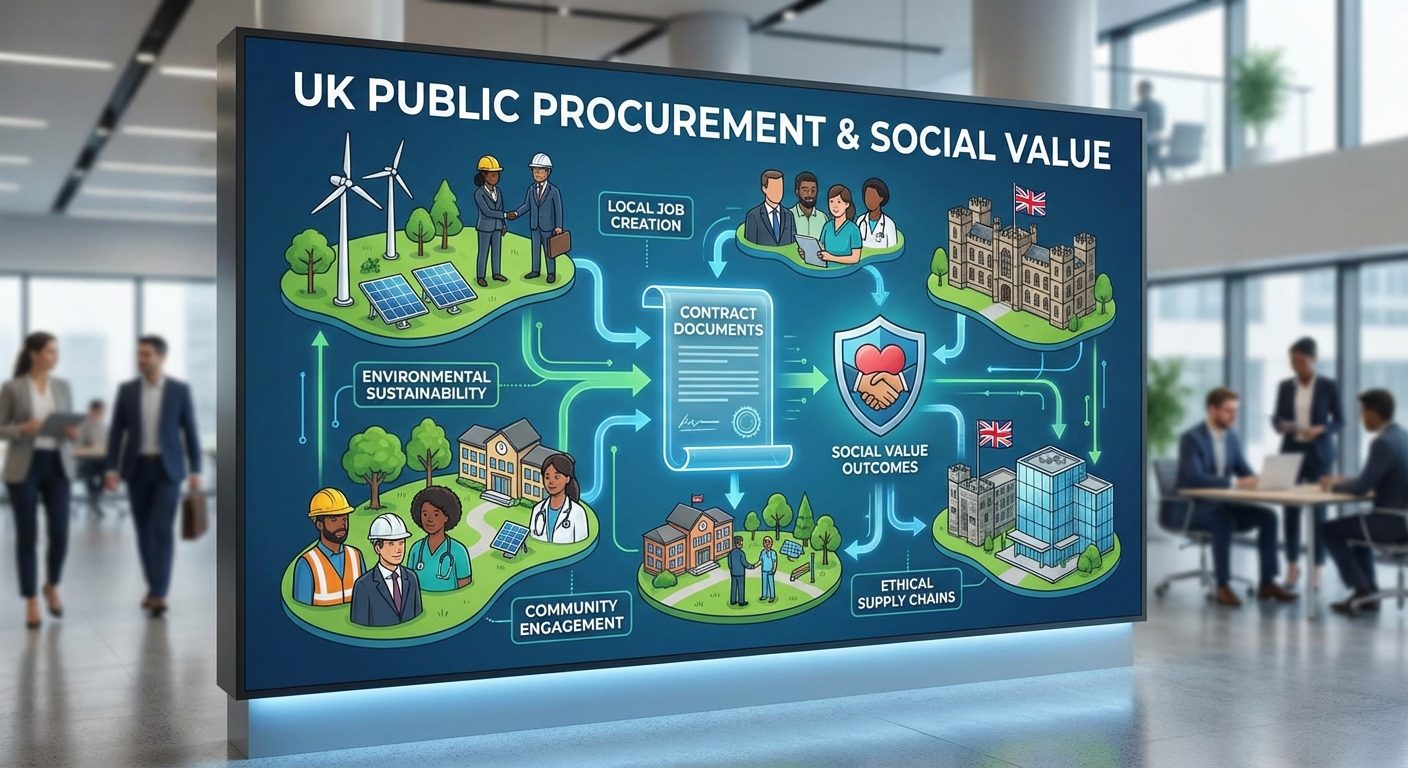
Social Value Procurement Guide 2026
Understanding the Social Value Landscape in 2026
Social value requirements differ fundamentally from technical or commercial evaluation criteria. Buyers assess your commitment to delivering wider benefits to society, economy, and environment alongside core contract delivery. Strong technical solutions and competitive pricing no longer suffice—tenders missing credible social value commitments consistently lose to bidders who demonstrate measurable community benefit.
The regulatory framework combines three key pieces of legislation, each expanding social value scope and strengthening enforcement: The Public Services (Social Value) Act 2012 introduced the principle that public authorities must consider social value before commencing procurement for services contracts above EU thresholds (now UK thresholds post-Brexit). While initially limited to central government services, the Act established social value as legitimate evaluation criterion and encouraged broader adoption across local government and NHS procurement. Procurement Policy Note 06/20 (PPN 06/20) elevated social value from consideration to mandatory evaluation, requiring central government contracting authorities to explicitly evaluate social value in all procurements and allocate minimum 10% weighting to social value themes. The Note introduced five standardized themes—COVID-19 recovery, tackling economic inequality, equal opportunity, wellbeing, and environmental sustainability. Though technically guidance rather than legislation, compliance monitoring ensures widespread adoption. The Procurement Act 2023 (effective October 2024) embedded social value into primary legislation for the first time. The Act requires contracting authorities to have regard to environmental, social, and economic wellbeing in conducting procurements, creates transparency obligations around social value commitments, and empowers enhanced monitoring and enforcement. Importantly, the Act extends beyond services to include goods and works contracts, broadening social value application across all procurement categories.Together, these frameworks create a landscape where social value evaluation is universal in public procurement. Private sector procurement increasingly adopts similar approaches—43% of large private organizations now include social value criteria in supplier selection, driven by ESG reporting obligations and stakeholder pressure.
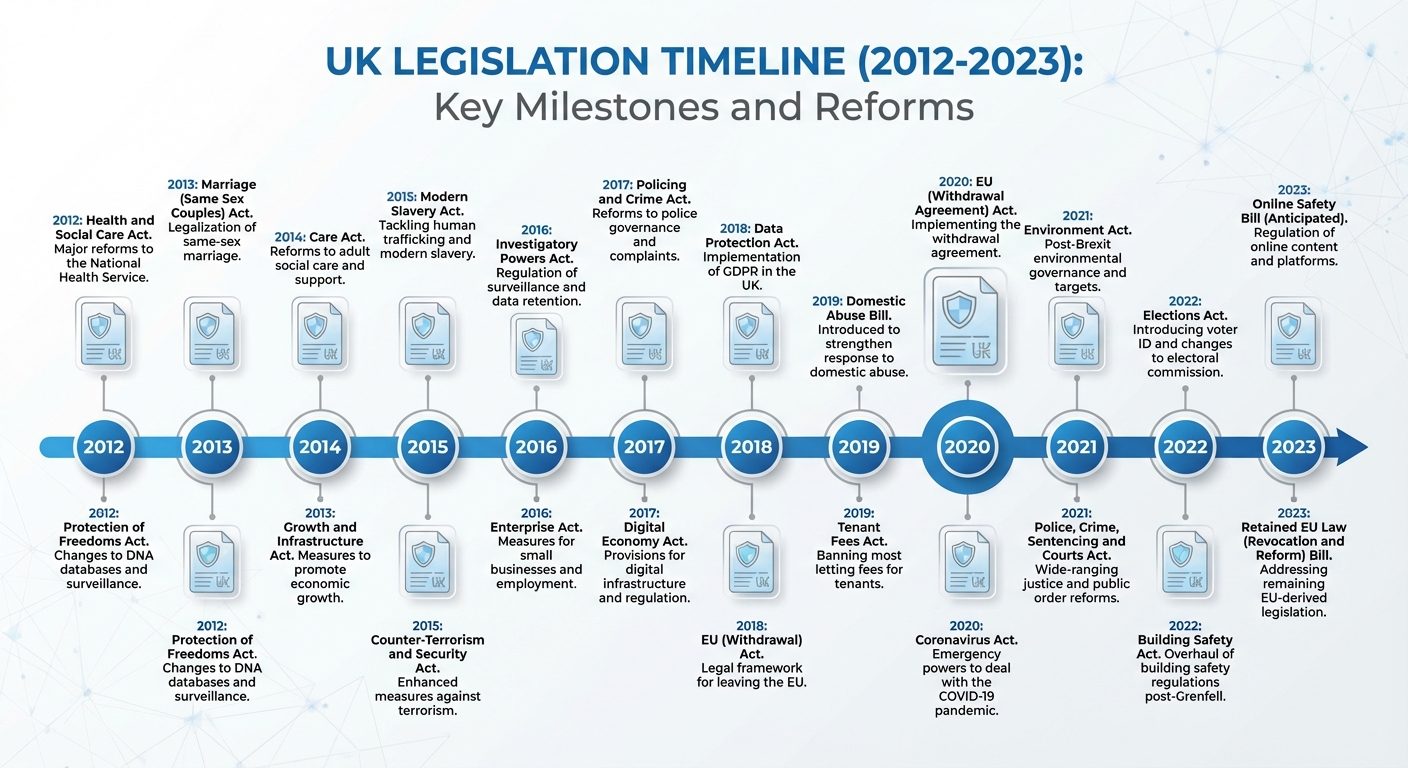
Social Value Legislation Timeline
The Five Core Social Value Themes
Social value evaluation typically assesses five interconnected themes. Understanding each theme's priorities and how buyers measure commitments separates high-scoring responses from weak submissions that recycle generic statements.
1. Fighting Climate Change and Environmental Sustainability
Environmental social value has evolved from tree-planting promises to rigorous carbon accounting and circular economy commitments. Buyers evaluate your carbon footprint reduction, resource efficiency, biodiversity protection, and alignment with Net Zero targets. Generic environmental statements no longer score—buyers want specific, measurable commitments with clear accountability.
What buyers look for: Carbon reduction commitments across Scope 1, 2, and 3 emissions with baseline data and annual targets. Science-based targets aligned with limiting global warming to 1.5°C. Circular economy approaches that minimize waste through design, reuse, and recycling. Biodiversity net gain commitments for construction and land-use contracts. Supply chain environmental standards and how you'll verify supplier compliance. High-scoring commitments include: "Reduce Scope 1 and 2 emissions by 42% by 2030 (baseline: 2023) through fleet electrification, renewable energy procurement, and energy efficiency measures. Achieve Scope 3 reduction of 25% over contract period by prioritizing local suppliers (reducing transportation emissions) and requiring environmental management certification for all major subcontractors. Independently verified through ISO 14064 greenhouse gas accounting." "Achieve 75% diversion from landfill across all contract waste streams through segregation at source, partnerships with social enterprises for reuse, and closed-loop recycling for uniform textiles and equipment packaging. Monthly reporting on waste by type and disposal route with continuous improvement targeting zero waste to landfill by contract year 3." What fails to score: "We are committed to protecting the environment." "Our company uses recycling bins." "We will minimize our environmental impact." "Staff are encouraged to reduce waste." These statements lack specificity, measurement, and accountability. Buyers cannot assess whether commitments are meaningful or distinguish your response from competitors. Measurement and reporting: Use carbon accounting frameworks (GHG Protocol, ISO 14064) to establish baselines and report progress. Specify verification mechanisms—third-party audits, client dashboard access, quarterly reporting formats. Align metrics with National TOMs (Themes, Outcomes, Measures) framework where buyers have adopted it—this ensures your commitments match evaluation criteria. Evidence of capability: Reference past environmental performance data from similar contracts. Include case studies showing successful implementation of environmental initiatives. If you hold ISO 14001 (environmental management system) certification, explain how your EMS drives continuous improvement. For smaller bidders without extensive environmental track records, partnerships with environmental specialists or social enterprises can demonstrate commitment and provide implementation capability.2. COVID Recovery and Health Inequalities
While COVID-19 specific recovery has evolved since the pandemic, buyers continue prioritizing health and wellbeing themes. Evaluation focuses on mental health support, health inequality reduction, and promoting healthy communities. Healthcare and social care contracts weight this theme particularly heavily, but all procurement categories now include wellbeing considerations.
What buyers look for: Mental health support provisions for workforce and wider community. Health and safety performance exceeding regulatory minimums. Programs addressing health inequalities in communities you operate in. Employee wellbeing initiatives demonstrating duty of care beyond legal requirements. Access to healthy food, exercise opportunities, and preventative health information. High-scoring commitments include: "Provide mental health first aid training for 100% of line managers and supervisors within three months of contract commencement. Partner with local mental health charity [specific organization] to offer confidential counseling services to all contract employees with guaranteed 48-hour access to initial appointment. Deliver 'Time to Talk' mental health awareness sessions reaching minimum 500 community members annually through schools, community centers, and workplaces in contract area." "Achieve silver level Workplace Wellbeing Charter accreditation within 12 months and gold level by contract year 3. Implement comprehensive wellbeing program including annual health assessments, subsidized gym membership, healthy eating options in staff facilities, and flexible working arrangements supporting work-life balance. Commit to achieving Disability Confident Leader status, ensuring inclusive recruitment and workplace adjustments." What fails to score: "We care about employee wellbeing." "Staff have access to a gym." "We comply with health and safety regulations." "Mental health is important to us." Without specific programs, measurement, and evidence of investment, these statements carry no weight in evaluation. Measurement and reporting: Track employee wellbeing metrics (absence rates, mental health referrals, wellbeing survey results) and report trends. Quantify community health program reach and outcomes. Use established frameworks like Workplace Wellbeing Charter for independent verification. Commit to sharing anonymized health data with client to demonstrate impact. Evidence of capability: Include case studies of wellbeing programs from previous contracts. Reference industry recognition (e.g., Sunday Times Best Places to Work, Workplace Wellbeing awards). Provide letters of support from health charities you've partnered with. For organizations new to structured wellbeing programs, outline implementation plan with clear milestones and external support partnerships.3. Tackling Economic Inequality and Creating Jobs
Economic social value evaluates job creation, skills development, support for disadvantaged groups, and progression opportunities. Buyers prioritize employment for people facing barriers (long-term unemployed, care leavers, ex-offenders, disabled people) and apprenticeships creating sustainable careers. Generic training promises score poorly—buyers want evidence of real employment pathways.
What buyers look for: New jobs created directly and through supply chain. Proportion of jobs offered to disadvantaged groups. Apprenticeships aligned with contract needs (not generic programs unrelated to contract work). Living Wage (not just National Minimum Wage) commitments. Work experience and meaningful job trial opportunities. Fair working practices including guaranteed hours and progression routes. High-scoring commitments include: "Create 23 new direct jobs over contract period including minimum 8 positions filled by people unemployed for 12+ months, 4 care leavers or care-experienced individuals, and 2 ex-offenders. Partner with [specific local employment agency] for recruitment and wraparound support ensuring job retention. All positions offered at Real Living Wage minimum (currently £12.00/hour, uprated annually) with guaranteed 37.5 hours per week, 28 days holiday including bank holidays, and occupational pension contribution." "Establish 12 apprenticeships over four-year contract period including electrical, mechanical, and administrative apprenticeships aligned with contract delivery needs. All apprenticeships follow recognized frameworks (Level 3 minimum) with clear progression to permanent employment. Target 50% apprenticeship recruitment from areas in top 20% Index of Multiple Deprivation, working with local schools and colleges to build talent pipeline. Achieve 85% apprenticeship completion rate and 90% progression to permanent employment." What fails to score: "We will create jobs where possible." "Training will be provided to employees." "We support apprenticeships." "Staff can progress within our organization." Without specific numbers, targeting, and accountability mechanisms, buyers cannot evaluate commitment strength or likelihood of delivery. Measurement and reporting: Use person-weeks or full-time equivalent calculations aligned with National TOMs. Specify job types, hours, and duration. Commit to quarterly reporting on recruitment, retention, and progression. Provide anonymized employee journey case studies demonstrating support effectiveness. Evidence of capability: Include data from past contracts showing employment created, apprenticeship completion rates, and progression outcomes. Reference employer accreditations (Disability Confident, Good Employment Charter). Provide testimonials from employees hired through disadvantaged groups programs. For smaller contractors, partnerships with specialist employment agencies or Jobcentre Plus demonstrates commitment and provides recruitment infrastructure.4. Equal Opportunity, Diversity, and Inclusion
Diversity and inclusion social value extends beyond workforce demographics to supplier diversity, community engagement, and accessibility. Buyers evaluate whether your organization reflects the communities you serve and whether your practices create opportunities for underrepresented groups.
What buyers look for: Workforce diversity data and improvement targets. Pay gap reporting (gender, ethnicity, disability) with action plans. Supply chain diversity including SMEs, social enterprises, and minority-owned businesses. Inclusive procurement practices removing barriers for smaller suppliers. Accessibility of services and physical locations. Community engagement ensuring diverse voices shape service delivery. High-scoring commitments include: "Achieve workforce representation reflecting contract area demographics within 18 months: minimum 35% female representation across all roles (currently 28%), 18% ethnic minority representation (currently 12%), and 8% disabled employees (currently 4.5%). Publish annual diversity data including intersectional analysis and pay gap reporting. Implement blind recruitment, diverse interview panels, and positive action programs for underrepresented groups. Achieve gold level Inclusive Employers accreditation by contract year 2." "Commit 25% of contract spend to SMEs, 5% to social enterprises, and actively seek minority-owned suppliers for relevant contract elements. Publish supply chain diversity data quarterly. Implement inclusive procurement practices including prompt payment (14-day terms for SMEs), accessible tender processes, and supplier development support. Establish supplier forum ensuring two-way communication and continuous improvement." What fails to score: "We are an equal opportunities employer." "We work with diverse suppliers." "Our organization values inclusion." "We comply with equality legislation." Legal compliance is the baseline—buyers want evidence of proactive diversity and inclusion initiatives with measurable impact. Measurement and reporting: Use National TOMs proxy values for diversity metrics. Commit to sharing workforce diversity data, supply chain diversity data, and progress against targets. Provide case studies of inclusive practice implementation and business benefits achieved. Reference independent accreditation (Inclusive Employers, Suppliers Diversity Charter). Evidence of capability: Include current diversity data demonstrating existing commitment. Reference external recognition (Sunday Times Top 100 Employers for Women, Stonewall Equality Index rankings). Provide examples of accessibility improvements or inclusive design from past contracts. For organizations beginning diversity journeys, outline clear action plan with external expertise support and interim milestones.5. Community Benefit and Social Innovation
Community benefit evaluates how you'll contribute to local areas beyond direct contract delivery. Buyers assess volunteering, donations, community asset creation, and innovative approaches that multiply social impact. Strong community benefit commitments connect to local priorities and involve genuine partnership with community organizations.
What buyers look for: Employee volunteering with guaranteed paid time. Support for local charities and community organizations through donations, pro bono services, or capacity building. Community spaces, facilities, or assets created through contract delivery. Social innovation approaches that achieve outcomes more effectively or efficiently. Local supplier and local labor commitments strengthening community economies. High-scoring commitments include: "Provide 500 employee volunteering days annually (equivalent to 2 days per employee) supporting community organizations in contract area. Partner with [specific local volunteer center] to match skills with community needs. Focus areas include: financial literacy workshops for vulnerable adults, CV writing and interview skills for job seekers, digital skills training for elderly residents, and environmental improvement projects. Track social value created through volunteering using pro bono rate methodology (estimated £97,500 annual contribution based on average skilled labor rate)." "Commit 15% of contract spend to suppliers headquartered within 20 miles of contract locations, strengthening local economy. Target 40% of workforce resident within contract area, achieved through local recruitment partnerships and living wage jobs attractive to local talent. Quantify local spend multiplier effect using economic modeling (estimated £1.2M annual local economic impact from £8M contract value through direct spending, wages, and secondary spending)." What fails to score: "Staff can volunteer if they wish." "We support local charities." "We will use local suppliers where possible." "Community engagement is important." Without guaranteed resources, specific partnerships, and measurement frameworks, these statements demonstrate aspiration rather than commitment. Measurement and reporting: Track volunteering hours, donations, and in-kind support value. Calculate social return on investment using established methodologies. Provide case studies of community partnerships and outcomes achieved. Use Local Multiplier 3 (LM3) or similar tools to quantify local economic impact. Evidence of capability: Reference community programs delivered in past contracts with outcomes data. Include testimonials from community organizations you've supported. Demonstrate organizational culture of community engagement through company-wide programs or foundation activities. For newer organizations, partnerships with established community anchors demonstrate commitment and provide delivery mechanisms.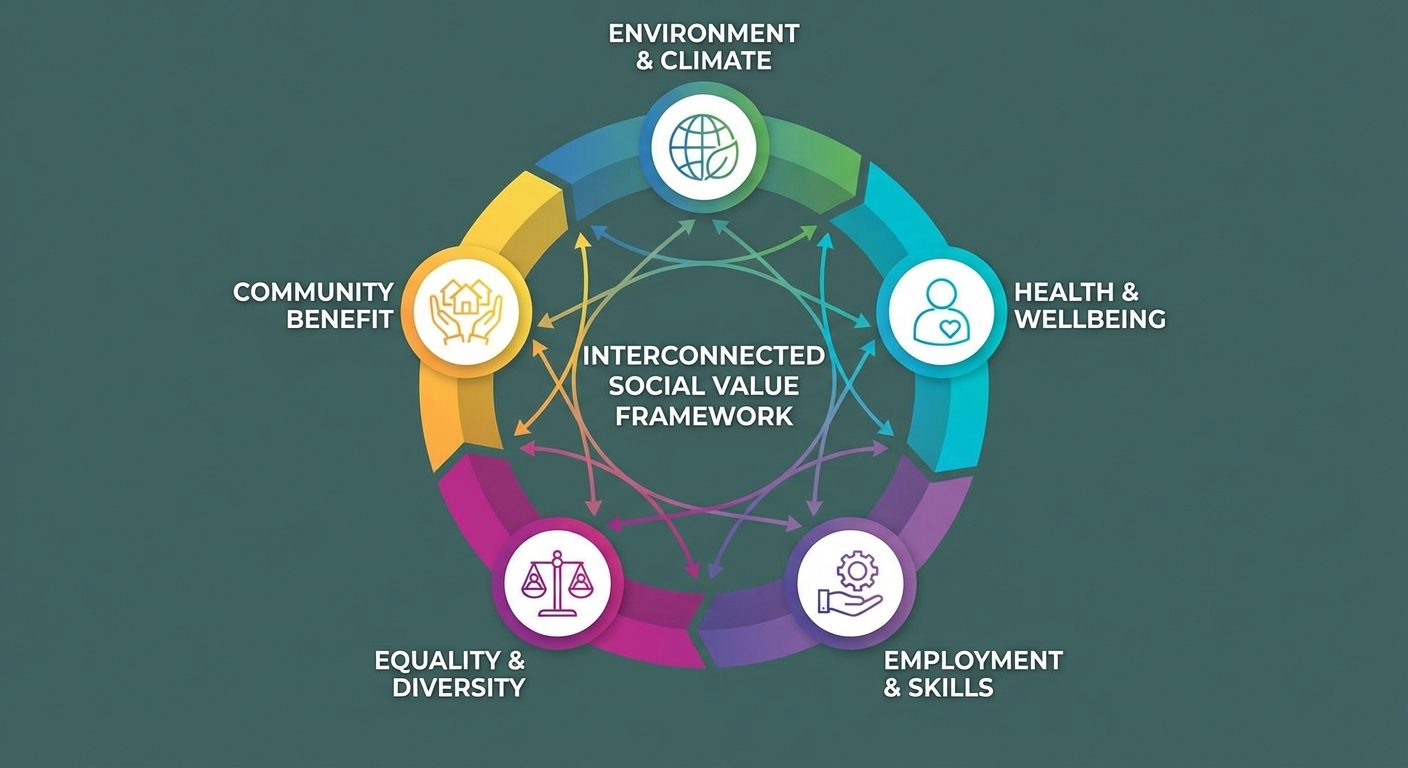
Social Value Themes Framework
The National TOMs Framework: Standardizing Social Value Measurement
The National Themes, Outcomes and Measures (TOMs) framework has become the de facto standard for social value measurement in UK public procurement. Developed by the Social Value Portal and now maintained as an open standard, TOMs provides consistent definitions, proxy values, and reporting formats that enable comparison across tenders and track delivery throughout contract lifecycles.
Understanding TOMs is essential for high-scoring social value responses because increasing numbers of contracting authorities explicitly reference the framework in evaluation criteria and require TOMs-aligned reporting during contract delivery.
The TOMs structure comprises five levels: Themes (the broad areas like environment, employment, growth), Outcomes (the changes sought like reduced carbon emissions, jobs for disadvantaged people), Measures (the specific units tracked like tonnes CO2e, number of jobs created), Proxy Values (the monetized social value of each measure unit), and Reporting Metrics (the evidence required to verify delivery). Why TOMs matters for tender responses: When buyers evaluate using TOMs, your commitments must align with TOMs Measures and use TOMs units to score points. For example, committing to "create 5 apprenticeships" scores zero points if the tender evaluates apprenticeships using the TOMs measure "No. of weeks of apprenticeships on the contract that have either been completed during the year or that will be supported by the organisation until completion" because the units don't match. The correct commitment would be "deliver 520 apprentice weeks over contract period (equivalent to 2 x 4-year apprenticeships, calculated as 52 weeks x 4 years x 2.5 apprentices average over contract period)." Common TOMs measures you'll encounter:For environmental themes: "Tonnes CO2e reduced," "Tonnes of waste diverted from landfill," "Plastic use reduced in procurement and delivery," "% of procurement from organisations with ISO 14001 or equivalent certification."
For employment and skills: "No. of local direct employees (FTE) hired or retained on contract," "No. of weeks of apprenticeships on contract," "No. of hours dedicated to supporting unemployed people into work," "No. of staff hours spent on local school and college visits."
For economic growth: "Total amount spent with VCSEs within your supply chain," "Total amount spent in LOCAL supply chain through the contract," "Meaningful work placements that pay Minimum or National Living Wage," "No. of hours of support provided to VCSEs and SMEs."
For social: "No. of hours volunteering time provided to support local community projects," "Donations or in-kind contributions to local community projects," "No. of opportunities for schools, community groups and other organisations to visit site," "Support provided to help employees with financial resilience."
Calculating social value using TOMs proxy values: Each TOMs measure has an assigned proxy value representing the social value created per unit. For example, an apprentice week currently values at £247.87 (based on lifetime earning differential). Creating 520 apprentice weeks therefore generates £128,892 of social value (520 weeks × £247.87). Total contract social value sums all measures × their proxy values, creating a comparable £ figure buyers use in evaluation. Strategic use of TOMs in tender responses: Review the tender's evaluation criteria to identify which TOMs measures buyers are scoring. Prioritize commitments in high-proxy-value measures where you have delivery capability. For example, if contract value is £5M and you commit to social value worth £500K (10% social value percentage), calculate whether you can realistically deliver commitments totaling that value across employment, environmental, and community TOMs measures.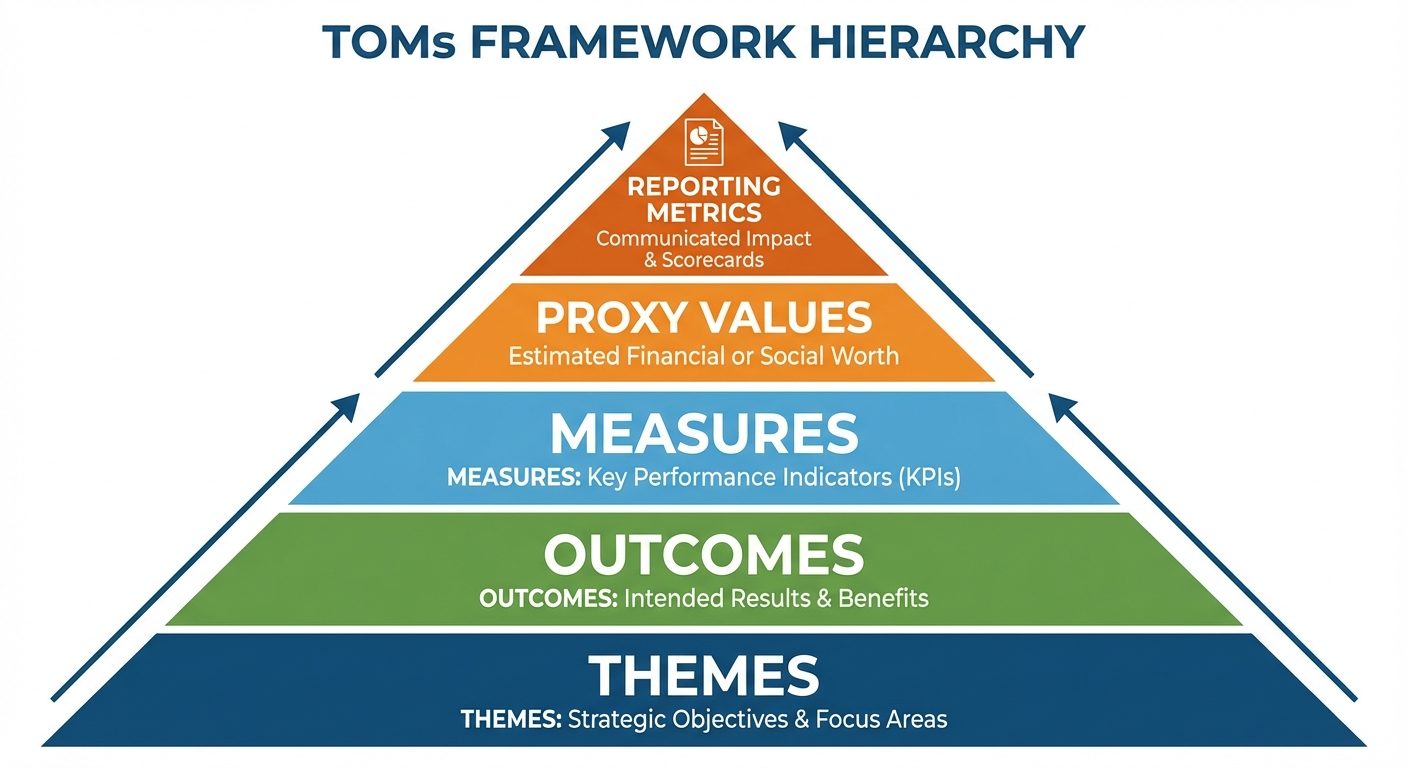
TOMs Framework Structure
Building a Credible Social Value Response
High-scoring social value submissions share five characteristics that distinguish them from weak, generic responses. Buyers can immediately identify submissions from bidders who understand social value delivery versus those treating it as box-ticking exercise.
1. Specific, Quantified Commitments
Vague aspirations score zero points. Buyers evaluate what you commit to deliver, measured in units they can verify. Every social value commitment must include: what you'll do, how many/how much (quantified), when (timeline), and how you'll report it.
Transform weak statements into high-scoring commitments:
Weak: "We will support apprenticeships during the contract." Strong: "Create 8 apprenticeships over 4-year contract period (2 per year commencing Years 1-4), including 4 electrical apprenticeships (Level 3), 2 plumbing/heating apprenticeships (Level 3), and 2 business administration apprenticeships (Level 3). All apprenticeships will be recruited from within 10 miles of contract locations, with 50% targeting candidates from areas in top 30% Index of Multiple Deprivation. Apprenticeships will be permanent positions with Real Living Wage (minimum £12/hour) throughout training. Report quarterly on recruitment, progression, and completion status." Weak: "Our company is committed to environmental sustainability." Strong: "Reduce carbon emissions from contract delivery by 30% by Year 3 (baseline: Year 1 measured according to GHG Protocol Scope 1 and 2). Achieve reduction through: 1) Transition to 100% electric vehicle fleet by Month 18 (currently 12% electric), 2) Procure 100% renewable electricity for contract facilities from Month 1, 3) Implement route optimization software reducing mileage by 15% by Month 6, 4) Engage supply chain to measure and reduce Scope 3 emissions with 80% of key suppliers (>£50K annual spend) reporting emissions data by Year 2. Report carbon footprint quarterly with independent verification annually."The difference is measurability, accountability, and buyer confidence in your commitment and ability to deliver.
2. Evidence of Delivery Capability
Commitments mean nothing without evidence you can deliver them. Buyers evaluate your track record, partnerships, and implementation plans to assess delivery risk. Organizations winning social value points consistently provide three types of evidence:
Past performance data: "In our current 3-year facilities management contract with [Client Name], we have delivered: 847 apprentice weeks across 14 apprenticeships (target: 780 weeks), created 31 jobs for long-term unemployed individuals (target: 24), achieved 68% diversion from landfill (target: 60%), and contributed 1,247 volunteering hours to local community projects (target: 900). Attached Appendix includes quarterly social value reports from contract demonstrating consistent delivery and progressive improvement." Partnerships and accreditations: "We hold ISO 14001 (environmental management) and ISO 45001 (health & safety) certifications with scope covering all contract-relevant operations. We are accredited Disability Confident Leader, Real Living Wage employer, and hold Gold level Inclusive Employers accreditation. We maintain formal partnerships with [Local Employment Agency] for disadvantaged group recruitment, [Mental Health Charity] for employee and community wellbeing support, and [Environmental Social Enterprise] for waste management and circular economy initiatives. Letters of support from partner organizations confirming our commitment and their capacity to support contract delivery are attached in Appendix." Implementation plans with milestones: "Social value delivery will be overseen by dedicated Social Value Manager (0.5 FTE, named individual: [Name, qualifications]) reporting to Contract Director with quarterly reporting to Client. Implementation milestones include: Month 1 - Establish baseline measurements and reporting dashboard; Month 3 - Complete apprenticeship recruitment campaign and make first hires; Month 6 - Achieve initial carbon reduction targets and publish first impact report; Month 12 - Complete first-year social value independent audit; Quarterly - Social value steering group meetings including client representation and community partner input."3. Alignment with Local Priorities
Generic social value commitments that could apply anywhere score lower than commitments clearly tailored to the specific contract location and buyer priorities. Research local context and demonstrate your understanding of community needs.
Research sources to understand local priorities: Contracting authority Corporate Plan and strategic objectives. Local Industrial Strategy and economic development plans. Joint Strategic Needs Assessment (for health and care contracts). Local Climate Action Plans and environmental strategies. Indices of Multiple Deprivation data for the area. Consultation with local Jobcentre Plus, local enterprise partnerships, and community anchor organizations. How to demonstrate local alignment: "Research into [Local Authority]'s Corporate Plan 2024-2028 identifies three priority areas directly relevant to our social value approach: 1) Youth unemployment in [specific wards] significantly exceeds national average at 14.2% versus 8.1%. Our commitment to recruit 6 apprenticeships and provide 240 work experience weeks targets young people NEET (not in education, employment or training) from these priority wards. 2) [Local Authority] has committed to carbon neutrality by 2030, ahead of national 2050 target. Our contract delivery carbon reduction of 30% by Year 3 and 50% by contract end contributes measurably to this ambition. 3) The locality has identified social isolation among elderly residents as key wellbeing priority. Our 500 annual volunteering days will include minimum 150 days dedicated to befriending services and digital skills support for elderly residents in partnership with [Local Age UK]."4. Robust Measurement and Reporting
Buyers assess not just what you promise but how you'll prove delivery. High-scoring responses include clear measurement methodologies, reporting frequencies, and verification mechanisms.
Measurement frameworks: Specify how you'll track each commitment. "Track direct jobs created using contract payroll records verified by client quarterly. Calculate local employment percentage using employee residential postcode data matched against contract area boundaries. Measure apprentice weeks using training provider records and apprenticeship service portal data. Calculate carbon emissions using GHG Protocol methodology with Scope 1 and 2 data from utility bills and fleet fuel consumption, independently verified annually by [certification body]." Reporting commitments: "Provide monthly social value performance dashboard via client portal with real-time access to key metrics. Deliver quarterly detailed social value reports including outcomes achieved against targets, case studies of impact, challenges encountered and mitigation actions, and forward look to next quarter priorities. Conduct annual independent social value audit by [verification body] confirming delivery and validating methodologies. Host annual stakeholder showcase event for client, community partners, and beneficiaries to demonstrate impact and gather feedback for continuous improvement." Verification and accountability: "All social value commitments will be included in contract KPIs with performance linked to contract management reviews. Underdelivery against social value targets will trigger improvement plans with 30-day remediation period. Social value performance data will be subject to same audit rights as financial and operational performance. We commit to publicly report social value outcomes through National Social Value portal, providing transparency and accountability to communities we serve."5. Innovation and Added Value
While meeting standard social value requirements is essential, high-scoring bidders often include innovative approaches that multiply impact or address needs in creative ways. Innovation demonstrates genuine commitment rather than compliance mindset.
Examples of social value innovation:"Rather than standard apprenticeships, we will establish a 'earn while you learn' partnership with [Local College] creating bespoke Level 4 Higher Apprenticeship in [relevant specialism] that doesn't currently exist. This addresses the skills gap identified in local labor market assessment while providing progression route beyond standard Level 3 apprenticeships. Programme will be co-designed with client and available to client's internal staff as well as our contract team."
"We will establish community benefit fund equivalent to 0.5% of contract value (£40K over 4 years) available to grassroots community organizations through quarterly application rounds. Fund will be governed by panel including client representative, our community engagement lead, and two community representatives. Priority themes align with local community plan priorities. This multiplies social impact beyond our direct activities by enabling community-led initiatives."
"Our environmental approach includes 'net positive' biodiversity commitment—we will create more habitat than we impact through contract delivery. Working with [Wildlife Trust], we will establish 0.5 hectares of pollinator meadow on underutilized contract site areas and install 12 swift nest boxes and 8 bat boxes on contract buildings. Annual biodiversity surveys will track species abundance with results shared through local schools' environmental education programmes."
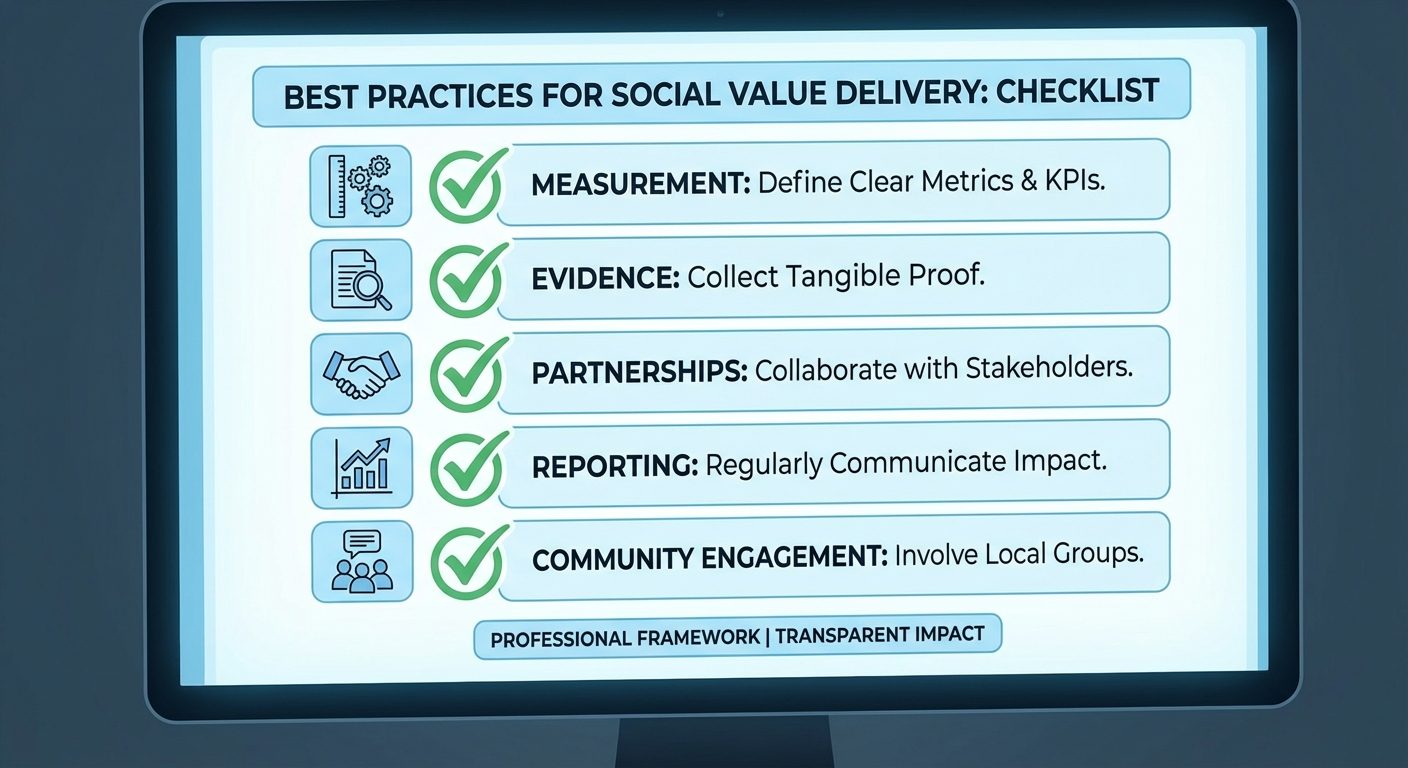
Social Value Best Practices
Common Social Value Mistakes That Cost Tender Scores
Even experienced bidders make preventable social value mistakes that cost evaluation points. Awareness of these pitfalls enables you to avoid them in your responses.
Mistake 1: Copy-Paste Generic Commitments
Using standard social value text across all bids regardless of contract type, location, or buyer priorities is immediately obvious to evaluators. Statements like "We are committed to being a good corporate citizen" or "Our company values the communities we work in" appear in hundreds of bids and differentiate none of them.
Why it fails: Buyers evaluate how your specific commitments address their specific procurement objectives. Generic statements could apply to any contract anywhere, providing no confidence you've understood local context or buyer priorities. Evaluators can readily identify copy-paste responses and score them accordingly. How to avoid: Customize every social value section to the specific tender. Reference the contracting authority by name, cite their strategic priorities, identify local challenges your commitments address, and quantify commitments appropriate to contract scope and value. Invest time researching local context—the evaluation scoring rewards this effort.Mistake 2: Promising Everything, Evidencing Nothing
Extensive lists of social value commitments spanning all possible themes look impressive until evaluators look for evidence of delivery capability. Commitments to create 50 apprenticeships, achieve carbon neutrality, donate £100K to charity, and provide 5,000 volunteering hours may be mathematically impossible for your organization size and contract value.
Why it fails: Buyers evaluate credibility alongside ambition. Unrealistic commitments raise questions about whether you understand social value delivery or are simply promising what you think buyers want to hear. Lack of evidence (past performance, partnerships, implementation plans) supporting ambitious commitments signals high delivery risk. How to avoid: Calculate realistic commitments based on contract value, workforce size, and delivery timeframes. A £2M contract cannot credibly support £500K of social value unless you're fundamentally restructuring operations. Provide evidence supporting every significant commitment—past performance data, partner letters of support, implementation resources. Better to commit confidently to achievable targets than promise aspirational goals you'll fail to deliver.Mistake 3: Ignoring Measurement and Reporting
Focusing solely on commitments without explaining how you'll measure delivery, when you'll report, and how buyers can verify performance is critical oversight. Social value commitments without measurement frameworks are unenforceable and often go undelivered during contract performance.
Why it fails: Buyers increasingly require social value reporting as contract deliverable, not optional extra. Without clear measurement methodology and reporting commitments in your tender response, buyers cannot assess whether you'll actually deliver social value or how they'll hold you accountable during contract management. How to avoid: Every social value commitment must include its measurement approach and reporting frequency. Specify units (jobs, apprentice weeks, tonnes CO2e, volunteering hours), data sources (payroll records, training provider reports, emissions calculations), and reporting formats (monthly dashboards, quarterly reports, annual independent audits). Commit to measurement frameworks aligned with National TOMs where applicable.Mistake 4: Treating Social Value as Separate from Core Delivery
Weak social value responses read like separate documents appended to technical and commercial responses. Strong responses integrate social value throughout, demonstrating how your delivery approach inherently creates social value rather than requiring additional effort.
Why it fails: Buyers evaluate integrated approaches more favorably than siloed responses. When social value feels like an afterthought or burden separate from core delivery, evaluators question whether it will actually be prioritized during contract performance. Integration demonstrates social value is part of how you work, not what you promise. How to avoid: Connect social value commitments directly to delivery methodology. For example: "Our planned workforce of 47 FTE includes 6 apprentices (13% apprentice ratio), providing both delivery resource and skills development social value. Our maintenance scheduling software optimizes routes to minimize mileage, simultaneously improving service responsiveness (technical benefit) and reducing carbon emissions (environmental social value). Our commitment to Real Living Wage (£12/hour minimum versus £11.44 National Living Wage) aids recruitment and retention in tight labor market while delivering economic social value."Mistake 5: Focusing Only on Internal Activities
Social value responses that describe only your own organization's activities (your carbon reduction, your apprentices, your volunteering) miss opportunities for supply chain and community partnership approaches that multiply impact.
Why it fails: Buyers increasingly recognize that supply chain represents majority of contract social value opportunity, particularly for contracts with extensive subcontracting or procurement of goods and services. Responses that ignore supply chain or community partnerships suggest limited understanding of social value potential. How to avoid: Include supply chain social value commitments with clear accountability. For example: "Our subcontractor framework agreement includes social value obligations for all subcontractors with >£100K annual value. Requirements include: Real Living Wage for all staff, apprenticeship commitments (minimum 1 apprentice per £500K subcontract value), environmental management certification, and monthly social value reporting. Subcontractor social value performance contributes to our overall contract targets and is reviewed quarterly with underperformance triggering improvement plans or subcontractor replacement." Consider community partnerships that enable social value delivery: "Partner with [Social Enterprise] for grounds maintenance supplies, creating employment for people with learning disabilities while meeting contract quality standards. Partnership delivers estimated £18K annual social value (calculated using TOMs social enterprise spend proxy value) while diversifying our supply chain and supporting local community enterprise."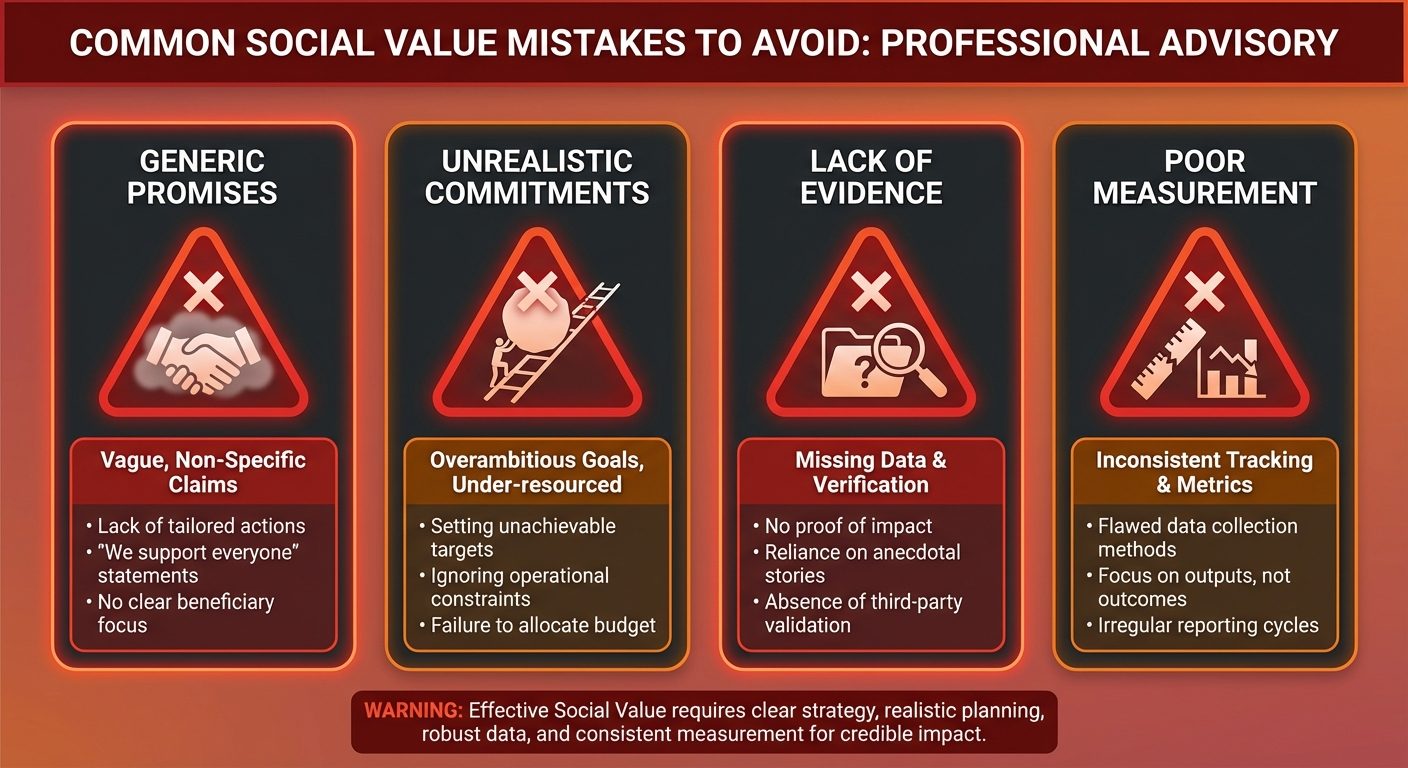
Social Value Common Mistakes
Practical Social Value Response Template
A structured response format ensures you cover all evaluation criteria while maintaining clear, logical flow. Adapt this template to specific tender requirements:
Section 1: Understanding and Commitment (10-15% of response)- Demonstrate understanding of social value and why it matters
- Reference buyer's strategic priorities and local context
- State overall social value commitment aligned with contract value
- Outline governance and leadership accountability for delivery
- Quantified jobs created (direct and supply chain) with local employment targets
- Apprenticeship commitments with numbers, levels, and timelines
- Support for disadvantaged groups with specific targeting and partnerships
- Fair employment practices including Living Wage, guaranteed hours, progression
- Measurement approach and reporting commitments
- Carbon reduction targets with baseline, timeline, and methodology
- Waste reduction and circular economy commitments
- Sustainable procurement and supply chain environmental standards
- Biodiversity or other environmental enhancement initiatives
- Reporting and verification approach including certifications
- Local supply chain commitments with spend targets
- Community engagement and volunteering with hours and focus areas
- Support for VCSEs and social enterprises
- Community facilities, assets, or services created
- Local economic impact quantification
- Workforce diversity commitments and improvement targets
- Inclusive recruitment and employment practices
- Employee wellbeing programs and mental health support
- Supplier diversity commitments
- Health inequality reduction initiatives
- Overall measurement framework (reference TOMs if applicable)
- Reporting schedule and formats
- Verification and audit approach
- Governance and stakeholder engagement
- Continuous improvement methodology
- Evidence of past social value delivery (case studies, reports from previous contracts)
- Partnership letters of support
- Relevant certifications (ISO 14001, Real Living Wage, Disability Confident, etc.)
- Key personnel CVs (Social Value Manager, Community Engagement roles)
- Social value calculator/methodology details
Leveraging Technology for Social Value Delivery and Reporting
Technology platforms increasingly enable efficient social value tracking, reporting, and verification. While not mandatory, technology adoption can strengthen both tender responses and delivery capability.
Social value measurement portals like Social Value Portal, Social Value UK's platform, or Thrive provide standardized frameworks, proxy value calculations, and reporting dashboards. These platforms enable real-time tracking against commitments, generate reports for client sharing, and provide independent verification of delivery. Including platform use in tender responses demonstrates measurement sophistication and reporting commitment. Supply chain management systems with social value tracking enable you to monitor and report subcontractor and supplier social value contributions. Platforms that aggregate supply chain diversity data, track SME and social enterprise spend, and enable supplier social value reporting strengthen your ability to deliver and evidence supply chain commitments. Carbon accounting software provides robust emissions tracking across Scope 1, 2, and 3, essential for credible environmental social value commitments. Tools ranging from simple calculators to enterprise carbon management platforms enable baseline establishment, target setting, and progress tracking with verification-ready reporting. Employment and skills tracking through applicant tracking systems (ATS) and learning management systems (LMS) enables reporting on local recruitment, disadvantaged group employment, training hours delivered, and progression outcomes. Integration between HR systems and social value reporting reduces administrative burden and improves data accuracy. Technology in tender responses: When including technology platforms in social value responses, explain: 1) What platform/tool you'll use and why, 2) How it supports measurement and reporting of specific commitments, 3) How clients will access dashboards or reports, 4) Integration with other contract management systems if applicable. Avoid technology for technology's sake—only include platforms that genuinely strengthen your delivery and reporting capability.The Future of Social Value in UK Procurement
Social value requirements continue evolving with increasing sophistication, broader application, and stronger enforcement. Understanding emerging trends helps you future-proof social value approaches and stay ahead of competitors.
Mandatory social value weighting increases: While current guidance suggests 10% minimum, many contracting authorities now allocate 15-30% of total evaluation to social value, particularly in local government and construction procurement. This trend will likely continue, making social value capability increasingly important for competitive positioning. Supply chain social value obligations strengthen: Buyers increasingly require evidence that social value commitments cascade through supply chains with subcontractor accountability. Expect supply chain social value clauses to become standard in both prime contracts and subcontracts, with reporting obligations extending throughout supply chains. Social value reporting becomes contract deliverable: Social value will shift from tender commitment to contract KPI with performance management, improvement plans for underdelivery, and potential commercial consequences for failure. Regular reporting, independent audits, and stakeholder engagement will be contractual requirements, not optional extras. TOMs becomes universal standard: National TOMs adoption will continue expanding across central government, local authorities, NHS, and private sector. Familiarity with TOMs framework will become essential bidding skill, and technology platforms supporting TOMs reporting will become industry standard. Focus intensifies on delivery and impact: Procurement reforms emphasize outcomes over promises. Expect increased use of past performance data in evaluating social value credibility, requirements for independent verification of delivery, and potential exclusion of bidders who consistently fail to deliver social value commitments. Integration with ESG and sustainability reporting: As corporate sustainability reporting requirements expand (e.g., mandatory TCFD climate disclosure, potential Social Value reporting requirements), alignment between procurement social value and corporate sustainability strategies will strengthen. Organizations with robust ESG frameworks will find tender social value requirements easier to meet credibly.Conclusion: Social Value as Competitive Advantage
Social value has evolved from peripheral consideration to core procurement evaluation criterion. Organizations treating social value as compliance exercise lose tenders to competitors who recognize it as opportunity to differentiate, demonstrate values alignment, and build authentic community relationships.
Success in social value requires shifting from "what we have to promise" to "what we genuinely deliver." Research buyers' priorities, understand local context, commit to achievable targets with robust measurement, provide evidence of capability, and deliver throughout contract performance. Organizations building social value into culture, operations, and supply chain management will consistently outscore competitors recycling generic commitments.
The procurement landscape rewards organizations that create value beyond contract deliverables—for communities, environment, and society. Master social value, and you master modern public procurement.
---
Need help crafting high-scoring social value responses? mytender.io provides AI-powered tools designed specifically for UK public procurement, including social value commitment calculators, local context research, TOMs framework integration, and evidence libraries. Request a demo to see how technology can strengthen your social value capability and win more contracts.Tags
Ready to Transform Your Tender Writing?
See how MyTender's AI can help you write winning tenders in a fraction of the time.