
How to Write a Social Value Delivery Plan That Evaluators Believe
PPN 026 is pushing social value from warm promises to contract-ready delivery plans. This guide shows bid teams how to write measurable jobs, skills and local opportunity commitments that evaluators trust.
mytender.io Research Team
Tender Writing & Bid Management Specialists
How to Write a Social Value Delivery Plan That Evaluators Believe
Social value used to be the section people wrote after the method statements, pricing notes and mobilisation plan were finished.
That is a problem now.
PPN 026 has made the direction of travel obvious: public sector buyers want social value commitments that create jobs, skills and local opportunity. They also want commitments that survive contact with contract delivery.
That last bit is where many bids fall apart.
A promise to create apprenticeships sounds good. A plan that explains which roles, which sites, which partner, which month, which manager and which evidence pack will prove delivery sounds credible. Evaluators know the difference.
This guide is for bid managers, commercial leads and accidental bid writers who need to turn a social value answer into a deliverable plan. Not a warm statement. Not a CSR page. A scored, evidenced, contract-ready plan.
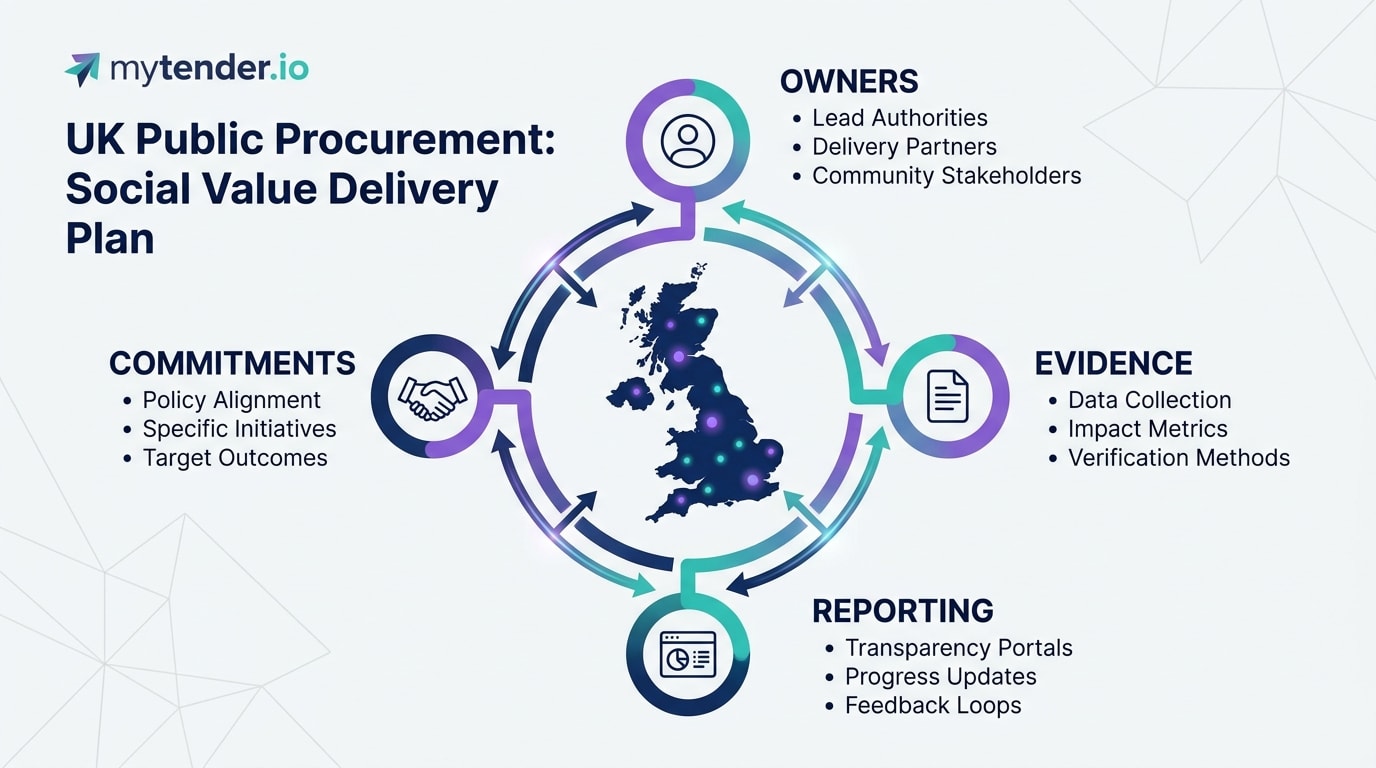
Social value delivery plan map showing commitments, owners, evidence and reporting
Why Social Value Delivery Plans Matter More in 2027
Central government has been using social value in procurement for years. What is changing is the weight and the seriousness attached to delivery.
PPN 026, published in 2026 for use from 2027, pushes central government procurements towards a stronger focus on good jobs, skills and opportunity across the UK. For larger contracts, the minimum social value weighting rises sharply.
Even where a buyer is not formally bound by the same timetable, the signal is clear. Local authorities, NHS bodies, housing associations, education trusts and other public buyers are watching the same policy direction.
For suppliers, that means social value is no longer a paragraph about intent. It is part of the contract story.
Evaluators increasingly ask:
- What will you deliver?
- Who benefits?
- When will it happen?
- Who owns it?
- How will you prove it?
- What happens if progress slips?
Those questions are not hostile. They are sensible. Buyers have seen too many vague promises that never become anything measurable.
The bid that wins is not always the one with the biggest social value number. It is often the one with the most believable delivery plan.The Mistake: Writing Commitments Before You Know the Contract
The weakest social value answers start with a menu of promises.
Five apprenticeships. Ten school visits. Twenty volunteering days. Local supply chain spend. Work placements. Carbon literacy training. Charity support.
Some of those may be useful. Some may be impossible. The problem is that they are often chosen before the team has understood the contract.
A strong delivery plan starts with the service model.
Ask:
- Where will the work actually happen?
- Which roles are needed to deliver the contract?
- Which roles are realistic entry points for local people?
- Which subcontractors or partners are already involved?
- Which communities are affected by the service?
- What mobilisation window is available?
- What reporting burden can the contract team handle?
That last question matters more than people admit. If your contract manager has no time, no system and no named owner for evidence, the social value plan will become a quarterly scramble.
Build the plan around the contract reality first. Then choose commitments that fit.
A Credible Social Value Plan Has Five Parts
Most tender responses make social value sound softer than it is. The best responses treat it like any other delivery workstream.
A credible plan has five parts:
- A small number of relevant commitments
- A named delivery owner
- A timeline linked to mobilisation and contract milestones
- Evidence that will be collected as the work happens
- Governance for reporting, risks and corrective action
That structure works whether you are bidding for facilities management, construction, waste, care, technology or professional services.
The content changes by sector. The logic does not.
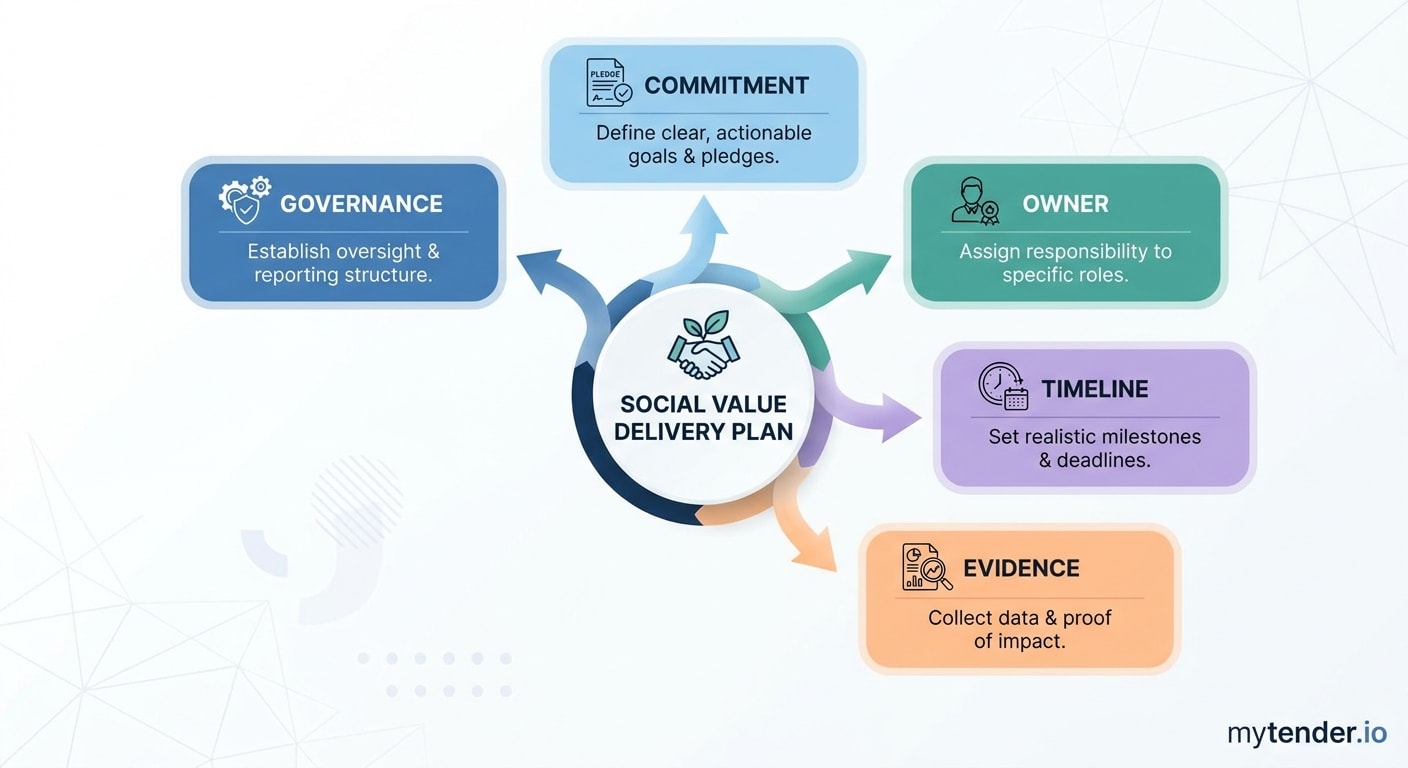
Five-part social value delivery framework with commitment, owner, timeline, evidence and governance
Start With Fewer Commitments, Then Make Them Sharper
Social value scoring does not reward chaos.
A bid with fifteen loose commitments can look impressive at first glance, but it is hard to believe. Evaluators will wonder who is coordinating it all and which promises are real.
A bid with five strong commitments can score better because it feels controlled.
For example, instead of saying:
> We will support local employment, apprenticeships, school engagement, volunteering, wellbeing, supply chain development and environmental initiatives throughout the contract.
Write something more concrete:
> During year one, we will create two Level 2 facilities services apprenticeships attached to the North and East regional teams, run four employability workshops with the authority's nominated skills partner, and ringfence two entry-level operative roles for candidates referred through local employment support providers. Progress will be reviewed monthly by the contract manager and reported quarterly through the social value tracker.
That is not longer for the sake of it. It is clearer.
The evaluator can see what will happen. They can also see how it fits the contract.
How to Choose the Right Commitments
Good commitments sit at the overlap between buyer priorities, contract activity and supplier capability.
If one of those is missing, the plan becomes weak.
Buyer priorities
Read the tender pack properly. Look for the buyer's corporate plan, local economic strategy, social value policy, climate plan, skills strategy and equality objectives.
Do not just quote them. Translate them.
If the buyer talks about youth unemployment, your answer should explain how your contract creates entry-level routes. If they talk about care leavers, veterans, disabled residents or long-term unemployment, show how your partnerships will reach those groups.
Avoid promising support for every group named in the policy. That looks like box-ticking.
Pick the areas where the contract can make a real contribution.
Contract activity
The commitment must connect to the work.
An FM contract can support apprenticeships, local recruitment, supplier development, work placements, wellbeing, community volunteering and environmental behaviour change because the service is local and labour-intensive.
A construction contract can support traineeships, site visits, supply chain opportunities, modern methods of construction training, waste reduction, carbon reporting and community engagement around disruption.
A waste contract can support behaviour-change campaigns, reuse partnerships, route-based local jobs, school engagement, repair initiatives and recycling education.
The closer the commitment is to the service, the more credible it feels.
Supplier capability
Do not invent a delivery model you cannot run.
If you already have apprenticeships, training providers, local recruitment routes or community partnerships, use them. If you are building something new, explain the setup steps and dependencies.
There is nothing wrong with saying a commitment depends on agreement with the buyer or a named partner. That is better than pretending everything is already guaranteed.
Turn Each Commitment Into a Mini Delivery Plan
A useful rule: every major commitment in your social value answer should pass the "first Monday" test.
If the contract started next Monday, would the contract manager know what to do?
For each commitment, define:
- the outcome
- the activity
- the target number
- the beneficiary group
- the delivery owner
- the partner or referral route
- the timeline
- the evidence
- the reporting route
- the risk control
That may sound like a lot, but it can fit into a simple table.
For example:
| Commitment | Delivery plan | Evidence |
|---|---|---|
| Create two apprenticeships | Contract manager confirms role profiles during mobilisation. HR opens recruitment in month two. Training provider enrols apprentices by month four. | Job descriptions, advert records, enrolment confirmation, attendance, completion status. |
| Run four employability workshops | Social value lead agrees topics with buyer's skills team. Site managers provide practical interview and workplace examples. | Workshop agendas, attendee numbers, feedback forms, photos where approved. |
| Increase local SME spend | Procurement lead maps subcontract packages and invites local suppliers to a meet-the-buyer session. | Supplier list, invitation records, quotes received, spend report. |
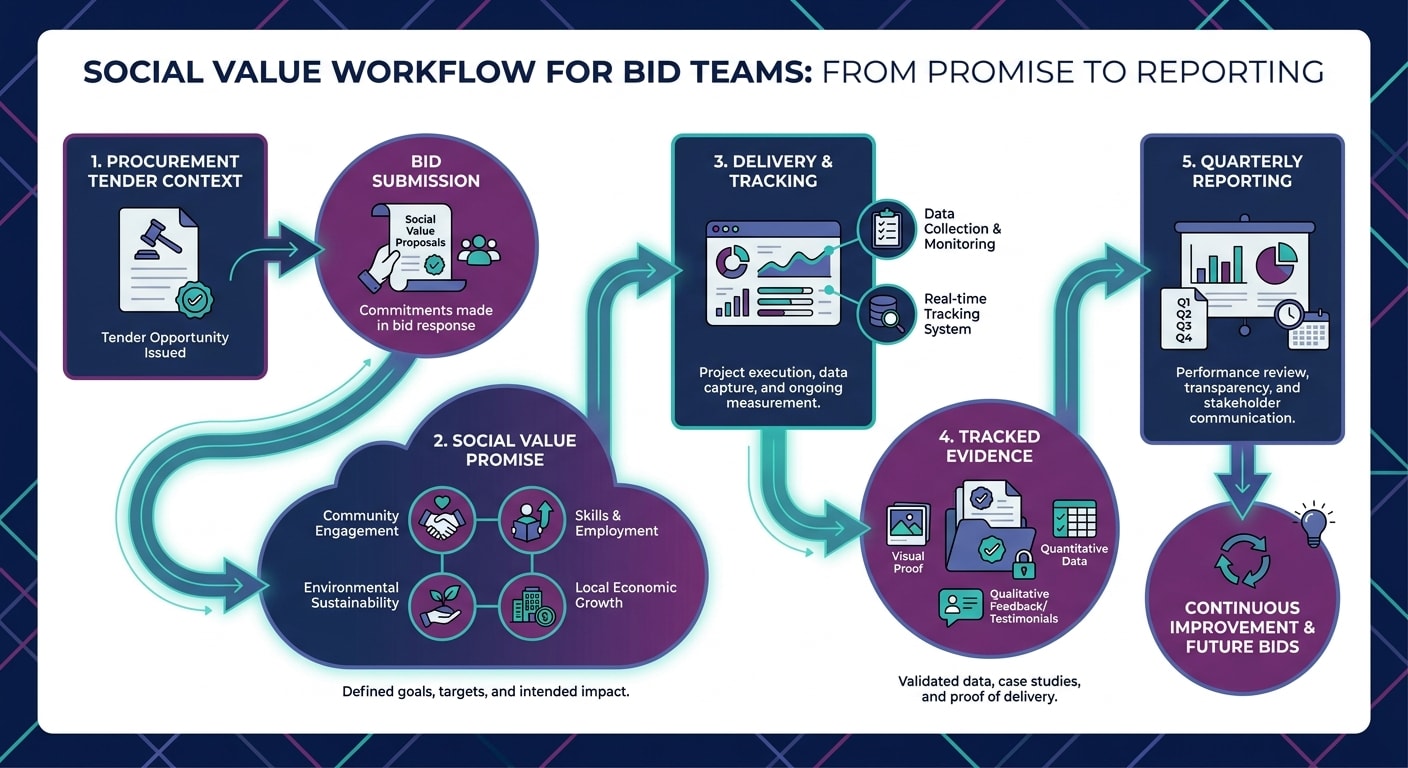
Commitment-to-evidence workflow showing how a social value promise becomes tracked delivery
Evidence Is the Bit Most Bids Forget
A social value plan without evidence is just hope with headings.
Before you submit the bid, decide what proof will exist if the commitment is delivered. Then write that into the response.
Useful evidence includes:
- signed apprenticeship agreements
- training attendance logs
- certificates and completion records
- anonymised beneficiary data
- supplier spend reports
- job adverts and recruitment outcomes
- workshop agendas and feedback forms
- case studies approved by participants
- volunteering timesheets
- carbon, waste or travel reports where relevant
- quarterly dashboard screenshots
Be careful with personal data. You do not need to promise names, protected characteristics or sensitive details in a tender response. Say that reporting will be aggregated or anonymised where appropriate.
Evaluators want assurance, not a GDPR headache.
Put Reporting Into the Contract Rhythm
The best social value reporting does not sit in a separate spreadsheet that nobody opens until quarter end.
It sits inside the contract governance rhythm.
That might mean:
- mobilisation meeting: confirm commitments and owners
- monthly operations review: check activity and risks
- quarterly contract review: submit the dashboard and evidence pack
- annual review: assess outcomes, lessons learned and next-year targets
This matters because social value delivery often fails through neglect, not malice.
The operations team is busy. The client has urgent service issues. The person who wrote the bid may not be involved after award. If the plan is not built into governance, it gets pushed down the list.
In your answer, show where the plan lives after award.
For example:
> The social value tracker will be reviewed as a standing item in the monthly contract meeting. Each commitment will have a named owner, RAG status, evidence field and next action. Slippage will be escalated to the account director with a recovery action agreed with the authority.
That is the kind of sentence evaluators believe.
What to Do When the Buyer Asks for TOMs or a Calculator
Some buyers use formal measurement frameworks. Others ask for a social value method statement without a calculator. Many do both.
If the tender gives you a scoring framework, use it exactly. Do not fight the template.
But do not let the calculator become the answer.
A number in a portal does not explain delivery. If you have entered a value for apprenticeships, local jobs or volunteering, the written response should show how that value will be achieved.
Treat the calculator as the quantified promise. Treat the method statement as the delivery proof.
If a commitment is high value in the calculator but weak in delivery, reduce it. An overclaimed target can damage credibility.
Procurement teams are getting better at spotting inflated social value numbers. They may ask clarifications. They may write commitments into the contract. They may monitor delivery.
Do not create a future problem to win a present mark.
Sector Examples That Feel Real
Social value is easier to write when it is grounded in the sector.
Facilities management
An FM supplier might commit to creating cleaning and maintenance entry routes for local residents, offering supervisor development for existing staff, using local SMEs for specialist works, and supporting building users through energy or recycling behaviour campaigns.
The plan should connect to sites, rotas, supervisors and service standards.
Weak version: "We will create local jobs."
Stronger version: "We will ringfence two entry-level cleaning operative vacancies per year for candidates referred by the council's employment support team, with site supervisors trained to provide four-week onboarding and attendance support."
Construction
A construction supplier might commit to apprenticeships, site visits, supply-chain briefings, work experience, local labour targets, retrofit skills or waste reduction education.
The plan should connect to the programme, subcontract packages and site constraints.
Weak version: "We will engage schools and colleges."
Stronger version: "We will deliver three site-safe careers sessions during the enabling works and frame stages, aligned to the project's programme so students can see different trades and routes into the sector."
Waste and environmental services
A waste supplier might commit to local route jobs, reuse partnerships, recycling education, repair events, community engagement and apprenticeships in fleet, depot or customer-service roles.
The plan should connect to rounds, depots, behaviour change and measurable diversion outcomes.
Weak version: "We will support the community with recycling initiatives."
Stronger version: "We will run six ward-level recycling participation workshops in areas agreed with the council, using contamination data to target streets where engagement can improve performance."
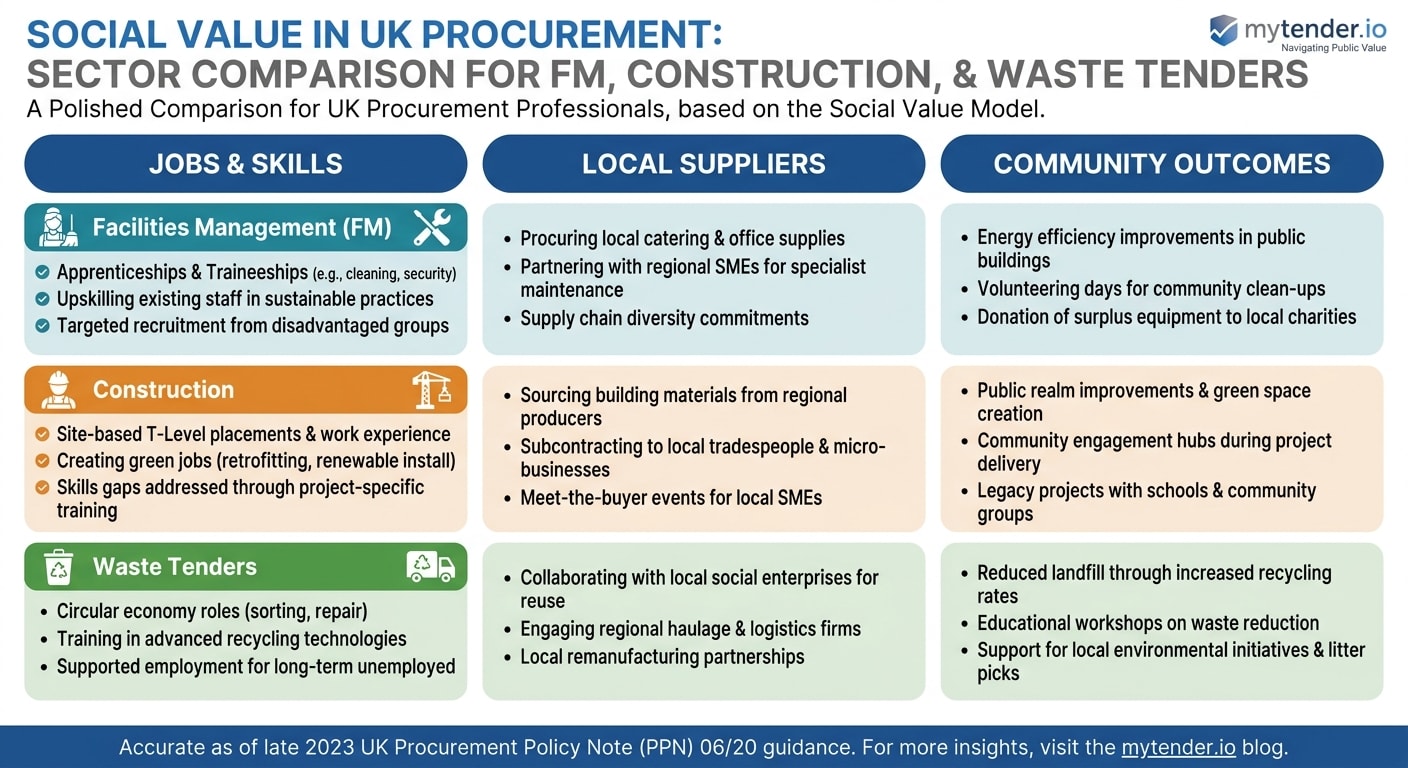
Sector-specific social value examples for FM, construction and waste tenders
How AI Can Help Without Making the Answer Generic
AI can help with social value responses, but only if you feed it real inputs.
If you ask a generic tool to write a social value answer, it will usually produce a generic answer. It will sound polished and score badly.
The useful inputs are:
- the buyer's local strategy
- the tender evaluation criteria
- the service specification
- your current apprenticeship and recruitment data
- previous social value commitments that were actually delivered
- case studies from similar contracts
- evidence templates and reporting packs
That is where a tender-specific content library helps. mytender.io can help bid teams pull previous commitments, shape them against the new buyer's priorities and keep the answer tied to evidence rather than filler.
The point is not to let AI invent community impact. The point is to stop losing time finding the proof you already have.
A Simple Structure for Your Tender Response
If you have 1,000 to 1,500 words, use this structure.
1. Open with the buyer's priority
Show that you understand what the buyer is trying to achieve.
Do not start with your company values. Start with their area, their residents, their workforce challenge, their skills gap or their contract objectives.
2. Summarise the commitments
Use a short table with commitment, target, beneficiary and contract link.
Keep it tight. Four to six commitments is usually enough.
3. Explain delivery governance
Name the roles. Explain the meeting rhythm. Show how social value sits in contract management.
4. Give detail for each main commitment
For each one, explain the activity, timeline, partner route and evidence.
This is where most of the marks are won.
5. Explain measurement and reporting
Describe the tracker, evidence pack, dashboard or review process.
Include corrective action if progress slips.
6. Close with assurance
Finish by linking social value back to contract success. The message is simple: these commitments are not extras. They are managed outcomes.
Red Flags Evaluators Notice Quickly
Evaluators read a lot of social value answers. They have sharp instincts for weak ones.
Watch for these red flags:
- commitments with no numbers
- numbers with no delivery route
- delivery routes with no owner
- owners with no evidence process
- national charity activity with no local link
- recycled case studies from unrelated contracts
- apprentice promises that do not match the contract roles
- local spend targets with no subcontract packages identified
- volunteering pledges that depend on staff goodwill alone
- heavy emphasis on awards and policies instead of delivery
None of these is fatal on its own. Together, they make the answer feel decorative.
Decorative social value does not score well any more.
The Bid Library Problem
Many suppliers have delivered good social value before. The evidence is just scattered.
One contract manager has photos from a careers event. HR has apprenticeship completion records. Finance has local supplier spend. Marketing has a case study. The bid team has last year's answer. Nobody has the full story.
That is why social value becomes painful at tender stage.
The fix is not complicated, but it does require discipline. Build a social value evidence library with:
- delivered commitments by contract
- evidence files
- beneficiary outcomes
- partner details
- lessons learned
- reusable wording
- approved case studies
- current commitments still in delivery
Update it quarterly, not the night before submission.
When the next tender arrives, you can choose commitments from a live evidence base instead of starting from a blank page.
The Best Answer Sounds Operational
Here is the simplest test for your draft: does it sound like the person writing it has to deliver it?
If the answer is full of values, ambitions and broad community language, tighten it.
If it names roles, months, partners, records, meetings, dashboards and recovery actions, you are closer.
A good social value delivery plan does not need to be flashy. It needs to feel real.
That means the commitments are specific. The numbers are proportionate. The evidence is named. The governance is part of the contract. The buyer can imagine your team doing exactly what you said.
That is what evaluators believe.
Useful Next Step
If you are planning bids for 2027, start by reviewing the social value commitments you have already made across live contracts. Which ones were delivered? Which ones have evidence? Which ones are still just words in an old tender response?
That review will do more for your next bid than another generic paragraph about supporting communities.
If you want to find live opportunities where a stronger social value plan could make the difference, the Tender Finder is free to use. Use it to spot relevant tenders early, then give your team enough time to build a plan evaluators can believe.
Tags
Ready to Transform Your Tender Writing?
See how MyTender's AI can help you write winning tenders in a fraction of the time.