

Social Value Scoring in Construction Tenders: Where Real Marks Are Won and Lost
Social value is now worth 10-30% of the score in most public construction tenders — but most bid teams still treat it as a tick-box exercise. Here is exactly where marks are won and lost.
mytender.io Research Team
Tender Writing & Bid Management Specialists
Social Value Scoring in Construction Tenders: Where Real Marks Are Won and Lost
You are three weeks from the submission deadline. The technical sections are looking solid. The pricing is competitive. Then you open the social value questions and someone on the team says: "Just put in the apprenticeship stuff and the environment bit."
That sentence costs contracts.
Social value is now worth between 10% and 30% of the evaluated score on most public sector construction tenders in the UK. On some frameworks, it sits at 20% as a standalone section evaluated independently before price is even opened. And yet the majority of bid responses treat it like a box to tick rather than a section to win.
This post covers the mechanics of how evaluators actually score social value in construction tenders, what separates a 4/5 from a 1/5, and the specific types of commitment that consistently win marks versus the generic filler that wastes word count.
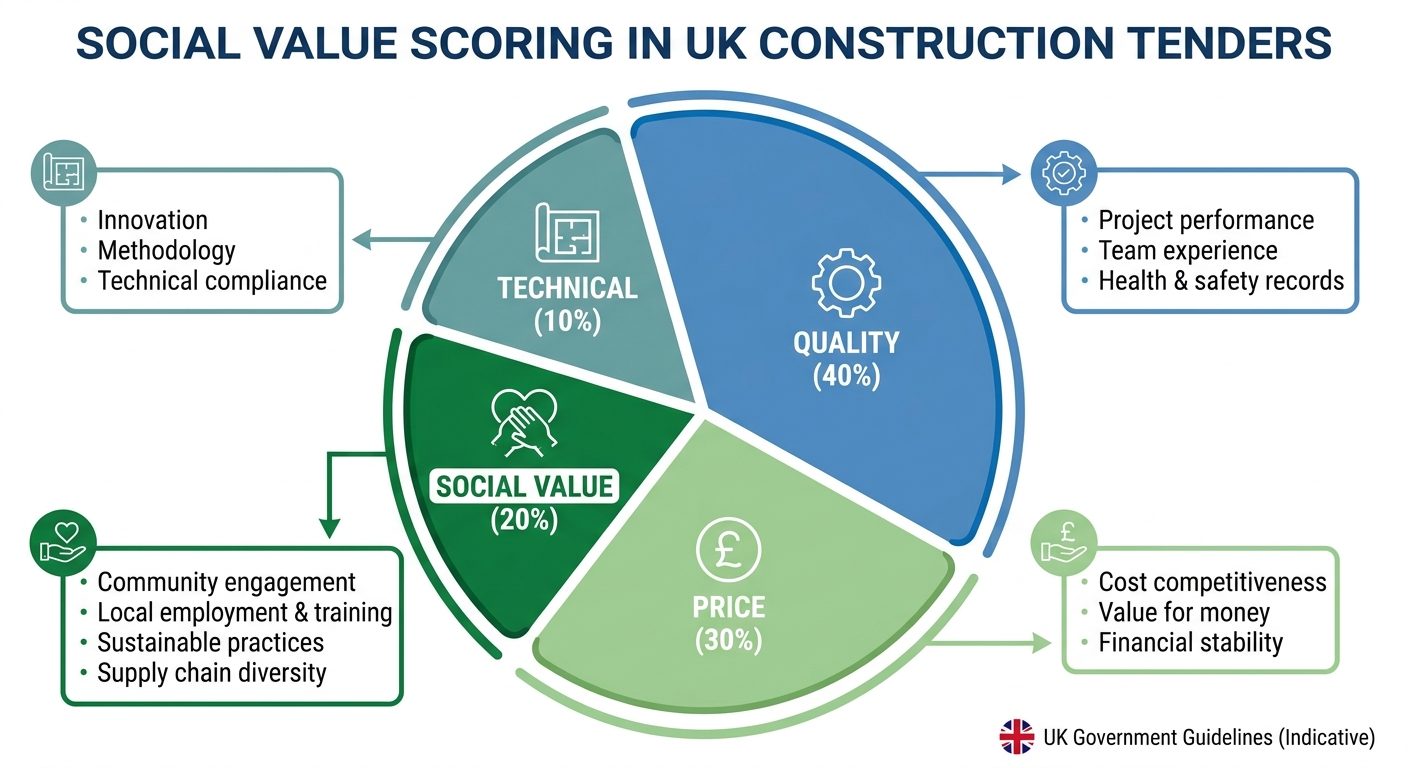
Social value scoring breakdown in UK construction tenders
Why Social Value Has Real Weight in Construction
The Construction Playbook (published 2020, updated 2022) made social value a mandatory consideration in all central government construction procurement above threshold. PPN 06/20 set the framework: a minimum 10% social value weighting in evaluation, with departments encouraged to go higher where contract type justified it.
In practice, most public construction contracts now sit between 15% and 25% weighting. Housing associations, combined authorities and NHS trusts routinely push to 25-30%. The floor has risen; the ceiling keeps moving up.
The rationale is straightforward. Construction contracts represent substantial public spend flowing into local economies. A £40m school build does not just deliver a school. It creates jobs, trains apprentices, sources materials, manages waste, and affects the communities around it for years. Buyers want to see that they are choosing contractors who understand this and will deliver tangible returns beyond the asset itself.
The problem for bid teams is that this shift happened faster than most bid libraries updated. Organisations that won on price and technical quality a decade ago are now losing contracts to competitors who invest more effort in social value responses, even when the technical offering is weaker.
The Measurement Framework Evaluators Use
Before you can write a winning response, you need to understand how social value is actually measured in construction procurement.
The dominant framework in UK public procurement is the National TOMs (Themes, Outcomes and Measures) framework, developed by Social Value Portal. It structures social value around four themes:
Theme 1: Promote economic growth and tackle economic inequality Jobs, apprenticeships, supply chain spend, skills training, supported businesses. Theme 2: Create a fairer society and tackle inequality Employment of disadvantaged groups, workforce inclusion, community investment. Theme 3: Deliver a greener future Carbon reduction, waste diversion, biodiversity, sustainable sourcing. Theme 4: Build healthier, more resilient communities Volunteering, mental health, community engagement, crisis response.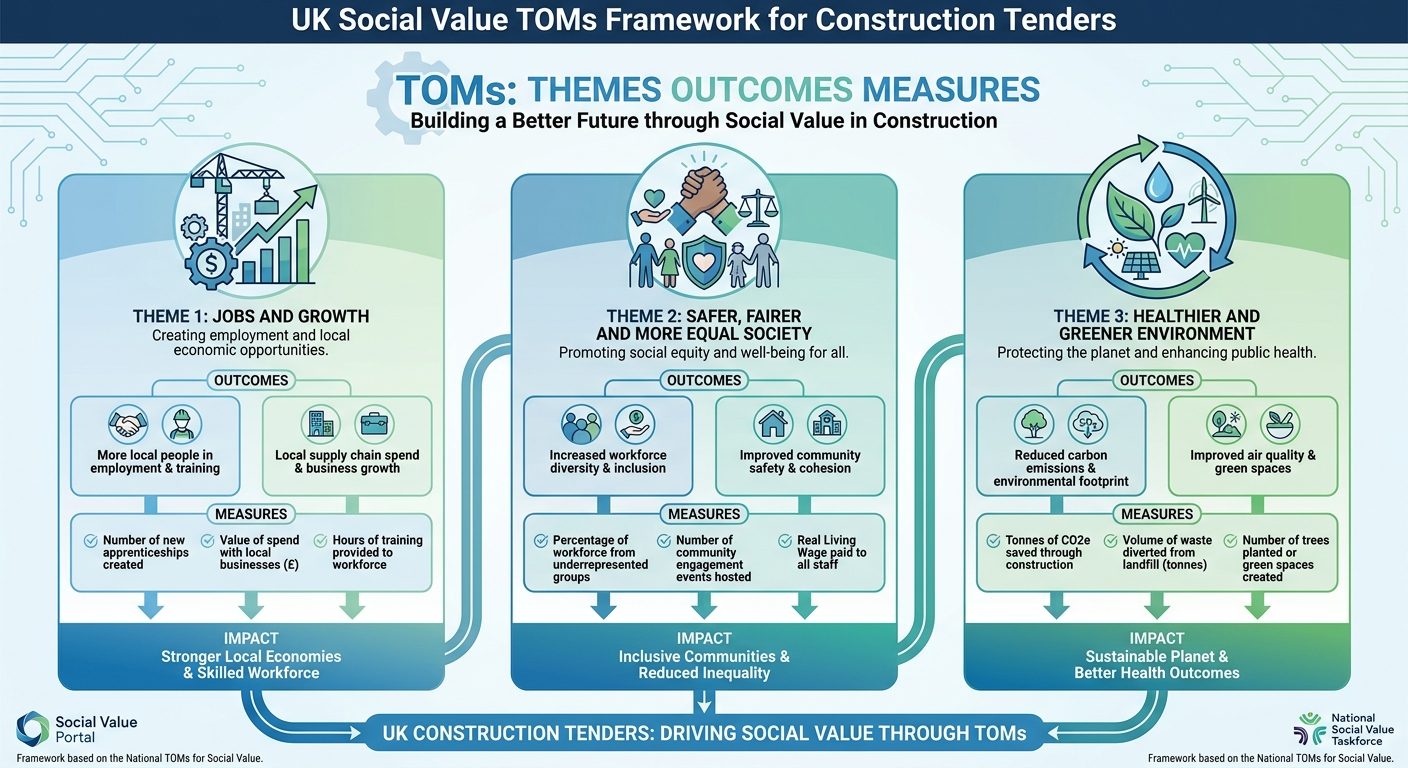
TOMs framework for social value in UK construction tenders
Each commitment maps to a specific TOM measure (e.g. T1 M1: weeks of employment created for people furthest from the labour market). Evaluators translate commitments into a monetised social value figure using defined proxy values (e.g. £22,000 per person placed into employment).
Not all buyers use TOMs explicitly, but nearly all evaluate social value through a lens that mirrors its structure. Understanding this framework tells you what evidence evaluators are looking for and how they translate narrative into a score.
Where Marks Are Actually Awarded
Here is what consistently separates high-scoring responses from average ones across construction tenders.
Specificity to the contract and community
The single biggest differentiator. Evaluators can tell in two paragraphs whether a response has been written for this contract or copied from the library.
A poor response says: "We will create apprenticeship opportunities and support local employment."
A scoring response says: "We will recruit a minimum of four apprentices during the build phase, with at least two drawn from the BD5-BD9 postcode cluster where unemployment runs at 14% above the national average. We will partner with Bradford College's Level 2 Construction Skills programme and guarantee interviews to all graduates during the contract period."
The specificity is not about longer sentences. It is about showing the evaluator that you have done the work: you know the area, you know the demographics, you have relationships with local training providers, and you are making commitments that connect to the client's own social value strategy.
Before writing the social value section, you should have:
- Read the client's social value strategy or corporate plan
- Identified the deprivation index for the project location (available via the English Indices of Deprivation)
- Researched local employment and training providers you can genuinely partner with
- Mapped your supply chain commitments to local SMEs in the area
Quantified commitments with a monitoring mechanism
Evaluators score what they can verify. A commitment to "support local employment" cannot be scored against a defined outcome. A commitment to "employ a minimum of 60% of the direct site workforce from within a 20-mile radius, monitored monthly via site register data submitted in the project KPI pack" is scoreable, auditable, and credible.
Every meaningful commitment should carry three things: a number, a timeframe, and a mechanism for reporting it.
The monitoring mechanism matters because it signals to the evaluator that you intend to actually deliver rather than just win. Buyers who have been burned by vague social value commitments that disappeared post-award are increasingly scoring monitoring frameworks as part of the evaluation.
Evidence from past contracts
Claims without evidence are worth very little. The most effective responses pair each commitment type with a precedent: "On the £28m leisure centre rebuild for Wigan Council (2024), we delivered 112 employment weeks for residents who had been out of work for more than 12 months, tracked via the TOMs portal and independently verified."
This does two things. First, it demonstrates you have actually delivered social value before rather than just promising it. Second, it implicitly argues that your processes are mature enough to replicate the outcome reliably.
The evidence needs to be project-relevant. A residential case study used to evidence social value on a highways contract scores poorly. Find the closest analogue in your contract history and make it specific.
Supply chain commitments with named local partners
Procurement spend multiplies through local economies when it stays local. Buyers know this, which is why supply chain local spend commitments score consistently well when they are credible.
The credibility problem: many bids state a local spend target without any evidence of how it will be achieved. "We will target 40% local supply chain spend" invites the evaluator to ask: how, with whom, measured how?
A stronger approach names supply chain categories, identifies regional businesses you have existing or prospective relationships with, and specifies the method for tracking and reporting. It might also acknowledge the challenges (specialist trades may not be available locally) and demonstrate how you will mitigate them.
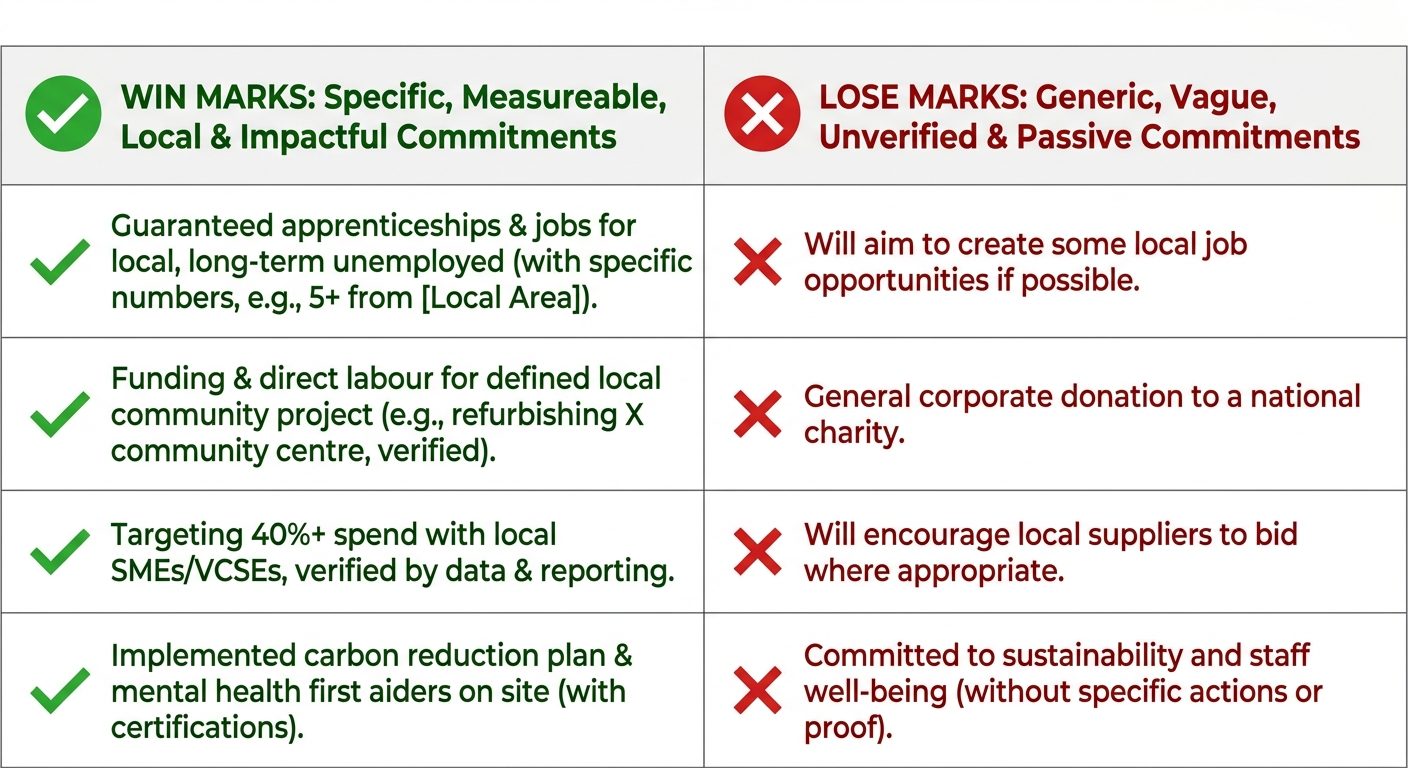
Comparison of winning versus generic social value commitments in construction tenders
Where Marks Are Lost
Generic environmental statements
Environmental commitments are the most common area of weak social value responses in construction. Most bids include a paragraph about carbon reduction, sustainable sourcing, and waste management. Most evaluators read them as boilerplate.
The reason is that environmental commitments in construction are increasingly hygiene, not differentiator. Saying you will target BREEAM Excellent or pursue a site waste management plan is not social value. It is compliance.
Marks are won where environmental commitments go beyond contractual minimum and connect to the specific project context. If the site is adjacent to a priority habitat, your biodiversity net gain commitments need to reflect that geography. If the client has a net zero 2030 target, your carbon reporting methodology should align with how they measure progress.
Evaluators score the delta between your commitments and what they would expect from any contractor on this contract. Generic environmental statements score zero delta.
Commitments made without realistic resource
Evaluators with experience can identify commitments that will not survive contact with a live site. An SME proposing to deliver 200 community volunteering days over an 18-month contract on a project that employs 12 people should expect scrutiny, because the maths do not work.
Over-promising is a more common problem than under-promising. The instinct to maximise every metric to score higher is understandable, but evaluators who have overseen contract delivery know what is realistic. A response that reads like a wishlist rather than a plan loses credibility, and evaluators will discount the entire social value section if they believe the commitments are not deliverable.
Write commitments that are ambitious but plausible. Stress test them against your resourcing plan. If the project employs 20 people and you are promising 500 employment weeks for disadvantaged groups over three years, be prepared to explain exactly how that works in the site interview.
Copying the client's language without adding substance
A common pattern: the bid team reads the social value questions, identifies the themes the client cares about, and writes responses that repeat those themes back using the client's own language. It reads like alignment but scores as empty.
The evaluator wrote the questions. They already know what themes they care about. They are not scoring you for stating them. They are scoring you for what you will actually do to deliver against them.
Mirroring language is useful for demonstrating you have understood the priorities. It fails when it substitutes for specificity.
The Process for Writing a Social Value Response That Scores
Most high-scoring construction social value responses follow a consistent method.
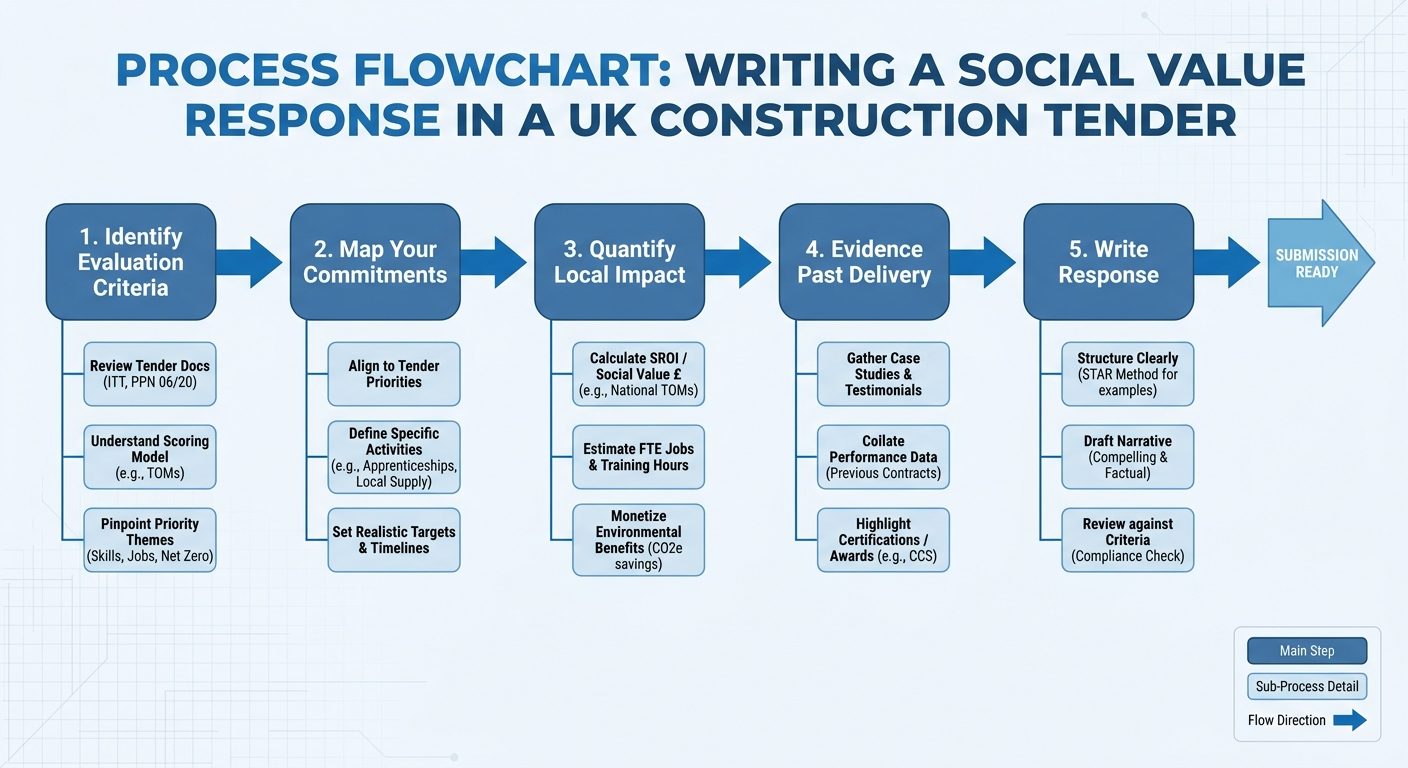
Step-by-step process for writing social value in construction tenders
How Evaluators Score Responses in Practice
Understanding the scoring methodology helps you calibrate your response.
Most construction tenders score social value on a 1-5 scale, sometimes with descriptors per score band. A typical scoring rubric looks like this:
5 (Exceptional): Response demonstrates exceptional understanding of local social value context. Commitments are specific, quantified, evidenced by past delivery, and tied to a robust monitoring and reporting framework. Supply chain and employment commitments go beyond what would be expected and are credibly deliverable. 4 (Good): Commitments are mostly specific and quantified with some evidence of past delivery. Monitoring mechanisms are described. Response shows good understanding of local context with some gaps. 3 (Satisfactory): Commitments are present but largely generic. Limited evidence of past delivery. Monitoring described at a high level only. Limited local specificity. 2 (Limited): Commitments are vague and largely unquantified. No credible monitoring mechanism. Little evidence of past performance. 1 (Poor): Generic statements without meaningful commitments. No evidence base. Does not demonstrate understanding of local context.The gap between a 3 and a 5 on a 20% weighted section is worth 4 percentage points of the evaluated score. In a competitive construction tender, that gap frequently determines the winner.
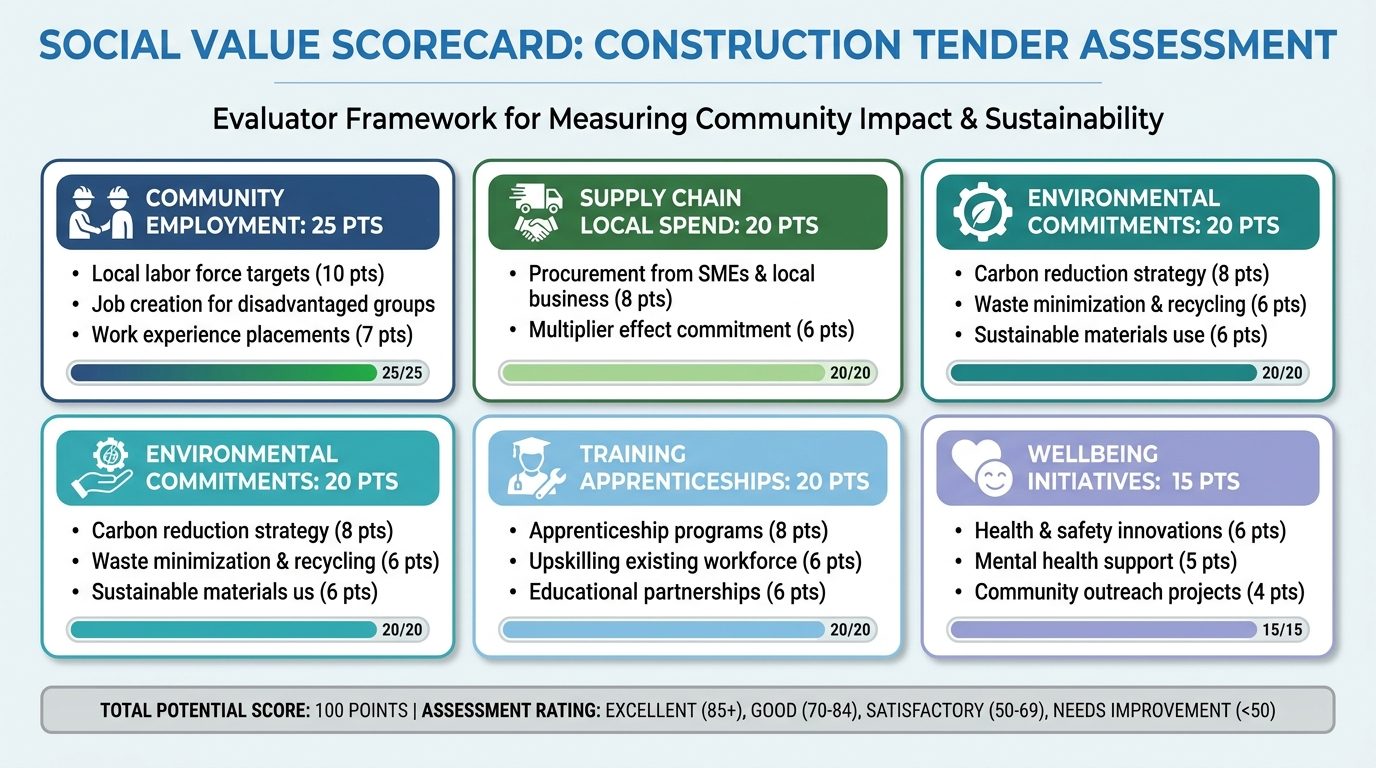
Evaluator scorecard for social value in construction tenders
The Procurement Act 2023 Dimension
The Procurement Act 2023, fully embedded in 2026, has introduced changes that affect how social value commitments work post-award.
Contracts now require specific KPI reporting against agreed metrics during delivery. Buyers have stronger enforcement mechanisms and, critically, poor social value delivery now has reputational consequences under the new transparency regime: contract performance data is published on the central digital platform.
This means the calculation for social value has changed. Previously, over-committing in a bid had limited downside: the commitment won the contract and delivery was assessed loosely if at all. Under the new regime, inflated commitments you cannot deliver become a published record of underperformance and can affect your ability to win future contracts.
The practical implication for bid teams: commitments need to be deliverable, not just impressive. This aligns with best practice but it now has regulatory force.
Using Technology to Improve Social Value Responses
One of the persistent challenges in bid writing is reusing social value commitments intelligently. A strong commitment developed for a housing association in Leeds contains valuable content, but lifting it wholesale into a schools framework response in Bristol produces the kind of generic response that scores a 2 or 3.
The better approach is to maintain a structured library of social value commitments that can be adapted efficiently. Each commitment should be stored with: the commitment type, the numbers delivered, the monitoring method, the project reference, the local context it was written for, and tags for the TOMs measures it maps to.
This library architecture lets bid teams adapt rather than create from scratch, replacing local context data while preserving the structure and evidence that evaluators reward. Platforms like mytender.io can store and surface this content intelligently, mapping previous commitments to new evaluation criteria and flagging where local context needs updating.
The time investment is in the library maintenance, not in rewriting the same commitments for every bid.
What Good Looks Like: Putting It Together
A construction company bidding for a £15m secondary school refurbishment in Burnley writes their social value response as follows.
They start by reading the council's social value strategy, which prioritises youth employment, apprenticeships in construction trades, and local supply chain spend given the economic regeneration agenda in East Lancashire.
They quantify four primary commitments: 12 apprenticeship starts from Burnley and Pendle postcodes over the contract period, in partnership with Burnley College's Level 3 Diploma in Construction and the Built Environment; 65% of direct labour recruited from BD11 and BB10-BB12 postcodes; minimum 45% measured supply chain spend with businesses based within 25 miles of the site, tracked via their procurement system and reported in monthly KPI packs; and 10 volunteering days per month contributed to Burnley Youth Zone's construction skills programme.
Each commitment references comparable delivery: the apprenticeship commitments are evidenced by delivery on a Calderdale Council programme completed in 2025, where 14 apprentices started and 11 completed. The local labour commitment is supported by a site register data extract from a comparable Pennine project. The supply chain commitment is backed by a named list of local subcontractor relationships in M&E, groundworks, and finishing trades.
They calculate the TOMs value of their package at approximately £1.4m, using proxy values from Social Value Portal, and present this in a summary table alongside the monitoring and reporting mechanism.
That response scores a 4 or 5. It costs the bid team approximately eight hours of preparation that most competitors do not invest.
In Summary
Social value is where construction tenders are won or lost when technical scores are close and pricing is competitive. The marks are available but the majority of responses do not score them.
The difference is preparation, specificity, and honesty about what you can deliver. Read the client strategy. Research the local context. Quantify everything. Evidence it from past contracts. Build in a monitoring mechanism. Do not over-promise.
Eight hours of pre-bid preparation on social value is worth significantly more than an additional hour on the technical method statement.
If you want to explore live construction tender opportunities in your region, the mytender.io Tender Finder is free to use and matches opportunities to your sector and geography.
Tags
Ready to Transform Your Tender Writing?
See how MyTender's AI can help you write winning tenders in a fraction of the time.