
Social Housing Tender Writing: Complete Guide to Winning Housing Association Contracts in 2026
A definitive guide to winning tenders with housing associations, local authority housing departments, and registered providers. Covers evaluation frameworks, social value requirements, asset management, repairs and maintenance contracts, and how AI tools are reshaping bid writing for the social housing sector.
mytender.io Research Team
Tender Writing & Bid Management Specialists
Social Housing Tender Writing: Complete Guide to Winning Housing Association Contracts in 2026
Social housing is one of the UK's most active procurement markets. Housing associations, local authority housing departments, and registered providers collectively spend over £9 billion annually on repairs and maintenance, construction and development, professional services, and technology. Yet despite the scale of opportunity, winning contracts in this sector remains fiercely competitive — and the evaluation frameworks that housing organisations use to select suppliers have become significantly more sophisticated.
This guide covers everything you need to know about tendering effectively for social housing contracts in 2026: the market landscape, procurement routes, how housing associations evaluate bids, what makes a winning submission, how to approach social value, and where AI tools can sharpen your competitive edge.
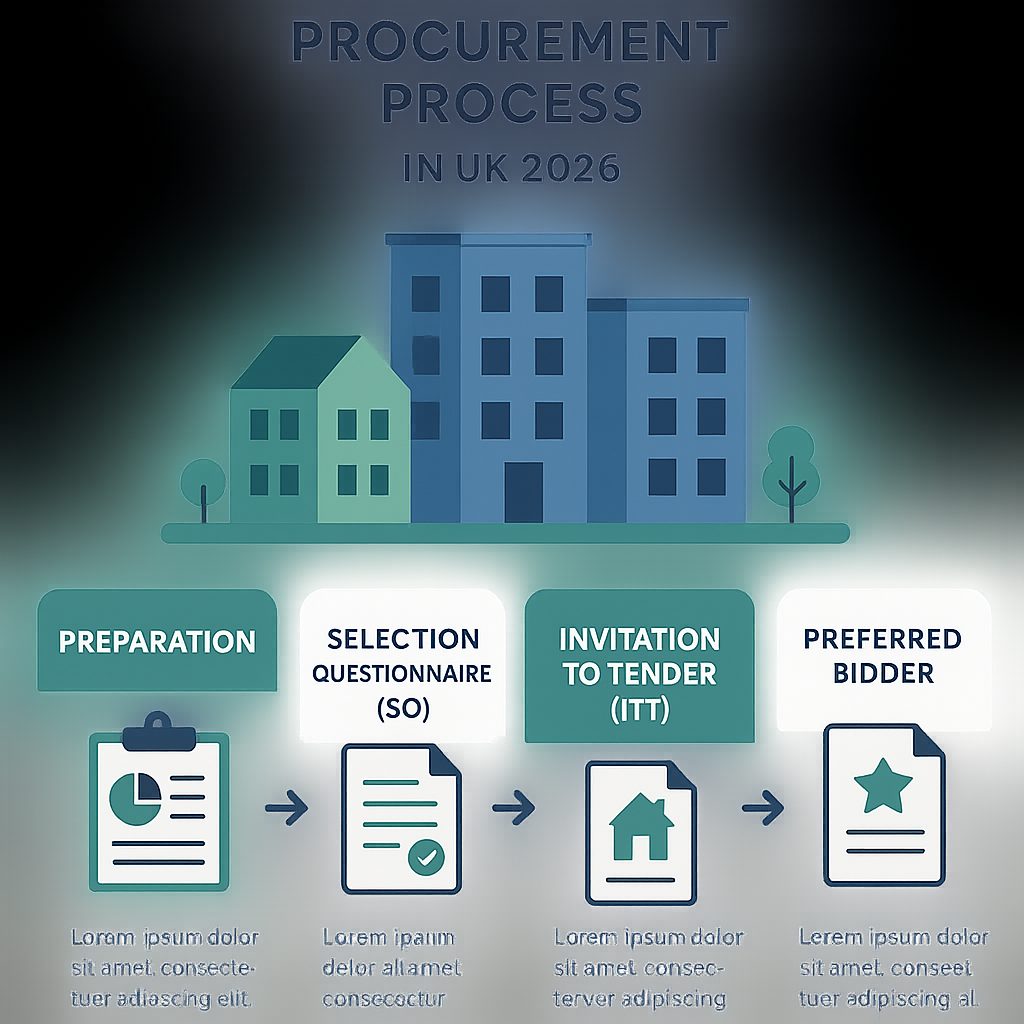
Social housing procurement process and tender stages in the UK
The Social Housing Procurement Landscape in 2026
Understanding the market before you write a word of your tender is non-negotiable. Social housing procurement has specific characteristics that distinguish it from central government contracts, NHS procurement, or private sector tenders.
Who Buys What
The social housing sector in England alone comprises approximately 1,500 registered providers (RPs) — ranging from small community land trusts with a few hundred homes to large group structures such as Clarion, Peabody, L&Q, and Sanctuary, which between them own hundreds of thousands of properties. Scotland, Wales, and Northern Ireland have their own registered provider frameworks under their respective regulators.
The procurement categories these organisations buy regularly are:
Repairs and Maintenance (R&M) — typically the largest category by value. Contracts range from small local authority responsive repairs contracts worth £500K annually to national framework agreements with the largest housing groups worth £50M+. Sub-categories include responsive/reactive repairs, voids and planned maintenance, gas servicing and heating, electrical compliance, and lift maintenance. Construction and Development — new build housing for social rent, shared ownership, and affordable housing schemes. Procurement includes main contractor packages, specialist subcontracts, and construction professional services. Asset Management — condition surveys, stock investment programmes, fire safety works, energy efficiency upgrades (particularly EPC-C compliance works under government targets), and planned component replacement. Professional Services — project management, quantity surveying, architecture, structural engineering, environmental consulting, legal, financial advisory, and HR services. Technology and Digital — housing management systems (HMS), digital tenant portals, predictive maintenance platforms, data analytics, and cybersecurity. Facilities Management — communal area cleaning, grounds maintenance, caretaking, CCTV and security, and concierge services.Procurement Routes
Housing associations are not bound by the Public Contracts Regulations (PCR) 2015 in the same way as public authorities — larger HAs sit in the "utilities" category under EU procurement law and are not fully subject to PCR thresholds. However, the sector has voluntarily adopted transparent procurement practices, and most larger providers follow or mirror public procurement procedures in the interests of fairness and regulatory compliance.
The Regulator of Social Housing (RSH) expects landlords to demonstrate value for money, which means procurement processes are scrutinised. Common procurement routes include:
Open/restricted tender — most common for contracts above £50K. Typically a Selection Questionnaire (SQ) or Pre-Qualification Questionnaire (PQQ) stage followed by an Invitation to Tender (ITT). Framework agreements — many large HAs use frameworks (their own or shared services ones like LHC, Fusion21, CHIC, and Procurement for Housing/PfH) for regularly-purchased categories. Winning a place on a framework does not guarantee work; you still need to win call-off competitions. Dynamic Purchasing Systems (DPS) — increasingly used for repairs and maintenance, allowing HAs to admit new suppliers throughout the DPS lifetime. Lower barriers to entry but still competitive for call-offs. Negotiated procedure — used for specialist work, emergency contracts, or where only one or two suppliers have the required capability. The Procurement Act 2023 came into force in February 2025 and, while primarily targeting central government contracting authorities, its transparency requirements and the Most Advantageous Tender (MAT) approach are increasingly influencing housing sector procurement practice.How Housing Associations Evaluate Bids
This is the intelligence most bidders lack — and it is the most important section in this guide. Understanding precisely how your tender will be evaluated allows you to allocate your writing effort correctly and craft responses that score maximum marks.
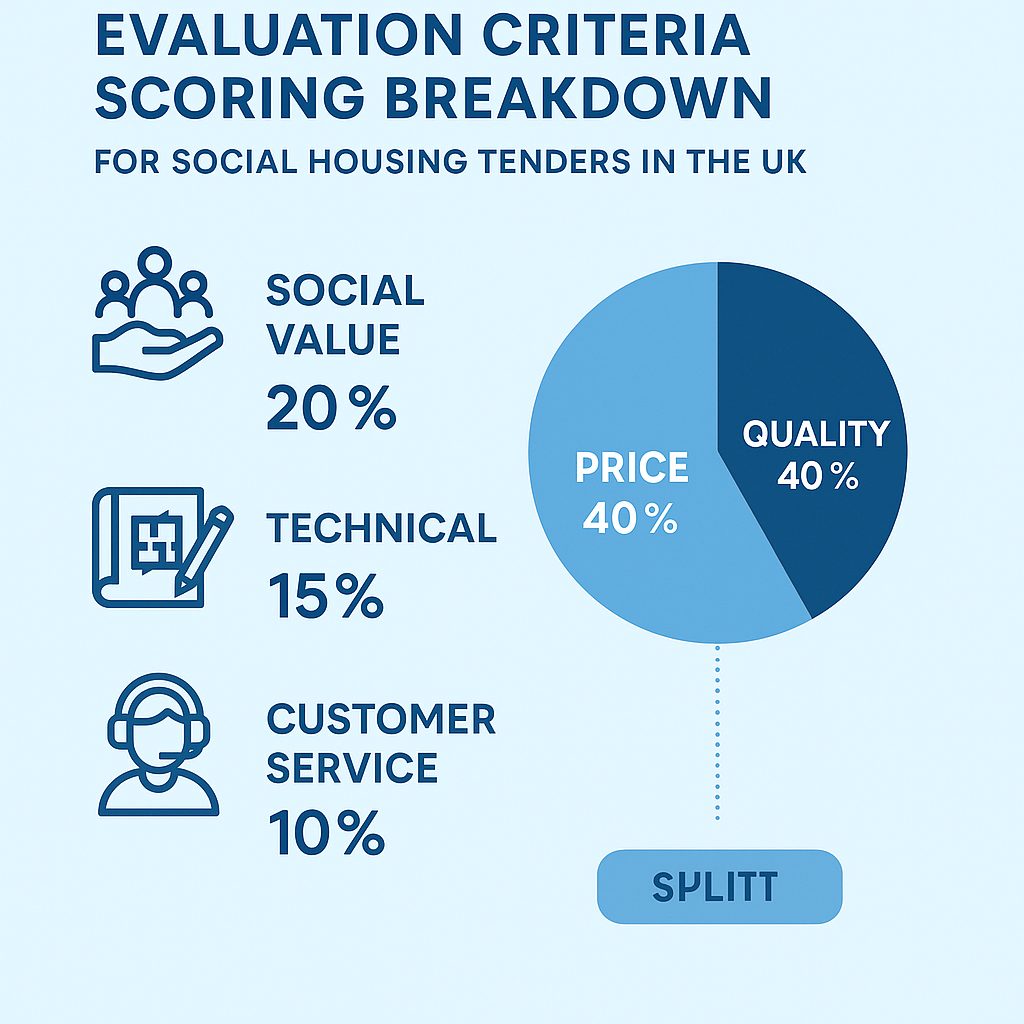
Evaluation criteria scoring breakdown for social housing tenders
The Typical Quality/Price Split
Social housing procurement has shifted significantly toward quality over the past five years. In 2019, a 60:40 price-to-quality split was common for repairs and maintenance contracts. Today, the typical weighting for R&M contracts is:
- Quality: 60–70% (method statements, social value, TUPE approach, mobilisation plan, KPI framework)
- Price: 30–40% (schedule of rates, pricing model)
For construction and development contracts, quality weightings are often higher still — 70–80% — because delivery competence and safety track record matter more than a marginally lower price on a scheme that will take three years to build.
For professional services, quality typically represents 70–80% of the evaluation, reflecting the importance of the team, methodology, and client relationships in service delivery.
Quality Evaluation Criteria
Within the quality component, housing associations typically evaluate submissions against these categories:
Methodology and approach — How will you deliver the service? What processes, systems, and governance structures will you use? This is usually the largest single quality criterion, worth 20–30% of the total score. Social value — Housing associations are social landlords. Community benefit is central to their purpose, not an afterthought. Social value criteria are typically worth 10–20% of total score and are taken more seriously in the HA sector than almost any other procurement market. Experience and track record — Case studies, references, and evidence of similar contracts. Worth 10–15%. Mobilisation and transition — Particularly important for large R&M contracts where a poor transition from the incumbent can cause significant service disruption to tenants. Worth 5–10%. Team and resources — Named key personnel, CVs, capacity planning. Worth 5–10%. Sustainability and environmental — Net zero targets, fleet electrification, embodied carbon, waste reduction. Increasingly weighted at 5–10%. Tenant engagement and satisfaction — How will you involve tenants in service delivery and measure their satisfaction? Worth 5–10%, reflecting post-Grenfell obligations and the Social Housing (Regulation) Act 2023.The Role of Tenant Scrutiny
The Social Housing (Regulation) Act 2023 has had a profound impact on how housing associations approach procurement. The Act strengthened the Regulator of Social Housing's powers and introduced new consumer standards that require landlords to demonstrate genuine tenant engagement and empowerment. This translates directly into tender evaluations.
In 2026, it is common for tender processes at larger housing associations to include tenant representatives on evaluation panels, tenant satisfaction commitments as scored criteria, and requirements for suppliers to report against Tenant Satisfaction Measures (TSMs) on a quarterly basis. Your tender must speak to tenants as stakeholders, not just the HA's procurement team.
Weak bidders describe tenant engagement in generic terms: "We will communicate with tenants via our customer care team." Strong bidders describe specific mechanisms: named tenant liaison roles, tenant satisfaction survey methodology, complaint response timescales, digital self-service portal functionality, and how tenant feedback will drive continuous improvement.
Writing a Winning Social Housing Tender
Understanding the Specification
Before you write a word of your submission, spend serious time on the specification. Housing association specifications for R&M contracts are typically dense documents covering service standards, KPI frameworks, reporting requirements, TUPE obligations, and asset data. Read them end-to-end. Then read them again.
Mark every requirement that your response needs to address directly. Housing associations use structured scoring matrices, and evaluators check whether responses address each element of the specification. A beautifully written response that fails to address a specific requirement scores poorly.
Pay particular attention to the housing association's own strategic documents: their corporate plan, asset management strategy, sustainability commitments, and tenant engagement framework. These are usually available on their website and tell you what matters to the organisation beyond the specification itself. Referencing these in your response demonstrates genuine interest and research — and earns marks.
Structuring Your Methodology
For repairs and maintenance contracts, a strong methodology typically follows this structure:
Service delivery model — How will you organise your workforce, scheduling, and sub-contractor network to deliver the required service? Include staffing structure, trade coverage, geographic coverage, and sub-contractor management. Responsive repairs delivery — How do you receive and triage repairs requests? What are your appointment booking processes? How do you ensure right-first-time completion? What is your parts and materials management approach? Planned maintenance delivery — How do you programme and manage planned works? How do you coordinate with tenants for access? How do you handle delays and reschedules? Void management — How do you approach void turnarounds? What is your standard void process from handback to re-let ready? What special procedures exist for complex voids? Quality management and assurance — What QA processes do you operate? How do you carry out post-completion inspections? How do you manage defects and complaints? Reporting and data management — What systems will you use? What reports will you produce and at what frequency? How will you manage and share asset data? Continuous improvement — How will you measure and improve performance over the contract term? What innovation will you bring?For each section, be specific. Name the systems you use (Aareon, Totalmobile, Simpro, Joblogic — whichever applies). Describe your scheduling logic. Give response time commitments. Include worked examples. Evaluators score responses on the depth and specificity of evidence, not on the quality of your English prose alone.
Social Value: Your Strongest Differentiator
Social value has always mattered in the housing sector — but post-Grenfell and post-pandemic, it carries more weight than ever. Housing associations are not purchasing departments; they are social mission organisations. They need their supply chains to share and demonstrate that social commitment.
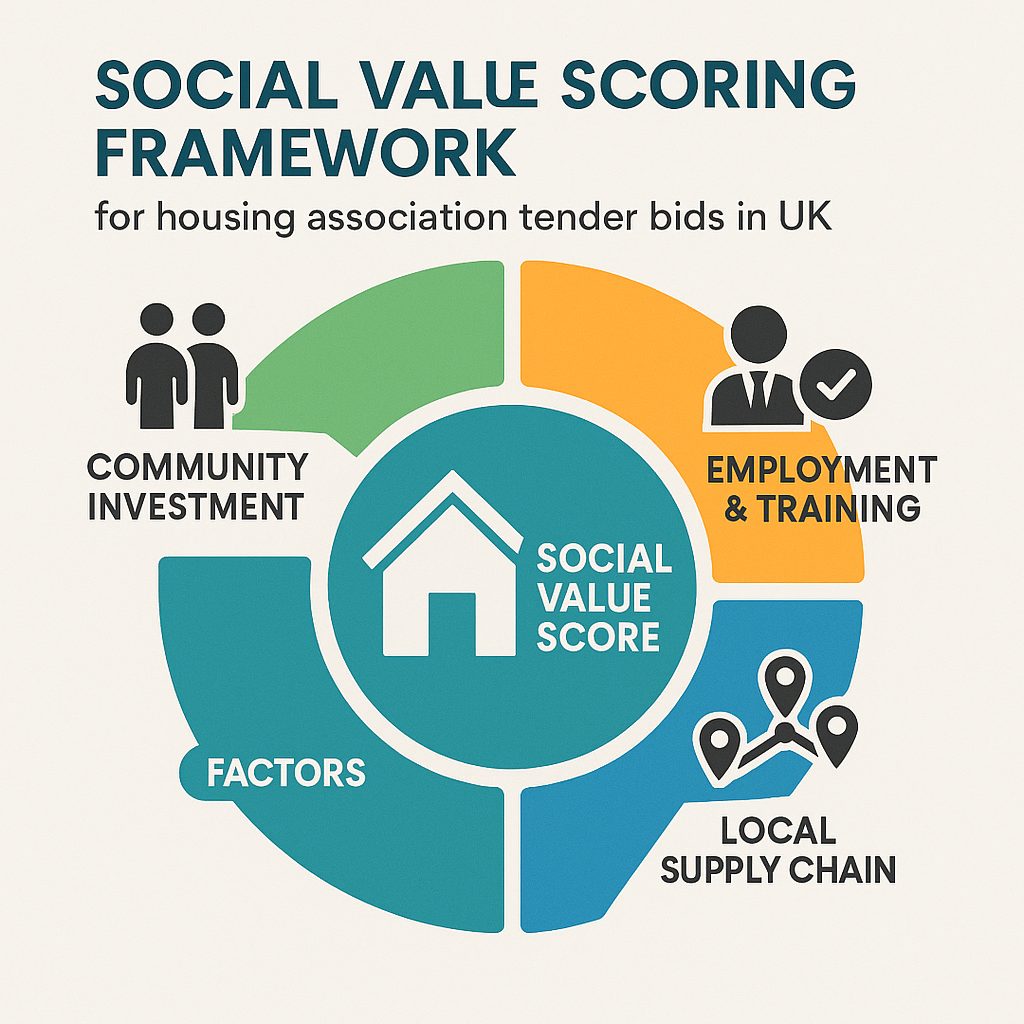
Social value scoring framework for housing association tender bids
A weak social value response looks like this: "We are committed to social value. We will employ local people, support apprenticeships, and make charitable donations." This response scores near zero because it is unquantified, unaccountable, and indistinguishable from every other bidder's response.
A strong social value response looks radically different. It:
Quantifies commitments precisely. "We commit to recruiting a minimum of 60% of our site-based workforce for this contract from within 10 miles of the service delivery area, verified quarterly against payroll data and reported in our monthly management information." Names specific local organisations you will partner with. "We have an existing relationship with Haringey Works, the local employment charity, through which we have placed 23 apprentices since 2021. We will formalise this relationship for this contract, targeting 4 new apprentices per annum, with 50% from the housing association's own tenant communities." Links to the housing association's stated priorities. If their corporate plan identifies youth unemployment and digital inclusion as community investment priorities, your social value response should address both specifically — not just offer generic employment and apprenticeship pledges. Commits to measurement and reporting. Social value commitments without accountability mechanisms are treated with scepticism. Describe the Social Value Portal metrics you will report against, the frequency of reporting, and what happens if you underperform. Goes beyond employment. Supply chain spend locally, tenant volunteering hours by staff, charity partnerships, free skills workshops, tenant digital device donations — differentiated commitments that reflect genuine thought about the specific community this contract will serve.The National TOMs (Themes, Outcomes, Measures) social value framework, developed by the Social Value Portal, is widely used by housing associations and local authorities to evaluate and compare social value proposals. Understanding the TOMs and ensuring your commitments map clearly to them is essential for any serious housing sector bidder.
Addressing Tenant Satisfaction and the Social Housing Regulation Act
The Consumer Standards introduced by the RSH in 2024 and reinforced in the Social Housing (Regulation) Act 2023 require registered providers to demonstrate high-quality landlord services, genuine tenant engagement, and transparent accountability. Procurement teams at housing associations must now demonstrate that their suppliers support compliance with these standards.
Your tender should show:
How you will contribute to Tenant Satisfaction Measures (TSMs). The 22 TSMs include measures on repairs satisfaction, time taken to complete repairs, communal area safety, and overall landlord satisfaction. For R&M contracts, your repairs quality and tenant communication directly affect TSM outcomes. Describe specifically how your service model drives TSM improvements. How you will collect and act on tenant feedback. Not just post-job satisfaction surveys (though those matter). Describe tenant forums, estate walkabouts involving your staff, digital tenant panels, and mechanisms by which tenant feedback genuinely influences your service model. How you will handle complaints. Housing associations receive regulatory scrutiny on complaint handling. Your complaint resolution process, escalation routes, and learning-from-complaints approach should be described in detail. How vulnerable tenants are protected. Adaptations for tenants with disabilities, safeguarding procedures, priority response for high-vulnerability households, and staff training on domestic abuse awareness. These are not optional extras in social housing procurement — they are core expectations.Asset Management and Energy Efficiency Tenders
A growing proportion of social housing procurement is driven by asset investment — particularly energy efficiency improvements driven by the government's net zero targets and the Social Housing Decarbonisation Fund (SHDF).
The Warm Homes Plan announced in late 2024 set out significant funding for social housing energy upgrades, with a pathway to EPC-C as a minimum standard for all social rented homes. This is driving a wave of procurement for:
- External wall insulation (EWI) and internal wall insulation (IWI)
- Loft and underfloor insulation
- Heat pump installations (air source and ground source)
- Solar PV and battery storage
- Smart heating controls and thermostats
- Electrical upgrades to support heat pump loads
- Whole-house retrofit assessments and PAS 2035 co-ordinator services
Tenders for this work have specific characteristics that differ from standard repairs contracts.
PAS 2035 Compliance
PAS 2035 is the publicly available specification for whole-house retrofit, mandatory for government-funded retrofit projects. If your organisation wants to win SHDF-funded social housing retrofit contracts, you must demonstrate PAS 2035 compliance: a qualified Retrofit Assessor, a Retrofit Co-ordinator, and installation teams certified under TrustMark or MCS.
Your tender methodology for retrofit contracts should describe your PAS 2035 compliance structure clearly, including named personnel with their qualifications, your QA process for Retrofit Assessment Reports (RARs), how you manage Medium Risk dwellings requiring special considerations, and your approach to monitoring and evaluation under PAS 2030.
Energy Performance and Data
Housing associations need data. Modern asset management procurement increasingly requires suppliers to provide EPC ratings pre and post improvement, modelled heat demand reductions, SAP score improvements, projected fuel bill savings for tenants, and embodied carbon data for materials. Demonstrate your data management capability, your digital outputs (BIM-compatible asset data, UPRN-linked records), and your ability to feed information into the HA's housing management and asset management systems.
Green Skills and Supply Chain
The retrofit market faces a significant skills gap. Qualified heat pump engineers, certified EWI installers, and PAS 2035 Retrofit Co-ordinators are in short supply relative to the market demand created by SHDF and Warm Homes funding. Tenders for retrofit work should address your supply chain strategy explicitly: how you are building green skills capacity in your workforce, your apprenticeship and retraining programmes, and your sub-contractor qualification and vetting process.
Common Mistakes in Social Housing Tenders
Years of bid evaluation data and post-tender feedback reveals recurring patterns in unsuccessful submissions. Knowing what to avoid is as valuable as knowing what to include.
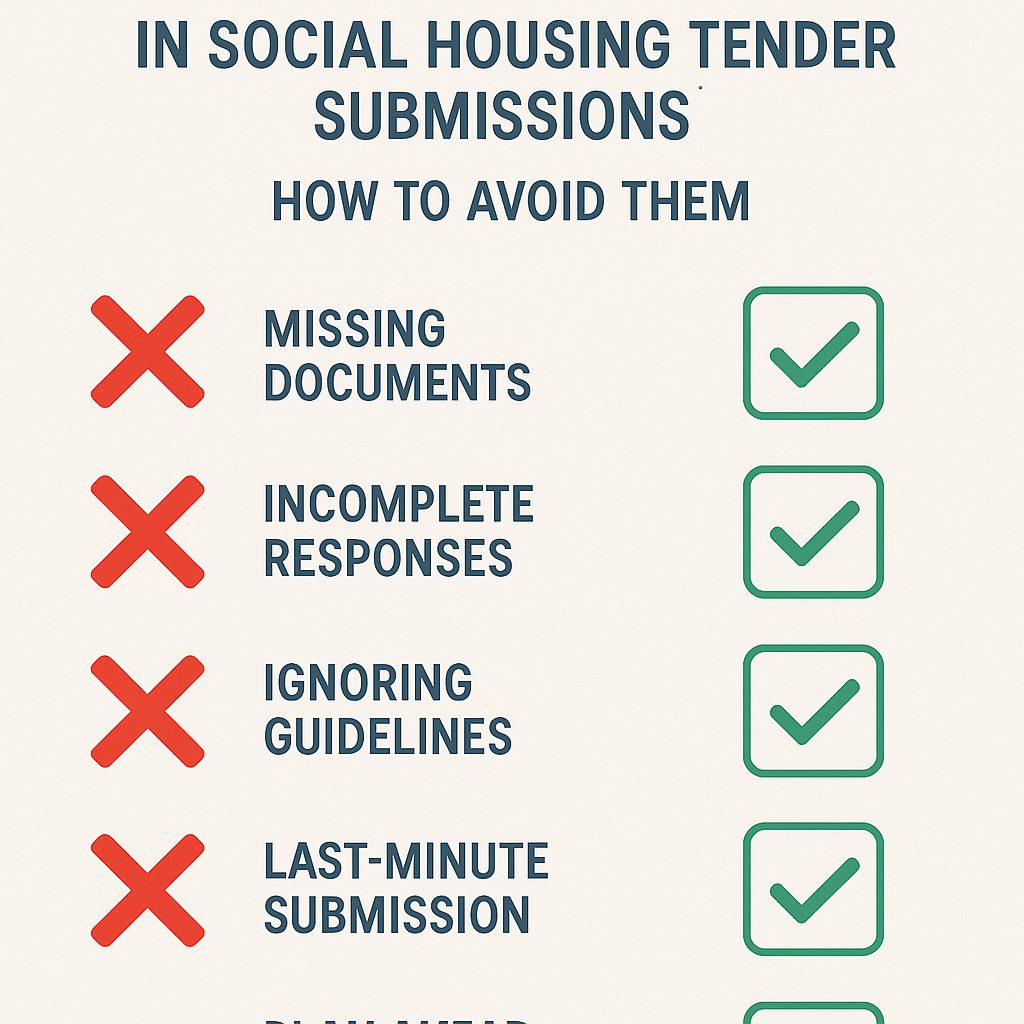
Common mistakes in social housing tender submissions and how to avoid them
Generic, Non-Contract-Specific Responses
The single most common failure. Bidders paste boilerplate from previous tenders, substituting the client name but leaving the methodology essentially identical regardless of whether they are bidding for a 500-home rural housing association or a 40,000-home urban group. Evaluators see this immediately. Your methodology should reference the HA's specific geography, their tenant demographics, their asset profile, and their stated strategic priorities.
Vague Social Value Commitments
Already covered above, but worth emphasising again. "We support local employment and apprenticeships" scores zero. Quantified, evidenced, locally-anchored commitments that reference named organisations and specific targets score well.
Weak Evidence
Claiming capability without demonstrating it. "We have extensive experience of managing R&M contracts for housing associations" tells an evaluator nothing. "Our current contract with Midland Heart Housing (12,000 properties across the West Midlands, £4.2M annual value, commenced 2022) has delivered 97.1% tenant satisfaction in the last four quarters, against a contractual target of 93%" is evidence. Use data, name clients (with permission), quantify outcomes.
Ignoring the Marking Scheme
Most ITTs include a marking guide explaining how responses will be scored. Bidders who ignore this and write long philosophical essays about company values score poorly. Bidders who read the marking scheme, understand what each mark band requires, and structure their responses accordingly score well. If the marking scheme says a 5/5 response must include a quantified improvement plan with named responsible owners and a monitoring schedule, give them exactly that.
Poor Structure and Formatting
Word limits exist for a reason — evaluators have dozens of responses to score. A response that exceeds the word limit forces an evaluator to either penalise you or spend extra time editing your submission. Responses without clear headings, subheadings, and paragraph breaks are harder to score. Use headers that mirror the question structure. Use bullet points for lists. Include tables for comparison data. Make the evaluator's job easy.
Late Submissions
It sounds obvious, but late tender submissions are disqualified. Social housing procurement timetables are often tight — evaluators at housing associations are typically dealing with live contract management responsibilities alongside procurement exercises. Build in buffer time for internal approvals, final proofing, and portal upload (e-tendering portals frequently have slow upload speeds for large files). Aim to submit 48 hours before the deadline.
Frameworks for Social Housing Suppliers
Gaining a place on a framework agreement is often the first step to winning consistent social housing work. The key frameworks operating in the sector in 2026 include:
PfH (Procurement for Housing) — One of the largest social housing-specific procurement organisations, offering frameworks covering repairs, planned maintenance, professional services, and technology. Membership-based; housing associations pay to access the frameworks. Fusion21 — A member-led procurement consortium offering frameworks in construction, FM, and professional services. Significant presence in northern England and Scotland. LHC (Local Housing Contracts) — Specialises in construction and refurbishment frameworks for housing associations, local authorities, and public bodies. CHIC (Central Housing Investment Consortium) — Housing sector buying collective operating frameworks across R&M, capital works, and energy efficiency. YPO / Crown Commercial Service — For technology and professional services, social housing organisations often access CCS and YPO frameworks.Winning a framework place requires a strong SQ/PQQ submission demonstrating financial standing, relevant experience, insurance levels, health and safety accreditations, and quality management systems. If you are targeting social housing work for the first time, focus on smaller direct tender opportunities to build references before pursuing major framework applications.
Accreditations That Matter
Most social housing tenders require or give advantage to suppliers holding certain accreditations. Build your accreditation profile around:
- ISO 9001 (Quality Management) — expected for most R&M and construction tenders
- ISO 14001 (Environmental Management) — increasingly mandatory
- ISO 45001 (Occupational Health and Safety) — standard for construction/repairs
- Contractors Health and Safety Assessment Scheme (CHAS) or Constructionline — sector-standard supply chain qualification
- Lloyds Register / NICEIC / Gas Safe — trade-specific certifications for relevant work
- TrustMark and MCS — mandatory for retrofit work
- Living Wage Foundation accreditation — frequently specified in social value criteria
- Armed Forces Covenant — often scored in social value sections
How AI Is Transforming Social Housing Bid Writing
The social housing sector has been slower than central government markets to generate the volume of procurement documentation that makes AI bid writing tools particularly valuable — but that is changing. As housing associations standardise their evaluation frameworks and generate libraries of past submissions, AI tools that can learn from winning responses are becoming a genuine competitive differentiator.

AI-powered tender writing software helping bid teams create social housing proposals
The Challenge of Sector-Specific Knowledge
Generic AI writing tools struggle with social housing tenders because the sector has its own vocabulary, regulatory framework, and evaluation culture. A tool that produces excellent prose for a central government IT tender will generate text that sounds alien to a housing association evaluator if it doesn't understand the difference between TSMs and KPIs, PAS 2035 and SAP assessments, or Fusion21 and Crown Commercial Service.
Specialist AI platforms like mytender.io address this by training on procurement-specific data, allowing bid teams to upload their own past submissions and case studies as a knowledge base, and applying sector-contextual understanding to generated content. The result is AI-assisted content that reflects your organisation's genuine experience and uses language that housing association evaluators recognise and respond to.
Practical Applications
The highest-value applications of AI in social housing bid writing are:
First draft generation for method statement questions. A bid writer who previously spent 6–8 hours on a complex methodology question can now generate a strong first draft in 20–30 minutes using an AI tool trained on similar contract responses. The remaining time goes into review, client-specific tailoring, and evidence insertion — the activities that most differentiate winning from losing responses. Social value section development. AI can help identify relevant social value commitments based on a HA's corporate plan priorities and local area demographics, generating a structured first draft that the bid team can refine with specific local partners and quantified targets. Compliance checking. AI tools can cross-reference your draft response against the specification to flag requirements that haven't been addressed, helping ensure nothing critical is missed before submission. Consistency review. For large tender submissions with multiple section authors, AI can review for consistency of tone, terminology, and claims — reducing the risk of contradictions between sections. Formatting and word count management. Automatically restructuring responses to meet word limits while preserving key messages.What AI Cannot Replace
The highest-scoring tender responses combine AI efficiency with human expertise. AI tools cannot:
- Draw on your organisation's specific delivery data (only your bid team has access to your actual performance metrics)
- Build genuine relationships with housing association procurement teams
- Conduct pre-market engagement conversations that inform your tender strategy
- Make strategic decisions about which lots to pursue and how to price competitively
- Review post-tender feedback from evaluators and translate it into improved methodology
The bid teams winning the most social housing contracts in 2026 are those who use AI to eliminate the low-value writing work — drafting, formatting, cross-referencing — and invest the time saved into the high-value activities: client research, evidence gathering, tender review, and strategic pricing.
Building a Social Housing Bid Library
Sustainable success in the social housing market requires a systematic approach to knowledge management. One-off tender wins are possible through hard work; a consistent pipeline of contract wins requires a library of reusable, high-quality content.
Your bid library should contain:
Case studies for each contract type — R&M, planned maintenance, construction, professional services. Each case study should include contract value, duration, client name (and permission to reference), key KPI performance data, notable achievements, and a 150-word and 300-word version for different word limits. Standard methodology components — mobilisation methodology, QA process descriptions, complaint handling procedures, TUPE approach, sub-contractor management — updated after every tender based on evaluator feedback. Social value evidence bank — documented outcomes from previous contracts: number of apprentices placed, local spend data, volunteering hours, community investment. This is often the hardest section to populate from scratch and the most valuable over time. Personnel CVs — maintained and updated quarterly for all key personnel. Ensure that named individuals consent to being included in tender submissions. Accreditation register — expiry dates and renewal status for all accreditations. Nothing undermines a tender submission like discovering a CHAS certificate expired two months ago. Reference contact list — previous clients willing to provide references or respond to verification enquiries. Keep this current and let references know when they might be contacted.AI tools like mytender.io can serve as the intelligence layer that sits on top of your bid library, drawing on your stored content to generate section-specific drafts that blend your organisation's specific evidence with best-practice methodology. The more content you feed into the system, the better the output — making early investment in knowledge management a long-term competitive advantage.
Winning Strategy: Before, During, and After the Tender
Before: Market Engagement and Intelligence
The most successful social housing bidders treat tender preparation as a six-to-twelve month activity, not a four-week sprint. Before a tender even goes to market, they:
Build relationships with procurement teams. Housing associations hold pre-market engagement events, annual supply chain days, and sector conferences. Attendance is not about sales — it is about understanding what the HA really needs, beyond what will be written into the specification. Monitor procurement portals. Social housing tenders are published on Find a Tender Service (FTS), Contracts Finder, and sector-specific portals like Delta eSourcing. Set up automated alerts for relevant keywords and geographies. Study the incumbent's performance. If you are bidding to displace an incumbent supplier, understand where they have underperformed. Tenant satisfaction data, complaint volumes, and Regulator of Social Housing regulatory notices are public information. Your tender can position your approach as the solution to identified weaknesses. Develop your social value pipeline. If you don't have existing local employment partnerships in the geography you are targeting, start building them before the tender lands. A relationship with a local employment charity that you can reference credibly in your submission is worth far more than a generic commitment established in response to the specification.During: Discipline and Process
Run your tender response like a project. Assign clear ownership for each section, set internal review dates, and hold a structured final review meeting covering content, compliance, formatting, and submission mechanics.
Invest in a pre-submission review by someone who has not been involved in writing the response — ideally someone with social housing procurement experience who can evaluate it as an evaluator would.
After: Learn from Every Outcome
Always request debriefs. Housing associations are generally willing to provide post-tender feedback, and the quality of that feedback is often better than central government equivalents. A thorough debrief tells you precisely where you lost marks, allowing you to target improvements for the next submission.
Track your win rate by tender type, client size, geography, and contract value. Over time, this data will reveal where your organisation has competitive advantage and where you are consistently underperforming, informing your bid/no-bid decisions.
Summary: The Social Housing Tender Checklist
Before submitting any social housing tender, review this checklist:
Research- [ ] Read the housing association's corporate plan, asset management strategy, and tenant engagement framework
- [ ] Identified the HA's top three strategic priorities and referenced them in your response
- [ ] Checked post-Grenfell obligations and Social Housing (Regulation) Act requirements relevant to this contract
- [ ] Method statements are contract-specific, not generic
- [ ] Named systems, platforms, and tools by name
- [ ] Included measurable commitments with quantified targets
- [ ] Addressed mobilisation, steady-state, and continuous improvement
- [ ] Risk register included with credible mitigations
- [ ] All commitments are quantified
- [ ] Named specific local organisations and partnerships
- [ ] Mapped to National TOMs or the buyer's own social value framework
- [ ] Included measurement and reporting methodology
- [ ] Described specific TSM contributions
- [ ] Named tenant liaison roles and mechanisms
- [ ] Addressed vulnerable tenant requirements
- [ ] Complaint handling described in detail
- [ ] Minimum three relevant case studies included
- [ ] Performance data quantified (not just claimed)
- [ ] Reference contacts up to date and briefed
- [ ] Named personnel with relevant credentials and experience
- [ ] Word limits respected in every section
- [ ] All mandatory attachments included
- [ ] Accreditations current and attached
- [ ] Financial standing documents up to date
- [ ] Internal review completed at least 48 hours before deadline
- [ ] Submission portal tested, login credentials confirmed
- [ ] Files correctly formatted and named per submission instructions
- [ ] Confirmation of receipt saved
---
The social housing sector rewards bidders who take the time to understand what housing associations genuinely need: not just cost-effective service delivery, but a supply chain partner that shares their social mission, engages their tenants with respect, and delivers measurable community benefit. Organisations that approach social housing tenders with this understanding — and use every available tool, including modern AI bid writing platforms, to execute against it efficiently — are the ones consistently winning contracts in 2026 and building the long-term partnerships that underpin sustainable growth in this sector.
mytender.io helps housing sector bid teams work faster and smarter, combining AI-powered first draft generation with a knowledge management system built on your organisation's own case studies and methodology. If you are serious about winning social housing contracts, explore how mytender.io can support your tender programme.
Tags
Ready to Transform Your Tender Writing?
See how MyTender's AI can help you write winning tenders in a fraction of the time.