
Smart FM Tender Evidence: How to Prove Predictive Maintenance, IoT and Energy Performance in 2027
A practical guide for facilities management bidders on evidencing smart FM, predictive maintenance, IoT sensors, CAFM data and energy performance in public sector tenders.
mytender.io Research Team
Tender Writing & Procurement Specialists
Smart FM Tender Evidence: How to Prove Predictive Maintenance, IoT and Energy Performance in 2027
Smart FM sounds brilliant in a sales deck.
Sensors. Dashboards. Predictive maintenance. Occupancy data. Energy optimisation. Fewer failures. Happier building users.
Then the tender asks for evidence.
That is where a lot of facilities management bids get thin. They describe the technology, list the platforms, add a few screenshots, and hope the evaluator connects the dots. The problem is that evaluators do not score ambition. They score confidence.
If you want marks for smart FM in 2027, you need to prove three things clearly: the data is reliable, the insight changes operational behaviour, and the contract will benefit in measurable ways.
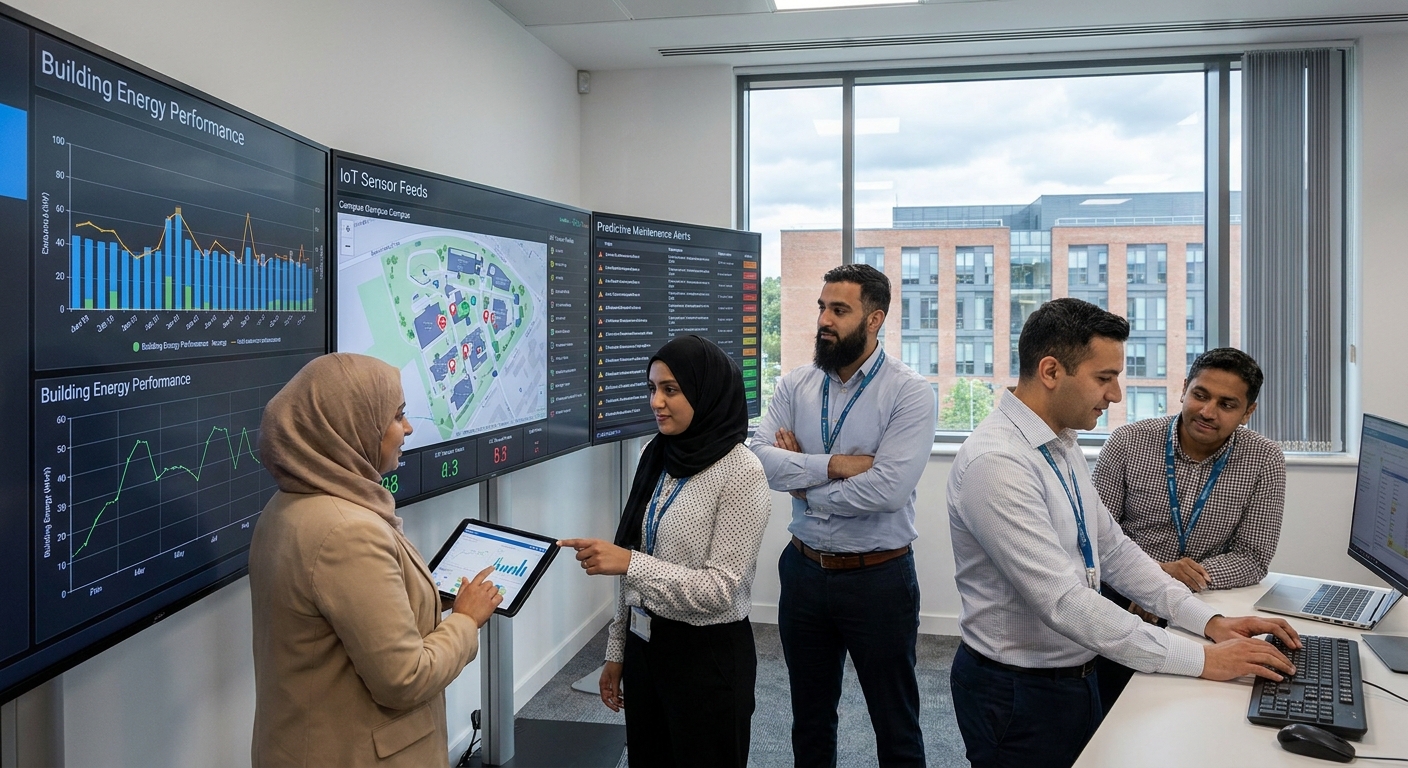
Smart FM operations room with facilities data dashboards, IoT sensor feeds and maintenance alerts
This guide is for FM bid teams, hard FM leads, mobilisation managers and commercial directors who need to write stronger tender responses around smart buildings, predictive maintenance, building management systems, energy performance and digital reporting.
It is not a technology buying guide. It is a bid evidence guide.
Because in a scored tender, the question is rarely “do you have smart FM tools?”
The real question is: can the buyer trust you to use them properly?
Why Smart FM Is Becoming a Tender Scoring Issue
FM buyers are under pressure from several directions at once.
They need estates to be safer, cheaper to run and easier to report on. They need to reduce carbon. They need to manage ageing assets. They need service users to stop complaining about rooms that are too hot, too cold, unavailable or badly maintained. And they need evidence that the supplier is not just reacting to failure.
That is why smart FM is moving from “nice extra” to scored method statement territory.
In many 2027 FM tenders, digital capability is no longer hidden in a generic innovation question. It appears across multiple sections:
- Maintenance methodology
- Asset management
- Mobilisation
- Energy and carbon reduction
- Management information
- Helpdesk and CAFM reporting
- Customer experience
- Continuous improvement
- Social value and skills
- Risk management
- Contract governance
The buyer may not always use the phrase smart FM. They might ask how you will use data to reduce reactive callouts, optimise planned maintenance, monitor statutory compliance, improve building availability or identify energy waste.
Those are all smart FM questions.
The best responses do not start with software. They start with the buyer’s problem.
A hospital estates team cares about critical asset uptime, patient environment and backlog pressure. A university cares about term-time disruption, space utilisation and energy performance across mixed-age buildings. A council cares about public access, statutory compliance, budget control and visible service standards.
The same sensor can support all three, but the tender response should not sound the same.
The Evidence Gap Most FM Bidders Miss
Most bidders can describe a digital tool.
Fewer can evidence the operational loop behind it.
That loop is what evaluators want to see:
- Data capture: what information is collected, how often, from which assets, and how quality is checked.
- Interpretation: how the data is analysed, triaged and turned into decisions.
- Action: what changes on site because of the insight.
- Measurement: how the buyer sees whether the action worked.
- Improvement: how the learning is built back into PPM, staffing, lifecycle planning and reporting.
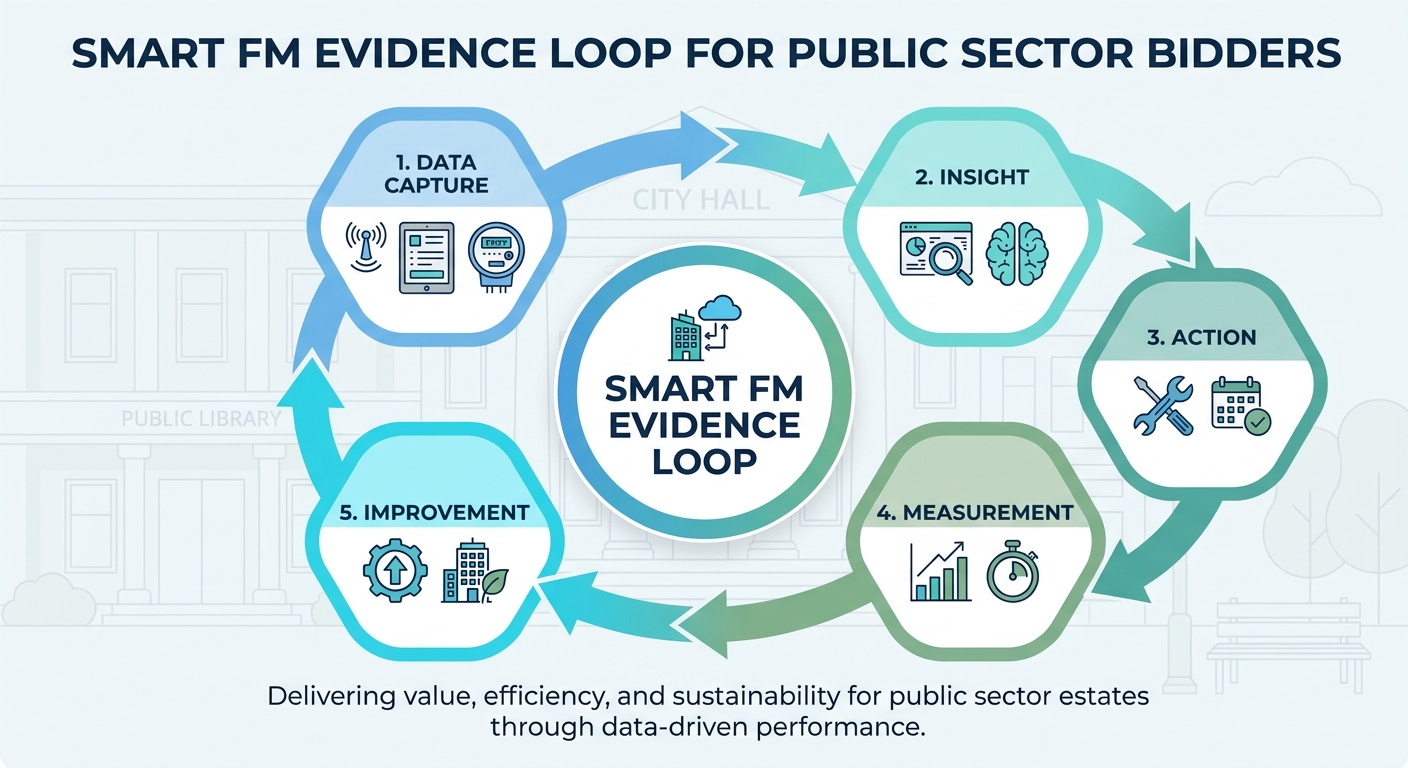
Smart FM evidence loop showing data capture, insight, action, measurement and improvement
A weak bid says:
“We will deploy IoT sensors to monitor asset performance and provide real-time dashboards.”
A stronger bid says:
“We will connect critical HVAC assets to the CAFM platform during mobilisation, validate baseline operating ranges in the first 30 days, configure exception alerts for drift outside agreed thresholds, and review recurring alerts weekly with the contract manager and energy lead. Actions will be logged against asset ID, response time, root cause, avoided downtime and energy impact. The monthly report will show trend movement by building, asset class and priority.”
The second answer is not more exciting. It is more believable.
That matters because smart FM has a credibility problem. Buyers have seen enough vague promises. They have paid for dashboards nobody used. They have been shown innovation that never survived mobilisation. They have read method statements that describe “real-time insight” without saying who acts on it at 7:30 on a Monday morning.
Your job is to remove that doubt.
What Evaluators Actually Score
Evaluators rarely score smart FM on technical sophistication alone.
They score it on whether it helps them manage the contract.
That means your answer needs to translate technology into service outcomes. You should make it easy for the evaluator to see the chain from tool to benefit.
1. Reliability
Can the buyer trust the data?
If you use sensors, explain calibration, coverage, connectivity, data validation and failure handling. If you use CAFM data, explain how records are cleaned, how duplicate assets are removed, and how the asset register is maintained.
Poor data creates poor decisions. Evaluators know this.
Good evidence includes:
- Asset register cleansing methodology
- Sensor commissioning checks
- Data quality review frequency
- Exception handling process
- Audit trail screenshots or sample reports
- Roles responsible for data ownership
2. Operational control
Who sees the information, and what do they do with it?
This is where many responses fall apart. They promise visibility but do not define behaviour.
A strong response explains alert ownership, escalation rules, SLA links, engineer workflows and management review. If a vibration sensor flags a potential pump bearing failure, who receives the alert? What work order is created? How is it prioritised? When is the client told? How is the avoided failure recorded?
The answer does not need to be complicated. It needs to be specific.
3. Measurable value
How will the buyer know it worked?
The buyer is not buying a dashboard. They are buying fewer failures, better comfort, lower energy use, clearer reporting and more control.
Map smart FM activity to measurable outcomes such as:
- Reduction in reactive maintenance tasks
- Increase in first-time fix rate
- Reduction in repeat failures
- Improved statutory compliance visibility
- Lower energy consumption in target zones
- Fewer comfort complaints
- Improved asset availability
- Better PPM completion on critical assets
- Reduced out-of-hours callouts
- More accurate lifecycle replacement planning
Do not claim all of these unless you can deliver them. Pick the outcomes that match the contract.
4. Governance
How will the buyer keep control of the technology?
Smart FM can make clients nervous if it feels like a black box. Your tender response should show that the buyer remains in control of priorities, reporting, change approval, cyber considerations and data access.
Include governance points such as:
- Named digital lead or contract data owner
- Monthly insight review
- Agreed KPI dashboard
- Data access and export arrangements
- Cyber and permissions controls
- Change request process for new sensors or reports
- Exit plan for data handover at contract end
Governance is not admin. It is reassurance.
Build the Response Around a Smart FM Evidence Matrix
The easiest way to make a smart FM response stronger is to build an evidence matrix before writing.
The matrix links each promise to proof.
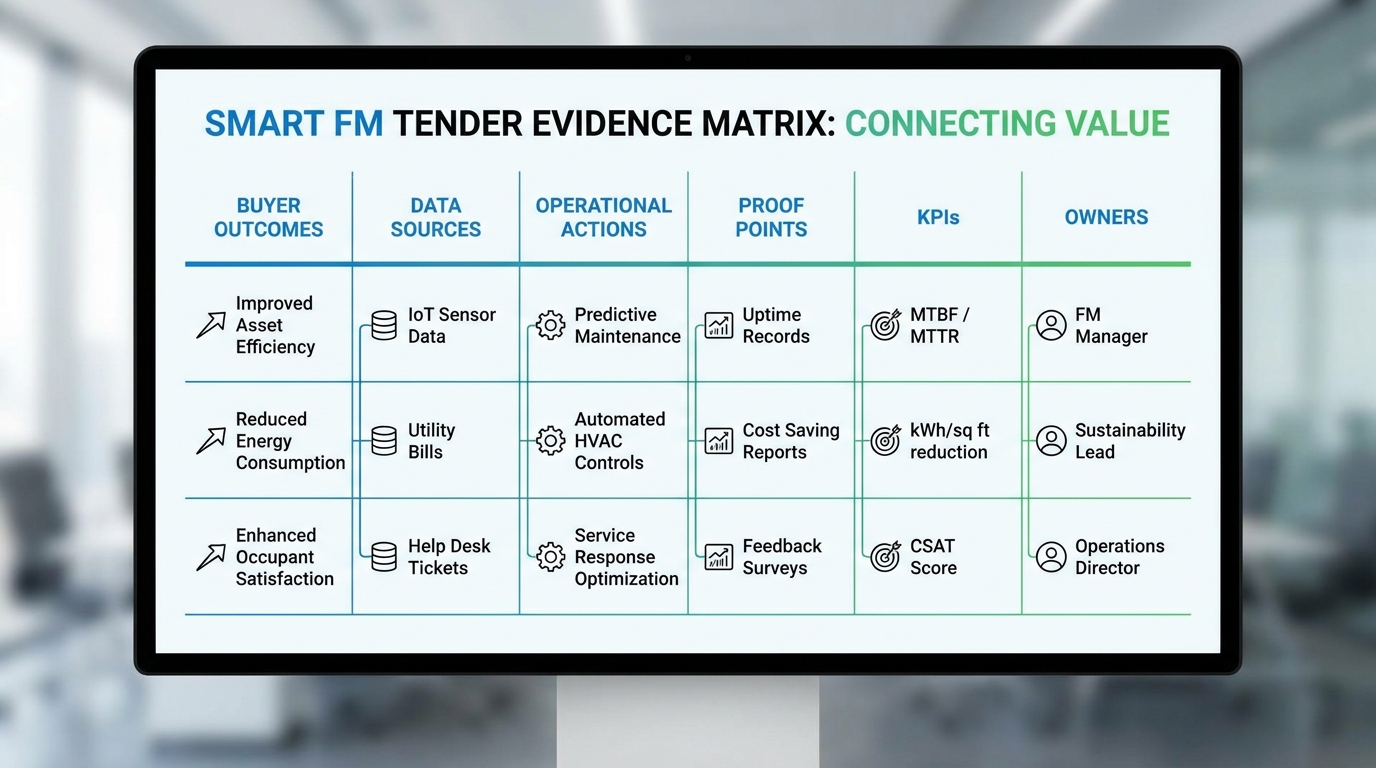
Smart FM tender evidence matrix connecting buyer outcomes, data sources, actions and proof points
Use a simple structure:
- Buyer objective
- Data source
- Operational action
- Evidence you can provide
- Contract KPI or benefit
- Owner
- Reporting frequency
For example:
Buyer objective: reduce plant room failures across a corporate estate. Data source: BMS trend data, CAFM history, engineer inspection notes and vibration readings on critical rotating assets. Operational action: identify recurring alarms, review assets with repeated reactive attendance, adjust PPM tasks, and schedule targeted inspection before failure. Evidence: previous contract trend report, anonymised asset failure analysis, sample dashboard, case study showing reduction in repeat callouts. KPI or benefit: reduced repeat failures, fewer emergency callouts, improved asset availability. Owner: contract manager supported by technical services manager. Reporting frequency: monthly client report with quarterly lifecycle review.This matrix does two useful things.
First, it stops your response drifting into generic innovation language. Every claim has to connect to evidence.
Second, it helps subject matter experts give the bid writer better input. Instead of asking the engineering team “what should we say about IoT?”, ask “which assets have we monitored before, what changed operationally, and what proof can we use?”
That question gets better answers.
Predictive Maintenance: Write the Method, Not the Myth
Predictive maintenance is one of the most overclaimed phrases in FM bidding.
A lot of responses use it when they really mean planned maintenance, condition monitoring or better reactive trend analysis. Evaluators may not challenge the language directly, but they will notice if the method is vague.
Be precise.
Predictive maintenance means using data to anticipate likely failure before it happens. That can include vibration readings, temperature trends, pressure variations, runtime patterns, fault codes, oil analysis, energy spikes, alarm frequency or other condition indicators.
If your proposed approach is not genuinely predictive, do not dress it up. Call it condition-based maintenance or data-led maintenance. That honesty can be stronger than an inflated claim.
A good predictive maintenance response should cover:
- Which assets are in scope
- Why those assets are suitable for predictive monitoring
- What data will be collected
- How thresholds will be set
- How false positives will be managed
- How alerts become work orders
- How engineer findings feed back into the model
- How the buyer will see performance
The key is to show judgement. Not every asset deserves a sensor. Not every site needs the same level of monitoring. Not every alert should create urgent work.
A mature answer might say:
“We will apply predictive monitoring selectively to high-criticality assets where failure would materially affect building availability, statutory compliance or user experience. During mobilisation, we will categorise assets by criticality, failure history and data availability. Predictive monitoring will be prioritised for assets where the intervention cost is justified by reduced downtime, avoided emergency attendance or energy savings.”
That sounds like someone who has run a contract.
IoT Sensors: Explain Coverage, Not Just Capability
IoT sensor claims are easy to make and hard to score unless they are grounded in the estate.
A tender response should explain where sensors will go, why they are needed, and how the data will be used. Avoid listing sensor types as if volume equals value.
For an office estate, occupancy and air quality sensors might support comfort, cleaning schedules, space planning and ventilation settings. For a hospital, temperature and humidity monitoring may support compliance and patient environment controls. For schools, sensors might help manage heating schedules and identify out-of-hours energy waste.
The evidence needs to be relevant.
A strong IoT section should answer:
- What problem is the sensor solving?
- Which locations or assets are prioritised?
- How will coverage be agreed with the client?
- How will readings be validated?
- What action is triggered by an exception?
- Who responds?
- How will results be reported?
- What happens if the sensor fails?
Do not forget the last question. Sensor failure is part of real life. A confident bidder explains fallback processes, battery checks, connectivity monitoring and exception review.
That kind of detail reassures evaluators because it shows you understand operational reality, not just product features.
Energy Performance: Turn Data Into Behaviour Change
Energy performance is one of the strongest smart FM angles because buyers can see a direct link to cost, carbon and comfort.
But energy sections often fall into the same trap. They promise monitoring without explaining how monitoring leads to change.
A better answer breaks the method into four stages.
Baseline
Start by establishing the baseline. Use utility data, BMS settings, meter readings, occupancy patterns, opening hours, weather context and known operational constraints.
Do not promise savings before you know the baseline. Instead, explain the baseline process and the timeframe.
For example:
“During the first 60 days, we will establish an energy baseline for each priority building using half-hourly consumption data where available, BMS schedules, occupancy patterns and plant operating hours. We will identify avoidable consumption, control conflicts, out-of-hours running and plant operating outside agreed parameters.”
That is more credible than saying “we will reduce energy by 15%”.
Diagnose
Explain how you will identify issues.
Examples include:
- Heating and cooling running at the same time
- Plant starting too early or stopping too late
- Poorly configured setpoints
- Excessive out-of-hours consumption
- High energy use in low-occupancy areas
- Faulty sensors causing incorrect BMS decisions
- Poor zoning or control conflicts
Act
Show how findings become operational changes.
This might involve BMS adjustment, recommissioning, engineer inspection, user communication, revised PPM tasks or minor works recommendations.
The important point is ownership. Who approves changes? Who implements them? Who checks comfort is maintained?
Prove
Finally, explain how you will report impact.
Use trend charts, before-and-after analysis, exception logs, savings estimates and commentary that links energy movement to actions taken. Be careful with attribution. Weather, occupancy and estate changes can all affect consumption.
A credible bid acknowledges this and explains how savings will be normalised where possible.

Energy performance dashboard for FM tenders showing baseline, exceptions, actions and verified results
Smart FM and the Procurement Act Transparency Mindset
The Procurement Act has made suppliers more aware that performance is not hidden forever. Buyers are publishing more notices, more data and more contract performance information. That changes how FM bids should be written.
A smart FM response should not only promise better performance. It should show how the supplier will create an audit trail that supports contract management.
That means linking your digital approach to evidence the buyer may need later:
- KPI reporting
- Contract review packs
- Performance improvement plans
- Payment discussions
- Extension decisions
- Benchmarking
- Future procurement planning
- Social value reporting
- Carbon reporting
This is where smart FM becomes more than operational tooling. It becomes a contract evidence system.
If your CAFM, sensors, helpdesk and reporting routines create a clear record of what happened, what action was taken and what changed, the buyer has better control. That control is valuable.
It also protects the supplier. Good evidence helps you show that issues were identified, escalated and managed properly. It helps explain unavoidable failures. It helps prove improvement. It helps defend performance in a contract review.
Bid teams should make this point carefully. Do not sound defensive. Frame it as transparency, governance and shared control.
Mobilisation: Where Smart FM Promises Become Real
Smart FM credibility is won or lost during mobilisation.
A tender response that promises advanced analytics from day one will sound naïve if the buyer knows the asset register is incomplete, BMS access is uncertain and historical CAFM data is messy.
Be honest about the mobilisation journey.
A strong mobilisation plan might include:
- Confirming asset data and criticality
- Validating existing CAFM records
- Agreeing naming conventions and asset hierarchy
- Reviewing BMS access and permissions
- Mapping meters, sensors and data feeds
- Identifying priority buildings or assets
- Setting alert thresholds
- Testing work order creation
- Training engineers and helpdesk staff
- Agreeing dashboard views with the client
- Running a 30, 60 and 90-day insight review
This is not boring detail. It is exactly what evaluators need to believe the proposal will work.
The 30, 60 and 90-day structure is especially useful.
First 30 days: establish access, data quality, asset priorities and reporting baseline. Days 31 to 60: configure alerts, validate workflows, test dashboards and start trend analysis. Days 61 to 90: review first insights with the client, agree improvement actions, refine thresholds and embed reporting into governance.That phased approach feels operationally real. It also stops you overpromising instant transformation.
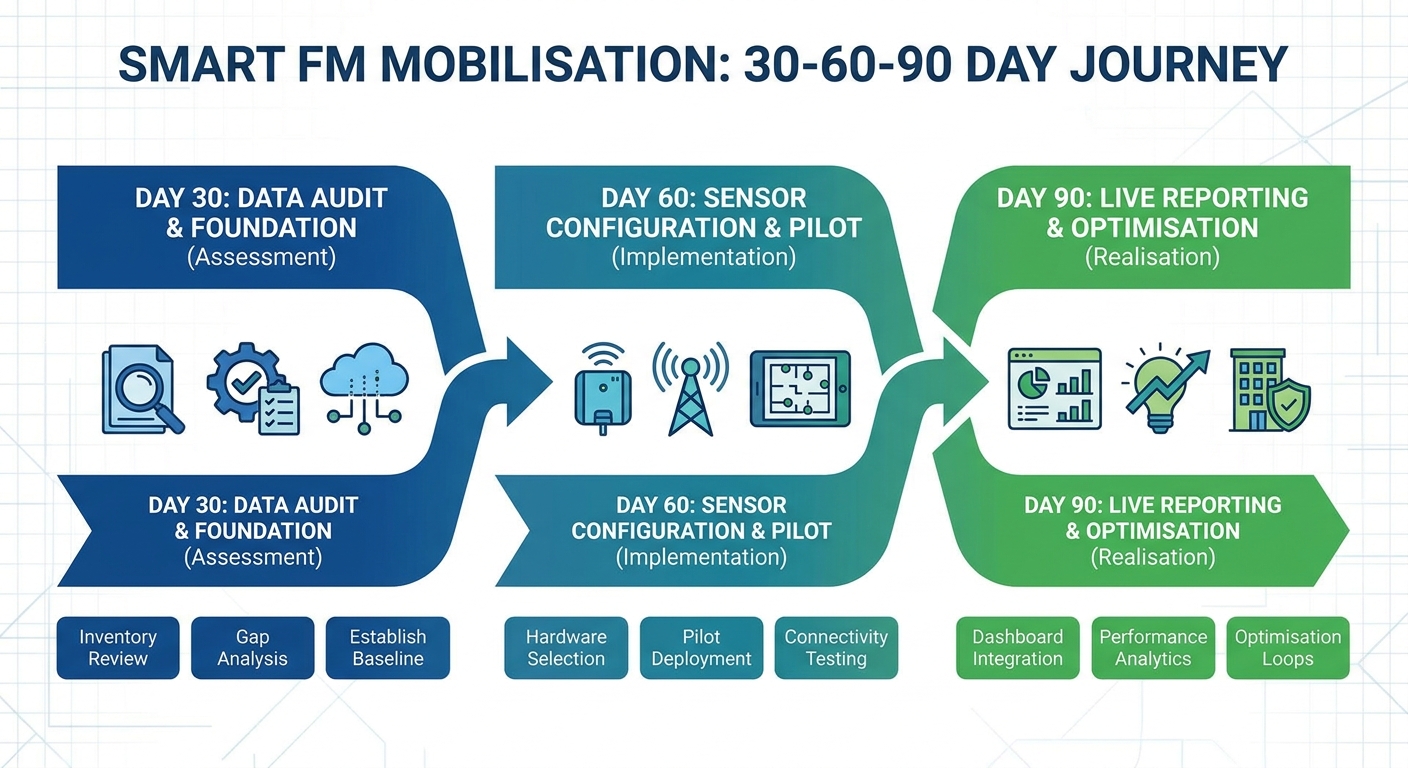
Smart FM mobilisation roadmap across 30, 60 and 90 days from data audit to live reporting
How to Write About Dashboards Without Sounding Generic
Everyone has a dashboard.
That means “real-time dashboard” is not a differentiator by itself.
If you mention dashboards, explain the decisions they support. A good dashboard section describes users, views, triggers and review cadence.
For example:
- The helpdesk view shows live SLA risk, repeat calls and urgent exceptions.
- The contract manager view shows KPI performance, open risks, overdue actions and client priorities.
- The energy view shows consumption trends, exception sites, BMS actions and verified savings.
- The technical view shows asset condition, repeated failure, statutory compliance and lifecycle risk.
- The client view shows agreed KPIs, narrative commentary and improvement progress.
This is much stronger than saying the dashboard is intuitive, transparent or user-friendly.
If you can include a sample report, do it. If you cannot include a live client screenshot because of confidentiality, create an anonymised example. Evaluators love evidence they can see.
The best sample reports include commentary, not just charts. A chart shows movement. Commentary explains what happened and what will happen next.
That is what clients actually need.
Cyber, Data and Access: Do Not Leave It to the IT Section
Smart FM depends on data, connectivity and system access. That means cyber security and data governance are not side issues.
You do not need to turn the FM method statement into a technical security document. But you should show that digital FM is controlled properly.
Cover the basics:
- Role-based access
- Client approval for integrations
- Secure user management
- Clear data ownership
- Audit logs
- Device management
- Supplier and subcontractor access controls
- Incident escalation
- Data handover at contract exit
If sensors, CAFM tools or analytics platforms are provided by partners, explain how partner performance and security obligations are managed. The buyer is appointing you, not your technology supplier. You remain accountable.
This point is especially important in public sector estates where operational technology touches sensitive environments. Schools, hospitals, custodial settings, defence-adjacent sites and civic buildings all bring different risk profiles.
A mature bid avoids both extremes. It does not ignore cyber, and it does not bury evaluators in technical jargon. It simply shows that smart FM data is governed, secure and usable.
Common Smart FM Tender Mistakes
Here are the mistakes that cost marks.
Mistake 1: Leading with technology names
Software names rarely win marks on their own. Lead with the buyer outcome, then show the tools and evidence behind it.
Mistake 2: Claiming prediction without proof
If you say predictive maintenance, show the data inputs, thresholds, work order process and measured results. Otherwise use more accurate language.
Mistake 3: Ignoring mobilisation constraints
If the estate data is messy, the answer should explain how you will clean it. Pretending everything will be live on day one is not credible.
Mistake 4: Forgetting the engineer
Smart FM is not only a dashboard. Engineers still inspect, diagnose, fix and report. Show how digital insight changes their work.
Mistake 5: Reporting data without interpretation
Clients do not need more charts. They need decisions. Always add commentary, action owners and next steps.
Mistake 6: Making savings claims too early
Energy and maintenance savings need baselines. If you claim a percentage, explain the evidence behind it and the conditions that affect it.
Mistake 7: Treating innovation as separate from service delivery
Smart FM should sit inside the core operating model. If it is only in the innovation section, it will feel optional.
A Practical Structure for Your Tender Response
If you are answering a smart FM or digital maintenance question, use this structure.
1. Start with the buyer’s objective
Repeat the objective in plain English. For example: reducing reactive maintenance, improving asset availability, cutting energy waste or improving estate visibility.
This shows you understand the point of the question.
2. Define your operating model
Explain the people, processes and systems involved. Name the roles, not just the platform.
3. Explain the data sources
Set out what data you will use and how you will keep it accurate.
4. Show the workflow
Describe how insight becomes action. Alerts, triage, work orders, engineer attendance, client communication and close-out should all be clear.
5. Evidence previous delivery
Use contract examples, anonymised reports, KPI movement, case studies or mobilisation lessons. Evidence beats claims.
6. Link to KPIs and governance
Show how the buyer will monitor performance through contract meetings, reports and improvement plans.
7. Be honest about assumptions
If success depends on access to systems, asset data or client approvals, say so. Then explain how you will manage those dependencies.
This structure works because it mirrors how evaluators think. They want to know what you will do, how you will do it, why it will work, and how they will know.
Example: Rewriting a Weak Smart FM Answer
Weak answer:
“Our smart FM solution uses IoT sensors, AI analytics and real-time dashboards to deliver predictive maintenance, reduce energy use and improve user experience across the estate.”
Better answer:
“We will use smart FM tools selectively where they improve operational control. During mobilisation, we will confirm asset criticality, validate available BMS and CAFM data, and agree priority buildings with the client. For high-criticality HVAC and mechanical assets, we will configure exception monitoring based on runtime, alarms, temperature drift and repeat attendance history. Alerts will be reviewed by the technical services manager, converted into planned interventions where appropriate, and tracked through the CAFM system. Monthly reporting will show exception volume, action taken, repeat failures, avoided downtime and any energy impact. This gives the client a clear audit trail from data signal to operational improvement.”
The better answer is longer, but it is not padded. It explains the method.
That is what wins marks.
Where mytender.io Fits
A smart FM tender response usually needs input from operations, energy, engineering, helpdesk, IT, commercial and bid teams. That creates a familiar problem: the evidence is spread across too many people and too many documents.
This is where a structured bid library matters.
For recurring FM tenders, keep reusable evidence packs for:
- Smart FM operating model
- Predictive maintenance examples
- Energy baseline and reporting approach
- CAFM governance
- Dashboard samples
- Mobilisation checklists
- Asset criticality methodology
- IoT sensor deployment lessons
- Cyber and access controls
- Continuous improvement examples
That is the difference between fast drafting and lazy drafting.
Final Checklist Before You Submit
Before submitting a smart FM response, check these ten points.
- Have you linked every digital feature to a buyer outcome?
- Have you named the data sources and explained how quality is checked?
- Have you shown who acts on alerts and insights?
- Have you explained the mobilisation steps needed to make the approach work?
- Have you included evidence from previous contracts or anonymised reporting?
- Have you avoided overclaiming predictive maintenance?
- Have you connected dashboards to decisions, not just visibility?
- Have you addressed cyber, access and data ownership at a sensible level?
- Have you linked smart FM activity to KPIs and governance?
- Have you shown how the buyer will know the approach is working?
If the answer to any of these is no, the response is probably still too generic.
Smart FM can genuinely improve FM contracts. It can reduce failures, improve comfort, support decarbonisation and give buyers better control. But only if the method is operationally real.
Tender evaluators know that.
So write the evidence, not the brochure.
If you want to find live FM opportunities where this kind of evidence can give you an edge, the Tender Finder is free to use.
Tags
Ready to Transform Your Tender Writing?
See how MyTender's AI can help you write winning tenders in a fraction of the time.