

Demonstrating Compliance with Simpler Recycling Reforms in 2026 Waste Tenders
The Simpler Recycling reforms changed what councils expect from waste contractors as of March 2026. This guide explains exactly how to evidence compliance in your tender response and avoid the scoring pitfalls most bidders miss.
mytender.io Research Team
Tender Writing & Bid Management Specialists
Demonstrating Compliance with Simpler Recycling Reforms in 2026 Waste Tenders
Picture this: you have spent three weeks writing a council waste collection tender. Your methodology is solid, your pricing is competitive, and the mobilisation plan is the best your team has produced. Then the evaluation feedback arrives and one phrase keeps appearing: "insufficient evidence of compliance with the Simpler Recycling requirements."
You covered it. It was in there. But it was not evidenced. It was stated.
That is the distinction that is costing waste contractors real marks right now, and it is entirely avoidable.
The Simpler Recycling reforms, enacted under the Environment Act 2021, came into full effect for English local authorities on 31 March 2026. From that date, councils must provide separate collections of specific waste streams from all households. For waste contractors bidding on new or re-tendered council contracts, this legislative shift is not just a compliance checkbox; it is the new foundation of every methodology question you will be asked to answer.
This guide is for bid managers, commercial leads, and anyone writing waste sector responses who needs to understand what evaluators are actually scoring when they ask about Simpler Recycling compliance, and how to give them the evidence they need to award maximum marks.
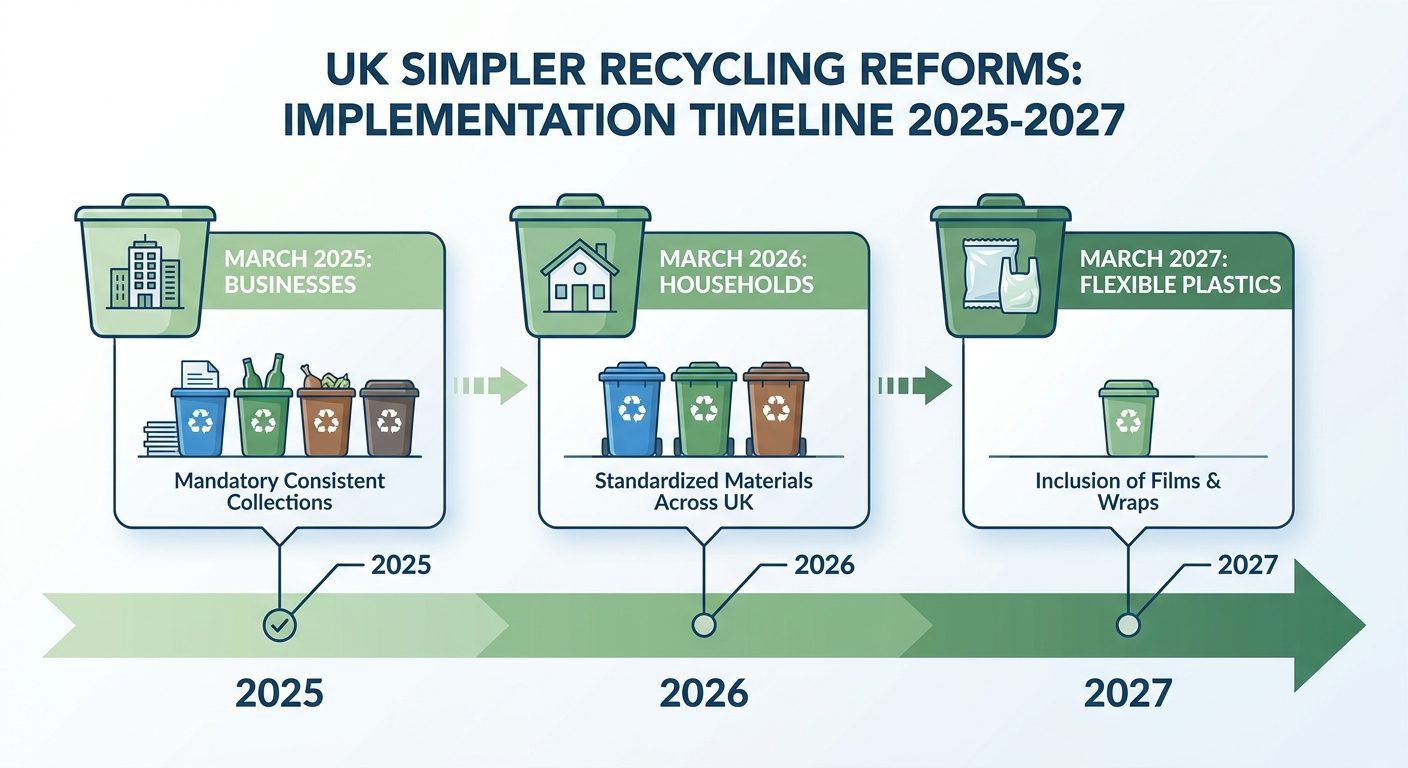
UK Simpler Recycling reforms timeline showing key milestones from 2025 to 2027
What the Simpler Recycling Reforms Actually Require
Before you can evidence compliance, you need to be precise about what the legislation mandates. Generalities will not score well. Evaluators have read the same vague opening paragraphs dozens of times.
As of 31 March 2026, local authorities in England are required to provide separate kerbside collection of the following waste streams from all households:
Food waste, collected on a weekly basis. This is the headline change and the one that has caused most operational complexity for councils, particularly around vehicle procurement and co-mingling with garden waste. The government allocated £295 million in transition funding to help authorities manage this, and procurement exercises are directly linked to whether contractors can support that delivery model. Paper and card, collected separately. There is a permitted exception where councils can co-collect paper and card with other dry recyclables if separate collection is technically or economically impractical, but this is an exception that requires justification rather than the default. Other dry recyclables, covering glass, metal, plastic, and cartons. The intent is to standardise what gets collected across England, ending the postcode lottery of varied local rules that has confused residents and suppressed recycling rates. Residual waste, separated from all the above streams.Looking ahead, the March 2027 deadline introduces mandatory kerbside collection of soft and flexible plastic films, so any tender for contracts running into 2027 needs to address how your service will accommodate that transition.
For businesses, most of the Simpler Recycling obligations came into force in March 2025 (for firms with ten or more employees), with micro-firms (fewer than ten employees) following by March 2027. If the contract you are bidding on includes commercial collections alongside household rounds, those timelines need to be addressed separately in your response.
The national digital waste tracking service adds another layer. From October 2026, operators of waste receiving facilities must record waste movements digitally. Your tender will increasingly need to demonstrate how your digital infrastructure integrates with this requirement.
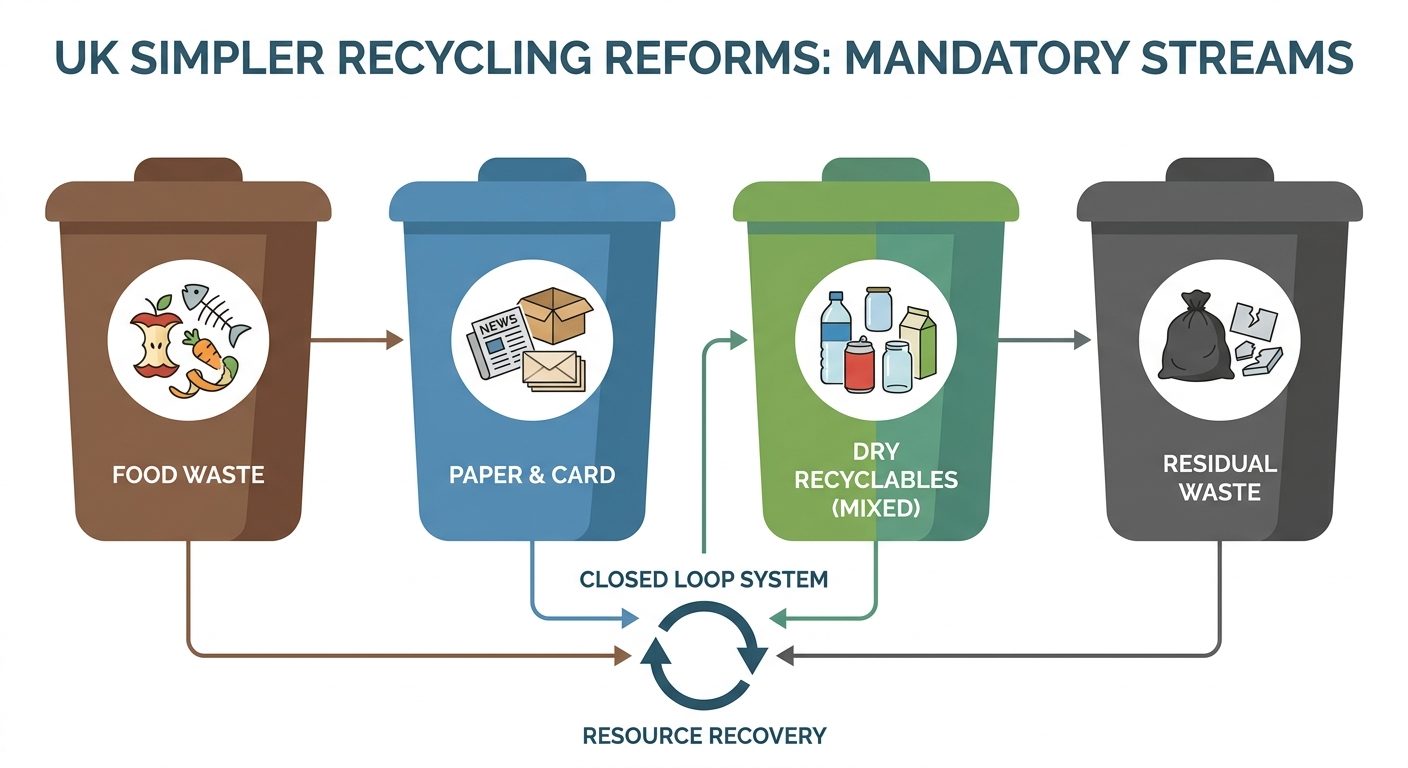
The four mandatory recycling collection streams under UK Simpler Recycling reforms for councils
Why Generic Compliance Statements Score Badly
Most bid writers are aware of the reforms. The problem is how they write about them. Two failure patterns appear repeatedly in tender responses.
The first is the policy statement: "Our company is fully compliant with the Simpler Recycling requirements and operates in accordance with the Environment Act 2021." This tells an evaluator nothing. It does not demonstrate that your crews are trained, that your vehicles are configured correctly, that your data reporting systems are in place, or that your mobilisation plan accounts for the operational changes required. Every bidder can write that sentence.
The second is the laundry list: a bullet-pointed summary of what the regulations say, lifted essentially from the government guidance, with minimal connection to how your company will actually deliver the service. Evaluators are not looking for evidence that you have read the legislation. They are looking for evidence that you can operate within it at the scale and geography the contract requires.
The distinction that separates high-scoring responses from average ones is specificity. You need to move from what the law requires to how your operation delivers it with referenced evidence at every step.
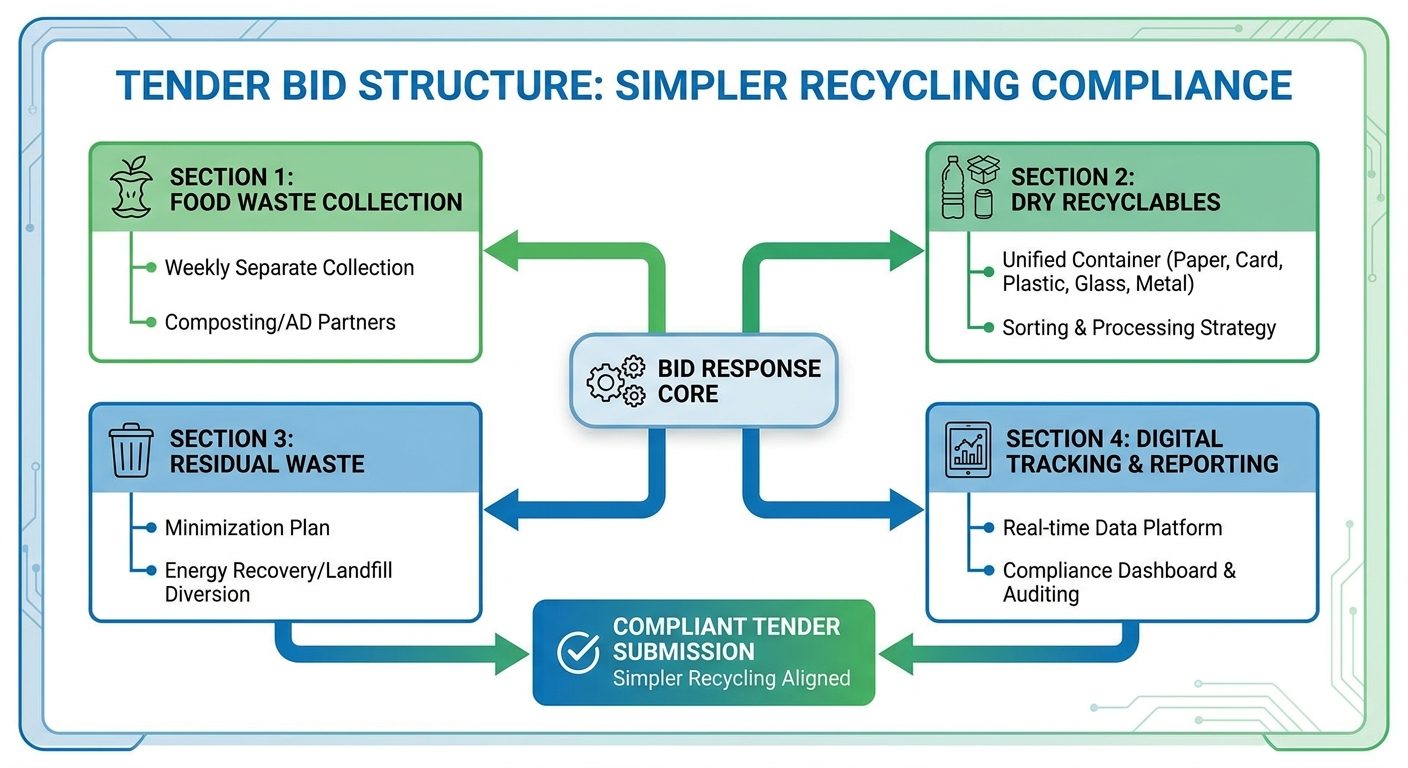
How to structure a waste tender bid response for Simpler Recycling compliance across all mandatory streams
Structuring Your Compliance Evidence
A well-structured tender response on Simpler Recycling compliance works across four dimensions. These do not have to be separate sections; in most tender formats you will be weaving them together across methodology questions. But as a mental framework for your bid team, each dimension needs to be covered.
Operational Readiness
This is the most immediate question evaluators have: can you actually run these collections right now? For food waste in particular, many councils have been frustrated by contractors who can win a tender but then face delays in deploying the right vehicles or providing appropriate caddy systems.
Your evidence here should reference:
Your current fleet configuration and any vehicles already compliant with weekly food waste collection requirements. If you have recently invested in dedicated food waste vehicles, say so and provide specifics: number of vehicles, payload capacity, collection round geography.
Your current caddy supply arrangements. A significant operational headache for councils has been the procurement of indoor and outdoor food waste containers. If you can demonstrate an established supply chain for 240-litre outdoor bins alongside smaller indoor kitchen caddies, that is worth stating explicitly.
Your experience of running food waste collections in other contracts. Named examples with the council, number of households, weekly tonnage recovered, and any challenges overcome carry far more weight than general claims of capability.
Methodology and Round Design
How you propose to design and run the collections matters as much as your existing capability. Evaluators want to see that you understand the operational challenges specific to their geography and have designed a service model that addresses them.
For food waste: how are you managing the weekly collection cycle alongside existing dry recyclables and residual rounds? Most councils are not going from zero to full weekly food waste collection; they are integrating it into existing service patterns that may include alternate weekly residual collection. Your bid should map the round interaction explicitly rather than treating food waste as a standalone addendum.
For dry recyclables: if the council currently co-collects paper and card with other materials, are you recommending they maintain that approach or move to separate streams? If you are proposing a change, the methodology question needs to address the resident communication and contamination management implications. If you are recommending they maintain co-mingling under the exception provisions, you need to reference the technical or economic justification that qualifies them for that exception.
For soft plastics: if the contract term extends into 2027, where does your methodology plan for integrating film plastic collection? Councils that are already commissioning for 2024 to 2029 or beyond will expect bidders to have thought this through. Vagueness here signals risk.
Data and Reporting
The introduction of digital waste tracking from October 2026 changes what councils will expect from their contractors in terms of data provision. This is worth addressing proactively in your response even if the ITT does not explicitly ask about it.
Your response should cover: how you currently record and report waste movements, what systems you use, what data formats you can provide, and how you will adapt to the digital waste tracking requirements when they come into force. If you already have an established data platform, name it and describe what outputs it produces.
A paragraph demonstrating that you understand the digital tracking obligation and have a roadmap to compliance will differentiate you from bidders who have not yet connected the regulatory dots. It signals forward-looking operational management rather than reactive compliance.
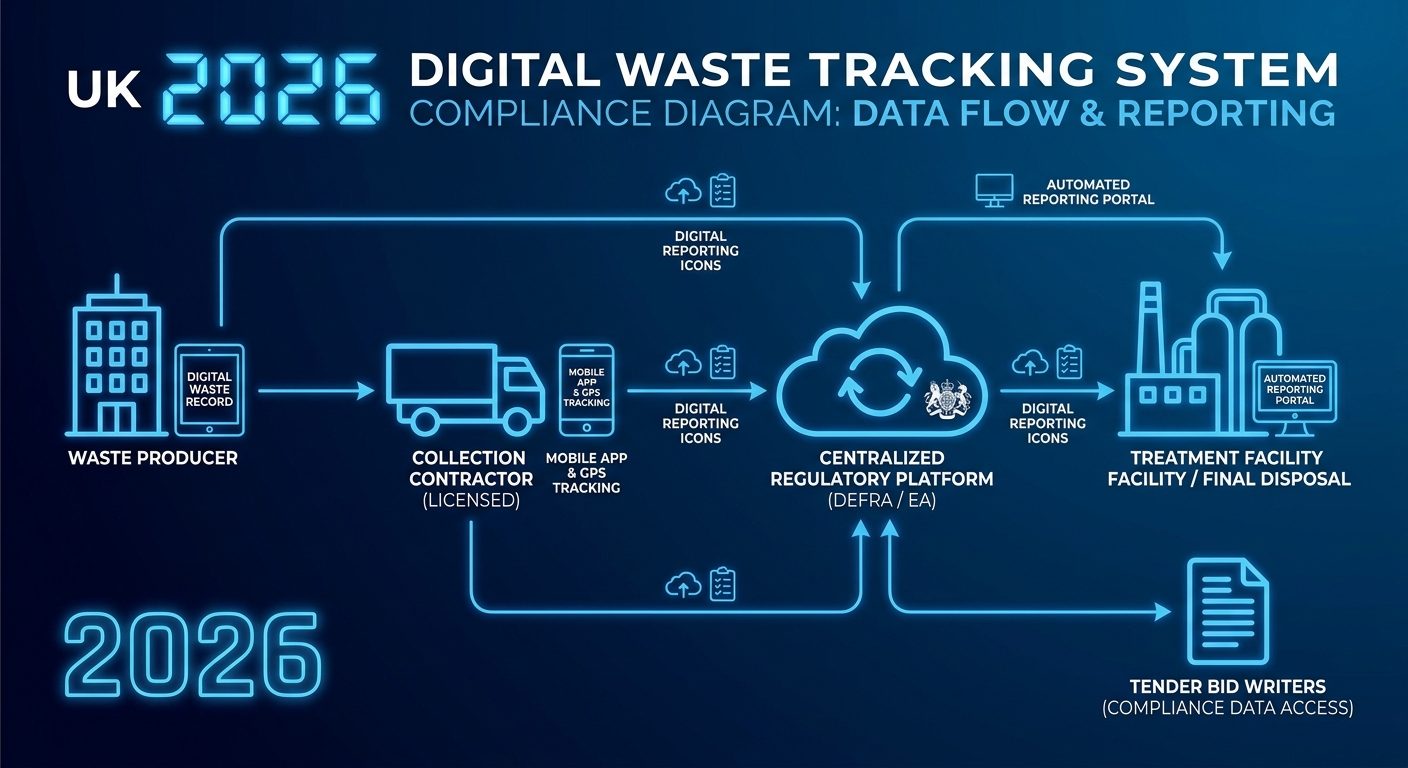
Digital waste tracking system data flow showing compliance reporting from collection through to treatment facility
Transition and Mobilisation
For councils that are still working toward full Simpler Recycling compliance (roughly 14% of local authorities had not met all requirements by the April 2026 deadline, with transitional agreements in place), your mobilisation plan needs to demonstrate how you will support their compliance journey rather than just assuming it is complete.
This includes: resident communication materials in formats appropriate to the council's demographics, crew training on new collection protocols, contamination management processes, and a clear timeline showing when each element of the reformed service will be fully operational.
The Questions Evaluators Ask Most Often
Every council phrases their questions differently, but in Simpler Recycling-era tenders you will encounter variations on the following.
"Describe how your proposed service meets the requirements of the Simpler Recycling reforms." This is the direct question. Answer it stream by stream: food waste, dry recyclables, residual, and any contracted commercial collections. Do not answer it at the policy level. Answer it at the operational level, with evidence. "How will you support the council in achieving its target recycling rate of [X]%?" The Simpler Recycling reforms are designed to push the national recycling rate toward 65% by 2035. Individual councils will have their own interim targets embedded in their waste strategies. Your response needs to connect your service methodology to those targets with a credible causal link: this collection frequency, combined with this resident engagement approach, typically produces this diversion rate in comparable authorities. "How will you manage contamination across the separate collection streams?" Separate collections only work if residents comply with stream separation. Contamination is the operational and commercial risk that councils are most anxious about in a reformed service. Your methodology for managing it, at both the point of collection and through resident communications, needs to be specific. General statements about driver training and contamination stickers are not sufficient. "Describe your approach to data collection and performance reporting." This question increasingly covers digital waste tracking. Include your current reporting capability and your plans for the 2026 digital tracking obligation in the same answer.What the Scoring Framework Actually Rewards
Council waste tenders vary in their specific weighting structures, but the pattern for how compliance questions are marked has become more consistent since the Simpler Recycling deadline passed.
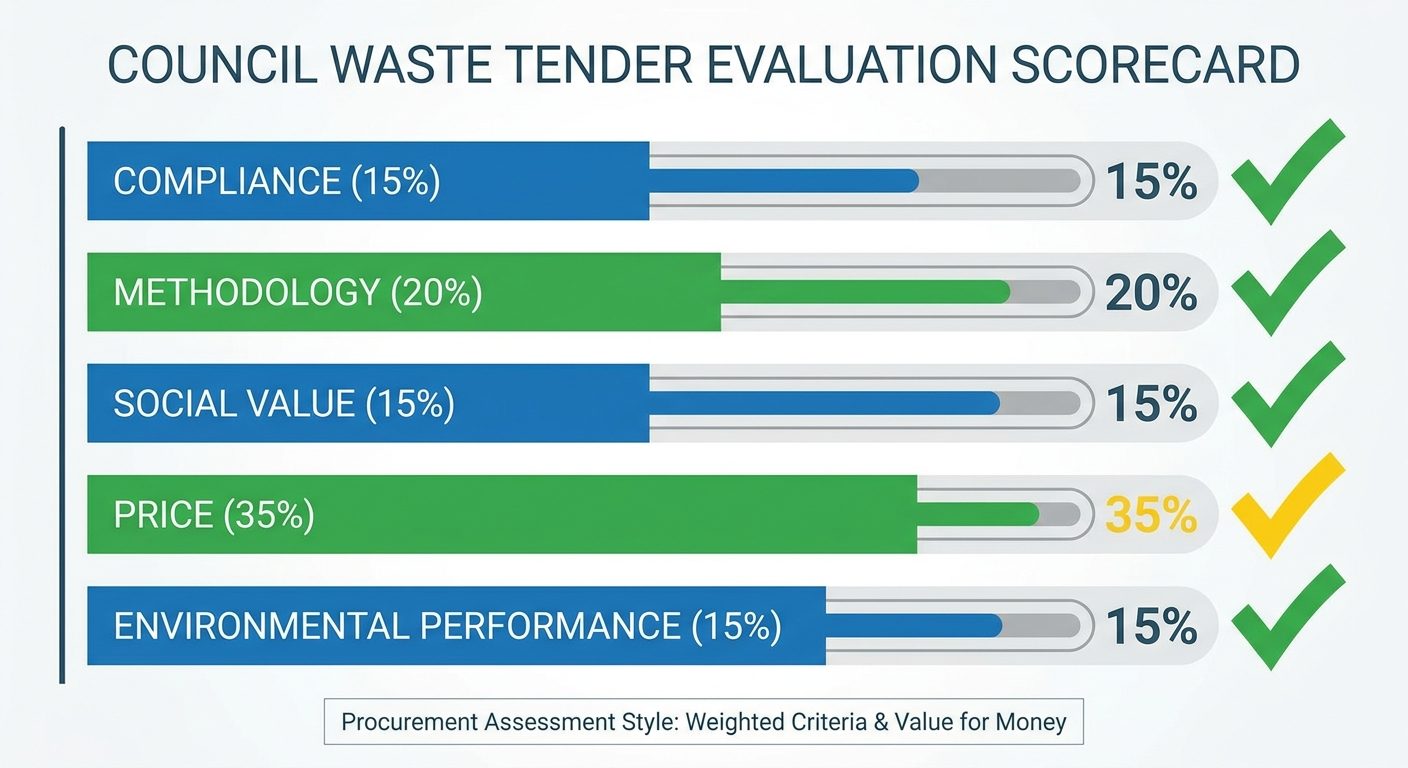
Evaluation scorecard showing how council waste tender scoring criteria are typically weighted
Maximum marks typically go to responses that demonstrate all of the following simultaneously: compliance with the specific legislative requirements for this contract's scope; an operational methodology that addresses the council's particular geography, demographics, and existing service configuration; evidence from comparable existing contracts; a clear transition or mobilisation plan; and a credible approach to ongoing performance measurement and reporting.
Responses that score in the middle tier tend to demonstrate compliance and provide some methodology, but the evidence is generic rather than contract-specific. They are competent but not differentiated.
Responses that score poorly tend to conflate compliance with description of the regulations. They are often well-written, but they are writing about the rules rather than writing about their own service.
The gap between a middle-tier score and a high-scoring response is almost always about specificity and evidence. It is not about writing ability or technical knowledge. The bid team that takes the time to reference real contract data, named council comparables, and specific operational decisions will consistently outscore the team that writes fluently but generally.
Structuring the Bid Response
When you sit down to draft the Simpler Recycling compliance sections of your response, a practical approach is to work through the following structure before you write a single word.
Start by listing every collection stream the contract covers: household food waste, household dry recyclables, household residual, and any commercial or mixed-use elements. For each stream, note the specific legislative requirement, the council's current position (are they already meeting it or moving toward it?), and the evidence you have from your own operations.
Then build your methodology around the gap between where the council is and where they need to be. If they already have weekly food waste collection running, your response focuses on continuity and optimisation. If they are transitioning from fortnightly collection, your response needs to address the operational uplift and mobilisation requirements. The same legislative backdrop but completely different emphasis.
Finally, identify the evidence you will reference. Named contracts, volume data, diversion rates, resident satisfaction scores, and digital reporting outputs all carry weight. If you have a contract in a demographically similar area, or one where you have already navigated the same transition the tendering council is about to make, that is your strongest card. Play it explicitly.
How mytender.io Supports Waste Sector Bid Teams
One of the consistent challenges for waste contractors is staying current across the many council procurement exercises that run simultaneously across England, particularly when the legislative landscape is shifting as quickly as it has been since the Environment Act 2021 came into force.
The mytender.io platform includes a Tender Finder that surfaces live public sector opportunities matched to your sector, including council waste and recycling contracts. Rather than monitoring multiple procurement portals manually, your bid team can track relevant opportunities in one place and focus preparation time on the contracts most aligned to your operational footprint.
If you want to see what council waste and environmental services contracts are currently live, the Tender Finder is free to use and does not require a commitment to the full platform.
Common Mistakes to Avoid
A few recurring errors are worth flagging specifically.
Treating Simpler Recycling as a single question rather than a cross-cutting theme. The reforms touch methodology, mobilisation, data reporting, resident engagement, and vehicle operations. If you only address them in one question rather than threading the evidence through wherever it is relevant, you leave marks on the table. Not differentiating between household and business collection requirements. The timelines and stream requirements differ between domestic and commercial collections. A tender response that conflates them signals to evaluators that the bid team has not read the regulations carefully. Ignoring the 2027 soft plastics requirement for long contracts. If the contract runs beyond March 2027, evaluators will want to see that you have a plan for integrating film plastic kerbside collection. Omitting it entirely is a red flag. Overpromising on digital tracking readiness. The digital waste tracking requirement does not come into full force until October 2026. Bid teams sometimes either overstate their current compliance or ignore the issue entirely. The most credible approach is to describe your current data management systems accurately and set out a clear, dated plan for how you will meet the October 2026 obligation. Generic contamination management sections. Contamination is the primary operational risk in any separated collection service. If your response sounds the same as every other contractor's, it will score the same as every other contractor's. Specific contamination data from comparable contracts, and a methodology that addresses the specific demographics of the tendering council, will score significantly higher.The Bigger Picture
The Simpler Recycling reforms are not a one-time compliance hurdle. They represent a structural shift in what councils are commissioning and how they will evaluate bids for the next decade. The national recycling target of 65% by 2035 is ambitious, and councils know that they can only achieve it with contractors who are genuinely operationally capable and evidentially credible rather than merely compliant on paper.
Bid teams that build their response around this context: that you are not just meeting a legal minimum but genuinely helping the council advance toward its waste strategy objectives, will write responses that feel different to evaluators. They will score better, and they will position the contractor as a strategic partner rather than a service provider.
That positioning matters beyond the individual contract. Councils talk to each other. Performance on one waste contract, particularly through a period of significant legislative change, shapes how you are perceived in the next procurement exercise. Getting the compliance evidence right in your 2026 bids is not just about winning this contract. It is about building the reference base that wins the next one.
Summary: What to Cover in Your Response
Before submitting any council waste tender that touches on Simpler Recycling compliance, run through this checklist.
Have you addressed each mandatory collection stream specifically: food waste, paper and card, dry recyclables, and residual?
Have you distinguished between household and commercial collection requirements where the contract includes both?
Have you provided operational evidence from named comparable contracts rather than general capability statements?
Have you addressed the 2027 soft plastics requirement if the contract term extends past March of that year?
Have you covered your data and reporting approach, including your roadmap for the October 2026 digital waste tracking obligation?
Have you addressed contamination management with specific methodology rather than generic protocols?
Have you connected your service model to the council's stated recycling rate targets?
If you can answer yes to all of those, your compliance sections are doing the job. If any are vague, that is where you are leaving marks on the table.
---
mytender.io helps waste management contractors find and win public sector contracts. The Tender Finder surfaces live council waste and environmental services opportunities matched to your sector. Explore the Tender Finder to see what is currently live in your geography.Tags
Ready to Transform Your Tender Writing?
See how MyTender's AI can help you write winning tenders in a fraction of the time.