
Evidencing Service Density in Cleaning Tenders: The Section Most Bidders Underestimate
Cleaning tender evaluators do not just want a method statement. They want proof that your labour, supervision, equipment and quality checks are dense enough for the estate you are promising to manage.
mytender.io Research Team
Tender Writing & Bid Management Specialists
Evidencing Service Density in Cleaning Tenders
Most cleaning tender responses promise high standards. Fewer prove they have enough coverage to deliver them.
That gap is where marks disappear.
A cleaning contract is not judged only on whether you understand cleaning. Evaluators want to know whether your proposed operation has enough density: enough labour in the right places, enough supervision at the right times, enough equipment close to the work, and enough quality control to catch problems before the client does.
That is what this guide covers.

Cleaning tender bid desk with route plans, KPI dashboard and method statement documents
Why Service Density Matters So Much
Service density is the practical answer to a simple evaluator question: can this bidder actually cover the estate?
In cleaning tenders, bidders often focus on inputs. They list hours, frequencies, machinery, chemicals, staff training and accreditations. All of that matters. But none of it proves the service is operationally dense enough for the client’s sites.
A school trust with multiple buildings does not just need daily cleaning hours. It needs cover across term-time peaks, holiday deep cleans, safeguarding constraints, washroom pressure points and spill response.
A transport estate needs a different rhythm. So does a council office estate, NHS facility, university campus, leisure centre or housing association portfolio.
The evaluator is looking for the same thing in each case: does the solution fit the geography, footfall, risk and operating pattern of the estate?
If your answer is generic, you have not evidenced density. You have described activity.
What Service Density Actually Means
Service density is the relationship between five things:
- the size and shape of the estate
- the level of cleaning demand across that estate
- the labour allocated to meet that demand
- the supervision and escalation model behind the labour
- the quality assurance system that proves standards are holding
It is not simply more hours.
Sometimes density means a mobile supervisor who can cover four nearby sites in one morning. Sometimes it means a resident day janitor in one high-footfall building. Sometimes it means splitting a team differently so washrooms, entrances and food areas are covered at the times they actually get dirty.
That distinction matters. Evaluators can spot a bidder who has just inflated the hours. They reward bidders who explain why the hours are placed where they are.
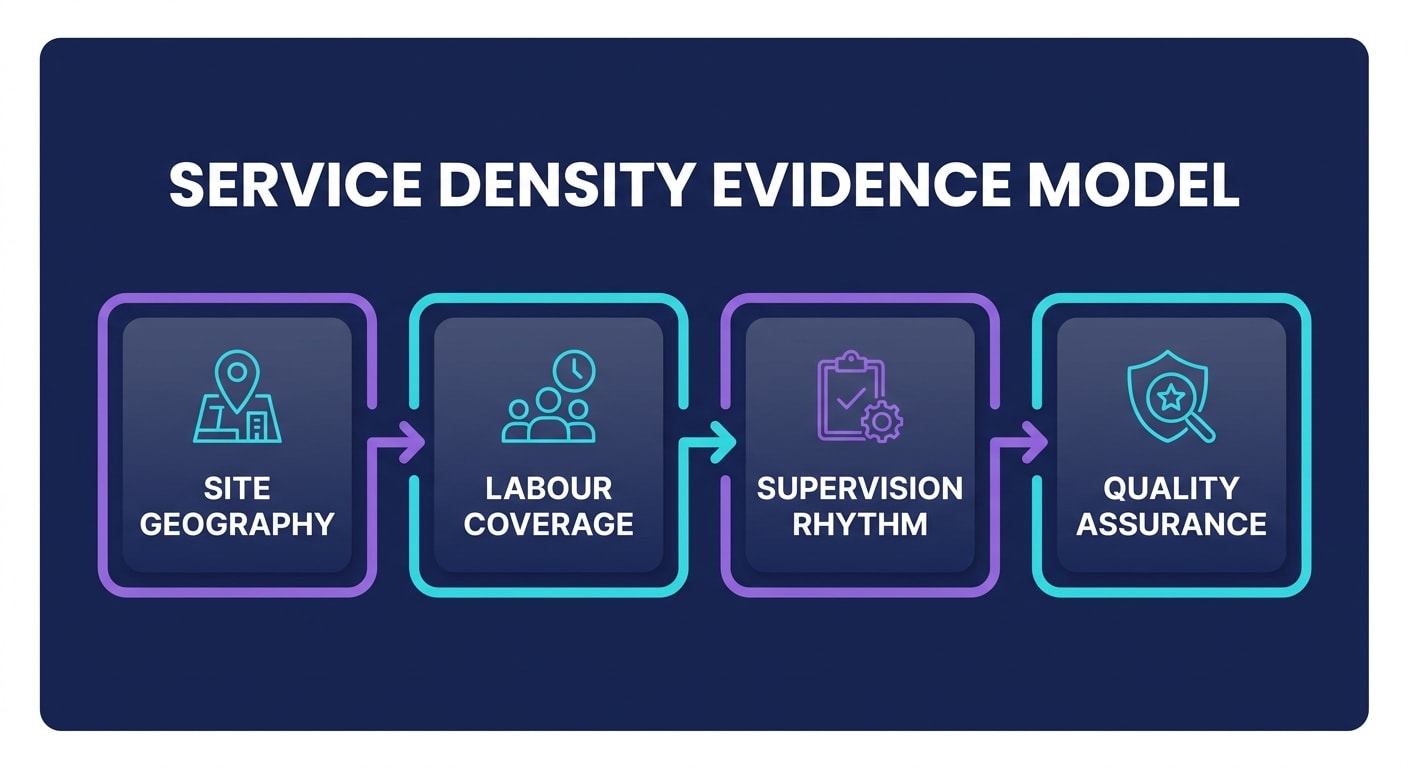
Service density model showing site geography, labour coverage, supervision rhythm and quality assurance
The Mistake Most Cleaning Bids Make
The most common mistake is treating the cleaning specification as a checklist.
The bidder sees daily, weekly, monthly and periodic tasks, then writes a response that says every task will be completed by trained staff using approved equipment. It sounds compliant. It is also thin.
Compliance is the floor. Scoring well needs more.
A strong response explains how the service will flex when reality intrudes:
- Friday footfall is heavier than Monday
- one building has poor storage and long travel distances
- washrooms need checks at lunchtime, not just at the end of the day
- sickness cover cannot wait until the area manager notices a gap
- periodic tasks need to happen without disrupting the client’s operation
- mobilisation has to protect standards while staff transfer, learn systems and adjust to new routines
That is the real work of a cleaning contract. Your tender response should show you understand it.
Start With the Estate, Not Your Company
Do not open the method statement by talking about your company history. Start with the client’s estate.
Evaluators are much more interested in whether you have understood their operating environment than whether you have cleaned similar buildings in general.
Use the first part of the response to summarise the specific service challenge. Keep it practical.
For example:
- number and type of sites
- opening hours and public access requirements
- high-footfall zones
- hygiene-critical areas
- security, safeguarding or access constraints
- known mobilisation risks
- seasonal or periodic workload peaks
- interface with caretakers, FM teams, tenants or building users
This does two things.
First, it proves you have read the specification properly. Second, it gives you a logical base for the service model that follows.
If you jump straight into your standard cleaning methodology, the evaluator has to do the work of connecting it to their estate. Do not make them work that hard.
Show the Labour Model in Plain English
Labour allocation is where many cleaning tenders become vague.
Bidders will often say they will provide “sufficient trained operatives” or “appropriate cover levels”. That is not evidence. It is a promise.
A stronger answer shows the shape of the labour model.
You do not always need to reveal commercially sensitive detail, but you should explain:
- where staff are based
- when they work
- which tasks are completed by resident operatives
- which tasks are completed by mobile teams
- how absence is covered
- how peaks are handled
- who has authority to redeploy labour
- how the model changes during holidays, events or planned closures
The point is not to drown the evaluator in rota tables. The point is to make the operational design visible.
A good rule: if the evaluator cannot picture how the service works on a Tuesday morning, the response is not specific enough.
Explain Productivity Without Sounding Like You Are Cutting Corners
Cleaning productivity is a sensitive topic.
If you talk only about efficiency, evaluators may worry you are under-resourcing the contract. If you ignore productivity, they may assume your solution is not commercially disciplined.
The best responses balance both.
Explain how productivity is achieved through planning, not pressure. That might include:
- zoning the building to reduce wasted travel time
- placing consumables closer to high-use areas
- using appropriate machinery for larger floor areas
- separating routine, reactive and periodic tasks
- aligning supervision visits with known risk periods
- using digital task management to reduce missed jobs
This shows you are not relying on staff rushing. You are designing the service properly.
That distinction is important in public sector tenders, especially under the Procurement Act’s broader focus on value, quality, social value and supplier performance. A low-cost model that looks brittle is not persuasive. A well-designed model that explains how standards will hold is.
Map Risk Zones Clearly
Every cleaning estate has risk zones.
Some are obvious: washrooms, entrances, food preparation areas, clinical spaces, reception areas and lifts. Others depend on the site: workshops, libraries, classrooms, communal lounges, changing rooms, bin stores, stairwells or tenant-facing spaces.
A strong tender response identifies those zones and explains how the service model responds.
Do not just say “high-risk areas receive additional attention”. Say what changes.
For example:
- higher inspection frequency
- named responsibility for checks
- additional consumable monitoring
- rapid response process for spillages
- separate colour-coded equipment
- supervisor sign-off after peak periods
- different cleaning windows for secure or occupied areas
That is service density in action.
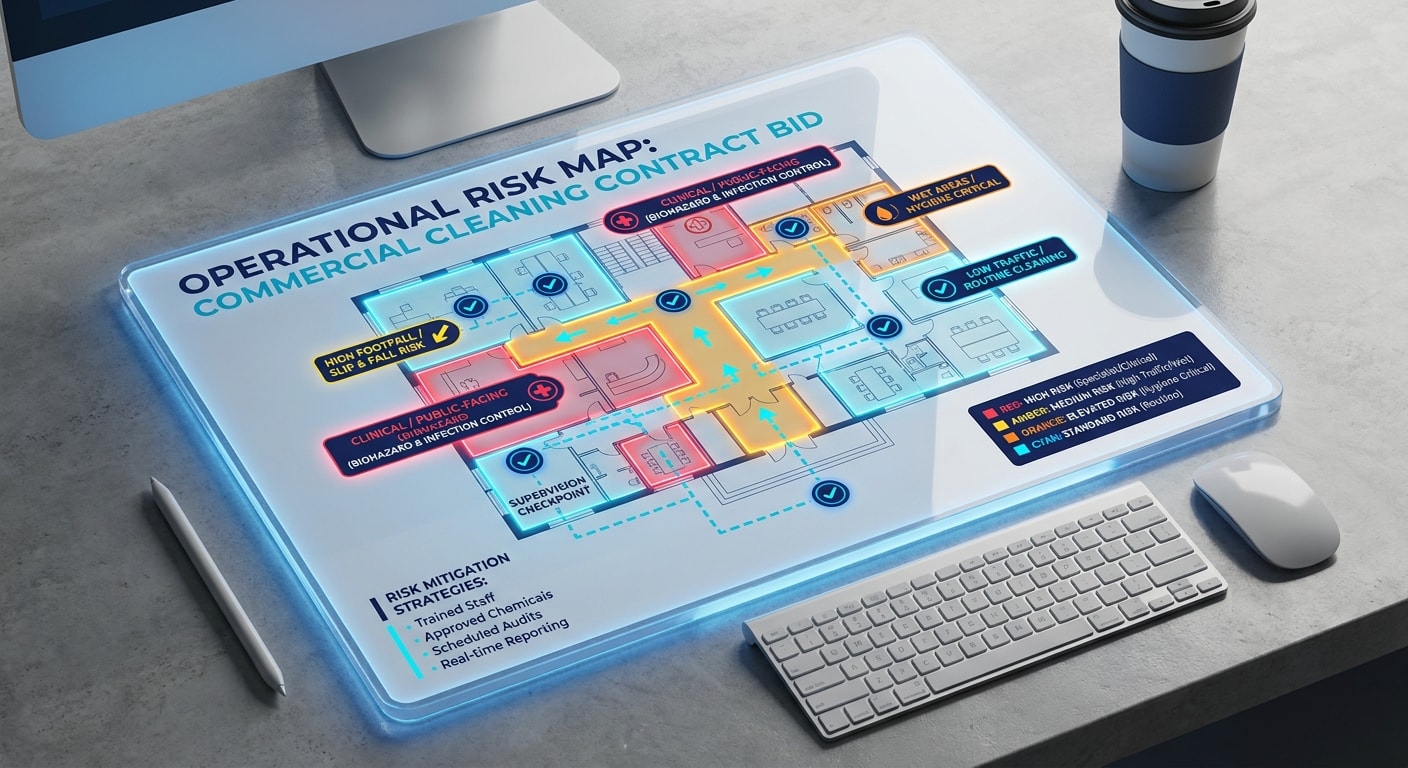
Cleaning site risk map showing high-footfall zones, washrooms, public areas and supervision checkpoints
Supervision Is Not an Add-On
Supervision is often treated as a management paragraph near the end of the response. That is a mistake.
In cleaning tenders, supervision is one of the clearest ways to prove density.
The evaluator wants confidence that standards will not depend on goodwill, memory or a monthly audit. They want to know someone is close enough to the work to spot issues early.
Your supervision section should explain:
- the supervisor-to-operative ratio
- site visit frequency
- how visits are scheduled
- what supervisors check
- how issues are recorded
- how corrective actions are tracked
- when the contract manager gets involved
- how client feedback is captured and closed
Be careful with vague phrases like “regular visits”. Regular means different things to different people.
If the contract needs daily checks, say daily. If the area manager visits weekly and the site supervisor checks every shift, say that. If high-risk areas get additional checks during peak hours, spell it out.
Specificity scores.
Build a Credible Escalation Model
Cleaning issues escalate quickly because they are visible.
A missed office clean may be irritating. A dirty washroom at lunchtime can become a client complaint. A hygiene failure in a sensitive setting can become a contract performance issue.
Your response should show how escalation works before the client has to chase.
A good model has three layers:
- immediate operative action for simple defects
- supervisor intervention for repeated or higher-risk issues
- contract manager ownership for systemic problems, resourcing gaps or client-impacting failures
The best responses also explain timeframes.
For example, urgent hygiene issues might be acknowledged within 15 minutes and resolved within one hour. Non-urgent quality defects might be corrected by the next scheduled clean and reviewed at the next supervisor visit. Repeated issues might trigger a root cause review within five working days.
The exact times depend on the contract. The principle does not: tell the evaluator how control is maintained.
Quality Assurance Needs to Be Operational, Not Decorative
Many bids include a quality assurance section that looks impressive but says very little.
It lists ISO 9001, audits, KPIs, monthly reports and continuous improvement. Fine. But how does any of that catch a missed clean before the client complains?
That is the test.
A useful QA model connects daily activity to management action:
- operatives complete task checklists
- supervisors inspect priority zones
- defects are logged with photographs where useful
- corrective actions have owners and deadlines
- trend data is reviewed with the client
- recurring issues trigger training, rota changes or specification review
This is more convincing than a generic “we monitor performance”.
It also links neatly to the Procurement Act’s stronger emphasis on supplier performance and transparency. For larger public contracts, buyers are increasingly conscious that contract performance can become visible beyond the contract management meeting. Your QA model should reassure them that you take that seriously.
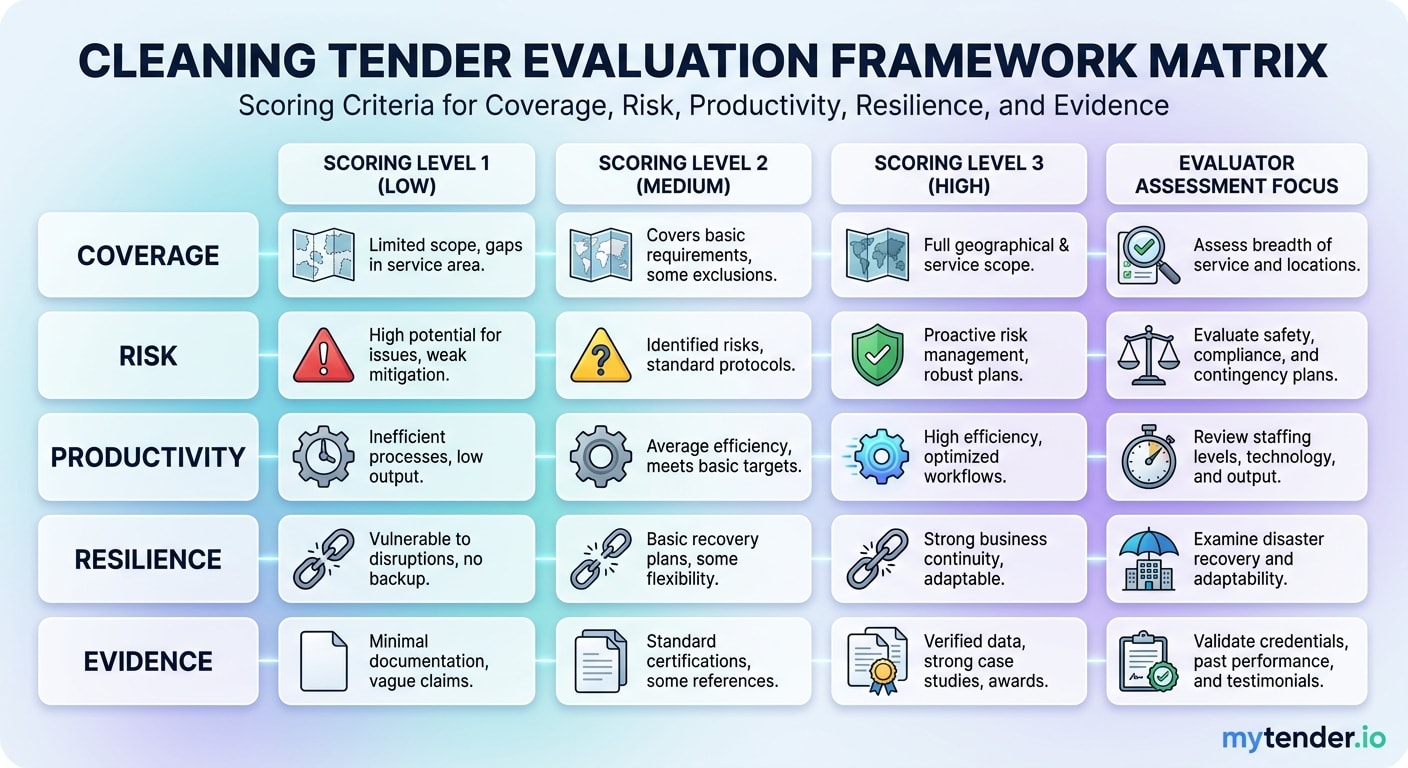
Cleaning tender evaluation framework showing coverage, risk, productivity, resilience and evidence
Evidence Beats Claims
The easiest way to improve a cleaning tender is to replace claims with evidence.
Weak: “We have extensive experience delivering cleaning services.”
Better: “On a multi-site local authority office contract, we reduced repeat cleaning defects by 32% in the first quarter by introducing supervisor-led washroom checks at lunchtime and closing defects through a digital action log.”
The second version gives the evaluator something to believe.
Use evidence in four places:
1. Similar contractsChoose examples that match the estate type, not just the service category. A single-site corporate office contract may not prove much for a multi-site council estate.
2. Mobilisation outcomesShow that you have taken over services without disruption. Mention TUPE, equipment transfer, staff induction, site surveys and first-month performance where relevant.
3. Performance dataUse defect reduction, audit scores, response times, absentee cover rates, complaints reduction or client satisfaction scores. Only use figures you can substantiate.
4. Named improvementsExplain what changed because of your management. Did you alter the rota? Add a supervisor check? Move storage? Train staff? Replace equipment? That is what proves active contract management.
Do Not Hide TUPE in the HR Section
TUPE is not just an HR issue. In cleaning tenders, it directly affects service density.
If staff transfer under TUPE, they bring site knowledge. They also bring existing working patterns, expectations and sometimes unresolved frustrations from the incumbent contract.
Your response should explain how TUPE is managed as part of mobilisation and service continuity.
Cover:
- how employee liability information will be reviewed
- how consultation will be planned
- how staff will be welcomed and inducted
- how site knowledge will be captured
- how training gaps will be assessed
- how supervision will support transferred staff in the early weeks
- how you will protect morale and service continuity
This matters even more because TUPE remains a live policy area in 2026, with government scrutiny around outsourced public services and worker protections. Evaluators do not expect you to predict every reform. They do expect a mature approach to people risk.
Mobilisation Should Prove the Model Before Day One
A cleaning mobilisation plan should not read like a list of admin tasks.
It should show how the service density model becomes real before go-live.
That means linking mobilisation activity to operational readiness:
- site surveys confirm zones, travel times and storage points
- staff consultation confirms availability and skills
- rota design matches the actual estate
- equipment and consumables are placed before service starts
- supervisors complete familiarisation visits
- quality baselines are agreed with the client
- early-life support is scheduled for the first month
This is where many bidders lose marks. They describe mobilisation as onboarding, not proof.
A better mobilisation section shows the evaluator that day one will not be guesswork.
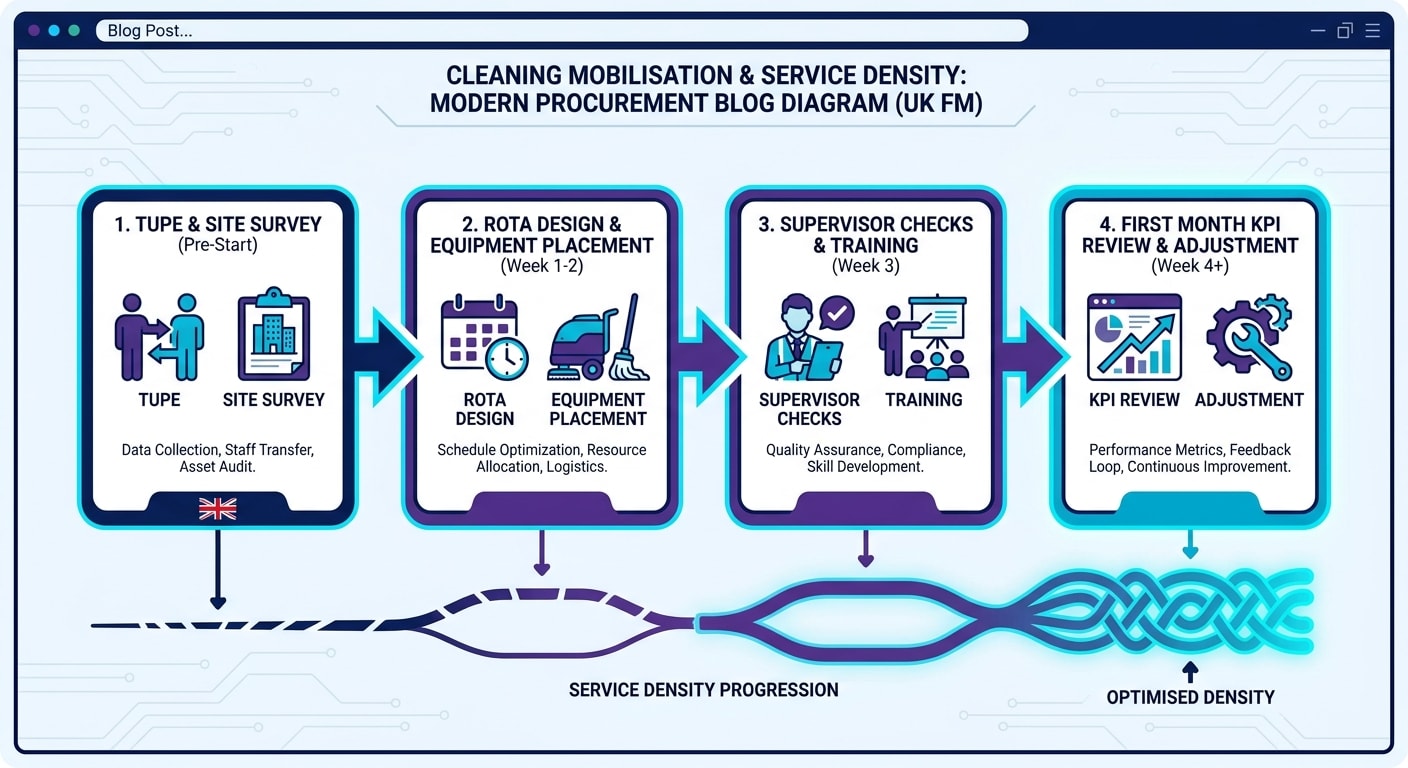
Cleaning mobilisation process map showing TUPE, site survey, rota design, equipment placement and first month KPI review
Make Resilience Visible
A cleaning model that works only when everyone turns up is not resilient.
Evaluators know sickness, vacancies, annual leave and unexpected events happen. They want to know the service will hold when they do.
Your bid should explain resilience without making the model sound overstaffed or expensive.
Good evidence includes:
- trained relief staff
- cross-trained operatives
- supervisor cover capability
- mobile response teams
- agency use rules, if appropriate
- escalation triggers for persistent absence
- recruitment pipeline for known vacancy risk
- contingency cover for weather, events or building changes
The key is to connect resilience to the client’s risk. For a small office, resilience might be simple cover arrangements. For a dispersed public estate, it may need a mobile team and a named contract manager escalation route.
Do not use the same answer for both.
Link Social Value to the Cleaning Operation
Social value in cleaning tenders often becomes detached from the service model.
Bidders promise apprenticeships, volunteering, local employment, training or community initiatives, but the link to contract delivery is vague. Evaluators can tell when the social value section has been pasted from another bid.
A stronger approach ties social value to the cleaning workforce and local estate.
For example:
- recruiting locally for relief and permanent roles
- offering accredited cleaning and supervisory training
- supporting progression from operative to team leader
- paying fairly and explaining workforce retention benefits
- using local suppliers where practical
- reducing chemical waste and improving consumable management
- supporting community spaces linked to the client’s estate
This works because it is credible. It also supports service density. Better trained, more stable teams are more likely to deliver consistent cleaning standards.
What Evaluators Are Really Scoring
The question may be called “methodology”, “service delivery”, “mobilisation”, “quality management” or “resources”. The scoring logic is usually similar.
Evaluators are looking for:
- understanding of the estate
- a credible labour model
- supervision close enough to the work
- strong mobilisation controls
- clear management of TUPE and people risk
- resilience when things go wrong
- measurable quality assurance
- evidence from comparable contracts
- a response tailored to the buyer’s priorities
Most losing bids do not fail because they are obviously non-compliant. They fail because they are generic. They could apply to any cleaning contract, which means they do not feel safe enough for this one.
That is the point to remember.
A Practical Structure for Your Answer
If you are staring at a blank method statement, use this structure.
1. Estate Understanding
Summarise the client’s sites, risks, operating hours and cleaning demand. Show you understand the contract before you describe your solution.
2. Service Density Model
Explain how labour, supervision, equipment and QA are distributed across the estate. Link the model to risk zones and footfall patterns.
3. Mobilisation and TUPE
Show how the model will be implemented before day one. Include surveys, staff consultation, rota validation, equipment placement and early-life support.
4. Day-to-Day Delivery
Describe routine cleaning, reactive work, periodic tasks, communication routes and supervisor checks. Make the operating rhythm visible.
5. Quality, Escalation and Improvement
Explain audits, defect management, KPI reporting, corrective actions and continuous improvement. Use examples where possible.
6. Evidence
Close the loop with proof from similar contracts. Use specific outcomes, not broad statements.
This structure is simple, but it forces the response to answer the evaluator’s real question: can you deliver this service reliably?
Where AI Helps, and Where It Does Not
AI can help cleaning bid teams move faster. It can draft a first structure, turn site notes into a coherent method statement, summarise specification requirements and spot missing compliance points.
But it cannot invent a credible service density model from thin air.
The useful workflow is this:
- gather the real operational inputs
- map the estate and risk zones
- define the labour and supervision model
- use AI to turn that evidence into a clear first draft
- review the draft against the scoring criteria
- add proof, figures and contract-specific examples
That is how tools like mytender.io should be used: to speed up the writing and compliance process while keeping the operational judgement with the bid and delivery team.
The danger is using AI to create fluent generic prose. Evaluators already see too much of that. The advantage comes when AI helps you express real evidence more clearly.
Final Checklist Before You Submit
Before submitting a cleaning tender response, check it against these questions:
- Have we summarised the client’s estate accurately?
- Have we shown where labour is placed and why?
- Have we explained supervision frequency and authority?
- Have we mapped high-risk zones and peak demand periods?
- Have we linked mobilisation to operational readiness?
- Have we treated TUPE as a service continuity issue, not just HR compliance?
- Have we shown resilience for sickness, vacancies and unexpected demand?
- Have we included specific performance evidence?
- Have we removed generic claims that could apply to any cleaning contract?
If the answer to any of these is no, the section is probably not ready.
The Bottom Line
Cleaning tenders are not won by saying you will clean well. Everyone says that.
They are won by proving that your service model is dense enough for the estate, resilient enough for real life and controlled enough for the client to trust.
That means showing the evaluator how the work is covered, how standards are checked, how people are supported and how problems are fixed before they become complaints.
If you want to find live cleaning and facilities management opportunities to practise this against, the Tender Finder is free to use. Start with the specification, map the estate, then build the response around evidence rather than promises.
Tags
Ready to Transform Your Tender Writing?
See how MyTender's AI can help you write winning tenders in a fraction of the time.