
Self-Cleaning Evidence in Tenders: How to Respond After Poor Performance Under the Procurement Act
Past performance problems do not have to end your next public sector bid. Here is how to build a credible self-cleaning evidence pack evaluators can trust.
mytender.io Research Team
Tender Writing & Bid Management Specialists

Bid team reviewing a supplier performance recovery dossier
A past contract problem is uncomfortable. Pretending it did not happen is worse.
Under the Procurement Act 2023, public buyers have sharper tools for looking at supplier performance. They can ask harder questions about contract terminations, serious breaches, published performance notices and whether a supplier has genuinely fixed what went wrong.
That does not mean one difficult contract automatically kills your next bid. It does mean the old response, a vague paragraph about lessons learned, is not enough.
If a buyer is worried about past poor performance, your job is simple: show that the problem is no longer continuing and is unlikely to happen again.
That takes evidence. Not reassurance. Not spin. Evidence.
This guide explains how to prepare a self-cleaning evidence pack for tenders, how to write about poor performance without sounding defensive, and how to give evaluators a reason to trust your recovery.
This article provides general bid-preparation guidance, not legal advice; seek specialist procurement-law advice on exclusion grounds, disclosures or disputed performance.
What self-cleaning means in tender writing
Self-cleaning is the evidence a supplier gives to show that a past issue has been taken seriously, investigated properly and fixed well enough that it is unlikely to recur.
In procurement law, this matters because poor performance can become a discretionary exclusion issue. The buyer may need to consider whether a supplier should be treated as excludable, then whether the evidence shows the risk has been cleaned up.
In bid writing, the practical question is more human:
Can the evaluator believe you?
A good self-cleaning response does not read like a courtroom argument. It reads like a controlled recovery story. It says what happened, why it happened, what changed, who owns the new controls, and what performance data proves the fix is working.
That is a very different document from a standard case study.
A case study usually says: here is what we did well.
A self-cleaning statement says: here is what went wrong, here is what we changed, and here is why you can rely on us now.
Why this is a live SEO and bid issue in 2026
Public procurement is moving further into performance transparency.
The Procurement Act has made contract management more visible, especially for larger public contracts with key performance indicators. Contracting authorities are expected to publish more information about contract performance, supplier delivery and serious issues. Payment performance, KPI management and contract governance are no longer hidden in the back office.
That shift changes how tender evaluators read your submission.
They are not just asking whether your method statement is polished. They are asking whether the supplier behind it is reliable. If your public record, references or declaration history suggests a problem, the bid needs to deal with that problem directly.
There is a second reason this topic matters. Many suppliers have had difficult contracts since 2020. Labour shortages, inflation, supply disruption, subcontractor failures and client-side scope changes have all created delivery pressure.
Some of those problems were managed well. Some were not.
The difference between the two is evidence.
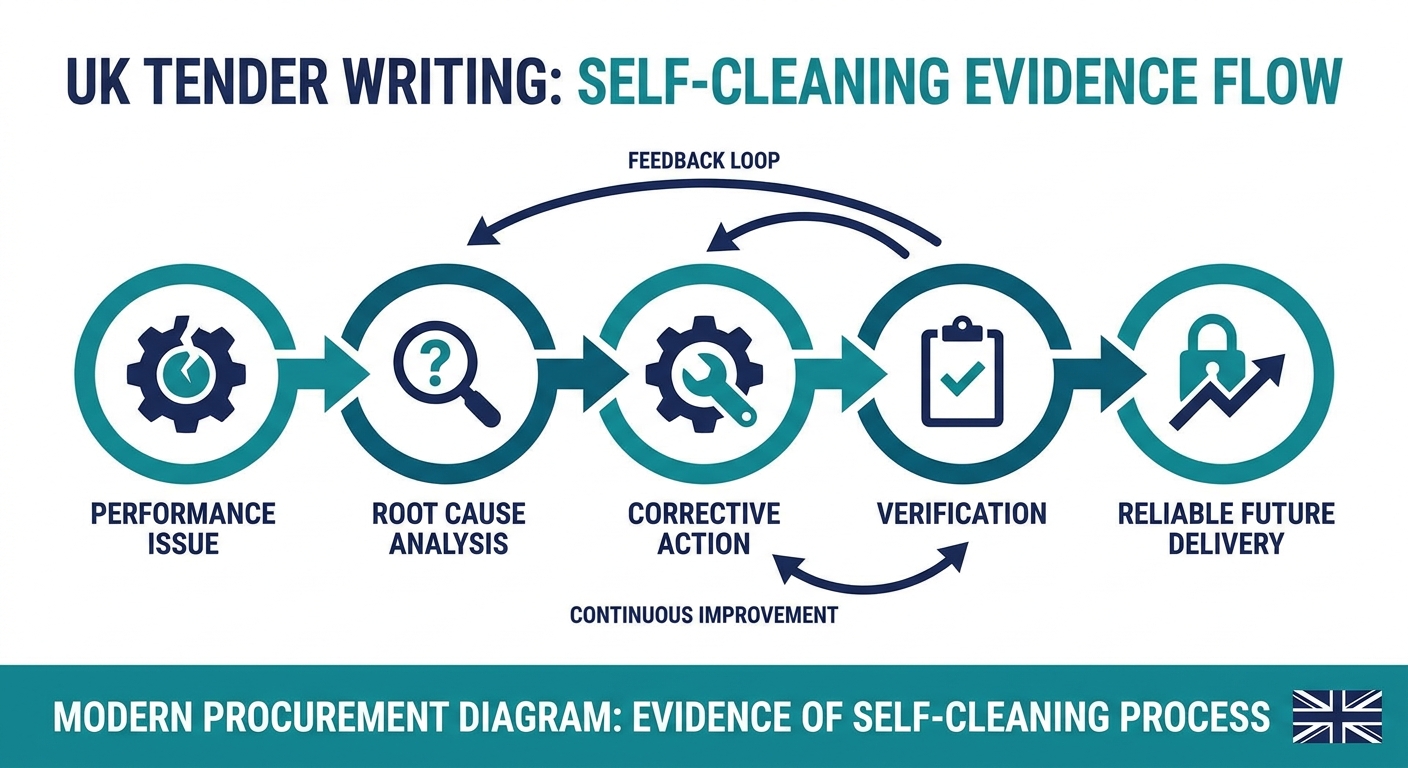
Self-cleaning evidence flow from issue to verified recovery
Poor performance is not always an automatic exclusion
This is the first point bid teams need to get right.
A performance issue does not automatically mean you are banned from bidding. Poor performance is usually a discretionary exclusion concern. The buyer has to look at the facts, the seriousness of the issue, the applicable procurement regime and the evidence you provide.
Not every contract ending badly is the same.
For example:
- A contract that naturally expired is not the same as one terminated for breach.
- A termination for convenience is not the same as termination for supplier default.
- A routine KPI report is not the same as a serious published performance notice.
- One missed service credit is not the same as sustained failure after a formal opportunity to improve.
- A disputed commercial settlement is not always a simple admission of poor performance.
That nuance matters. Your tender response should not overstate the issue, but it must not minimise it either.
If the tender asks about exclusion grounds, contract breaches or poor performance, answer accurately. If the situation is disputed or legally sensitive, get procurement-law advice before submitting. Bid teams should never guess their way through a declaration.
For the writing itself, the safest tone is factual and measured.
Avoid phrases like:
- It was not our fault.
- The buyer misunderstood the situation.
- This has no relevance to the tender.
- We have fully solved everything.
- We guarantee this will never happen again.
Stronger wording sounds like this:
- The issue was reviewed through a formal root-cause process.
- The primary causes were identified as staffing resilience, subcontractor oversight and delayed escalation.
- Corrective actions were completed between March and June 2026.
- Subsequent KPI data shows sustained performance above target across the following two quarters.
- The revised governance model is now standard on contracts with similar risk characteristics.
One version argues. The other evidences.
The four pillars of a credible self-cleaning pack
A self-cleaning evidence pack should be easy for an evaluator to follow. If they have to piece the story together from scattered appendices, you have made their job harder.
Use four pillars.
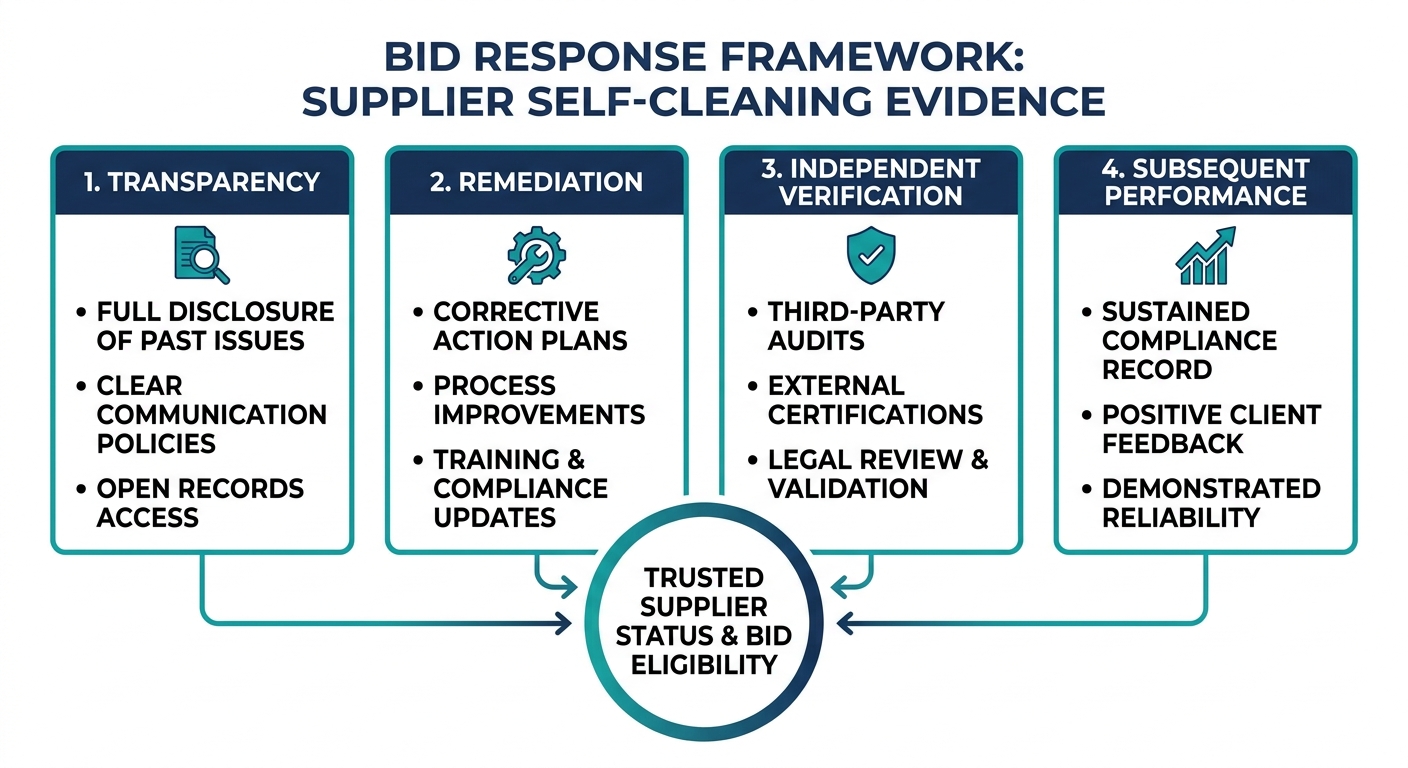
Four pillars of a credible self-cleaning evidence pack
1. Transparent chronology
Start with the facts.
Set out what happened in a short chronology. Include dates, contract scope, the nature of the issue and the point at which it was identified. Keep it calm. Do not bury the difficult bit in soft language.
A useful structure is:
- Contract name or anonymised description, if confidentiality requires it.
- Service type, geography and contract scale.
- What performance requirement was missed.
- When the issue emerged.
- How it was raised by the buyer, your team or an audit.
- What immediate containment action was taken.
- When the recovery plan was agreed.
- When the corrective actions were completed.
This should be short. The chronology is not the main argument. It is the map that lets the evaluator understand the evidence that follows.
2. Root-cause analysis
Weak self-cleaning statements jump straight from problem to apology.
Strong ones explain why the problem happened.
That matters because a buyer cannot assess recurrence risk unless they understand the cause. If you say you have fixed the issue, but never explain what caused it, your response feels hollow.
Root causes should be specific enough to be useful. Avoid generic lines such as operational pressures or communication breakdown. Say what actually failed.
For example:
- The mobilisation plan depended on a single subcontractor for specialist labour, with no validated backup supplier.
- The reporting process relied on manual spreadsheet updates, which delayed escalation of missed visits.
- The contract manager carried too many sites during the first six weeks, creating slow client communication.
- The handover checklist did not require confirmation of asset data completeness before go-live.
- The finance process did not flag disputed subcontractor invoices early enough for senior review.
Those are uncomfortable sentences. They are also useful ones.
They show that you have looked under the bonnet.
3. Completed corrective action
Promises do not clean up performance risk. Completed actions do.
Your response should separate actions already completed from actions still in progress. Do not blur the two. Evaluators know the difference between a new policy written yesterday and a control that has been running for six months.
Completed corrective actions might include:
- Replacing or strengthening the contract leadership team.
- Introducing a named executive sponsor for high-risk mobilisations.
- Changing subcontractor approval, onboarding or performance review processes.
- Adding second-source suppliers for critical materials or labour.
- Revising mobilisation gates, including go or no-go checks before service commencement.
- Implementing automated KPI reporting from operational systems.
- Increasing internal audit frequency for similar contracts.
- Updating training, supervision and escalation routes.
- Settling outstanding financial matters where appropriate.
- Creating a board-level performance review for contracts with public-sector visibility.
Each action should be linked back to a cause.
If the cause was weak subcontractor oversight, show the new subcontractor checks. If the cause was delayed escalation, show the new escalation trigger. If the cause was unrealistic mobilisation planning, show the revised planning gate.
The evaluator should be able to draw a straight line from failure to fix.
4. Verification and subsequent performance
This is where many responses fall down.
They describe internal improvements, but they do not prove the improvements worked.
Verification can come from several places:
- Subsequent KPI results on the same contract.
- KPI results from similar contracts after the corrective action.
- Internal audit reports.
- External certification or independent audit findings.
- Client reference letters.
- Governance meeting minutes.
- Training completion records.
- Subcontractor performance scorecards.
- Payment performance reports.
- System screenshots showing live reporting controls.
The best evidence is usually a blend. One client letter is good. A client letter plus two quarters of KPI data plus an audit extract is much stronger.
Do not swamp the evaluator. Give them the proof that answers the risk question.
How to decide whether to disclose the issue
This is not a place for guesswork.
If a procurement document asks a direct question about termination, breach, poor performance, exclusion grounds, debarment, notices or misrepresentation, you need to answer it accurately. If you are unsure whether an event falls within the question, ask a procurement lawyer before submitting.
That said, bid teams can prepare the evidence long before the tender arrives.
Use a contract history audit.
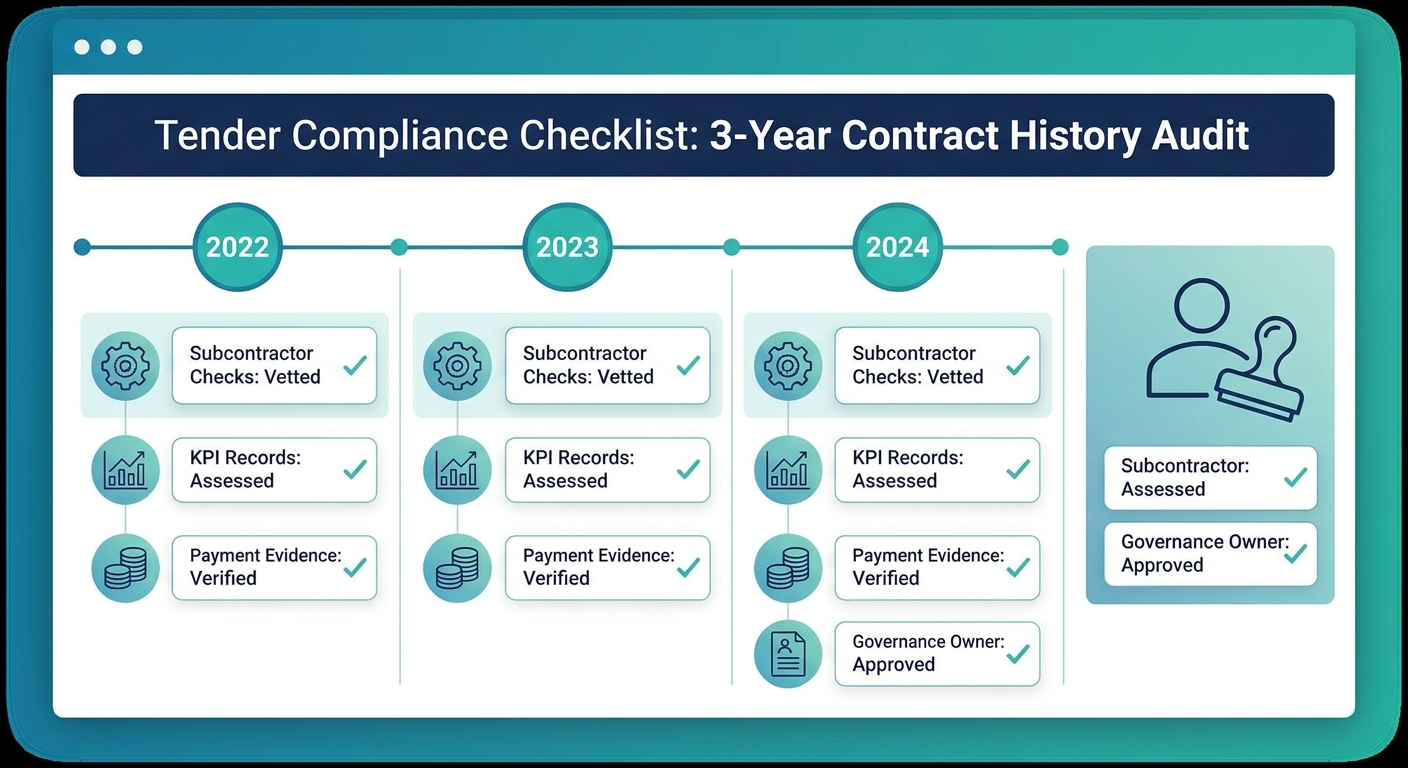
Contract history audit checklist for tender teams
Review the last three to five years of relevant contract history and record:
- Contracts terminated for default, breach or performance failure.
- Contracts partly terminated or descoped because of performance issues.
- Formal notices of breach, improvement notices or cure notices.
- Serious KPI failures that required formal recovery plans.
- Settlements, damages or compensation linked to performance disputes.
- Published performance notices or adverse public records.
- Contracts where a key subcontractor caused material delivery problems.
- Major buyer complaints that reached senior governance.
- Any debarment, exclusion or misconduct correspondence.
Then classify each issue.
Some events will be irrelevant to tender declarations. Some will need legal review. Some will be highly relevant and need a prepared self-cleaning response.
The point is not to create panic. The point is to stop the bid team discovering a sensitive issue two hours before portal submission.
How to write the self-cleaning answer
A good self-cleaning answer has seven parts.
1. Direct opening
Start plainly.
Do not write three paragraphs of context before acknowledging the issue. That looks evasive.
A simple opening might be:
> We recognise the seriousness of the performance issue on this contract. We completed a formal review, implemented corrective action, and have provided evidence below showing why the circumstances are no longer continuing and are unlikely to recur.
That sentence does three useful things. It takes the issue seriously, points to action and frames the evidence around recurrence risk.
2. Factual context
Give the evaluator enough context to understand scale and relevance.
For example:
> The issue related to a regional facilities management contract covering 18 sites. During the first mobilisation phase, planned maintenance completion fell below the agreed monthly target for two reporting periods.
That is better than saying there were temporary operational challenges.
3. Root cause
Explain the cause without sounding like you are blaming everyone else.
For example:
> The review found three primary causes: incomplete asset data at handover, over-reliance on one specialist subcontractor, and delayed escalation from site supervisors to the regional contract manager.
This is specific. It gives the buyer something to test.
4. Immediate containment
Show what you did at the time to protect service users and the buyer.
For example:
> The immediate containment plan added weekend engineering cover, created a daily client escalation call, and brought in a backup subcontractor for statutory maintenance tasks.
This helps evaluators see that you did not wait passively.
5. Permanent corrective action
Now set out what changed permanently.
Use a short table in your internal pack, then translate it into prose for the tender answer. Match each action to the root cause.
Example:
- Asset data: new pre-mobilisation data validation gate, signed by operations and client lead.
- Subcontractor resilience: approved second-source supplier required for statutory tasks.
- Escalation: amber trigger at 95 percent planned completion, with regional director review within 48 hours.
- Governance: high-risk mobilisation board for the first 90 days of comparable contracts.
The bid answer should not feel like a policy dump. It should feel like targeted risk control.
6. Evidence of effectiveness
This is the most important section.
Give results after the change.
For example:
> Since the revised mobilisation controls were introduced, planned maintenance completion has remained above 98 percent across four consecutive quarters on comparable contracts. Two subsequent mobilisations using the new gateway process went live without critical defects, and both achieved first-month reporting compliance above target.
If you do not yet have long-term data, be honest. Use the evidence you do have and explain what is still being monitored.
7. Relevance to the tender
Finish by connecting the learning to the opportunity you are bidding for.
For example:
> The same controls will be applied to this contract because the mobilisation risk profile is similar: multiple sites, inherited asset data and specialist subcontractor dependency. We have therefore included the mobilisation assurance plan in Appendix 4 and the first 90-day governance calendar in Appendix 5.
This final step is easy to miss. Do not miss it.
Self-cleaning evidence is not just about the past. It is about giving the buyer confidence in this contract.
What evaluators are really looking for
Evaluators are not looking for perfection.
They are looking for reliability.
A supplier that had a problem, investigated it properly and changed its operating model may feel safer than a supplier that claims it has never had a serious issue but provides no evidence of governance.
The difference is how you write it.
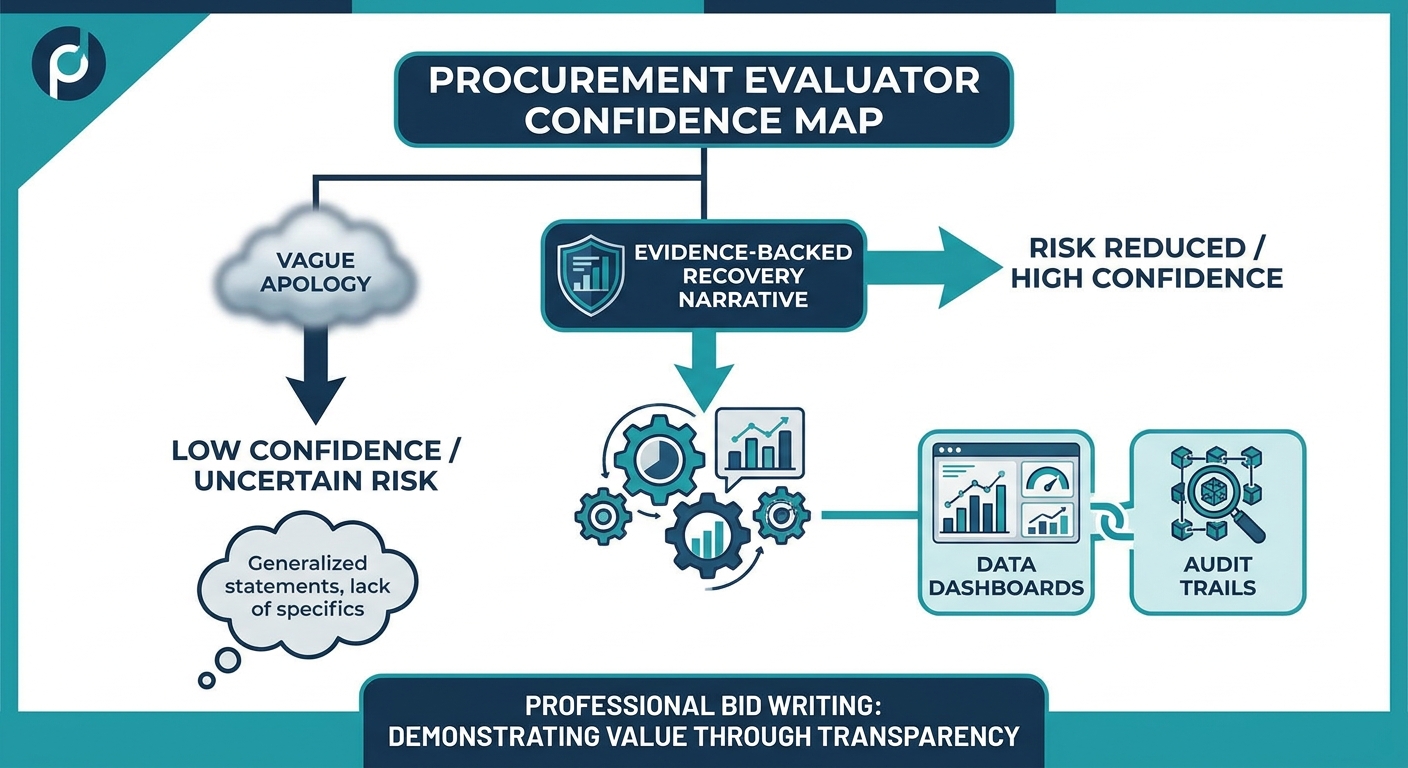
Evaluator confidence map for self-cleaning evidence
Poor responses tend to do one of five things:
- They apologise without proving change.
- They blame the buyer, subcontractor or market conditions.
- They provide legal argument but no operational evidence.
- They attach policies that were not created because of the issue.
- They make absolute promises about future performance.
Stronger responses do the opposite:
- They acknowledge seriousness.
- They explain cause.
- They show completed action.
- They verify the fix.
- They connect the learning to the new contract.
That is the difference between a defensive submission and a credible recovery narrative.
Build your evidence pack before the tender lands
The worst time to prepare self-cleaning evidence is during a live bid.
Everyone is stressed. The portal deadline is close. Legal, operations, finance and contract management all need to check facts. Someone remembers a settlement clause. Someone else has the KPI dashboard but not the client correspondence. The bid writer is left trying to turn half-verified information into a compliant answer.
Do the work earlier.
Your standard self-cleaning pack should include:
- A contract issue register with dates and owners.
- A short factual chronology for each material issue.
- Root-cause analysis records.
- Corrective action plans and completion evidence.
- Board or senior management sign-off.
- Training records and revised procedures.
- KPI data before and after the issue.
- Internal or external audit evidence.
- Client correspondence that can be disclosed.
- Approved wording for common tender questions.
- A legal review note for sensitive declarations.
Keep privileged legal advice separate and controlled. Bid teams should know the approved position, but they should not casually upload sensitive legal documents into a portal because a question feels difficult.
How this changes your bid library
Most bid libraries are built around strengths.
They contain case studies, policies, method statements, accreditations, CVs and boilerplate. That is useful, but it misses a growing need: evidence of resilience when things go wrong.
Add a recovery evidence section to your bid library.
It should include approved modules for:
- Contract recovery governance.
- Poor performance remediation.
- Subcontractor replacement and escalation.
- KPI recovery and continuous improvement.
- Payment process improvement.
- Client complaint resolution.
- Mobilisation replanning.
- Independent audit and assurance.
These modules should not be copied blindly. They should give bid teams a safe starting point, with prompts to add the contract-specific evidence.
If you use AI in bid writing, this is where guardrails matter. Tools can help organise evidence, map root causes to corrective actions and keep wording consistent. They should not invent recovery evidence or soften declarations that need legal precision.
That is why mytender.io focuses on grounded bid content, reusable evidence and structured review. Sensitive tender sections need source-backed drafting, not confident guesswork.
A practical self-cleaning checklist
Use this before you submit any tender where past performance may be relevant.
Contract history
- Have you reviewed relevant contracts from the last three to five years?
- Have you identified terminations, serious breaches, formal notices and major KPI failures?
- Have you checked whether any key subcontractor in the bid has a relevant issue?
- Have you separated undisputed facts from disputed or legally sensitive matters?
Declaration and legal review
- Does the tender ask about exclusion grounds, poor performance or contract termination?
- Is the answer consistent with the procurement documents?
- Has legal reviewed any disputed, confidential or high-risk issue?
- Is the wording accurate without over-disclosing unnecessary detail?
Evidence quality
- Is there a clear chronology?
- Are root causes specific?
- Are corrective actions completed, not just planned?
- Is each action linked to a cause?
- Is there evidence the fix worked?
- Are client references, KPI data or audit records available?
Bid response quality
- Does the response take the issue seriously?
- Does it avoid blame and defensiveness?
- Does it explain why recurrence is unlikely?
- Does it connect the learning to the tender you are bidding for?
- Is the evidence easy for an evaluator to follow?
If you cannot tick these boxes, the answer is not ready.
Common mistakes to avoid
Mistake 1: Treating self-cleaning as legal wording only
Legal accuracy matters. But a buyer also needs operational confidence.
A legally careful answer with no KPI evidence still feels risky. Pair compliance wording with practical proof.
Mistake 2: Using generic continuous improvement language
Continuous improvement is not enough on its own.
Say what improved. Say why. Say how you measured it.
Mistake 3: Hiding behind confidentiality
Some information genuinely cannot be disclosed. That does not mean you should provide nothing.
Use anonymised evidence, ranges, redacted records or summary data where appropriate. Explain why detail is limited, then give the buyer enough assurance to assess the risk.
Mistake 4: Forgetting subcontractors
Exclusion and reliability questions can extend beyond the prime contractor. If a key subcontractor caused the issue, or if a proposed subcontractor has its own performance history, you need a controlled position.
Do not assume the buyer will only look at the lead bidder.
Mistake 5: Overpromising
Never write that an issue cannot happen again.
No serious evaluator believes that. Say what controls reduce the risk, how they are monitored and what happens if early warning indicators appear.
Where self-cleaning fits in the wider bid strategy
Self-cleaning evidence should not sit in isolation.
It connects to several parts of the tender:
- Selection questions: accurate declarations and supporting evidence.
- Method statements: revised controls embedded in delivery plans.
- Risk registers: recurrence risk and mitigation owners.
- Mobilisation plans: new gateways and assurance checks.
- Quality management: audit trails and continuous improvement.
- Social value: proof that commitments are governed, not just promised.
- Contract management: KPI reporting, escalation and client review rhythm.
- Supply chain: due diligence, prompt payment and subcontractor oversight.
This is why the best response is not a standalone apology. It is a thread running through the bid.
If the issue was mobilisation failure, the mobilisation answer should show the new gateway. If the issue was subcontractor performance, the supply-chain answer should show new controls. If the issue was KPI reporting, the contract management answer should show dashboard governance.
The self-cleaning statement says you changed. The rest of the bid proves you have embedded the change.
Sector examples: what recovery evidence looks like in practice
Self-cleaning evidence is strongest when it reflects the risk profile of the contract you are bidding for. A generic recovery story rarely scores well because different sectors fail in different ways.
Facilities management
In FM tenders, poor performance often centres on mobilisation, statutory compliance, PPM completion, reactive response times, cleaning audit scores or subcontractor control.
A credible recovery pack might include:
- Revised mobilisation gateways for asset data, staff transfer and subcontractor readiness.
- PPM completion data before and after the corrective action.
- Evidence that missed statutory tasks now trigger director-level escalation.
- Audit extracts showing improved site quality scores.
- Client review minutes confirming the recovery plan was closed.
The tender answer should connect that evidence to the buyer's estate. If the new opportunity involves inherited asset data, multiple sites and specialist subcontractors, say exactly how the revised controls will apply.
Construction
In construction, the issue may relate to programme slippage, health and safety performance, quality defects, subcontractor failure, payment disputes or building safety record keeping.
Useful evidence might include:
- Updated project controls and weekly programme governance.
- Independent health and safety audit results.
- Revised subcontractor financial and capability checks.
- Defects close-out trend data.
- Evidence of improved design change control.
- Lessons learned embedded into the proposed delivery plan.
Do not just say the project was complex. Evaluators hear that every week. Explain what the complexity exposed in your controls and what you changed.
Waste and environmental services
For waste contracts, recovery evidence often focuses on missed collections, contamination rates, round design, depot resilience, vehicle availability, data accuracy or complaints.
A strong response might show:
- Revised route modelling and contingency rounds.
- Vehicle availability data after fleet changes.
- Complaint reduction after crew training.
- Improved contamination reporting and resident communication.
- Depot resilience planning for peak periods.
- Evidence that digital tracking records are now reviewed daily.
Waste buyers care about operational continuity. The recovery story should show how service disruption will be spotted early and fixed before it becomes political.
How to brief the people who hold the evidence
Bid teams rarely own the evidence themselves. Operations, finance, legal, HR, commercial and contract managers all hold pieces of the story.
Do not ask them for a general update. You will get vague notes and half-useful attachments. Ask targeted questions.
Send a short evidence request that covers:
- What happened, in one factual paragraph.
- Which contractual requirement or KPI was affected.
- What the root-cause review found.
- Which corrective actions are complete.
- Which documents prove completion.
- Which KPIs improved after the change.
- Which evidence can be disclosed externally.
- Which information needs legal or client approval before use.
Give each owner a deadline and a format. A shared spreadsheet is usually enough. The key is to separate fact, evidence and commentary.
Your bid writer can then turn the raw material into a coherent answer without accidentally overstating the legal position or inventing operational proof.
The one-page recovery narrative
Before drafting the tender response, write a one-page recovery narrative for internal approval.
It should include:
- The issue: what happened and why it matters.
- The cause: what the review found.
- The response: what you did immediately.
- The fix: what changed permanently.
- The proof: what evidence shows the fix worked.
- The relevance: how this learning applies to the tender.
- The boundaries: what cannot be disclosed and why.
This page becomes the source of truth. Legal can check it. Operations can confirm it. The bid team can use it consistently across the selection questionnaire, method statements and appendices.
Without it, different sections of the bid can tell slightly different stories. That is dangerous. If one answer says the problem was subcontractor resilience and another says it was client data quality, the evaluator will notice.
Consistency builds trust.
Final thought: own the recovery, not the embarrassment
No supplier wants to write about poor performance.
But evaluators are not shocked by the idea that contracts sometimes go wrong. They are worried about suppliers who do not learn, do not evidence recovery and do not tell the truth until forced.
A strong self-cleaning response is not a confession of weakness. It is a proof of maturity.
It says: we know what happened, we fixed the causes, we can evidence the change, and we will apply that learning to your contract.
That is a much stronger message than pretending nothing ever goes wrong.
If you want to find live public sector opportunities while keeping your bid pipeline focused, the Tender Finder is free to use. It helps you spot relevant tenders early, so your team has time to check risks, gather evidence and bid properly.
Tags
Ready to Transform Your Tender Writing?
See how MyTender's AI can help you write winning tenders in a fraction of the time.