

Security Services Tender Writing Guide 2026: Win More Manned Guarding and Public Sector Security Contracts
Master security services tender writing with proven strategies for manned guarding, CCTV monitoring, and public sector security contracts. Expert guidance on SIA licensing, ACS accreditation, TUPE, social value, and AI-powered bidding for UK security companies in 2026.
mytender.io Research Team
Procurement & Tender Writing Specialists
The UK private security industry is worth over £8 billion annually, with public sector contracts — across central government, local authorities, NHS trusts, universities, housing associations and transport operators — representing the most stable and lucrative portion of that market. For security companies ready to move beyond relationship renewals and grow through competitive procurement, winning public sector tenders is the most powerful growth lever available.
Yet security tenders are consistently underestimated. On the surface, the ask seems straightforward: provide trained, licensed officers to protect a site. In practice, evaluators are assessing your organisation's licensing compliance, financial stability, employment practices, technology capability, quality management systems, social value commitments, and mobilisation track record — all before price even comes into focus. A security company that submits a generic, template-heavy response will lose, regardless of how experienced their officers are on the ground.
This guide covers everything you need to know to win security services tenders in 2026: the market landscape, how evaluation really works, the compliance framework, common pitfalls, and how AI-powered bid writing tools are giving forward-thinking security companies a genuine competitive edge.

Professional security guard team outside UK government building
Understanding the UK Public Sector Security Market
The public sector security market fragments into distinct sub-markets, each with its own buyer behaviour, compliance requirements and evaluation priorities. Treating them as a single opportunity is the fastest route to losing bids.
Central government and Crown buildings represent the largest and most complex segment, covering HMRC offices, DWP job centres, DVLA facilities, courts, prisons (perimeter and visitor management), military establishments, and Crown Court buildings. These contracts sit within Crown Commercial Service (CCS) frameworks — most notably RM6174 (Security Services) — and range from single-site contracts worth £200,000 annually to multi-site framework call-offs exceeding £50 million over five years. Evaluation here is rigorous: Cyber Essentials Plus, BPSS screening for all officers, ACS accreditation, and ISO 9001 are effectively non-negotiable prerequisites. NHS and healthcare security accounts for approximately £600 million annually across acute trusts, mental health trusts, ambulance services and primary care networks. The sector has specific demands beyond standard manned guarding: conflict resolution training (PMVA — Prevention and Management of Violence and Aggression), NHS Protect standards compliance, and experience managing vulnerable patient populations. NHS Supply Chain frameworks and individual trust procurements both offer opportunities, with contract values typically ranging from £300,000 to £5 million annually per trust. Local authority security covers civic buildings, council offices, housing estate concierge services, car parks, and leisure centres. These contracts are often smaller — £100,000 to £1.5 million annually — and procured through regional consortium frameworks like ESPO, YPO, and NEPO, or directly via Contracts Finder. Social value and local employment commitments carry significant weight, and buyers are often more price-sensitive than their central government counterparts. Higher and further education security sits at roughly £400 million annually. Universities have complex security requirements spanning 24/7 residential campuses, research facilities with high-value assets, and large-scale events management. TUPE transfers are frequent as universities retender ageing contracts. SIA-licensed officers, body-worn cameras, and integrated access control systems are now standard expectations on most university contracts. Transport security — covering rail stations, bus terminals, airports (landside), and port facilities — is worth approximately £350 million in the public and semi-public sector. Transport for London, Network Rail, and regional transport authorities all procure significant security packages. Crowd management, counter-terrorism awareness (Project Griffin training), and CCTV operator licensing requirements add complexity to bids in this segment. Housing association security — concierge, estate patrol, and lone worker protection — totals around £200 million. These contracts often overlap with cleaning and FM services and are increasingly bundled into wider facilities management agreements. The social housing sector places particular emphasis on resident-facing behaviour, vulnerability awareness training, and anti-social behaviour management capability.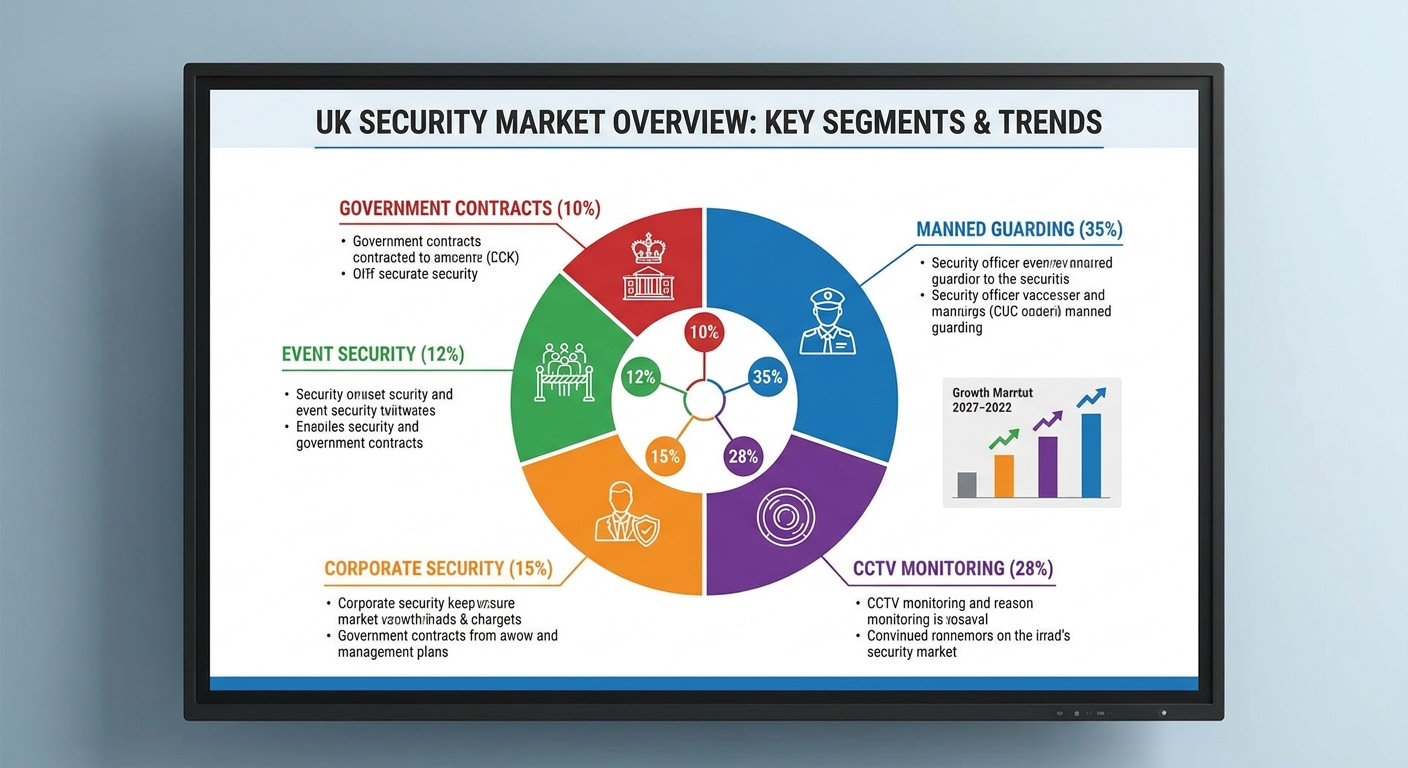
UK security services market segments overview
Contract Types and What They Require
Public sector security contracts divide into four principal service models, each with different bid requirements and evaluation priorities.
Static manned guarding is the core of most security contracts: SIA-licensed officers deployed to fixed positions on a client site, covering access control, reception security, patrols, and incident management. Evaluation focuses on officer quality, management supervision ratios, response procedures, and TUPE track record. Pricing is heavily scrutinised — evaluators will check whether your all-in hourly rate is consistent with paying at least the Real Living Wage plus SIA licence costs, uniform, holiday pay, and management overhead. Mobile patrol services involve officers covering multiple sites on a patrol route, conducting lock-and-unlock, alarm response, and welfare checks. These contracts suit smaller sites where a full-time static presence isn't cost-justified. Bid requirements emphasise response time guarantees, GPS tracking capability, patrol reporting systems, and vehicle maintenance standards. CCTV monitoring and remote surveillance has grown significantly as technology has improved. Remote Monitoring Centres (RMCs) are now a mainstream procurement category. Buyers want to understand your platform's uptime record, operator licensing (CCTV operator licence under SIA), escalation procedures, and integration capability with third-party access control and alarm systems. Event security covers stewarding, crowd management, and close protection for public events — concerts, sporting fixtures, festivals, and protest management. BS 8406 (event stewarding) and NPSA guidance compliance are important here, alongside public liability insurance levels (typically £10m minimum), SIA door supervisor licences for controlled entry points, and evidence of crowd management experience at comparable events.The Evaluation Framework: What Buyers Are Really Assessing
Before writing a single word of your tender response, understand how your submission will be scored. Most public sector security tenders use a quality/price split — 60:40 or 70:30 in higher-complexity procurements, sometimes 50:50 for price-sensitive buyers. Quality can account for 60–70% of your total score. Competing on price alone is rarely viable in security — the sector's low-margin economics mean race-to-the-bottom pricing typically produces service failures within twelve months.
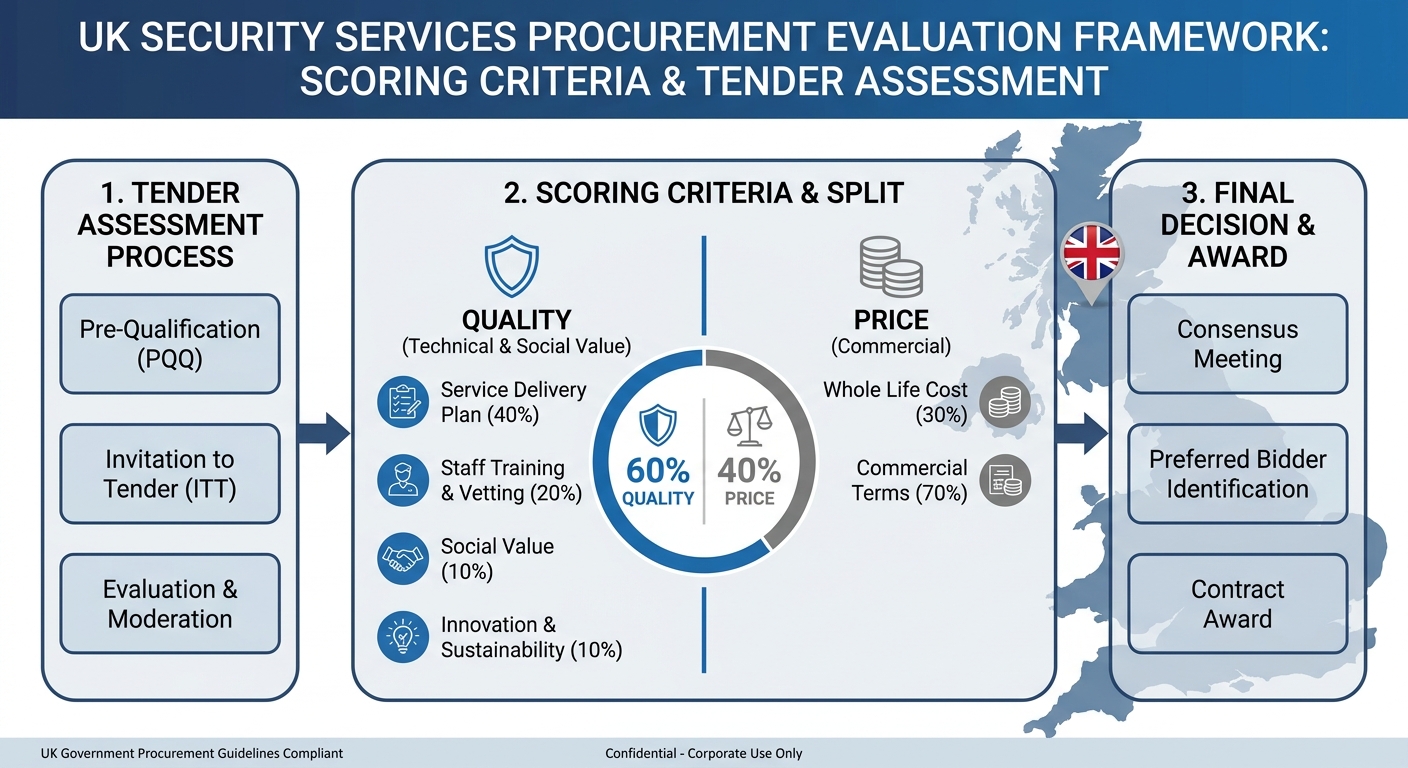
Security tender evaluation scoring framework
Pass/Fail Compliance Checks
These gates must be cleared before your quality responses are even read. Failure at this stage is elimination.
SIA licensing is the most fundamental requirement. Every officer who will deliver the contract must hold a valid SIA licence for the relevant activity — manned guarding, door supervision, CCTV operation, or close protection. Evaluators will ask for evidence of your licence management processes: how you track expiry dates, how you manage renewals, and what happens when an officer's licence lapses. A credible answer goes beyond "we have a spreadsheet" — buyers want to see licence management software, automated reminders, and a clear policy for maintaining 100% licensing compliance at all times. ACS (Approved Contractor Scheme) accreditation is mandatory for most public sector security contracts. The SIA's ACS accreditation scheme assesses security companies against a rigorous standard covering management systems, staff training, licensing compliance, and continuous improvement. Non-ACS companies are disqualified from most significant public sector opportunities. If you're not ACS-accredited, achieving it is the single most impactful investment a security company can make before bidding public sector work. Insurance minimums are typically £10m employer's liability and £10m public liability. Central government contracts frequently require £20m public liability. Check the ITT carefully — underinsured bids are rejected at the compliance stage. Financial health checks assess whether your turnover is sufficient relative to the contract value. The standard test is 2x turnover to contract value — a £3 million annual contract typically requires £6 million in annual turnover. Companies that fail this test can sometimes bridge the gap through parent company guarantees, but this needs to be addressed explicitly in your bid. Cyber Essentials or Cyber Essentials Plus is increasingly required for contracts involving any digital access to client systems — CCTV platforms, access control, visitor management software. Government contracts almost universally mandate Cyber Essentials Plus.Scored Quality Questions
After compliance checks, your quality responses are scored — typically by a panel of two to four evaluators working independently. Common scored question themes include:
Service delivery methodology asks how you will actually deliver the contracted security services. Generic answers fail. Evaluators want to see that you understand their specific environment: the unique risks of a mental health ward require different procedures to an HMRC office or a university campus. Show site-specific thinking, name specific threat vectors, and explain how your operational model mitigates them. Reference your standard operating procedures (SOPs) and how they'll be customised for the contract. TUPE and workforce transition is almost always a scored question on retender contracts. You must demonstrate that you understand which employees will transfer, that you've assessed the TUPE liability correctly, that you have a clear mobilisation timeline, and that you'll manage the transfer in line with both legal requirements and good employer practice. A strong answer addresses the human dimension too — how you'll communicate with transferring staff, how you'll integrate them into your culture, and what support you'll provide during the transition period. Management and supervision asks how you'll oversee contract delivery and respond to performance issues. Evaluators want to see a credible supervision structure: on-site supervisors, area managers, dedicated account management, and escalation paths. Key Performance Indicators (KPIs), regular client review meetings, and a clearly described contract manager with named backup cover all feature in high-scoring responses. Training and development is increasingly heavily weighted. Buyers want evidence that your officers receive more than the statutory minimum SIA licence training. First aid currency, conflict resolution refreshers, counter-terrorism awareness (ACT Awareness e-learning, Project Griffin), customer service training, and mental health first aid all differentiate strong bids. If your company has a formal training academy or continuous professional development programme, describe it specifically. Technology and innovation has grown from a nice-to-have to a weighted scoring criterion. Body-worn cameras with audit trail capability, officer monitoring apps (like TrackTik, Guardhouse, or Shield), lone worker protection devices, and integrated reporting platforms all feature in high-scoring responses. Buyers want to understand not just what technology you use, but how it improves accountability and client visibility. Social value carries increasing weight under PPN 06/20 and the Social Value Act 2012. Security companies are well-positioned here: the sector employs large numbers of people from diverse backgrounds, often including veterans, ex-offenders, and individuals returning to work. Commitments to paying the Real Living Wage (above the statutory minimum), supporting mental health in the workforce, hiring locally, and providing career progression pathways all resonate with public sector evaluators. The key is specificity: vague commitments to "value our people" score poorly. Measurable commitments — "we will create 10 apprenticeships in years 1–2 of the contract, recruit 30% of officers from the local area, and achieve a 90% retention rate within the first twelve months" — score well.SIA Licensing: The Non-Negotiable Foundation
No aspect of your tender will be scrutinised more carefully than SIA licensing compliance. The Security Industry Authority licenses individuals, not companies — but companies bear the responsibility for ensuring every operative deployed is correctly licensed for their activity.
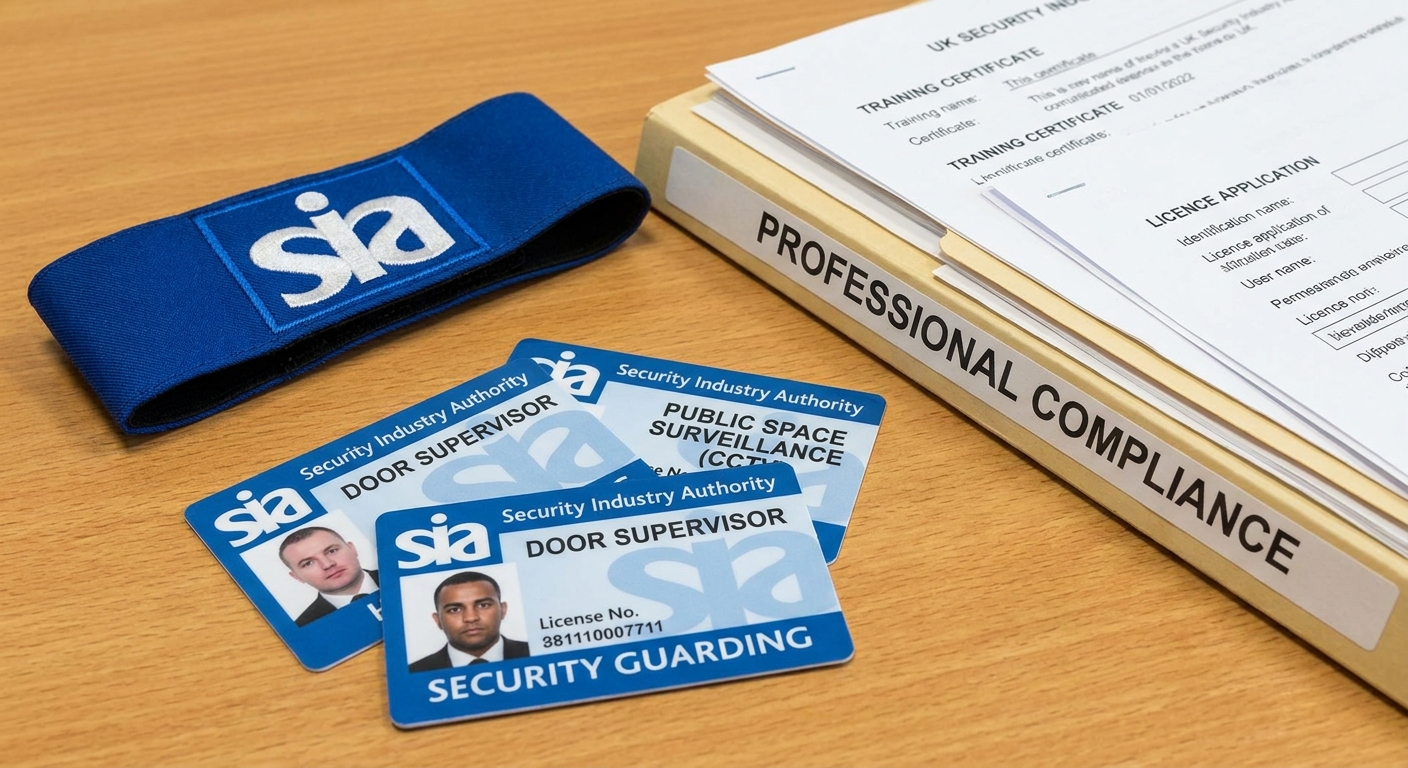
SIA licensing compliance for security tenders UK 2026
Pricing Security Tenders: Getting It Right
Pricing security tenders is genuinely difficult, and the sector has a long history of companies winning on unsustainable rates only to cut corners, lose officers, and ultimately fail the contract. Evaluators are increasingly aware of this and actively scrutinise pricing for sustainability.
The all-in hourly rate must cover: basic pay (at minimum Real Living Wage — £12.60 from April 2025 for all workers, or London Living Wage £13.85 in London), holiday pay (12.07% uplift), employer's National Insurance, pension auto-enrolment contributions, SIA licence costs (amortised over the licence period), uniform and PPE, management overhead, and an appropriate margin.A typical viable all-in rate for manned guarding in provincial England in 2026 sits between £19.50 and £22.50 per officer hour. London rates are typically £22 to £26. Evaluation panels will red-flag any bid where the all-in rate appears too low to sustain compliant, adequately paid employment. Some buyers now ask bidders to break down their pricing to demonstrate sustainability — be prepared for this.
Operational cost drivers unique to security that bidders frequently underestimate include: Relief cover costs — you need trained, licensed relief officers available to cover sickness, holidays, and unexpected absences. Under-resourcing relief creates pressure to deploy unlicensed or undertrained officers when regular staff are unavailable. Supervision costs — public sector buyers want visible, responsive supervision. Factor in on-site supervisors, area manager time, and account management overhead as a genuine cost, not an aspiration. Technology platform costs — if you've committed to officer monitoring apps, body-worn cameras, or digital reporting platforms in your quality response, those have real unit costs that must be in your price. Mobilisation costs — TUPE transfers involve HR and legal costs. New site setups involve uniform, access control setup, training, and induction costs. These are legitimate mobilisation costs that should be reflected in your pricing model, particularly for year one.TUPE: The Bid Differentiator Most Security Companies Get Wrong
TUPE (Transfer of Undertakings, Protection of Employment Regulations 2006) applies to most security contract retenders. When a new contractor takes over a security contract, employees employed on that contract by the outgoing contractor transfer to the incoming contractor on their existing terms and conditions.
In practice, TUPE is one of the most complex and risk-laden aspects of winning security contracts. Evaluators know this and use TUPE questions to separate sophisticated, experienced bidders from those who treat it as a bureaucratic formality.
What a strong TUPE response covers: Pre-award due diligence — how you'll request the Schedule of Employee Information (SOEI) from the incumbent, what your HR team will do with that information, and how you'll model the TUPE liability into your pricing. Note that you typically receive SOEI data only after award, but your response should demonstrate a clear process for rapid assessment once received. Employee communication — a credible timeline and method for communicating with transferring staff before the contract starts. Employees have the right to information and consultation. A response that describes a clear, humane communication plan — including individual meetings where appropriate, written FAQs, and a named HR contact — scores well. Integration and retention — evaluators know that high turnover in the first six months of a new contract creates operational risk. Describe your onboarding process, how you'll integrate transferred staff into your company culture, what support is available for staff who are anxious about the change, and your track record on TUPE retention from previous contracts. ETO dismissals — the only lawful grounds for dismissing TUPE-protected employees are Economic, Technical, or Organisational (ETO) reasons. Your response should confirm that you do not plan to make TUPE-related dismissals (unless there is a genuine ETO reason), and that any changes to terms and conditions will be agreed through proper consultation.Social Value: Where Security Companies Can Genuinely Differentiate
Social value is no longer a checkbox exercise. Under PPN 06/20, public sector buyers must evaluate social value as a meaningful percentage of the quality score — typically 10–20% — using specific, measurable commitments rather than generic statements.

Security services social value workforce development
Security companies are exceptionally well-placed to make strong, credible social value commitments. The sector naturally employs large numbers of people from groups that public sector social value frameworks want to support:
Veterans and service leavers — security is one of the primary civilian sectors for military leavers. A specific commitment to recruiting a named percentage of veterans, engaging with MOD's Career Transition Partnership, and adapting induction for those with military backgrounds is highly valued in central government bids. Ex-offenders and rehabilitation — many social housing and probation service security contracts explicitly value experience employing people with criminal records. Partnering with organisations like Nacro or the St Giles Trust, and describing a clear DBS-proportionate hiring policy, demonstrates genuine commitment. Mental health support — the security sector has historically poor mental health outcomes, with high rates of stress, isolation (particularly for lone workers), and sleep disorders from shift work. A bid that includes specific mental health commitments — trained Mental Health First Aiders at supervisory level, an Employee Assistance Programme, a shift working wellbeing protocol — addresses a genuine need and scores well. Real Living Wage — committing to pay the Real Living Wage (or London Living Wage) to all staff, and ideally seeking accreditation from the Living Wage Foundation, is now a powerful differentiator. Evaluators recognise that Living Wage accreditation requires genuine compliance, not just a commitment statement. Local employment — for local authority and housing association contracts, a commitment to recruit a specific percentage of officers from within the local area, partner with local employment programmes, and work with local colleges for training provision resonates strongly. Apprenticeships — security has a recognised apprenticeship standard at Level 2 (Security Industry Specialist). A commitment to create apprenticeships during the contract period demonstrates long-term workforce investment.The cardinal rule: make every social value commitment measurable, time-bound and contractually accountable. Vague commitments to "support local communities" or "value our workforce" contribute nothing to your score.
Technology and Innovation in Security Tenders
Technology capability has become a genuine differentiator in security procurement. Buyers who once accepted a night-watch operative with a torch and a logbook now expect integrated digital reporting, real-time officer tracking, and data-driven performance monitoring.
Officer monitoring and scheduling platforms — tools like TrackTik, Guardhouse, and i-Patrol allow clients to see in real-time whether officers are on post, completing patrols on schedule, and responding to incidents within target times. Describing these platforms in your bid, and committing to provide client-visible dashboards, materially differentiates your response. Body-worn cameras are now expected on most high-risk or public-facing security contracts. Your bid should address not just the camera hardware but the data governance framework: how footage is stored, who can access it, how long it's retained, and how it's used in incident investigations. GDPR compliance in your BWC policy is a compliance requirement, not an afterthought. Lone worker protection — for mobile patrol officers, retail security staff, and any officer working alone, Lone Worker protection devices (apps or dedicated devices with automatic check-in, man-down alerts, and two-way communication) are increasingly specified. Describe your platform and the escalation process when an alert is triggered. Visitor management and access control integration — many security contracts involve managing visitor access and integrating with the client's existing access control infrastructure. Describing your capability to work with common systems (Lenel, Honeywell, CCURE, Gallagher) and your approach to integrating or improving client access control demonstrates operational sophistication. AI-enabled CCTV analytics — computer vision tools that detect tailgating, abandoned objects, unusual loitering, or perimeter breaches are moving from speculative to operational. If your CCTV monitoring capability includes analytics-enabled monitoring, describe it. Buyers are increasingly receptive to these solutions, particularly where officer headcount reduction is a budget driver.Common Mistakes That Lose Security Tenders
After reviewing hundreds of security services bids, certain patterns emerge in losing submissions.
Generic method statements that could have been written for any contract, by any security company, in any sector. Evaluators score method statements against a marking guide that rewards specificity. A method statement that describes your generic guarding procedures without referencing the client's specific site, risks, or requirements will score in the bottom quartile. Underpriced bids that create suspicion rather than competitive advantage. Evaluation panels now routinely red-flag bids where the all-in rate appears incompatible with legal employment obligations. A bid that wins on price but is clearly undeliverable at that price doesn't just fail the contract — it damages your reputation and may attract scrutiny from HMRC and GLAA (Gangmasters and Labour Abuse Authority). Weak TUPE responses that treat the transfer as a formality. "We will comply with all TUPE obligations" scores zero. Evaluators want to see that you've thought through the actual transfer process, the employee communication, the HR due diligence, and the mobilisation risk. Thin social value commitments that repeat aspirational language from your company website without any measurable specificity. "We are committed to equality and diversity and will support local communities" is the social value equivalent of not answering the question. Ignoring the word limit — either significantly under-writing (implying you don't have enough to say) or over-writing (implying you haven't edited, and potentially obscuring your strongest points). Word limits exist for a reason. Respect them. Compliance documents that don't match the question — attaching a generic quality policy when asked to describe how you'll manage quality on this specific contract, or providing a company ISO certificate when asked for an implementation plan.How AI-Powered Bid Writing Transforms Security Tender Success
Security companies face a structural challenge with bid writing: the operational teams who know the delivery detail are busy running contracts, while the small teams who manage bids often lack the sector depth to write compelling, site-specific method statements.
AI-powered bid writing platforms like mytender.io are changing this equation. By training on your company's existing proposals, method statements, case studies, and policies, the platform can generate first-draft quality responses that combine your company's specific operational detail with the evaluation framework the buyer has specified.

AI-powered bid writing for security services tenders
mytender.io's proprietary Bid Intelligence Engine has helped security companies improve their win rates by an average of 32% within the first twelve months of adoption. The platform works with your existing content — your method statements, case studies, policies and past bids — to generate first-draft responses that your team can personalise and strengthen.
Key Accreditations for Security Tenders
Beyond ACS and SIA licensing, a number of accreditations materially improve your competitive position in security tenders.
ISO 9001 (Quality Management) is expected by most central government and NHS buyers. It demonstrates that your management systems are externally audited and continuously improved. Many regional and local authority contracts don't mandate it, but holding it removes a common evaluation uncertainty. ISO 45001 (Occupational Health and Safety) is increasingly specified for contracts involving physical risk — event security, transport security, and any role with significant physical intervention requirements. ISO 14001 (Environmental Management) is primarily relevant for larger operations with vehicle fleets (mobile patrol) or significant energy consumption (control rooms). Increasingly asked for by NHS and central government buyers as part of their sustainability requirements. Cyber Essentials Plus is mandatory for central government contracts involving any digital infrastructure. The baseline Cyber Essentials is not sufficient for most government work. The assessment covers your network boundaries, user access controls, device patching, and malware protection. Living Wage Foundation accreditation — formally certifying your commitment to pay the Real Living Wage to all directly employed and contracted staff. This carries significant credibility over a commitment statement alone, because buyers know it involves annual auditing. CHAS, Altius, or SafeContractor — health and safety accreditations frequently required by facilities management buyers and property companies that bundle security within FM contracts. BSIA (British Security Industry Association) membership — while not a formal evaluation criterion, membership of the BSIA signals engagement with industry standards, access to guidance materials, and peer benchmarking that sophisticated buyers value.Framework Agreements: Your Route to Repeat Public Sector Work
Framework agreements are multi-supplier vehicles that allow public sector buyers to call off contracts with reduced procurement friction. Getting onto relevant frameworks should be a strategic priority for any security company serious about public sector growth.
Crown Commercial Service RM6174 (Security Services) is the primary central government security framework, covering manned guarding, CCTV, access control, and integrated security solutions. Getting onto RM6174 opens opportunities across hundreds of government bodies. The next refresh cycle is worth tracking carefully — CCS usually announces OJEU prior information notices 12–18 months before the framework re-procurement. NHS Supply Chain frameworks — the NHS Shared Business Services security framework and NHS Supply Chain's facilities management arrangements both include security lots. NHS trusts that use these frameworks can run mini-competitions between appointed suppliers, reducing the procurement burden for both buyer and supplier. Regional consortia — ESPO (Eastern Shires Purchasing Organisation), YPO (Yorkshire Purchasing Organisation), and NEPO (North East Procurement Organisation) all operate security frameworks covering local authorities and public bodies in their regions. These frameworks typically retender every four years and offer call-off opportunities for individual sites and multi-site contracts. London Tenders Portal — TfL and the London boroughs collectively use the London Tenders Portal. Security frameworks operated through this portal cover Transport for London, the GLA, and participating London boroughs.Getting onto a framework requires meeting the compliance and quality threshold set in the framework competition — typically a lighter version of individual contract bid requirements. Once appointed, the commercial relationship is essentially established: mini-competitions focus on service specifics and price within the agreed framework parameters.
Preparing to Bid: A Security Company Readiness Checklist
Before submitting your first major public sector security tender, work through this readiness checklist:
Compliance fundamentals:- ACS accreditation achieved and current
- ISO 9001 in place (for central government and NHS targets)
- Cyber Essentials Plus in place (for any contract with digital infrastructure access)
- Insurance levels at minimum £10m EL and £10m PL (check ITT — many require £20m)
- Financial accounts showing sufficient turnover relative to target contract values
- Modern Slavery Statement published and current
- GDPR and Data Protection policy updated for 2024 regulations
- Licence management system tracking all officer licences with 90-day renewal alerts
- Officer monitoring platform in place (TrackTik, Guardhouse, or equivalent)
- Body-worn camera policy and GDPR-compliant footage management
- Lone worker protection system for mobile and solo officers
- Standard Operating Procedure library that can be customised for specific contracts
- Case study library covering at least three to five comparable contracts with quantified outcomes
- Named mobilisation references from satisfied clients
- TUPE track record documented with retention rates from previous transfers
- Social value data: workforce statistics, community programmes, Living Wage status
- Past bid library organised for AI platform training
- Designated bid manager or access to professional bid writing support
- SME (Subject Matter Expert) access — operations director, HR lead, finance — for bid production
- Review process with minimum two pairs of eyes on every submission
Winning Your First Major Security Contract: A Realistic Timeline
Security companies unfamiliar with competitive public sector procurement often underestimate both the lead time and the sustained effort required to win a first significant contract. Here is a realistic planning timeline.
Months 1–6: Foundation building. Achieve ACS accreditation if not already held. Obtain ISO 9001. Build your compliance document library. Identify target framework recompetitions and individual contract opportunities. Subscribe to Find a Tender Service and Contracts Finder alerts. Months 3–9: Framework applications. Once accreditations are in place, apply to relevant CCS and regional consortium frameworks during open windows. These applications are significant but less pressured than full contract bids — good practice for the process. Months 6–18: First competitive bids. Target contracts at the lower end of your financial capacity threshold — where you clearly meet the turnover requirement with headroom. Focus on sectors where you have existing operational experience and documented track record. Invest in bid writing support if internal capability is limited. Ongoing: Debrief and improve. Under the Procurement Act 2023, contracting authorities have stronger obligations to provide meaningful feedback to unsuccessful bidders. Request debriefs on every bid, regardless of outcome. Use that feedback to systematically improve your response quality over successive submissions.Most security companies with the right compliance foundation can expect to win their first significant public sector contract within 18–24 months of serious effort. The companies that accelerate this timeline are those that invest in bid writing quality — either through specialist in-house resource or AI-powered platforms that multiply the effectiveness of small bid teams.
The mytender.io Advantage for Security Companies
mytender.io is built specifically for companies that want to win more public sector contracts without scaling a large internal bid team. For security companies, the platform addresses the specific challenges that cost security bids points.
The platform's knowledge base learns from your existing bid content — your method statements, policies, case studies, and past winning responses — and generates first-draft quality text that your team can refine and personalise. It understands procurement frameworks, social value models, and evaluation criteria, generating responses that address what evaluators are actually looking for.
Security-specific capabilities include:
- Method statement generation tailored to specific security disciplines (manned guarding, CCTV monitoring, mobile patrol, event security)
- Social value frameworks aligned to PPN 06/20 and the four Social Value Model themes
- TUPE response templates that capture the required depth of process and empathy
- Compliance document library management so your ACS certificate, ISO certificates, and insurance schedules are always accessible and correctly formatted
- Concurrent bid management across multiple active opportunities without sacrificing quality
Companies using mytender.io in the security sector have seen average win rate improvements of 28–35% within the first year, with the most significant gains in quality score improvement on method statements and social value questions.
Start your free trial at mytender.io and see how many hours your bid team could reclaim while producing better-scoring responses.Conclusion: Winning Security Tenders Takes More Than Good Officers
The security companies that consistently win public sector contracts share a common characteristic: they invest as seriously in their bid process as they invest in their operational delivery. SIA licensing, ACS accreditation, and good officers on the ground are the entry ticket. Winning the evaluation requires specific, evidence-backed responses to every question, a sustainable and credible price, a compelling social value offer, and the discipline to customise every bid for the client's specific environment and evaluation framework.
In 2026, the competitive landscape is intensifying. Procurement Act 2023 reforms have made public sector contracting more transparent and more accessible to challenger companies. More security businesses are investing in bid quality. The standard that earned a win three years ago now earns a shortlist position.
The companies pulling ahead are those combining operational excellence with bid writing sophistication — and increasingly, with AI platforms that make high-quality, high-volume tendering achievable for companies of any size.
The work is real. The market is large. The opportunity is there for security companies prepared to pursue it systematically.
---
mytender.io is the UK's leading AI-powered bid writing platform, helping security companies, facilities management providers, and professional services firms win more public sector contracts. Book a free demonstration at mytender.io.Tags
Ready to Transform Your Tender Writing?
See how MyTender's AI can help you write winning tenders in a fraction of the time.