

When You're a Sales Director Who Also Has to Write Bids: A Practical Survival Guide
You're meant to be closing deals and managing a pipeline. Instead, you're up at 11pm trying to answer a 3,000-word question about your mobilisation approach. Here's how to get through it.
mytender.io Research Team
Bid Writing & Sales Enablement Specialists
When You're a Sales Director Who Also Has to Write Bids: A Practical Survival Guide
It's a Tuesday. You're three weeks out from end of quarter, the pipeline is a bit thin, and a 45-page tender document has just landed in your inbox with a 14-day return window.
You're the Sales Director. You don't write bids. Except today, you do. Because there isn't anyone else.
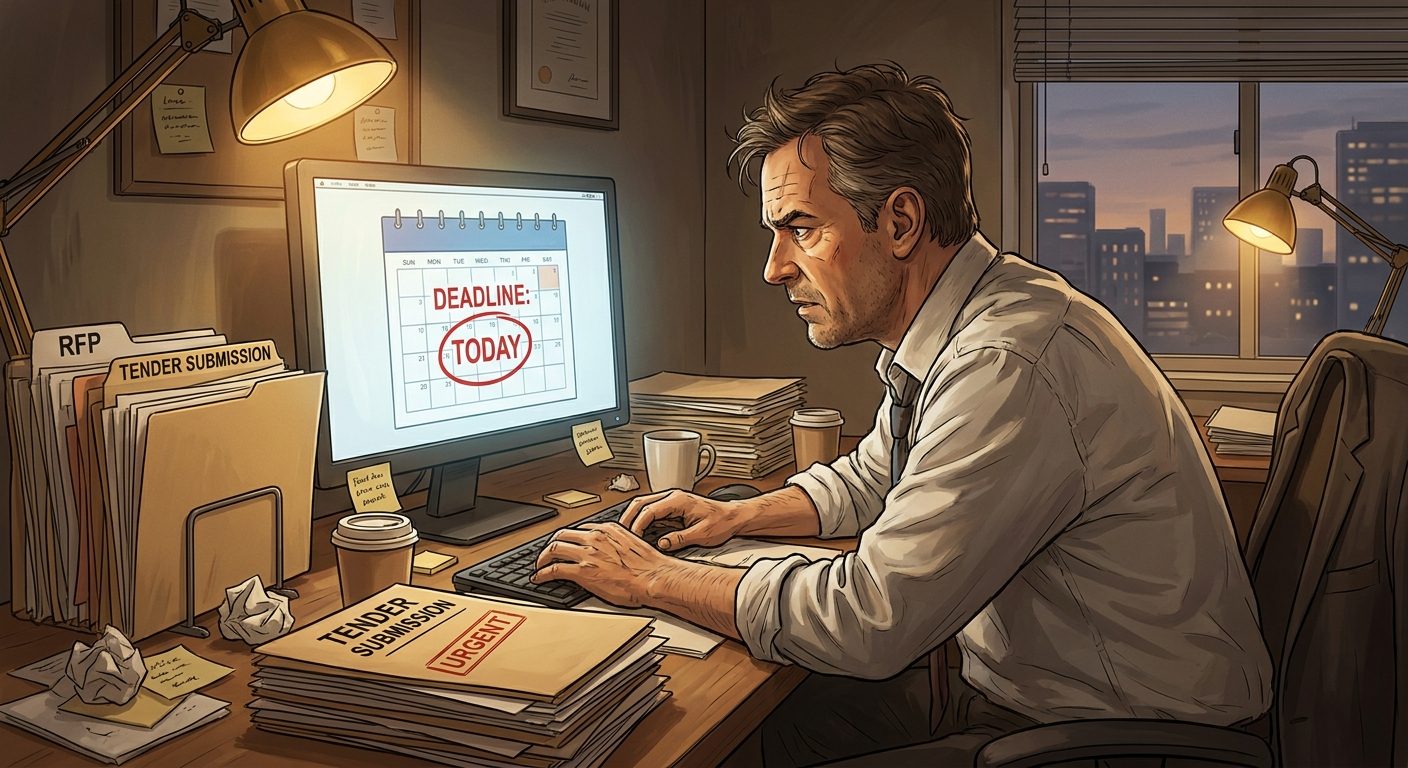
Stressed sales director surrounded by tender documents at a desk
This guide is for you. The accidental bid writer. The Head of Marketing who's been "voluntold" to lead the response. The SHEQ Manager who knows the operations side but has never written a 2,500-word method statement under pressure.
You're not a bid writer. That's fine. You're going to write a bid anyway. Here's how to do it without losing your weekend, your win rate, or your mind.
Why This Keeps Happening to You
If you're reading this, your company probably falls into one of these buckets:
- No dedicated bid function, so it falls to whoever has the most context.
- A small bid team that's already maxed out on three other live submissions.
- A new opportunity from a relationship you built, so leadership says "you know the client best, you lead it."
- A growing company where bid hires haven't caught up with the volume of work coming through.
None of those are your fault. But they all end the same way: with you, a Word document, and a Friday deadline.
The instinct is to feel like an imposter. You shouldn't. The fact that the bid is on your desk means leadership trusts you to handle it. You just need a system.
The Five Biggest Mistakes Non-Specialists Make
Before the process, the pitfalls. These are the ones evaluators see again and again from people writing bids who aren't bid writers.
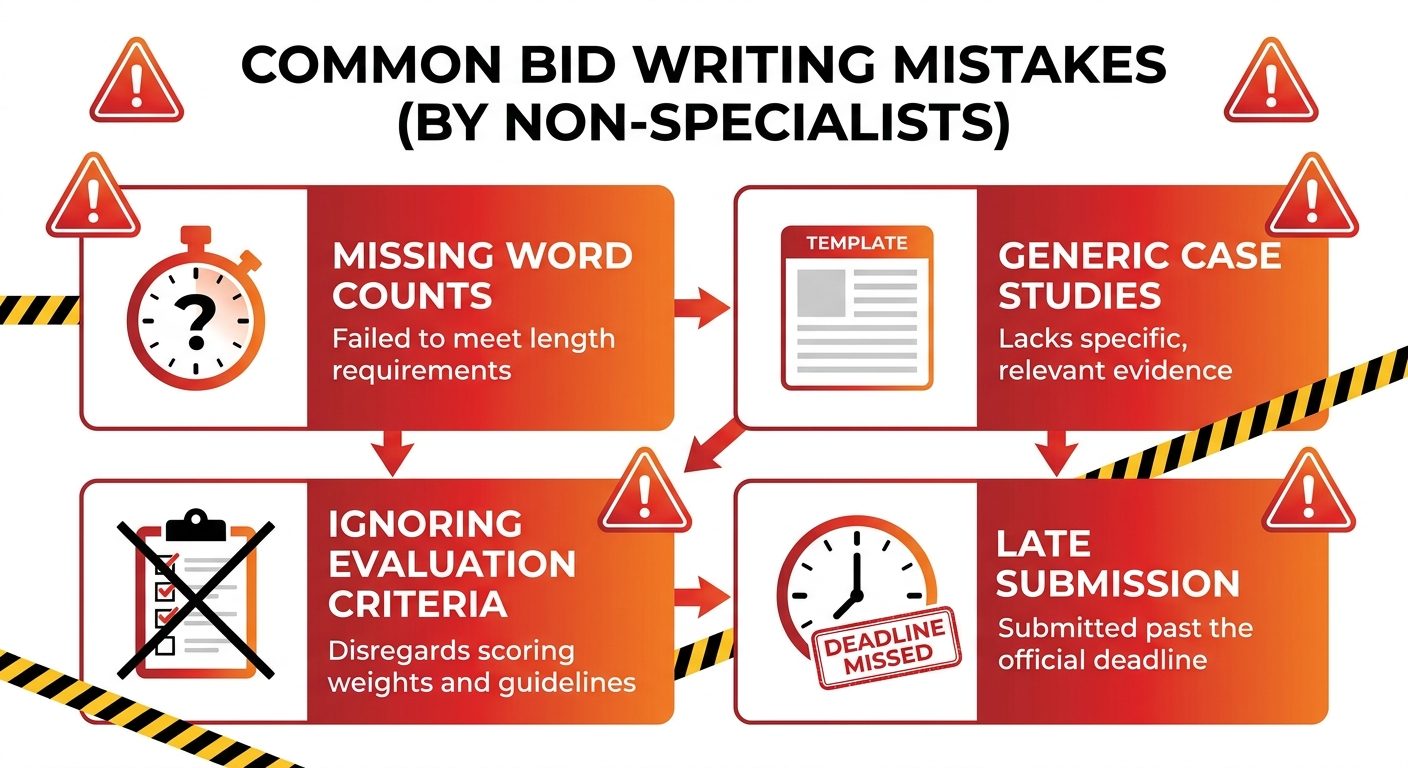
Infographic of common bid writing mistakes including missing word counts, generic case studies, ignoring criteria, and late submission
You skim the question. You spot two familiar keywords. You write 800 words about your favourite topic. The actual question asked something quite different. Evaluators score against the question, not against your enthusiasm.
2. Generic case studies.You drop in the same case study you used last time. Different sector, different contract size, different scope. The evaluator can tell. The case study has to map to their contract, or it scores low.
3. Ignoring the word count.If the question says 500 words, 1,200 words isn't impressive, it's non-compliant. Many evaluators stop reading at the limit. Some truncate automatically. You've just thrown away your strongest points by burying them at the end.
4. No evidence.Sales-trained writing tends towards claims: "best-in-class", "proven track record", "industry leading". Evaluators want numbers, dates, contract names, KPI evidence. If you can't back a claim with a fact, cut the claim.
5. Leaving it too late.You've got two weeks. You start on day 10. The "final review" turns into "first draft submitted in panic". This is the single biggest predictor of a bad score, and it's entirely within your control.
A Simple Five-Step Bid Process You Can Actually Follow
Forget what the bid consultants charge five grand to teach. Here's the version that fits on a single page.
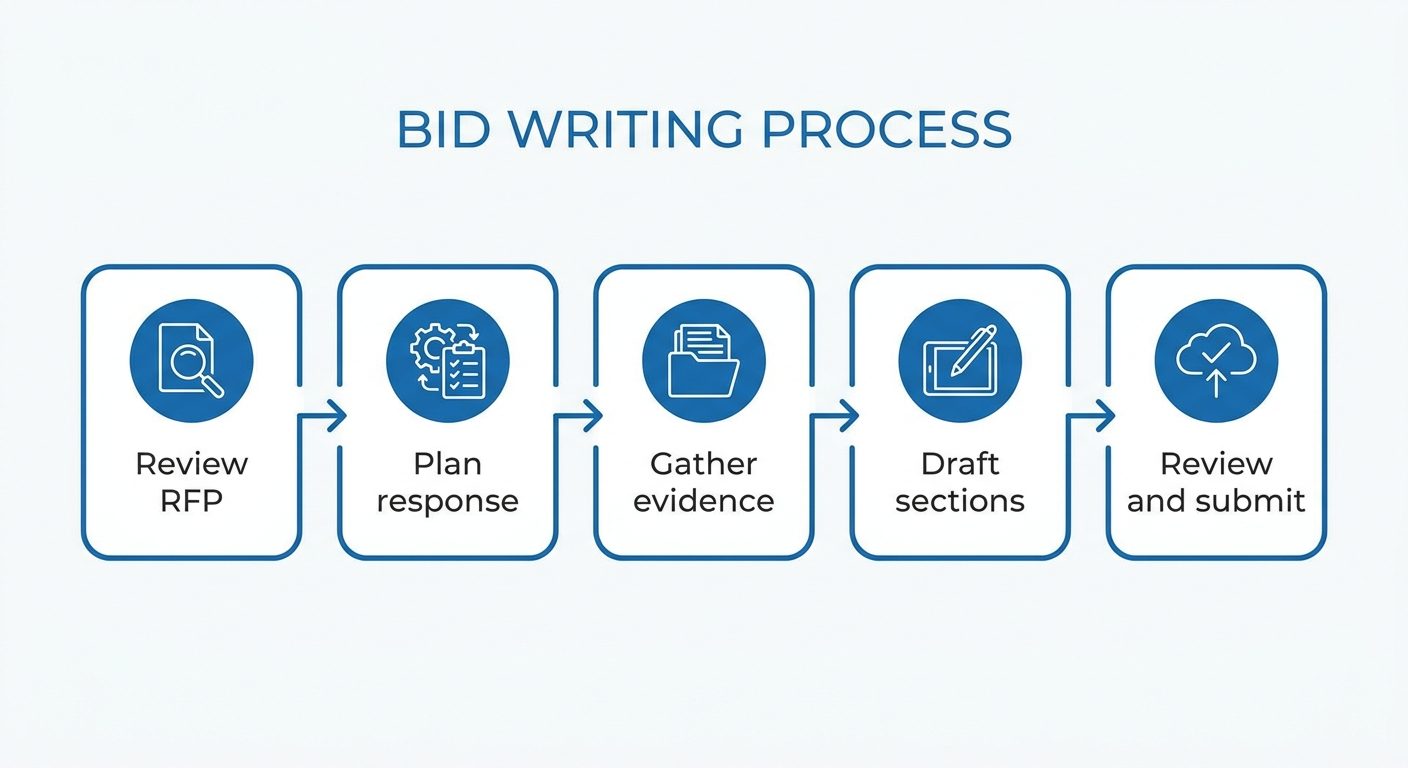
Five-stage bid writing process flowchart showing review, plan, gather, draft, and final review
Day one. Read the whole tender. Not just the questions. The instructions to bidders, the scoring methodology, the pass/fail criteria, the contract terms. Most accidental bid writers skip this and miss something disqualifying.
Step 2: Plan your time.Block calendar time now for drafting, internal reviews, and a buffer for things going sideways. As a rule of thumb: half your available days on first drafts, a quarter on reviews, and a quarter on polish and submission admin. Submission day is for uploading and checking, not writing.
Step 3: Gather your answers.Before you write anything, go and find what you already have. Old bids, case studies, policies, accreditations, CVs, ISO certificates. Get them in one folder. Talk to the operations lead, the SHEQ manager, the finance lead. Get their input early so you're not chasing them at midnight on day 13.
Step 4: Draft section by section.Don't try to write linearly. Write the questions you find easiest first to build momentum. Stick to the word count from the start. Use the buyer's terminology, not yours. If they call it "mobilisation", don't call it "onboarding".
Step 5: Review and submit.Get a second pair of eyes on it. Ideally someone who hasn't been close to the draft. They'll spot the missing acronyms, the unanswered sub-questions, the case study that's slightly off. Submit at least 24 hours before the deadline. Portals crash. Files don't upload. Don't let admin lose you the bid.
How to Manage Your Sales Job at the Same Time
You still have a number to hit. That doesn't pause because a tender landed. So you need to make space.
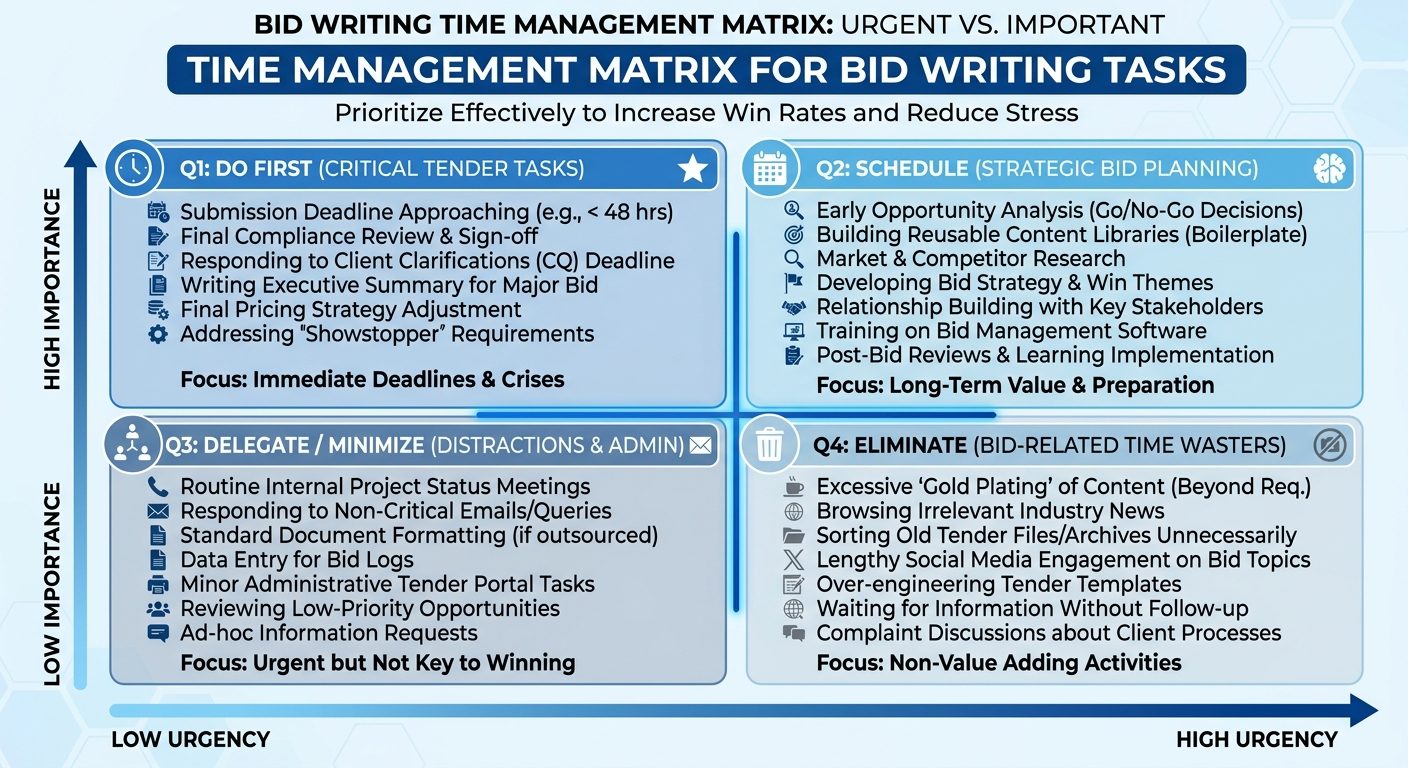
Time management matrix showing urgent and important quadrants applied to bid writing tasks
Things to deprioritise for the bid window:
- Internal meetings that aren't deal-critical.
- Pipeline grooming and CRM hygiene (catch up after submission).
- Net-new prospecting (your existing pipeline matters more than fresh top-of-funnel for two weeks).
- Anything that's "good to have" but won't move a deal this quarter.
Things to protect:
- Active late-stage opportunities (these are your forecast).
- Customer escalations (a churn risk during a bid is a disaster).
- Your one-to-ones with reps who need decisions to keep deals moving.
Communicate clearly. Tell your team you're heads-down on the bid for the next ten working days, and who to escalate to in your place. Tell your VP or CEO what you're deprioritising and why. Nobody likes finding out after the fact that the pipeline slipped because of a tender they didn't know about.
If you're managing a team, get them helping. The BDR can pull case study evidence. The Sales Engineer can write the technical method statement. The Marketing lead can handle formatting and brand compliance. You don't have to do every word yourself.
How to Know You've Outgrown the DIY Approach
The DIY approach works for one bid. Maybe two a year. It does not scale.

Sales director reviewing a winning tender response on a laptop
Signs you've outgrown it:
- You're submitting more than four or five tenders a year and every one means a missed sales week.
- Your win rate on tenders is sitting below 25 per cent.
- You're recycling the same case studies because nobody's updated the bid library in two years.
- Quality is slipping on commercial sales because you keep getting pulled into bids.
- You're saying no to qualified tender opportunities because you don't have capacity.
At that point, it's not a sales problem anymore, it's a capacity problem. The fix is either bringing in dedicated bid support (in-house or freelance), or using software that lets non-specialists produce specialist-grade responses without the time hit.
That's the gap mytender.io was built to close. It gives accidental bid writers the structure, the content library, and the AI drafting support to produce bids that score, without needing a full bid team behind them. And if you want to see what's actually live in the market before you commit to a response, our Tender Finder surfaces UK public sector opportunities filtered to your sector and value band.
The Takeaway
If you've landed on a bid you didn't plan for, you're not alone. Most UK SMEs and mid-market companies run their tender responses exactly like this: someone senior who knows the client, a few late nights, and a lot of caffeine.
You can absolutely win bids this way. People do it every week. But it costs you time, it costs you sales focus, and it caps how many opportunities you can actually pursue.
Get through this one with the five-step process above. Then have an honest conversation about whether the current setup is the right one for the next ten bids, or just the right one for this week.
---
Ready to make the next bid feel less like a survival exercise? Try mytender.io and see how much of the response you can produce in a fraction of the time, without losing quality or your weekend.
Tags
Ready to Transform Your Tender Writing?
See how MyTender's AI can help you write winning tenders in a fraction of the time.