

Recruitment & Staffing Tender Writing Guide 2026: Win More Public Sector Contracts
Master recruitment and staffing tender writing with proven strategies for NHS agency staff, local authority frameworks, and public sector workforce contracts. Expert guidance on AWR compliance, TUPE obligations, IR35, and AI-powered bidding.
mytender.io Research Team
Recruitment & Workforce Specialists
Recruitment & Staffing Tender Writing Guide 2026: Win More Public Sector Contracts
The UK public sector spends over £6.5 billion annually on contingent and temporary workforce services — everything from NHS bank nurses to council social workers, central government contractors to school supply teachers. Staffing and recruitment agencies that can navigate the sector's complex compliance landscape and demonstrate genuine workforce quality are competing for some of the most reliable, long-term revenue streams in UK procurement.
Yet staffing tender win rates sit at roughly 13% on average. The gap between bidding and winning comes down to three persistent problems: underestimating compliance rigour, failing to differentiate on quality beyond price, and writing generic bids that could apply to any agency. Buyers in this sector have seen every stock phrase. They want evidence, specifics, and proof that you understand their workforce challenges.
This guide covers everything you need to win recruitment and staffing contracts in 2026 — from understanding the major framework vehicles to TUPE obligations, IR35, AWR compliance, social value requirements, and the growing role of AI in bid preparation.

Recruitment & Staffing Tender Writing Guide 2026
The UK Public Sector Staffing Market in 2026
Public sector workforce procurement is large, diverse, and growing. The NHS remains the dominant buyer — NHS England alone spends over £3.2 billion on agency and bank staff annually, making it one of the largest single purchasers of temporary labour anywhere in Europe. Local authorities collectively spend another £1.8 billion on contingent workers, primarily in social care, education, and environmental services. Central government departments account for approximately £1.1 billion, concentrated in IT, project management, and policy contracting roles.
What's changed in 2026 is the concentration of that spend through managed frameworks. Individual spot-purchasing outside frameworks has become the exception rather than the rule, driven by Cabinet Office pressure to reduce agency spend wastage and improve visibility of contingent workforce costs. This consolidation creates a critical dynamic for agencies: getting onto the right frameworks is the gatekeeping challenge, not day-to-day sales.
The major framework vehicles you need to know: NHS Workforce Alliance and NHS Shared Business Services (NHS SBS) operate the dominant healthcare staffing frameworks. HealthTrust Europe (HTE) runs parallel frameworks for acute and community healthcare. These frameworks tier suppliers by specialism and geography, with Lot structures covering medical and dental, nursing and allied health professionals, non-clinical, and executive interim. NHS frameworks typically run for 4 years with optional extensions. Appointment to a framework does not guarantee work — it qualifies you to receive call-offs and mini-competitions. Crown Commercial Service (CCS) Workforce Staffing frameworks cover central government, including Management Consultancy, Contingent Labour ONE (CL1), and specialist technology staffing vehicles. CCS frameworks are often highly prescriptive on pricing models, IR35 determinations, and off-payroll working compliance. The off-payroll rules have created significant complexity for agencies bidding these frameworks — buyers expect robust IR35 assessment processes, not just contractual pass-through clauses. Local government frameworks operate through regional purchasing organisations: ESPO, YPO, NEPO, LASER, and Eastern Shires Purchasing Organisation are the main players. Social care staffing frameworks are often managed separately from generic temporary staffing, reflecting the specialism and safeguarding requirements involved. Scottish and Welsh government operate their own framework structures through Scotland Excel and the Welsh NHS Shared Services Partnership respectively. If you operate nationally, getting onto these vehicles matters — but the compliance and evidence requirements differ from England.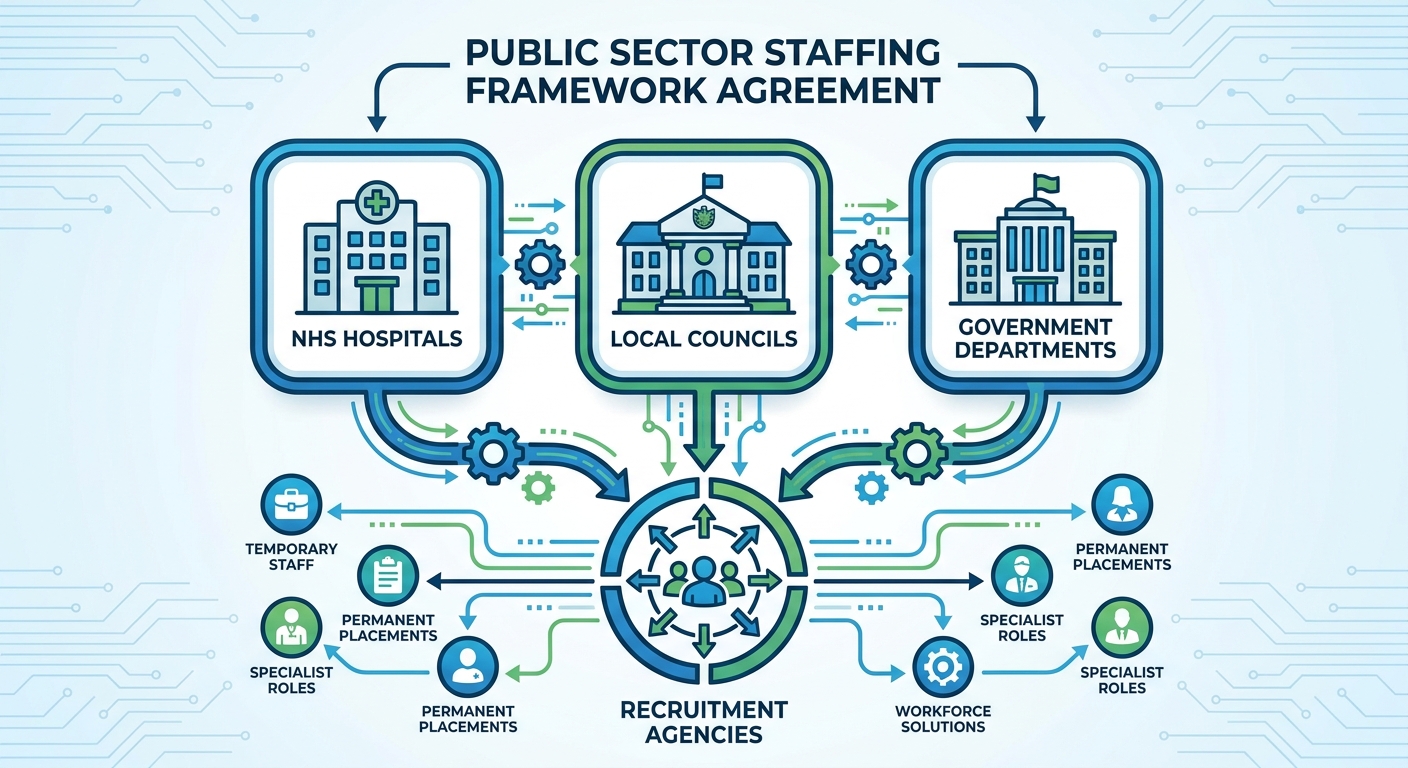
Public Sector Staffing Frameworks 2026
The Core Compliance Challenge: What Buyers Really Scrutinise
Staffing sector compliance is unusually complex because you're dealing with three-way relationships: the agency, the client organisation, and the worker. Getting any leg of that triangle wrong creates legal risk for all parties — and buyers know it. This is why compliance sections in staffing tenders are disproportionately detailed compared to other sectors.
Agency Workers Regulations (AWR) 2010
AWR entitles agency workers to the same basic working conditions as directly employed staff after 12 continuous weeks in the same role with the same hirer. The key word is basic — it covers pay, working hours, rest breaks, annual leave, and access to shared facilities. It does not cover occupational sick pay, redundancy, or pension benefits unless contractually agreed.
What buyers look for: A documented AWR tracking system — not a spreadsheet, a genuine process. Who monitors worker placements against the 12-week threshold? Who is notified when a worker approaches or passes that threshold? How do you communicate the worker's qualifying rights to the client organisation? What training do your consultants receive on AWR obligations? Common failures: Generic statements that "we comply with AWR" without explaining how. Lack of clarity on the Swedish derogation route — many agencies still reference this, but the loophole was closed in April 2020 and buyers now treat it as a red flag if mentioned as current practice. Inadequate tracking for workers placed with multiple clients across rolling assignments. Winning approach: Describe your AWR management system by name if you use specialist software (Tempest, Bond Adapt, Bullhorn with AWR modules). Provide the process flowchart — how information flows from consultant to compliance team to client. Include a worked example: "When a worker approaches week 10, our system automatically flags the placement. Our compliance team issues a Day 1 Rights Notification to the client within 24 hours, and the worker receives written confirmation of their qualifying rights." Specificity wins.IR35 and Off-Payroll Working
The 2021 extension of IR35 rules to the private sector (having applied to the public sector since 2017) means all medium and large client organisations are responsible for determining the employment status of contractors. For staffing agencies operating in the contractor and interim market, this fundamentally affects how you price, structure contracts, and manage worker relationships.
What buyers look for in public sector IR35 questions: Your process for receiving and acting on Status Determination Statements (SDS) from clients. How you handle disagreements or appeals by workers. Your payroll infrastructure for inside-IR35 contractors — do you operate PAYE, umbrella company management, or both? How do you ensure umbrella companies in your supply chain are compliant and not enabling non-compliant tax arrangements? The umbrella company minefield: HMRC's 2025 crackdown on non-compliant umbrella companies has made this section of staffing tenders much more demanding. Public sector buyers are now routinely asking agencies to confirm: (a) which umbrella companies they work with; (b) how those companies are vetted; (c) whether they are FCSA accredited or Professional Passport approved; and (d) what happens if a worker complains about umbrella practices. If you can't answer these with specifics, you'll lose marks. Winning approach: Name your compliance framework. Reference your FCSA membership or Professional Passport accreditation if you have it. List the umbrella companies on your approved panel. Describe your due diligence process — not just "we vet all umbrellas" but how often, against what criteria, and with what documentation. Include your escalation process for non-compliance.TUPE: The Transfer Challenge
Transfer of Undertakings (Protection of Employment) regulations apply when a staffing contract transfers from one agency to another, and incumbent workers transfer with it. For staffing agencies, TUPE is operationally complex because workers may be placed across dozens of sites and client organisations.
What buyers look for: Evidence that you understand your TUPE obligations as both an incoming and outgoing contractor. Can you demonstrate experience managing complex TUPE transfers? What is your process for providing employee liability information to a successful incoming tenderer? How do you communicate with workers during a transition period? Common failures: Treating TUPE as a legal boilerplate issue rather than an operational one. Failing to acknowledge that staffing TUPE situations can be contested — workers' employment status (employee vs worker) affects whether TUPE applies at all. No evidence of having successfully managed a previous framework transfer. Winning approach: If you've managed a major TUPE transfer previously, describe it specifically (volume of workers, complexity, timescale, outcome). Provide your TUPE transfer checklist. Show you understand the consultation obligations. If you're an SME without a large TUPE track record, demonstrate that you have specialist employment law support available — name the firm and describe the relationship.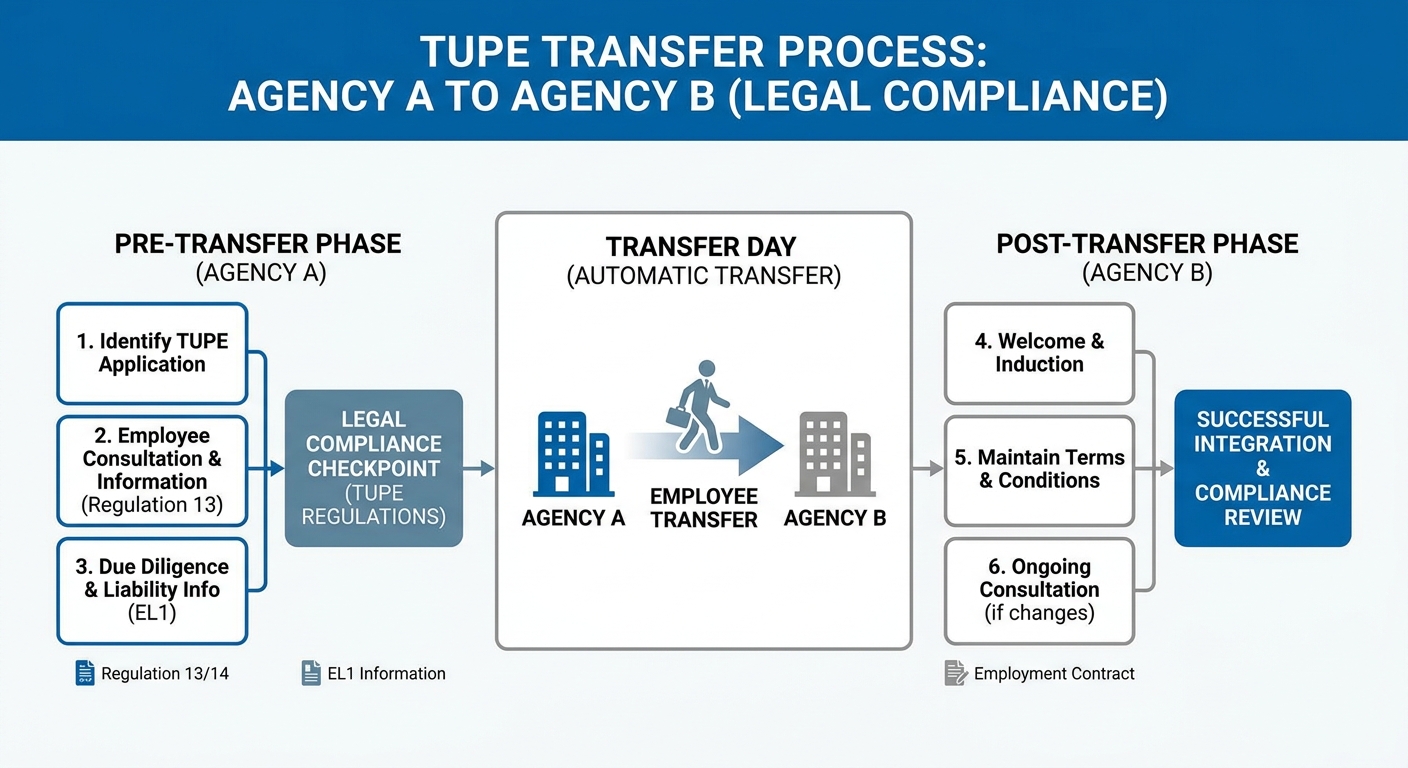
TUPE Staffing Compliance Guide
Quality and Candidate Compliance Frameworks
Beyond agency compliance, buyers want evidence that the workers you supply meet their quality requirements. This section separates professional agencies from box-checkers.
Safer Recruitment and DBS
Any staffing agency supplying workers to roles involving children or vulnerable adults must demonstrate rigorous safer recruitment practices. This is non-negotiable — failures here result in automatic disqualification. Buyers aren't just checking that you conduct DBS checks; they're evaluating the robustness of your vetting process across your entire candidate pool.
The questions buyers ask: What level of DBS check do you conduct for different role types? How do you manage workers with disclosed convictions? Who makes risk assessment decisions, and what training have they received? How do you handle a worker whose DBS comes back with new information mid-placement? What is your process when a client reports a safeguarding concern about a placed worker? Winning approach: Map your DBS process to the role types in the tender specification. Show you understand the difference between enhanced DBS with barred list check and enhanced without — and which roles require which. If you use an umbrella body for DBS processing (Disclosure and Barring Service registered umbrella body), name them and explain the process. Provide your barred list check policy. Show your safeguarding referral procedure.Occupational Health and Right to Work
Right to Work verification has become significantly more rigorous following immigration enforcement actions in the sector. The introduction of Identity Document Validation Technology (IDVT) for British and Irish citizens, and the digital visa status checking service for non-UK citizens, has changed what "best practice" looks like in 2026.
What buyers look for: Your Right to Work checking methodology — manual, IDVT, or a combination. How you handle complex cases (time-limited visas, biometric residence permits due for renewal). How you record and audit Right to Work checks. What happens when a worker's leave expires mid-placement. NHS-specific requirements: Healthcare staffing tenders have additional occupational health requirements beyond the standard. DBS is the minimum — most NHS frameworks also require: immunisation and vaccination status verification (relevant for clinical roles), evidence of professional registration with NMC, GMC, HCPC or other relevant bodies, and reference checking to standards that exceed the general employment market. Winning approach: For healthcare tenders, map your compliance checks against the NHS Employment Check Standards. These are published by NHS England and represent the definitive standard buyers use. Showing you know these standards exist — and that your process maps to them — signals expertise.Professional Registration Management
For healthcare, social work, legal, and other regulated professions, continuous monitoring of professional registration is a buyer expectation, not just a nice-to-have. The risk scenario is clear: a nurse whose NMC registration lapses mid-placement creates patient safety risk and regulatory liability for the NHS trust.
What buyers want: A live monitoring system, not annual checks. NHSBS Workforce Check Solution, Experian's ReadyID, or similar systems that provide automated alerts when a worker's registration status changes. Evidence that your system covers all relevant regulatory bodies.Pricing Strategy: The Agency Margin Minefield
Staffing tender pricing is unlike most other sectors. The core output isn't goods or a fixed-scope service — it's the cost of a worker plus your agency margin. Buyers have become highly sophisticated in scrutinising both components.
Understanding Pay/Charge Rate Structures
Most public sector staffing frameworks use some form of pay/charge rate model: the buyer sees the worker's pay rate and the agency's margin as separate line items, rather than an opaque total charge rate. This structure has increased transparency but also created new ways for bids to go wrong.
Common pricing pitfalls:Underpricing to win, then failing to recruit at those rates. This is the sector's most common failure mode. A 2025 NHS England audit found that 34% of framework suppliers regularly failed to fill requisitions at quoted rates, citing inability to recruit at the agreed pay rates. Buyers have become sophisticated at identifying bids where the pay rate assumptions are unrealistic for the market.
Margin dumping on NHS frameworks. NHS frameworks cap agency margins for most staff categories — the rates are published and buyers know what to expect. Bidding below-floor margins to win a framework position, then refusing to fill low-margin requisitions, is a known tactic that is now actively monitored.
Ignoring on-cost complexity. Holiday pay, employer NI, and pension contributions (auto-enrolment) all sit on top of the base pay rate. Agency workers' holiday pay accrual can be processed as rolled-up pay (where legal) or accrued and paid on termination — buyers increasingly prefer the latter for transparency. Make sure your pricing model reflects the actual cost structure.
Winning pricing approach: Show your workings. Provide a rate card that breaks down base pay, holiday pay calculation methodology, employer NI, pension contributions, and agency margin. Demonstrate that your pay rate assumptions are grounded in actual market data — reference salary surveys, benchmarking data, or your own placement history in the relevant geography and role type.Social Value in Staffing Pricing
The Social Value Act 2012, as strengthened by the Public Services (Social Value) Act, requires public sector buyers to consider social value in all major procurement decisions. For staffing agencies, social value typically means employment outcomes for disadvantaged groups, skills development programmes, and local economic impact.
The weighting of social value has increased substantially. Many NHS and local authority staffing frameworks now weight social value at 10-15% of total evaluation score. Agencies that treat this as box-ticking — "we support our local community" with no specifics — consistently underperform against agencies that have a genuine social value programme.
High-scoring social value commitments for staffing:Employment pathways for under-represented groups. Partnering with Jobcentre Plus, rehabilitation programmes (ex-offenders), care leavers, or long-term unemployed. Quantify: how many placements did you make through these pathways last year? What are your targets for this contract?
Training and upskilling. Do you fund or co-fund worker training? Many staffing agencies in social care fund care certificate completions or NVQ programmes for workers who came through them. This creates retention and quality benefits — but also genuine social value.
Living Wage commitment. Accreditation as a Living Wage employer, and commitment to paying at least the Living Wage Foundation's Real Living Wage, scores well with NHS and local authority buyers. The gap between statutory minimum wage and the Real Living Wage is meaningful to buyers who are under political pressure around low-pay workforce practices.
Sector-Specific Modules: NHS vs Local Authority vs Central Government
The three main public sector buyer types evaluate staffing tenders differently. Understanding this is crucial to calibrating your bid.
NHS Staffing Tenders
NHS tenders are the most complex and the most rewarding. The evaluation frameworks are structured, published, and consistent — which means preparation pays off more here than anywhere else.
Quality weighting is high. Most NHS staffing frameworks weight quality at 60-70% versus 30-40% for price. This reflects NHS England's stated objective to reduce over-reliance on agency staff by making it worthwhile for agencies to invest in quality. For agencies, it means a mediocre price with excellent quality evidence outperforms an aggressive price with weak quality. The NHS England 2025 Staffing Standards introduced new requirements for agency suppliers around workforce planning integration. Agencies are now expected to share supply-side data with NHS trust workforce planning teams — not just fill individual requisitions, but provide intelligence on candidate pipelines, supply constraints, and emerging shortages. Bids that demonstrate genuine workforce intelligence capability score better. Patient outcomes language. NHS buyers evaluate staffing bids through a patient safety lens. Write your quality evidence in terms of patient safety outcomes, not just operational metrics. "Our pre-placement competency verification process ensures clinical workers meet the trust's required competency standards before first shift, reducing incidents caused by skills mismatch" performs better than "we conduct thorough candidate checks."Local Authority Staffing Tenders
Local authority staffing procurement is more fragmented and less standardised than NHS procurement. Individual authorities procure directly; regional frameworks aggregate demand. The social care specialism is critical — social worker shortages mean authorities are highly dependent on agency and locum social workers, creating a buyer who is simultaneously frustrated by cost and dependent on supply.
Safeguarding is paramount. Local authorities have had high-profile failures involving agency social workers. Every authority that has experienced a serious case review involving an agency worker has tightened its agency vetting requirements. Demonstrating your understanding of the specific authority's safeguarding framework — their Local Safeguarding Children Board (LSCB) protocols, their Adult Safeguarding procedures — shows homework that most agencies haven't done. Continuity of supply. Local authorities hate temporary worker churn. A social worker placed with a family, then replaced after three months, creates relationship breakdown that the authority has to manage. Any evidence that you can provide continuity — long-term placement rates, worker retention statistics, mechanisms to convert temporary to permanent workers — scores highly. Cost pressure context. Local authorities are under more financial pressure in 2026 than at any point in recent memory. Acknowledging this context in your bid — and showing you understand their budget constraints — demonstrates commercial empathy. Propose flexible models: supplier-neutral managed service structures, shared risk pricing, or fixed-budget solutions for predictable demand categories.Central Government and CCS Frameworks
CCS frameworks for contingent labour are specification-heavy and evaluator-sophisticated. The Evaluation teams for major CCS frameworks include commercial specialists who know exactly what to look for.
IR35 expertise is the differentiator. Central government was the first public sector to implement the IR35 off-payroll rules in 2017, and government buyers have four years more experience managing IR35 complexity than NHS or local authority buyers. They expect agencies to be expert — not just compliant. Questions about IR35 in CCS tenders are often scenario-based: "Describe how you would handle a situation where a worker disputes the Status Determination Statement issued by the client organisation." Generic answers score low. Security clearance management. For Cabinet Office, Home Office, MOD and intelligence community contracts, Baseline Personnel Security Standard (BPSS) and higher clearances are mandatory. Demonstrating a robust clearance pipeline — and understanding the time constraints involved — matters. How do you manage workers awaiting clearance? How do you handle clearance refusals? Pricing sophistication. CCS buyers model agency cost proposals through detailed financial analysis. They compare your assumptions against ONS labour market data, ONS ASHE earnings surveys, and their own internal benchmarks. Bids where pay rate assumptions deviate significantly from market data without explanation are challenged. Show your evidence base.
AI Recruitment Tender Technology 2026
Writing Compelling Staffing Tender Responses
Compliance and pricing are necessary but not sufficient. The quality of your written responses determines how your evidence is received. Evaluators reading thirty staffing bids in sequence become pattern-matching machines — they spot stock phrases, generic claims, and copy-paste answers within seconds.
The Evidence Hierarchy
The most consistently effective structure for staffing tender responses follows an evidence hierarchy:
Claim → Evidence → Outcome. Don't just assert that you have robust compliance processes — show the process, then explain the outcome it delivers. "Our pre-placement right to work verification process uses IDVT technology for British and Irish citizens, verified against our in-house compliance database before the worker's first shift. In 2025, this process identified 14 workers with expired documentation before placement, preventing potential enforcement action for four client organisations." Quantify wherever possible. Win rates, fill rates, retention rates, compliance audit outcomes, time-to-fill metrics, worker satisfaction scores, client satisfaction data — all of these turn qualitative claims into credible evidence. Buyers are deeply sceptical of agencies that can't provide data. If you don't currently track a metric that the tender asks about, invest in tracking it before your next bid. Use client references strategically. Most staffing tenders allow or require client testimonials or case studies. Choose references who can speak specifically to the evaluation criteria, not just general satisfaction. A reference from an NHS Trust Medical Director speaking to clinical workforce quality carries far more weight than a generic "excellent service" quote.Structure and Tone
Staffing tender responses often suffer from an identity crisis: trying to be simultaneously warm and commercial, technical and accessible, confident and humble. The winning tone is matter-of-fact expertise. You know your sector, you know your compliance obligations, you understand the buyer's challenges. Write like a professional talking to a professional, not like a sales document.
Avoid the generic opener. "ABC Recruitment is a leading provider of temporary and permanent staffing solutions with over 20 years of experience..." Evaluators have read this sentence ten thousand times. Start with the client's challenge: "NHS trusts in the South East face persistent nursing vacancy rates of 12-16%, driven by post-Brexit workforce contraction and competing demand from the private sector. Our regional presence across Kent, Sussex and Surrey, with a nurse database of 2,400 active registrants, means we can consistently fill acute medical ward requisitions within 24 hours." Answer the question asked. Many agencies write about what they want to say rather than what was asked. Tender questions are usually precise. If a question asks how you manage workers transitioning from self-employed to PAYE status under IR35, answer that specific question first before expanding. Use the buyer's language. Read the tender specification carefully and adopt its terminology. If the buyer refers to "requisitions" not "orders", use requisitions. If they use the NHS Employment Check Standards framework, reference it explicitly. This shows you've read their documents and understand their world.Leveraging Technology and AI in Staffing Bids
The use of AI in bid writing has moved from novelty to competitive necessity in the staffing sector. Agencies generating more tender responses with the same team, without sacrificing quality, have a structural advantage over agencies treating each bid as a blank page exercise.
Where AI adds most value in staffing bids:Compliance evidence synthesis. Staffing tenders often require the same compliance evidence (GDPR, AWR, DBS processes) to be described across multiple questions in slightly different framings. AI tools can draft these variations rapidly, ensuring consistency while tailoring each answer to the specific question.
Case study and data integration. AI-assisted bid writing platforms like mytender.io store your historical bid content — previous case studies, client testimonials, compliance framework descriptions — and surface the most relevant content for each new tender question. Rather than starting from scratch, your writers are refining and contextualising high-quality baseline content.
Tender analysis and scoring prediction. Advanced platforms analyse tender documentation to identify evaluation criteria weightings, flag compliance requirements, and predict scoring patterns based on buyer organisation type. This helps prioritise effort: if a question is worth 5 marks, don't spend 10 hours on it; if it's worth 25 marks, it deserves proportionate investment.
Gap analysis before submission. AI review tools identify response gaps — questions where claims are made without evidence, where word limits haven't been met, or where the buyer's explicit requirements haven't been addressed. Catching these before submission rather than in debrief feedback transforms bid quality.
The human element remains critical. AI handles volume and consistency well; it doesn't replace the specialist recruiter's knowledge of your candidate pool, your authentic client relationships, or the judgment calls about how to position your agency against competitors. The winning agencies in 2026 are those that have figured out how to combine AI efficiency with human expertise — using technology to raise the floor of bid quality while freeing consultants to invest in the highest-value differentiation.
UK Staffing Procurement Spend 2026
Framework Lots, Bid/No-Bid, and Strategic Prioritisation
Staffing agencies face a specific strategic challenge: the same opportunity (e.g., an NHS temporary staffing framework) may have multiple Lots across different staff categories, geographies, and specialist roles. Bidding for every Lot looks ambitious but often delivers poor results — stretched resources across too many responses, with no response achieving the depth of evidence that evaluators reward.
How to Prioritise Framework Lots
Capability match. Map each Lot against your actual delivery capability. If you don't have a meaningful nursing candidate database in North East England, bidding the North East nursing Lot is a resource drain with minimal win probability. Concentrate on Lots where your candidate pool and client relationships give you genuine advantage. Margin economics. Not all Lots are equally profitable. Evaluate the margin architecture of each Lot before committing resource to the bid. Highly competitive, low-margin Lots in commoditised categories (standard admin temporaries) may not justify the bid investment even if you could win them. Specialist Lots with higher margins and less competition often deliver better ROI on bid investment. Reference building. Sometimes a smaller, less profitable Lot is worth bidding to build a framework reference. Being appointed to CCS Contingent Labour ONE — even in a minor Lot — provides credibility that supports future bids. Factor this strategic value into your bid/no-bid analysis.The Bid/No-Bid Framework
Before committing to any staffing tender, run a formal assessment:
Can we deliver? Do we have the candidate supply, operational infrastructure, and compliance systems to meet the contract's requirements? Being appointed to a framework you can't service damages your market reputation. Can we win? What is our honest assessment of our competitiveness against likely bidders? Are we on the incumbent shortlist, or starting cold? What's our realistic win probability? Is it worth winning? What is the expected value of the framework appointment? Apply realistic conversion rates — framework appointment doesn't mean guaranteed revenue. Model the expected call-off volumes against your bid investment cost. What's the strategic value? Does winning this framework build your positioning for a larger future opportunity? Does it give you a reference in a buyer category or geography you want to grow into?Debrief Analysis: Learning from Lost Bids
The staffing sector has an above-average rate of agencies repeating the same bid mistakes across multiple tender cycles. This happens because debrief feedback — which public sector buyers are obliged to provide — is rarely analysed systematically.
Request a full written debrief for every tender, including frameworks where you weren't shortlisted. The most valuable feedback is often in the scoring breakdown: where exactly did you lose marks? Were you competitive on compliance but weak on social value? Strong on price but poor on workforce development evidence? Each debrief tells you where to invest for the next bid.
Build a debrief library. Document every piece of debrief feedback, cross-referenced by buyer type, Lot category, and evaluation criterion. Over time, patterns emerge that show your systematic bid weaknesses — and your systematic strengths. Agencies that do this consistently improve their win rates by 3-7 percentage points over 12-18 months.
Common Staffing Tender Mistakes — and How to Avoid Them
After analysing hundreds of staffing tender submissions and debrief reports, these are the mistakes that cost agencies points most consistently:
1. Describing what you do rather than how. "We conduct thorough candidate vetting" scores zero against "we conduct a seven-stage vetting process including identity verification, right to work check, DBS enhanced with barred list, professional reference verification, occupational health screening, professional registration check, and skills competency assessment." 2. Claiming compliance without process evidence. Stating "we comply with AWR" without describing your AWR tracking and notification system. Every agency claims compliance; few explain their process. 3. Ignoring the specification detail. Missing a mandatory compliance requirement buried in the specification — which causes automatic disqualification. Read the specification document thoroughly before reading the question set. 4. Generic social value. "We are committed to supporting local communities and diversity in the workplace" with no measurable commitments, no historical evidence, and no specific relevance to the buyer's social value priorities. 5. Candidate supply claims without evidence. Claiming to have thousands of pre-cleared workers available without providing data on database size, compliance status, and recent activity rates. An agency claiming 5,000 registered workers that can only fill 60% of requisitions scores lower than an agency with 2,000 workers and a 95% fill rate. 6. Not addressing the TUPE risk honestly. Most agencies gloss over TUPE. Buyers know TUPE transfers are complex and potentially disruptive. An agency that says "we have a detailed TUPE management process, here it is, and here's an example of a transfer we managed successfully" builds far more confidence than one that states "we comply with all TUPE obligations." 7. Late submissions. Tender portals close at the precise deadline. Leaving upload until the last hour is risky — portal congestion, technical issues, and last-minute file format problems are common. Aim to submit 24 hours early.Getting Started: Your 90-Day Framework Readiness Plan
If you're new to public sector staffing tenders, or if you've been bidding unsuccessfully and need to rebuild your approach, this 90-day plan provides a structured path to framework readiness.
Days 1-30: Compliance infrastructure reviewAudit your compliance systems against the NHS Employment Check Standards and the REC Code of Professional Practice. Identify gaps. Commission fixes — whether that's new software, staff training, or specialist HR support. Document your processes in a format that can be evidenced in tender responses. Engage a specialist employment lawyer to review your TUPE, AWR, and IR35 policies.
Days 31-60: Evidence buildingGather your performance data: fill rates, time-to-fill, worker retention rates, compliance audit outcomes, client satisfaction scores. If you don't have this data, establish the tracking systems now. Gather client testimonials — approach three to five clients you've delivered well for and ask for written references specifically addressing compliance quality, worker quality, and service reliability. Prepare case studies for your two or three most relevant contracts.
Days 61-90: Bid capability developmentReview the framework tender documents for your target frameworks — most are publicly available on the framework operator's website or via Find a Tender. Study the question sets and evaluation criteria. Compare your evidence bank against the requirements. Identify remaining gaps. Consider specialist bid writing support for your first major tender — the investment is justified given the multi-year framework revenue at stake.
Register on Find a Tender (FTS), Contracts Finder, and any sector-specific portals (NHS Supply Chain portal, Crown Commercial Service supplier registration). Set up alerts for framework re-procurement events — major frameworks typically re-procure every 4 years, and advance notice gives you preparation time.
How mytender.io Supports Staffing Agency Bids
Staffing agencies using mytender.io report significant improvements in tender output volume and quality. The platform's core capabilities address the specific challenges of staffing bids:
Compliance library management. Store your AWR policy, TUPE process documents, DBS procedure, right to work checking methodology, and all other compliance frameworks in a structured content library. When a tender question asks about any of these, the relevant content is surfaced automatically and contextualised to the specific question. Question variation handling. The same compliance question appears in dozens of slightly different framings across different framework tenders. mytender.io learns your strongest answers and helps generate appropriate variations — maintaining consistency while tailoring tone and emphasis to each buyer. Collaborative bid management. Large staffing framework bids involve multiple contributors: bid managers, compliance specialists, HR, operations leads. mytender.io provides collaborative workflows that prevent version conflict, track contribution status, and maintain a single authoritative response document through to submission. Win/loss analysis. Integrated debrief tracking helps identify patterns in your scoring across multiple bids, guiding investment in your evidence bank where it will improve win rates most.The staffing sector's procurement landscape rewards preparation, compliance rigour, and genuine workforce quality evidence. Agencies that invest in building this foundation — and have the bid management capability to articulate it compellingly — consistently outperform competitors who rely on price competition alone.
The frameworks are open. The opportunity is substantial. The question is whether your bid reflects the quality of your operation.
---
mytender.io helps recruitment and staffing agencies write stronger public sector tenders, faster. Our AI platform combines compliance library management, intelligent question answering, and collaborative bid workflows to help agencies win more framework appointments and call-offs. Start your free trial today and see how leading staffing agencies are using AI to raise their bid quality.Tags
Ready to Transform Your Tender Writing?
See how MyTender's AI can help you write winning tenders in a fraction of the time.