
Professional Services Tenders 2026: How to Win More Work
Master the art of winning professional services tenders across consulting, legal, accounting, HR, and advisory sectors. Expert strategies for demonstrating intellectual capital, building trust, and crafting compelling professional service proposals.
Evie
Professional Services Specialist
Professional services represent one of the most competitive and intellectually demanding sectors in public and private procurement. Whether you're bidding for management consulting contracts, legal services frameworks, accounting engagements, HR transformation projects, or strategic advisory roles, the tender process demands a fundamentally different approach from product or construction-based bids.
The professional services tender landscape in 2026 has evolved dramatically. Procurement teams now demand rigorous demonstration of intellectual capital, evidence-based methodologies, cultural alignment, and value-adding partnerships that extend far beyond hourly rates and CV submissions. The global professional services market, valued at over £4.5 trillion, continues to shift toward outcomes-based contracts where buyers seek genuine transformation partners rather than transactional service providers.
For the fundamentals that apply in every sector, see our bid writing guide, how to respond to an invitation to tender and how to write a method statement.
This comprehensive guide explores the specific challenges, evaluation criteria, and winning strategies for professional services tenders across all major sub-sectors: management consulting, legal services, accounting and audit, HR and recruitment, IT consulting, training and development, and strategic advisory.
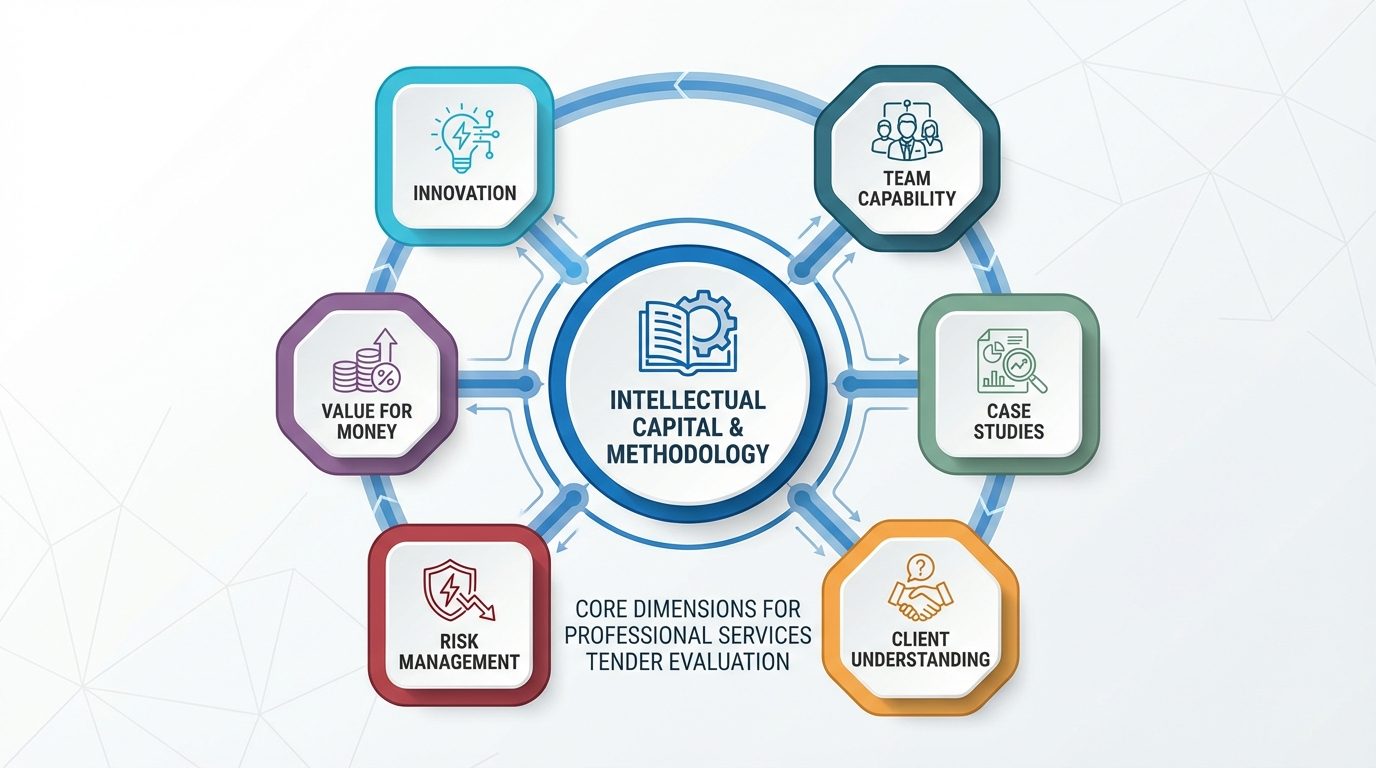
Professional services tender evaluation framework showing seven key dimensions
Understanding the Professional Services Procurement Landscape
Professional services procurement differs fundamentally from goods or works procurement in three critical ways: intangibility of deliverables, reliance on human capital, and the centrality of trust and relationship in service delivery. These differences create unique challenges and opportunities in the tender process.
Procurement teams evaluating professional services tenders face inherent difficulties in comparing proposals. Unlike construction projects with defined specifications or product purchases with measurable features, professional services outcomes depend heavily on the quality of thinking, expertise application, cultural fit, and collaborative dynamics—all challenging to assess from written proposals.
The typical professional services evaluation framework weighs quality and capability at 60-70% of the total score, with price representing only 30-40%. Some frameworks for strategic consulting or legal services push quality weighting even higher. This quality-heavy weighting reflects the recognition that the right professional services partner creates exponentially more value than the cheapest provider.
Public sector professional services procurement has undergone significant reform. The UK government's Outsourcing Playbook and the introduction of more flexible frameworks like the Management Consultancy Framework Three (MCF3) and the Legal Services Panel have shifted emphasis from rigid specifications toward outcome-focused, collaborative partnerships. Private sector procurement increasingly mirrors this approach, with outcome-based fee structures and value-sharing arrangements becoming standard in complex advisory engagements.
Core Evaluation Criteria Across Professional Services Tenders
While specific criteria vary by sector and engagement type, professional services tenders consistently evaluate proposals across seven core dimensions that form the foundation of any winning submission.
Intellectual Capital and Methodology
Evaluators scrutinise your firm's intellectual property, proprietary methodologies, frameworks, and thought leadership. They want to understand not just what you'll do but how you think, what distinguishes your approach, and how your methods have evolved through experience and learning.
Winning submissions demonstrate intellectual capital through detailed methodology descriptions that explain the theoretical underpinning, practical application, and evolution of your approach. They reference published research, case studies, white papers, or tools your firm has developed. They show how your methodology addresses the specific challenges outlined in the specification while maintaining flexibility for client collaboration and customisation.
The strongest intellectual capital sections don't simply describe generic industry frameworks but articulate your firm's unique perspective, incorporating lessons learned from previous engagements and demonstrating continuous methodology refinement. They explain decision points, alternative pathways, and the rationale behind approach selection, showing sophisticated thinking rather than mechanical process application.
Team Capability and Experience
The proposed team represents your most important asset in professional services delivery. Evaluators assess individual qualifications, relevant experience, team composition, continuity commitments, and the credibility of role assignments.
Winning team sections provide comprehensive CV summaries that go beyond listing qualifications to demonstrate directly relevant experience in similar contexts. They explain why specific individuals were selected for particular roles, how their experience complements one another, and what unique value each brings to the engagement.
The most compelling team presentations include org charts showing clear reporting lines and communication pathways, named individuals for all key roles with explicit continuity commitments, and evidence of previous successful collaboration among core team members. They address potential concerns about capacity by demonstrating how the proposed team's current workload allows full commitment to the engagement.
Strong submissions also address knowledge transfer and sustainability, explaining how the team will build client capability rather than creating dependency. They outline how less experienced team members will be developed throughout the engagement and how knowledge will be captured and transferred to the client organisation.
Relevant Case Studies and Track Record
Case studies provide tangible evidence of your capability to deliver the required outcomes. Evaluators examine the relevance of previous engagements, the quality of outcomes achieved, client satisfaction levels, and your ability to handle complexity and navigate challenges.
Winning case studies are carefully selected for maximum relevance to the specific tender. They describe engagements with similar scope, complexity, stakeholder environments, and challenges. They articulate the original problem, your approach, the obstacles encountered, how you adapted, and the measurable outcomes achieved.
The strongest case studies go beyond describing what you did to explain why you made particular decisions, how you navigated stakeholder politics or organisational resistance, and what you learned that has influenced your subsequent methodology. They include quantified outcomes with specific metrics: cost savings achieved, efficiency improvements, revenue growth, risk reduction, or other measurable impacts.
Credible case studies also address challenges honestly. They explain moments when the original approach required adjustment, how you recognised the need for change, and how you collaborated with the client to refine the solution. This demonstrates adaptive capability and mature client relationship management rather than suggesting every engagement proceeds perfectly according to plan.
Understanding of Client Context and Requirements
Evaluators assess how thoroughly you understand their organisation, the specific challenges they face, the context in which you'll be operating, and the outcomes they're seeking to achieve.
Winning submissions demonstrate deep understanding through research-based insights about the client's sector, competitive environment, regulatory context, and strategic priorities. They reference the organisation's published strategies, recent annual reports, sector developments, and relevant external factors affecting their operating environment.
The most compelling understanding sections connect the client's stated requirements to broader strategic objectives, demonstrating how the specific engagement sits within their wider transformation agenda. They identify unstated challenges or risks that the specification may not explicitly address but that experienced practitioners recognise as likely considerations.
Strong proposals also demonstrate cultural understanding, acknowledging the client organisation's values, working style, stakeholder sensitivities, and political dynamics. For public sector clients, this includes understanding democratic accountability, public scrutiny, and political cycles. For private sector clients, it includes commercial pressures, shareholder expectations, and competitive positioning.
Risk Management and Quality Assurance
Professional services engagements carry significant risks: project delay, budget overrun, stakeholder resistance, reputational damage, or failure to achieve intended outcomes. Evaluators assess how comprehensively you've identified potential risks and how convincingly you've outlined mitigation strategies.
Winning risk sections provide comprehensive risk registers that identify specific risks related to the engagement scope, methodology, timeline, stakeholder management, and external factors. They categorise risks by likelihood and impact, assign clear ownership for risk monitoring and mitigation, and describe specific actions to prevent or minimise each risk.
The strongest risk management approaches demonstrate proactive rather than reactive thinking. They describe early warning indicators, governance mechanisms for risk escalation, contingency plans for high-impact scenarios, and learning processes to capture risk insights throughout the engagement.
Quality assurance frameworks should be specific rather than generic. They describe particular quality checkpoints aligned to project milestones, peer review processes, client feedback mechanisms, and senior oversight arrangements. They explain how quality standards will be maintained if team changes become necessary and how quality assurance processes themselves will be reviewed and improved.
Value for Money and Commercial Model
Even in quality-weighted evaluations, commercial proposals must demonstrate value for money, realistic pricing, transparent cost structures, and commercial terms that balance risk fairly between client and supplier.
Winning commercial submissions provide clear, detailed pricing breakdowns that allow evaluators to understand exactly what they're paying for and how costs are calculated. They separate fees, expenses, and contingencies clearly, explain assumptions underpinning the pricing, and demonstrate how the commercial model aligns with the delivery approach.
The most compelling commercial proposals go beyond simple day rates to articulate the value creation logic. They connect investment to outcomes, explain efficiency mechanisms that generate savings or accelerate delivery, and demonstrate how their commercial structure incentivises the right behaviours and outcomes.
For outcome-based or gain-sharing commercial models, winning submissions explain measurement methodology, baseline determination, gain calculation, and sharing mechanisms in detail. They demonstrate how the commercial model creates partnership dynamics rather than transactional relationships.
Innovation and Added Value
Procurement teams increasingly seek partners who bring fresh thinking, challenge conventional approaches, and offer value beyond the basic specification. Evaluators assess your capacity for innovation and the additional value you bring to the engagement.
Winning innovation sections propose specific enhancements that would improve outcomes, accelerate delivery, reduce risk, or create additional benefits beyond the specification requirements. They explain how these innovations have been proven in other contexts and how they could be adapted to the client's specific situation.
The strongest added value propositions are concrete and relevant rather than generic. They might include access to proprietary tools or technology platforms, connection to relevant networks or expertise communities, contribution to the client's thought leadership through joint publications, or knowledge transfer workshops that build lasting client capability.
Credible innovation sections also acknowledge constraints and trade-offs. They explain which innovations would require additional investment versus which can be incorporated within the proposed budget, and they demonstrate understanding of the client's risk appetite and appetite for novel approaches.
Sector-Specific Winning Strategies
While the core evaluation criteria remain consistent, each professional services sub-sector has distinctive characteristics, procurement approaches, and winning strategies that successful bidders understand and address.

Professional services sector comparison across consulting, legal, accounting, HR, and IT
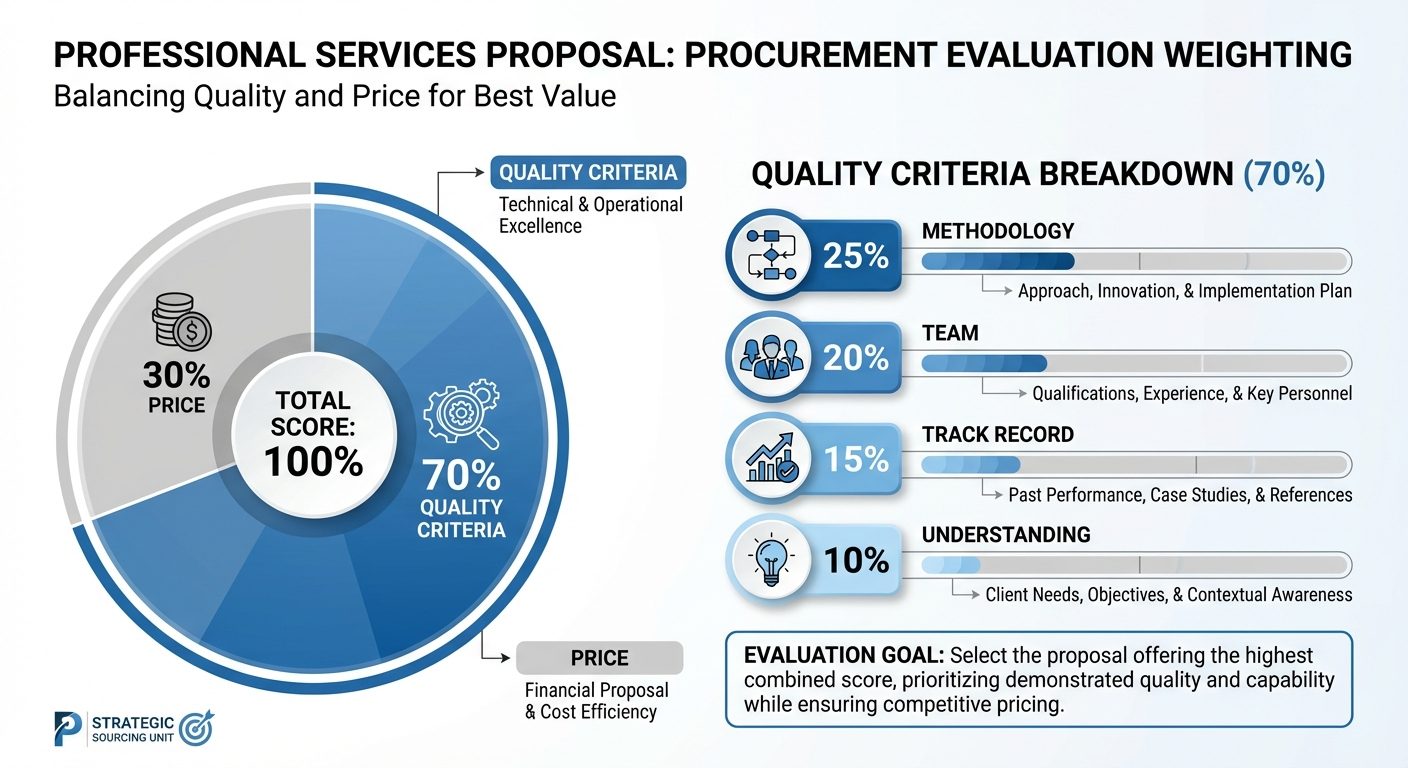
Quality vs price weighting in professional services tender scoring
Management Consulting Tenders
Management consulting procurement spans strategy development, operational improvement, organisational transformation, change management, and programme leadership. Consulting tenders typically emphasise methodology sophistication, senior team involvement, intellectual capital, and transformation track record.
Winning consulting proposals demonstrate thought leadership through proprietary frameworks, diagnostic tools, or transformation methodologies developed and refined through extensive client work. They show how these approaches have evolved based on lessons learned and how they incorporate latest thinking from academic research, sector developments, and cross-sector best practice.
The consulting sector increasingly faces procurement scepticism following high-profile failures and cost controversies. Winning submissions address this directly by emphasising concrete deliverables, measurable outcomes, knowledge transfer commitments, and commercial models that share risk and reward. They explain how they'll build client capability rather than create dependency and how they'll ensure the value of their engagement persists long after their involvement ends.
Strong consulting proposals also demonstrate senior involvement credibly. They explain not just who the senior team members are but specifically when and how they'll be involved, what decisions require their input, and how their experience directly benefits the engagement. They address the common concern about "bait and switch" by making explicit commitments about named individual involvement and continuity.
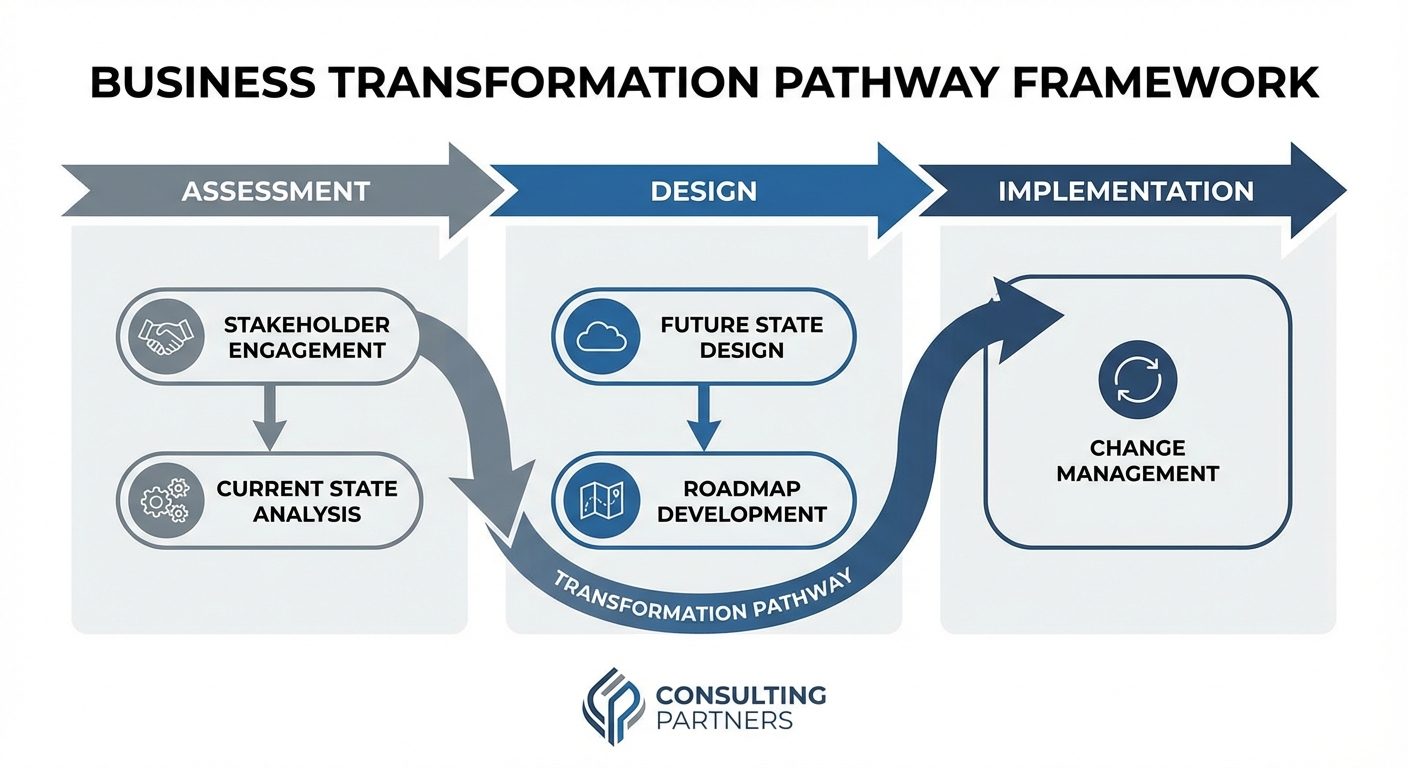
Consulting methodology transformation pathway framework
Legal Services Tenders
Legal services procurement includes general counsel services, specialist legal advice, litigation support, transaction work, regulatory compliance, and legal project management. Legal tenders emphasise technical expertise, sector knowledge, relationship continuity, and value-focused service delivery.
Winning legal services proposals balance technical excellence with accessibility and commercial awareness. They demonstrate deep technical expertise in the relevant legal areas while explaining complex legal concepts in clear, business-focused language that resonates with non-lawyer evaluators.
The legal sector has undergone significant fee structure evolution. Alternative fee arrangements, fixed fees, capped fees, success fees, and blended rate structures have largely replaced pure hourly billing for tender work. Winning legal proposals embrace these models proactively, explaining how the proposed fee structure aligns incentives, provides cost certainty, and delivers value.
Strong legal submissions also demonstrate technological capability. They explain how their practice management systems, document automation, contract lifecycle management tools, or legal research AI enhance efficiency, reduce costs, and improve service quality. They show understanding that modern legal procurement seeks partners who combine legal excellence with efficient, technology-enabled delivery.
Relationship continuity matters significantly in legal services. Winning proposals explain how they'll ensure consistency even as matters or team members change, how knowledge about the client and their business will be captured and shared, and how they'll integrate seamlessly with in-house legal teams.
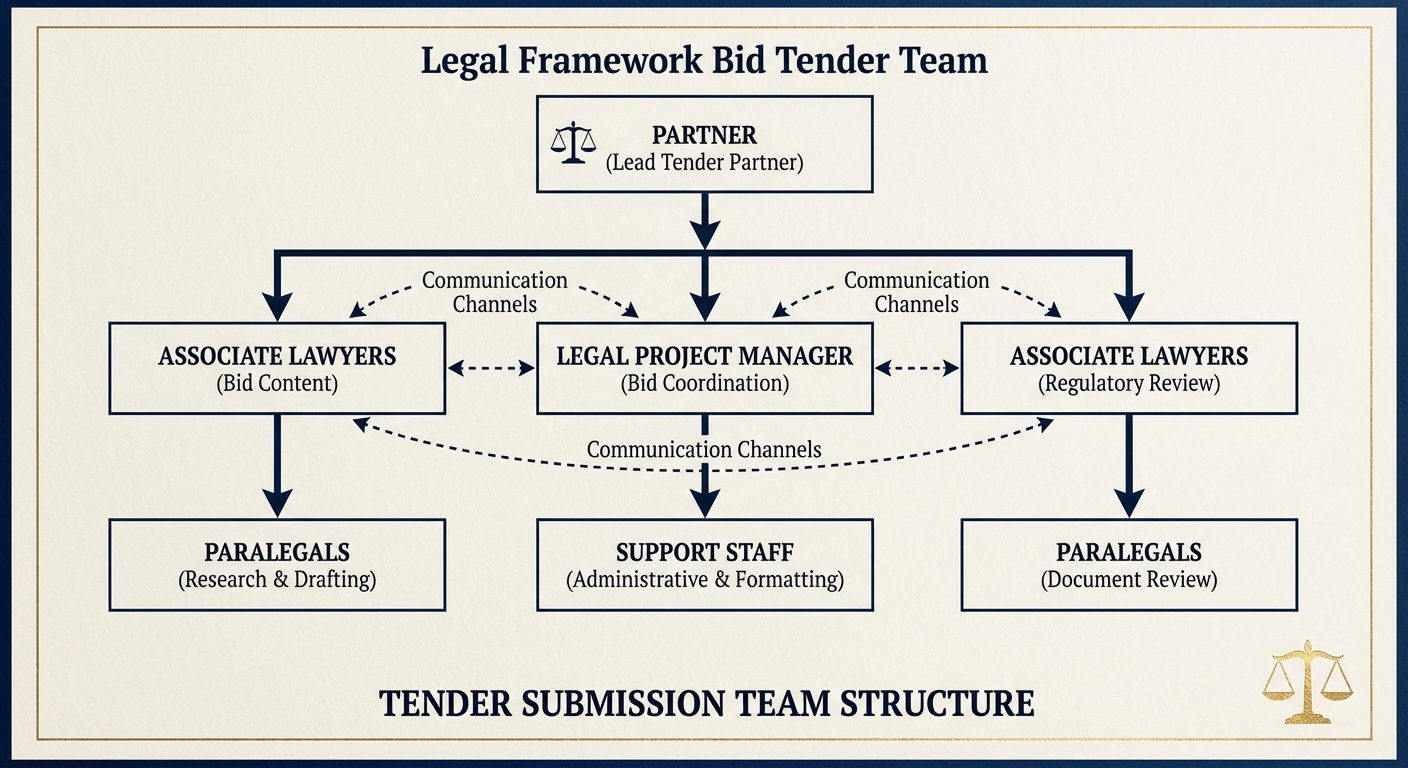
Legal services team structure and hierarchy for tender proposals
Accounting, Audit and Tax Services
Accounting services procurement covers external audit, internal audit, tax advisory, financial reporting, risk management, regulatory compliance, and transaction support. These tenders emphasise technical competence, regulatory compliance, independence, quality assurance, and commercial realism.
Winning accounting and audit proposals demonstrate technical excellence through the qualifications and experience of proposed team members, understanding of relevant accounting standards and regulatory requirements, and track record in similar complexity and scale of engagement.
The audit sector operates under strict independence and quality control requirements. Winning audit proposals explicitly address independence considerations, explain how potential conflicts would be managed, describe the firm's quality control procedures, and reference regulatory inspection results or quality recognition.
For audit tenders, methodology description must balance standardisation with tailored risk assessment. Winning proposals explain the firm's audit approach while demonstrating how risk assessment, materiality determination, and audit emphasis would be specifically calibrated to the client's circumstances, sector risks, and reporting objectives.
Tax advisory and planning tenders require demonstrating both technical tax knowledge and commercial advisory capability. Winning tax proposals show understanding of the client's commercial objectives, explain how tax considerations integrate with broader business strategy, and demonstrate proactive identification of tax efficiency opportunities while maintaining absolute commitment to compliance and risk management.
HR, Recruitment and Organisational Development
HR services procurement includes recruitment, executive search, organisational design, people strategy, performance management, reward design, employee engagement, and HR transformation. These tenders emphasise cultural understanding, change management capability, stakeholder engagement, and sustainable people practices.
Winning HR and OD proposals demonstrate sophisticated understanding of human dynamics, organisational culture, and change psychology. They move beyond process description to explain how they'll navigate political sensitivities, build stakeholder buy-in, address resistance, and create lasting cultural change.
The HR sector increasingly emphasises data-driven approaches, evidence-based practice, and measurable people outcomes. Winning HR proposals explain how they'll measure engagement effectiveness, track behaviour change, assess cultural transformation, or demonstrate recruitment quality improvements. They reference research evidence supporting their approaches and explain how they'll build the client's people analytics capability.
Recruitment and executive search tenders require demonstrating access to relevant talent pools, search methodology rigour, diversity commitment, and candidate experience quality. Winning recruitment proposals explain their sourcing strategies, how they'll attract passive candidates, their assessment methodologies, and how they ensure diverse candidate pools without compromising selection quality.
Organisational development proposals must demonstrate facilitation excellence, change leadership capability, and sustainable transformation rather than quick fixes. They explain how they'll build internal change capability, transfer knowledge to client teams, and ensure interventions create lasting change rather than temporary improvement.
IT Consulting and Digital Transformation
IT consulting procurement spans technology strategy, digital transformation, systems integration, cybersecurity, data strategy, and technology-enabled change. These tenders emphasise technical expertise, transformation experience, vendor neutrality, and business outcome focus.
Winning IT consulting proposals demonstrate deep technical knowledge while maintaining strong business focus. They explain technology choices in business value terms, connect technical solutions to strategic outcomes, and show understanding that successful technology projects ultimately depend on organisational change rather than technical implementation alone.
The IT consulting sector faces procurement concerns about vendor lock-in, bias toward particular technology platforms, and recommendations driven by commercial relationships rather than client interest. Winning proposals address these concerns directly by demonstrating vendor neutrality, explaining evaluation criteria for technology selection, and committing to recommendations based solely on client requirements and business case merits.
Digital transformation projects often fail due to insufficient change management, stakeholder resistance, or capability gaps. Winning digital transformation proposals allocate substantial focus to these organisational dimensions. They explain how they'll build digital capability in client teams, address change resistance, manage stakeholder expectations, and ensure technology adoption drives intended business benefits.
Strong IT consulting proposals also demonstrate security awareness, data protection compliance, and risk management rigour. They explain how they'll protect client data, ensure confidentiality of sensitive information, maintain cybersecurity throughout the engagement, and comply with relevant regulations like GDPR.
Crafting Compelling Professional Services Narratives
Beyond addressing evaluation criteria systematically, winning professional services proposals tell compelling narratives that build evaluator confidence, demonstrate partnership thinking, and differentiate your approach from competitors.
Demonstrating Thought Leadership
Professional services buyers seek partners who bring fresh perspectives, challenge their thinking, and introduce ideas and approaches that advance their practice. Thought leadership signals intellectual confidence, continuous learning, and the capacity to add strategic value beyond tactical delivery.
Demonstrate thought leadership by referencing your firm's published research, speaking engagements, industry contributions, or white papers relevant to the tender topic. Explain how this thought leadership has informed your methodology development and how insights from your research could benefit the client.
Quote or reference relevant external research, academic studies, or sector reports that support your approach. Show that your thinking is grounded in evidence and current best practice rather than outdated conventions or unsupported assertions.
Offer a perspective on emerging trends, future developments, or evolving challenges in the client's sector. Explain how your approach anticipates these developments and positions the client to respond effectively.
Building Trust Through Transparency
Professional services engagements often involve accessing sensitive information, influencing significant decisions, and operating with substantial autonomy. Evaluators assess trustworthiness through proposal transparency, acknowledgment of limitations, and ethical clarity.
Build trust by acknowledging challenges, risks, or uncertainties in the engagement. Explain what you don't yet know, what you'll need to learn during initial phases, and where judgment calls or trade-offs will be required. This realism signals maturity and confidence rather than weakness.
Address potential concerns directly rather than avoiding uncomfortable topics. If the timeline seems ambitious, explain how you'll manage schedule risk. If certain assumptions underpin your approach, state them explicitly. If previous similar engagements encountered particular challenges, explain what you learned and how you've adapted.
Demonstrate ethical clarity by explaining how you'll handle conflicts of interest, maintain confidentiality, respect client autonomy in decision-making, and escalate ethical concerns if they arise. Reference your firm's professional standards, code of conduct, or ethics policies.
Showing Partnership Rather Than Supplier Mindset
The language, tone, and framing of professional services proposals significantly influence evaluator perceptions. Partnership-oriented proposals use collaborative language, shared ownership, and co-creation thinking. Supplier-oriented proposals use transactional language, deliverable focus, and "us and them" framing.
Frame your proposal around "we" and "our" rather than "you" and "your" where appropriate. Discuss "our shared objectives," "challenges we'll navigate together," and "decisions we'll make collaboratively." This language signals partnership thinking without being presumptuous.
Emphasise co-creation and collaboration in your methodology description. Explain how client teams will be involved in analysis, option development, decision-making, and solution design. Show that you see your role as enabling and amplifying client capability rather than imposing external solutions.
Demonstrate genuine interest in the client organisation's success beyond the specific engagement. Reference how this engagement contributes to their broader strategy, how outcomes will support other initiatives, and how you hope to contribute to their long-term success.
Differentiation Through Specificity
Professional services proposals often sound similar because consultants use comparable frameworks, reference similar experience, and describe analogous approaches. Differentiation comes from specificity: specific insights about this client, specific examples from your experience, specific commitments, and specific innovations.
Replace generic statements like "we have extensive experience in this sector" with specific examples: "Over the past three years, we've supported seven local authorities through similar transformation programmes, achieving average efficiency savings of 18% while improving service satisfaction scores from 72% to 89%."
Replace vague methodology descriptions like "we'll conduct comprehensive stakeholder engagement" with specific approaches: "Our stakeholder engagement will include structured interviews with all 15 service heads using our Transformation Readiness diagnostic, three half-day workshops with cross-functional teams using Liberating Structures facilitation methods, and an online survey for the broader workforce using our validated Engagement Index tool."
Replace general commitments like "we'll ensure knowledge transfer" with specific mechanisms: "Knowledge transfer will be embedded through paired working where your team members lead analysis and decision-making with our support, fortnightly learning sessions documenting insights and methods, a comprehensive methodology playbook co-created throughout the engagement, and three facilitated sessions where your team presents findings to senior leadership."
Common Pitfalls in Professional Services Tender Writing
Even experienced professional services firms make recurring mistakes that undermine otherwise strong proposals. Recognising and avoiding these pitfalls significantly improves win rates.
Over-Reliance on Generic Capability Statements
The single most common weakness in professional services proposals is excessive generic content about the firm's overall capabilities, history, and values without sufficient engagement-specific content. Evaluators want to understand what you'll do for them, not read about everything you've ever done.
Limit generic firm information to a brief introduction. Focus the substantial body of your proposal on the specific engagement: your understanding of their particular situation, your tailored approach for their context, your specific team assigned to their work, and your relevant experience in similar situations.
Insufficient Evidence for Claims
Professional services proposals frequently make broad claims—"our innovative approach," "our proven methodology," "our excellent track record"—without providing evidence that allows evaluators to assess these claims.
Support every significant claim with specific evidence. If you claim innovation, explain what's innovative and what evidence demonstrates its effectiveness. If you claim proven methodology, reference case studies showing outcomes achieved. If you claim excellent track record, provide client satisfaction data or testimonials.
Weak Team Commitment and Availability
Professional services buyers frequently experience "bait and switch" where impressive team members featured in proposals rarely appear during delivery. Proposals that fail to make explicit, credible availability commitments fuel this concern.
Make specific commitments about team member involvement: "Sarah Williams will attend all Strategic Board meetings, participate in at least 50% of stakeholder interviews, lead the final presentation, and maintain fortnightly contact with the Programme Director." Explain how their current workload allows these commitments.
Misalignment Between Methodology and Commercial Proposal
Professional services proposals sometimes describe ambitious methodologies requiring substantial time investment while proposing budgets that clearly don't support the described approach. This misalignment signals either unrealistic planning or lack of internal coordination.
Ensure your commercial proposal logically supports your methodology. If you propose 40 stakeholder interviews, your budget should reflect realistic time allocation. If you propose three workshops, include preparation, facilitation, and follow-up time. Check that day-rate pricing, total fees, and activity description align logically.
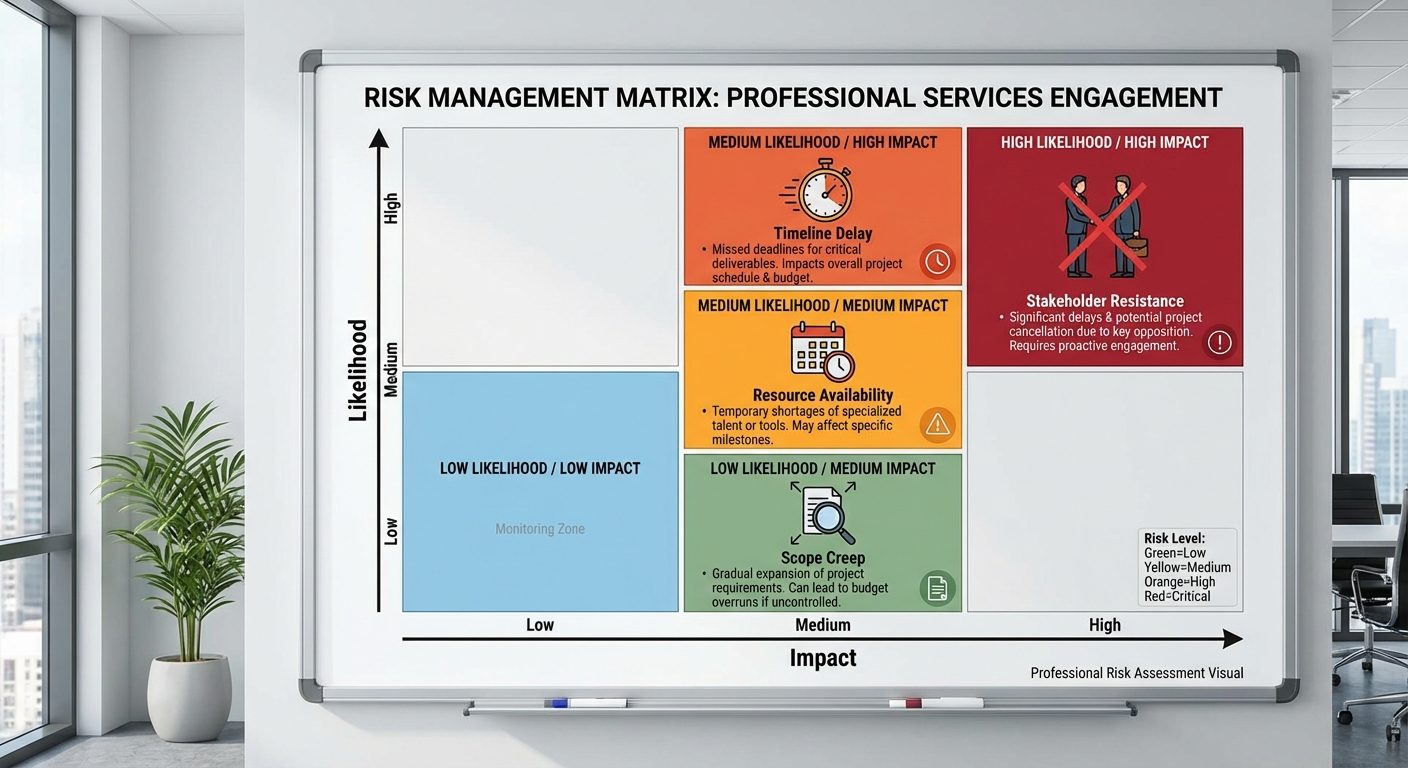
Professional services risk assessment matrix
Inadequate Risk Acknowledgment
Some professional services proposals present optimistic scenarios without acknowledging potential difficulties, resistance, or implementation challenges. This can signal naivety or lack of experience with complex change.
Acknowledge realistic risks and challenges. Show that you understand what could go wrong, what typically creates difficulty in similar engagements, and how you'll navigate these challenges. This demonstrates mature risk awareness rather than undermining confidence.
Missing the Strategic Context
Professional services proposals sometimes focus narrowly on the specific engagement scope without demonstrating understanding of how it connects to the client's broader strategic objectives and organisational context.
Begin with the strategic context. Explain your understanding of why they're undertaking this engagement now, how it relates to their wider transformation agenda, what success would enable them to achieve subsequently, and what the strategic implications of different approaches would be.
Leveraging Technology in Professional Services Tender Writing
Modern professional services tender writing increasingly benefits from technology platforms that enhance quality, efficiency, and consistency while supporting rapid response to tight deadline opportunities.
AI-Assisted Proposal Development
AI-powered tender writing platforms like mytender.io transform professional services proposal development by combining intelligent content generation with sophisticated quality control, compliance checking, and win theme optimisation.
These platforms help professional services firms by maintaining databases of case studies, team CVs, methodology descriptions, and previous proposal content, making it rapidly accessible for new proposals. They suggest relevant content based on the specific tender requirements, accelerating initial draft development while maintaining consistency with firm messaging and quality standards.
AI assistance particularly benefits professional services proposals by helping craft compelling narratives from technical or process-heavy content. It can transform a methodological framework into an engaging story, reframe defensive risk responses into confidence-building assurance, and enhance readability of complex technical descriptions.
The quality control capabilities of AI tender platforms are especially valuable for professional services proposals where excellence of written communication directly signals professional capability. These platforms identify inconsistencies, suggest improvements for clarity and impact, check alignment between different proposal sections, and ensure comprehensive addressing of evaluation criteria.
Knowledge Management and Collaboration
Professional services firms produce enormous volumes of proposal content, case studies, thought leadership, and technical material. Effective knowledge management systems ensure this intellectual capital is accessible and reusable rather than trapped in individual computers or lost in email archives.
Modern knowledge management platforms use AI-powered search to help proposal teams find relevant content quickly using natural language queries. They tag and categorise content automatically, maintain version control, track usage and performance of different content elements, and suggest updates when content becomes outdated.
Collaborative platforms enable distributed proposal teams to work together effectively even under tight deadlines. They support simultaneous editing with change tracking, provide commenting and review workflows, manage approval processes, and maintain comprehensive audit trails of proposal development.
Proposal Performance Analytics
Leading professional services firms track proposal performance systematically to identify patterns, understand what works, and continuously improve win rates. Analytics platforms enable this data-driven approach to proposal development.
These systems track win rates by sector, tender type, team composition, and proposal characteristics. They analyse evaluation feedback to identify common strengths and improvement areas. They compare successful versus unsuccessful proposals to understand differentiating factors. They monitor team performance, identify skills development needs, and track individual contributions.
Performance analytics support evidence-based decisions about resource allocation, capability investment, and proposal strategy. They help firms understand which sectors, tender types, or client segments represent the best opportunities and where capability development would generate the greatest return on investment.
Winning Professional Services Tenders: A Strategic Framework
Success in professional services tender writing requires strategic thinking that extends beyond individual proposal development to encompass opportunity qualification, go/no-go decisions, team deployment, pricing strategy, and continuous learning.
Opportunity Qualification
Professional services firms should be strategic about which opportunities they pursue. The most successful firms carefully qualify opportunities before investing substantial proposal resources, recognising that selective bidding with high win rates generates better returns than high-volume bidding with low win rates.
Strong qualification frameworks assess strategic fit, alignment with the firm's capabilities and positioning, realistic win probability given the competitive landscape, relationship status with the buyer, and economic attractiveness considering likely fee levels and resource requirements.
Qualification should also consider opportunity risk. Some tenders carry significant execution risk, reputational exposure, or scope ambiguity that makes them unattractive even if winnable. Others present relationship-building opportunities that justify investment even if immediate profitability seems marginal.
Win Theme Development
The most successful professional services proposals are built around clear, compelling win themes—the distinctive value propositions that differentiate your approach and resonate with the buyer's priorities and concerns.
Effective win themes are specific to the opportunity, grounded in genuine strengths, directly relevant to buyer priorities, credibly evidenced, and woven consistently throughout the proposal. They should answer the buyer's implicit question: "Why should we choose you over alternatives?"
Win themes might focus on distinctive methodology advantages, superior team experience in closely analogous contexts, risk mitigation strengths particularly relevant to the buyer's concerns, innovation that genuinely enhances outcomes, or partnership approach that aligns perfectly with the buyer's cultural values.
Investment and Resource Allocation
High-quality professional services proposals require significant investment: senior time for proposal strategy and review, technical specialists for methodology development, experienced writers for narrative crafting, and coordination resources for proposal management.
The most successful firms treat proposal development as strategic investment requiring appropriate resource allocation. They assign experienced proposal managers to coordinate development, involve senior professionals in proposal strategy and quality review, allocate sufficient time for stakeholder engagement and research, and invest in tools and training that improve proposal quality and efficiency.
They also recognise that proposal quality significantly influences brand perception, relationship development, and firm reputation even when particular tenders aren't won. Well-crafted proposals signal professional excellence, thought leadership, and genuine interest in the client relationship.
Continuous Improvement and Learning
Winning professional services firms treat tender writing as a capability requiring continuous development. They conduct systematic lessons-learned reviews after both successful and unsuccessful bids, sharing insights across the firm. They track performance data to identify improvement opportunities. They invest in training to develop proposal writing skills. They benchmark against competitor submissions when accessible.
The most effective learning cultures encourage honest feedback, recognise that proposal development expertise develops through practice and reflection, share knowledge generously across teams and practice areas, and celebrate excellence in proposal craft alongside delivery excellence.
The Mytender.io Advantage for Professional Services Firms
Professional services firms face unique tender writing challenges that conventional tools and processes struggle to address effectively. Mytender.io has been specifically designed to support the distinctive requirements of professional services proposal development while enhancing quality, consistency, and efficiency.
Intelligent Content Management for Professional Services
Mytender.io maintains sophisticated libraries of professional services content—case studies, methodology descriptions, team CVs, technical capabilities, thought leadership—organised for rapid retrieval and reuse. The platform's AI understands context, allowing it to suggest relevant content based on the specific tender requirements and evaluation criteria.
For professional services proposals, where demonstrating intellectual capital and thought leadership is crucial, mytender.io helps firms present their distinctive frameworks, methodologies, and approaches consistently while tailoring examples and applications to the specific engagement context.
Methodology and Approach Development
Professional services tenders demand detailed, credible, tailored methodology descriptions. Mytender.io helps firms develop these by providing structured frameworks that guide methodology description while ensuring comprehensive coverage of all required elements.
The platform suggests methodology components based on the engagement type, client sector, and specific requirements. It helps transform technical process descriptions into compelling narratives. It checks methodology descriptions for clarity, logical flow, and evaluation criteria alignment.
Team and Case Study Optimisation
Mytender.io maintains comprehensive databases of team member profiles, experience, availability, and previous proposal involvement. It suggests optimal team composition based on required skills, relevant experience, and team availability. It helps craft compelling team descriptions that go beyond CV listings to explain team selection rationale and individual value contribution.
For case studies, mytender.io helps select the most relevant examples based on similarity to the tender requirements. It provides structured frameworks for case study development that ensure inclusion of all essential elements: situation description, approach explanation, outcome quantification, and learning articulation.
Quality Assurance and Compliance
Professional services proposals must demonstrate excellence of written communication as a proxy for professional capability. Mytender.io provides sophisticated quality checking that identifies inconsistencies, improves clarity and impact, ensures comprehensive evaluation criteria coverage, and maintains alignment across different proposal sections.
The platform checks compliance with tender requirements, word limits, formatting specifications, and mandatory content inclusion. It flags potential issues early in the development process, allowing time for correction rather than last-minute emergency fixes.
Collaborative Professional Services Proposal Development
Professional services proposals typically involve multiple contributors—technical specialists developing methodology content, HR professionals compiling team information, marketing professionals managing case studies, partners reviewing and approving content. Mytender.io supports this distributed development through collaborative features designed specifically for professional services workflow.
The platform enables simultaneous section development with automatic version control and conflict resolution. It provides approval workflows that ensure appropriate review at each stage. It maintains complete audit trails of proposal development. It supports commenting, feedback, and iterative refinement while maintaining proposal coherence.
Conclusion: Mastering Professional Services Tender Writing
Professional services tender writing represents one of the most intellectually demanding and commercially significant activities for consulting, legal, accounting, HR, IT advisory, and other professional services firms. Success requires deep understanding of evaluation criteria, sophisticated narrative development, genuine insight into client needs, and credible demonstration of intellectual capital and delivery capability.
The professional services tender landscape continues to evolve. Procurement teams increasingly demand evidence-based approaches, measurable outcomes, knowledge transfer, fair risk sharing, and genuine partnership rather than transactional relationships. Technology, particularly AI-powered platforms, enables more efficient, higher-quality proposal development while supporting consistency and continuous improvement.
The firms that excel in professional services tender writing approach proposals strategically: qualifying opportunities carefully, developing compelling win themes, investing appropriately in proposal quality, and learning systematically from both successes and disappointments. They recognise that proposal excellence signals professional excellence and that each tender represents both a commercial opportunity and a relationship-building moment.
By understanding evaluation priorities, demonstrating genuine thought leadership, building trust through transparency, showing partnership commitment, and leveraging modern proposal technology, professional services firms can significantly improve their tender win rates while strengthening their market positioning and client relationships.
The investment in professional services tender writing excellence generates returns far beyond individual contract wins. It strengthens the firm's intellectual capital, develops client understanding, builds internal collaboration, and enhances market reputation. In an increasingly competitive professional services marketplace, tender writing mastery represents a sustainable competitive advantage and a critical driver of long-term growth and success.
Tags
Ready to Transform Your Tender Writing?
See how MyTender's AI can help you write winning tenders in a fraction of the time.