
Procurement-Specific Questionnaire (PSQ): The Supplier Guide to Passing Selection Under the Procurement Act
A practical supplier guide to the Procurement-Specific Questionnaire under the Procurement Act: PSQ evidence, Central Digital Platform alignment, pass/fail checks and tender-ready answer structure.
mytender.io Research Team
Tender Writing & Bid Management Specialists
Procurement-Specific Questionnaire (PSQ): The Supplier Guide to Passing Selection Under the Procurement Act
The Procurement-Specific Questionnaire is where many suppliers will win or lose before the real scoring starts.
That sounds dramatic, but it is the practical reality of public sector bidding in 2026. The Procurement Act 2023 has changed the shape of early-stage supplier checks. Buyers still need to understand whether a supplier is legally eligible, financially stable, technically capable and safe to contract with. What has changed is how much of the generic supplier information now sits in the Central Digital Platform, and how much of the tender-specific assurance must be answered through the PSQ.
For bid teams, this is easy to underestimate. The PSQ can look like admin. Company details, exclusions, insurance, policies, accounts, cyber controls, modern slavery, health and safety, equality, quality, environmental management, supply chain arrangements. Nothing glamorous. Nothing that feels like the story that wins the contract.
But a weak PSQ answer creates two expensive problems. First, it can get you rejected before quality scoring. Second, it can quietly damage evaluator confidence before they reach your method statements.

Bid team reviewing a Procurement-Specific Questionnaire pack for a public sector tender
The strongest suppliers treat the PSQ as a proof pack, not a form. They use it to show control, readiness and credibility. They make eligibility easy to verify. They connect generic company assurance to the specific contract. They avoid accidental contradictions between the Central Digital Platform profile, the PSQ response and the main technical submission.
This guide explains how suppliers should approach the Procurement-Specific Questionnaire under the Procurement Act. It covers what the PSQ is, how it differs from the old Selection Questionnaire and PQQ habits, what evidence evaluators expect, how to prepare reusable answers, and how a controlled tender-writing workflow such as mytender.io helps bid teams pass selection without burning days on repeated admin.
What is the Procurement-Specific Questionnaire?
The Procurement-Specific Questionnaire is the buyer's contract-specific selection and assurance questionnaire. It sits alongside the supplier information held on Find a Tender, the Central Digital Platform. The platform is designed around a tell us once principle, so suppliers do not have to re-enter core organisational data from scratch for every public sector opportunity.
That does not mean the buyer no longer asks selection questions. It means the buyer can separate basic supplier identity information from contract-specific checks.
In plain English, the Central Digital Platform answers who you are. The PSQ answers whether you are suitable for this contract.
A PSQ may ask for evidence of financial standing, insurance levels, technical and professional ability, relevant experience, cyber security, data protection, safeguarding, equality, environmental management, health and safety, modern slavery compliance, supply chain controls, conflict of interest management and exclusion grounds. The exact content depends on the contract. A cleaning tender, a software tender, a highways framework and an adult social care contract will all ask different questions because the risks are different.
This is the key shift for bid teams: the PSQ is not a standard form to be copied blindly. It is a buyer risk assessment. Every answer should make the evaluator more comfortable awarding you a place in the competition.
Why PSQ quality matters more in 2026
The Procurement Act regime puts more emphasis on transparency, performance and proportionate supplier assessment. Buyers are expected to run fair, defensible processes. Suppliers are expected to keep core information accurate and to provide evidence that matches the contract.
At the same time, the public record around procurement has expanded. Pipeline notices, tender notices, transparency notices, contract performance notices and payment compliance data all add more visibility to procurement decisions and supplier performance. Buyers know that poor selection decisions can create problems later. They are therefore more likely to look for evidence that a supplier can actually deliver what it says.
The PSQ is one of the first places they look.
A strong PSQ helps a buyer answer five questions.
First, is this supplier eligible to bid? This covers exclusion grounds, debarment risks, connected persons, convictions, professional misconduct, insolvency and other issues that could prevent an award.
Second, is this supplier financially and operationally stable enough for the contract? That may include accounts, turnover, insurance, parent company guarantees, contract values, resource capacity and continuity plans.
Third, does this supplier have relevant experience? Buyers do not want generic capability claims. They want evidence that the supplier has delivered comparable services, scale, complexity, geography and outcomes.
Fourth, can this supplier manage the contract risks? This is where policies and controls matter: cyber, health and safety, safeguarding, environmental management, quality assurance, equality, social value governance, subcontractors and data protection.
Fifth, can we trust the rest of the bid? The PSQ sets the tone. If the selection response is messy, contradictory or unsupported, evaluators become more cautious when reading the scored sections.
PSQ versus PQQ and Selection Questionnaire: what has changed?
Many bid teams still use old language: PQQ, SQ, selection questionnaire, supplier questionnaire. That is understandable. The industry has used those terms for years. But the working habits behind them need updating.
The old PQQ mindset was often about maintaining a bank of standard corporate answers and dropping them into every bid. It worked reasonably well when questions were predictable and buyer scrutiny was lighter. The problem is that it created bulky, generic responses. It also encouraged teams to treat selection as a clerical stage rather than a strategic one.
The PSQ should be approached differently.
Under the new regime, the Central Digital Platform carries more of the reusable supplier profile. Buyers can ask suppliers to share registered core information instead of requesting the same background data repeatedly. The PSQ should then focus more sharply on the contract: the risks, requirements, eligibility conditions and evidence that matter for this procurement.
That does not remove the need for reusable content. In fact, it makes a good content library more valuable. The difference is that reusable content must be modular, current and evidence-led. Instead of one generic health and safety answer, you need building blocks: policy summary, governance model, incident statistics, contract-specific risk assessment method, training evidence, named accountability, subcontractor controls and examples relevant to the service.
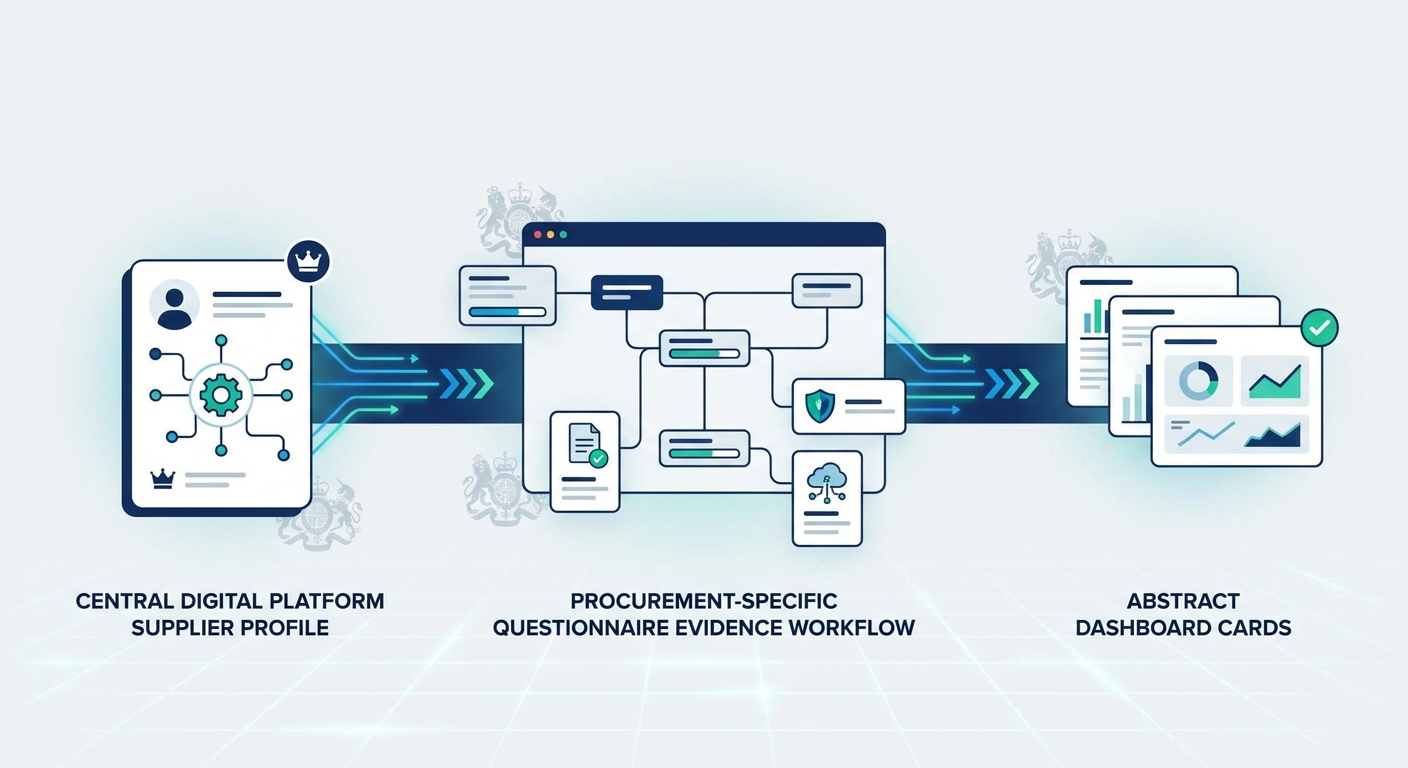
Central Digital Platform supplier profile feeding into a PSQ evidence workflow
Think of it this way. The old model rewarded having a large answer bank. The new model rewards having accurate evidence that can be assembled quickly around the buyer's exact question.
The PSQ is not only pass or fail
Some PSQ questions are pass or fail. If the buyer requires £10 million public liability insurance and you cannot provide it or commit to obtaining it before award, that may be decisive. If a mandatory exclusion ground applies and cannot be resolved, the issue is fundamental. If the contract requires Cyber Essentials Plus and you only have basic controls with no credible plan, you may not progress.
But not every PSQ question works that way. Some questions assess risk. Some inform shortlisting. Some shape clarification questions. Some help the buyer decide whether a supplier's technical response is credible.
This matters because suppliers often give minimum answers to selection questions. They provide the certificate but not the explanation. They paste the policy but not the operating model. They list three references but do not explain why those examples are relevant. They confirm compliance but do not show how the process works.
That is a missed opportunity.
A good PSQ answer is still concise, but it does three things. It answers the question directly. It points to evidence. It explains relevance to the contract.
For example, if the buyer asks about quality management, a weak answer says the organisation operates an ISO 9001-certified quality management system. A stronger answer says the organisation operates an ISO 9001-certified quality management system, explains the governance cycle, describes how non-conformances are captured, shows how learning is fed into mobilisation and contract review, and links that system to the service being procured.
The second answer gives the evaluator a reason to trust the supplier beyond the certificate.
Build the PSQ around an evidence matrix
The practical way to improve PSQ quality is to build an evidence matrix before writing. This does not need to be complicated. It is a simple table that maps each buyer question to the answer owner, source evidence, expiry date, risk level and response status.
The matrix should include:
| PSQ area | Typical evidence | Common failure | Best practice |
|---|---|---|---|
| Legal identity and ownership | Central Digital Platform profile, company number, group structure, connected persons | Profile does not match bid documents | Reconcile names, entities and ownership before submission |
| Exclusion grounds | Self-declarations, debarment checks, internal compliance statement | Incomplete connected person information | Confirm who has authority to approve declarations |
| Financial standing | Accounts, turnover, credit checks, parent guarantee, insurance | Contract value exceeds stated capacity | Explain financial resilience and mitigation clearly |
| Technical ability | Case studies, references, CVs, accreditations, delivery metrics | Examples are not comparable | Match examples to scale, complexity and buyer needs |
| Cyber and data protection | Cyber Essentials, ISO 27001, DPIA method, access controls | Policy claims without operational detail | Explain data flow, ownership, review and incident response |
| Health and safety | Policy, training, incident data, RAMS method, audit reports | Expired documents or generic statements | Use recent evidence and contract-specific risk controls |
| Modern slavery and social responsibility | Statement, supplier checks, escalation process | Annual statement is missing or out of date | Show supply chain due diligence, not only policy wording |
| Environmental management | ISO 14001, carbon plan, waste procedures, fleet data | Net zero claims not evidenced | Tie controls to the contract activity and measurable outputs |
| Subcontracting | Named subcontractors, due diligence, flow-down terms | Subcontractors appear late or unexplained | Show selection, monitoring and accountability routes |

Procurement-Specific Questionnaire evidence matrix with policies, certificates and owner approvals
This is where many bid teams lose time. The content is not missing, but it is scattered across SharePoint, inboxes, old tenders, finance folders, HR policies, operations documents, quality manuals and subcontractor packs. Someone knows the answer, but not quickly enough.
mytender.io is built for exactly this problem. It helps bid teams connect the tender requirement to approved organisational knowledge, retrieve relevant evidence, generate a structured first draft and keep humans in control of the final answer. The point is not to make the PSQ longer. It is to make it more accurate, faster and easier to verify.
What evaluators want to see in PSQ answers
Evaluators are not looking for literary brilliance in a PSQ. They are looking for confidence.
They want to see that the supplier has read the question, understood the risk and supplied evidence that is current, relevant and complete. They do not want vague claims. They do not want marketing language. They do not want certificates attached with no explanation. They do not want contradictions between the PSQ and the rest of the submission.
The best answers are plain and specific.
If the question asks for three comparable contracts, do not simply list your three biggest clients. Select the three most relevant examples. Explain why they are comparable: service type, annual value, geography, contract length, mobilisation complexity, user group, asset base, response times, compliance environment or outcome profile. A smaller but more relevant example is often stronger than a prestigious but unrelated one.
If the question asks for supply chain controls, do not say all subcontractors comply with our policies. Explain onboarding, due diligence, contract clauses, audit rights, training, performance monitoring, escalation and removal. If named subcontractors are important to delivery, show that their evidence has been checked, not assumed.
If the question asks about cyber security, do not stop at accreditation. Explain access control, data segregation, staff training, incident management, supplier hosting, vulnerability management and how buyer data will be protected during mobilisation and live delivery.
If the question asks about insurance, answer the exact levels and basis. If cover will be increased on award, say so clearly and provide broker confirmation if available. Ambiguity creates unnecessary clarification risk.
If the question asks about financial standing, do not panic if accounts need explanation. Buyers understand that growth businesses, subsidiaries, groups and seasonal operators may require context. Provide a calm explanation, parent support where relevant, pipeline visibility, cash controls, contract mobilisation funding and continuity planning. The worst answer is silence around an obvious concern.
The answer structure that works for most PSQ questions
A reliable PSQ answer structure has five parts.
Start with a direct confirmation. Do you comply? Do you hold the accreditation? Do you meet the threshold? Can you provide the evidence? Answer that first. Do not make the evaluator hunt for it.
Then explain the operating model. How does the control work in practice? Who owns it? How often is it reviewed? What happens if something goes wrong? This turns a policy into a real management process.
Then provide evidence. Name the certificate, policy, report, case study, reference, KPI dashboard, audit, training record or system output that proves the claim. If attachments are required, make sure file names are clear and referenced in the answer.
Then connect the answer to the contract. Why does this matter for the buyer's requirement? How will the control apply during mobilisation, delivery, reporting or contract management?
Finally, state any limitations honestly. If an accreditation is in progress, give the status and date. If a parent company guarantee is available subject to approval, say that. If insurance will be increased on award, explain the route. Do not hide the issue and hope it disappears.
Here is a simple pattern:
| Answer stage | Purpose | Example phrasing |
|---|---|---|
| Direct answer | Removes ambiguity | We confirm that we hold Cyber Essentials certification and will maintain it throughout the contract. |
| Operating model | Shows control | Our Information Security Manager owns the control framework, with quarterly review through the risk committee. |
| Evidence | Proves the claim | Certificate CE-2026-1042 and the incident response procedure are included in Appendix B. |
| Contract relevance | Makes it buyer-specific | The same controls will apply to all contract files, user access and mobilisation data provided by the Authority. |
| Limitation or assurance | Handles risk openly | If Cyber Essentials Plus is required before award, our assessor slot is provisionally booked for November 2026. |
Common PSQ mistakes that cost suppliers time and marks
The first mistake is treating the PSQ as a copy-and-paste exercise. Old answers often contain expired dates, wrong buyer names, outdated accreditations, irrelevant contract examples and claims that no longer match current operations. Under a more transparent regime, sloppy reuse is risky.
The second mistake is over-answering. A PSQ is not the place for five pages of brand narrative unless the buyer asks for it. Long generic responses make it harder for evaluators to find the evidence. They also increase the chance of contradictions.
The third mistake is answering from the wrong entity. Many suppliers bid through a trading subsidiary, parent company, joint venture or consortium. The PSQ must be clear about which organisation holds the accounts, insurance, accreditations, staff, contracts and liabilities. If the evidence belongs to another group company, explain the relationship and support mechanism.
The fourth mistake is ignoring expiry dates. Insurance certificates, ISO certificates, Cyber Essentials, modern slavery statements, financial accounts, policies and training records all go stale. A content library is only useful if someone owns renewal checks.
The fifth mistake is failing to align PSQ commitments with technical delivery. If the PSQ says all staff are directly employed but the method statement names subcontractors, the evaluator will notice. If the PSQ says no AI tools are used but the delivery model includes automated triage, that needs explanation. If the PSQ says all suppliers are audited annually but the mobilisation plan adds new subcontractors without due diligence, the bid looks weak.
The sixth mistake is leaving finance until the last day. Financial standing questions often need input from finance directors, accountants, brokers or parent company approvers. Chasing those people two hours before submission is a completely avoidable way to lose a good opportunity.
How to prepare a reusable PSQ library
A good PSQ library is not a folder of old answers. It is a controlled set of evidence-backed modules.
Start by separating fixed data from narrative. Fixed data includes company registration number, VAT number, registered address, insurance limits, accreditations, policy owners, turnover bands, headcount, locations and approved contact details. This should match the Central Digital Platform profile and be reviewed regularly.
Then build evidence modules for common themes: quality, health and safety, environmental management, cyber security, data protection, equality, modern slavery, safeguarding, financial standing, business continuity, subcontractor management, social value governance and complaints handling.
Each module should include four things: a short answer, a fuller explanation, source evidence and expiry or review date. That gives the bid team flexibility. A short PSQ box can use the concise version. A higher-risk question can use the fuller explanation and supporting evidence.
Then tag each module by sector and contract type. A health and safety answer for grounds maintenance should not be identical to one for software implementation. A data protection answer for a low-risk consultancy contract should not be identical to one for an NHS system handling sensitive records.
Finally, create an approval route. PSQ answers often touch legal, finance, HR, operations, quality, IT and executive sign-off. If the bid team does not know who can approve each topic, every tender becomes a scramble.
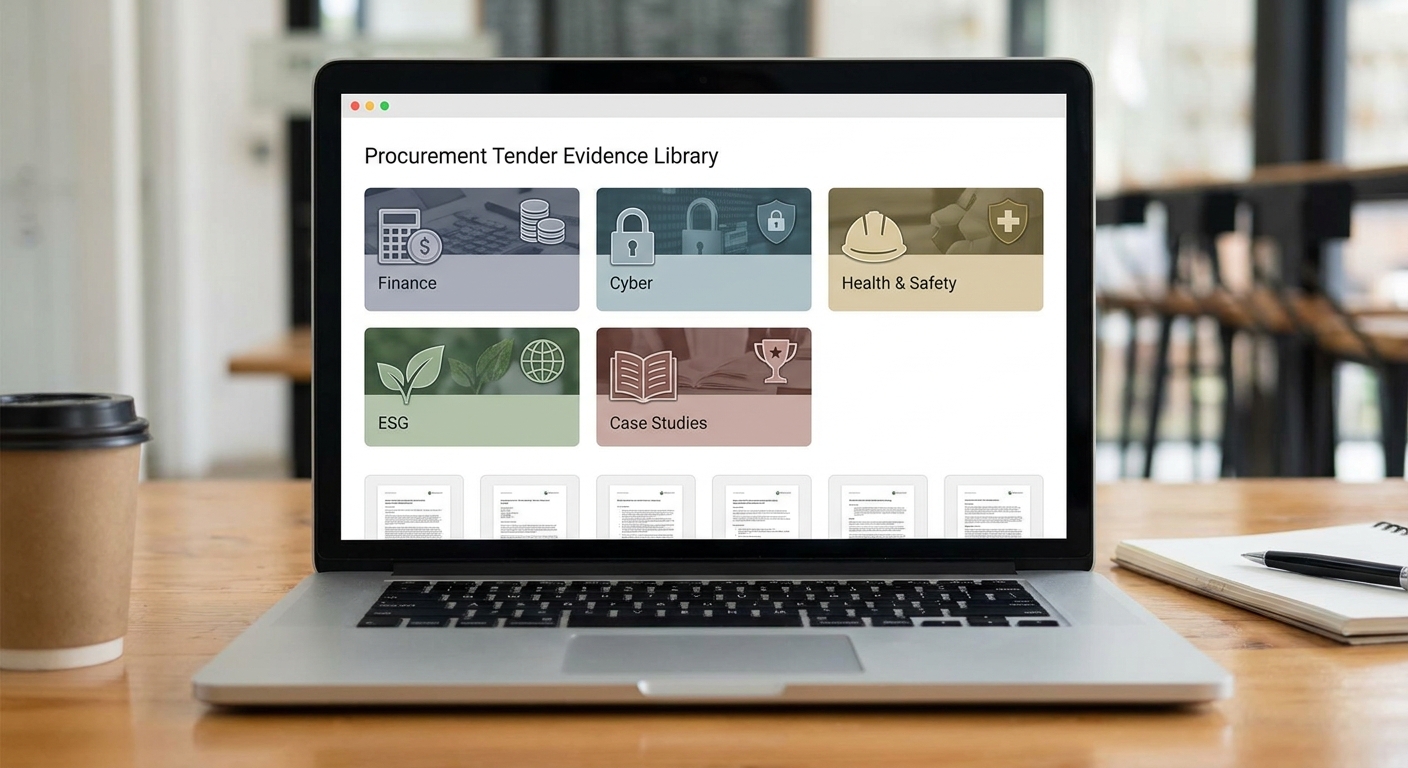
Organised PSQ content library with approved modules for finance, cyber, health and safety and ESG evidence
This is one of the biggest advantages of using mytender.io instead of scattered documents. The platform helps teams reuse approved knowledge while still tailoring it to the tender. That matters because selection answers need both speed and control.
How AI should and should not support PSQ responses
AI can help with PSQs, but only if it is grounded in approved evidence.
Good uses of AI include summarising buyer requirements, mapping questions to evidence, finding previous approved answers, drafting from known documents, checking for missing attachments, identifying contradictions and improving readability. Those tasks save time without removing human accountability.
Poor uses of AI include inventing policies, filling gaps with generic best practice, fabricating case study details, guessing financial information, rewriting compliance statements without approval or using sensitive tender documents in unmanaged public tools.
The rule is simple: AI should accelerate evidence-based work, not replace evidence.
For PSQ responses, this matters more than in many scored narrative sections. If a method statement sounds polished but needs refinement, the team can edit it. If a PSQ answer invents an accreditation, misstates insurance, hides an exclusion risk or attaches the wrong accounts, the issue can become fatal.
A safe AI-assisted PSQ workflow should have four controls.
First, the AI should draw from approved sources: policies, certificates, previous submissions, case studies, operating procedures and structured company data.
Second, the response should show its evidence trail. Bid reviewers should be able to see where the claim came from and whether it is current.
Third, subject matter owners should review sensitive answers. Finance reviews financial standing. IT reviews cyber. HR reviews workforce and safeguarding. Operations reviews delivery capability.
Fourth, the final response should be checked against the tender instructions and the Central Digital Platform profile.
This is why general-purpose AI tools can be risky for selection work. They are not designed around bid governance. mytender.io is purpose-built for tender teams that need AI speed without losing control of evidence, compliance and review.
PSQ guidance for SMEs and growing suppliers
SMEs often worry that PSQ requirements favour larger incumbents. Sometimes buyers do set requirements that feel disproportionate. But suppliers should not assume the PSQ is unwinnable.
The Procurement Act environment encourages proportionate procurement and better access for SMEs. Buyers should not create unnecessary barriers. They should consider lotting, pipeline visibility, fair treatment and requirements that match the contract risk. That gives SMEs room to compete, but only if their PSQ answers are organised.
A growing supplier should focus on clarity. If turnover is lower than a large incumbent's, explain financial resilience, contract capacity and risk controls. If an accreditation is in progress, provide the implementation timetable and interim controls. If experience is narrower, use examples that are directly comparable rather than trying to look bigger than you are. If you plan to use subcontractors or consortium partners, explain accountability clearly.
Do not apologise for being an SME. Prove that you are controlled, responsive and relevant.
SMEs can often outperform larger suppliers in PSQ answers because they are closer to delivery. They can name decision-makers, explain escalation routes, show direct ownership and provide recent, specific examples. The danger is not size. The danger is looking informal.
A strong PSQ makes a smaller supplier feel safe to award.
PSQ preparation timeline
The worst time to build PSQ evidence is after the tender lands. Some information will always be buyer-specific, but most preparation can happen in advance.
Ninety days before a target tender, review the Central Digital Platform profile, company details, insurance levels, core policies, accounts, accreditations and standard declarations. Check expiry dates and ownership.
Thirty days before, refresh sector-specific case studies, references, KPI data, social value evidence, health and safety statistics, cyber evidence and subcontractor packs. Make sure the bid team knows where everything lives.
At tender release, build the PSQ evidence matrix before drafting. Identify mandatory pass or fail requirements immediately. Escalate gaps to the right owner on day one, not day ten.
During drafting, answer each question from evidence. Keep responses concise. Reference attachments clearly. Check entity names, dates, thresholds and buyer instructions.
Before submission, run a consistency review across the PSQ, Central Digital Platform data, pricing, method statements, mobilisation plan and contract management sections. The aim is to remove contradictions before the evaluator finds them.

PSQ preparation timeline from supplier profile review through evidence matrix, drafting and final consistency check
After submission, save the final answers, clarifications and buyer feedback back into the library. Selection work improves fastest when every tender teaches the next one.
A practical PSQ checklist for bid teams
Use this checklist before submitting a Procurement-Specific Questionnaire.
Have you checked that your Central Digital Platform profile matches the bidding entity, registered address, company number and ownership information in the tender response?
Have you identified every mandatory pass or fail requirement and confirmed evidence for each one?
Have finance, legal, IT, HR, quality and operations reviewed the answers that relate to their areas?
Are all policies, certificates, accounts and insurance documents current and correctly named?
Do your case studies match the scale, complexity and risk profile of the contract?
Have you explained any gaps, pending accreditations, increased insurance requirements or parent company support openly?
Do subcontractor details match the delivery model, pricing assumptions and mobilisation plan?
Are cyber, data protection and AI-related statements consistent across the PSQ and technical response?
Have you removed old buyer names, outdated dates and irrelevant boilerplate from reused content?
Can every material claim be traced back to evidence?
If the answer to any of these questions is no, fix the PSQ before polishing the scored sections. A beautiful quality response will not help if the supplier fails selection.
How mytender.io helps with PSQs
PSQs are exactly the kind of work where bid teams lose hidden time. The questions look simple, but the answers depend on scattered knowledge. People chase documents. Attachments go missing. Old answers are reused because they are easy to find, not because they are right. Review happens late. The final submission gets over the line, but the team knows it was harder than it needed to be.
mytender.io gives bid teams a better operating model.
The platform helps analyse tender requirements, break down the PSQ, retrieve relevant approved content, generate first drafts from your own evidence, identify gaps and support review. Instead of starting from a blank page or an old folder, the team works from structured organisational knowledge.
That has three practical benefits.
First, it saves time. Bid teams can produce first drafts in minutes, not days, and spend their effort on judgement rather than document hunting.
Second, it improves consistency. Answers align with approved policies, previous winning content and current evidence. That reduces contradictions between PSQ, method statements and supporting attachments.
Third, it improves confidence. Reviewers can focus on risk, relevance and final sign-off rather than rewriting basic content from scratch.
The best PSQ response is not the longest. It is the one that makes the evaluator's decision easy. It proves eligibility, reduces risk and creates trust before the scored narrative begins.
Final thought: the PSQ is your first trust test
The Procurement-Specific Questionnaire is not glamorous, but it is strategically important. It tells the buyer whether your organisation is ready, controlled and credible. It shows whether your bid team understands the contract risk. It reveals whether your evidence is organised or improvised.
In 2026, suppliers cannot afford to treat selection as admin. The Central Digital Platform may reduce repetition, but it does not remove the need for strong, contract-specific assurance. If anything, it makes the quality of your PSQ evidence more visible.
Build the evidence library. Keep the supplier profile current. Map questions before drafting. Use AI only where it is grounded in approved information. Review sensitive answers with the right owners. Make the evaluator comfortable.
That is how the PSQ stops being a hurdle and becomes the first proof that you are the right supplier to shortlist.
If your team is still chasing policies, certificates and old answers every time a tender lands, mytender.io can help you turn scattered evidence into faster, stronger and more controlled tender responses.
Tags
Ready to Transform Your Tender Writing?
See how MyTender's AI can help you write winning tenders in a fraction of the time.