

Procurement Compliance Under the New UK Procurement Act 2023: The Complete Tender Writing Guide for 2026
Master procurement compliance under the UK Procurement Act 2023 with this comprehensive tender writing guide. Learn the new requirements, avoid costly mistakes, and win more public sector contracts in 2026.
mytender.io Editorial Team
Content Team
The UK public sector procurement landscape transformed dramatically with the Procurement Act 2023 coming into force on 24 February 2025. For organisations bidding on public sector contracts in 2026, understanding and implementing robust procurement compliance is no longer optional—it's the difference between winning lucrative contracts and automatic disqualification before your proposal is even read.
This comprehensive guide provides everything you need to master procurement compliance under the new legislation, avoid the costly mistakes that lead to tender rejection, and position your organisation for success in the transformed UK public sector marketplace.
Understanding the UK Procurement Act 2023: A Fundamental Shift
The Procurement Act 2023 represents the most significant overhaul of UK public procurement law in decades. It replaces the Public Contracts Regulations 2015 with a new framework designed to create a simpler, more flexible, and transparent commercial system that opens opportunities for new market entrants whilst maintaining rigorous standards.
The legislation introduces fundamental changes that affect every aspect of tender writing and submission. For organisations accustomed to the previous regime, 2026 marks the first full calendar year of operating under these new rules, and the compliance requirements are both more extensive and more transparent than ever before.
The Core Principles Behind the New Act
The Procurement Act 2023 is built on three foundational pillars that inform all compliance requirements: transparency, integrity, and equal treatment. These aren't merely aspirational values—they're embedded into the procedural requirements that contracting authorities must follow and that suppliers must demonstrate in their submissions.
Transparency requires that public spending becomes more scrutinisable at every stage of the commercial lifecycle. This means detailed record-keeping, publication of contract information on the Central Digital Platform, and comprehensive reporting requirements that extend well beyond contract award.
Integrity demands that all parties act honestly and avoid conflicts of interest. For suppliers, this translates into stringent declarations about beneficial ownership, compliance with tax obligations, and adherence to exclusion grounds that can disqualify organisations from bidding.
Equal treatment ensures that all suppliers—regardless of size, location, or previous relationships with the contracting authority—have fair access to opportunities and are evaluated consistently against published criteria.
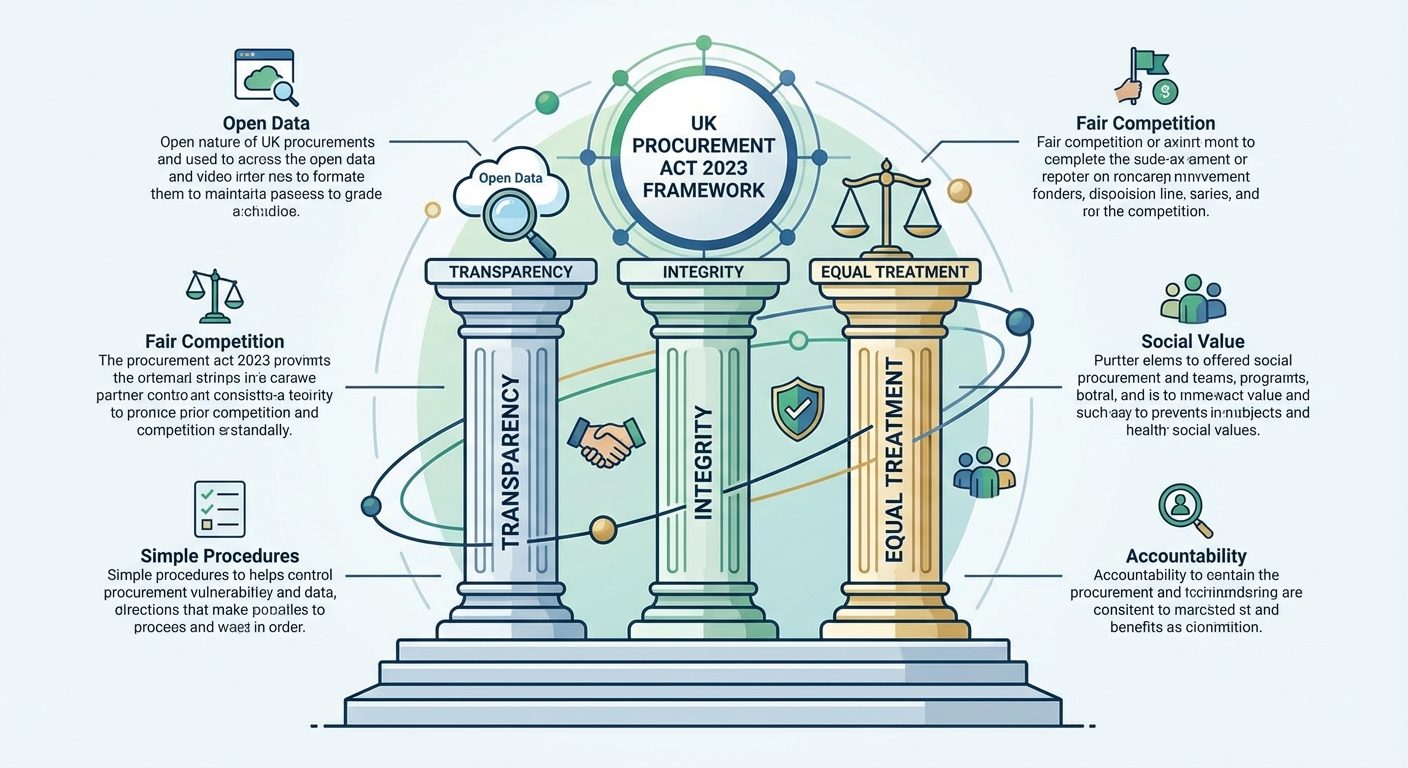
UK Procurement Act 2023 framework showing the three foundational pillars: transparency, integrity, and equal treatment
From MEAT to MAT: A Cultural Shift in Evaluation
One of the most significant changes is the replacement of the "Most Economically Advantageous Tender" (MEAT) principle with the "Most Advantageous Tender" (MAT) approach. Whilst this might appear to be a subtle linguistic change, it represents a fundamental shift in how contracting authorities can evaluate bids.
Under MEAT, evaluation was primarily focused on economic factors—typically price and quality, with quality often interpreted through a relatively narrow lens. MAT explicitly allows contracting authorities to consider a much broader range of factors, including environmental sustainability, social impact, innovation, and strategic alignment with policy objectives.
For tender writers, this shift requires a more holistic approach to demonstrating value. A compliant bid under the new regime must address not only technical capability and cost-effectiveness but also demonstrate how your organisation contributes to broader social and environmental objectives.
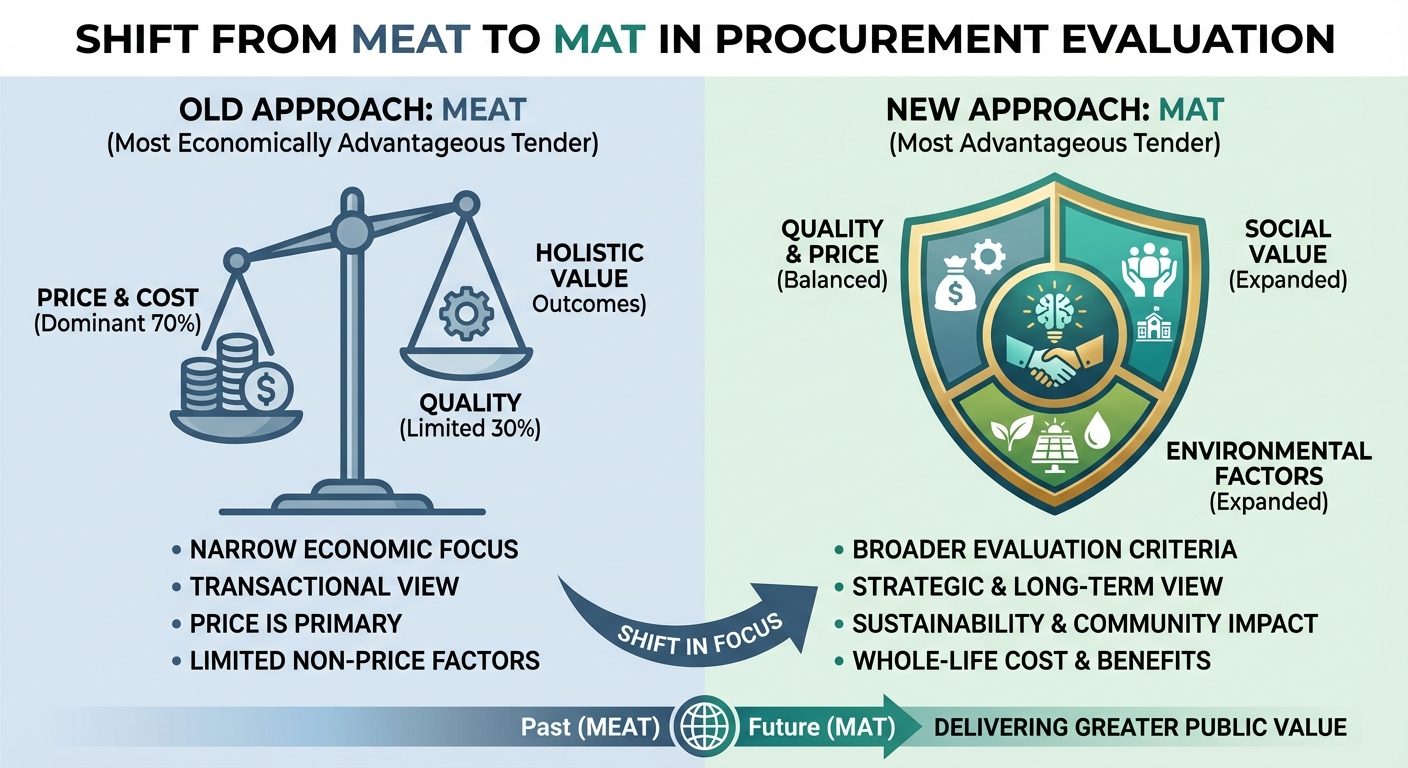
Comparison showing the shift from MEAT to MAT evaluation approach, highlighting expanded criteria including social value and environmental factors
Lower Thresholds Mean More Scrutiny
From 1 January 2026, procurement thresholds decreased significantly across almost all contract types. For central government authorities, the threshold for goods and services contracts is now £135,018, whilst for sub-central government authorities it's £207,720. Works contracts for sub-central authorities have a threshold of £5,386,006.
These lower thresholds mean that many more contracts now fall within the scope of the Procurement Act's main provisions. Contracts that previously might have been procured through simpler procedures now require full compliance with transparency requirements, publication on the Central Digital Platform, and adherence to statutory timescales.
For suppliers, this expanded scope means that achieving and maintaining tender-ready status has become essential for a much larger proportion of your potential contract opportunities.
Critical Compliance Requirements for 2026
Understanding the specific compliance requirements introduced or strengthened by the Procurement Act 2023 is essential for avoiding disqualification. These requirements operate as gateways—failure at any of these points means your tender won't proceed to qualitative evaluation, regardless of how strong your technical proposal might be.
Central Digital Platform: The New Hub for Transparency
The Central Digital Platform represents one of the most visible changes introduced by the Procurement Act. All contracting authorities must publish key information about their procurement activities on this platform, and suppliers must ensure their submissions reference and align with published information.
For tender writers, this means developing new habits around research and preparation. Before drafting any tender response, you must review the contract notice, tender documents, and any additional information published on the Central Digital Platform. Your submission must demonstrate awareness of and compliance with all requirements listed in these published documents.
The platform also serves as the repository for contract award notices, contract details, and ongoing contract modifications. This increased transparency creates both opportunities and obligations for suppliers. You can more easily research contracting authorities' procurement patterns and requirements, but you must also ensure that all information you provide is consistent across different submissions and verifiable against public records.
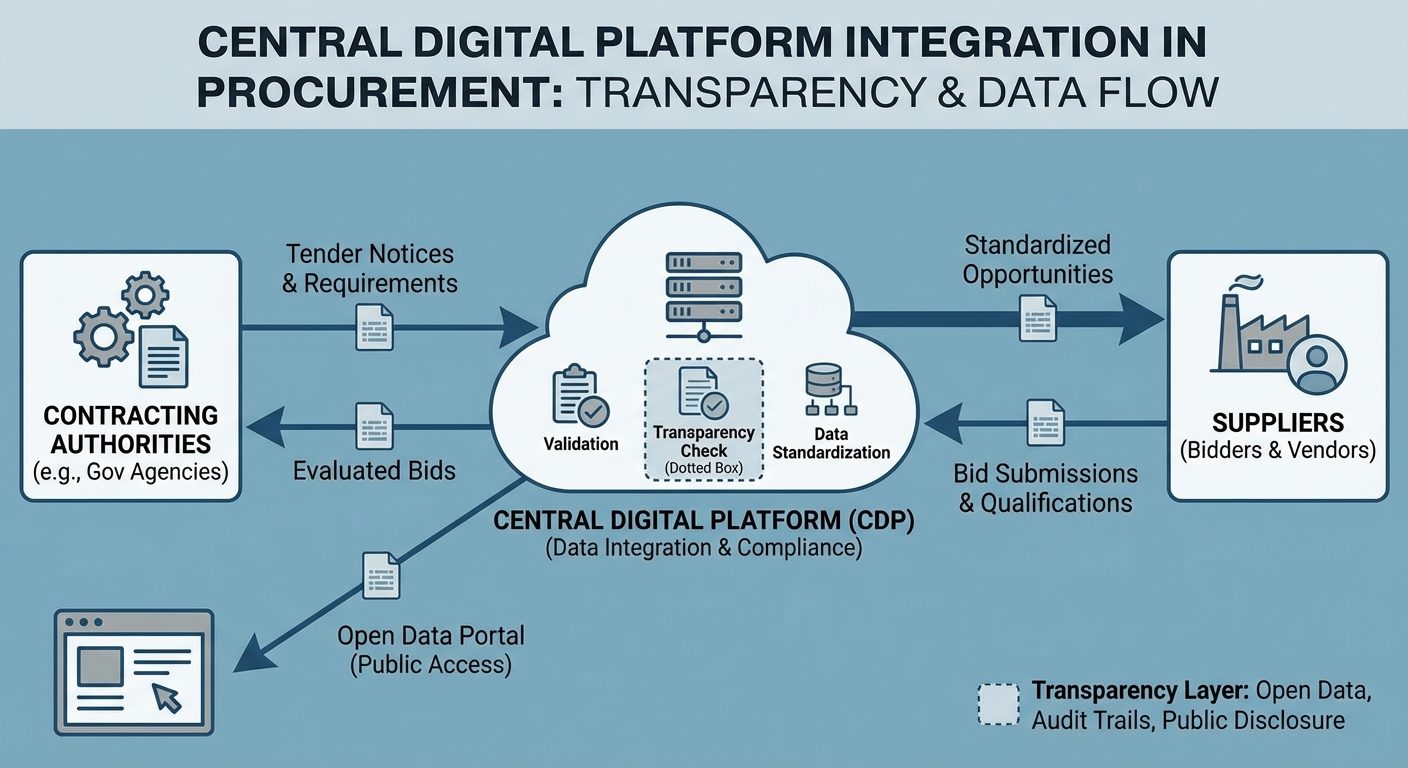
Process diagram showing Central Digital Platform integration and information flow between contracting authorities and suppliers
Payment Reporting Requirements: New Obligations from April 2026
Starting 1 April 2026, contracting authorities must publish details of all payments over £30,000 made under public contracts. Whilst this requirement primarily affects the buying organisation, it has significant implications for suppliers' compliance obligations.
Suppliers must maintain meticulous records that align with the payment information that contracting authorities will publish. Any discrepancies between your invoicing records and published payment data can raise red flags in future procurement processes.
Additionally, the payment reporting requirement means that your delivery performance becomes more transparent. Contracting authorities will be able to see patterns in payment histories, including whether suppliers have required payment plan variations, dispute resolutions, or penalties for non-performance.
For tender writers, this increased scrutiny means that past performance evidence must be even more robust. Claims about successful contract delivery can be verified against published payment records, making exaggeration or misrepresentation easier to detect and more damaging to your organisation's reputation.
Mandatory KPIs for Contracts Over £5 Million
The Procurement Act requires that all contracts exceeding £5 million must include at least three Key Performance Indicators. These KPIs must be published and reported against throughout the contract lifecycle, and they can encompass a range of metrics including environmental performance, social value delivery, and innovation outcomes.
For suppliers bidding on these higher-value contracts, compliance means not just accepting whatever KPIs the contracting authority proposes, but actively engaging in the development of meaningful, measurable indicators that demonstrate your commitment to excellence and accountability.
Your tender submission must address how you will track, report, and continuously improve against these KPIs. This requires investment in monitoring systems, data collection processes, and quality assurance mechanisms that can demonstrate performance in real-time.
Environmental KPIs have become particularly prominent under the new regime. Contracting authorities are encouraged to include metrics related to carbon reduction, circularity, biodiversity protection, and other sustainability outcomes. Your tender must demonstrate not just awareness of these requirements but genuine capability to measure and improve environmental performance.
Social Value: From Aspiration to Requirement
Social value has shifted from a desirable add-on to a central component of procurement evaluation. The Procurement Act strengthens the legislative basis for considering social value and provides clearer guidance on how it should be assessed and delivered.
For tender compliance, this means that your submission must include a comprehensive social value delivery plan. This isn't a brief paragraph about corporate social responsibility—it requires detailed, costed proposals showing how your contract delivery will create benefits for communities, develop skills, support local economies, or advance equality and diversity objectives.
Contracting authorities are using the National TOMs (Themes, Outcomes, Measures) framework increasingly frequently to standardise social value measurement. Familiarising yourself with this framework and demonstrating your capability to deliver and report against TOMS metrics has become a compliance requirement for many public sector tenders.
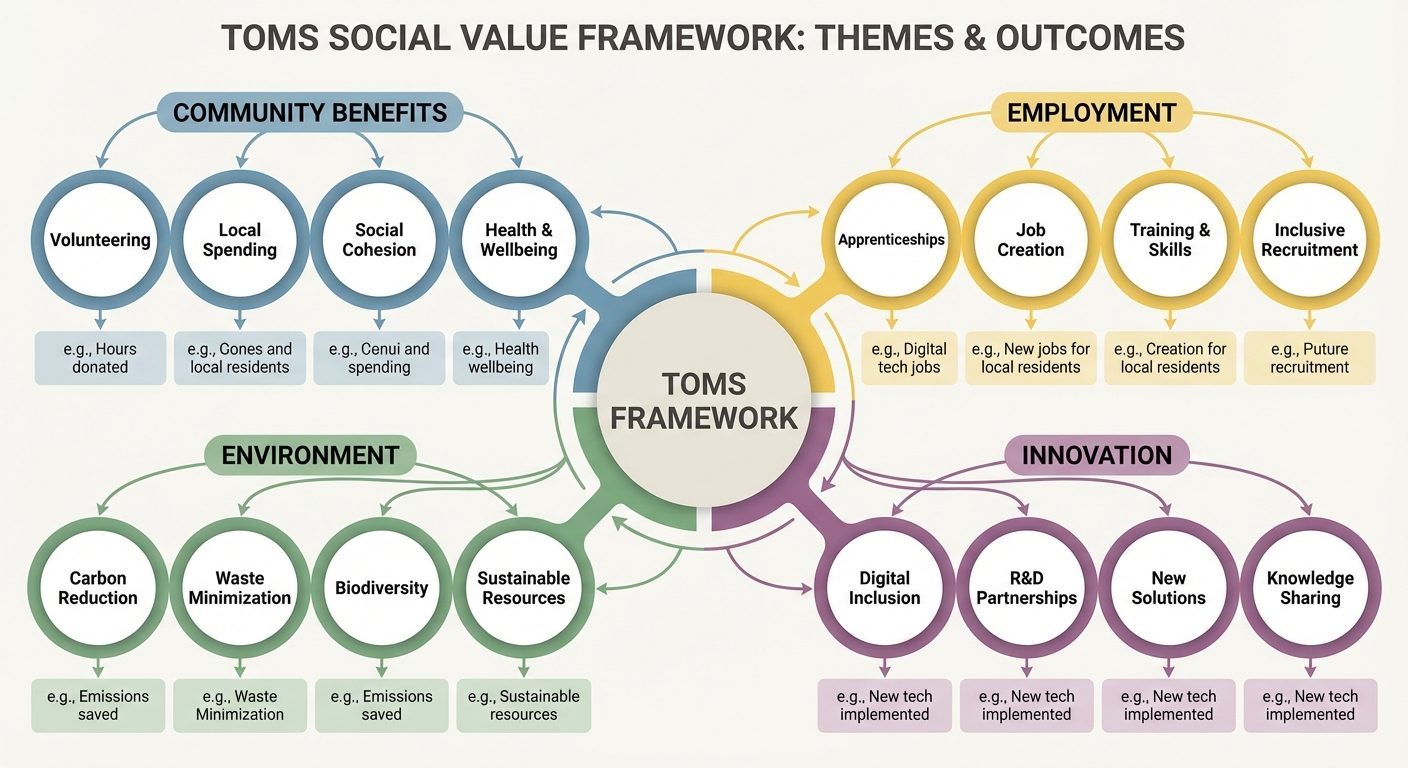
Social value TOMS framework diagram showing themes, outcomes, and measurement approach for community benefits
Your social value proposals must be realistic, measurable, and integrated into your delivery approach. Contracting authorities are increasingly sophisticated in distinguishing between genuine commitments and vague promises. Compliance means providing evidence of past social value delivery, clear methodologies for tracking outcomes, and resource commitments that demonstrate serious intent.
Exclusion Grounds: Expanded Disqualification Criteria
The Procurement Act maintains and in some cases expands the grounds on which suppliers can be excluded from procurement processes. These exclusion grounds operate as absolute compliance requirements—if you fall within any of them and fail to disclose this or demonstrate self-cleaning measures, your bid will be rejected.
Mandatory exclusion grounds include certain criminal convictions, breaches of competition law, insolvency proceedings, serious professional misconduct, and failure to pay taxes or social security contributions. The Act also provides discretionary exclusion grounds that contracting authorities can apply, including previous poor performance, misrepresentation, or conflicts of interest.
For tender compliance, you must conduct thorough due diligence on your organisation and any key subcontractors before beginning a tender response. The selection questionnaire will require declarations about exclusion grounds, and false declarations constitute grounds for immediate disqualification and potential prosecution.
If your organisation has any issues that might trigger exclusion grounds, you must either demonstrate that you have taken self-cleaning measures or make a strategic decision not to bid. Attempting to hide or minimise issues that later come to light is far more damaging than upfront disclosure with evidence of remediation.
Building a Tender-Ready Compliance Framework
Achieving compliance with the Procurement Act's requirements isn't something that happens during the tender writing process—it requires year-round preparation and maintenance of organisational systems that ensure you're always ready to bid.
Establishing Robust Documentation Systems
The foundation of tender readiness is having all necessary documentation prepared, current, and immediately accessible. This includes certifications, insurance policies, financial statements, quality management systems, health and safety policies, environmental management certifications, and evidence of past performance.
Each document must be dated, signed by appropriate authorities, and valid on the date of tender submission. Many tenders are lost because organisations discover too late that a crucial certification has expired or that their insurance coverage doesn't meet the required thresholds.
Implement a calendar system that tracks renewal dates for all key documents, with reminders set well in advance to ensure renewals are processed with time to spare. Assign clear responsibility for maintaining each category of documentation, and conduct quarterly reviews to ensure nothing falls through the cracks.
Financial documentation deserves particular attention. The Procurement Act requires enhanced transparency about ownership structures and economic standing. You'll need up-to-date accounts, audited where appropriate, as well as clear documentation of your ownership structure including any beneficial owners with 25% or more control.
Developing Compliance-First Tender Writing Processes
Your tender writing process should be designed around compliance as the foundational requirement, with persuasive content and differentiation built on top of this solid compliance base.
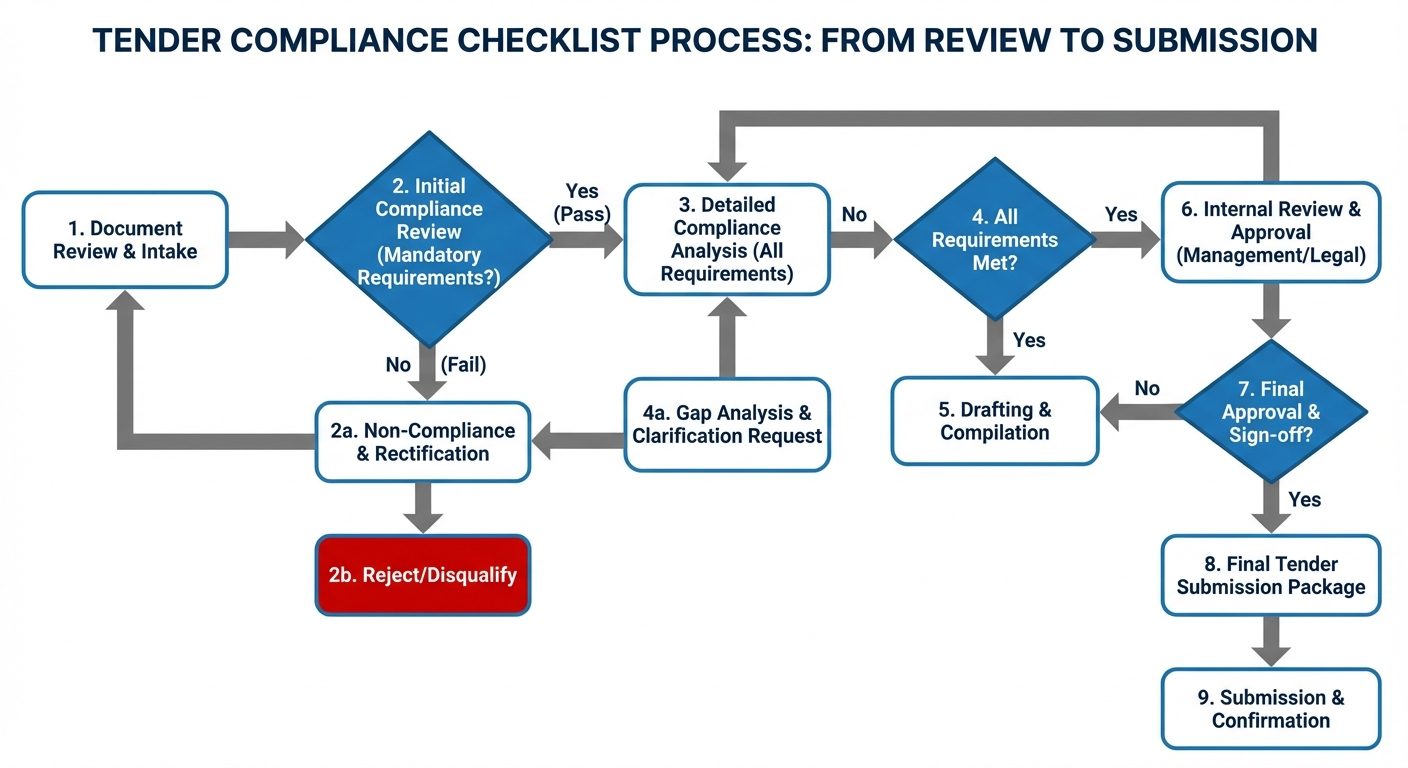
Tender compliance checklist flowchart showing the process from document review through mandatory checks to final submission
Begin every tender response with a comprehensive compliance checklist derived from the specific tender documents. Before a single word of narrative is written, identify every mandatory requirement, every question that must be answered, every document that must be submitted, and every declaration that must be completed.
Assign responsibility for each compliance element to specific team members, with clear deadlines that allow for internal review before the final submission deadline. The most common cause of non-compliance is not ignorance of requirements but poor project management that results in elements being overlooked or completed hastily.
Implement a mandatory peer review process where someone other than the primary writer checks every compliance element against the original tender documents. Familiarity breeds blindness—the person who has been immersed in writing the bid can easily miss omissions that a fresh pair of eyes will spot immediately.
Use checklists and templates that have been specifically designed for Procurement Act 2023 compliance. Legacy templates from pre-2025 tenders may not include all the new requirements, leading to inadvertent non-compliance.
Supplier Due Diligence for the Supply Chain
Under the Procurement Act, prime contractors bear significant responsibility for the compliance of their subcontractors and supply chain partners. Contracting authorities increasingly require detailed information about key subcontractors as part of the tender submission, including their financial standing, technical capability, and compliance with exclusion grounds.
This means your tender-ready framework must extend beyond your own organisation to encompass thorough vetting of your regular supply chain partners. Before including any subcontractor in a tender response, you should have already conducted due diligence equivalent to what the contracting authority would conduct on your own organisation.
Maintain a preferred supplier list with regularly updated documentation from each partner. This should include their certifications, insurance, financial information, references, and declarations regarding exclusion grounds. Having this information readily available dramatically reduces the time required to compile a compliant tender response.
When engaging new subcontractors for a specific opportunity, build sufficient time into your bid process to complete thorough due diligence. The risk of including a non-compliant subcontractor is too great to justify shortcuts in this area.
Training and Capability Development
Compliance with the Procurement Act's requirements isn't just about documentation—it requires knowledge and skills distributed throughout your organisation. Everyone involved in tender preparation needs training on the new regime, and regular refresher training should be scheduled to ensure knowledge stays current.
This training should cover not just the procedural requirements but also the philosophy behind them. Understanding why the Act requires certain information or processes helps team members make better judgments about how to respond to ambiguous requirements or unanticipated situations.
Consider developing internal certification for staff involved in tender writing, ensuring they've demonstrated understanding of compliance requirements and capability to apply them correctly. This creates accountability and ensures that compliance isn't dependent on a single expert who may not always be available.
Writing Compliant Tender Responses: Practical Techniques
With a solid compliance framework in place, the actual process of writing tender responses becomes more manageable and less prone to costly errors. These practical techniques help ensure that your submissions meet all requirements whilst also being persuasive and competitive.
Mandatory Requirements: The Non-Negotiable Foundation
Every tender contains mandatory requirements that must be met for your submission to be considered. These typically include submission deadlines, response formats, specific questions that must be answered, required appendices, and declarations that must be completed.
Identify all mandatory requirements during your initial review of the tender documents, and create a master compliance checklist. Mark each item as you complete it, and conduct multiple reviews to ensure nothing has been missed.
Pay particular attention to seemingly minor requirements like page limits, font sizes, file formats, and naming conventions. Contracting authorities are within their rights to reject submissions that violate these requirements, and many do so to manage the volume of responses they receive.
When answering mandatory questions, ensure you actually answer what has been asked. A common compliance failure occurs when tender writers provide excellent information that doesn't directly respond to the specific question posed. Read each question carefully, identify the specific information being requested, and structure your response to address that requirement explicitly before adding supporting detail.
Demonstrating Understanding of the Contracting Authority's Needs
Compliance under the MAT regime requires demonstrating not just technical capability but genuine understanding of the contracting authority's specific context, challenges, and objectives. Generic responses that could apply to any similar contract are unlikely to score highly even if they meet minimum compliance standards.
Research the contracting authority thoroughly before writing your response. Review their published strategies, annual reports, committee minutes, and previous procurement notices. Understand their political priorities, demographic challenges, financial constraints, and strategic objectives.
Reference this research explicitly in your tender response. Show that you understand not just the technical requirements of the contract but how successful delivery will help the authority achieve its broader objectives. Connect your proposed approach to their published strategies and demonstrate awareness of the context in which they operate.
For example, if bidding to provide services to a local authority that has published a climate emergency declaration and carbon neutrality target, your response should explicitly address how your delivery approach supports these commitments. If the authority has published data showing demographic changes that create service pressures, demonstrate that you understand these trends and have designed your approach accordingly.
Social Value Proposals: Making Commitments Count
Social value sections of tender responses require particular care to achieve compliance whilst being genuinely competitive. The challenge is to make commitments that are substantial enough to score well whilst being realistic enough that you can deliver them if awarded the contract.
Structure your social value proposals using the SMART framework: Specific, Measurable, Achievable, Relevant, and Time-bound. Vague commitments like "we will support local communities" provide no assurance of delivery and will score poorly. Instead, specify exactly what you will do, how you will measure it, and what resources you will commit.
Quantify your social value commitments wherever possible. Rather than stating that you will employ local people, commit to ensuring that a specified percentage of staff working on the contract will be recruited from within a defined local area. Rather than promising to support skills development, commit to providing a specified number of apprenticeships, work experience placements, or training hours.
Demonstrate a clear methodology for tracking and reporting social value delivery. Contracting authorities need assurance that you can evidence outcomes, not just activities. Show that you have systems in place to collect data, calculate social value using recognised methodologies like TOMS, and provide transparent reporting.
Importantly, ensure that your social value commitments are integrated into your overall delivery approach rather than treated as an add-on. The most credible social value proposals show how social value creation is embedded in your business model and delivery methodology rather than being a separate activity funded from profit margins.
Risk Management and Mitigation Strategies
Contracting authorities use tender evaluation partly to assess and minimise risk. A compliant tender response must identify relevant risks and demonstrate robust mitigation strategies that give the authority confidence in your ability to deliver successfully.
Avoid the temptation to minimise or ignore risks in an attempt to appear more capable. Sophisticated evaluation teams recognise that all contracts involve risks, and they're more impressed by suppliers who demonstrate awareness of risks and capability to manage them than by those who claim everything will go smoothly.
Identify contract-specific risks that arise from the particular requirements, timescales, or context of the opportunity. Generic risk registers that could apply to any contract suggest you haven't thoroughly analysed this specific opportunity.
For each identified risk, provide a clear mitigation strategy that includes preventive measures (how you'll reduce the likelihood of the risk occurring) and contingency plans (how you'll respond if the risk materialises despite preventive measures). Assign clear responsibility for risk monitoring and provide evidence that your proposed risk management approach is embedded in your quality management systems rather than being created specifically for this bid.
Pricing: Transparency and Competitiveness
The Procurement Act's transparency requirements extend to pricing, and your tender submission must provide clear, detailed, and justifiable cost information. The format and level of detail required will be specified in the tender documents, and compliance means providing exactly what has been requested in the required format.
Break down your pricing to show how costs have been calculated. This typically includes staffing costs (with day rates or hourly rates specified), materials, equipment, overhead allocations, and profit margins. The level of transparency required may feel uncomfortable if you're accustomed to providing lump sum prices, but it's essential for compliance.
Ensure that your pricing is consistent with your technical proposal. If your technical approach specifies certain resources, expertise, or delivery methods, your pricing must reflect the costs of providing these. Inconsistencies between technical and commercial submissions raise red flags and can result in clarification requests that weaken your competitive position.
Be prepared to justify your pricing if requested. Under the new regime, contracting authorities have more flexibility to engage with suppliers to understand and potentially negotiate pricing. Having clear documentation of how your prices have been calculated and why they represent value for money is essential.
Consider including pricing options or value engineering alternatives that demonstrate your commitment to providing best value. Show what could be achieved at different price points or with different delivery models, giving the contracting authority flexibility in their decision-making.
Technology and Tools for Compliance Management
Managing compliance with the Procurement Act's extensive requirements is significantly easier with appropriate technology and tools. Whilst it's possible to manage everything with spreadsheets and manual processes, this approach increases risk and reduces efficiency.
Document Management Systems
A robust document management system ensures that all compliance documentation is stored securely, version-controlled, and easily accessible to authorised team members. This should include automated workflows for document review and approval, expiration date tracking, and integration with your tender writing processes.
When selecting a document management system, prioritise those that allow you to create compliance packs—pre-assembled collections of documents that are commonly required together—and that can automatically populate tender response templates with relevant information from your document library.
Cloud-based systems offer advantages for organisations with dispersed teams or those that use external consultants for tender writing support. Ensure that whatever system you choose includes appropriate security measures and audit trails that demonstrate who has accessed or modified documents.
Bid Management Platforms
Specialised bid management platforms provide functionality specifically designed for tender writing and compliance management. These typically include features like compliance checkers that automatically verify whether all requirements have been addressed, question libraries that store previously used responses for adaptation, and workflow management tools that coordinate multi-person bid teams.
The most sophisticated platforms include AI-powered features that can analyse tender documents to extract requirements, suggest relevant content from your question library, or identify inconsistencies between different sections of your response. Whilst these tools don't replace human judgment, they can significantly reduce the risk of compliance failures and improve efficiency.
Integration capabilities are important when selecting a bid management platform. The system should integrate with your document management system, CRM, project management tools, and financial systems to streamline information flow and reduce manual data entry that can introduce errors.
Compliance Monitoring and Reporting Tools
For organisations that regularly bid for contracts, maintaining visibility of compliance across multiple opportunities and tracking success rates is essential for continuous improvement. Compliance monitoring tools provide dashboards showing the status of key documents, upcoming renewal dates, and compliance performance across different tender responses.
These tools can also support post-award compliance by tracking KPI reporting requirements, contract variations, and ongoing obligations to update information on the Central Digital Platform. Treating compliance as a continuous lifecycle activity rather than a point-in-time tender submission requirement is essential under the new regime.
Common Compliance Failures and How to Avoid Them
Despite the best intentions, compliance failures continue to be the leading cause of tender rejection. Understanding the most common pitfalls helps you implement safeguards to prevent them occurring in your submissions.
Late Submission: The Preventable Disaster
Late submission is the most frustrating compliance failure because it's entirely preventable. Yet it continues to account for a significant proportion of tender rejections, often affecting organisations with otherwise strong proposals.
The primary cause of late submission isn't ignorance of the deadline—it's inadequate time management during the bid process that results in a last-minute rush. Implement internal deadlines that are at least 24 hours before the official submission deadline, allowing time to address any technical issues with the submission portal or to make final corrections without panic.
Build buffer time into your bid schedule to account for unexpected complications. If key personnel are unavailable due to illness, if required information from subcontractors arrives late, or if technical problems occur with your systems, you need contingency time to handle these issues without missing the deadline.
Test the submission process well before the deadline. Many e-tendering portals have file size limits, specific format requirements, or technical quirks that can cause problems. Conducting a test submission (where the platform allows this) or at least verifying that you can access the submission area and that your files meet technical requirements should happen days before the deadline, not hours.
Incomplete Responses: Missing the Obvious
Incomplete responses occur when tender writers fail to answer all questions, omit required appendices, or miss sections of the tender documentation. This seems like an obvious error that shouldn't occur, yet it's remarkably common, particularly in lengthy or complex tender documents.
The root cause is usually attempting to work from summary notes or extracts rather than systematically working through the complete tender documentation. Create a compliance checklist by literally going through every page of the tender documents and noting every question, requirement, or requested item of information.
Assign a unique reference number to each item on your compliance checklist, and mark this reference in your tender response document where you address that requirement. This creates a clear audit trail showing that every requirement has been addressed and makes it easy to locate specific content if you need to review or revise it.
Conduct multiple reviews using your compliance checklist. Have different team members review different sections, and designate one person to conduct a final comprehensive review of the entire submission against the complete checklist before submission.
Non-Compliant Formatting and Presentation
Many tenders specify formatting requirements such as page limits, font sizes, margin widths, or file formats. Violating these requirements, even unintentionally, can result in rejection or in content beyond page limits being disregarded.
Create tender response templates that meet common formatting requirements, and modify these for each specific opportunity based on what the tender documents specify. Use styles and automated formatting in your word processing software rather than manual formatting, which is more prone to inconsistencies.
Pay particular attention to page limits. If a question has a two-page limit, use exactly two pages—going over is non-compliant, but significantly under-using the space may suggest you don't have sufficient capability to discuss. Plan your content carefully to use the available space effectively.
When converting documents to required file formats (typically PDF), verify that the conversion has maintained formatting and that all content is present and readable. Occasionally font embedding or image compression can cause problems that make submitted documents difficult to read or that change pagination.
Inadequate or Expired Documentation
Submitting documentation that doesn't meet specifications or that has expired is a common compliance failure that suggests poor organisational systems. Examples include insurance certificates with coverage amounts below required thresholds, certifications that expired before the tender deadline, or financial statements that are older than the specified period.
Implement a compliance calendar that tracks all document expiration dates and renewal requirements. Set reminders at least three months before expiration to ensure renewal processes are completed with time to spare before documents are needed for tender submissions.
When reviewing tender requirements, verify not just that you have the required documents but that they meet all specifications regarding coverage amounts, scope, dates of validity, and issuing authorities. A certificate that almost meets requirements is still non-compliant.
If you discover that a required document has expired or doesn't meet specifications, be proactive about renewal or upgrade. The time and cost of bringing documentation into compliance is trivial compared to the opportunity cost of being unable to bid or being rejected for non-compliance.
Conflicts and Inconsistencies Within the Response
Large tender responses written by multiple contributors often contain internal conflicts or inconsistencies that undermine credibility and can constitute non-compliance. Examples include different sections describing different delivery approaches, technical and commercial sections based on inconsistent assumptions, or contradictions between the main response and appendices.
Designate a lead bid writer with responsibility for overall coherence and consistency across all sections. This person should conduct multiple reviews specifically looking for conflicts, and should have authority to revise content to ensure the entire response tells a consistent story.
Use a bid plan or response framework agreed by all contributors before writing begins. This should specify key messages, the proposed delivery approach, assumptions about resources and timing, and other elements that need to be consistent across different sections.
Conduct a consistency review meeting where representatives from different writing teams present their sections and other team members challenge any apparent conflicts or inconsistencies. This collaborative review is more effective at catching problems than individual reviews.
Continuous Improvement: Learning from Feedback
The Procurement Act's transparency requirements create new opportunities for learning and continuous improvement. When your tender is unsuccessful, request feedback from the contracting authority about both your compliance and your competitive performance.
Feedback on compliance failures is particularly valuable because it reveals systemic issues in your tender preparation processes rather than just content weaknesses. If feedback indicates that you failed to address specific requirements, this suggests problems with your compliance checking processes that need to be fixed.
Maintain a lessons-learned database that captures compliance issues identified in tender feedback, along with the corrective actions you've implemented. Review this database before starting each new tender to ensure previous mistakes aren't repeated.
Track your tender success rate and analyse patterns in wins and losses. If you're being eliminated at the compliance stage more frequently than industry norms would suggest, this indicates that your tender-ready framework needs strengthening. If you're passing compliance but losing on quality, the focus should be on developing more persuasive technical content.
Benchmark your processes against industry best practices and consider engaging external expertise to audit your compliance framework and tender writing processes. An external perspective can identify blind spots and opportunities for improvement that internal teams may miss.
Looking Ahead: Preparing for Ongoing Evolution
The Procurement Act 2023 establishes a framework that will continue to evolve through secondary legislation, guidance documents, and developing practice. Maintaining compliance requires staying informed about these developments and adapting your processes accordingly.
Subscribe to updates from the Cabinet Office, the Crown Commercial Service, and relevant professional bodies. Attend webinars and training sessions about procurement law developments. Participate in supplier forums where contracting authorities share information about their implementation of the new regime.
Build flexibility into your compliance framework and tender writing processes so that you can adapt quickly when requirements change. Avoid hardcoding specific requirements into templates or checklists in ways that would require extensive revision if requirements evolve.
Consider the Procurement Act as establishing minimum requirements rather than best practice. Organisations that view compliance as a ceiling to reach will always be playing catch-up. Those that view it as a foundation to build upon—implementing practices that exceed minimum requirements and demonstrate commitment to transparency, social value, and excellence—will be better positioned for success.
Conclusion: Compliance as Competitive Advantage
In the transformed UK public sector procurement landscape of 2026, compliance with the Procurement Act 2023 requirements is not merely a gateway to be passed—it's an opportunity to demonstrate professionalism, capability, and commitment to the principles of transparency and value creation that underpin the new regime.
Organisations that invest in robust compliance frameworks, that train their teams thoroughly, that maintain meticulous documentation, and that approach tender writing with systematic attention to requirements will not only avoid the costly error of rejection for non-compliance but will also find that their organised, professional approach extends to the quality of their technical proposals.
The compliance requirements of the Procurement Act may initially appear burdensome, but they create a more level playing field where quality and capability can compete fairly, where smaller organisations with excellent solutions aren't disadvantaged by opaque processes, and where public sector buyers can make decisions based on genuine value rather than familiarity or risk aversion.
Embrace compliance not as an administrative burden but as an integral component of your commitment to excellence. The organisations that thrive under the new regime will be those that recognise that meeting obligations to transparency, social value, environmental responsibility, and ethical conduct isn't just about winning contracts—it's about contributing to a public sector procurement system that delivers better outcomes for communities, taxpayers, and society as a whole.
Success in 2026 and beyond requires treating procurement compliance as an organisational capability to be developed continuously, not a checklist to be completed hastily during tender preparation. Invest in your systems, train your people, maintain your documentation, and approach every tender with professional attention to detail. The rewards—in contract wins, in reputation, and in the sustainable growth of your public sector business—will justify the investment many times over.
Tags
Ready to Transform Your Tender Writing?
See how MyTender's AI can help you write winning tenders in a fraction of the time.