

Procurement Act 2023 KPI Reporting for Suppliers: The Complete 2026 Guide
Master mandatory KPI reporting under the Procurement Act 2023. Learn what metrics to track, how to avoid the debarment list, and how to use performance data to win more public sector contracts.
Evie
Procurement Specialist
The Procurement Act 2023 changed the rules. Not just the rules for winning contracts, but the rules for keeping them — and for everything that comes after. For suppliers working with UK public sector bodies, one of the most consequential changes is the introduction of mandatory KPI (Key Performance Indicator) reporting for contracts above a certain threshold.
This isn't a minor administrative update. It's a fundamental shift in how the government monitors supplier performance, shares that data publicly, and uses it to inform future procurement decisions. Get it right, and your KPI record becomes a competitive asset. Get it wrong, and you risk ending up on the debarment register — with serious consequences for your ability to win public contracts at all.
This guide covers everything you need to know: what the rules actually require, which contracts are caught, how to set up compliant KPI frameworks, and how to use your performance data strategically to improve your win rate on future bids.
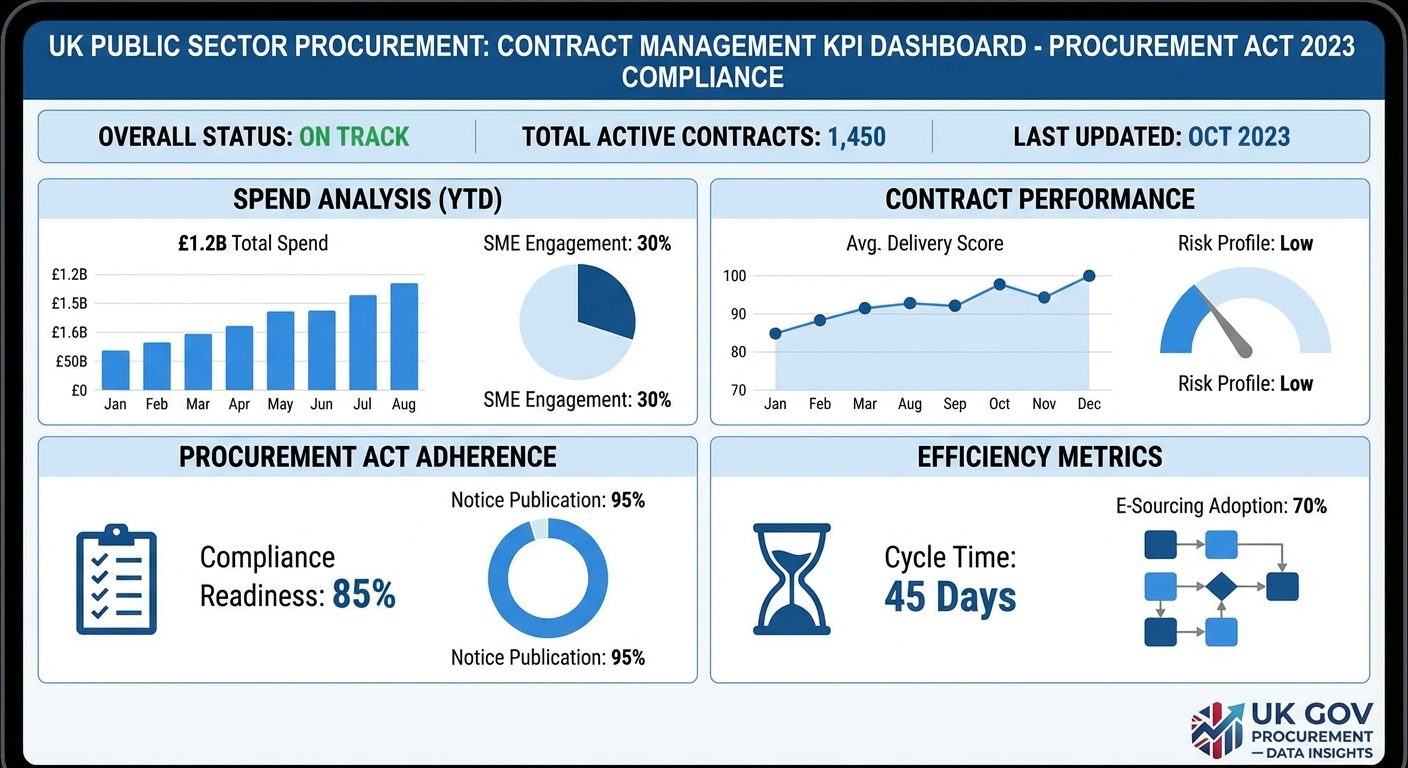
Procurement KPI reporting dashboard showing contract performance metrics and compliance tracking
What the Procurement Act 2023 Actually Requires
The Procurement Act 2023 came into full effect in February 2025, replacing the Public Contracts Regulations 2015 and a patchwork of related legislation. Alongside changes to how contracts are awarded — the shift from Most Economically Advantageous Tender (MEAT) to Most Advantageous Tender (MAT) — the Act introduced a new contract management and transparency regime.
The headline requirement: suppliers on contracts above the relevant thresholds must report on agreed KPIs at intervals specified in the contract. Contracting authorities must then publish the results on the central digital platform (the government's Find a Tender successor system) and make them publicly accessible.
This matters for three reasons. First, buyers can now see your track record before they award you new business. Second, persistent underperformance triggers escalating consequences, up to and including debarment. Third, strong performance data becomes quantifiable social proof you can reference in future tender responses.
Which Contracts Are Caught?
KPI reporting requirements apply to contracts above the relevant thresholds:
- Central government contracts: £5 million and above
- Wider public sector contracts (NHS, local authorities, etc.): £5 million and above
- Utilities and defence: Subject to their own thresholds under associated regulations
Below these thresholds, contracting authorities still have discretion to impose KPI reporting requirements, and many do. If your contract includes KPI provisions — regardless of value — treat them as mandatory. The legal consequences of non-compliance apply wherever the requirement is explicitly included in contract terms.
It is also worth noting that the Act catches subcontracting relationships. If you are a subcontractor delivering a significant portion of an above-threshold contract, your prime contractor may pass KPI obligations down the supply chain. You need to understand your exposure at every tier.
The Central Digital Platform Connection
The Central Digital Platform (CDP) is the government's new procurement transparency infrastructure. Suppliers must register on the CDP and keep their information current — basic company data, financial information, and ultimately KPI reports flowing from live contracts.
When a contracting authority publishes your KPI performance data on the CDP, it becomes searchable by other buying organisations. This is the transparency mechanism that gives the Act its teeth. A poor record with one NHS trust, for example, is no longer invisible to a local authority evaluating your bid for a new contract.
Registration and data maintenance on the CDP isn't optional — it is a condition of being awarded above-threshold contracts. If you haven't completed your CDP registration, do it now.
Setting Up a Compliant KPI Framework
Most suppliers fail KPI reporting not because their performance is bad, but because their internal systems weren't built to capture the data they need to report. The time to set up your KPI framework is before the contract starts, not after you receive the first reporting request.
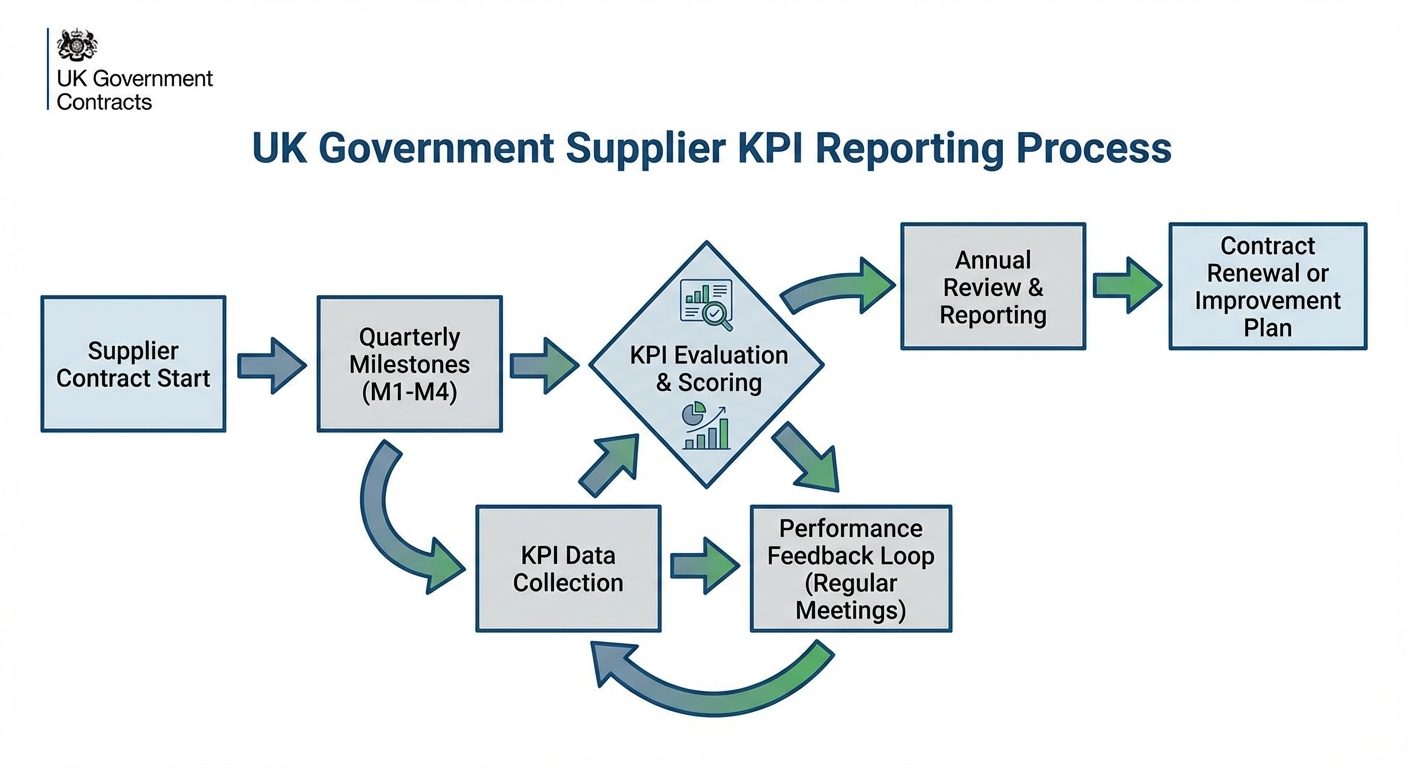
Supplier KPI reporting process flow for UK government contracts
Step 1: Understand What KPIs the Contract Specifies
Every above-threshold contract must specify the KPIs that will be reported and the methodology for measuring them. These are typically set out in the contract schedules — look for a "Performance Management Framework," "KPI Schedule," or similar section.
Common KPI categories in public sector contracts include:
Service delivery metrics: On-time delivery rates, response times, service availability, completion rates. These vary enormously by sector — a cleaning contract will measure something very different from an IT services contract. Quality indicators: Defect rates, complaint volumes, audit outcomes, accreditation compliance. Buyers often look for both absolute performance and trend data (improving vs. declining). Financial metrics: Spend against budget, savings delivered, invoice accuracy, payment terms compliance. Social value indicators: Employment of disadvantaged groups, apprenticeship starts, supply chain SME spend, carbon reduction against baseline. Social value KPIs are becoming increasingly prominent and are often weighted at 10% or more of overall contract performance. Contract management indicators: Reporting timeliness, management information accuracy, escalation response times.If the contract KPIs seem vague or undefined, push back during contract negotiations. Ambiguous KPIs create disputes later. You want clear definitions, agreed baselines, and unambiguous measurement methodologies before you sign.
Step 2: Map KPIs to Internal Data Sources
For each KPI, trace it back to where the underlying data lives in your business. Who owns it? Is it captured automatically by a system, or does someone need to compile it manually? How reliable is the data? What's the lag between activity happening and data being available?
This mapping exercise frequently surfaces gaps. A supplier might discover that their job management system captures completion dates but not the time the original request was raised — making on-time delivery measurement impossible without a manual workaround. Better to discover this at contract start than when the first report is due.
Step 3: Build Your Reporting Rhythm
Establish a clear internal calendar for KPI data collection, review, and submission. Most contracts require quarterly reporting, but some specify monthly or even monthly spot-checks with quarterly formal reports.
Key discipline: never leave KPI reporting to the last minute. Data quality deteriorates rapidly if you're compiling it retrospectively. The best suppliers treat KPI data collection as an ongoing operational activity, not a periodic reporting task.
Assign ownership. There should be a named individual responsible for each KPI — not just for reporting it, but for managing the underlying performance it measures. Without individual accountability, KPI management becomes nobody's job.
Step 4: Agree the Reporting Format with the Contracting Authority
The Procurement Act specifies what must be reported, but gives contracting authorities discretion on format. Some have standard templates; others will accept your own format provided it contains the required information. Agree this upfront to avoid wasted effort.
Whatever format you use, make sure it includes: the KPI definition, the target, the actual performance for the period, any variance explanation, and the trend compared to previous periods. Clear narrative on underperformance and remediation actions is not optional — it is what separates a supplier who is managing their contract from one who is simply submitting numbers.
The Debarment Regime: Understanding Your Risk
One of the most significant new elements of the Procurement Act 2023 is the formal debarment regime. A debarment list is now maintained by the government, and suppliers on the list are excluded from competing for above-threshold public contracts — including frameworks and dynamic purchasing systems.
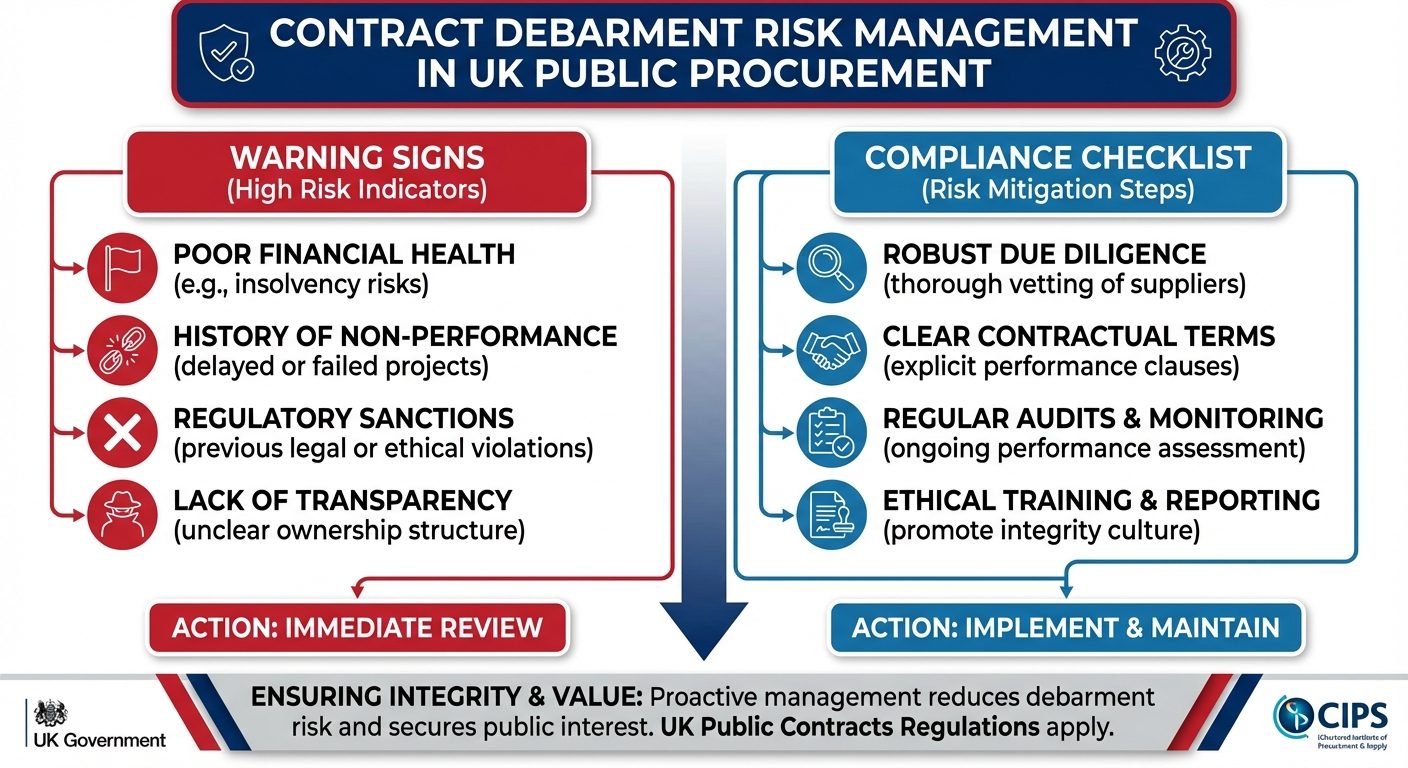
Contract debarment risk management in UK public procurement
What Gets You on the Debarment List?
Debarment is a serious sanction, not triggered by minor or one-off performance issues. The grounds for debarment under the Act include:
Mandatory exclusion grounds: These are absolute — a supplier must be excluded if they apply. They include serious criminal convictions (fraud, corruption, money laundering, modern slavery offences), failure to pay taxes, and sanctions violations. Discretionary exclusion grounds relevant to performance: These are the ones suppliers need to watch. They include: significant or persistent failure to perform a public contract without reasonable excuse; serious misrepresentation in connection with a procurement; and conduct that puts national security at risk.The "significant or persistent failure to perform" ground is the one most likely to be triggered by chronic KPI underperformance. This isn't about missing a target in one quarter — it's about sustained, documented failure across a contract lifecycle, particularly where the supplier has not engaged constructively with remediation.
The Debarment Process
Debarment isn't automatic. A contracting authority must refer a supplier to the Cabinet Office Debarment Panel, which conducts an independent investigation. The supplier has the right to make representations before any debarment decision is made.
However, the process itself carries consequences. Being under investigation for potential debarment can affect your ability to pass pre-qualification checks even before any formal decision is made. And once on the debarment list, the exclusion can last up to five years.
Practical Risk Management
The practical lesson is straightforward: if your performance is deteriorating, don't wait for the contracting authority to raise it. Escalate proactively, propose a remediation plan with specific milestones, and document everything. Buyers generally prefer a supplier who identifies problems early and fixes them to one who conceals issues until they become crises.
Maintain a paper trail of every performance conversation, every agreed remediation step, and every improvement milestone. If things escalate, your documentation is your defence.
Using KPI Data Strategically: Turning Compliance into Competitive Advantage
Most suppliers treat KPI reporting as a compliance burden. The smarter ones treat it as a marketing asset.
Think about what public KPI data actually represents: verified, third-party-published evidence of your performance on live contracts. That is exactly what tender evaluators want but can almost never get — objective proof that your bid claims match your operational reality.
Referencing Performance Data in Tender Responses
Under the Procurement Act's transparency regime, your published KPI records are accessible to any buyer researching potential suppliers. But don't wait for them to find it — reference it actively in your tender responses.
When writing case studies and evidence sections, cite specific KPI outcomes from completed or ongoing contracts. Instead of saying "we consistently deliver on time," write "our Q3 2025 KPI report for [contracting authority name], published on the Central Digital Platform, shows a 97.3% on-time delivery rate against a 95% target."
This is quantified, verifiable, third-party-endorsed evidence. It carries far more weight with evaluators than self-reported performance claims.

Bid team reviewing performance metrics and tender submission strategies
Building a Performance Narrative
Beyond individual data points, your KPI history tells a story. If you have multiple contracts with strong performance records, that pattern is powerful evidence of organisational capability. If you had a difficult contract two years ago but your performance has demonstrably improved, that narrative of learning and adaptation can itself be a selling point.
Buyers are not expecting perfection. They are looking for suppliers who understand what drives performance in their sector, who have the systems to measure it honestly, and who respond constructively when things go wrong. A supplier who can show that story with data is a supplier a buyer can trust.
Social Value KPIs as Differentiation
Social value performance is increasingly tracked through KPI frameworks, and it is an area where strong data can genuinely differentiate your bid. If your contracts show that you consistently deliver apprenticeship starts, pay the Real Living Wage across your supply chain, or exceed carbon reduction targets, those outcomes matter — both to evaluators weighting social value criteria and to buyers who care about reputational risk.
Keep granular records of social value delivery. Measure outcomes, not just inputs. "We delivered 23 apprenticeship starts across two contracts in 2025" is more compelling than "we have an apprenticeship programme."
Sector-Specific KPI Considerations
KPI frameworks vary significantly by sector. Here's a brief overview of what matters in the most active areas of UK public procurement.
Construction and Infrastructure
Performance metrics in construction typically focus on programme adherence (time against schedule), cost performance (final account vs. target cost), quality (defect rates, snagging completion), health and safety (RIDDOR incidents, near-miss reporting), and environmental impact (waste diversion rates, embodied carbon).
Framework contracts in this sector often use NEC4 or JCT conditions, which have performance measurement mechanisms built in. Suppliers on Crown Commercial Service or Procurement Frameworks frameworks face additional scrutiny because poor performance affects the entire supply chain they represent.
The government's Construction Playbook, updated to align with the Procurement Act, emphasises outcome-based measurement and collaborative contract management. If you're in construction, review your KPI frameworks against the Playbook guidance.
NHS and Healthcare
Healthcare contracts carry the highest stakes for performance failures — both commercially and in terms of public safety. KPI frameworks typically include patient outcome indicators, infection control compliance, equipment availability, response times, and regulatory compliance (CQC requirements, MHRA regulations).
NHS trusts and ICBs are increasingly joining collaborative procurements through NHS Shared Business Services and regional frameworks. Performance records from one trust are visible to others in the same ICS, making strong KPI delivery across your NHS portfolio a genuine competitive differentiator.
Facilities Management
FM contracts typically measure service delivery (helpdesk response, planned maintenance completion), compliance (statutory inspections, building regulations), environmental performance (energy consumption, waste management), and customer satisfaction (tenant surveys, complaint resolution times).
The shift to outcome-based FM contracts — paying for outcomes like comfort and productivity rather than tasks completed — requires more sophisticated KPI frameworks. Suppliers who have already built the data infrastructure to support outcome-based reporting are better positioned for this growing contract type.
IT and Digital Services
Technology contracts face a particular challenge: KPIs must evolve as technology evolves. Service availability (uptime), security incident response, user adoption rates, and system performance benchmarks are standard, but the specific targets need regular review.
G-Cloud and Digital Outcomes framework suppliers face quarterly performance reviews against Service Level Agreements that feed directly into renewal decisions. Your G-Cloud service status is also partially visible through published customer reviews — another public performance signal.
Common KPI Reporting Mistakes and How to Avoid Them
After working with dozens of suppliers on contract performance management, certain failure patterns repeat consistently.
Mistake 1: Setting targets that are too easy.Negotiating low targets to ensure you always hit them is a short-term tactic that backfires. Evaluators comparing KPI records across suppliers will notice that your "95% on-time delivery against a 90% target" is less impressive than a competitor's "97% against a 95% target." Stretch yourself to targets that are genuinely aspirational.
Mistake 2: Confusing activity with outcome.A KPI that measures how many visits your team made to a client site measures activity. A KPI that measures whether client satisfaction scores improved measures outcome. Buyers increasingly want outcomes, not activities. Push back on activity-based KPIs during contract negotiation and propose outcome equivalents.
Mistake 3: Treating social value KPIs as optional extras.Social value commitments made in your tender response become contractual obligations. If you bid on the basis of delivering 50 apprenticeship starts and you deliver 12, that discrepancy will appear in your KPI report and it will damage your reputation. Only commit to what you can deliver — and then over-deliver.
Mistake 4: Leaving reporting to the contract manager alone.KPI data touches every part of your operation — HR for social value metrics, finance for cost performance, operations for service delivery. Contract managers who try to compile KPI reports without embedded data systems across the business consistently struggle with quality and timeliness. KPI management is an organisational capability, not an individual one.
Mistake 5: Not reviewing and learning.KPI data tells you what happened. The more valuable question is why — and what you're going to do differently. Set up quarterly internal reviews of your contract KPI trends, identify root causes of underperformance, and build the findings into your operational processes. This improvement loop is what turns KPI compliance into genuine competitive advantage.
How AI is Transforming KPI Management for Suppliers
AI-powered tools are beginning to change how suppliers approach contract performance management and KPI reporting. The implications are significant.
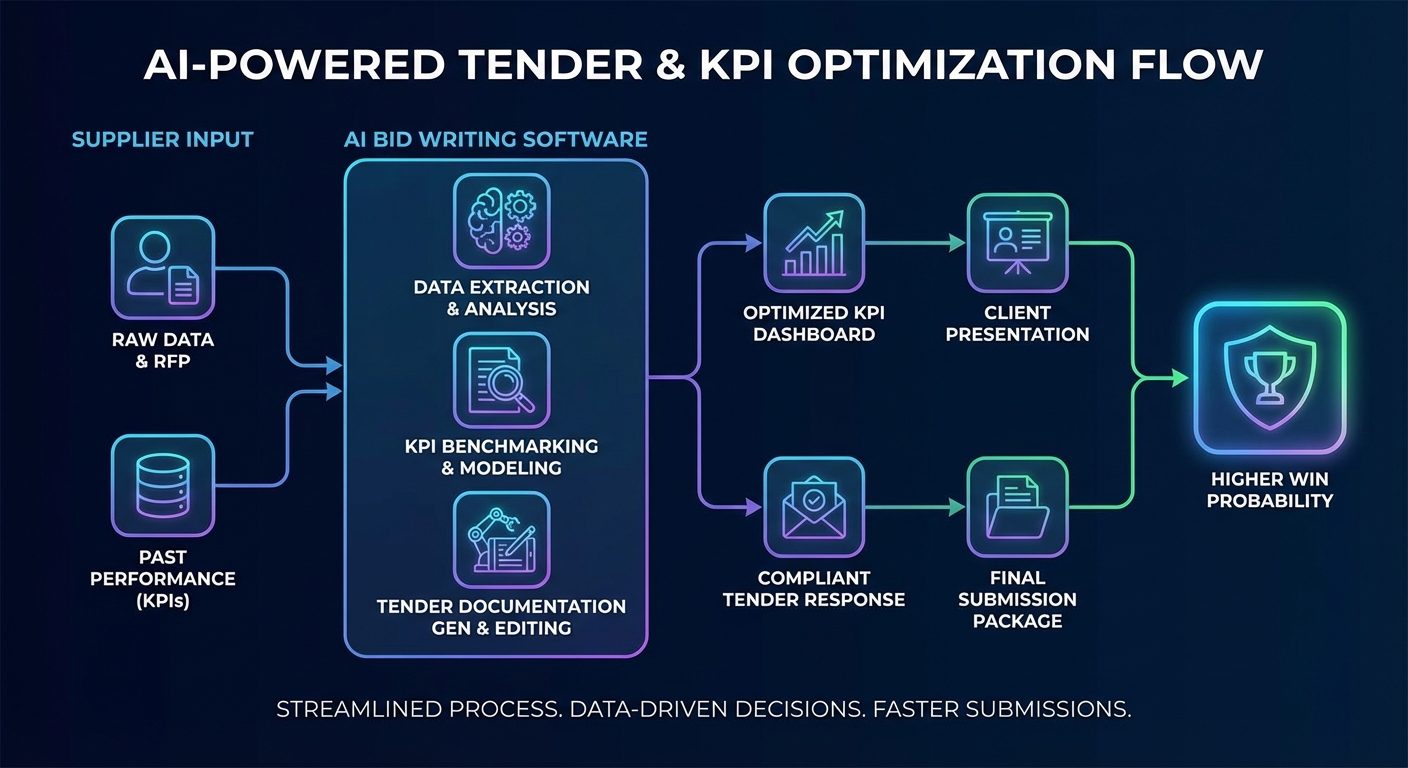
AI-powered bid writing software helping suppliers prepare KPI data and tender documentation
Automated Data Aggregation
The most immediate value is in data collection. Modern contract management platforms can connect to operational systems — job management software, HR systems, environmental monitoring tools — and aggregate KPI data automatically, eliminating the manual compilation that consumes so much contract management time.
mytender.io's platform, for example, allows suppliers to build a centralised library of performance evidence that can be drawn on both for KPI reporting and for future tender submissions. When your operations team logs a completed job, that data can simultaneously update your KPI dashboard and populate the evidence base for your next bid. This is the kind of integration that transforms compliance into competitive advantage.
AI-Assisted Narrative Writing
Beyond raw data, KPI reports require narrative — explanations of performance trends, descriptions of remediation actions, context that numbers alone can't provide. AI tools can now help draft these narratives from structured data inputs, saving significant time while maintaining the tone and specificity that evaluators expect.
For tender responses that reference KPI performance, AI can help translate dry performance data into compelling case study narratives that highlight outcomes, evidence capability, and address likely evaluator questions. The human insight still needs to be there — you understand your contracts and your client relationships in ways AI doesn't — but the drafting efficiency gains are real.
Predictive Performance Management
The most advanced applications use machine learning to identify performance risk before KPIs deteriorate. By analysing operational data patterns — resource utilisation, complaint trends, workforce absence rates — these tools can flag likely future underperformance and trigger management intervention while there is still time to course-correct.
This is particularly valuable for suppliers managing multiple contracts simultaneously, where it can be difficult for contract managers to maintain visibility across their full portfolio.
Building Your KPI Programme: A Practical Action Plan
If you are starting from scratch or overhauling a inadequate existing approach, here is a practical sequence to follow.
In the first 30 days: Register on the Central Digital Platform if you haven't already. Audit every above-threshold contract you currently hold and document the KPI requirements in each. Identify the gaps between what you need to report and what your current systems can actually measure. Days 31-60: Implement data capture fixes for identified gaps. This might mean configuring your job management system to capture additional fields, setting up a social value tracking spreadsheet, or integrating a third-party analytics tool. Agree reporting formats with each contracting authority. Days 61-90: Run your first full dry-run reporting cycle internally before submitting anything to a contracting authority. Review the outputs with senior leadership. Identify any data quality issues. Adjust collection processes as needed. Ongoing: Establish quarterly internal KPI review meetings. Use performance data to populate your tender evidence library. Review your KPI frameworks at contract milestones (year-end, mid-term reviews) and renegotiate where targets have become too easy or too hard.Frequently Asked Questions
Do KPI reporting requirements apply to contract extensions?Yes. Where a contract is extended under the Procurement Act's extension provisions, the KPI reporting obligations continue and are reset to reflect the extended contract period. Some extensions may trigger a review and update of the KPI framework itself.
What happens if I miss a KPI reporting deadline?Missing a reporting deadline is itself a performance failure and will typically be recorded by the contracting authority. Persistent late reporting can be cited as evidence of poor contract management. If you know a deadline cannot be met, notify the contracting authority in advance and agree an extension — don't simply miss it.
Can I challenge KPI assessments I believe are unfair?Yes. Contracts should include a dispute resolution mechanism for KPI assessments. If you believe a performance score is inaccurate — because of a data error, because circumstances beyond your control affected delivery, or because the measurement methodology was applied incorrectly — raise it through the formal process. Document everything and act promptly; most contracts have time limits on raising disputes.
How does KPI performance affect framework renewals?Framework agreements under the Procurement Act typically include performance review mechanisms. Suppliers who consistently underperform against KPI targets may face suspension from the framework or removal at renewal. Conversely, strong performers may be prioritised for call-off opportunities or offered extended framework terms.
Do subcontractors need to report KPIs?Directly, no — KPI reporting obligations run between the prime contractor and the contracting authority. However, prime contractors may impose equivalent obligations on key subcontractors as part of their supply chain management. If you are a subcontractor, review your subcontract terms carefully for any performance reporting obligations passed down from the prime.
The Bottom Line
The Procurement Act 2023 KPI reporting regime is one of those changes that separates suppliers who engage strategically with procurement regulation from those who simply try to keep up. The compliance bar is real — miss it, and the consequences escalate quickly. But the opportunity is equally real.
Suppliers who build robust KPI frameworks, deliver strong performance, and learn to reference that performance effectively in their tender submissions will find that the new transparency regime works in their favour. Your track record is now publicly visible and independently verified. That is powerful evidence — and evidence is what wins bids.
If you are currently managing tender submissions without a systematic approach to capturing and referencing your performance data, mytender.io can help. Our platform is built to bridge the gap between contract delivery and bid writing — so that every contract you perform well on becomes fuel for the next one.
Strong performance deserves strong recognition. Make sure your KPI data is working as hard as your team is.
Tags
Ready to Transform Your Tender Writing?
See how MyTender's AI can help you write winning tenders in a fraction of the time.