
PPN 026 and Jobs-and-Skills Social Value: What Bid Teams Need to Evidence in 2027
PPN 026 shifts central government social value towards jobs, skills and fair work. Here is how suppliers should turn that policy change into credible tender evidence.
mytender.io Research Team
Tender Writing & Bid Management Specialists
PPN 026 and Jobs-and-Skills Social Value: What Bid Teams Need to Evidence in 2027
Social value is about to get less vague.
For years, many tender responses have treated social value as a familiar bundle: apprenticeships, volunteering days, local spend, carbon reduction, charity partnerships and a few lines about community benefit.
Some of that will still matter. But PPN 026 points central government buyers towards a sharper model from 2027, with a stronger focus on jobs, skills, fair work and measurable outcomes.
That changes the bid-writing job.
The safest response is no longer a broad promise to "support the local community". The stronger response shows exactly who benefits, what changes, how it will be measured, and how the commitment links to delivery of the contract.
The winning suppliers will treat social value like a delivery workstream, not a nice paragraph near the end of the bid.
Jobs and skills social value evidence map for public sector tender responses
Why PPN 026 matters for suppliers
PPN 026 introduces a revised Social Value Model for central government procurements starting from 1 January 2027.
The headline is simple: social value is expected to carry more weight, especially on larger contracts. For contracts between £1 million and £5 million, the minimum weighting is expected to be 10%. For contracts worth £5 million or more, it rises to 20%.
That is not a side issue.
On a large public contract, 20% can decide the result. A supplier with a technically sound bid and weak social value evidence can lose to a bidder that makes the same delivery promise but proves a stronger wider benefit.
The direction of travel is also clear. Public buyers want commitments that are easier to compare, easier to monitor and harder to dress up with generic language.
That is good news for good suppliers.
If you already invest in training, apprenticeships, fair working practices, local recruitment or supply-chain development, PPN 026 gives you a better chance to turn that work into marks.
But only if you can evidence it properly.
What has changed in practical terms
The old trap in social value writing was breadth.
Bid teams tried to cover every theme because they feared missing something. The result was often a long, soft answer with too many promises and not enough substance.
PPN 026 pushes suppliers towards a narrower set of outcomes. The language coming through the market is jobs and skills first: good work, better access to opportunity, fair conditions and credible routes into employment.
For bid teams, that means three practical changes.
First, vague community benefit statements will score worse. Evaluators need to see specific, contract-relevant commitments.
Second, evidence will matter more than intent. A claim about apprenticeships is stronger when it is backed by historic numbers, named delivery partners, supervision capacity and retention data.
Third, the mobilisation plan and the social value plan need to talk to each other. If your answer promises local jobs but your mobilisation programme has no recruitment window, training owner or onboarding capacity, the promise looks thin.
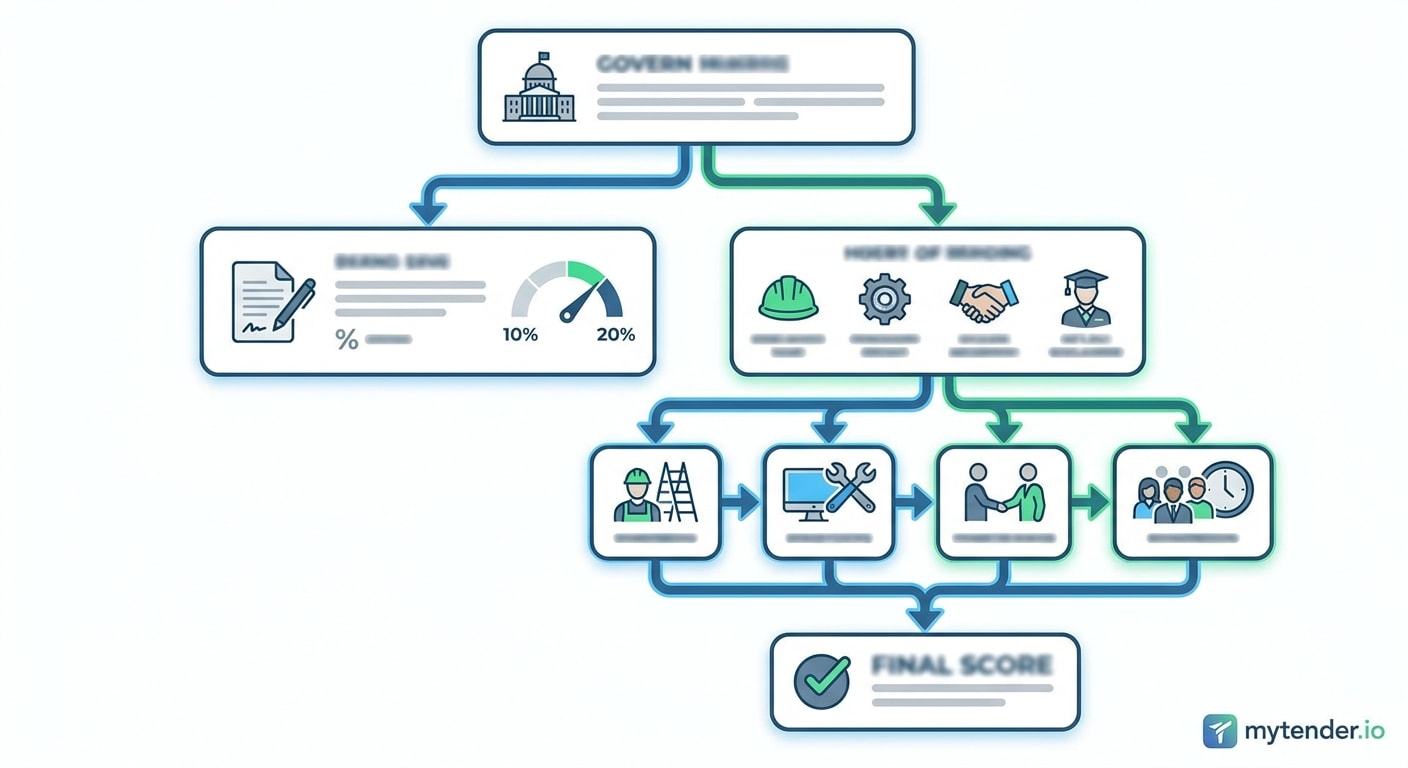
Framework for jobs, skills and fair work social value scoring in central government tenders
The new centre of gravity: jobs and skills
Jobs-and-skills social value is not just "we will create apprenticeships".
That line appears in thousands of bids. On its own, it does very little.
A credible jobs-and-skills answer explains how the contract will create or protect good work. It also shows how people will gain skills that matter beyond the life of the contract.
That could include:
- New entrant roles attached to the contract.
- Apprenticeships or traineeships with proper supervision.
- Upskilling for existing staff.
- Work placements with a real route into employment.
- Partnerships with colleges, job centres or local employability providers.
- Return-to-work routes for people facing barriers.
- Digital, technical or green-skills training linked to the contract.
- Fair pay, fair scheduling and safe working practices.
The important phrase is "linked to the contract".
A national graduate scheme might be positive, but it may not answer the question if it has no connection to the authority, geography, service users or delivery model.
Evaluators want to know what this contract makes possible.
Start with the buyer's local need
The strongest social value responses do not start with the supplier's favourite initiatives.
They start with the buyer's problem.
A waste contract might need HGV drivers, recycling education officers and supervisors who can manage route changes. A facilities management contract might need cleaning operatives, mobile engineers, helpdesk staff and supervisors who understand public buildings. A construction project might need site operatives, trade apprentices, resident liaison support and health-and-safety competence.
Each contract creates a different jobs-and-skills opportunity.
So before writing, ask five questions:
- Which roles will this contract actually need?
- Which roles are hard to recruit or retain locally?
- Which skills will improve contract performance?
- Which groups could benefit from a route into those roles?
- Which commitments can we genuinely deliver without weakening the service?
That last question matters.
Social value promises that damage delivery are bad promises. A bidder that offers 20 apprentices on a small, short-term contract may look impressive for five minutes. Then the evaluator asks who will supervise them, where they will work and how the programme fits the mobilisation timetable.
If the answer is fuzzy, the mark drops.
How to write commitments that evaluators believe
A useful commitment has four parts: action, number, owner and evidence.
For example, this is weak:
"We will create apprenticeship opportunities and support local employment."
This is stronger:
"We will create two Level 2 facilities services apprenticeships in year one, supervised by the Contract Manager and delivered with a local college partner. Progress will be reviewed monthly through the contract social value dashboard, with retention and completion reported at quarterly review meetings."
The second version is not longer for the sake of it. It gives the evaluator something to score.
For every commitment, try to define:
- What will happen.
- How many people or hours it affects.
- When it starts.
- Who owns it.
- Which partner supports it, if any.
- How progress is measured.
- What happens if delivery slips.
This works because it makes social value operational.
It also protects you from overclaiming. If you cannot name the owner, timing or measurement method, the commitment probably is not ready for the bid.
Build an evidence library before the tender lands
The worst time to gather social value evidence is the week before submission.
By then, the bid team is chasing policies, case studies, HR data, apprenticeship figures, training certificates and supplier-diversity examples from five different people. Everyone is busy. The answer becomes a scramble.
A better approach is to build a jobs-and-skills evidence library before the question appears.
At minimum, keep evidence for:
- Current headcount by role and region.
- Apprenticeships started, completed and retained.
- Training hours by job family.
- Health, safety and wellbeing training.
- Fair work policies, pay commitments and scheduling practices.
- Local recruitment partnerships.
- Examples of people progressing into permanent roles.
- Supply-chain training or SME support.
- Contract examples where social value commitments were delivered.
- KPI reports from previous contracts.
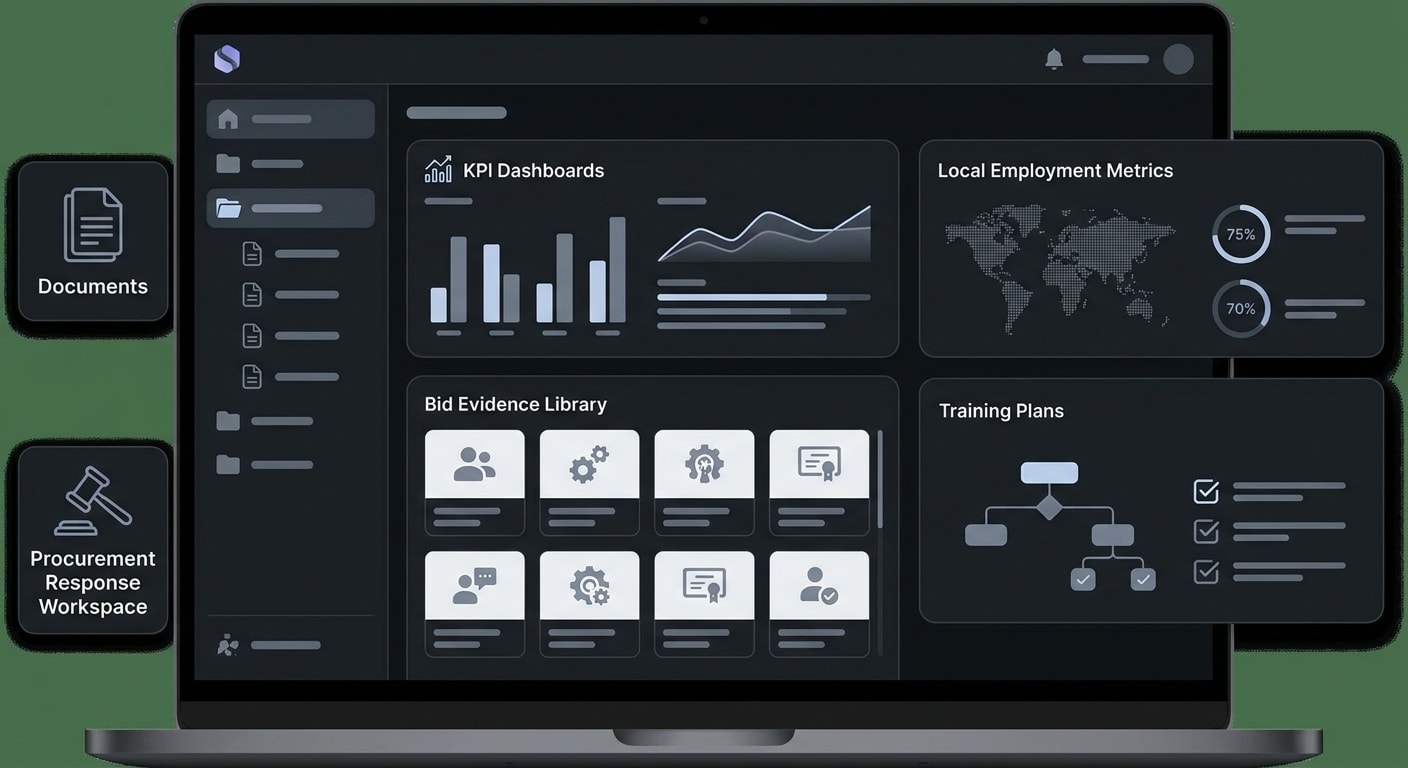
Evidence library for social value tender responses showing jobs, skills, training, fair work and KPI records
The key is to store usable proof, not just marketing claims.
A paragraph saying "we care about skills" is weak. A one-page case study showing 14 local recruits, 9 completions, 3 promotions and a named training partner is much stronger.
This is where a bid library becomes more than a document store. The best teams tag evidence by sector, contract type, region, buyer priority and outcome.
That makes reuse faster and safer.
Make fair work tangible
Fair work can sound abstract in a bid.
Do not leave it that way.
If the question asks about good jobs, fair working conditions or workforce wellbeing, explain the practices that staff will actually feel.
That may include:
- Predictable shifts and rotas.
- Safe staffing levels.
- Clear supervision routes.
- Training time protected inside working hours.
- Fair pay practices.
- Grievance and whistleblowing routes.
- Mental health and wellbeing support.
- Worker voice, consultation and representation.
- Progression pathways for frontline staff.
Again, the trick is not to list everything. Pick the points that matter for the contract.
For example, in a facilities management tender, fair work might mean stable cleaning shifts, named supervisors, health-and-safety refreshers and progression into team leader roles.
In a construction tender, it might mean site induction quality, subcontractor labour checks, welfare standards, skills cards, toolbox talks and apprenticeship supervision.
In a waste contract, it might mean driver safety, route planning, fatigue management, in-cab coaching and progression for loaders into driver roles.
Specific beats worthy.
Link social value to contract performance
A common mistake is to treat social value as separate from delivery.
That is backwards.
The best jobs-and-skills commitments improve the contract itself.
Training reduces defects. Better supervision reduces complaints. Local recruitment improves resilience. Fair scheduling reduces churn. Apprenticeships build capacity. Digital skills improve reporting. Green-skills training improves environmental performance.
When you write the answer, make that connection explicit.
For example:
"Our route-supervisor training programme will support the social value commitment to upskill frontline staff, while also reducing missed collections through better local decision-making."
That line does two jobs. It shows social value and it supports operational confidence.
This is especially useful where evaluators worry that social value promises are bolted on. If the commitment helps the service run better, it feels less like decoration and more like delivery discipline.
Turn promises into KPIs
PPN 026 sits in a wider procurement environment where buyers are paying more attention to performance, transparency and contract management.
That means your social value answer should already think like a contract manager.
Do not wait for award to decide how commitments will be tracked. Put the measurement model in the tender response.
Useful KPIs might include:
- Number of new entrant roles created.
- Apprenticeship starts, progress and completions.
- Training hours delivered by role.
- Percentage of roles recruited locally.
- Retention rates for targeted roles.
- Work placement starts and outcomes.
- Number of staff gaining accredited qualifications.
- Supplier development sessions delivered.
- Quarterly social value commitments delivered on time.
Do not drown the evaluator in metrics. Choose a small set that matches the commitments.
Then explain governance.
Who collects the data? How often is it reviewed? Which meeting owns it? What corrective action happens if performance falls behind?
That governance paragraph is often where the marks are. It proves that your promise can survive contact with the real contract.

Roadmap from social value policy to measurable tender commitments and contract KPIs
What bid teams should do now
Waiting until January 2027 is a mistake.
The suppliers who move early will have better evidence, cleaner case studies and more realistic commitment menus. The suppliers who wait will be writing from scratch when the tender clock is already running.
Start with five actions.
1. Audit your current social value evidence
Find out what you can actually prove.
Look at apprenticeships, local recruitment, training, fair work, workforce wellbeing and contract-level reporting. Separate claims from evidence.
If you say you create local jobs, can you show numbers by contract? If you say you invest in skills, can you show completions and outcomes? If you say you provide fair work, can you show policy, practice and staff experience?
2. Build a jobs-and-skills commitment menu
Create a menu of commitments by contract size, sector and geography.
This stops the bid team inventing promises under pressure. It also helps commercial teams avoid commitments that look good but cost too much or cannot be delivered.
The menu should include low, medium and high-intensity options.
A £1.2 million service contract and a £40 million framework lot should not carry the same promise.
3. Gather proof from live contracts
Ask contract managers for examples now.
The best evidence often sits outside the bid team: onboarding records, training logs, client review packs, HR reports, community partner updates and contract dashboards.
Turn those into short, reusable evidence notes.
Each note should say what happened, who benefited, what was measured and what the client gained.
4. Align HR, operations and bidding
Social value cannot be owned by the bid team alone.
HR understands recruitment and training. Operations knows what can be delivered. Commercial teams know the margin. Contract managers know the governance rhythm.
Bring them together before tenders arrive.
That way, when a bid asks for jobs-and-skills outcomes, you are not asking people to approve a promise they have never seen before.
5. Update your bid library tags
Tag social value evidence by:
- Sector.
- Buyer type.
- Region.
- Contract value.
- Role type.
- Skills theme.
- Delivery partner.
- KPI.
This sounds admin-heavy until you need the evidence quickly.
Then it is the difference between a clear answer and a Friday night panic.
A simple structure for a PPN 026 response
If you are staring at a blank social value question, use this structure.
First, state the contract-specific opportunity. Explain the jobs, skills or fair work outcome that matters for this buyer and service.
Second, give three to five commitments. Make each one measurable, owned and timed.
Third, show evidence that you have delivered similar commitments before.
Fourth, explain delivery governance. Name the owner, reporting route, review frequency and corrective action.
Fifth, connect the commitments back to contract performance.
That structure is simple because the evaluator needs clarity. They are not rewarding literary flair. They are rewarding confidence that the promise will happen.
Where mytender.io fits
A lot of social value answers fail because good evidence exists but cannot be found quickly.
One case study is in a contract manager's inbox. The apprenticeship numbers are in HR. The policy is in SharePoint. The last winning answer is in an old tender folder. The bid writer knows the evidence is somewhere, but the deadline does not care.
That is exactly the kind of bid-library problem mytender.io helps teams solve.
The value is not just writing faster. It is finding the right evidence, reusing it safely and turning scattered proof into a stronger answer.
For PPN 026, that matters because evaluators will be looking for proof, not polish.
The bottom line
PPN 026 should be a wake-up call, but not a panic.
The direction is sensible: fewer vague claims, more measurable jobs-and-skills outcomes, stronger fair work evidence and better contract governance.
For bid teams, the work starts now.
Audit what you can prove. Build a commitment menu. Capture live evidence. Align HR and operations. Tag your bid library properly.
Do that, and social value becomes less of a scramble. It becomes a scoring advantage.
If you want to see live public sector opportunities while you sharpen your evidence library, the Tender Finder is free to use.
Tags
Ready to Transform Your Tender Writing?
See how MyTender's AI can help you write winning tenders in a fraction of the time.