
Planned Procurement Notices: How Suppliers Can Turn Early Signals Into Winning Tenders
A practical 2027 guide for UK suppliers on Planned Procurement Notices, reduced tender periods, early bid preparation and Procurement Act pipeline strategy.
mytender.io Research Team
Tender Writing & Procurement Specialists
Planned Procurement Notices: How Suppliers Can Turn Early Signals Into Winning Tenders
Most bid teams still treat the formal Tender Notice as the start of the race.
That habit is becoming expensive quickly.
Under the Procurement Act 2023, public buyers have more ways to signal demand before the tender opens. Pipeline Notices show broad future procurement plans. Preliminary Market Engagement Notices show where a buyer wants input from the market. Contract Award Notices and Contract Details Notices reveal what has been bought and by whom. Sitting between those signals is a notice many suppliers still overlook: the Planned Procurement Notice.
A Planned Procurement Notice is not just another procurement admin label. It is an early warning that a competitive tender is expected. If it meets the legal requirements, it can also allow the buyer to shorten the later tender response window. In practical terms, a contract you first noticed months before publication can still arrive with a much tighter live deadline than your team expected.
That changes the supplier playbook. If your bid process only begins when the Tender Notice lands, you may be trying to do qualification, mobilisation, evidence gathering, pricing, governance and writing inside a compressed window. If your team starts at the Planned Procurement Notice stage, the formal tender period becomes the final tailored response phase, not the frantic beginning.
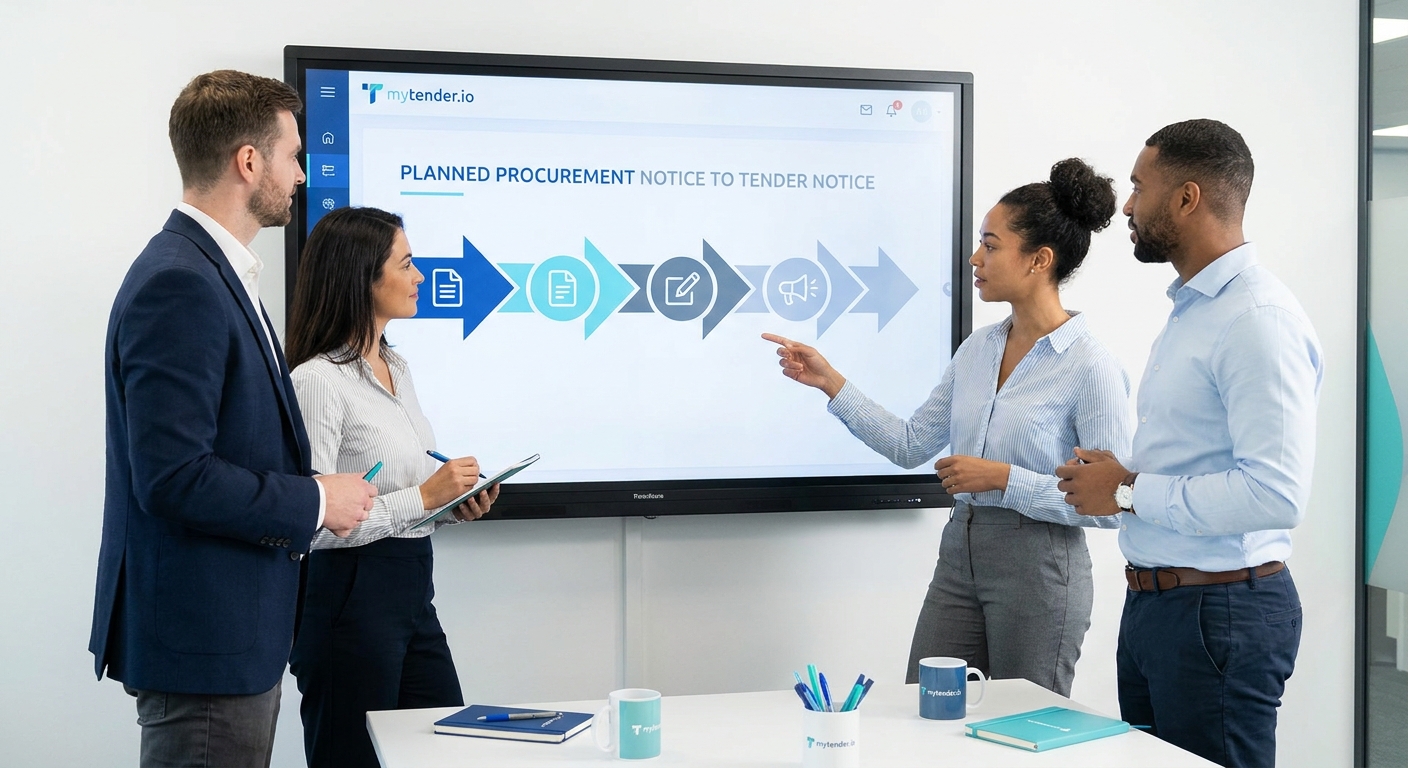
Bid team reviewing a Planned Procurement Notice timeline before a public sector tender opens
This guide explains what Planned Procurement Notices mean for UK suppliers, why they matter under the Procurement Act, how they differ from other notices, and how to turn them into a disciplined bid preparation workflow.
What Is a Planned Procurement Notice?
A Planned Procurement Notice is an optional notice that a contracting authority can publish before it issues the formal Tender Notice for a competitive procurement.
In plain English, it tells the market: we expect to buy something, and a tender is likely to follow.
It replaced part of the old world of Prior Information Notices, but suppliers should not treat it as a like-for-like rebrand. Under the Procurement Act, the notice regime is more structured, more lifecycle-based and more searchable. A Planned Procurement Notice has a specific purpose in the pre-tender phase. It gives the market advance visibility and, where it qualifies, it can support a shorter minimum tendering period when the competition formally opens.
The important point is that a Planned Procurement Notice is not usually the competition itself. It is not the document pack, it is not the scored response, and it is not normally where you submit your full bid. It is an early signal that should trigger preparation.
For suppliers, that distinction matters. A weak team sees the notice and files it under something to watch. A strong team uses it to start the bid clock.
A good Planned Procurement Notice may tell you the authority, the likely contract title, the estimated value, the intended procedure, the expected timing, the broad scope and the category of goods, works or services. It may not give you every detail you want. It may not include the final specification. It may change before the formal tender. But it is still commercially valuable because it gives your team time.
Time is the thing most bid teams run out of first.
Why Planned Procurement Notices Matter in 2027
The current public procurement environment rewards suppliers who prepare early. That is true for three reasons.
First, the Procurement Act has made public procurement more transparent across the contract lifecycle. Buyers are publishing more signals before, during and after procurements. Suppliers that know how to interpret those signals can build a cleaner pipeline, prioritise better opportunities and enter competitions with more context.
Second, the move to the Most Advantageous Tender means quality, delivery confidence, social value, risk, whole-life value and measurable outcomes often matter as much as price. Those responses are harder to assemble at speed. You cannot invent strong case studies, robust KPIs, named delivery roles, supply chain commitments or buyer-specific social value evidence the night before submission.
Third, qualifying Planned Procurement Notices can support reduced tender periods. The headline supplier risk is simple: a buyer may publish a qualifying notice well before the competition, then later use the formal tender period for a shorter response window. If you ignored the early signal, the reduced period feels unreasonable. If you acted on it, the shorter period is manageable.
This is why Planned Procurement Notices sit at the intersection of SEO interest and real bid team pain. Suppliers are searching for what the new notices mean because the operational impact is immediate. A notice is no longer just procurement transparency. It is bid capacity planning.
Planned Procurement Notice vs Pipeline Notice
Planned Procurement Notices and Pipeline Notices are often confused because both point to future procurement activity. They are not the same.
A Pipeline Notice is a broader forward-looking disclosure. It is generally associated with authorities that meet the relevant annual procurement spend threshold and must publish information about expected procurements above a certain value. It helps suppliers understand what may be coming across a portfolio of future activity.
A Planned Procurement Notice is more procurement-specific. It relates to an intended competitive procurement and can be used to give the market advance notice before a Tender Notice is issued.
Think of the difference like this. A Pipeline Notice helps you identify target opportunities months ahead and decide where to invest relationship and preparation effort. A Planned Procurement Notice tells you that a particular procurement is moving closer to market and should be treated as a live pre-bid trigger.
Both are useful. They should work together.
A supplier looking at a Pipeline Notice might add the opportunity to its strategic account plan, monitor buyer activity, identify incumbent history and start relationship development. A supplier looking at a Planned Procurement Notice should go further: allocate an opportunity owner, check eligibility, start evidence gathering, draft reusable content, identify pricing inputs, agree governance dates and decide whether to participate in any related market engagement.
The biggest mistake is passivity. A notice is only useful if it changes behaviour.
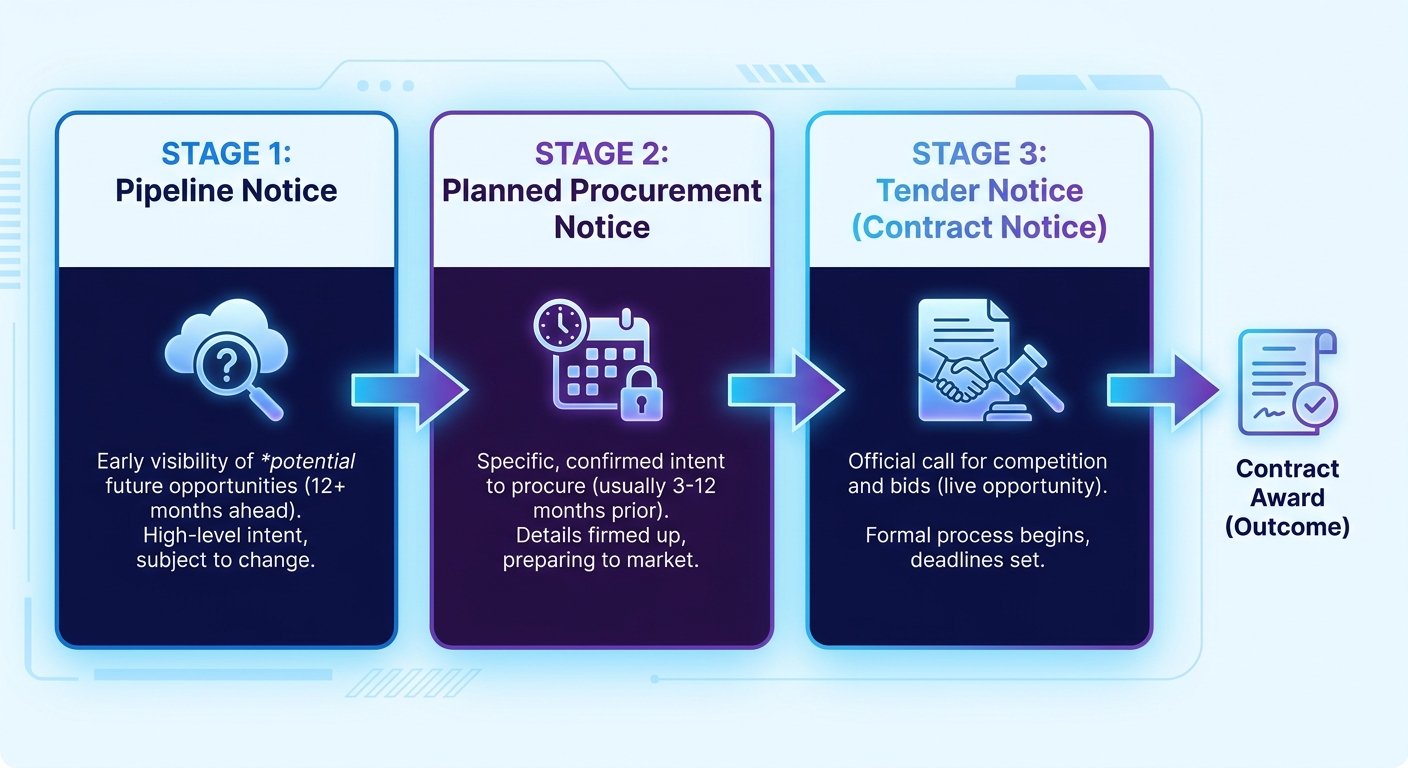
Comparison chart showing Pipeline Notices, Planned Procurement Notices and Tender Notices in the supplier preparation journey
Planned Procurement Notice vs Preliminary Market Engagement Notice
A Preliminary Market Engagement Notice is about engagement. It signals that the buyer is consulting, testing the market, inviting feedback, running supplier sessions or gathering information before finalising the procurement approach.
A Planned Procurement Notice is about planned procurement. It signals that a competitive tender is expected.
In practice, the two may appear close together. A buyer might use market engagement to shape the requirement, then issue a Planned Procurement Notice before the formal Tender Notice. Another buyer might publish a Planned Procurement Notice and include information about engagement activity. Suppliers should read the full context rather than relying on the label alone.
The response should also be different.
When you see a Preliminary Market Engagement Notice, your priority is to understand and influence the requirement appropriately. You might attend the event, submit feedback, explain delivery risks, suggest lotting options, highlight innovation, or flag barriers that could exclude SMEs. You are not submitting a bid, but you are helping the buyer design a better competition.
When you see a Planned Procurement Notice, your priority is to prepare for the likely tender. You should still watch for engagement opportunities, but the internal machine needs to start moving: qualification, resource planning, evidence, commercials, document readiness and win strategy.
The strongest suppliers connect the two. They use market engagement to understand the buyer and use the Planned Procurement Notice to convert that understanding into tender readiness.
The Reduced Tender Period Risk
The practical supplier concern is the reduced tender period.
Under the Procurement Act, a Planned Procurement Notice may qualify for reduced tendering periods if it is published within the required timing window before the Tender Notice. Current guidance points to a window of at least 40 days and no more than 12 months before the Tender Notice. Where the requirements are met, the authority may be able to reduce the later minimum tendering period.
For many electronic submissions, suppliers often think in terms of a 25-day minimum period for open or competitive flexible procedures. With a qualifying Planned Procurement Notice, that minimum can reduce significantly, potentially to 10 calendar days.
That does not mean every tender will be 10 days. It also does not mean buyers can ignore complexity. Tender periods still need to be reasonable, taking account of the contract, the procurement process, site visits, subcontracting, pricing complexity and the work needed to submit a proper response.
But suppliers should not build their operating model around best-case timeframes. A 10-day window may be lawful in the right circumstances. Even where the buyer gives longer, the existence of a Planned Procurement Notice is a signal that they expected suppliers to have advance visibility.
This is where many bid teams get caught.
They see a tender with a compressed deadline and blame the buyer. Sometimes that is fair, especially if the procurement is complex or the documentation is materially different from the early notice. But often the team simply failed to convert the earlier signal into preparation. The commercial question is not just whether the authority could have given longer. It is whether your competitors used the early notice better than you did.
What Suppliers Should Do When a Planned Procurement Notice Appears
A Planned Procurement Notice should trigger a structured pre-bid workflow. Not a full bid response. Not a panic. A controlled preparation sequence.
The first action is ownership. Someone needs to be accountable for the opportunity from the moment the notice is identified. If nobody owns it, it will sit in a pipeline spreadsheet until the Tender Notice appears, at which point everyone will rediscover it together and lose the advantage.
The second action is qualification. Do not wait for the final tender pack to ask whether the opportunity is worth pursuing. Use the available information to assess buyer fit, contract fit, value, geography, sector, likely competitors, incumbent position, capacity, certifications, insurance, financial standing, social value expectations and strategic importance.
The third action is evidence mapping. List the likely proof points the tender will need. For a facilities management contract, that may include mobilisation plans, TUPE experience, planned preventative maintenance performance, health and safety records, social value delivery, carbon reduction, helpdesk reporting, subcontractor controls and customer references. For a professional services contract, it may include relevant case studies, named consultants, methodology, quality assurance, data security, professional indemnity and measurable outcomes.
The fourth action is gap closure. If the notice suggests a contract you want but your evidence is weak, the pre-tender window is when to fix it. Update case studies. Request client references. Pull performance data. Refresh policies. Confirm accreditations. Speak to potential partners. Check insurances. Validate pricing assumptions. Build the skeleton before the race starts.
The fifth action is governance. If your organisation needs director sign-off, finance input, legal review, bid/no-bid approval or pricing committee time, book it early. A reduced tender period becomes far less frightening when the decision pathway is already planned.
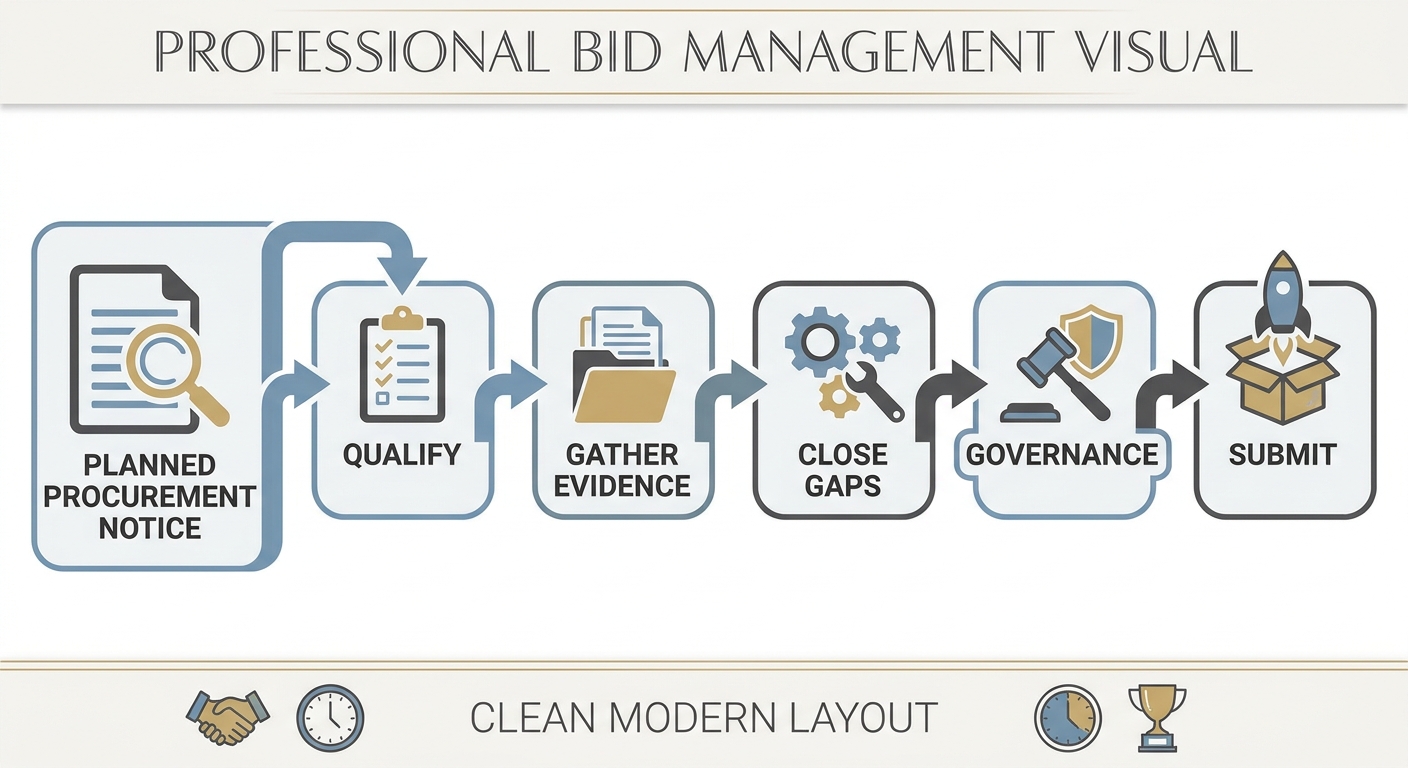
Early tender preparation workflow triggered by a Planned Procurement Notice, from qualification to evidence gathering and governance
A Practical 10-Day Response Model
If a Tender Notice lands after a Planned Procurement Notice and the response window is short, your team needs a different operating model.
Day one should be document triage. Download everything immediately. Do not rely on the title or notice summary. Check the instructions, evaluation criteria, deadlines, clarification process, portal requirements, pricing schedule, word counts, required attachments, forms, declarations and contract terms. Compare the final pack with the assumptions made during the Planned Procurement Notice stage.
Day two should be bid confirmation. Hold a short bid/no-bid review using the full documents. If the opportunity still fits, confirm team roles, deadlines, review points and the response plan. If it no longer fits, stop cleanly. A reduced deadline is exactly when teams waste money on bids they should decline.
Days three to six should focus on tailoring. The best-prepared suppliers will already have baseline evidence, reusable methodology, case studies and compliance documents in place. The live tender period should be used to tailor those assets to the buyer, not to hunt for them. This is where a platform like mytender.io helps: it can surface relevant past answers, generate first drafts from approved content, map requirements and keep the team aligned around the actual scoring criteria.
Day seven should be commercial and compliance review. Check pricing against assumptions, risk allocation, contract terms, insurance, mobilisation cost, social value commitments and KPI reporting obligations. Make sure the promises in the quality response are reflected in the price and delivery model.
Day eight should be red team review. Review the response against the question, the scoring guidance and the buyer's stated objectives. Cut generic language. Strengthen evidence. Check whether every claim is backed by proof.
Day nine should be finalisation. Format, proof, cross-check attachments, validate file names, complete portal forms and prepare upload.
Day ten should be reserved for submission only. This is not the day to rewrite the method statement. It is the day to upload, check receipts and avoid portal drama.
This model only works if preparation began before day one. Without the Planned Procurement Notice workflow, the team spends the first half of the tender period doing basic discovery. That is how rushed bids happen.
What to Look For Inside the Notice
Not every Planned Procurement Notice will be rich with detail. Some will be thin. Some will change. But suppliers should still extract as much as possible.
Start with the buyer. Is this an authority you know? Have you bid to them before? Have they published related Pipeline Notices, Preliminary Market Engagement Notices, award notices or performance notices? Do they have a corporate plan, estates strategy, net zero plan, digital strategy or social value policy that helps explain the likely scoring priorities?
Then look at the scope. Does the notice describe goods, services or works that fit your core capability? Is it a single service, a bundled contract, an integrated model, a framework, a dynamic market, a call-off or a one-off contract? Is the likely delivery geography manageable? Are there signs the buyer is trying to consolidate suppliers, open the market to SMEs, replace an incumbent or change the delivery model?
Next, look at the value and term. Does the estimated value make sense for your business? Is it large enough to justify the bid cost? Is it so large that turnover, insurance or financial standing could become a barrier? Does the term create mobilisation or working capital pressure?
Then review timing. When is the Tender Notice expected? Is the gap long enough to prepare properly? Does the timing clash with other major bids, annual leave, financial year-end, accreditations, audits or customer delivery milestones?
Finally, check procedure clues. If the notice suggests a competitive flexible procedure, prepare for more than a written submission. There may be stages, presentations, interviews, demonstrations, negotiations or down-selections. If it is likely to be an open procedure with a reduced deadline, preparation has to be front-loaded.
A Planned Procurement Notice is rarely perfect. But it usually gives enough to ask the only question that matters: what would we regret not preparing if the Tender Notice arrived tomorrow?
How SMEs Should Use Planned Procurement Notices
Planned Procurement Notices are especially valuable for SMEs because they can reduce the disadvantage of short deadlines.
Large incumbents often have account teams, bid libraries, dedicated estimators, compliance staff and existing buyer relationships. SMEs may have stronger service quality and sharper local knowledge, but less spare bid capacity. Early signals help level that gap if SMEs act on them quickly.
The first SME priority is eligibility. Check whether likely conditions of participation could create a barrier: turnover, insurance, accreditations, quality management systems, cyber requirements, health and safety standards, professional qualifications or previous experience. If something looks disproportionate, the pre-tender phase is the right time to raise it through market engagement or clarification routes where available.
The second priority is partnerships. A Planned Procurement Notice gives time to form a consortium, subcontracting arrangement or local supply chain partnership. Trying to build those relationships during a 10-day tender period is usually too late. Buyers increasingly care about SME access and supply chain resilience, but they also need confidence that partnerships are real, governed and deliverable.
The third priority is evidence packaging. SMEs often have good delivery stories but weak documentation. They know they did excellent work, but they do not have a polished case study, KPI dashboard, testimonial, mobilisation record, social value evidence or lessons learned summary. The pre-tender window is when to turn delivery history into evaluator-ready evidence.
The fourth priority is capacity discipline. Early notice does not mean you should bid everything. It means you can make better decisions earlier. If the buyer, contract, geography, risk or competition does not fit, decline before the team burns time.

SME supplier preparation board showing evidence gaps, partner actions and bid readiness before a tender deadline
Common Mistakes Suppliers Make
The first mistake is treating the notice as information rather than action. Knowing that an opportunity is coming is not an advantage unless it changes the work you do before competitors start writing.
The second mistake is assuming the final Tender Notice will match the early notice exactly. It may not. Scope, dates, lots, values and procedures can change. Early preparation should be flexible, evidence-led and reusable, not over-fitted to assumptions.
The third mistake is waiting for the perfect document pack before starting qualification. You rarely need perfect information to make useful early decisions. You can identify buyer fit, likely evidence needs, broad risk, strategic value and capacity impact long before the final pack arrives.
The fourth mistake is forgetting the commercial model. Teams often prepare quality content early but leave pricing until the formal tender. That is dangerous. Even if detailed pricing cannot be completed before the schedule is issued, you can still test cost drivers, margin assumptions, mobilisation requirements, indexation, TUPE exposure, subcontractor pricing and insurance implications.
The fifth mistake is over-committing during market engagement. Early engagement is valuable, but suppliers should not casually promise capabilities, timelines, innovations or savings that they cannot later price or evidence. The best engagement is helpful, honest and strategically disciplined.
The sixth mistake is failing to capture learning. Every Planned Procurement Notice should improve your pipeline intelligence. Whether you bid or not, record what happened: did the Tender Notice arrive when expected, did the scope change, was the deadline reduced, did the buyer use a competitive flexible procedure, what competitors appeared, and what evidence would you prepare earlier next time?
How mytender.io Helps Bid Teams Act Earlier
The Planned Procurement Notice problem is really a knowledge problem.
When an early notice appears, the team needs to know whether it has relevant past answers, credible case studies, compliant policies, approved boilerplate, subject matter experts, pricing assumptions and evidence. In many organisations, that knowledge is scattered across SharePoint folders, old bids, email attachments, spreadsheets and people's heads.
That is why early notice does not always translate into early readiness. The team wants to prepare, but the material is hard to find.
mytender.io is built for exactly this kind of bid operation. It helps teams turn past successful content into a usable knowledge base, generate first drafts from approved material, analyse tender requirements, organise evidence, support compliance checking and keep collaborators aligned around the response.
For Planned Procurement Notices, the value is upstream. You do not need to wait for the final tender to start building the response architecture. You can create an opportunity workspace, map likely themes, pull relevant examples, identify missing evidence and prepare reusable content while the tender is still approaching.
Then, when the formal documents land, the AI-supported work is not generic copy. It is grounded in your previous bids, your evidence and the buyer context you have already gathered.
That is the difference between using AI as a last-minute writing shortcut and using it as bid infrastructure.
A Planned Procurement Notice Checklist for Suppliers
When a Planned Procurement Notice appears, use this checklist.
Identify the buyer, likely contract, estimated value, timing and procedure. Search for related Pipeline Notices, Preliminary Market Engagement Notices, previous awards, incumbent contracts and public strategies. Assign an opportunity owner. Run an early bid/no-bid assessment. Check eligibility risks such as turnover, accreditations, cyber, insurance, health and safety, professional qualifications and relevant experience. Map likely evaluation themes. Gather case studies and performance data. Identify social value and carbon evidence. Check whether partners or subcontractors are needed. Validate pricing assumptions. Book governance time. Prepare reusable drafts and evidence packs. Monitor for the Tender Notice daily as the expected date approaches.
That sounds like a lot. It is still easier than trying to do all of it during a compressed live tender window.
Building an Internal Notice-to-Bid Operating Rhythm
The best way to use Planned Procurement Notices is to turn them into a repeatable operating rhythm. If every notice relies on individual initiative, the process will fail as soon as the bid team is busy. The workflow needs to be boring, visible and owned.
Start with alert routing. Decide who receives notice alerts, who screens them, and how quickly they must be classified. A useful rule is to triage every relevant notice within one working day. The first decision is not whether to bid. It is whether the opportunity deserves active watching, early preparation, partner exploration or immediate rejection.
Then create a readiness record. This does not need to be complicated. Capture the buyer, category, estimated value, expected tender date, likely procedure, strategic fit, evidence gaps, potential partners, commercial concerns and next review date. If the Tender Notice appears six weeks later, the team should not have to reconstruct the original thinking from inbox threads.
Next, maintain a bid readiness library. Planned Procurement Notices often point to repeat categories: cleaning, security, hard FM, construction, consultancy, software, healthcare support, waste, transport or professional services. For each target category, keep current evidence packs ready. That means case studies, KPIs, mobilisation examples, CVs, method statements, risk registers, social value examples, carbon evidence, accreditations, insurances and references. The live tender period should be used for tailoring, not archaeology.
Finally, review notice performance monthly. Which notices converted into tenders? Which ones were delayed? Which ones had reduced deadlines? Which opportunities did you decline early, and was that decision right? Which evidence gaps appeared repeatedly? This is where procurement transparency becomes management information. Over time, the team learns which buyers are worth tracking, which sectors need stronger evidence, and where bid capacity should be invested before the next formal deadline arrives.
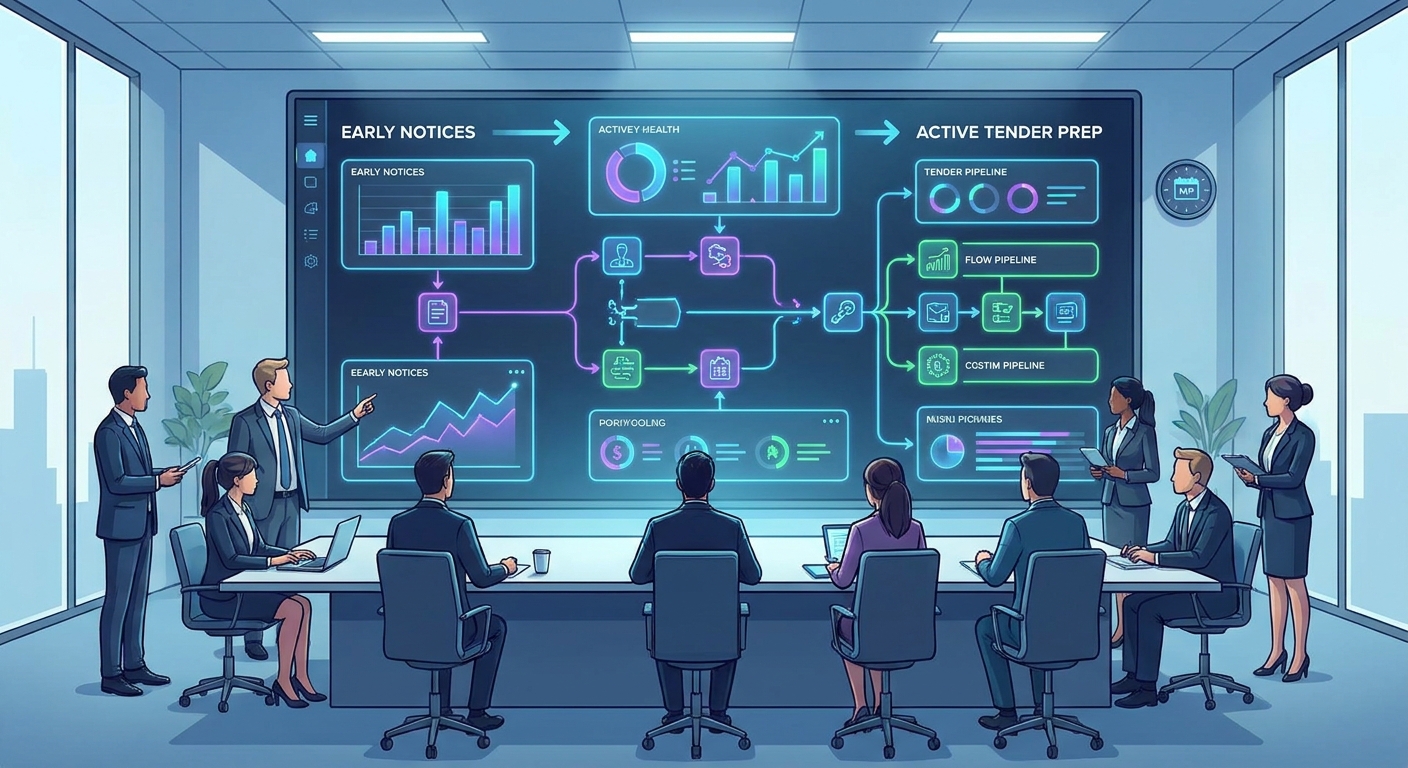
Monthly bid pipeline review showing Planned Procurement Notices converted into active tender preparation actions
A mature bid function does not treat notices as noise. It treats them as demand signals. That is what separates reactive tender writing from strategic bidding.
The Bottom Line
Planned Procurement Notices are not glamorous. They will not write the bid for you. They will not replace buyer research, strong evidence, commercial discipline or a proper bid process.
But they are one of the clearest early signals suppliers now have under the Procurement Act.
The suppliers that win more public sector work in 2027 will not be the ones who simply receive more alerts. They will be the ones who turn alerts into action. A Planned Procurement Notice should trigger qualification, evidence gathering, gap closure, partner planning, pricing preparation and governance before the formal Tender Notice lands.
If the later tender period is generous, you will be ahead. If it is reduced, you will be ready. Either way, you have converted public procurement transparency into a practical win-rate advantage.
That is the point. The notice is not the race. It is the starter pistol before everyone else realises they should be warming up.
Tags
Ready to Transform Your Tender Writing?
See how MyTender's AI can help you write winning tenders in a fraction of the time.