
Pipeline Notices: How to Turn Early Procurement Signals Into a Better Bid Plan
Pipeline notices are one of the most useful changes under the Procurement Act. Here is how suppliers can use them to plan capacity, gather evidence, influence market engagement and avoid the usual last-minute tender panic.
mytender.io Research Team
Tender Writing & Bid Management Specialists
Pipeline Notices: How to Turn Early Procurement Signals Into a Better Bid Plan
Most bid teams find out about a tender when the clock is already running.
The ITT lands. The deadline is four weeks away. The answer library is half useful. The case study you need is trapped in someone's inbox. The commercial lead wants to bid because the contract value looks good. The bid manager can already see the problem: there was a better version of this bid, but it needed to start two months ago.
Pipeline notices are designed to change that.
Under the Procurement Act 2023, larger contracting authorities have stronger transparency duties. One of the most useful for suppliers is the pipeline notice: an early signal that a buyer expects to run future procurements. It will not write the tender for you. It will not guarantee the opportunity happens on the exact date shown. But it gives you something precious in bidding: time.
Used properly, a pipeline notice can help you plan capacity, shape market engagement, prepare evidence, build a bid team and decide whether an opportunity is genuinely worth chasing before the ITT arrives.
Used badly, it becomes another link someone drops into Slack with the words “one to watch”. Then nothing happens until panic mode.
This guide explains how to avoid that.

Bid pipeline dashboard showing early procurement notices, capacity planning and tender deadlines
What is a pipeline notice?
A pipeline notice is an early publication from a contracting authority about contracts it expects to procure in the future.
The point is transparency. Instead of suppliers only seeing an opportunity when a tender is formally advertised, the market can see what may be coming and prepare earlier.
For suppliers, that means pipeline notices sit before the usual tender scramble. They are not the same as a tender notice, a preliminary market engagement notice or a contract award notice. They are earlier than that.
Think of them as a planning signal.
They may include details such as:
- the buyer
- the likely contract title or service area
- estimated value
- expected procurement timing
- contract start date
- contract duration
- CPV codes or category
- whether market engagement may happen later
The detail will vary. Some notices will be rich enough to support serious planning. Others will be thin. That is fine. The mistake is treating all thin notices as useless.
A thin signal is still a signal.
Why pipeline notices matter in 2026
The Procurement Act has made transparency a bigger part of the UK procurement regime. Buyers are expected to publish more information across the commercial lifecycle, including early planning, tendering, award, performance and payment.
For bid teams, this changes the competitive rhythm.
The old rhythm looked like this:
- Tender appears.
- Bid/no-bid meeting happens quickly.
- Everyone searches for evidence.
- Drafting starts late.
- Review is rushed.
- Lessons learned are promised and forgotten.
The better rhythm looks like this:
- Pipeline signal appears.
- The opportunity is scored and parked in the bid pipeline.
- Evidence gaps are identified early.
- Market engagement is monitored.
- Bid capacity is reserved.
- The ITT lands into a team that already knows the story it wants to tell.
That is a real advantage.
The tender itself may still be hard. But you are no longer starting from zero.
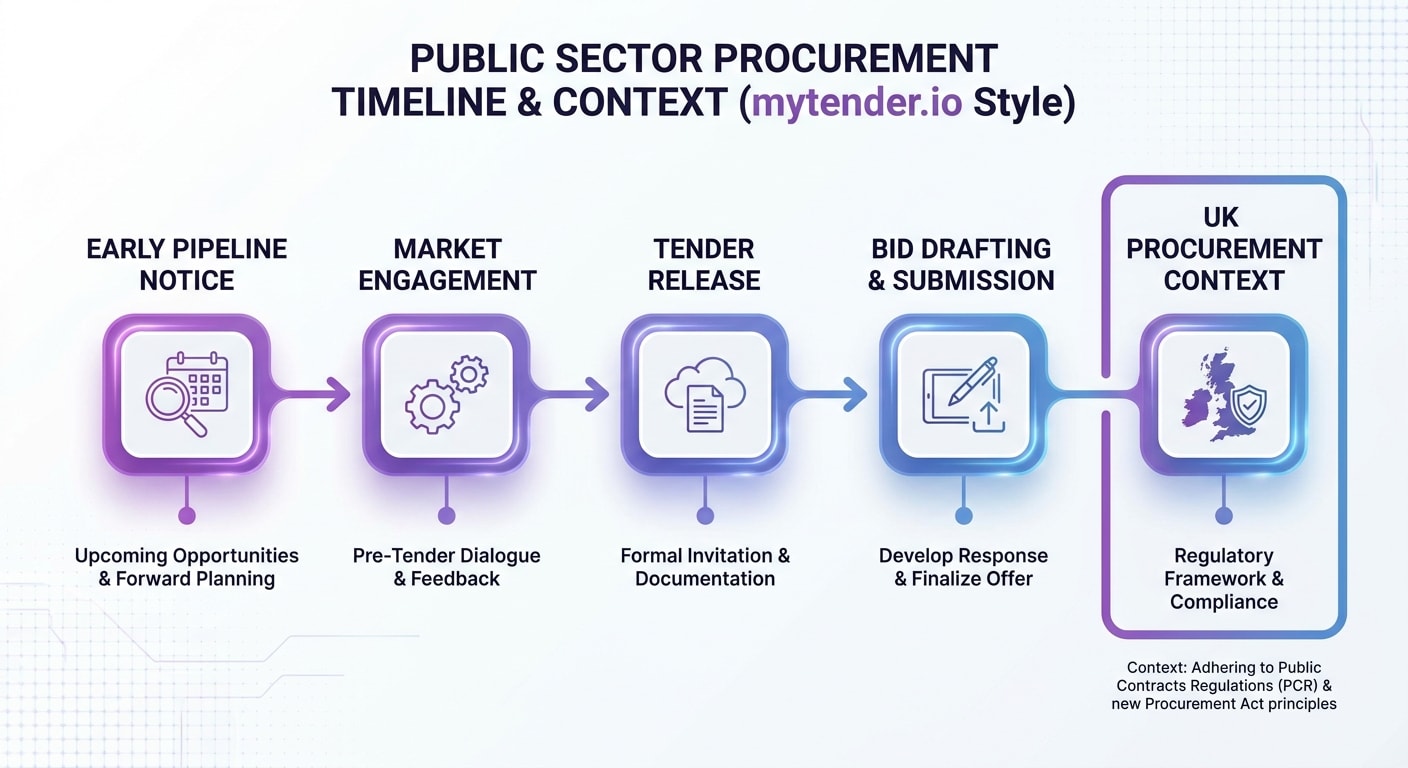
Timeline showing pipeline notice, market engagement, tender release, bid drafting and submission
The big mistake: tracking notices but not acting on them
Lots of teams already track upcoming opportunities. Fewer teams turn those signals into work.
That distinction matters.
A spreadsheet full of possible tenders is not a bid strategy. It is a waiting room.
If you add a pipeline notice to a tracker and nothing changes, you have not gained much. The value comes from the actions it triggers.
A good pipeline process should answer four questions:
- Is this opportunity strategically worth preparing for?
- What evidence would we need to win it?
- What can we do before the tender is released?
- Who owns the next action?
If your process cannot answer those questions, it is too passive.
Step 1: Score the opportunity before the ITT exists
Do not wait for the full tender pack to run a first bid/no-bid assessment.
You will not have every detail. You do not need every detail. At pipeline stage, the aim is not to make a final decision. The aim is to decide how much preparation the opportunity deserves.
Use a simple scoring model.
Strategic fit
Does the contract sit in a sector, geography and service line you actually want more of?
A £4m contract in the wrong region can be less valuable than a £600k contract in a sector where you already have density. Pipeline notices are useful because they give leadership time to think commercially, not just react to headline value.
Ask:
- Does this support the growth plan?
- Would winning it strengthen our reference base?
- Is it close to existing delivery sites or customers?
- Would it stretch operations in a sensible way, or a reckless one?
Be honest. The cheapest time to walk away is before anyone has spent 80 hours preparing.
Incumbent position
If you are the incumbent, the pipeline notice is a warning light.
It means the rebid clock has started. You should already be gathering performance evidence, client feedback, improvement stories, KPI results and lessons from delivery.
If you are the challenger, the notice tells you to start building the case for why change is worth the perceived risk.
That usually means evidence around mobilisation, service continuity, price realism and stronger outcomes.
Evidence readiness
This is the part most teams skip.
Look at the likely service area and ask what evidence a strong bid would need. Not generic “case studies”. Proper evidence.
For example:
- mobilisation plans from similar contracts
- KPI performance data from the last 12 months
- social value outcomes by location
- TUPE transfer experience
- innovation examples that actually saved time or money
- complaints reduction data
- carbon reporting or sustainability proof
- client testimonials or evaluation feedback
Then score how ready you are.
If the evidence is weak, the pipeline notice has done you a favour. You now have time to fix it.
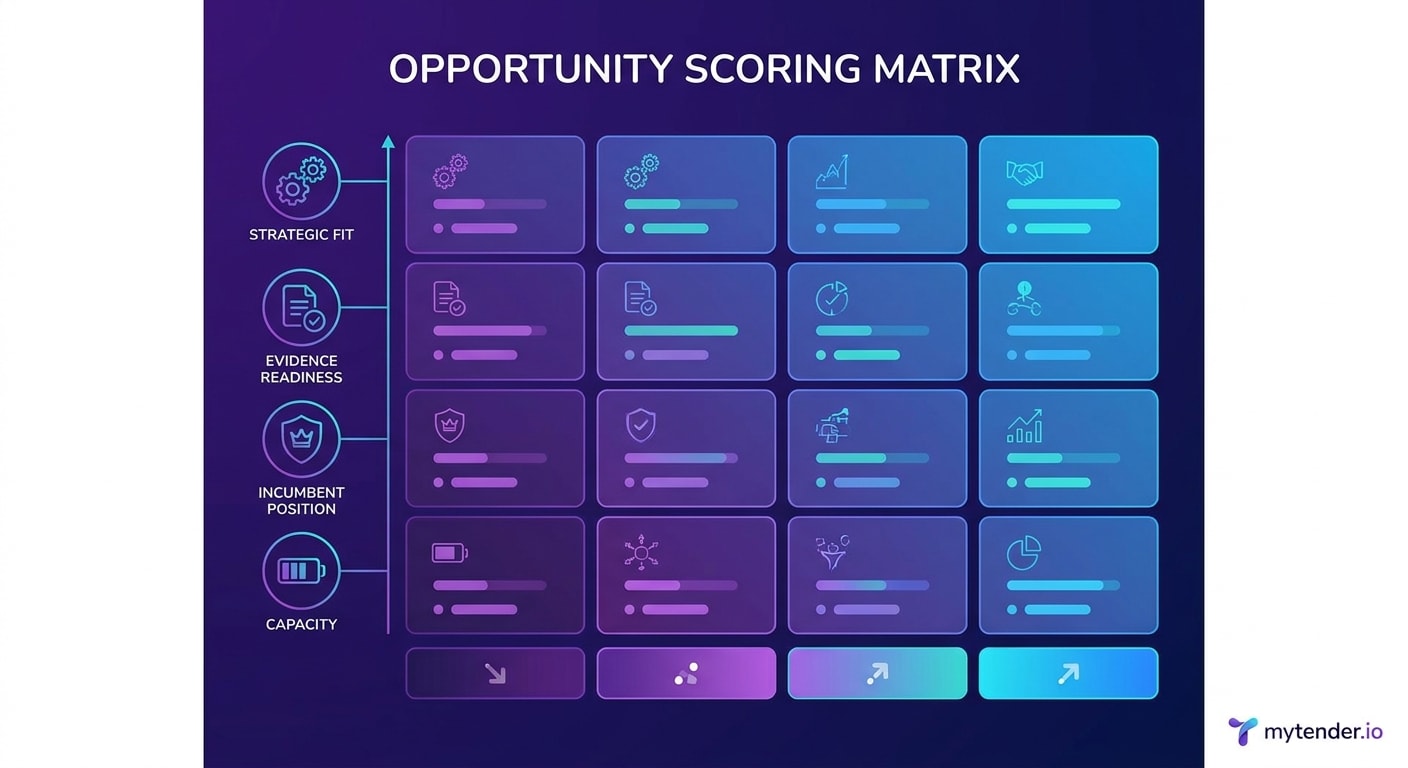
Opportunity scoring matrix for pipeline notices with fit, incumbent position, evidence readiness and capacity
Step 2: Build an evidence plan, not just a watchlist
Here is the difference between a passive and active pipeline entry.
Passive entry:
> “Council FM contract. Expected Q4. £2.5m. Watch.”
Active entry:
> “Council FM contract. Expected Q4. £2.5m. Likely soft FM with TUPE. Need two education cleaning case studies, mobilisation evidence from recent council site, social value local employment outcomes, updated carbon reduction plan. Ops owner: Priya. Evidence deadline: 31 August.”
The second one gives the team something to do.
This is where bid teams should be ruthless. For every serious pipeline opportunity, create an evidence plan with owners and dates.
A useful evidence plan includes:
- the likely tender themes
- the evidence you already have
- the evidence that needs updating
- the evidence that does not exist yet
- the person who can get it
- the date it needs to be ready
This turns early visibility into better content.
It also reduces the worst kind of bid stress: chasing operational teams for proof while the submission deadline is already close.
Step 3: Watch for market engagement
A pipeline notice may be followed by preliminary market engagement. This is where suppliers can learn more, ask sensible questions and understand what the buyer is trying to achieve.
Do not treat market engagement as a sales pitch.
Buyers are not usually looking for a polished brochure. They are trying to understand the market, test assumptions and reduce procurement risk.
Your job is to be useful.
Good market engagement preparation includes:
- reading the pipeline notice and related documents properly
- checking the buyer's current contract, if visible
- researching their strategy, budget pressures and local priorities
- preparing questions that help you understand outcomes, not just process
- identifying where the specification could create delivery risk
- being clear about what strong suppliers need to price and deliver accurately
The best suppliers use market engagement to understand the buyer's problem before everyone else starts writing answers.
They also avoid a trap: pushing their preferred solution too hard. If you sound like you are trying to bend the procurement around your offer, buyers switch off.
Be helpful. Be specific. Be commercially mature.
Step 4: Reserve bid capacity early
Pipeline notices are not just for sales teams. They are capacity planning tools.
This matters because bid teams rarely fail from lack of intelligence alone. They fail because six good opportunities land at once and nobody wants to say no.
If a pipeline notice suggests a major tender is likely in September, do not wait until September to ask whether the bid team has room.
Block provisional capacity.
That does not mean you commit fully. It means you mark the likely window and avoid sleepwalking into a clash.
A simple bid capacity view should show:
- expected ITT release window
- expected submission window
- likely complexity
- probable bid lead
- required subject matter experts
- review dates
- executive sign-off requirements
This is especially important for SMEs, where the “bid team” may be a sales director, an operations manager and one very tired person who knows how to write.
Pipeline notices give you the chance to protect that person's diary before everyone else fills it.

Bid capacity calendar showing upcoming pipeline notices, tender windows and reviewer availability
Step 5: Start the win theme early
A tender response should not be a collection of decent answers. It should make a coherent argument.
Pipeline-stage planning helps because you have time to decide what that argument should be.
For example:
- If you are the low-risk incumbent, your theme may be continuity plus measurable improvement.
- If you are the challenger, it may be fresh thinking without mobilisation risk.
- If you are an SME, it may be senior attention, local knowledge and faster issue resolution.
- If the buyer is under budget pressure, it may be whole-life value rather than cheap inputs.
- If the contract is politically sensitive, it may be assurance, transparency and community outcomes.
Do this before the tender drops and your drafting becomes sharper.
The first version of the win theme does not need to be perfect. It needs to be good enough to guide evidence gathering.
If your likely argument is “lower risk mobilisation”, you need mobilisation proof. If your likely argument is “better local outcomes”, you need local outcomes. If your likely argument is “innovation that reduces cost”, you need a real example with numbers.
The earlier you know the story, the earlier you can gather the proof.
Step 6: Prepare clarification questions before the rush
Pipeline notices can also help you prepare better clarification questions.
Most clarification questions are written in a hurry. Some are too narrow. Some ask for information already in the documents. Some accidentally reveal the bidder has not understood the requirement.
Early planning gives you time to identify the issues that genuinely matter.
You can start a question bank before the ITT, based on likely unknowns:
- contract volumes
- asset condition
- incumbent performance
- TUPE data quality
- mobilisation access
- pricing assumptions
- social value locality rules
- performance reporting expectations
- data transfer and system integration
When the ITT lands, you still need to check the documents. But you are not starting cold.
That means your questions are sharper and your internal decision-making is calmer.
What pipeline notices cannot tell you
Pipeline notices are useful, but they are not magic.
They may not tell you the final scope. They may not include the exact evaluation criteria. The estimated dates can move. The buyer may change approach. Budgets can shift. Procurement plans can be paused.
So do not over-invest too early.
The right approach is staged commitment.
At pipeline stage, you might spend a few hours assessing fit and evidence gaps. If the opportunity looks strong, you might spend more time building the evidence plan and monitoring engagement. Once preliminary market engagement appears, you increase commitment. Once the tender notice lands, you make the formal bid/no-bid call.
That staged approach prevents two bad outcomes:
- ignoring opportunities until it is too late
- wasting weeks preparing for tenders that never happen
The skill is not “chase every pipeline notice”. The skill is knowing which signals deserve action.
A practical pipeline notice workflow
Here is a simple workflow most bid teams can adopt.
1. Capture
Record the notice in your bid pipeline. Include buyer, category, value, timing, contract start date, source link and owner.
Do not leave it as a browser bookmark. Bookmarks are where opportunities go to die.
2. Triage
Give it an initial score for strategic fit, likely profitability, evidence readiness, incumbent position, capacity and operational risk.
Keep this light. The aim is to decide whether to ignore, monitor or prepare.
3. Assign
Every serious opportunity needs an owner.
Not a vague team. A person.
The owner does not have to do all the work. They are responsible for making sure the next action happens.
4. Prepare
Create the evidence plan. Gather or refresh the proof you will probably need. Update case studies. Ask operations for KPI data while there is still time.
5. Monitor
Watch for preliminary market engagement, tender notices, buyer updates and changes to timing.
If the opportunity slips, update the capacity plan. If it disappears, close it properly.
6. Review
When the ITT arrives, compare the actual tender with your assumptions.
What did you predict correctly? What did you miss? Which evidence was useful? Which preparation was wasted?
This feedback loop improves the next pipeline assessment.
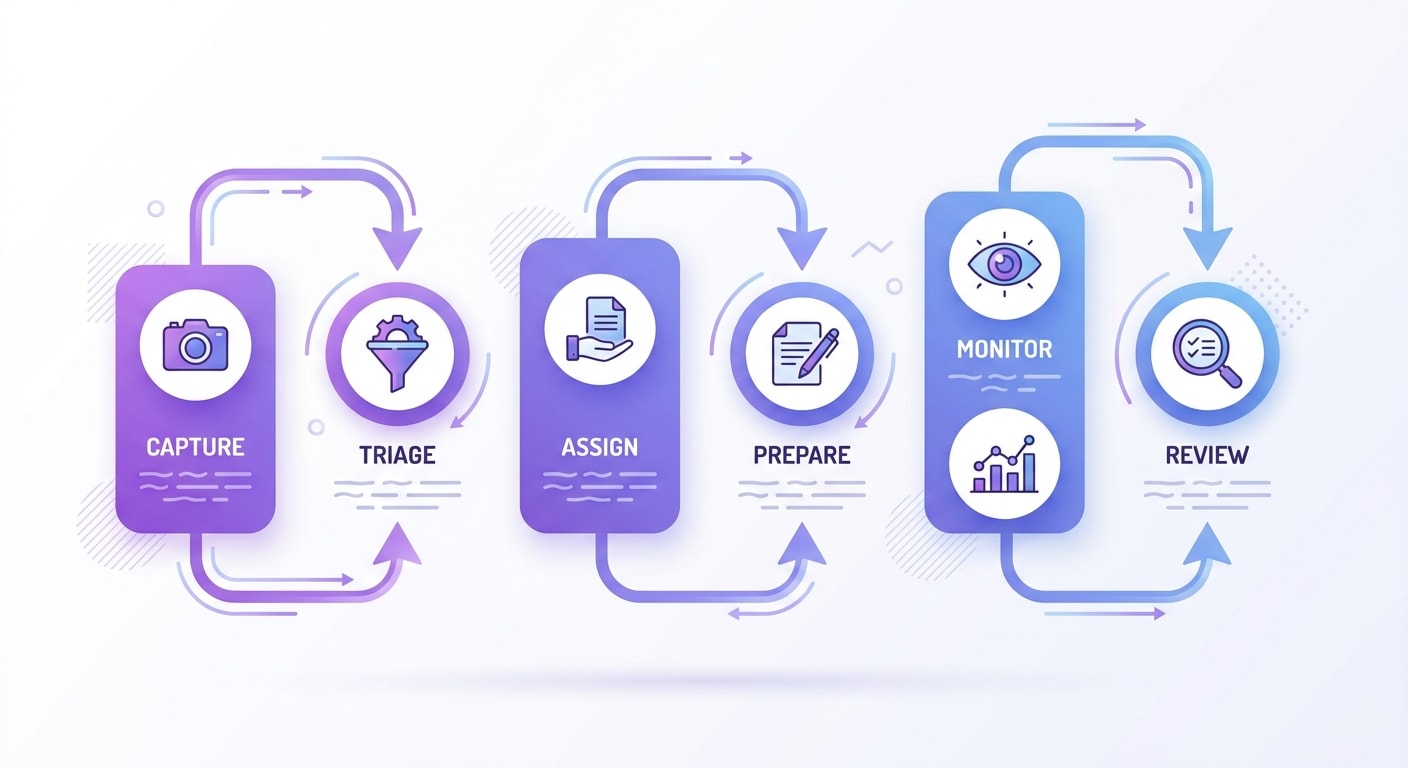
Workflow diagram from capture to triage, assign, prepare, monitor and ITT review
What to put in your pipeline tracker
A good tracker does not need to be complicated. It needs to force the right decisions.
Include these fields:
- Buyer
- Notice title
- Source URL
- Category or service line
- Estimated value
- Expected tender date
- Expected contract start date
- Strategic fit score
- Evidence readiness score
- Incumbent status
- Likely bid owner
- SME input required
- Current stage
- Next action
- Next action owner
- Next action date
- Bid/no-bid status
- Notes from market engagement
The most important fields are not value or date. They are next action, owner and deadline.
Those are the fields that stop the tracker becoming theatre.
How mytender.io fits into this
Pipeline planning is only useful if it connects to the content you will eventually use.
That is where mytender.io helps. Your bid library, previous answers, case studies and evidence can sit in one place, tagged by sector, buyer type, service line and theme.
So when an early notice appears, you are not asking “do we have anything relevant?” in the abstract. You can check what you already have, spot the gaps and brief the right people while there is still time.
This is the real productivity gain. Not writing faster at the last minute. Avoiding the last minute in the first place.
The team habit that makes this work
A pipeline notice process fails if it belongs only to the bid team.
Sales, operations, finance and leadership all have a role.
Sales should know which buyers and sectors matter. Operations should know whether delivery is realistic. Finance should understand whether the likely pricing model is attractive. Leadership should decide whether the opportunity supports the growth plan.
The bid team can coordinate the process, but they cannot manufacture strategy alone.
The best habit is a short monthly pipeline review.
Keep it tight. Thirty minutes is enough if the tracker is clean.
Review:
- new pipeline notices
- high-value opportunities due in the next six months
- evidence gaps
- capacity clashes
- opportunities to drop
- market engagement events to attend
The point is not to admire the pipeline. The point is to make decisions earlier.
A quick example
Imagine a local authority publishes a pipeline notice for a soft FM contract expected in six months. The estimated value is £3m per year. The contract covers cleaning, security and caretaking across civic buildings.
A passive team adds it to the tracker and waits.
An active team does this:
- checks current delivery density in the region
- confirms whether it wants integrated FM work with that buyer type
- gathers two recent mobilisation case studies
- asks operations for KPI data from similar multi-site contracts
- refreshes TUPE transition evidence
- monitors for market engagement
- blocks provisional bid capacity around the likely tender date
- drafts an early win theme around service continuity and local responsiveness
When the ITT arrives, the active team is still busy. But it is not scrambling.
That difference shows in the quality of the bid.
Final thought
Pipeline notices reward suppliers who treat bidding as a managed commercial process, not an emergency response function.
They give you earlier visibility. What you do with that visibility is the important bit.
The winning move is not to track more notices. It is to turn the right notices into earlier decisions, better evidence and calmer bid delivery.
If you want to see live opportunities and start building a cleaner view of your future bid pipeline, the Tender Finder is free to use.
Tags
Ready to Transform Your Tender Writing?
See how MyTender's AI can help you write winning tenders in a fraction of the time.