
Payment Transparency in Public Contracts: What Suppliers Need to Prepare for in 2026
Payment transparency is becoming part of the public procurement record. Learn how suppliers should prepare invoice evidence, governance and bid responses for 2026 tenders.
mytender.io Research Team
Tender Writing & Bid Management Specialists
Payment Transparency in Public Contracts: What Suppliers Need to Prepare for in 2026
Payment used to sit in the finance folder.
The bid team rarely touched it unless a tender asked for accounts, insurance, credit checks or a quick line about financial controls. Delivery teams worried about KPIs. Finance worried about invoices. Bid writers worried about word limits.
That separation is starting to look risky.
Under the Procurement Act 2023, public contract data is moving into a more transparent era. From 2026, payment information is not just back-office admin. It is part of the wider record of how public contracts perform, how buyers manage suppliers, and how suppliers prove they can deliver without creating commercial friction.

Bid team reviewing public contract payment transparency dashboard
For suppliers, the immediate question is practical: what should you do with this information before the next tender lands?
The answer is not panic. It is preparation.
Payment transparency will not win a tender on its own. But weak payment governance can undermine a bid. Strong payment evidence can support answers on contract management, mobilisation, supplier relationships, risk, social value and financial resilience.
This guide explains what payment transparency means for suppliers, why it matters in bid writing, and how to turn finance data into tender evidence without making your response sound like an accounts pack.
Why payment transparency is now a bid issue
The Procurement Act is built around a simple direction of travel: more visibility across the procurement lifecycle.
Not just who won. Not just how much the contract is worth. More about how contracts are managed after award.
That includes performance information, notices, supplier identifiers, KPI reporting and payment-related data. Public bodies are being pushed to publish more information about what happens once the contract is live.
For suppliers, this matters because tender evaluation is increasingly about confidence.
Can you deliver what you promise? Can you manage risk? Can you work cleanly with the authority? Can your subcontractors be paid properly? Can your governance survive pressure after mobilisation?
Payment behaviour sits inside all of those questions.
A buyer does not want a supplier whose delivery model depends on messy invoicing, unclear approvals, disputes with subcontractors or cashflow pressure. Even if the tender does not ask directly, evaluators are reading for signs of control.
The best bids make the buyer feel there will be no unpleasant surprises after award. Payment governance is part of that reassurance.What has changed in 2026?
Several Procurement Act changes are converging in 2026.
Public bodies have new duties around transparency and contract management. Suppliers need to register and maintain accurate information through the Central Digital Platform as it develops. Contracting authorities are also expected to publish certain information about significant payments under public contracts.
The exact operational detail can vary by contract type, value and authority. But the direction is clear enough for bid teams to act now.
More public contract information will be visible. More supplier data will be structured. More post-award behaviour will be available to buyers, auditors and competitors.
That changes how you write.
A bid can no longer treat delivery governance as a generic promise. It needs to show the systems behind the promise.
For payment transparency, that means being ready to evidence:
- how invoices are raised, validated and approved
- how payment issues are escalated
- how subcontractors and supply chain partners are protected
- how disputed items are handled without disrupting delivery
- how contract managers, finance and operations work together
- how reporting data is checked before it becomes client-facing
None of this needs to be theatrical. In fact, it should not be.
Evaluators trust calm, specific processes more than grand claims.
The real risk is not the publication itself
Many suppliers hear "payment transparency" and imagine a public register that makes them look bad.
That is possible in edge cases, but it is not the main risk.
The bigger risk is that your internal data tells a different story from your tender response.

Supplier teams aligning invoice data, contract KPIs and tender evidence
For example, your bid says you have a mature contract management process. But your finance team cannot easily show invoice approval times. Your mobilisation plan says suppliers will be onboarded in week one. But subcontractor purchase orders usually lag by three weeks. Your social value answer promises local SME participation. But your payment process makes small suppliers chase invoices.
That gap is where trust breaks.
Buyers are not expecting perfection. They know contracts are messy. They know invoices get queried, specifications change, and mobilisation throws up surprises.
What they want is evidence that you notice problems early and handle them properly.
A good tender response should show the mechanism:
- who owns payment governance
- what data is reviewed
- how often it is reviewed
- what happens when an invoice is disputed
- how the supplier prevents the same issue recurring
- how subcontractors are kept informed
That is much stronger than saying, "we pay suppliers promptly".
Where payment transparency affects tender scoring
Most scoring matrices will not have a section called "payment transparency".
The theme usually appears under other headings. That makes it easy to miss.
Contract management
This is the obvious one.
When a tender asks how you will manage the contract, it is not only asking for meeting cadences. It is asking whether the authority can trust your controls once the contract becomes real.
Payment evidence can support this answer well.
You can describe monthly contract review packs that include invoice status, purchase order alignment, disputed items, aged debt, subcontractor payment checks and corrective actions.
That tells the evaluator you are not treating finance as an afterthought.
Mobilisation
Mobilisation answers often focus on people, kit, TUPE, systems and timelines.
Payment setup is often missing.
That is a mistake.
A mobilisation plan should include the commercial plumbing: purchase orders, invoicing routes, approval workflows, subcontractor onboarding, rate-card validation and first-month reconciliation.
If those steps are vague, the first few weeks of delivery can become painful. The buyer knows this because they have lived it.
Supply chain management
If you rely on subcontractors, payment governance becomes even more important.
Authorities care about supply chain resilience. They also care about fair treatment of SMEs, VCSEs and local suppliers.
A supplier that talks about local supply chains but cannot explain how smaller partners are paid on time has a weak answer.
A stronger answer explains payment terms, onboarding support, dispute handling, escalation routes and how subcontractor feedback is captured.
Social value
Payment is not usually framed as social value. It should be more often.
Paying smaller local suppliers promptly helps them survive. It protects jobs. It reduces stress in the supply chain. It makes public money work more cleanly in the local economy.
That is not fluffy. It is operational social value.
If your social value commitments involve local SMEs, apprenticeships, community partners or voluntary organisations, your payment process needs to support them.
Risk management
Late or disputed payments create risk.
They distract operational managers. They damage relationships. They can cause subcontractors to deprioritise your contract. They can create escalation noise at exactly the moment you need the client to trust you.
A risk answer that includes payment controls feels more grounded than one that only lists health and safety, staffing and business continuity.
What suppliers should prepare now
Do not wait until a tender asks for this.
By then, you will be stuck asking finance for data during a live deadline. Everyone will be annoyed, and the answer will come back in a spreadsheet that needs three hours of translation.
Build the evidence once. Reuse it carefully.
1. Create a payment evidence pack
This does not need to be complicated.
Start with a short internal pack that explains how payment works across public contracts.
Include:
- standard invoice workflow
- roles and responsibilities
- approval thresholds
- purchase order controls
- disputed invoice process
- subcontractor payment approach
- escalation route
- reporting cadence
- sample dashboard or management report
- examples of improvements made after issues

Bid manager preparing a payment performance evidence pack for a tender
The pack should be written for bid teams, not accountants.
Plain English. Clear ownership. No mystery acronyms.
If a bid writer cannot understand it in ten minutes, it is not ready.
2. Map payment evidence to tender sections
Do not dump finance content into every response.
Map it properly.
For contract management, use it to prove governance. For mobilisation, use it to prove readiness. For social value, use it to prove fair treatment of smaller suppliers. For risk, use it to prove escalation and prevention.
The same evidence can support several answers, but the angle changes.
That is where good bid writing matters.
3. Check subcontractor payment before promising social value
This is the section I would be strict about.
If your bid promises local SME participation, but your actual payment process is slow or confusing, do not write around the problem. Fix it.
Tender commitments should not be a parallel universe.
Local suppliers often run on tighter cashflow than large primes. If you expect them to help you win public work, make the commercial relationship easy to survive.
Your bid can then say something meaningful:
"We support local SME partners through clear onboarding, agreed invoice routes, named commercial contacts and monthly payment-status checks during mobilisation."
That is better than another generic line about supporting the local economy.
4. Build a payment issue log
Every supplier has payment issues sometimes.
The difference is whether you learn from them.
Keep a simple log of repeated invoice queries, approval bottlenecks, PO mismatches and subcontractor escalations. Capture the root cause and corrective action.
This becomes useful bid evidence.
Not because you want to advertise problems, but because evaluators trust suppliers who can show mature improvement.
A good line might be:
"Where invoice queries recur, our contract manager records the root cause, owner and corrective action in the monthly governance log. On a recent local authority contract, this reduced first-time invoice queries after mobilisation by clarifying evidence requirements for variable works."
Specific. Credible. Calm.
5. Align payment reporting with KPI reporting
Payment data and KPI data should not live in separate worlds.
If your monthly contract pack reports service performance, complaints, staffing and risk, it should also report commercial friction points.
That does not mean turning every contract meeting into a finance review.
It means spotting patterns before they damage delivery.
For example:
- repeated invoice disputes linked to unclear job completion evidence
- delayed approvals linked to missing client sign-off
- subcontractor payment queries linked to inconsistent timesheets
- credits linked to quality failures or rework
These are operational signals, not just finance signals.
How to write about payment transparency in a tender
The trick is to avoid sounding defensive.
Do not write as though you are terrified of compliance. Write as though you already run clean contracts and can evidence it.
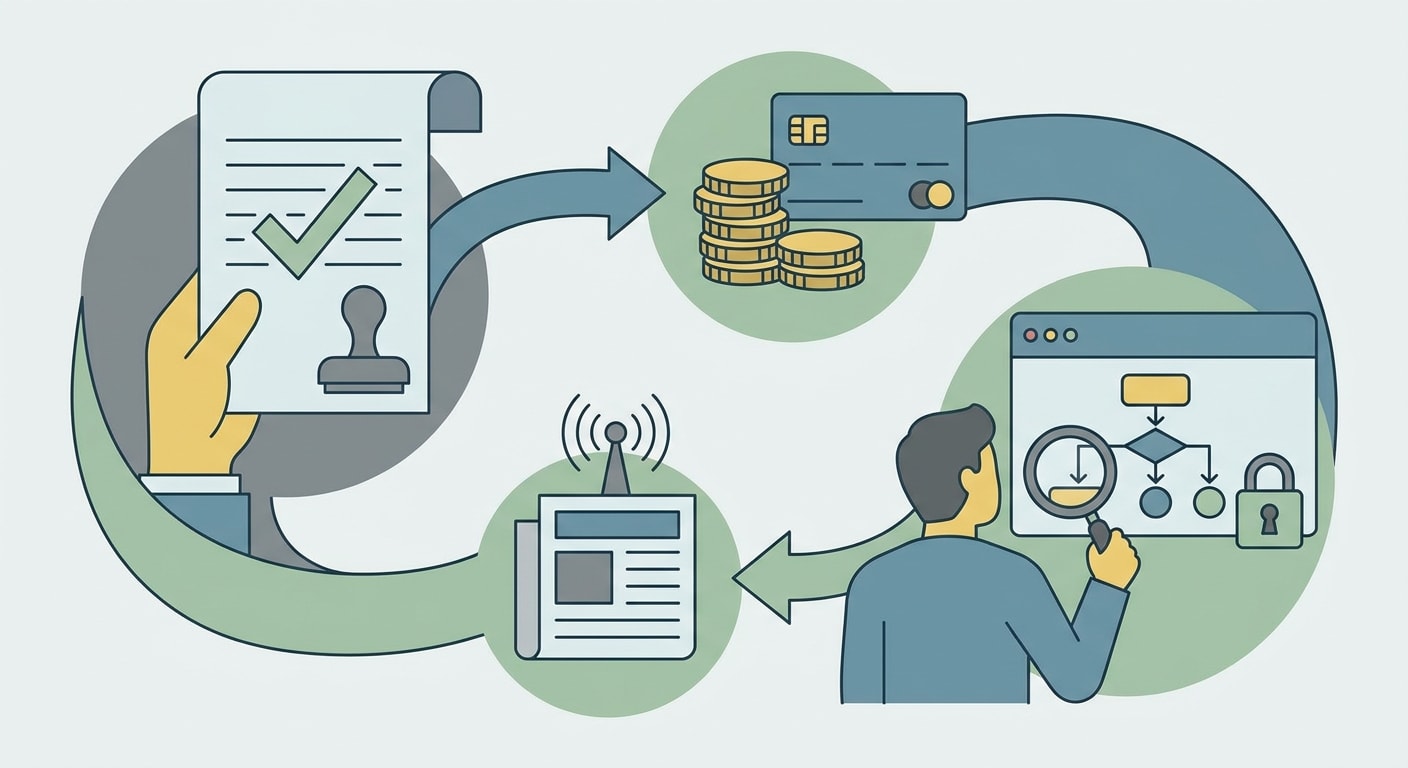
Workflow from invoice approval to public notice and future tender evidence
A strong response usually has four ingredients.
Clear ownership
Name the roles involved.
For example:
"The Contract Manager owns day-to-day commercial governance, supported by Finance for invoice processing and the Operations Lead for service evidence. Payment risks are reviewed monthly and escalated to the Account Director where they could affect delivery, supplier relationships or client reporting."
That feels real because people can picture it.
Specific controls
Avoid generic phrases like "robust processes".
Use concrete controls:
- PO validation before mobilisation
- invoice evidence checklist
- named approver matrix
- disputed invoice tracker
- subcontractor payment check-ins
- monthly commercial governance report
You do not need fifty controls. You need the right five.
Evidence of improvement
Evaluators like continuous improvement when it is practical.
If you changed a process because of payment friction, say so.
For example:
"Following early invoice queries on a multi-site contract, we introduced a completion-evidence checklist for variable works. This reduced queries, improved approval speed and gave site managers a clearer audit trail."
No drama. Just learning.
Link to buyer benefit
Always translate the control into a benefit for the authority.
The buyer does not care about your internal workflow for its own sake. They care because it reduces admin, protects continuity and prevents disputes.
So write the sentence that connects the dots:
"This gives the authority a single view of commercial issues before they become service risks."
That is the point.
The questions bid teams should ask finance
Bid teams do not need to become finance experts.
They do need better questions.
Before writing a contract management, mobilisation or supply chain answer, ask finance:
- What are our standard payment terms for subcontractors on public contracts?
- How do invoices get checked before submission?
- What causes most invoice disputes?
- How quickly do we resolve disputed items?
- Who owns payment escalations during mobilisation?
- What reporting can we show a client monthly?
- Do we have examples where we improved payment or invoice processes?
- How do we support smaller suppliers who are new to our systems?
- What data would we be comfortable putting in a tender response?
- Where are we not yet as strong as the bid usually claims?
The last question is the uncomfortable one.
Ask it anyway.
It stops you writing promises the business cannot support.
Common mistakes to avoid
There are a few traps here.
Treating payment as purely financial
Payment issues often reveal operational issues.
If invoices are regularly disputed, ask why. Maybe service evidence is poor. Maybe job completion records are inconsistent. Maybe the contract variation process is unclear.
A finance symptom can be an operations problem wearing a spreadsheet costume.
Overclaiming prompt payment
Do not claim perfection unless you can prove it.
It is better to say you have clear controls, reporting and escalation than to make absolute claims that fall apart under scrutiny.
Forgetting subcontractors
If your delivery model depends on subcontractors, your payment answer needs to include them.
This is especially true in facilities management, construction, waste, healthcare support services and local government contracts, where layered supply chains are common.
Reusing boilerplate
Old contract management boilerplate often says nothing.
"We will hold regular meetings and maintain open communication" is not enough. Everyone writes that. Nobody believes it.
Explain the data, the cadence, the owner and the action.
Writing a compliance essay
Do not turn the tender answer into a legal briefing on the Procurement Act.
The evaluator wants to know whether you can run the contract well. Mention the Act where relevant, but focus on practical delivery.
A simple response structure you can reuse
Here is a clean structure for a 500-word tender answer on commercial governance and payment transparency.
Paragraph 1: Ownership
State who owns commercial governance and how finance, operations and contract management work together.
Paragraph 2: Controls
List the core controls: PO validation, invoice evidence, approval matrix, dispute tracker and subcontractor payment checks.
Paragraph 3: Reporting
Explain the monthly dashboard or governance pack. Include invoice status, disputed items, root causes and corrective actions.
Paragraph 4: Escalation
Show what happens when an issue could affect delivery, supplier relationships or client reporting.
Paragraph 5: Buyer benefit
End with the outcome: fewer disputes, clearer audit trail, less admin for the authority and stronger continuity for service users.
That structure is simple because it should be.
Good bid writing is not about making the answer sound clever. It is about making the buyer feel safe choosing you.
How this links to win rate
Payment transparency will not become the headline scoring factor in most tenders.
But it will influence the parts of the bid where buyers judge maturity.
A supplier with clean payment evidence can write stronger answers on governance, mobilisation, supply chain management and risk. It can also support social value claims with something more tangible than good intentions.
A supplier with messy payment evidence has two choices.
Fix the process, or keep writing around it until a buyer spots the gap.
I know which one I'd choose.
Where mytender.io fits
This is exactly the kind of evidence that gets lost when bid teams work from old folders, scattered spreadsheets and half-remembered case studies.
A useful bid library should not only store polished answers. It should store the proof behind them: payment controls, KPI examples, governance packs, mobilisation lessons, subcontractor processes and corrective actions.
That way, when a tender asks how you manage commercial risk, you are not starting from a blank page at 9pm.
You are starting from evidence.
If you want to find live public sector opportunities where stronger governance and payment evidence could make a difference, the mytender.io Tender Finder is free to use.
Final thought
Payment transparency is not just a finance requirement.
It is a signal.
It tells buyers whether your organisation understands that winning the contract is only the beginning. The real test is whether your systems, people and supply chain can deliver cleanly after award.
If your bid says that, and your evidence proves it, you will look lower risk than the supplier still relying on boilerplate.
That is where the marks are.
Tags
Ready to Transform Your Tender Writing?
See how MyTender's AI can help you write winning tenders in a fraction of the time.