
Payment Compliance Notices: How to Stop 30-Day Payment Rules Costing You Tender Marks
A practical guide for suppliers on payment compliance notices, 30-day supply-chain payment terms, and how to evidence payment performance under the Procurement Act 2023 without losing marks.
mytender.io Research Team
Tender Writing & Bid Management Specialists

Bid team reviewing payment compliance evidence for a public tender
Late payment used to feel like a finance problem. Under the Procurement Act 2023, it is becoming a bid problem.
This article is part of our Procurement Act series. For an overview of what changed and links to every guide in the series, see our Procurement Act 2023 supplier's guide.
That shift matters. Contracting authorities are under more pressure to publish payment information, enforce 30-day terms through the supply chain, and treat poor payment performance as a real commercial risk. For suppliers, the uncomfortable truth is simple: if your payment story looks messy, evaluators may trust your delivery story less.
This guide is for bid managers, commercial directors, and finance leads who need to make payment compliance tender-ready. Not someday. Before the next public sector opportunity lands.
Why payment compliance is suddenly a tender issue
The public sector has talked about prompt payment for years. The difference now is visibility.
The Procurement Act has strengthened the transparency regime around public contracts. Authorities are expected to publish more contract information, including payment performance reporting. Payment compliance notices are part of that wider shift: buyers are being asked to show whether public money is moving through the supply chain properly.
That changes how evaluators read your bid.
A supplier that pays subcontractors late is not just creating cashflow pain. It is signalling weak contract management, poor governance, and higher delivery risk. In sectors that rely on subcontractors, specialist trades, agency labour, or local supply chains, that risk sits directly inside the service model.
Construction, FM, waste, social care, IT implementation, security, catering, cleaning: all of them depend on supplier ecosystems. If those ecosystems are under cash pressure, service quality suffers.
So payment compliance is no longer a paragraph you can leave to finance at the end of the bid. It belongs in your commercial model, mobilisation plan, social value response, supply-chain management answer, and sometimes your exclusion-risk narrative.
What are payment compliance notices?
Payment compliance notices are public reporting notices that show how contracting authorities are meeting their payment obligations under public contracts.
For suppliers, the practical point is not just what authorities publish about themselves. It is the behaviour those notices force across the market.
Buyers are becoming more sensitive to:
- whether prime contractors pass 30-day payment terms down the chain
- how quickly suppliers pay subcontractors in practice
- whether payment processes are auditable
- whether disputed invoices are handled fairly
- whether late payment could undermine service continuity
- whether poor payment performance creates exclusion or reputational risk
The notice itself may be buyer-side reporting, but the bid impact lands supplier-side. If a contracting authority has to publish its own performance, it will be more careful about choosing suppliers whose processes could make that performance worse.
That is the part bid teams need to internalise.
The 30-day rule in plain English
Public sector payment terms are designed around fast payment. The broad expectation is that valid, undisputed invoices should be paid within 30 days, and equivalent obligations should flow through the supply chain.
In a tender, that means evaluators may want to know three things.
First, can you pay your subcontractors quickly enough?
Second, can you prove you actually do?
Third, if something goes wrong, do you have a process that prevents small suppliers being left in limbo?
That third point is where many bids fall apart. They say, “we pay within 30 days”, then give no evidence of invoice approval workflows, dispute resolution, payment monitoring, or senior accountability.
A statement is not evidence. It is just a promise.
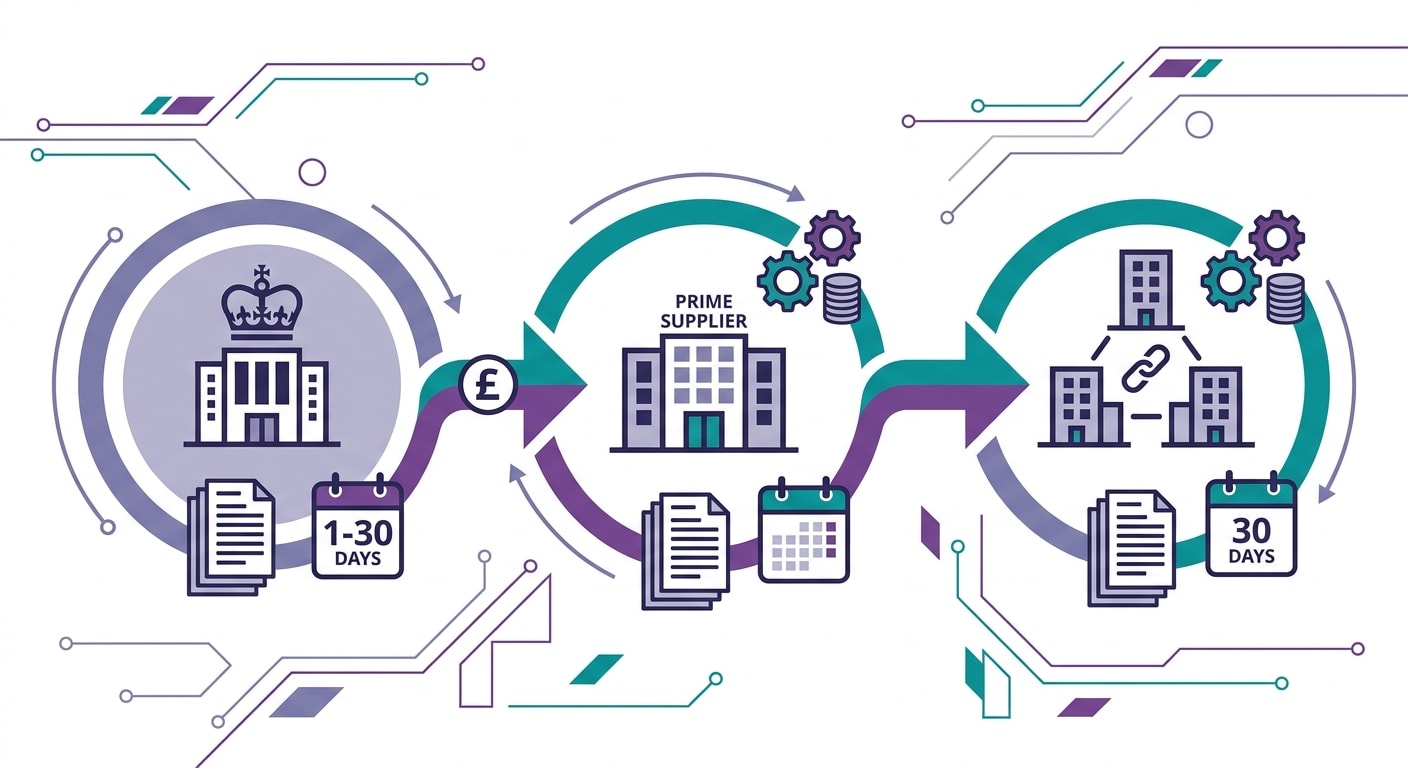
Flow of 30-day payment obligations from contracting authority to prime supplier to subcontractors
Where payment performance shows up in tenders
Payment compliance rarely appears as one neat question. It tends to leak into several sections.
You may see it in a direct prompt, such as:
- Describe how you will ensure prompt payment of subcontractors.
- Confirm how 30-day payment terms will be flowed down to your supply chain.
- Explain your approach to fair payment and dispute management.
- Provide evidence of your payment performance.
But it can also appear indirectly.
In a mobilisation question, buyers may ask how you will onboard suppliers without service disruption. If your answer depends on subcontractors absorbing mobilisation cost for 60 or 90 days, the evaluator may see a risk.
In a social value question, prompt payment supports local SMEs and VCSEs. If you are promising local supply-chain participation but cannot show fair payment processes, the social value story weakens.
In a risk management question, late payment is a delivery risk. It can trigger subcontractor disengagement, poor staffing continuity, slower call-outs, and disputes at exactly the wrong time.
In a contract management question, payment governance shows whether you run a disciplined operation or just hope invoices sort themselves out.
The best bids connect these dots. The weakest bids treat payment as boilerplate.
The evidence evaluators actually believe
Evaluators do not need a glossy policy. They need confidence.
That confidence comes from operational evidence: the things your organisation uses every month, not the things invented for the tender.
Strong evidence includes:
- a clear payment policy with 30-day terms for valid invoices
- standard subcontract terms showing prompt-payment clauses
- invoice approval workflow with named roles and escalation points
- payment performance data for the last 6 to 12 months
- aged creditor reports showing invoice ageing bands
- dispute logs showing how quickly queries are resolved
- finance system screenshots or process maps
- supplier onboarding checks that capture bank, VAT, insurance, and contact details early
- senior owner for payment performance, usually finance director or commercial director
- board or management reporting where payment performance is reviewed
You do not need to dump all of this into the response. You need to select the evidence that answers the question.
If the question is about policy, quote the policy and attach the relevant clause.
If the question is about performance, use numbers.
If the question is about contract delivery, show the workflow from invoice received to paid.
A useful answer might say: “In the last 12 months, 94% of valid subcontractor invoices were paid within 30 days, with the remaining 6% held for documented query resolution. Payment performance is reviewed monthly by the Finance Director and reported to the Operations Board.”
That sentence does more work than three paragraphs of generic commitment.
Build a payment evidence pack before the tender arrives
Most bid teams lose time because payment evidence is scattered.
Finance has the aged creditors report. Commercial has the subcontract template. Operations knows how disputes are handled. Legal owns the clauses. The bid team owns the deadline panic.
Do not wait until the tender asks for payment evidence. Build a small evidence pack now.

Payment compliance evidence pack for tender submissions
At minimum, keep these eight items current:
- Prompt payment policy, dated and approved.
- Standard subcontractor payment clause.
- A one-page invoice workflow diagram.
- Last 12 months payment performance summary.
- Aged creditor snapshot by invoice age.
- Dispute management process.
- Named accountable owner and escalation route.
- Short case example showing a payment issue resolved fairly.
This pack should live in your bid library, not someone’s inbox.
If you use a platform like mytender.io, tag the evidence so it can be pulled into supply-chain, mobilisation, commercial, and social value responses. Payment evidence is cross-functional. Store it like that.
How to write the tender response
A good payment compliance answer has five parts.
1. Start with the commitment
Open plainly.
State that valid, undisputed subcontractor invoices will be paid within 30 days. Confirm that prompt-payment obligations are flowed into subcontract terms. Avoid legal fog.
Bad opening:
“Payment obligations are considered within our wider commercial governance framework.”
Better opening:
“We pay valid, undisputed subcontractor invoices within 30 days and include equivalent prompt-payment obligations in all subcontract agreements for this contract.”
The second one is clearer. Clearer scores better.
2. Show the process
Then explain how it works.
The evaluator wants to see that payment is not dependent on one overworked contracts administrator remembering to approve an invoice.
Cover:
- invoice receipt route
- validation checks
- who approves goods or services received
- how disputed items are separated from undisputed items
- payment run frequency
- escalation if approval stalls
- reporting to senior management
Keep this practical. A simple process described clearly is stronger than a complicated model nobody believes.
3. Add performance data
If you have payment data, use it.
Do not over-polish it. Evaluators trust honest, specific numbers more than perfect claims.
For example:
“Across FY2025/26, 91% of subcontractor invoices were paid within 30 days. Of the remaining invoices, 7% were subject to documented query resolution and 2% exceeded 30 days due to approval delay. We introduced weekly exception reporting in April 2026 to reduce approval delays, with Finance Director oversight.”
That is credible because it admits the gap and shows the fix.
If your data is weaker, do not hide it. Explain the improvement plan. A realistic control plan beats a claim that procurement can disprove later.
4. Explain dispute handling
Payment delays often come from disputes. Evaluators know this.
Your answer should separate genuine disputes from payment avoidance.
Set out how you:
- notify suppliers quickly when an invoice is queried
- pay undisputed amounts while resolving the disputed element
- keep a dispute log
- use named contacts rather than generic inboxes
- escalate unresolved disputes after a fixed period
This protects both sides. It shows the buyer that subcontractors will not be punished for raising issues, and that your finance process will not become a service risk.
5. Link it back to contract performance
Finally, connect payment compliance to delivery.
Prompt payment is not just ethical. It keeps subcontractors engaged, protects capacity, and reduces churn. In FM, that can mean faster specialist call-outs. In construction, it can mean fewer programme delays. In waste, it can mean stable haulage and treatment partners. In social care, it can mean workforce continuity.
Make the operational link explicit.
A strong closing might read:
“This approach protects contract resilience by ensuring local subcontractors have predictable cashflow, reducing the risk of withdrawal, staffing disruption, or delayed specialist support during mobilisation and steady-state delivery.”
That is the sentence evaluators wanted you to reach.
Sector-specific angles: construction, FM, and waste
Payment compliance is not identical across sectors. The same core rule applies, but the delivery risk looks different.
Construction
Construction buyers are alert to payment risk because the supply chain is layered. Main contractor, subcontractor, specialist subcontractor, labour-only subcontractor, materials supplier. Cash pressure travels fast.
In construction tenders, payment evidence should sit alongside programme risk, subcontractor management, and quality control. If you are relying on specialist trades for fire stopping, M&E, roofing, cladding, or temporary works, show how payment keeps those partners committed.
Mention project bank accounts if relevant. Explain how you manage applications for payment, valuations, retention, disputed variations, and final accounts. Do not pretend construction payment is simple. Evaluators know it is not.
Facilities management
FM contracts often rely on specialist suppliers: lift engineers, fire systems, pest control, security, cleaning consumables, grounds, M&E, reactive maintenance.
Late payment can quickly become service failure. A specialist who is owed money may deprioritise call-outs. A cleaning agency may struggle to cover shifts. A local supplier may stop accepting additional work.
FM responses should link prompt payment to uptime, helpdesk closure, planned preventive maintenance, and mobilisation stability.
If the contract includes local SME commitments, this is even more important. Do not promise local supply-chain value while giving no evidence that those suppliers will be paid on time.
Waste and environmental services
Waste contracts depend on treatment outlets, haulage partners, plant availability, container suppliers, and sometimes community reuse organisations.
Payment delays can disrupt disposal routes or recycling performance. If a subcontracted processor has cashflow pressure, the risk can become operational very quickly.
For waste tenders, connect payment compliance to route resilience, treatment capacity, contingency arrangements, and social value. If VCSE partners are involved in reuse or community engagement, prompt payment becomes part of the social value delivery model.
Common mistakes that cost marks
The same mistakes appear again and again.
The first is writing a policy answer when the question asks for evidence. “We are committed to prompt payment” is not enough. The evaluator wants proof.
The second is ignoring subcontractors beyond tier one. If your delivery model depends on tier-two or specialist suppliers, explain how prompt-payment expectations flow beyond the direct subcontract.
The third is hiding behind “subject to valid invoice”. That phrase is necessary, but it can sound evasive if you do not explain how invoices become valid and how queries are resolved.
The fourth is giving finance ownership with no operational link. Payment performance is finance-led, but operations creates the approval evidence. If contract managers delay sign-off, finance cannot pay. Show joint ownership.
The fifth is overclaiming. If you say 100% of invoices are paid in 30 days and cannot evidence it, you have created a bigger problem than the one you tried to solve.
A bid-ready answer structure you can adapt
Use this structure when the tender asks how you will ensure prompt payment.

Tender response structure for payment compliance and supplier payment performance
That structure is not fancy. It works because it answers the question in the order evaluators think.
What to do if your payment data is not good enough yet
Some suppliers will read this and realise their payment performance is not tender-ready.
That is uncomfortable, but useful.
Do not wait for procurement to expose the weakness. Fix the data first.
Start with four actions.
First, measure the last 12 months. You need to know what percentage of valid subcontractor invoices were paid within 30 days. If your finance system cannot report that easily, create a manual baseline from a sample.
Second, separate true late payment from disputed invoices. Evaluators will accept that disputes happen. They will not accept a vague pile of overdue invoices with no explanation.
Third, introduce exception reporting. Every invoice approaching 30 days should have an owner, reason, and next action.
Fourth, update your bid library every quarter. Payment performance is a live metric. A 2024 figure in a 2026 tender looks stale.
If performance is genuinely poor, be careful. You may need a commercial decision about whether to bid, how to disclose improvement activity, and whether legal advice is needed. Do not let the bid team improvise around a governance issue.
The win-rate angle: payment compliance builds trust
Tender scoring is not only about who writes the nicest response. It is about trust.
Can the buyer trust you to deliver the service? Can they trust your supply chain to stay stable? Can they trust your governance? Can they trust that your social value promises will not collapse when local suppliers are squeezed?
Payment compliance is one of those boring areas that quietly influences all of those answers.
A bid that shows disciplined payment processes feels safer. A bid that hand-waves them feels risky.
That does not mean payment compliance will win the tender on its own. It will not. But it can stop you leaking marks in sections that should have been straightforward.
In close competitions, that matters.
A quick checklist before the next tender
Before your next public sector bid, check these points:
- Do we have a current prompt-payment policy?
- Do our subcontract terms include 30-day payment obligations?
- Can we report payment performance for the last 12 months?
- Can we separate late invoices from disputed invoices?
- Do we have a clear invoice approval workflow?
- Is there a named escalation owner?
- Do contract managers understand their role in payment approval?
- Can we link prompt payment to mobilisation, resilience, and social value?
- Is the evidence stored somewhere the bid team can actually find it?
If you answer “no” to more than two, the issue is not the tender response. It is the system behind it.
The practical next step
Payment compliance is not glamorous. That is exactly why it is a good place to gain an edge.
Plenty of competitors will still paste in a generic fair payment statement and move on. A stronger bidder will show the buyer how prompt payment is governed, measured, escalated, and connected to contract resilience.
That is the standard to aim for.
If you want to keep live public sector opportunities and bid requirements organised by sector, the Tender Finder is free to use. It is a useful way to spot opportunities early enough to get this evidence ready before the deadline panic starts.
Tags
Ready to Transform Your Tender Writing?
See how MyTender's AI can help you write winning tenders in a fraction of the time.