

Outcome-Based FM Tender Responses: How to Prove Value Without Sounding Vague
Outcome-based FM tenders are becoming more common, but many bidders still answer them like input-based contracts. Here is how to write evidence-led responses that turn performance, compliance and service improvement into marks.
mytender.io Research Team
Tender Writing & Bid Management Specialists
Outcome-Based FM Tender Responses: How to Prove Value Without Sounding Vague
Outcome-based FM tenders look simple until you try to write one.
The buyer no longer asks how many cleaners, engineers or supervisors you will provide. They ask how you will keep buildings available, safe, compliant, efficient and pleasant to use. That sounds liberating. It is also where many bids fall apart.
Input-based answers are easy to evidence. You can point to headcount, visit frequency, shift patterns, response times and statutory task lists. Outcome-based answers need a different kind of proof. You have to show how your operating model produces the result the client cares about.
That is harder. It is also where good FM bidders can win serious marks.
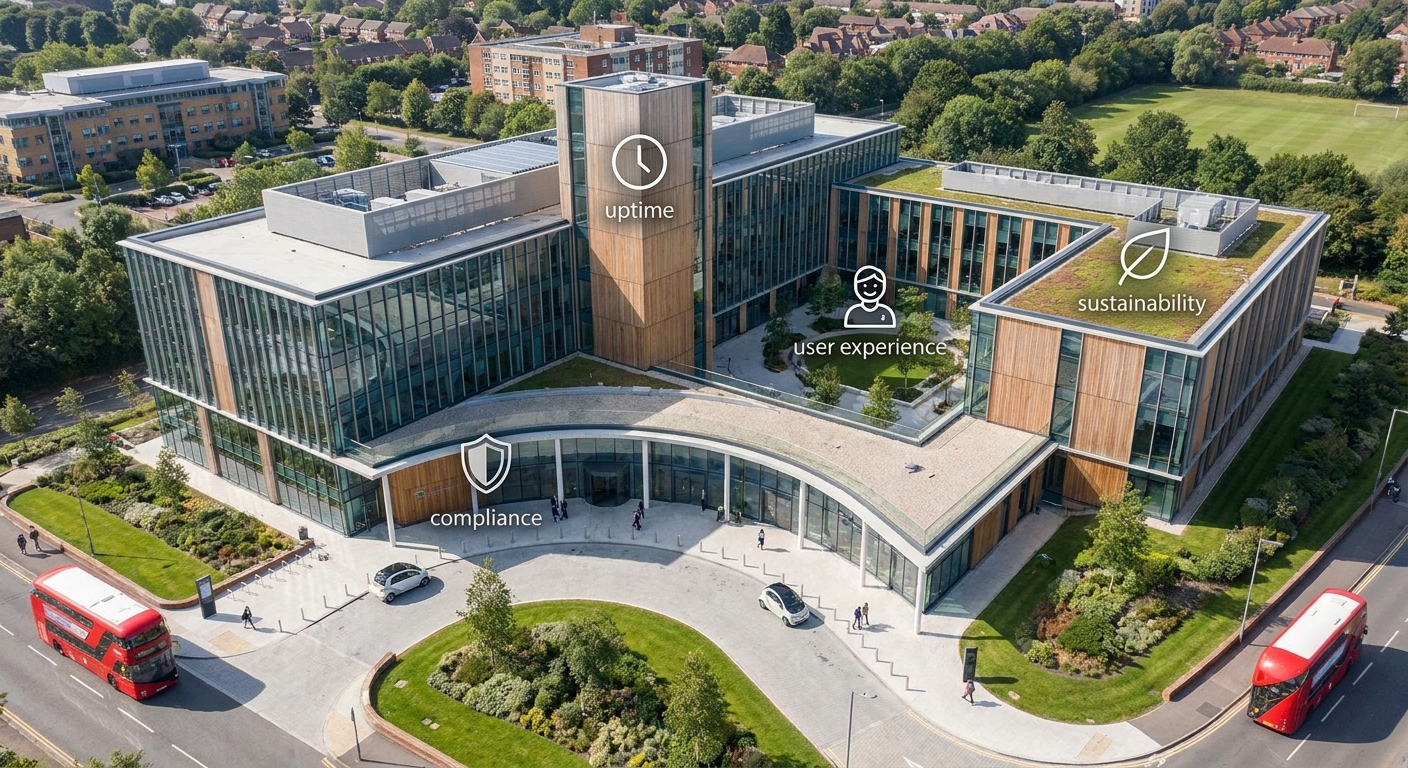
Outcome-based FM tender response hero showing estate outcomes, service inputs and measurable performance evidence
Why Outcome-Based FM Tenders Are Growing
Public sector FM buyers are under pressure from every direction.
Budgets are tight. Estates are ageing. Compliance risk is higher. Net zero plans are no longer optional. Building users expect consumer-level service even when the contract is being procured through a formal tender.
At the same time, the Procurement Act has shifted the conversation towards the most advantageous tender. That does not mean price has stopped mattering. It means evaluators have more room to score value, risk control, resilience, social value and performance confidence.
For FM, that naturally pushes tender questions away from inputs and towards outcomes.
Instead of asking, "How many PPM visits will you complete?", the buyer asks, "How will you maintain statutory compliance and asset uptime across a mixed estate?"
Instead of asking, "How many cleaning hours will you provide?", they ask, "How will you maintain a consistently safe, clean and welcoming environment while reducing waste and chemical use?"
Instead of asking, "What helpdesk system do you use?", they ask, "How will you give the authority visibility, assurance and early warning when service risk increases?"
Those are better questions. They are also less forgiving.
A bidder can hide behind a long task list in an input-led tender. In an outcome-led tender, the evaluator wants to know whether the operating model will actually work.
The Mistake: Writing Outcomes as Aspirations
The common failure is painfully familiar.
The question asks for outcomes. The answer gives warm promises.
"We will deliver a high-quality, customer-focused FM service."
"We will work in partnership with the authority to drive continuous improvement."
"We will use innovation to optimise performance across the estate."
None of that is wrong. None of it scores well either.
Evaluators cannot award marks for vibes. They need mechanisms, evidence and control points. If the question is outcome-based, your response needs to connect four things:
- The outcome the client wants.
- The operational method that produces it.
- The evidence that proves you have done it before.
- The measures that show whether it is working during the contract.
Miss any one of those and the answer feels thin.

Four-part outcome response model linking client outcomes, operational method, evidence and contract measures
Start by Translating the Outcome
Outcome-based questions often use broad language. Your first job is to make it specific.
If the tender asks for "a safe and compliant estate", break that down. It might mean:
- Zero overdue statutory tasks.
- A complete asset register with risk-based prioritisation.
- Clear escalation for remedial actions.
- Evidence trails available for audit.
- Faster closure of high-risk defects.
- Site teams who understand their compliance duties.
If the tender asks for "excellent user experience", translate that too. It might mean:
- Fewer repeat complaints.
- Cleaner washrooms at peak times.
- Faster response to room temperature issues.
- Better communication during disruption.
- Named contacts for school, hospital, office or civic building users.
This translation matters because it shows the evaluator you understand the client’s real world.
A council does not buy cleaning hours. It buys fewer complaints from residents and staff. A university does not buy planned maintenance visits. It buys buildings that support teaching, research and student experience. A healthcare client does not buy helpdesk tickets. It buys safe, compliant spaces where clinical teams are not distracted by estates failures.
Write the answer from that place.
Map Each Outcome to a Control Mechanism
Once you have translated the outcome, show the mechanism.
This is where many FM responses become too shallow. They jump from desired result to broad commitment without explaining the operational bridge between them.
A strong response says, in plain terms, how the outcome will be created.
For example:
Outcome: statutory compliance across the estate.Mechanism: a validated asset register, risk-ranked PPM schedule, automated alerts before due dates, monthly compliance review, named accountable person for each service line, and audit sampling by the contract manager.
Outcome: fewer disruptive reactive jobs.Mechanism: trend analysis of repeat faults, root-cause reviews for high-frequency assets, targeted lifecycle recommendations, and a spend-to-save register agreed with the client each quarter.
Outcome: better building user experience.Mechanism: site-specific service standards, clear front-of-house escalation, monthly satisfaction pulse checks, complaint trend analysis, and visible corrective actions shared with building leads.
The mechanism is what makes the promise believable.
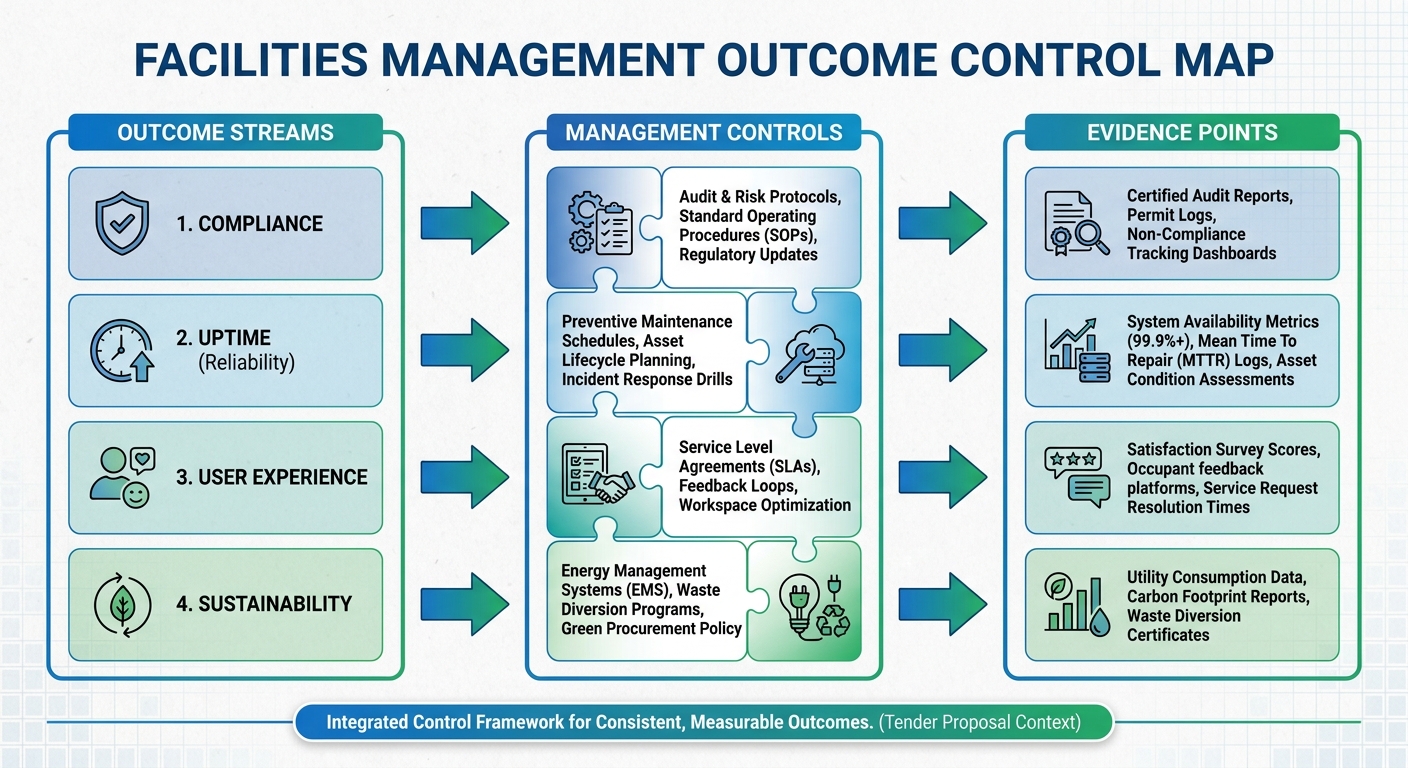
FM outcome control map showing compliance, uptime, user experience and sustainability linked to management controls
Use KPIs Without Letting Them Take Over
Outcome-based tenders need KPIs, but KPIs are not the whole answer.
A KPI tells the evaluator what you will measure. It does not prove you can deliver. It also does not explain what you will do when performance dips.
That distinction matters.
A weak response says: "We will achieve 98% PPM completion."
A stronger response says: "We will maintain 98% PPM completion by validating the asset register during mobilisation, locking statutory tasks into the CAFM system before go-live, reviewing upcoming compliance tasks weekly, and escalating any amber-risk items through the contract governance meeting before they become overdue."
Same KPI. Much better answer.
For FM tenders, your KPI section should normally cover five areas:
- Statutory compliance and audit readiness.
- Planned maintenance completion.
- Reactive response and first-time fix.
- User satisfaction and complaint resolution.
- Sustainability, waste, energy or carbon performance where relevant.
Do not list 40 measures. Evaluators do not need a dashboard dumped into the answer. They need the handful of measures that show control.
A good rule: if you cannot explain what action you take when the measure turns amber, do not include it as a headline KPI.
Evidence Beats Method Statements
Outcome-based FM tenders reward proof.
A beautiful method statement without evidence is still just a claim. A decent method statement backed by hard examples is much safer to score.
Use evidence in three layers.
First, use operational evidence. This includes contract performance data, audit results, mobilisation outcomes, response time improvements, complaint reductions, PPM completion rates and safety records.
Second, use contextual evidence. Show that the previous contract looked like the buyer’s estate. Similar building types matter. Similar geography matters. Similar user groups matter. A national office contract is not the same as a multi-site school estate. A hospital hard FM contract is not the same as a civic centre cleaning contract.
Third, use decision evidence. Explain what you changed and why. Evaluators like to see that you can diagnose problems, not just operate a process.
For example:
"On a 42-site mixed public estate, repeat heating faults accounted for 31% of winter reactive calls. We introduced a targeted pre-winter asset review for the ten highest-failure plant rooms, replaced two recurring components, and reduced heating-related repeat calls by 24% in the following quarter."
That sentence does more work than a whole paragraph about continuous improvement.
Show the Governance Rhythm
Outcomes do not manage themselves.
If your response promises improved performance but never explains governance, the evaluator is left guessing who owns the result.
Your governance section should answer four questions:
- Who reviews performance?
- How often do they review it?
- What data do they use?
- What happens when performance is off track?
In FM, the governance rhythm normally includes daily operational control, weekly contract review, monthly performance reporting and quarterly strategic review. The exact cadence depends on contract size, but the principle is the same.
The best answers avoid ceremony for its own sake. They show a practical rhythm.
Daily huddles deal with immediate risk. Weekly reviews clear blockers. Monthly reports track contractual performance. Quarterly reviews look at improvement, lifecycle planning and strategic risk.
Make it clear where the client is involved. Buyers want partnership, but they do not want to manage your contract for you. The response should show you are accountable while giving them visibility and control.
Make Risk Visible Before the Client Has To
Outcome-based FM contracts are exposed to risk because the buyer is often paying for results, not tasks.
That changes the bid response.
You need to show how you spot risk early, not just how you react when something fails.
Useful early-warning indicators include:
- Rising repeat reactive jobs on the same asset.
- Overdue remedials after statutory inspection.
- Helpdesk complaints from the same building or service line.
- Cleaning quality failures at specific times of day.
- Engineer travel time increasing because of rota gaps.
- Supplier lead times affecting parts availability.
- Energy performance drifting away from expected baselines.
This is where digital systems can help, but do not make the system the hero. The evaluator cares what people do with the information.
A strong answer might explain that amber risks are reviewed weekly, assigned an owner, given a target action date, and escalated to the contract manager if unresolved. High-risk compliance items go straight to senior review. Repeat failures trigger root-cause analysis rather than another reactive job.
That is the difference between reporting and control.
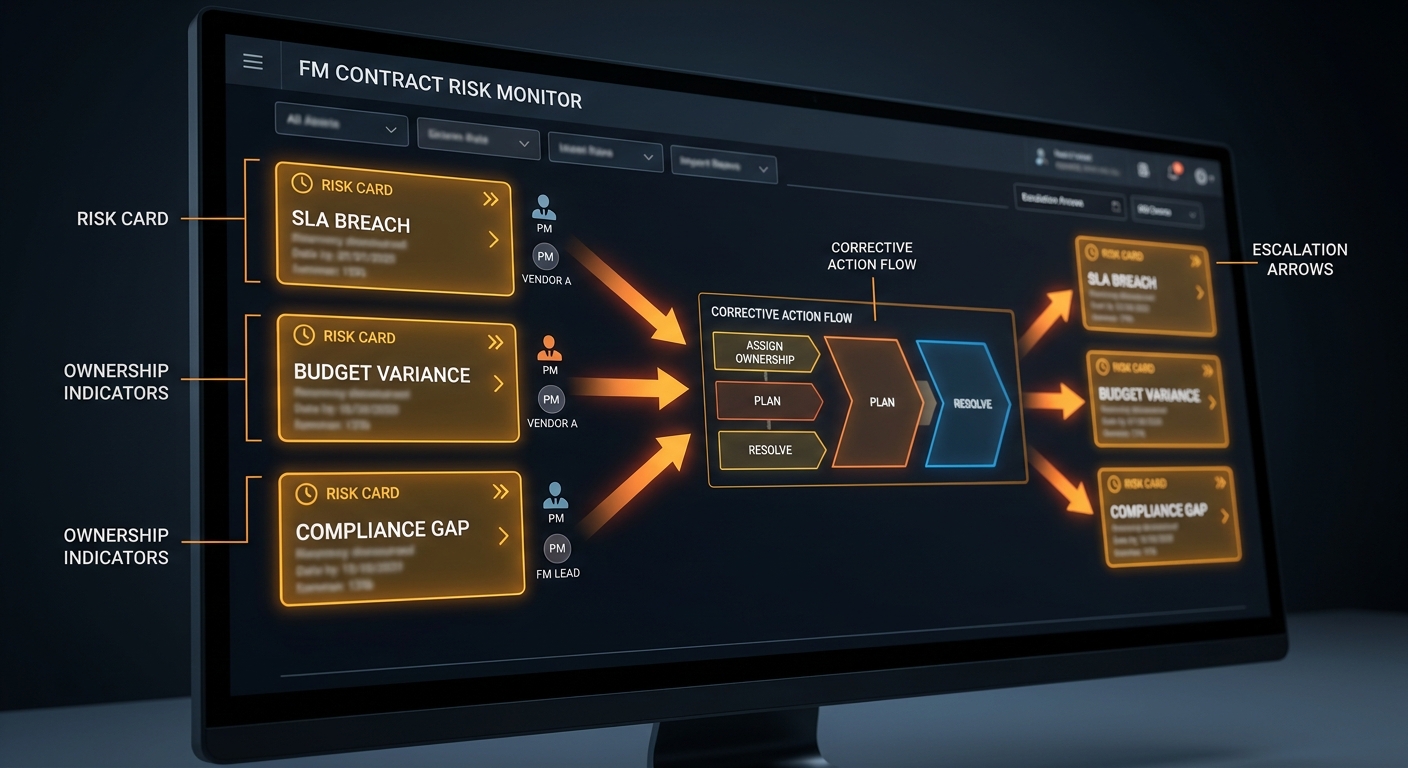
Early warning dashboard concept for FM tenders showing amber risks, ownership, escalation and corrective actions
Sustainability Needs Numbers, Not Pledges
Sustainability is now baked into FM procurement.
That does not mean every answer needs a lecture about net zero. It means your environmental commitments need to be practical, measured and connected to the contract.
For soft FM, that might include chemical reduction, concentrated products, waste segregation, daytime cleaning, water-saving methods and supply chain packaging reductions.
For hard FM, it might include plant optimisation, lifecycle planning, energy audits, controls tuning, LED replacement programmes, refrigerant management and low-carbon maintenance planning.
For total FM, it may include estate-wide carbon baselining and joint improvement plans with the client.
The key is to avoid generic green language. Say what you will measure.
Examples include:
- kWh reduction from agreed baseline.
- Percentage of scheduled tasks completed using low-emission vehicles.
- Waste diverted from landfill.
- Cleaning chemical volume reduction.
- Number of lifecycle recommendations with carbon impact attached.
- Supplier deliveries consolidated per month.
If you cannot quantify it, at least define the evidence trail. Evaluators are increasingly alert to claims that sound good but cannot be audited.
Social Value: Connect It to the FM Workforce
Social value in FM is strongest when it is linked to the workforce and the communities around the estate.
That is especially true as jobs-and-skills commitments become more prominent in public procurement. FM contracts employ cleaners, engineers, supervisors, helpdesk staff, apprentices and local supply chain partners. That gives bidders a real platform for social value, but only if the commitments are specific.
A weak answer says: "We will create local employment opportunities."
A stronger answer says:
"We will advertise all entry-level roles within the contract postcode area for two weeks before wider release, ringfence two apprenticeship starts in year one, offer quarterly work experience placements through the client’s nominated community partner, and report progress through the monthly contract dashboard."
That is scoreable because it has a number, a mechanism and a reporting route.
Do the same for skills, volunteering, SME supply chain spend and community engagement. Keep the commitments realistic. Overpromising social value is a fast way to create contract management pain later.
Write Innovation Like a Controlled Change
FM tender responses love the word innovation. Evaluators are tired of it.
The problem is not innovation itself. The problem is that bidders describe it as a magic ingredient rather than a managed change.
If you propose technology, new working patterns or a different service model, explain how you will test it, govern it and measure whether it worked.
For example, do not simply say you will use sensors to improve cleaning. Explain where they would be used, what data they collect, how privacy is protected, what threshold triggers action, and how success will be measured.
Do not say you will use predictive maintenance. Explain which assets are suitable, what data is available, how recommendations are reviewed, and how you avoid replacing human judgement with noisy alerts.
A practical innovation paragraph follows this structure:
- The problem it solves.
- The proposed change.
- Where it will be piloted.
- What data will be measured.
- How the client approves rollout.
- What happens if it does not work.
That final point is important. Mature bidders know that not every pilot succeeds. Evaluators trust bidders who show controlled experimentation more than bidders who promise transformation without friction.
Mobilisation: Where Outcomes Become Real
Outcome-based FM responses often talk confidently about steady-state service, then underplay mobilisation.
That is risky. Outcomes only happen if the contract starts cleanly.
Your mobilisation section should show how you will build the conditions for outcome delivery before day one. That includes:
- Asset and data validation.
- CAFM configuration.
- Compliance schedule upload.
- Staff transfer, induction or recruitment.
- Site familiarisation.
- Subcontractor onboarding.
- Client reporting setup.
- Baseline performance measurement.
- Communication with building users.
The baseline point is often missed. If the contract is outcome-based, you need to know the starting point. Without a baseline, improvement claims become arguments later.
For example, if you promise to reduce reactive demand, define how current reactive demand will be measured. If you promise to improve user satisfaction, define the first survey point. If you promise energy improvement, agree the baseline period and weather adjustment approach.
Good mobilisation answers reduce future disputes because they make measurement clear from the beginning.
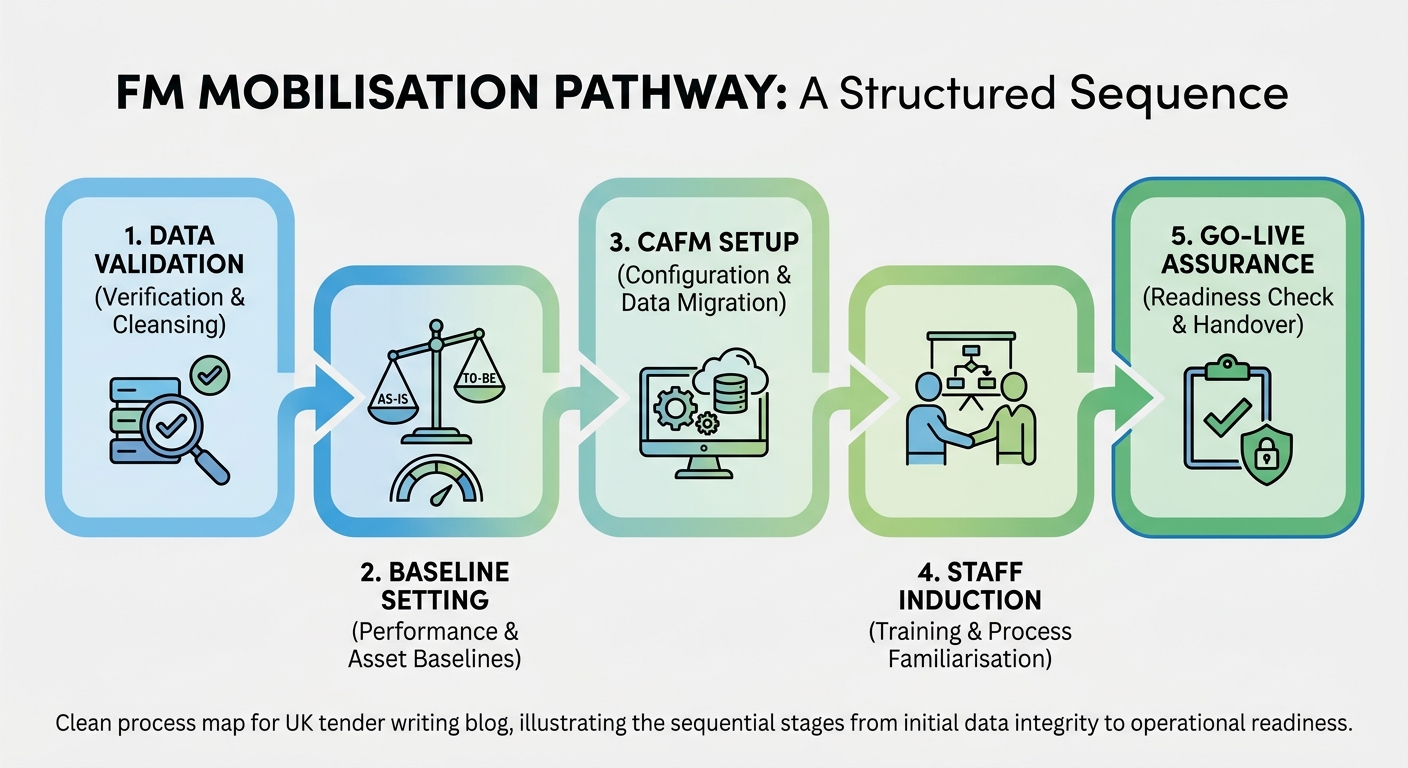
FM mobilisation pathway showing data validation, baseline setting, CAFM setup, staff induction and go-live assurance
Pricing Still Has To Match the Outcome
Outcome-based language does not remove commercial reality.
If your method promises high-touch management, extra assurance, innovation pilots, frequent reporting and social value commitments, the price needs to support it. Evaluators may not see your full cost build-up, but they can spot a mismatch.
A very low price with a highly ambitious outcome model creates doubt. Either the method is under-resourced or the price is unrealistic.
This does not mean you should pad the bid. It means your commercial strategy and quality response need to tell the same story.
If you are proposing a lean model, explain the controls that make it safe. If you are proposing a premium model, explain the value the client receives. If you are relying on technology to reduce labour intensity, show the transition plan and evidence.
FM evaluators are practical people. They know what it takes to run buildings. Respect that.
How to Structure the Actual Tender Answer
A strong outcome-based FM response usually follows a simple structure.
1. Start with the client outcome.Open by naming the outcome in the buyer’s terms. Refer to the estate, users and risk profile. Do not start with your company history.
2. Explain the operating model.Show how people, process, technology and supply chain combine to produce the outcome.
3. Add evidence early.Do not save proof for the end. Put a short evidence point in the first third of the answer so the evaluator knows the method is grounded.
4. Define the measures.List the KPIs or service measures that prove delivery, but keep them focused.
5. Explain governance and escalation.Show who owns performance, how risk is reviewed, and how the client gets visibility.
6. Close with assurance.End by summarising why the model is low-risk, measurable and realistic.
This structure works because it mirrors how evaluators score. They can see understanding, method, evidence, measurement and control.
A Worked Example: Reactive Maintenance
Imagine the question is:
"Describe how you will deliver an outcome-based reactive maintenance service that maintains building availability and user confidence across the estate."
A weak answer starts with helpdesk opening hours, engineer numbers and response categories.
Those details matter, but they are not the outcome.
A better answer starts here:
"For this estate, reactive maintenance success means keeping priority spaces usable, restoring service quickly when failures occur, and reducing repeat faults so building users experience fewer disruptions over time. Our model combines triage, mobile engineering, first-time-fix control and root-cause review to protect availability rather than simply process tickets."
That opening does three useful things. It defines the outcome. It shows the mechanism. It signals that the bidder understands the difference between activity and value.
Then the answer can cover:
- Helpdesk triage by operational impact, not just fault category.
- Engineer allocation based on skills, parts availability and location.
- Van stock matched to the highest-frequency faults.
- First-time-fix tracking by asset type.
- Repeat-fault review for assets with three or more callouts in a quarter.
- Communication standards for affected building users.
- Monthly analysis of avoidable reactive demand.
Now the operational detail has a purpose. It is not a list of tasks. It is a system designed to protect building availability.
A Worked Example: Cleaning Quality
For cleaning, outcome-based questions often ask for safe, clean and welcoming environments.
Again, the trap is to answer with hours and schedules.
A better response links resource to building use.
In a civic building, peak footfall may be lunchtime and late afternoon. In a school, washroom quality may be most at risk between morning break and lunch. In a transport site, weather can change the service requirement within an hour.
A strong answer explains how cleaning plans flex around those patterns.
It might include:
- Baseline cleaning specification by area type.
- Peak-time checks for high-use washrooms and entrances.
- Supervisor audits using agreed quality standards.
- Rapid response for spills, complaints or weather-related issues.
- Consumable monitoring to prevent user complaints.
- Monthly trend review by building and time of day.
The outcome is not "we cleaned according to the schedule". The outcome is that users experience the building as clean, safe and well managed.
That shift in language matters.
A Worked Example: Compliance Assurance
Compliance questions are where FM bidders should be strongest, but many answers still feel generic.
The buyer wants confidence that statutory tasks will not drift. Your answer should show a closed loop.
Start with asset validation. Then show how tasks are loaded, assigned, completed, evidenced, reviewed and escalated.
For example:
"During mobilisation, we will validate all statutory assets against the incumbent register, site walkdowns and available O&M information. Each statutory task will be loaded into the CAFM system with frequency, responsible trade, evidence requirement and escalation date. The contract manager will review the four-week lookahead every Monday, with any amber-risk tasks escalated before due date. Completed tasks will be sampled monthly for evidence quality, not just completion status."
That is practical. It tells the evaluator exactly how compliance stays under control.
If you have audit evidence, use it here. For example, "99.6% statutory PPM completion across 18 public buildings over the last 12 months" is far more persuasive than "we have extensive compliance experience".
Where AI Can Help Bid Teams
Outcome-based FM answers are difficult because the evidence sits in too many places.
The performance data is in monthly reports. The good example is buried in a mobilisation review. The KPI language is in the contract management plan. The social value numbers are in a quarterly slide deck. The best proof often exists, but the bid team cannot find it quickly enough.
That is where a specialist bid workspace helps.
A platform like mytender.io can help teams turn previous FM responses, case studies, compliance evidence and performance data into stronger first drafts. The point is not to replace the bid writer. The point is to stop them starting from a blank page when the contract deadline is already too close.
The human judgement still matters. Someone needs to decide which evidence fits, where the risk is, and how bold the commitment should be. AI is useful when it gives that person better material, faster.
The Review Checklist Before You Submit
Before you submit an outcome-based FM response, read it once as an evaluator.
Then ask these questions:
- Have we translated the buyer’s outcome into specific operational results?
- Have we shown the mechanism that produces each result?
- Have we included evidence from comparable contracts?
- Have we explained who owns performance and escalation?
- Have we defined the KPIs without dumping a dashboard into the answer?
- Have we shown what happens when performance dips?
- Have we connected sustainability and social value to the actual FM contract?
- Have we made mobilisation and baselines clear?
- Does the price support the quality promise?
If the answer only says what you will do, it is probably not strong enough. It needs to show why that method produces the outcome and how the client will know it is working.
The Bottom Line
Outcome-based FM tenders are not asking for prettier promises. They are asking for more confidence.
The bidders who win will be the ones who can connect client outcomes to operational control. They will show the system, the evidence, the measures and the governance. They will write like people who understand buildings, not like people filling space in a method statement.
That is good news for serious FM providers. If you have the evidence, outcome-based questions give you room to prove it.
If you want to find live FM and public sector opportunities to test this approach, the Tender Finder is free to use. It is a useful way to spot relevant tenders early, before the writing window gets painfully tight.
Tags
Ready to Transform Your Tender Writing?
See how MyTender's AI can help you write winning tenders in a fraction of the time.