
NHS Estates Backlog and Hard FM Tenders: How Suppliers Can Win Healthcare Frameworks in 2027
A practical guide for facilities management, construction and estates suppliers bidding into NHS and healthcare frameworks as backlog maintenance, statutory compliance, net zero and social value shape the 2027 pipeline.
mytender.io Research Team
Tender Writing & Procurement Specialists
NHS Estates Backlog and Hard FM Tenders: How Suppliers Can Win Healthcare Frameworks in 2027
The NHS estates market is entering a period where maintenance, compliance and resilience will matter as much as price.
That is good news for suppliers who can prove they understand healthcare environments. It is also a warning for suppliers who still treat facilities management tenders as generic method statements with a few healthcare references added at the end.
The pressure is visible. NHS England estates data has put the maintenance backlog in the tens of billions, with high-risk and significant-risk work sitting alongside everyday operational demand. At the same time, major public frameworks are being refreshed under the Procurement Act 2023. Hard FM, construction consultancy, healthcare soft FM, total FM, decarbonisation, fire safety, water hygiene, ventilation, medical gases, standby power and building management systems are no longer isolated service lines. They are part of one question: can this supplier keep critical healthcare estates safe, compliant and usable while the system is under pressure?
For bid teams, that changes the way a healthcare tender should be written. A strong response does not just say the supplier has experience. It connects evidence to patient continuity, clinical risk, statutory obligations, asset condition, workforce resilience, escalation routes and measurable improvement.

NHS estates team reviewing a hard FM tender evidence map in a hospital plant room
This guide explains how suppliers should approach NHS estates and hard FM tenders in 2027. It is written for facilities management companies, specialist contractors, construction consultancies, compliance providers and bid teams preparing for healthcare frameworks and call-offs.
The short version is simple. Buyers need suppliers who can reduce risk, not just complete tasks. Your tender has to prove it.
Why NHS Estates Tenders Are Different Now
Healthcare estates have always been complex, but the current procurement environment makes that complexity more explicit.
A hospital estate is not an ordinary property portfolio. A delayed lift repair can affect patient transfers. A ventilation failure can close clinical capacity. A weak water hygiene process can become a safety incident. Poorly managed planned preventive maintenance can push an already stretched estates team into reactive firefighting. Even routine cleaning, portering, security, waste, reception and grounds work can affect patient experience and clinical flow.
That context matters because public buyers are not simply buying labour hours. They are buying assurance. They need to know that a supplier can work around live clinical environments, manage access constraints, protect vulnerable patients, support infection prevention, maintain records, coordinate subcontractors, respond out of hours and escalate risk before it becomes operational failure.
Several trends are coming together.
First, the backlog is no longer background context. Estates maintenance pressure is now a central driver of procurement strategy. Buyers are looking for suppliers who can help prioritise risk, maintain ageing assets and provide evidence that scarce capital and revenue budgets are being used intelligently.
Second, frameworks are getting larger and more structured. NHS Shared Business Services, Crown Commercial Service, Government Commercial Agency and other framework routes are shaping how work reaches the market. Suppliers may win a place on a framework first, then compete again at call-off level. That means bid evidence must work twice: once to secure access, and again to win live work.
Third, the Procurement Act 2023 has changed the language and rhythm of public procurement. Buyers have more flexibility through procedures, more transparency obligations and more focus on lifecycle performance. Suppliers need to show they can support the whole contract journey, not just write a good implementation plan.
Fourth, social value is narrowing toward good jobs and skills for central government procurements from 2027, while sustainability continues to appear through specifications, KPIs and technical requirements. Healthcare estate buyers will still care about carbon, energy, waste and resilience, but they will expect practical delivery rather than broad ESG promises.
The result is a more demanding bid environment. A supplier can be technically capable and still lose if its tender does not translate that capability into buyer confidence.
The SEO Topic Behind This Guide
The market is searching for practical help around NHS hard FM frameworks, healthcare facilities management tenders, statutory compliance evidence and backlog maintenance. That search intent is not abstract. It comes from bid teams trying to understand what buyers will reward in the next wave of frameworks and call-offs.
Many suppliers already have the raw material. They have PPM schedules, CAFM data, asset registers, audit reports, water hygiene logs, fire door surveys, permit systems, workforce training records, helpdesk response data, mobilisation trackers, subcontractor scorecards and case studies from live healthcare contracts. The problem is that this information is often scattered across operations, compliance, HR and finance.
A winning tender turns that scattered material into a clear story:
- what risks exist in healthcare estates
- how the supplier finds and prioritises those risks
- what evidence proves the controls work
- how performance is measured during the contract
- how the supplier improves the estate without disrupting care
That is where AI-supported bid management can help, if it is used properly. Not to invent claims, but to find relevant evidence, structure responses, map requirements, compare previous answers and flag missing proof before submission.
mytender.io is built around that exact problem. Bid teams should not have to hunt through shared drives at midnight to prove something they already do every day.
What Buyers Really Mean by Hard FM Capability
Hard FM capability is often described in service categories: mechanical and electrical, building fabric, fire safety, lifts, water hygiene, medical gases, critical ventilation, standby power, building management systems and statutory inspections.
Those categories are important, but they are not enough. A buyer reading a healthcare hard FM tender is usually testing five deeper questions.
Can the supplier keep critical services running?
Can it spot risk early enough to prevent avoidable disruption?
Can it work safely in clinical and patient-facing areas?
Can it evidence compliance without creating administrative burden for the trust?
Can it improve asset performance over time?
If your response only lists services, accreditations and staffing levels, it leaves those questions half answered. The better approach is to build each answer around operational assurance.
For example, do not just state that you provide planned preventive maintenance. Explain how PPM schedules are risk-ranked by asset criticality, how missed tasks are escalated, how statutory tasks are separated from discretionary work, how access restrictions are managed, and how the buyer sees assurance through dashboards and review meetings.
Do not just say you manage subcontractors. Explain how subcontractor competence is checked, how specialist works are planned around clinical constraints, how RAMS are reviewed, how service levels flow down into subcontracts, and how poor performance is corrected before it affects the trust.
Do not just say you understand healthcare. Show it through examples: decant planning, infection prevention controls, out-of-hours working, permits, emergency response, isolation procedures, patient dignity, estates-team handover, and communication with ward managers.
This is the difference between a generic FM bid and a healthcare estates bid.
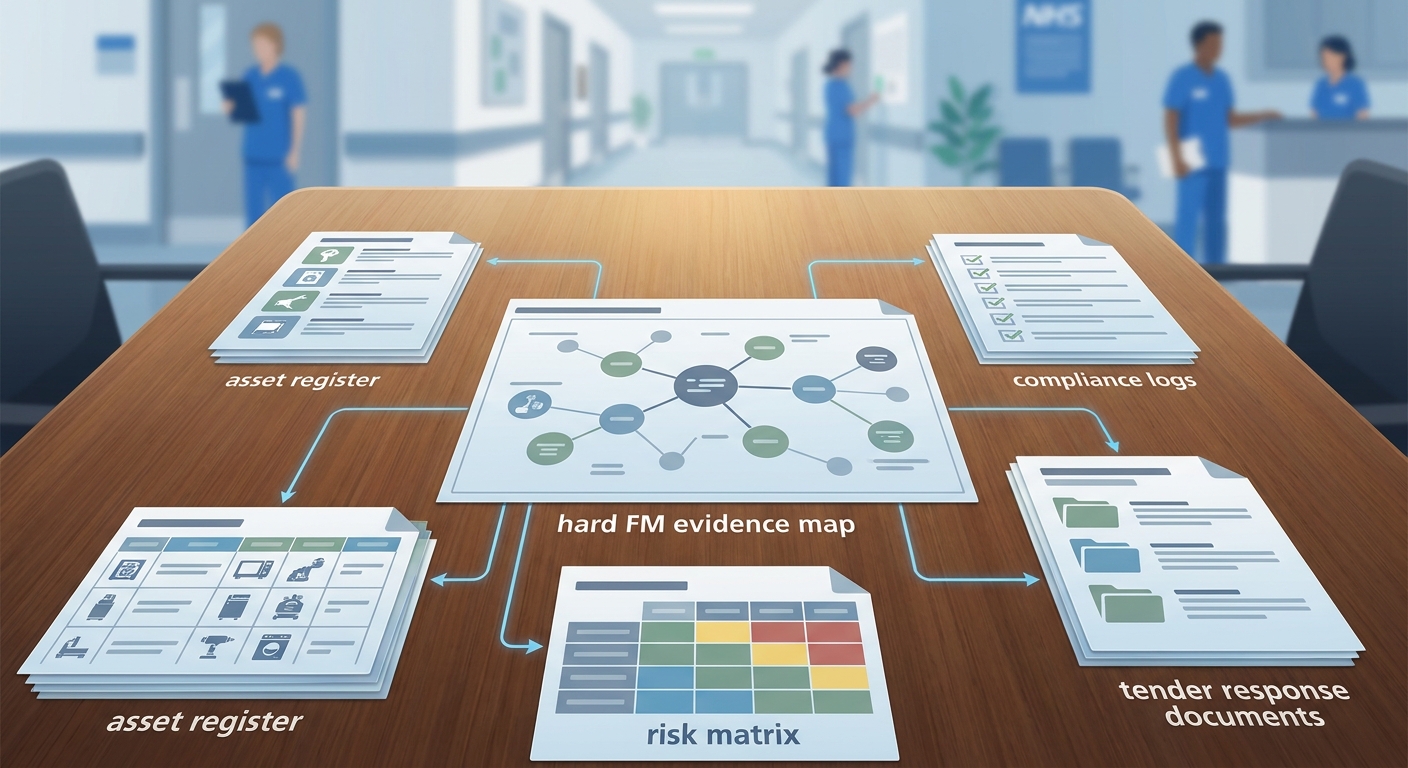
Healthcare hard FM evidence map linking assets, risks, tasks, compliance logs and tender responses
Start With the Backlog, Not the Service Catalogue
The strongest NHS estates tenders start with the buyer's pressure, not the supplier's brochure.
Backlog maintenance changes the tone of a tender because it creates competing priorities. Buyers need statutory compliance, operational continuity, safe environments, budget control and long-term improvement at the same time. They know not everything can be fixed instantly. They want to see how a supplier makes sensible decisions under constraint.
That means a good response should explain your approach to triage.
How do you classify high-risk, significant-risk and lower-priority defects? How do you combine asset condition, clinical impact, statutory urgency, cost, lifecycle risk and operational disruption? How do you advise the buyer when a short-term repair is false economy? How do you evidence that a risk has been reduced, not merely logged?
This is where many suppliers underperform. They describe a helpdesk, an asset register or a maintenance plan, but they do not explain decision-making. The buyer is left to infer that the supplier can prioritise. In a backlog-heavy environment, inference is weak.
A better tender sets out a simple operating model.
First, establish the baseline. On mobilisation, validate asset data, critical systems, compliance status, backlog items, access constraints, known pain points and existing contractor dependencies. Do not promise a perfect dataset on day one. Promise a controlled validation process with clear exceptions.
Second, rank risk. Use a consistent matrix that considers safety, statutory duty, clinical impact, service continuity, cost exposure, environmental impact and reputational risk. Make clear who signs off priority changes and how urgent findings are escalated.
Third, build a forward plan. Separate immediate safety actions, statutory catch-up, planned maintenance recovery, lifecycle recommendations and improvement projects. Buyers need to see the difference between urgent control and long-term estate improvement.
Fourth, report in a way executives understand. Estates leaders do not need another dump of task data. They need trend, risk, decision and exception reporting: what is getting safer, what is slipping, where money should go next, and what the supplier is doing about it.
That structure is more persuasive than a page of generic commitments.
Evidence That Wins Healthcare Framework Scores
Healthcare buyers score evidence, not ambition.
The best tender responses use proof in layers. Each claim is supported by something concrete: data, examples, process, governance and named accountability.
For NHS estates and hard FM tenders, the evidence library should be ready before the tender lands. Waiting until the ITT is live creates panic, especially when operations teams are busy and the bid deadline is immovable.
At minimum, prepare evidence in ten areas.
- Statutory compliance records. Fire safety, water hygiene, asbestos, electrical testing, pressure systems, lifts, gas, ventilation, medical gases and any service-specific compliance evidence should be current, version-controlled and easy to summarise.
- Asset management evidence. Buyers want to know how you capture, validate and use asset data. Include examples of asset registers, condition surveys, criticality models, lifecycle plans and data-cleaning processes.
- PPM performance. Provide evidence of completion rates, missed-task controls, escalation processes, remedial closure and lessons learned. Avoid vanity percentages without context. Explain how you handle clinically constrained access.
- Reactive performance. Response and rectification data should be segmented by priority, service line, site type and root cause. A strong answer explains how reactive trends feed back into planned work.
- Healthcare mobilisation. Include mobilisation plans that show clinical liaison, access control, staff onboarding, TUPE, permit systems, subcontractor transition, data migration, communications and early-life support.
- Workforce competence. Healthcare estates need trained, supervised people. Keep records of technical qualifications, DBS where relevant, site induction, safeguarding awareness, infection prevention, permit-to-work competence and emergency response roles.
- Subcontractor governance. Specialist services are common in healthcare FM. Show how you qualify, monitor, audit and escalate subcontractor performance, particularly where statutory compliance is involved.
- Business continuity. Buyers need confidence that you can handle failure. Evidence should cover on-call arrangements, spares strategy, escalation routes, winter planning, major incident support, supply chain resilience and communications.
- Sustainability and energy. Even where net zero is not a standalone social value outcome, healthcare estates will still evaluate energy reduction, low-carbon maintenance, waste reduction, lifecycle choices and practical decarbonisation support.
- Continuous improvement. Include examples where you reduced failures, improved compliance, cut repeat calls, improved asset data, saved energy or improved reporting. Buyers want to know what gets better after award.
The aim is not to overwhelm the evaluator. The aim is to make every important claim verifiable.

Statutory compliance dashboard for healthcare estates showing fire, water hygiene, ventilation and lift assurance
How to Write the Compliance Answer
Compliance answers are where many healthcare FM bids become either too vague or too technical.
A vague answer says the supplier complies with all relevant legislation and industry standards. That is not enough.
A too-technical answer lists regulations, acronyms and inspection frequencies without explaining how the buyer receives assurance. That can also fail, because evaluators need confidence that the system is managed, not merely known.
A strong compliance answer has four parts.
First, state the obligation in plain language. For example, the buyer needs safe water systems, controlled fire risk, maintained critical ventilation, safe electrical infrastructure and reliable records.
Second, explain the management system. Who owns the register? How are tasks scheduled? How are certificates stored? How are remedials tracked? What happens if access is denied? What is escalated to the trust? How are high-risk issues separated from routine defects?
Third, provide evidence. Use a short case example, a performance metric, an audit outcome or a corrective action story. If you improved compliance from an inherited position, explain the baseline and the journey.
Fourth, explain reporting. Buyers need to see how they will know the position at any point. Monthly reports, live dashboards, exception logs, review boards and audit packs all matter if they are genuinely used.
For example, instead of writing that your company maintains water hygiene compliance, write about your water safety plan interface, asset validation, sampling schedules, temperature monitoring, remedial risk ranking, responsible person reporting and evidence packs for review. Then support it with a real example of reducing overdue remedials or improving record quality.
The same structure works across fire, asbestos, medical gases, lifts, pressure systems, electrical inspection and ventilation.
The key is to make compliance feel controlled. Healthcare buyers cannot accept black boxes.
Mobilisation Is a Scored Risk, Not a Project Plan Appendix
Mobilisation is often the section that decides whether the evaluator believes the rest of the bid.
In healthcare estates, mobilisation risk is high. The supplier may inherit imperfect asset data, incumbent knowledge gaps, overdue remedials, TUPE concerns, multiple subcontractors, live clinical constraints and systems that do not speak to each other. A plan that says week one discovery, week two onboarding, week three go-live is not credible unless it shows risk control.
A stronger mobilisation answer is built around workstreams.
Governance: who leads mobilisation, who attends transition boards, what decisions are needed from the trust, how risks are escalated and how progress is reported.
People: TUPE consultation, role mapping, training, inductions, vetting, site familiarisation, rota assurance and emergency cover.
Assets and data: asset register validation, critical asset checks, PPM import, compliance certificate review, backlog review, data gap logging and buyer sign-off.
Systems: CAFM configuration, helpdesk routes, reporting templates, mobile working, permissions, integrations and user acceptance testing.
Compliance: immediate review of statutory obligations, overdue tasks, high-risk remedials, permits, RAMS, assurance documents and responsible-person interfaces.
Clinical interface: ward communication, infection prevention controls, access planning, noisy works, isolation requirements, theatre and critical area constraints.
Supply chain: subcontractor novation or replacement, contract alignment, competence checks, spares availability and emergency call-out routes.
Early-life support: enhanced reporting, daily huddles, rapid issue resolution and a controlled move from transition into business as usual.
This is more than a plan. It is a confidence mechanism. It tells the buyer that the supplier has done this before and knows where transitions fail.

Healthcare mobilisation war room with risk register, asset data and clinical access planning for an NHS FM contract
The Social Value Shift: Jobs and Skills in Healthcare FM
From 2027, central government social value expectations are moving toward a sharper focus on good jobs and skills for in-scope procurements. Even where a healthcare buyer has its own framework rules, the direction of travel is clear: broad social value promises are less persuasive than measurable workforce outcomes.
For FM and estates suppliers, that can be an advantage.
Healthcare estates work naturally connects to apprenticeships, technical training, local employment, progression routes and hard-to-fill skills. A hospital estate needs electricians, mechanical engineers, building fabric specialists, fire safety professionals, water hygiene technicians, energy specialists, cleaners, porters, security officers, supervisors and contract managers. Many of these roles can support good local jobs if the supplier has a real workforce plan.
The mistake is to write social value as a charity paragraph. Sponsoring a local event may be nice, but it rarely proves that the contract will create lasting value.
A stronger answer links social value to contract delivery.
Show how apprenticeships will support the future engineering workforce. Explain how you will create progression pathways for existing staff. Set out training hours, mentoring, supervisor development, return-to-work pathways, school or college engagement, and opportunities for people facing barriers to employment. Make the KPIs specific enough to manage.
In healthcare, also connect social value to service resilience. Better trained local teams reduce churn. Stronger supervision improves safety. Apprenticeships build future capacity. Skills partnerships help address shortages. Staff wellbeing supports continuity in a demanding environment.
That is much more compelling than a generic community fund.
Net Zero Still Matters, But It Has Moved Into the Detail
Some suppliers have misunderstood the recent narrowing of social value themes as a signal that environmental performance is becoming less important. That is a bad read.
Healthcare estates remain under pressure to reduce energy use, carbon impact, waste and inefficient lifecycle decisions. Net zero may sit in technical specifications, estate strategies, energy lots, KPI schedules, method statements or contract management requirements rather than in a broad social value question. It has not disappeared.
For hard FM suppliers, the best environmental answers are operational.
How will maintenance improve energy performance? How will engineers identify avoidable plant run-time, poor controls, leaks, insulation issues, inefficient set points or failing components? How will recommendations be costed and prioritised? How will lifecycle choices balance carbon, cost, reliability and clinical risk? How will the supplier avoid disruption while making improvements?
This is where facilities management suppliers can be more persuasive than high-level sustainability consultants. You are close to the assets. You see failures, wastage and opportunities every day. The tender should turn that operational visibility into a practical improvement model.
A good answer might describe a rolling energy-opportunity log, BMS optimisation reviews, seasonal commissioning, LED and controls opportunities, plant replacement recommendations, heat-loss reduction, water efficiency, waste segregation and low-emission fleet planning. It should also explain governance: who approves recommendations, how savings are measured, and how clinical constraints are protected.
Avoid the trap of promising unrealistic carbon savings without baseline control. Healthcare buyers know the estate is complicated. Credibility beats ambition when the claim is not evidenced.
Framework Bids and Call-Off Bids Need Different Evidence
Suppliers often use the same bid library content for framework submissions and call-off competitions. That saves time, but it can weaken the response.
A framework bid usually asks whether the supplier has the capability, capacity, governance, systems and evidence to be appointed as an approved supplier. It rewards breadth, assurance and repeatability. You need to show that your model can work across sites, regions and buyer types.
A call-off bid asks how you will deliver for this buyer, this estate, this service scope and this risk profile. It rewards specificity. You need to show that you understand the buildings, the users, the constraints, the backlog, the stakeholders and the mobilisation route.
The evidence should therefore be layered.
At framework level, prepare strong standard modules: healthcare governance, mobilisation model, statutory compliance system, PPM approach, reactive model, asset management, workforce competence, subcontractor control, social value, sustainability and continuous improvement.
At call-off level, customise the modules. Replace generic healthcare wording with the buyer's context. Reference the estate profile, known priorities, lot structure, required service lines, response categories, reporting expectations, local labour market, incumbent risks and contract outcomes.
AI can help here if the source material is controlled. mytender.io can help teams find previous healthcare examples, compare them with the new specification, and create a first draft that is grounded in approved evidence. The human bid lead still owns strategy and accuracy, but the team does not start from a blank page.
How to Build an NHS Estates Evidence Library
The practical answer to most bid stress is preparation.
An NHS estates evidence library should not be a dumping ground. It should be organised around the questions healthcare buyers ask. If a bid writer has to open twenty folders to find one example of improved lift availability, the library is not doing its job.
Structure the library around evidence themes:
- mobilisation and transition
- statutory compliance
- asset management and lifecycle planning
- PPM and reactive maintenance
- critical systems and emergency response
- subcontractor management
- workforce training and competence
- healthcare infection prevention and clinical access
- sustainability and energy improvement
- social value, jobs and skills
- performance reporting and KPIs
- case studies and lessons learned
Each evidence item should include the claim it supports, the sector, the contract type, the measurable result, the date, the owner and any limitations. Limitations matter. A case study from a university campus may still be useful for asset management, but not for infection prevention in a hospital theatre.
The library should also separate approved reusable content from raw documents. Bid teams need clean narrative blocks, verified statistics, current certificates and links back to source proof. If all they have is a pile of PDFs, they will either miss useful evidence or copy outdated claims.
This is where a bid platform becomes more than a writing tool. It becomes the operating memory of the bid function.
KPIs That Healthcare Evaluators Believe
Tender responses often include KPIs that look impressive but do not prove much. Ninety-eight per cent completion sounds good until the evaluator asks what was completed, whether statutory tasks were separated, how access denial was treated, and whether high-risk remedials stayed open.
Healthcare KPIs need to reflect risk.
For planned maintenance, separate statutory, critical and routine tasks. Show completion, overdue tasks, reason codes, escalation and remedial linkage.
For reactive work, separate response and fix. A fast attendance time is not enough if repeat failures continue. Include first-time fix, repeat calls, root cause, backlog impact and critical asset trends.
For compliance, show evidence status as well as task status. A certificate that exists in someone's inbox is not the same as an auditable record available to the buyer.
For mobilisation, use transition milestones, data validation progress, induction completion, subcontractor readiness, open risks and early-life incident trends.
For social value, use contract-specific outputs: apprenticeships started, training hours completed, local employment outcomes, progression milestones, work placements, mentoring and retention.
For sustainability, use energy opportunities identified, approved, implemented and measured. Avoid reporting only ideas generated; buyers care about implemented improvement.

Performance dashboard for an NHS hard FM contract showing PPM, remedials, compliance and social value KPIs
The best KPI answers also explain governance. Who reviews the data? What happens when performance slips? How are exceptions escalated? How does the supplier prevent gaming of the numbers? How does the buyer see the same version of the truth?
That last point is important. Healthcare estates teams are busy. A supplier that reduces reporting burden while increasing assurance has a genuine advantage.
Common Mistakes in NHS Hard FM Tender Responses
The same weaknesses appear again and again.
The first is generic healthcare language. Phrases such as patient-centred, live environment and critical estate are useful only if followed by specific controls. Evaluators have read those phrases hundreds of times.
The second is over-reliance on accreditations. Certifications matter, but they do not answer how the contract will be delivered. ISO standards, CHAS, NICEIC, Gas Safe, SafeContractor and sector memberships should support the answer, not replace it.
The third is weak case studies. A case study that says the contract was delivered successfully is not enough. What was the problem? What did the supplier do? What changed? What was measured? What would the buyer recognise as relevant?
The fourth is ignoring inherited risk. Many healthcare contracts begin with data gaps, backlog, ageing assets or incumbent issues. Pretending mobilisation will be smooth can look naive. Better to show how you identify and control inherited risk without blaming the outgoing supplier.
The fifth is separating price from quality. In estates work, poor quality creates cost. Repeat failures, emergency call-outs, missed statutory tasks, inefficient plant and weak lifecycle advice all have financial consequences. A strong tender links quality controls to whole-life value.
The sixth is unsupported social value. If the response promises apprenticeships, local jobs or training, it must explain delivery partners, numbers, timing, accountability and reporting. Social value should not read like a wish list.
The seventh is failing to tailor framework content at call-off. Buyers can tell when a response was written for everyone. The closer the competition is to a live estate, the more specific the answer must become.
A Practical Response Structure for Healthcare FM Questions
When the tender question is complex, use a repeatable structure.
Start with the buyer outcome. State what the trust or framework authority needs: safe critical systems, compliant records, reduced backlog risk, responsive service, minimal clinical disruption, transparent performance or improved estate resilience.
Then explain your method. Keep it clear. Break the answer into stages or workstreams only where that helps the evaluator follow it.
Then prove it. Use one or two strong evidence points rather than six weak claims. Include numbers where they are current and defensible.
Then explain governance. Show who owns performance, how the buyer is involved, how issues escalate and how improvement is tracked.
Then close with benefit. Make the evaluator's job easy by spelling out the result: fewer avoidable failures, cleaner compliance assurance, safer mobilisation, better budget decisions, stronger workforce resilience or clearer social value reporting.
This structure works for most healthcare FM questions because it balances narrative and evidence. It avoids the two extremes of fluffy sales copy and unreadable technical detail.
Where AI Helps, and Where It Cannot Replace Judgement
AI is becoming normal in bid writing, but healthcare tenders are exactly where careless AI use becomes risky.
AI can help a bid team analyse the specification, build a compliance matrix, retrieve relevant evidence, compare the tender with previous submissions, draft first-pass answers and check for missing proof. Used well, it saves time and improves consistency.
AI should not invent healthcare experience, create unverified statistics, guess compliance obligations, rewrite technical commitments beyond operational approval, or produce generic answers that sound polished but say very little.
The right model is human-led and evidence-grounded. Operations, compliance and commercial teams approve the claims. The bid platform helps assemble, structure and test them. The bid lead makes strategic decisions about what matters most to the buyer.
That is especially important under the Procurement Act environment, where transparency, performance and supplier accountability are becoming more connected. A promise made in a tender can become a contract KPI, a review agenda item and eventually part of the supplier's public performance story.
Speed matters, but accuracy wins.
The Bid Team Checklist
Before submitting an NHS estates or healthcare FM tender, ask these questions.
Have we explained the buyer's estate pressure before describing our services?
Have we separated statutory compliance, critical assets and routine tasks?
Have we shown how backlog and inherited risk will be assessed, prioritised and reported?
Have we used healthcare-specific examples, not generic FM examples?
Have we evidenced mobilisation risk controls in enough detail?
Have we linked workforce plans to good jobs, skills and contract resilience?
Have we shown how sustainability is delivered through maintenance, energy and lifecycle choices?
Have we tailored framework content to the buyer's estate, region, lot and call-off context?
Have we checked every claim against source evidence?
Have we made the evaluator's decision easier?
If the answer to any of these is no, the tender is not ready.
Final Thoughts
The NHS estates opportunity is substantial, but it is not easy money. The buyers in this market are dealing with old buildings, constrained budgets, safety obligations, clinical priorities, workforce pressure and public scrutiny. They do not need another supplier promising partnership in abstract terms. They need evidence that the supplier can reduce risk from day one and keep improving after award.
That is the standard bid teams should write to.
The strongest suppliers will not win because they say they understand healthcare. They will win because their tenders prove it: through asset evidence, compliance control, mobilisation realism, workforce planning, measurable KPIs and practical improvement.
mytender.io helps bid teams turn that evidence into clear, compliant, persuasive responses faster. First drafts become easier. Compliance checks become calmer. Knowledge stops living in scattered folders. And the bid team gets more time for the judgement calls that decide whether a healthcare framework submission is merely complete or genuinely competitive.
In 2027, NHS estates tenders will reward suppliers who can bring order to complexity. Your bid needs to show that before the contract ever starts.
Frequently asked questions
What should suppliers emphasise in NHS hard FM tenders?
Suppliers should emphasise statutory compliance, critical asset resilience, healthcare-specific mobilisation, backlog prioritisation, clinical access controls, workforce competence, subcontractor governance and clear KPI reporting. Generic FM experience is not enough unless it is connected to healthcare risk and patient continuity.
How does the NHS estates backlog affect tender responses?
The backlog means buyers want evidence that suppliers can prioritise risk, validate asset data, manage urgent remedials, advise on lifecycle decisions and report estate condition clearly. Tender responses should show how the supplier reduces risk under budget and access constraints.
Does social value still matter in healthcare FM tenders?
Yes. From 2027, central government social value expectations focus more sharply on good jobs and skills, while healthcare buyers still value practical local employment, apprenticeships, training, progression and workforce resilience. The strongest answers link social value to the contract workforce, not generic charity activity.
Tags
Ready to Transform Your Tender Writing?
See how MyTender's AI can help you write winning tenders in a fraction of the time.