
MEAT to MAT: How the Most Advantageous Tender Framework Changes Your Bidding Strategy in 2026
The Procurement Act 2023 replaces MEAT with MAT, fundamentally changing how public sector contracts are awarded. Learn how to adapt your bidding strategy to win under the new Most Advantageous Tender framework.
Evie
Procurement Specialist
The UK public sector procurement landscape underwent a seismic shift in February 2025 when the Procurement Act 2023 came into full force, replacing the decade-old Public Contracts Regulations 2015. At the heart of this transformation lies a seemingly subtle but profoundly impactful change: the replacement of MEAT (Most Economically Advantageous Tender) with MAT (Most Advantageous Tender).
For organisations bidding on public sector contracts worth billions of pounds annually, this isn't merely a linguistic adjustment. It represents a fundamental recalibration of what "value" means in public procurement, how proposals are evaluated, and what it takes to win. As we navigate the first full calendar year under the new regime, understanding and adapting to the MAT framework isn't optional—it's essential for competitive success.
This article is part of our Procurement Act series. For an overview of what changed and links to every guide in the series, see our Procurement Act 2023 supplier's guide.
This comprehensive guide explores the MEAT to MAT transition, what it means for your organisation, and how to restructure your bidding strategy to thrive under the new evaluation paradigm.
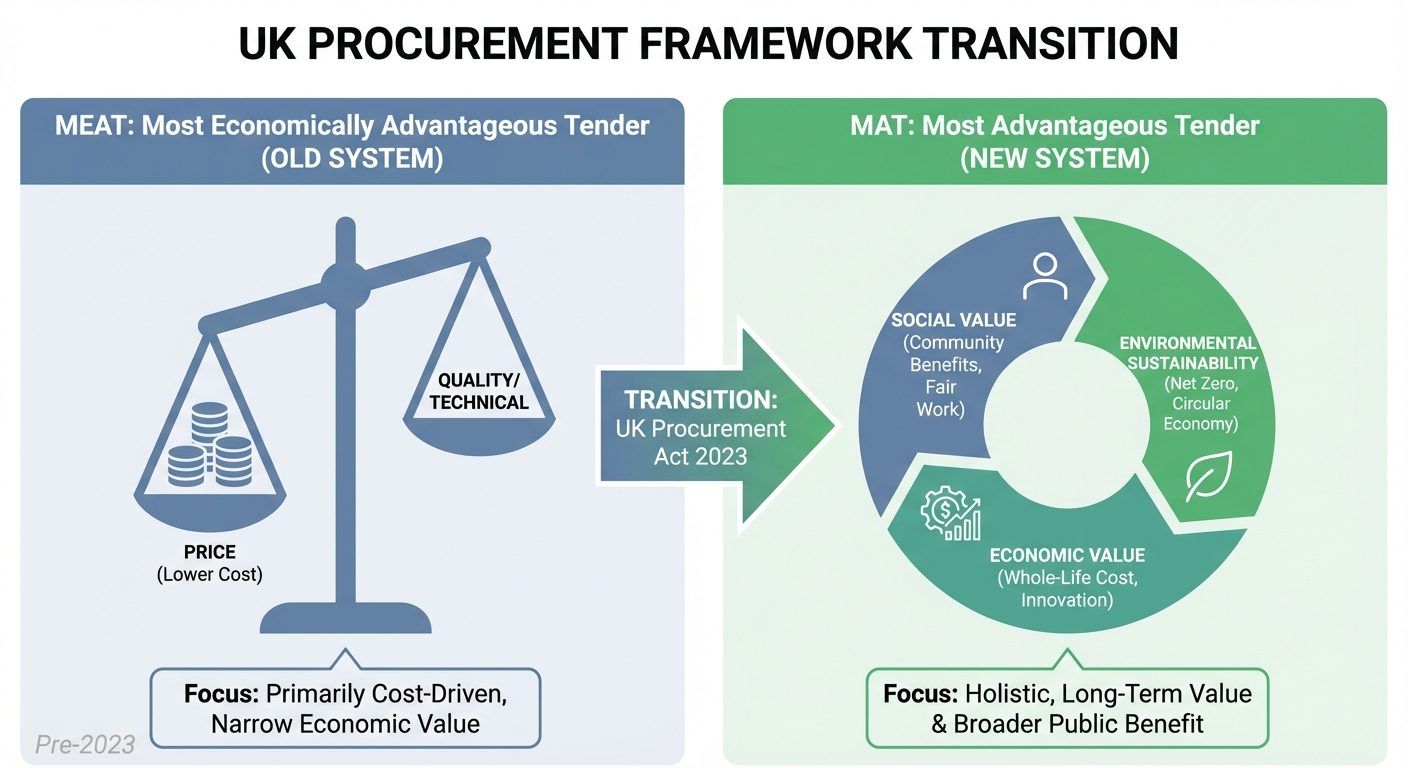
Transition from MEAT to MAT framework under UK Procurement Act 2023
Understanding MEAT: The Old Paradigm
Before we examine the new MAT framework, it's worth understanding what we're moving away from. MEAT—Most Economically Advantageous Tender—dominated UK public procurement for over a decade under the Public Contracts Regulations 2015 and its predecessor directives.
Under MEAT, contracting authorities evaluated bids based on a balance between price and quality factors. The emphasis was decidedly economic. While quality mattered, the framework was rooted in identifying the tender that offered the best economic return for the public purse. In practice, this often meant:
Price-centric evaluation: Even when quality scores were weighted at 60% or 70%, the final decision frequently came down to competitive pricing. A technically excellent bid could lose to a marginally adequate one if the price difference was substantial enough. Short-term value focus: The "economically advantageous" lens naturally gravitated toward immediate, quantifiable financial benefits. Long-term societal outcomes, environmental sustainability, and community benefits were often treated as secondary considerations or tick-box exercises. Limited scope for innovation: The economic framework incentivised conservative, proven approaches. Innovative solutions that might deliver superior long-term value but carried higher upfront costs or implementation risks struggled to score competitively. Compliance-driven quality responses: Bidders learned to craft quality responses that met the minimum requirements while keeping costs low. The emphasis was on demonstrating competence rather than excellence.This approach served its purpose in an era focused on fiscal efficiency and value for money narrowly defined. However, it increasingly came under criticism for failing to address broader societal challenges, from climate change to economic inequality, that public procurement—representing roughly £300 billion annually in the UK—has the potential to influence significantly.
The MAT Revolution: What's Changed?
The shift from MEAT to MAT isn't merely semantic. It represents a philosophical transformation in how the public sector defines and pursues value through procurement.
MAT—Most Advantageous Tender—removes the word "economically" deliberately and purposefully. This single omission opens the door to a far more holistic, nuanced, and future-oriented approach to evaluating tenders. Here's what the new framework enables:
Broader Value Definition
Under MAT, "advantageous" encompasses not just economic value but social, environmental, and long-term strategic value. This means contracting authorities can—and increasingly must—consider:
Social value outcomes: The Procurement Act 2023 mandates a minimum 10% weighting for social value in all relevant public sector tenders, with flexibility to increase this where justified. Social value encompasses job creation, skills development, supporting disadvantaged groups, improving health and wellbeing, and strengthening local communities. Environmental sustainability: Climate commitments and net-zero targets are no longer optional add-ons. The MAT framework explicitly encourages evaluation of carbon footprints, circular economy approaches, biodiversity protection, and long-term environmental stewardship. For the first time, extending the life of IT equipment or implementing circular procurement models can be scored as substantive advantages rather than nice-to-haves. Innovation and modernisation: MAT creates space to value innovative approaches that might deliver superior outcomes over the contract lifetime, even if they require higher initial investment or carry implementation complexity. Strategic alignment: Proposals can be evaluated on how well they align with broader government priorities—whether that's levelling up regional economies, supporting SMEs, or advancing specific policy objectives.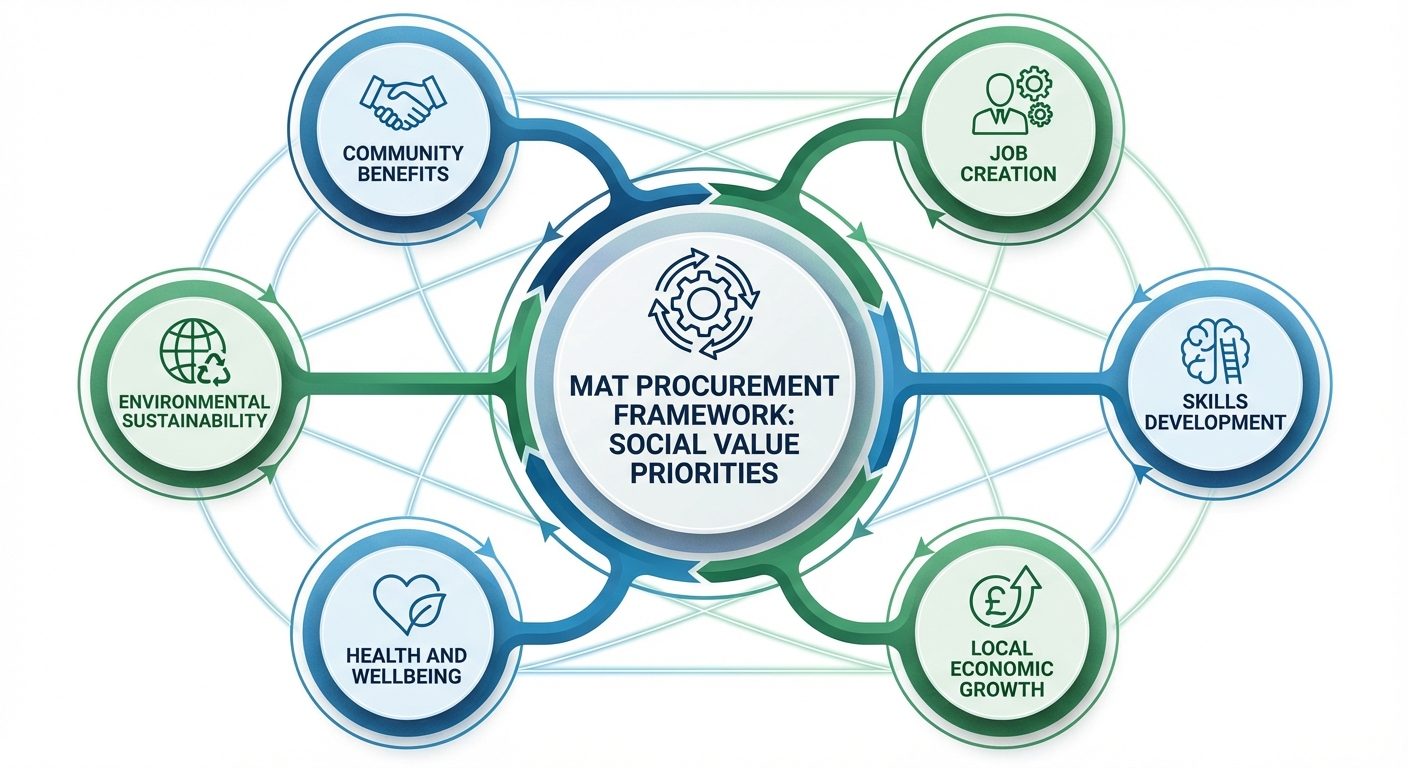
Social value and sustainability priorities in MAT framework
Transparency and Data-Driven Decision Making
The Procurement Act 2023 doesn't just change evaluation criteria—it fundamentally transforms the transparency and accountability of the procurement process. A new central digital platform will serve as the backbone of this transformation, requiring:
Comprehensive notice publication: From pipeline notices signalling future opportunities to contract award notices and ongoing performance reporting, far more information will be publicly available than ever before. Performance transparency: Starting from January 2026, contracting authorities must publish payments compliance notices, significant payments notices, and contract performance notices. This creates an unprecedented level of visibility into how contracts are delivered, not just awarded. Better quality data: Standardised formats and digital-first processes will improve the relevance, consistency, and usability of procurement data, enabling better benchmarking, market analysis, and strategic decision-making.For bidders, this transparency cuts both ways. It creates opportunities to demonstrate your track record of excellent performance on previous contracts, but it also means poor performance becomes a matter of permanent public record, potentially affecting future bids.
Enhanced Supplier Accountability
The introduction of a centralised debarment list marks another significant departure from the previous regime. Organisations excluded from public sector tendering due to past non-compliance, underperformance, or misconduct will be listed on a single national register.
This amplifies the stakes considerably. Under MEAT, poor performance on one contract might damage your reputation with that particular contracting authority, but opportunities remained elsewhere. Under MAT, with the debarment list and enhanced performance transparency, the consequences of underdelivery extend across the entire public sector procurement ecosystem.
The first suppliers were added to this debarment list in early 2026, sending a clear signal: the public sector is serious about holding contractors accountable for delivery, not just promises made during the tender stage.
Strategic Implications for Bidders
The MEAT to MAT transition requires fundamental rethinking of bidding strategies across four key dimensions:
1. Quality Response Transformation
Gone are the days when a competent, compliant quality response combined with aggressive pricing could secure wins. Under MAT, quality responses must demonstrate genuine excellence, innovation, and alignment with broader value outcomes.
Evidence-based differentiation: Generic statements about "commitment to excellence" or "proven track record" won't suffice. You need specific, quantified evidence of outcomes achieved, benefits delivered, and improvements generated on comparable contracts. Case studies must include measurable social, environmental, and economic impacts—not just successful project completion. Outcome-focused methodology: Describe not just what you'll do, but what results you'll deliver. If you're bidding on a facilities management contract, don't just outline your cleaning schedule—demonstrate how your approach will improve workplace wellbeing, reduce environmental impact, create local employment opportunities, and deliver measurable cost savings over the contract lifetime. Innovation that matters: MAT creates space for innovative approaches, but innovation must be purposeful, not novelty for its own sake. Connect your innovative solutions to specific client challenges, demonstrate how innovation delivers superior value, and provide evidence from pilot projects or previous implementations. Alignment with priorities: Research the contracting authority's specific priorities—whether that's carbon reduction targets, local economic development, workforce diversity, or service user outcomes—and explicitly demonstrate how your proposal advances these objectives.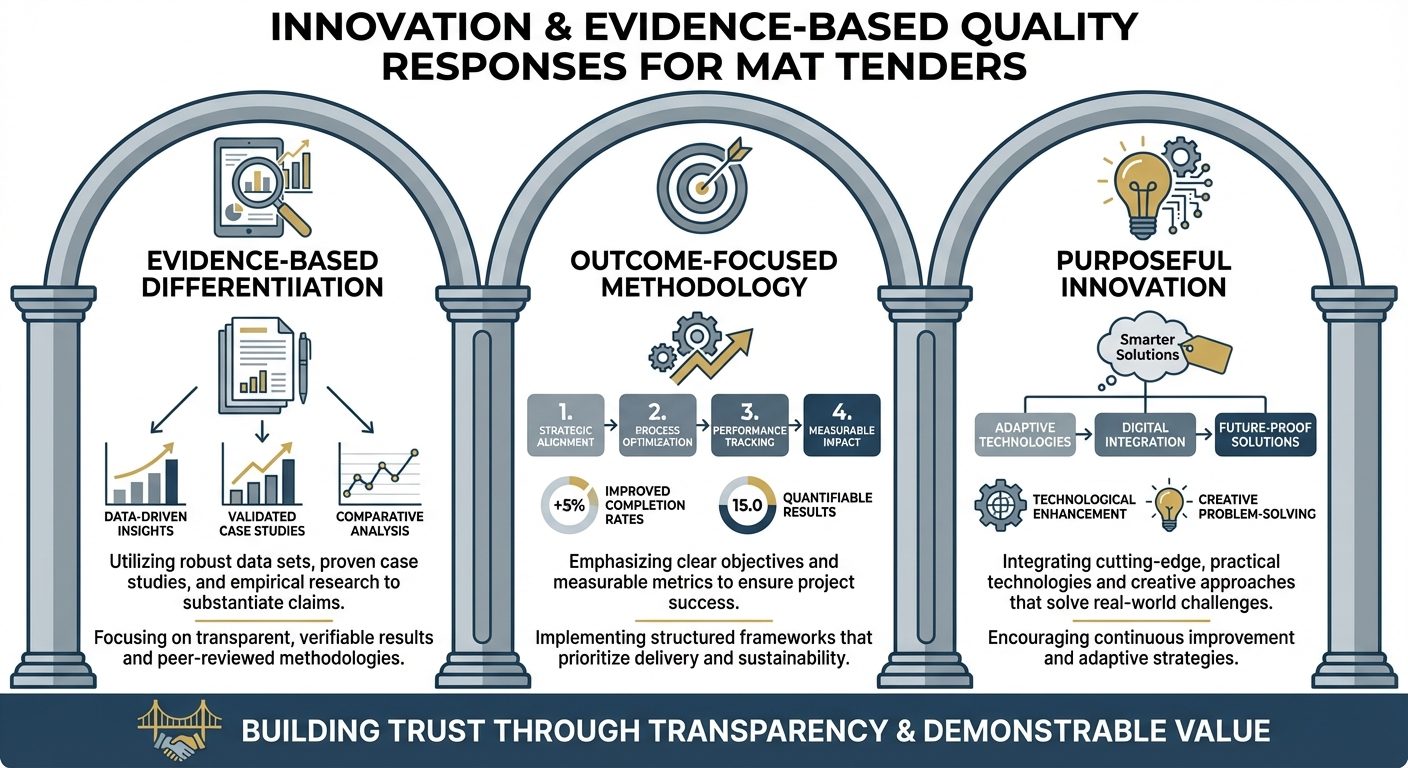
Innovation and evidence-based quality responses for MAT tenders
2. Pricing Strategy Evolution
While MAT broadens the value definition beyond pure economics, price remains critically important—just within a more nuanced context.
Whole-life value, not lowest cost: Under MEAT, aggressive initial pricing often won the day. MAT encourages contracting authorities to consider total cost of ownership, lifecycle costs, and long-term value. This creates opportunities to justify higher upfront costs if you can demonstrate superior long-term value through reduced maintenance, extended asset life, lower environmental costs, or enhanced service outcomes. Value narrative: Your pricing needs a compelling narrative that connects cost to outcomes. Don't just present numbers—explain how your pricing delivers superior value across economic, social, and environmental dimensions. Break down costs to show where investment goes and what benefits it generates. Transparent, defensible pricing: With increased transparency comes greater scrutiny. Your pricing must be robust, defensible, and backed by clear assumptions. Gone are the days of optimistic pricing hoping to manage margins during delivery. Underbidding that leads to poor performance now carries consequences that extend far beyond a single contract. Innovation investment: Consider whether innovative approaches might justify premium pricing through demonstrably superior outcomes. Under MAT, a more expensive solution that delivers significantly better social or environmental outcomes might score higher than a cheaper, conventional approach.3. Social Value as Core Strategy
The mandatory 10% minimum weighting for social value transforms it from optional add-on to core competitive differentiator. Organisations that treat social value as a tick-box exercise will lose to those that embed it authentically into their service delivery.
Meaningful commitments, not generic promises: Contracting authorities have become sophisticated in evaluating social value. They can distinguish between meaningful, deliverable commitments and generic promises recycled across multiple bids. Your social value proposition must be:- Specific: Connected to the particular contract, local area, and contracting authority's priorities
- Measurable: With clear outcomes, metrics, and reporting mechanisms
- Achievable: Backed by realistic plans, resources, and track record
- Verified: Supported by evidence from previous contracts
4. Environmental Sustainability as Differentiator
Environmental sustainability has transitioned from disclosure to active implementation as a core evaluation criterion under MAT. The framework explicitly encourages consideration of Scope 3 emissions, circular economy principles, and long-term environmental stewardship.
Carbon reduction commitments: Contracting authorities increasingly expect detailed carbon reduction plans, not just policy statements. This includes:- Baseline carbon footprint for your proposed service delivery
- Specific reduction targets aligned with net-zero commitments
- Concrete actions and investments to achieve reductions
- Transparent reporting mechanisms
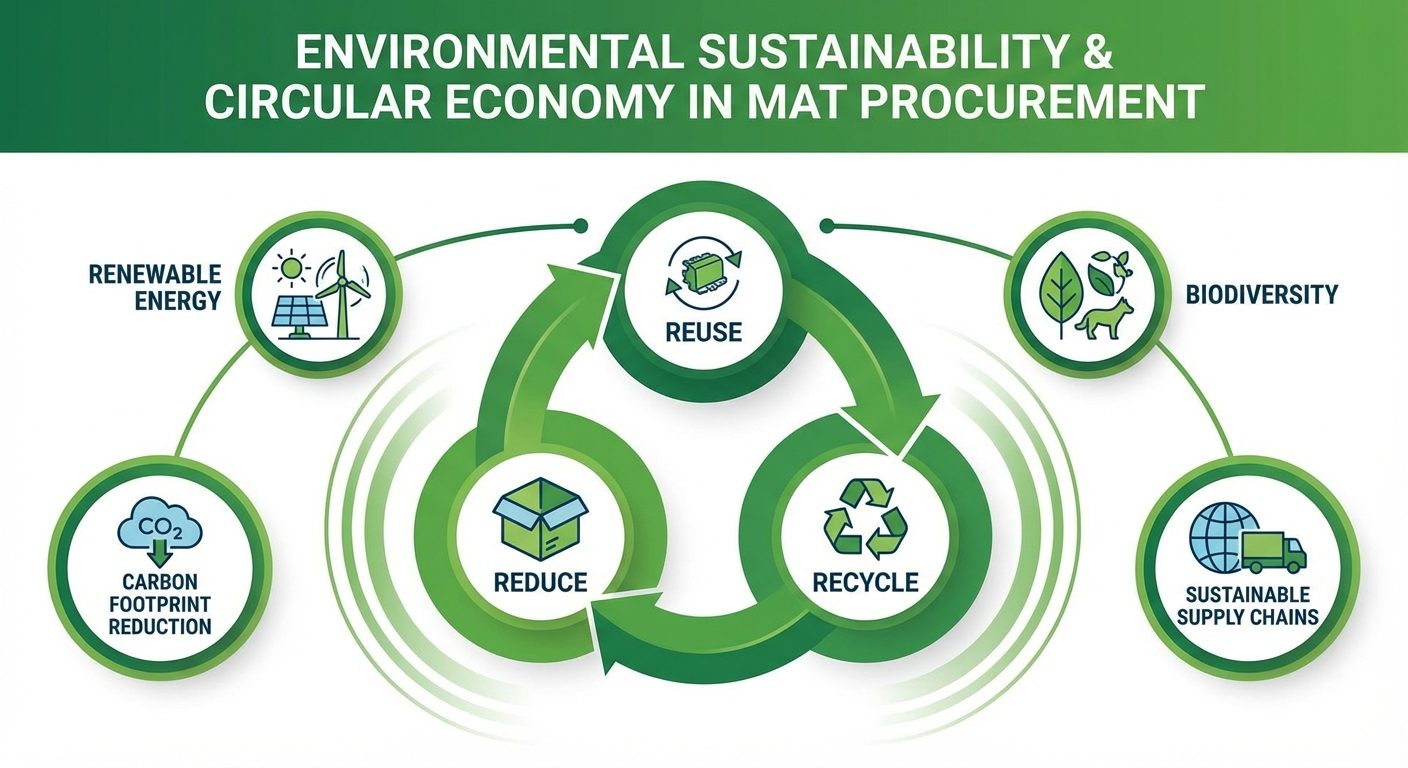
Environmental sustainability and circular economy in MAT procurement
Sector-Specific Adaptations
While the MAT framework applies across all public sector procurement, its practical impact varies by sector. Here's how to adapt your strategy for key sectors:
Construction and Infrastructure
Construction is one of the highest-impact sectors for social and environmental value, making the MAT framework particularly transformative.
Modern Methods of Construction (MMC): Offsite manufacturing, modular construction, and digital design tools can deliver superior environmental performance, quality consistency, and social value through controlled factory environments. Under MAT, these innovations can score competitively even at premium pricing if you demonstrate whole-life value. Local labour and skills: Commit to specific percentages of local labour, apprenticeships, and skills training. Document your relationships with local training providers, colleges, and employment services. Show how previous projects created lasting employment and skills outcomes. Carbon reduction: Construction accounts for approximately 25% of UK carbon emissions. Detailed carbon reduction plans—covering materials sourcing, construction methods, transport, waste management, and operational energy—are increasingly decisive in tender evaluation. Community engagement: Demonstrate meaningful community engagement throughout project delivery, from local supplier procurement to addressing construction impacts on residents to creating community legacy benefits.IT and Digital Services
Digital transformation is a top priority for public sector organisations, with substantial investment in cloud migration, AI, cybersecurity, and automation.
Sustainability: IT equipment carries significant environmental cost, from manufacturing through disposal. Circular procurement models, equipment life extension, responsible disposal, and energy-efficient operations are increasingly valued under MAT. Skills transfer: Commit to meaningful knowledge transfer and skills development for client staff, ensuring the organisation builds internal capability rather than creating dependency. Accessibility and inclusion: Demonstrate how your solutions advance digital inclusion, accessibility for users with disabilities, and equitable service access. Innovation with risk management: Public sector organisations want innovation but are risk-averse. Show how you'll introduce innovative technologies or approaches while managing implementation risks through pilots, staged rollouts, and robust governance.Professional Services
Consulting, legal, audit, and other professional services contracts are often high-value and strategic in nature.
Diverse teams: Demonstrate workforce diversity and inclusive practices in team composition, leadership, and career development. Skills development: Show how your delivery approach builds client capability, transfers knowledge, and develops client staff skills—moving beyond dependency-creating consulting models. SME collaboration: Partner with smaller, specialist firms to access niche expertise while supporting SME development. Document how you'll ensure fair payment terms, genuine collaboration, and capacity building for SME partners. Thought leadership: Provide evidence of sector expertise, innovation, and thought leadership that will benefit the client beyond the specific contract scope.Facilities Management
FM contracts offer rich opportunities for social and environmental value delivery.
Employment model: FM is labour-intensive, making employment practices crucial. Commit to living wage (not just minimum wage), quality employment terms, career development opportunities, and fair treatment of transferred staff. Environmental performance: Demonstrate how your approach will reduce energy consumption, waste, water use, and carbon emissions while maintaining or improving service quality. Local supply chains: Commit to local sourcing for consumables, maintenance services, and supplies where quality and value are competitive. Community investment: Show how you'll engage with local communities, support community organisations, and create social value beyond the immediate client site.Building Your MAT-Ready Organisation
Adapting to the MAT framework isn't just about writing better bids—it requires organisational transformation to deliver on enhanced commitments.
Culture and Capability
Social value champions: Appoint individuals or teams responsible for social value strategy, delivery, and reporting across all contracts. This isn't an HR or marketing function—it's core to service delivery. Environmental expertise: Build in-house expertise on carbon measurement, circular economy, and sustainable procurement. This can't be outsourced to consultants who parachute in for tender responses. Performance measurement: Implement robust systems to measure, track, and report on social value and environmental outcomes. This data becomes your evidence for future bids and demonstrates delivery credibility. Innovation culture: Foster a culture that encourages innovation, tests new approaches, and learns from both successes and failures. MAT rewards organisations that can demonstrate genuine innovation backed by evidence.Partnerships and Ecosystem
Community relationships: Build authentic relationships with community organisations, training providers, local enterprises, and social purpose organisations. These partnerships should be ongoing, not activated only during tender preparation. Supply chain collaboration: Work with suppliers and subcontractors to align on social value and sustainability objectives. Help smaller suppliers build their own capability in these areas. Sector engagement: Participate in industry associations, sustainability initiatives, and social value networks. This provides learning, benchmarking, and credibility.Documentation and Evidence
Contract case studies: Document outcomes, impacts, and lessons learned from every contract, with specific focus on social value and environmental performance. Quantify results wherever possible. Testimonials and verification: Secure client testimonials, third-party verification, and community feedback that validates your social value and sustainability delivery. Awards and recognition: Pursue industry awards and certifications that provide independent validation of your commitment and performance.Common Pitfalls to Avoid
As organisations adapt to MAT, several common mistakes are emerging:
Greenwashing and Social-Washing
Making grandiose commitments you can't deliver is career-limiting under the new transparency regime. Performance data will be public, and failure to deliver on social value or sustainability commitments will be visible to all future contracting authorities.
Solution: Make realistic, evidence-based commitments you have concrete plans and resources to deliver. Under-promise and over-deliver rather than the reverse.Generic Responses
Recycling the same social value and sustainability content across multiple bids is increasingly transparent to evaluators who've seen hundreds of responses.
Solution: Tailor every element of your response to the specific contract, location, client priorities, and opportunity. Research the area's economic and social challenges. Understand the contracting authority's specific priorities and constraints.Treating Social Value as Separate
Presenting social value as an add-on distinct from core service delivery weakens your proposition and raises questions about genuine commitment.
Solution: Integrate social value into your methodology, showing how social outcomes enhance rather than distract from primary service objectives.Neglecting the Basics
In the rush to emphasise social value and sustainability, some organisations neglect core quality and capability demonstration.
Solution: Remember that MAT is about holistic value. You must still demonstrate technical competence, robust methodology, and capability to deliver core requirements. Social value and sustainability augment, rather than replace, quality and capability.Underestimating Resource Requirements
Delivering meaningful social value and sustainability outcomes requires genuine resource investment—time, money, and expertise.
Solution: Build realistic costs into your pricing to support social value and sustainability commitments. Allocate dedicated resources, not spare capacity, to delivery.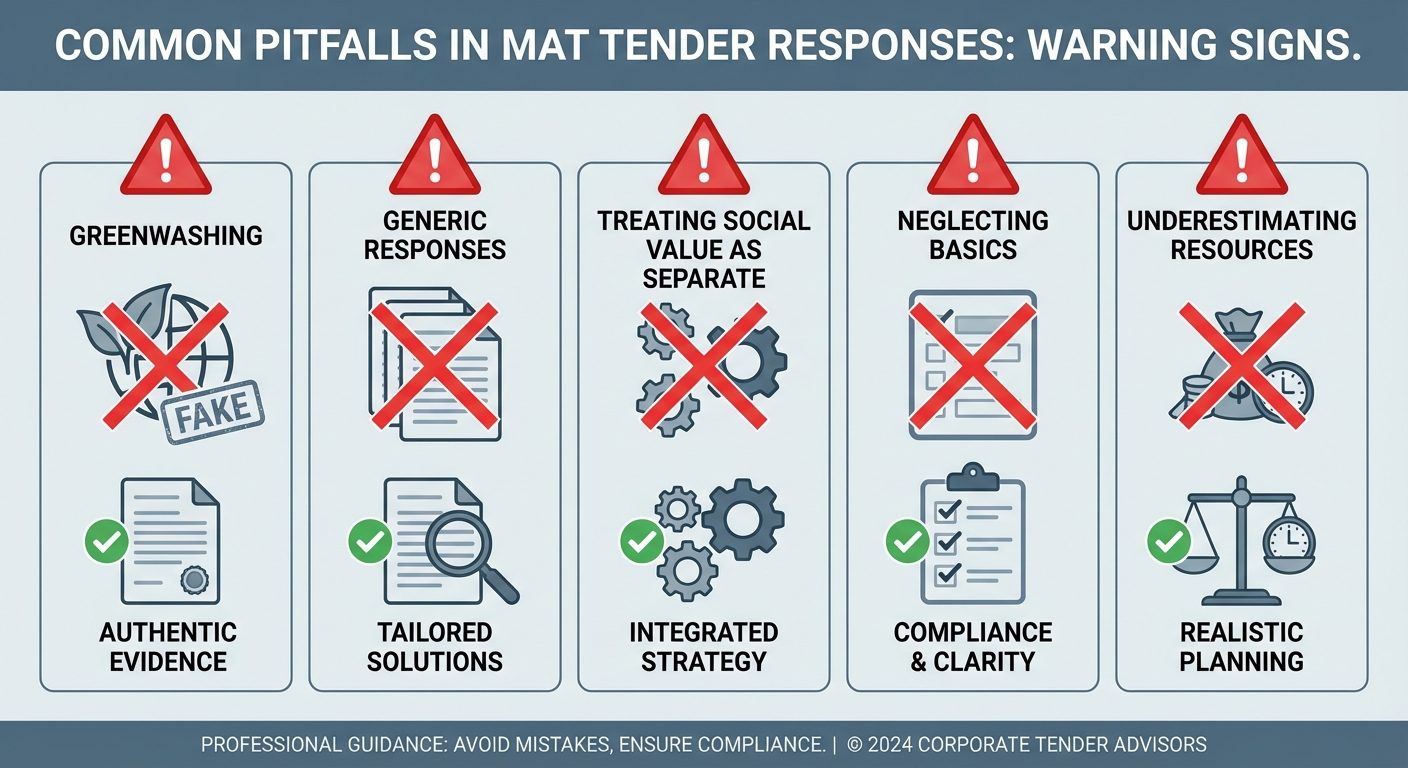
Common pitfalls and mistakes in MAT tender responses
Looking Ahead: The Evolution Continues
The MAT framework is not static. As we progress through 2026 and beyond, several developments will continue to shape the landscape:
Court Precedents
2026 will bring the first court decisions interpreting the Procurement Act 2023, providing clarity on ambiguous provisions and setting precedents for how the MAT framework is applied in practice. These cases will be closely watched and will influence both contracting authority practices and bidding strategies.
Further Reforms
The Cabinet Office has signalled additional procurement reforms on the horizon, including provisions to promote national interest and support British businesses. Wales is expected to implement socially responsible public procurement provisions. The Employment Rights Act 2025 will introduce measures to prevent "two-tier workforce" scenarios in public sector outsourcing, likely taking effect in autumn 2026.
Technological Evolution
AI and digital technologies will increasingly influence both the tendering process and contract delivery. Expect to see greater use of AI in tender evaluation, data analysis for performance monitoring, and innovation in service delivery approaches.
Sustainability Acceleration
As the UK pursues net-zero targets and faces increasing climate pressure, environmental criteria in procurement will become more stringent. Expect higher weightings, more rigorous carbon accounting requirements, and greater emphasis on circular economy principles.
Conclusion: Embracing the MAT Mindset
The transition from MEAT to MAT represents more than a change in evaluation framework—it's a fundamental shift in what public sector procurement is for. Beyond securing goods and services at competitive prices, procurement is now explicitly recognised as a lever for advancing broader societal objectives: building a fairer economy, tackling climate change, strengthening communities, and creating lasting value.
For organisations bidding on public sector contracts, this creates both challenge and opportunity. The bar has been raised. Generic, compliance-focused bids with aggressive pricing will no longer suffice. Success under MAT requires:
Genuine commitment to social value and sustainability, integrated into your organisational DNA, not just your tender responses. Evidence and track record of delivering measurable outcomes, verified by clients and communities. Innovation and excellence that demonstrably delivers superior value across economic, social, and environmental dimensions. Transparency and accountability in commitments, delivery, and reporting.The organisations that thrive in this new landscape won't be those that view MAT as an obstacle to navigate, but those that embrace it as an opportunity to differentiate, deliver meaningful impact, and build lasting competitive advantage through genuine value creation.
The MEAT era prioritised efficiency and economy. The MAT era demands something more ambitious: procurement that solves problems, creates opportunities, and builds a better future. For forward-thinking organisations willing to invest in genuine transformation rather than surface-level compliance, the potential for growth, impact, and success has never been greater.
The question isn't whether to adapt to MAT—that's non-negotiable for anyone serious about public sector contracts. The question is whether you'll adapt grudgingly and minimally, or embrace the opportunity to lead, innovate, and define what excellent, impactful public service delivery looks like in the 2020s and beyond.
Choose wisely. Your competitors are making the same decision right now.
Tags
Ready to Transform Your Tender Writing?
See how MyTender's AI can help you write winning tenders in a fraction of the time.