

Lotting Strategy for SMEs: How to Pick the Right Public Sector Tender Lots in 2026
The Procurement Act has made lotting a bigger strategic issue for suppliers. Here is how SMEs should decide which lots to bid, partner on, or leave alone.
mytender.io Research Team
Tender Writing & Bid Management Specialists
Lotting Strategy for SMEs: How to Pick the Right Public Sector Tender Lots in 2026
A tender split into lots looks helpful at first.
Then the bid team opens the documents and the panic starts. Lot 1 covers the region you know. Lot 2 has better margin. Lot 3 is just outside your delivery footprint, but the buyer has hinted they want SME participation. Lot 4 looks winnable until you realise the mobilisation window is brutal.
This is where a lotting strategy matters.
Not a vague preference. Not "we'll bid everything and see what happens". A proper decision about where you can win, where you can deliver, and where the bid would quietly drain two weeks of your team's life for no sensible return.

Bid team reviewing a public sector tender lotting strategy map
The Procurement Act 2023 has made this more important. Contracting authorities are expected to think harder about whether large contracts should be divided into smaller lots. That should create more room for SMEs, specialists and regional suppliers.
But smaller lots do not automatically mean easier bids.
They create choices. Choices create trade-offs. And trade-offs need discipline.
This guide shows how to choose the right lots, avoid the wrong ones, and build a stronger answer when the lot structure is designed to open the door for suppliers like you.
Why lotting is becoming a bigger bid strategy issue
Lotting is not new. Buyers have been splitting contracts by geography, service line, value band, asset type and specialist scope for years.
What has changed is the pressure around it.
Under the Procurement Act 2023, public bodies have a clearer duty to consider whether contracts can be divided into lots. The policy aim is simple: reduce barriers for SMEs and make public procurement more competitive.
In practice, that creates more tenders where the question is not "can we bid this contract?" It is:
- Which lot gives us the best chance of winning?
- Which lot can we deliver without over-stretching?
- Should we bid as prime, subcontractor or consortium partner?
- Does bidding multiple lots strengthen or weaken our case?
- Will the buyer believe we have enough capacity if we chase everything?
Those are commercial questions, not admin questions.
A good lotting strategy protects bid capacity. It also helps you write more credible responses, because the whole bid is built around a clear delivery choice.
The lazy answer is to bid every lot
Some teams treat lots as a volume game.
If there are six lots, they bid all six. The logic is understandable. More lots should mean more chances to win.
Usually, it does the opposite.
When you bid too many lots, three things happen.
First, your answers become generic. Instead of writing a sharp response for a specific geography, asset base or service requirement, you write something broad enough to fit everything. Evaluators notice.
Second, your evidence gets stretched. The same case study appears in every lot, even when the match is weak. That tells the evaluator you have not really thought about the difference between the lots.
Third, your delivery story starts to wobble. If you are an SME bidding four regional lots at once, the buyer will ask whether you can mobilise all of them. You need an answer before they ask.
The point is not to be timid. It is to be selective.
A focused two-lot bid often beats a thin six-lot bid.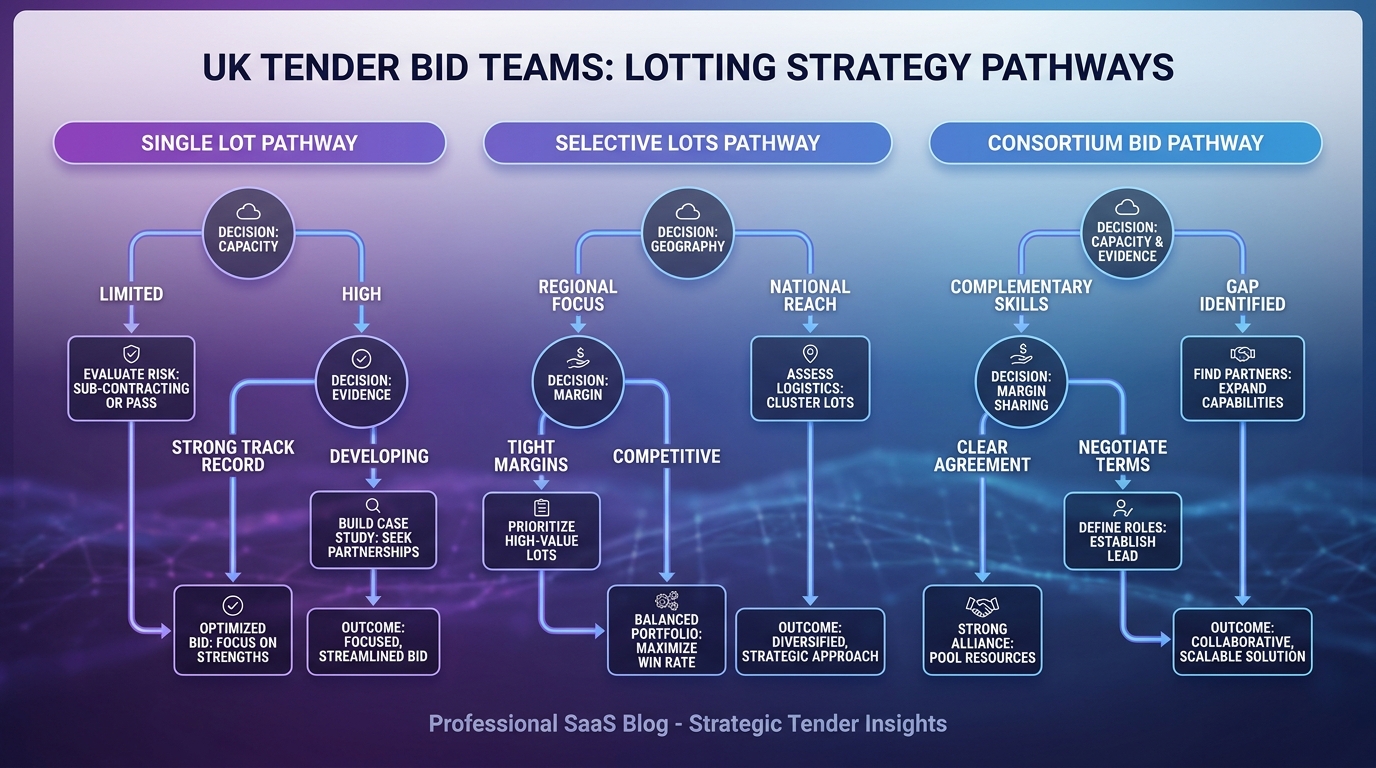
Decision map showing three tender lotting routes: single lot, selective lots and consortium bid
Start with the buyer's reason for lotting
Before choosing lots, work out why the buyer split the contract that way.
A lot structure is never random. It reveals what the buyer is worried about.
Geographic lots
If the tender is split by region, the buyer is probably testing local coverage, travel time, mobilisation practicality and continuity of service.
Your bid needs to prove local delivery. That means named depots, response times, field teams, regional managers, supply chain partners and live examples from nearby contracts.
A national case study may help, but it cannot carry the answer alone.
Service-line lots
If the tender is split by service, the buyer wants specialists. Facilities management is a good example. Cleaning, M&E, security, grounds and helpdesk services may be separated because the buyer does not want one generalist supplier doing everything badly.
Your job is to show depth.
Do not write like a general contractor. Write like the specialist the lot was designed to attract.
Value-band lots
Some frameworks split by contract size. Smaller value lots can be designed for SMEs, while higher bands are reserved for suppliers with larger balance sheets, insurance, mobilisation depth or national delivery capacity.
This is where ego gets expensive.
If the value band is above your realistic delivery capacity, the bid may look ambitious rather than credible. You can still partner, but bidding as prime without the evidence is risky.
Customer-type lots
A framework might split by schools, housing, healthcare, highways, central government or local authority work.
Here the issue is context. Buyers want suppliers who understand their environment, stakeholders and operating constraints.
A strong answer explains why your approach changes for that customer type. A weak answer just swaps the heading.
Use a five-filter lot fit test
The best way to choose lots is to score each one before anyone starts writing.
Do it quickly. Do it honestly. Do it before the bid team falls in love with the opportunity.
1. Strategic fit
Does the lot match the work you actually want more of?
This sounds obvious, but lots can drag you sideways. A facilities management supplier might chase a low-margin cleaning lot because it is available, then realise it does not support the contracts it wants to win next year.
Ask:
- Does this lot fit our target sectors?
- Does it strengthen our reference base?
- Would winning it help us win the next contract?
- Would we still want it if the buyer name was less attractive?
If the honest answer is no, be careful.
2. Evidence fit
Can you prove you have done this before?
Not broadly. Specifically.
For each lot, list your three best evidence points:
- A similar contract
- A relevant KPI
- A named delivery challenge you solved
If you cannot find three, the lot may still be possible. But you are writing uphill.
3. Capacity fit
Can you bid it and deliver it?
Bid capacity and delivery capacity are different problems. You need both.
A lot might be easy to write but hard to mobilise. Another might be commercially attractive but require a contract manager you do not have. Another might be deliverable if won alone, but dangerous if won alongside two other lots.
Model the win scenario, not just the submission.
4. Margin fit
Can you price the lot sensibly?
Some lots look attractive because they are small. Then the fixed cost of management, reporting, mobilisation and governance eats the margin.
This is common on regional lots, especially where travel time or dispersed sites are involved.
Before bidding, test:
- Management overhead
- Mobilisation cost
- Travel and logistics
- Reporting burden
- TUPE or staffing risk
- Price pressure from incumbents
A lot you can win but cannot profitably deliver is not a win.
5. Evaluator fit
Can you tell a story the evaluator will believe?
This is the filter people skip.
Even if you can deliver the lot, the buyer has to believe it from the bid. That means your evidence, team structure, mobilisation plan and pricing narrative all need to line up.
If the story relies on "trust us", the fit is weak.
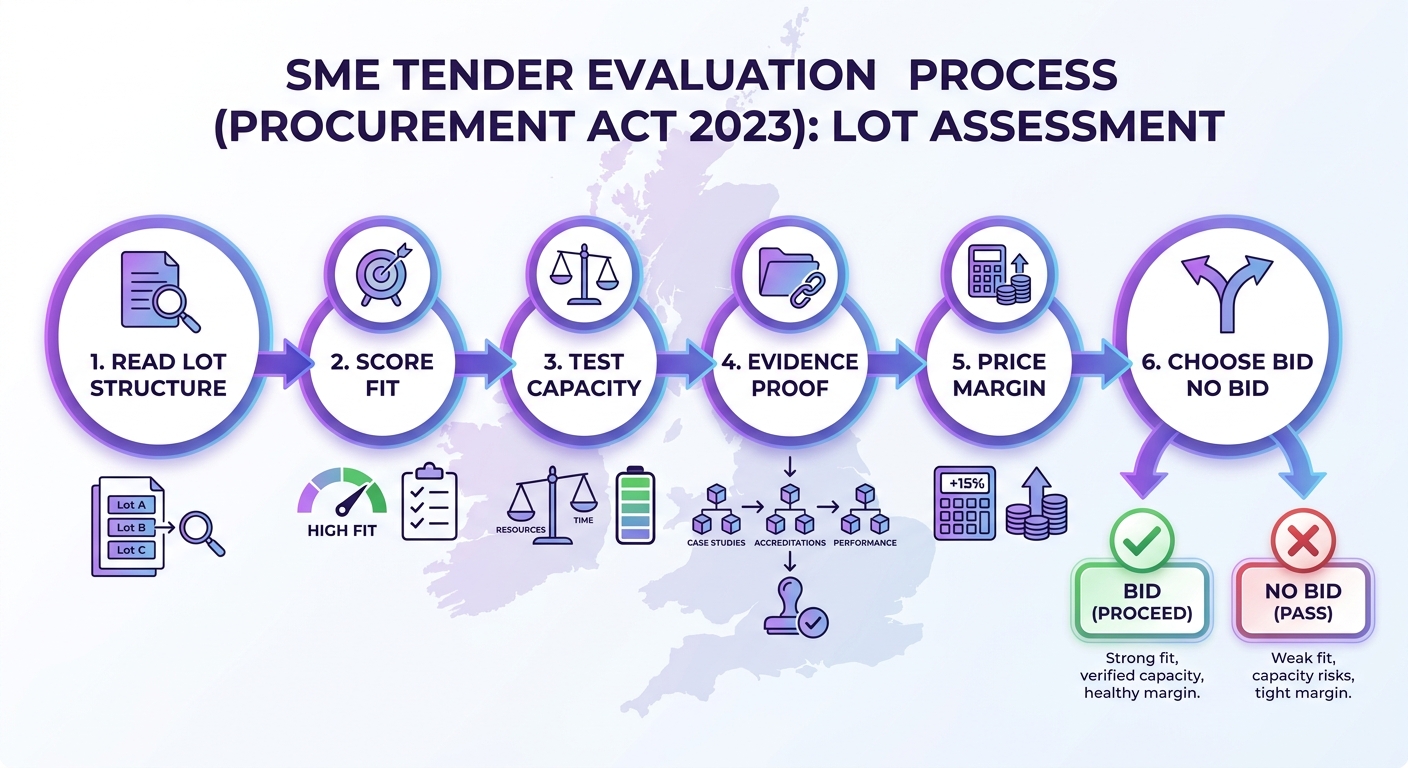
Five-step framework for assessing tender lot fit before bidding
Build a simple lot scoring matrix
You do not need a complicated model. You need a visible decision.
Create a table with each lot down the left and your filters across the top:
- Strategic fit
- Evidence fit
- Capacity fit
- Margin fit
- Evaluator fit
Score each from 1 to 5. Then add a short note explaining the score.
The note matters more than the number.
For example:
- Lot 1: strong geography, two relevant contracts, good margin, low mobilisation risk
- Lot 2: attractive value, but weak local evidence and heavy TUPE exposure
- Lot 3: specialist fit, but needs partner for 24/7 coverage
- Lot 4: poor strategic fit, price likely to be driven down by incumbent
This gives the team a shared view. It also stops the loudest person in the room deciding the bid strategy by instinct.
The four lot choices
Once you have scored each lot, place it into one of four categories.
Bid
This is a lot where you have strong fit, credible evidence, enough capacity and a sensible commercial case.
For these lots, write a tailored response. Do not copy and paste from other lots unless the requirement is genuinely identical.
Your win theme should be specific to the lot. If the lot is regional, lead with local delivery. If it is specialist, lead with technical depth. If it is a value-band lot, lead with proportional governance and low-risk mobilisation.
Partner
This is a lot where the opportunity is attractive, but you need another supplier to make the story credible.
Partnership is not a sign of weakness. In public procurement, it can be the most credible route.
Use it when you need:
- Geographic coverage
- Specialist licences or accreditations
- Additional workforce capacity
- Local social value delivery
- Technical depth in a narrow service area
The mistake is bolting on a partner at the last minute. If the partner matters, integrate them into the delivery model, evidence and mobilisation plan.
Monitor
This is a lot you do not bid now, but want to track.
Maybe the fit will improve later. Maybe it gives useful intelligence about a buyer, incumbent, specification or pricing direction. Maybe it is a future target when you have stronger evidence.
A monitor decision is still a decision. Capture why you are not bidding and what would need to change next time.
Walk away
This is the most underrated option.
Some lots are wrong for you. Too low-margin. Too far from your evidence base. Too operationally risky. Too likely to be won by an incumbent with a price advantage.
Walking away protects your team for bids you can actually win.
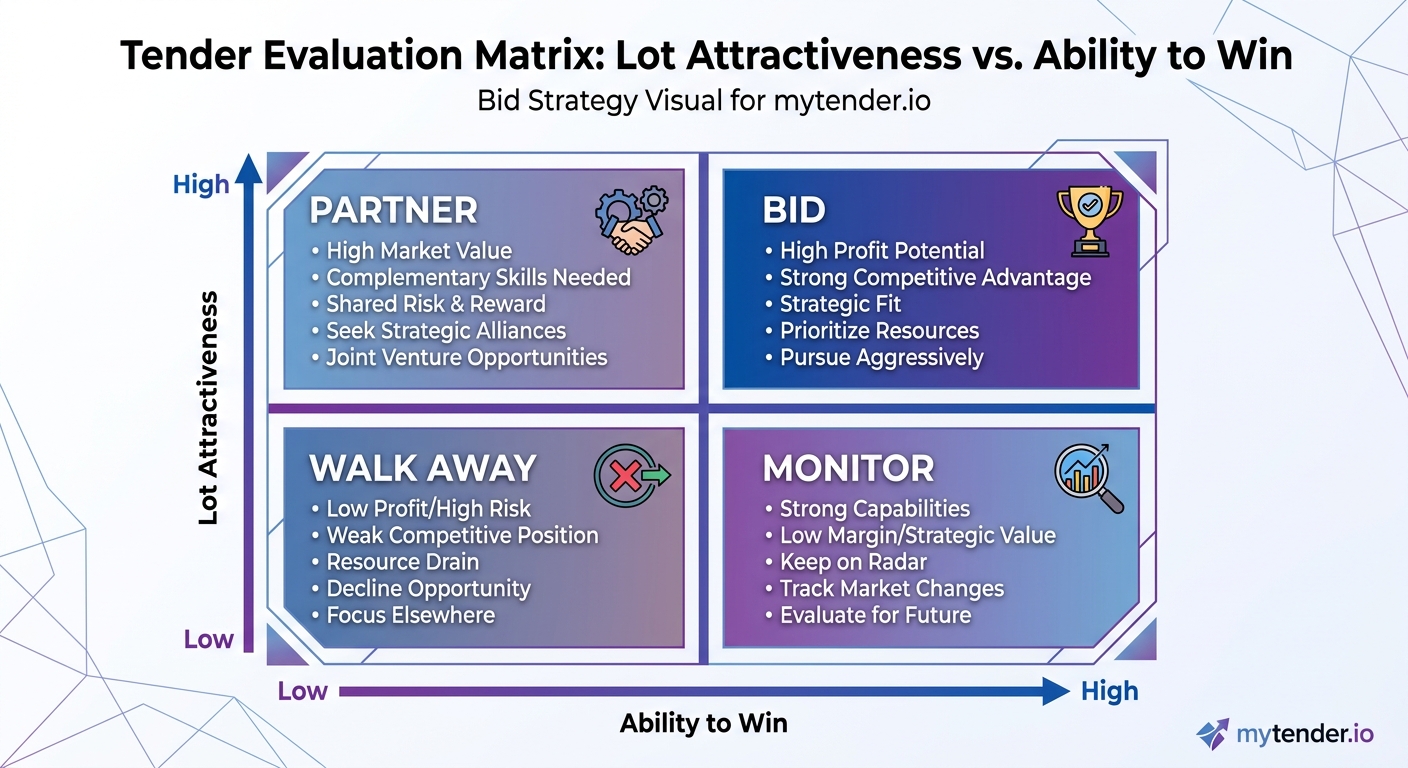
Tender lot attractiveness and ability to win matrix for bid, partner, monitor and walk away decisions
How many lots should an SME bid?
There is no perfect number.
But there is a useful rule: bid the maximum number of lots you can make feel individually written.
If the evaluator can tell you have treated Lot 3 as a recycled version of Lot 1, you have gone too far.
For many SMEs, that means one to three lots. Sometimes more, if the lots are genuinely similar and your delivery model scales cleanly. Sometimes just one, if the lot is complex and high value.
Ask these questions before adding another lot:
- Can we tailor the method statement properly?
- Do we have specific evidence for this lot?
- Can we explain mobilisation if we win multiple lots?
- Does the pricing still work if we win only this one?
- Does the bid team have enough time to avoid a generic answer?
If any answer is weak, adding the lot is probably vanity.
The multi-lot trap: capacity promises evaluators do not believe
Multi-lot bids often fail because the capacity story is thin.
The supplier says it can deliver all awarded lots. The evaluator looks at the organisation chart and quietly disagrees.
If you bid multiple lots, include a clear scalability plan.
Show:
- Which resources are dedicated per lot
- Which resources are shared centrally
- How mobilisation sequencing works
- What happens if you win one, two or all lots
- Where additional staff or partners will come from
- Who owns contract governance across lots
Do not hide the complexity. Explain how you control it.
For example, a cleaning supplier bidding three regional lots might show a core mobilisation team, separate regional supervisors, local recruitment pools, and a phased site onboarding plan. That is more believable than one generic mobilisation paragraph repeated three times.
When a consortium bid makes sense
Consortium bidding can be powerful when the lot structure is designed to encourage specialist participation.
But it only works when the buyer can see clear accountability.
A consortium bid should answer three questions fast:
- Who is responsible for delivery?
- Who does what?
- What happens if something goes wrong?
If those answers are fuzzy, the consortium creates risk rather than confidence.
Use a consortium when it gives the buyer something better than a single supplier could provide. For example, a regional SME with strong local relationships might partner with a technical specialist. Or a waste operator might partner with a social enterprise for reuse, repair and community engagement.
The bid should not read like a list of logos. It should read like one integrated delivery model.
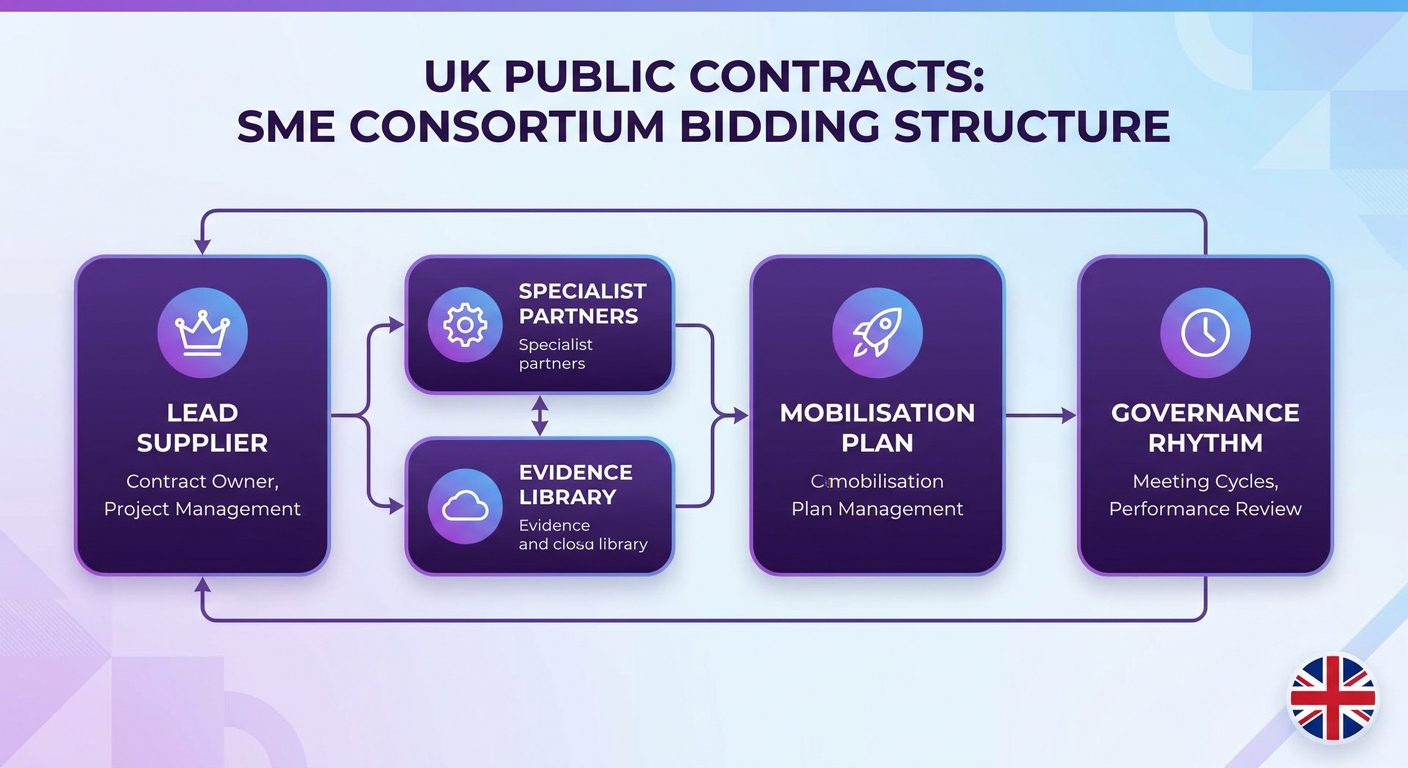
Consortium bidding model showing lead supplier, specialist partners, governance and evidence library
What to write when the buyer asks about lot capacity
If the tender asks how you will manage one or more lots, be direct.
A strong answer usually has four parts.
1. Your lot-specific delivery model
Explain how the delivery model changes by lot.
Do not say every lot will use the same approach unless that is genuinely true. Evaluators expect differences in geography, staffing, service profile or stakeholder management.
2. Your award scenario plan
Show what happens if you win different combinations of lots.
This is especially useful for frameworks. You can explain the minimum viable team for one lot, the scaled structure for multiple lots, and the governance layer that protects consistency.
3. Your evidence
Use evidence that matches the lot.
For a regional lot, use regional delivery evidence. For a specialist lot, use specialist performance evidence. For a high-value lot, use scale and governance evidence.
If you only have one perfect case study, use it carefully. Then support it with operational data, CVs, accreditations, mobilisation examples and lessons learned.
4. Your controls
Explain how you stop performance drifting.
This might include KPI reviews, mobilisation gates, contract risk logs, escalation routes, audit schedules, customer meetings and named contract owners.
Controls reassure evaluators because lotting can create fragmentation. Your answer needs to show the buyer they get SME focus without losing contract discipline.
Pricing lots without fooling yourself
Lot pricing can be deceptive.
A small lot can carry a big management burden. A regional lot can look profitable until travel time is included. A specialist lot can depend on one expensive person. A framework lot can require sales effort long after award.
Before finalising your bid, test each lot on its own.
Then test the combinations.
You need to know:
- Is each lot profitable if won alone?
- Are there savings if multiple lots are won?
- Are those savings real or just hopeful?
- Does mobilisation cash flow work?
- Are you carrying unrecovered bid or management cost?
Do not rely on cross-subsidy unless the tender allows it and the commercial logic is sound. Winning one bad lot because you hoped to win three good ones is a painful way to learn procurement maths.
How lotting affects your win themes
Your win themes should change by lot.
A single set of themes across every lot usually sounds lazy. The evaluator wants to know why you are the right supplier for this specific part of the contract.
For a geographic lot, your themes might be:
- Local coverage
- Faster response
- Established labour pool
- Relevant regional contracts
- Community and social value links
For a specialist service lot:
- Technical depth
- Named experts
- Specialist accreditations
- Service-specific KPIs
- Better risk control than a generalist supplier
For an SME-accessible lot:
- Senior attention
- Low bureaucracy
- Direct accountability
- Flexible mobilisation
- Stronger customer intimacy
This is where SMEs can beat larger competitors. Big suppliers often struggle to make smaller lots feel important. You can make the buyer feel like this lot is exactly the work you care about.
Evidence that makes a lot-specific answer stronger
Lot-specific evidence does not need to be complicated.
It needs to be relevant.
Useful evidence includes:
- Similar contract examples
- KPI performance from comparable work
- Mobilisation plans from similar sites or regions
- CVs for people who would manage the lot
- Customer feedback or reference quotes
- Lessons learned from previous delivery
- Social value activity in the same geography
- Supply chain agreements or letters of intent
- TUPE experience where staffing transfer is likely
- Risk logs showing how similar issues were controlled
The phrase "similar" is doing the work here.
If the lot is for a council waste contract, an NHS cleaning case study may show discipline, but it will not prove context. If the lot is hard FM in schools, a commercial office case study only gets you part of the way.
Match evidence as tightly as you can.
How mytender.io helps with lot decisions
Lotting strategy is partly a judgement call. But the judgement gets better when your evidence is easier to find.
That is where a bid library matters.
If your team has to search old folders every time a tender is split into lots, you will default to whatever evidence is easiest to find. That is not always the evidence most likely to win.
A better approach is to tag examples by sector, service, geography, contract value, buyer type, KPIs and mobilisation challenge. Then the bid team can build each lot around the best-fit proof.
Teams use mytender.io to organise reusable bid evidence, draft lot-specific responses and keep answers consistent without making them generic.
The aim is not to automate the decision. It is to give the team enough structure to make a better one.
A practical lotting strategy checklist
Before you commit to a lot, answer these questions.
Opportunity fit
- Does this lot fit our target market?
- Would winning it help our future positioning?
- Is the buyer a good strategic account?
- Is the lot size right for our business?
Evidence fit
- Do we have three strong proof points?
- Are they genuinely similar?
- Can we show performance, not just experience?
- Do we have named people who strengthen the answer?
Delivery fit
- Can we mobilise within the required timescale?
- Do we have enough management capacity?
- What happens if we win multiple lots?
- Do we need a partner or subcontractor?
Commercial fit
- Is the lot profitable on its own?
- Have we included mobilisation and reporting cost?
- Are there hidden travel, TUPE or compliance costs?
- Is the incumbent likely to have a structural price advantage?
Bid fit
- Can we write a tailored answer in the time available?
- Do we understand the scoring criteria?
- Can we make the lot feel important?
- Are we bidding because we should, or because it is there?
That last question is usually the most revealing.
The best SME advantage is focus
Lotting gives SMEs a route into public sector contracts that might otherwise be too large, too broad or too dominated by incumbent suppliers.
But the opportunity only works if you are selective.
The strongest SME bids do not try to look like smaller versions of large suppliers. They show why a focused supplier is better for this lot, this buyer and this delivery problem.
That means choosing carefully. It means walking away sometimes. It means partnering when the story is stronger together. It means writing each lot like it matters.
Because evaluators can tell the difference.
If you want to find live public sector opportunities that match your sector and capacity, the mytender.io Tender Finder is free to use. It is a useful way to spot opportunities early, compare lots, and avoid spending your bid time on the wrong contracts.
Tags
Ready to Transform Your Tender Writing?
See how MyTender's AI can help you write winning tenders in a fraction of the time.