
Jobs and Skills in Public Sector Tenders: How to Evidence the New Social Value Priority in 2026
UK public procurement is putting sharper weight on jobs, skills and local opportunity. This guide shows bid teams how to turn that policy shift into credible, scoreable tender evidence.
mytender.io Research Team
Tender Writing & Bid Management Specialists
Jobs and Skills in Public Sector Tenders: How to Evidence the New Social Value Priority in 2026
Social value used to be the section teams wrote after the method statement was finished. A few apprenticeships, a volunteering day, maybe a promise to buy locally. Done.
That approach is getting weaker by the month.
The government has now put sharper focus on public spending backing British jobs and skills. The direction is clear: if you want to win larger public contracts, you need to show how your delivery will create real opportunity for the people and places attached to the contract.
Not a slogan. A plan.

A bid team planning jobs and skills evidence for a public sector tender
This matters because social value is moving away from broad, pleasant commitments and towards measurable labour market outcomes. Evaluators want to see who benefits, how many people benefit, when it happens, who owns it, and how it will be reported.
That is uncomfortable for bidders who have treated social value as copy-and-paste content. It is good news for bidders who can prove they already invest in people.
This guide explains how to write a stronger jobs and skills response in 2026 public sector tenders. It is written for bid managers, commercial leads and accidental bid writers who need practical structure, not policy waffle.
What changed in 2026
The big shift is not that social value suddenly exists. It has been part of public procurement for years.
The shift is emphasis.
Recent UK procurement direction has put job creation, skills development and opportunity for under-represented groups closer to the centre of evaluation. That includes groups such as young people not in education, employment or training, care leavers, people with long-term health conditions, disabled people and local residents facing barriers to work.
At the same time, the Procurement Act 2023 has increased the wider pressure for transparency, published KPIs and supplier performance visibility. That creates a different kind of tender environment.
A vague commitment is easier to challenge. A measurable commitment is easier to score.
For major contracts, buyers are increasingly expected to think about outcomes that can be tracked during delivery. If you promise ten apprenticeships, someone may ask for progress. If you promise local recruitment, someone may ask what postcode area you mean. If you promise training, someone may ask whether it leads to a recognised qualification or just a lunchtime webinar.
That is the standard bid teams should now write to.
Why this matters for bid scoring
Jobs and skills commitments are attractive to buyers because they connect procurement spend to visible local benefit.
A council can explain a cleaning contract in terms of service quality. It can also explain it in terms of entry-level jobs, supervisor progression, local training partnerships and better routes into work for people who have been excluded from the labour market.
A health trust can justify an estates contract on compliance and cost. It can also point to apprenticeships, work placements and career pathways in the local area.
A construction client can procure a school project. It can also create a pipeline of site experience, trade skills and community benefit around that project.
That is politically and practically powerful.
For bidders, the scoring opportunity is obvious. Jobs and skills cut across nearly every sector:
- Facilities management contracts need cleaners, engineers, supervisors and contract managers.
- Construction contracts need trades, site managers, logistics staff and health and safety capability.
- Waste contracts need drivers, loaders, mechanics, route planners and depot teams.
- Professional services contracts need analysts, administrators, project managers and specialists.
If your delivery model involves people, you have material for this section.
The problem is that most tender responses still read like a policy statement.
The weak version of a jobs and skills response
Here is the sort of paragraph evaluators see constantly:
> We are committed to supporting local employment and skills development. We will work with local partners to create apprenticeships, support under-represented groups, provide training opportunities and maximise social value throughout the contract.
It is not wrong. It is just thin.
It does not tell the evaluator:
- how many opportunities will be created
- which roles they relate to
- which groups are being targeted
- what partnerships already exist
- when activity will happen
- how success will be measured
- who is accountable
- what happens if uptake is lower than expected
A good evaluator cannot give that full marks. There is not enough there to score.
The stronger version does not need to be flashy. It needs to be specific.
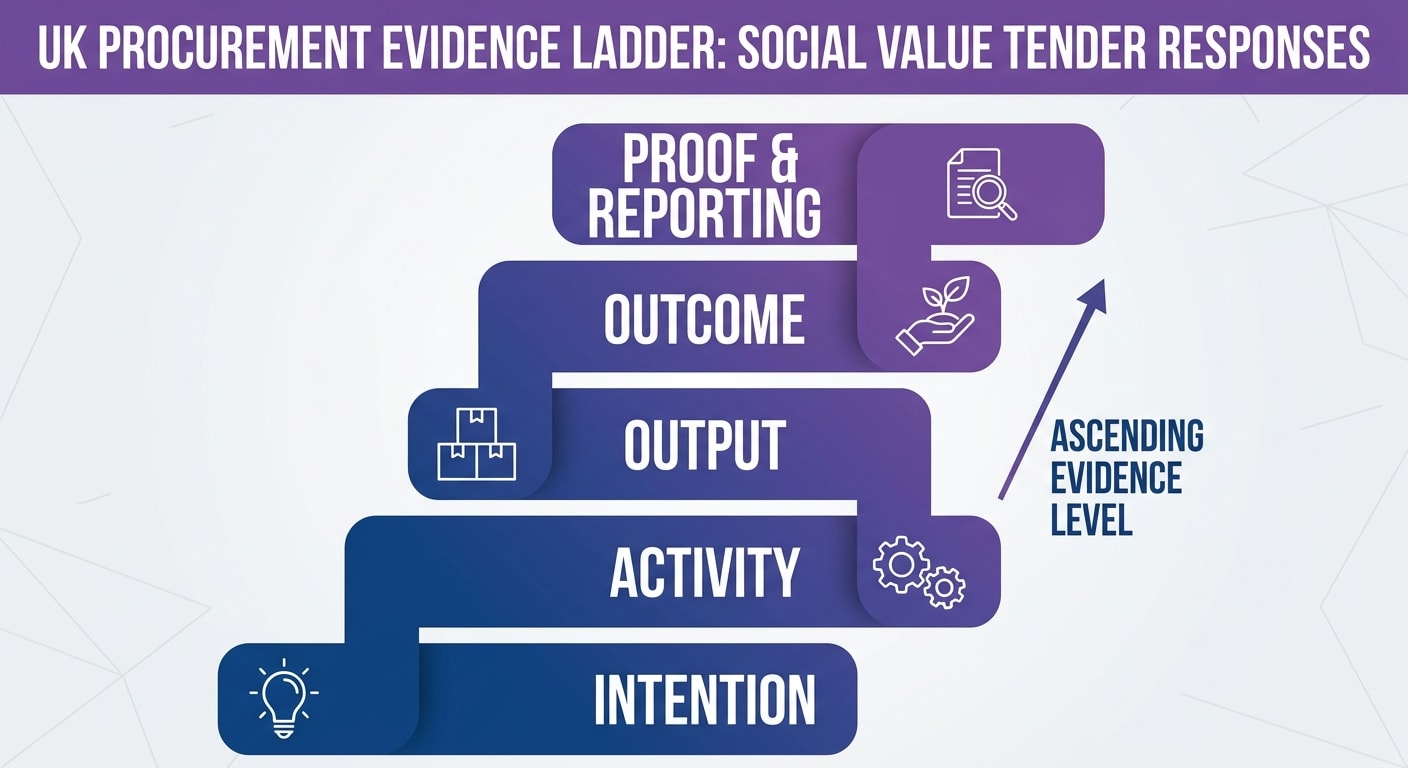
A comparison of weak versus strong jobs and skills evidence in tender responses
The evidence ladder: from claim to proof
A useful way to improve this section is to think in five levels.
Level 1: intention
This is the weakest level. It says what you care about.
Example: “We are committed to creating local employment opportunities.”
Fine as an opening line. Useless on its own.
Level 2: activity
This says what you will do.
Example: “We will attend two local job fairs and advertise vacancies through the council’s employment service.”
Better. Still not enough.
Level 3: output
This says what will be delivered.
Example: “We will create six entry-level roles in year one, with at least four advertised locally before wider recruitment.”
Now the evaluator can see a concrete commitment.
Level 4: outcome
This says what changes for people.
Example: “At least four recruits will complete a structured 12-week onboarding plan, including manual handling, customer care and route safety training, with progression review at week 10.”
This is stronger because it connects a job to development.
Level 5: proof and reporting
This shows how the buyer will know it happened.
Example: “Progress will be reported quarterly through a social value dashboard covering applications, interviews, hires, retention after six months, training completed and progression outcomes. The Contract Manager owns the action plan and reviews underperformance with HR each month.”
That is the level bid teams should aim for.
You do not need every commitment to reach level five. But your core commitments should.
Start with the contract, not the policy
The easiest mistake is to begin with national policy and then bolt on generic commitments.
Start with the contract instead.
Ask three questions before writing:
- What labour does this contract actually need?
- Where are the natural entry points for new people?
- What skills can realistically be developed through delivery?
A waste collection contract might create entry points for loaders, depot operatives and apprentice HGV mechanics. A hard FM contract might create entry points for electrical apprentices, helpdesk coordinators and trainee facilities assistants. A construction project might create site work placements, trade apprenticeships and supervisor shadowing.
That contract-specific thinking matters. Evaluators can smell generic social value content from three pages away.
If the opportunity is in a region with high youth unemployment, refer to that. If the contract sits near a college with relevant courses, build that in. If mobilisation needs 40 new hires, explain how many could be local, how recruitment will be sequenced, and what support will be provided.
The best responses make the evaluator think: “They have understood our place, not just our procurement document.”
Build a practical jobs and skills plan
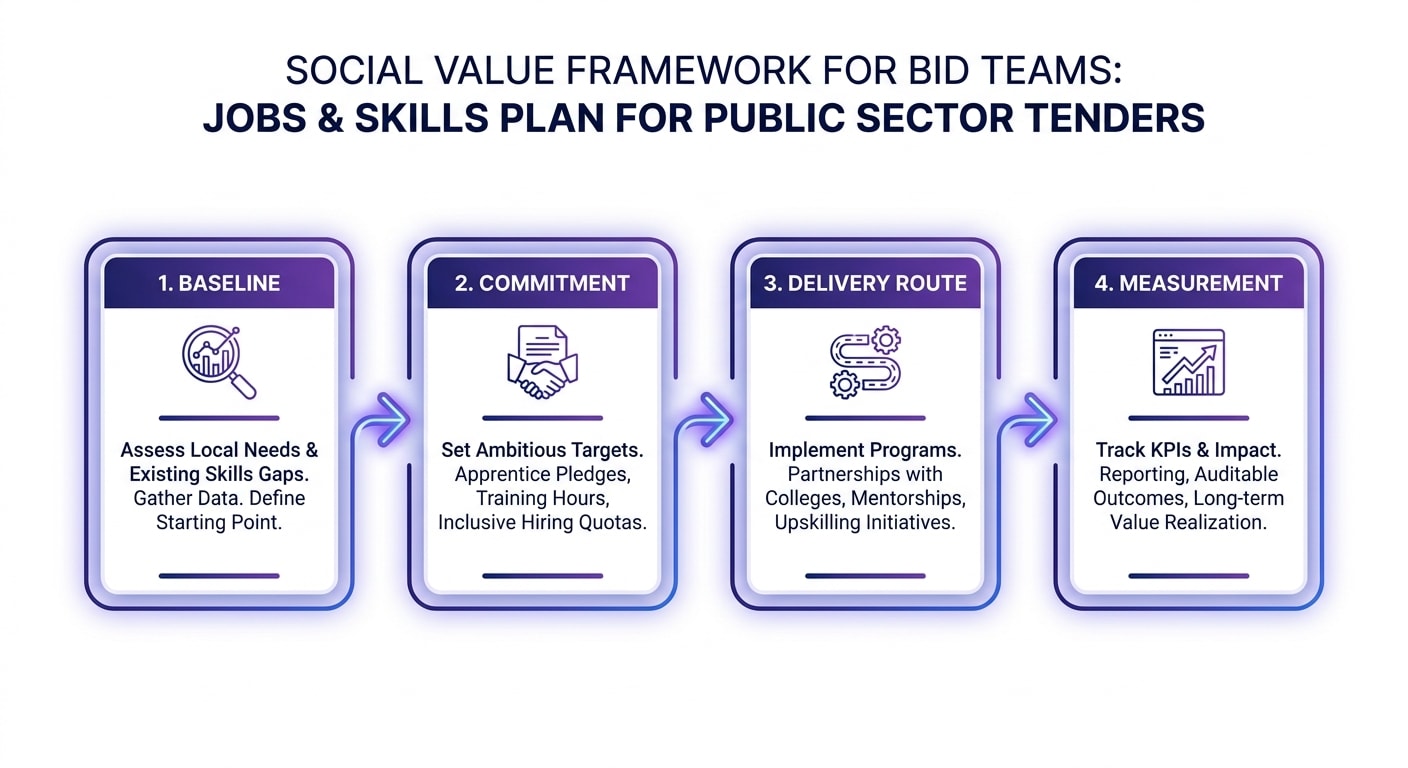
A strong tender response usually needs four parts: baseline, commitment, delivery route and measurement.
1. Baseline
Set out the current position. This could include your existing workforce, current apprentices, retention rates, training completion data or previous social value delivery.
Do not overdo it. The purpose is credibility.
For example:
> Across our current North West contracts, 68% of operational staff live within 15 miles of their primary depot. In the last 12 months, 14 colleagues completed funded Level 2 or Level 3 qualifications, with four promoted into supervisory roles.
That is much stronger than saying you value local employment.
2. Commitment
State the specific promise.
Good commitments are:
- measurable
- relevant to the contract
- realistic within the contract value
- time-bound
- owned by a named role
Bad commitments are impressive but impossible. Do not promise 50 apprenticeships on a 12-month contract with a team of eight people. You will look unserious, and if you win, delivery will be painful.
3. Delivery route
Explain how the commitment will actually happen.
This is where you name recruitment channels, training partners, onboarding plans, mentoring arrangements and internal processes. If you have an existing relationship with a college, charity, local authority employment team or Jobcentre Plus, say so.
If the partnership is not yet agreed, be honest. Write “we will approach” rather than pretending a relationship exists.
Evaluators prefer a credible plan to a fictional partnership.
4. Measurement
Show how the buyer will see progress.
This can include:
- monthly recruitment updates
- quarterly social value reports
- training completion certificates
- apprenticeship starts and completions
- retention after six and twelve months
- local postcode analysis
- case studies of progression
- corrective action if targets are missed
Measurement is where many bids fall apart. A commitment without reporting feels like a brochure promise.
A four-part framework for writing jobs and skills commitments in tender responses
How to write commitments evaluators believe
The best commitments are specific enough to score but flexible enough to deliver.
Use this structure:
> We will deliver [specific commitment] for [target group or geography] by [date or contract phase], through [delivery mechanism], measured by [reporting method], owned by [role].
Here are examples.
Facilities management example
> We will create four new entry-level cleaning operative roles for residents within 10 miles of the contract sites during mobilisation. Vacancies will be shared first through the council’s employment team and two local community partners. Recruits will complete our 10-day paid induction, COSHH training and a three-month supervisor mentoring programme. Progress will be reported monthly through the mobilisation dashboard and quarterly through the social value report.
Why it works: it connects jobs to mobilisation, names the geography, explains the training and shows reporting.
Construction example
> We will provide 120 student engagement hours across the build programme, including site visits, curriculum talks and work placements for construction learners at two local colleges. Activity will be scheduled around RIBA stages 4 to 6, with the Site Manager and Social Value Lead jointly accountable for delivery. We will report attendance, placement hours, feedback and follow-on applications at each progress meeting.
Why it works: it fits the project lifecycle and avoids pretending every engagement becomes a job.
Waste management example
> We will recruit two apprentice HGV mechanics in year one and offer route safety work tasters for up to 12 local residents facing barriers to employment. The depot manager will coordinate placements with our HR team and local employment partners. We will report starts, completion, retention and progression quarterly, with corrective action agreed if uptake falls below plan.
Why it works: it links to a real workforce need and addresses delivery risk.
Do not ignore target groups
The current direction of travel is not just “more jobs”. It is jobs and skills for people who need better routes into work.
That means bid teams should think carefully about target groups.
Depending on the buyer’s priorities, relevant groups may include:
- young people not in education, employment or training
- care leavers
- people with long-term health conditions
- disabled people
- veterans
- prison leavers
- long-term unemployed residents
- people changing career after redundancy
- residents in the most deprived local wards
Do not list every group and promise everything to everyone. That reads like scattergun social value.
Pick the groups that fit the contract, the location and your delivery capability.
Then explain the support model. Hiring someone who faces barriers to work is not the same as hiring someone and hoping for the best. Good responses mention job coaching, buddying, flexible interviews, reasonable adjustments, travel support, phased onboarding or pastoral support where relevant.
This is where a response becomes human. It shows you understand that access to work is not solved by posting a vacancy.
Partner evidence matters
Partnerships can strengthen a jobs and skills response. They can also weaken it if they look invented.
Strong partnership evidence includes:
- named organisations
- existing memoranda of understanding or previous activity
- referral routes
- agreed roles and responsibilities
- examples of outcomes already delivered
- letters of support, if the tender allows attachments
Weak partnership evidence sounds like this:
> We will work with local schools, colleges and charities to support employment outcomes.
Which ones? Doing what? When? Who has agreed it?
If you already have a relevant national partner, explain how that partner will adapt to the local contract. If you need to build local relationships after award, make the timeline realistic and show the buyer how you will manage the risk.
For example:
> During mobilisation weeks 1 to 4, our Social Value Lead will agree referral routes with the council employment team, the local college construction department and Jobcentre Plus. We have used this mobilisation model on three comparable contracts, creating 21 work placements and nine sustained jobs in the last 18 months.
That is credible. It admits the local setup still needs to happen, but backs it with experience.
How this connects to Most Advantageous Tender
The move from MEAT to MAT under the Procurement Act is not just a wording change. It gives buyers more room to define advantage beyond lowest price and narrow technical compliance.
Jobs and skills sit neatly inside that shift.
A strong MAT response should show how your proposal helps the buyer achieve the contract outcome and wider policy objectives. For jobs and skills, that means linking your commitments to the buyer’s priorities.
If the buyer has a local economic strategy, read it. If the council plan mentions youth employment, inclusive growth, green skills or care leavers, connect your proposal to that language. If an NHS trust has workforce priorities, reflect them. If a housing association talks about resident employment, use that as your anchor.
Do not paste the strategy back at them. Show how your delivery model supports it.
A useful sentence structure is:
> This commitment supports [buyer priority] by [specific action], producing [measurable outcome] during [contract phase].
That makes the line between policy and delivery explicit.
Common mistakes that lose marks
Most poor social value responses fail in predictable ways.
Mistake 1: promising activity instead of outcomes
A careers fair is not an outcome. A training session is not an outcome. A social media vacancy post is not an outcome.
They may be useful activities, but evaluators want to know what changes because of them.
Write the output and outcome, not just the event.
Mistake 2: using national numbers with no local connection
Large suppliers often lean on national apprenticeship or employment figures. Those can help credibility, but they do not answer the local question.
A buyer in Bristol does not only care that you created 200 apprenticeships nationally. They care what will happen in Bristol.
Use national evidence as proof of capability, then localise the commitment.
Mistake 3: ignoring contract scale
Social value must be proportionate. A small contract cannot carry the same commitments as a £50m framework.
If your promise looks detached from the contract value, evaluators will question whether you understand delivery.
Mistake 4: forgetting retention
Job starts are easy to promise. Sustained employment is harder and more valuable.
If you can report retention at six months or twelve months, include it. If you support progression into supervisor roles, include that too.
Mistake 5: treating training as a tick-box
Training only scores well when it is relevant. “All staff receive training” is weaker than “all new operatives complete COSHH, safeguarding, customer care and route safety training before independent deployment.”
Specific training tells the evaluator you know the work.
Where AI can help without making the response generic
AI can be useful in this section, but only if you give it real evidence.
Do not ask AI to invent social value commitments. That is how you get polished nonsense.
Use AI to organise existing material:
- previous social value reports
- contract mobilisation plans
- HR training records
- apprenticeship data
- local labour market notes
- buyer strategy documents
- partner descriptions
- KPI packs
The point is to find the proof your team already has, then shape it into the buyer’s scoring language.
This is one reason teams use mytender.io. A bid team can keep approved evidence, previous commitments and contract examples in one place, then adapt them to the current tender rather than starting from a blank page every time.
The important word is adapt. Social value content should never feel pasted in from the last bid.

A workflow showing how bid teams turn HR, contract and community evidence into a tender-ready jobs and skills response
A simple structure for your tender answer
If you are staring at a blank social value question, use this order.
1. Open with the buyer outcome
Start by naming what the buyer wants to achieve.
Example:
> We understand the council wants this contract to create accessible employment routes for residents who face barriers to work, while building skills that support long-term service quality.
This shows you have read the room.
2. State your commitments
Put the measurable commitments early. Do not bury them after three paragraphs of values.
Example:
> Over the initial three-year term, we will create eight local entry-level roles, two apprenticeships and 80 structured work-taster hours, prioritising residents referred through the council’s employment team.
3. Explain delivery
Describe the recruitment, training, support and management process.
Make it operational. Who does what? When does it start? How does it fit mobilisation and steady-state delivery?
4. Evidence your capability
Use previous contracts, retention data, training completion rates, case studies or partner outcomes.
One strong example beats five vague claims.
5. Explain reporting and governance
Finish by showing how the buyer will know the commitment is being delivered.
Mention meeting cadence, dashboards, named owners and corrective action.
This structure works because it mirrors how evaluators think: outcome, promise, method, proof, control.
A checklist before you submit
Before the bid goes in, ask these questions:
- Have we named the specific jobs, skills or progression outcomes?
- Are the commitments proportionate to contract size and duration?
- Have we linked the plan to the buyer’s local priorities?
- Have we identified the target groups clearly?
- Have we explained the support model, not just the vacancy route?
- Have we named real partners or been honest about mobilisation-stage partnership building?
- Have we included previous evidence?
- Have we shown who owns delivery?
- Have we explained how progress will be reported?
- Have we avoided generic social value language?
If the answer to any of those is no, the section probably needs another pass.
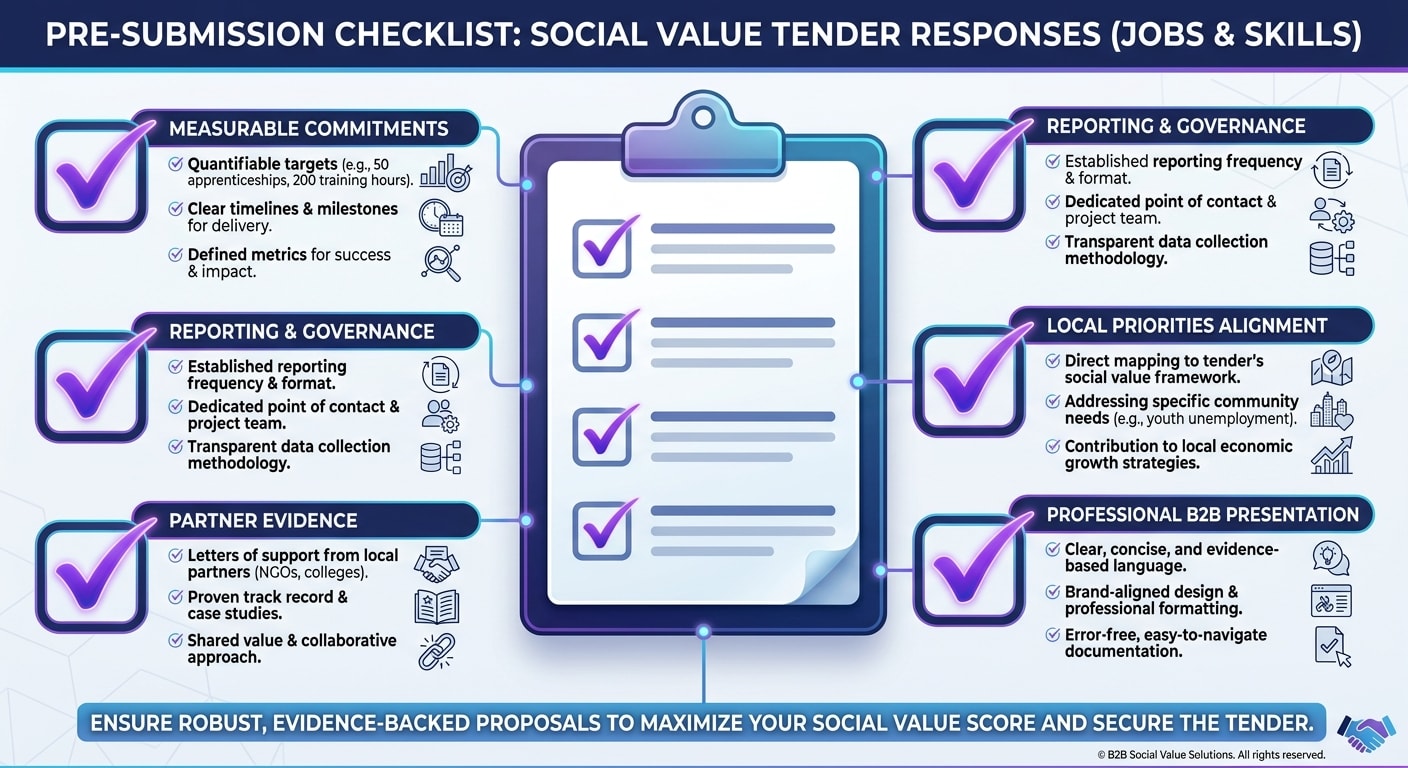
A pre-submission checklist for jobs and skills social value tender responses
Sector examples: what good looks like
Different sectors need different evidence. Do not use the same jobs and skills paragraph across every bid.
Facilities management
FM tenders are people-heavy, which gives you real material. Cleaning, security, catering, front-of-house, maintenance and helpdesk roles can all support local employment and progression.
Strong FM evidence might include:
- local recruitment during mobilisation
- paid induction and role-specific training
- progression from operative to supervisor
- technical apprenticeships for hard FM
- partnerships with local employment services
- retention and absence management data
The best FM responses link jobs and skills to service quality. Better training means fewer missed tasks, safer working and stronger resident or user experience.
Construction
Construction has obvious skills opportunities, but evaluators have heard big promises before. Be precise.
Strong construction evidence might include:
- apprenticeship starts by trade
- site placement hours
- college engagement linked to project stages
- green skills and retrofit training
- supervisor mentoring
- local subcontractor development
Avoid promising permanent jobs if the project is short and labour demand peaks only briefly. Work placements, trade tasters and structured training may be more credible.
Waste and environmental services
Waste contracts offer practical routes into work, especially through depot operations, collection crews, HGV pathways, mechanics and customer contact roles.
Strong waste evidence might include:
- loader to driver progression pathways
- funded HGV licence support
- depot-based apprenticeships
- route safety training
- local recruitment around mobilisation
- inclusive recruitment for residents facing barriers to work
Waste responses should also connect skills to compliance. Well-trained crews reduce contamination, missed collections and health and safety incidents.
How to avoid overpromising
Bid teams are under pressure to score. That can tempt people into inflated commitments.
Do not do it.
Overpromising creates three problems.
First, evaluators may not believe you. Unrealistic commitments can damage the whole response.
Second, the contract team inherits promises it cannot deliver. That creates tension within weeks of award.
Third, under the new transparency and performance environment, delivery failure is harder to hide.
A credible smaller commitment beats a grand promise with no operational backing.
If you are unsure, use tiered commitments:
- minimum commitment: what you will definitely deliver
- stretch commitment: what you will pursue if recruitment conditions allow
- reporting commitment: how you will keep the buyer informed
For example:
> We commit to creating four local entry-level roles during mobilisation. Subject to vacancy levels and referral uptake, we will target a further two roles in year one. Progress and barriers will be reviewed monthly with the council contract manager.
That is more honest and more useful than promising ten roles you cannot control.
What to store in your bid library
The best time to prepare social value evidence is not the week before submission.
Create a jobs and skills evidence pack in your bid library. Keep it updated every quarter.
It should include:
- apprenticeship starts, completions and progression
- local recruitment data by contract
- training completion records
- staff retention data
- partner case studies
- community engagement outcomes
- social value dashboards
- role profiles for entry-level positions
- examples of reasonable adjustments and inclusive recruitment
- contract manager testimonials
- photos or evidence from events, if usable
Keep the evidence approved and source-linked. If you cannot prove it, do not let it become standard copy.
This is where bid capacity and win rate connect. A clean evidence library saves hours, but it also improves quality because writers can focus on tailoring rather than hunting for proof.
The practical takeaway
Jobs and skills are becoming a sharper scoring battleground in public sector tenders.
The winning responses will not be the ones with the warmest language. They will be the ones that make a believable promise and back it with a delivery plan.
Write less about commitment. Write more about mechanism.
Who will you help? What will you create? How will you support them? What proof do you have? How will the buyer know it happened?
Answer those questions clearly and you will be ahead of most bidders.
If you want to find live public sector opportunities where this kind of evidence matters, the Tender Finder is free to use. It helps you spot relevant tenders early, so your team has time to build the evidence before the deadline panic starts.
Tags
Ready to Transform Your Tender Writing?
See how MyTender's AI can help you write winning tenders in a fraction of the time.