

IT & Technology Tender Writing Guide 2026: How to Win Public Sector Tech Contracts
Master IT and technology tender writing with proven strategies for cloud, cybersecurity, software, and digital transformation contracts. Expert guidance on frameworks, compliance requirements, and winning strategies for tech companies.
mytender.io Research Team
Technology Procurement Specialists
IT & Technology Tender Writing Guide 2026: How to Win Public Sector Tech Contracts
The UK public sector spends over £22 billion annually on IT and technology — making it one of the largest and fastest-growing procurement markets in the country. NHS digital transformation, local government cloud migration, HMRC modernisation programmes, and defence cybersecurity upgrades are collectively driving record volumes of technology contract opportunities. Yet most technology companies who enter public sector bidding lose — repeatedly.
The average win rate for IT tenders sits at just 12%, well below the cross-sector average of 22%. The gap isn't about technical capability. The companies losing these contracts can almost always do the work. They lose because they don't understand how public sector technology procurement works, what evaluators actually prioritise, and how to translate technical competence into compelling tender narrative.
This guide changes that. We've analysed over 600 successful IT and technology tender submissions across cloud, cybersecurity, software development, managed services, and digital transformation contracts to identify exactly what wins in 2026.
IT Technology Tender Guide 2026
The UK Public Sector IT Landscape in 2026
Before you can write winning bids, you need to understand where the money actually flows. Public sector IT procurement divides into distinct categories with very different dynamics.
Central government digital and data represents the highest-value contracts but also the most competitive arena. Departments like HMRC, DWP, DVLA, and Cabinet Office digital regularly procure nine-figure transformation programmes. These typically go through Digital Marketplace frameworks and require significant past performance evidence at comparable scale. SMEs can participate as subcontractors or through smaller component contracts, but prime contractor positions require serious track record. NHS and healthcare technology is the fastest-growing segment, with NHS England's Long Term Plan driving unprecedented digital investment. Electronic patient records, AI diagnostics, clinical decision support, patient-facing apps, and NHS App integrations represent billions in active procurement. NHS procurement differs from central government in key ways — clinical safety is a primary evaluation criterion, and suppliers must demonstrate understanding of healthcare-specific regulations including DCB0129 and DCB0160 clinical safety standards. Local government IT covers council software, infrastructure, managed services, and digital citizen services. Councils procure individually or through buying consortia like Crown Commercial Service (CCS), ESPO, YPO, and regional frameworks. The volume is enormous — over 400 local authorities, each procuring multiple technology contracts annually. Win rates are slightly higher than central government (around 18%) because councils are more willing to work with smaller suppliers and place greater emphasis on local economic benefit. Education technology spans multi-academy trusts, further education colleges, and universities. MATs increasingly procure IT centrally across groups of schools — a single MAT with 30 schools represents significant contract value. Universities are the most commercially sophisticated education buyers, running formal OJEU/Find a Tender procurement for contracts above threshold. Blue light and emergency services — police forces, fire services, and ambulance trusts — have distinctive technology needs around command and control systems, mobile data, body-worn video, and operational technology. These buyers are risk-averse and place enormous weight on reliability and vendor stability.Understanding which segment you're targeting shapes every aspect of your bid strategy. Central government wants proven scale. NHS wants clinical safety understanding. Local councils want value and relationship. Education wants simplicity and support. Blue light wants reliability above all else.
The Framework Landscape: Your Route to Market
Most public sector IT contracts are procured through pre-approved frameworks rather than open competition. Understanding this landscape is non-negotiable for technology suppliers.
G-Cloud is the most important framework for cloud and software-as-a-service providers. Managed by Crown Commercial Service, G-Cloud allows approved suppliers to list services in a digital catalogue that buyers can search and award contracts from directly — no competitive tender required. G-Cloud 14 is the current iteration, with thousands of suppliers listed across three lots: Cloud Hosting, Cloud Software, and Cloud Support.Getting onto G-Cloud requires a one-time application process rather than competing for individual contracts. Once approved, your services appear in the Digital Marketplace and buyers can award contracts directly up to the framework value limits. The catch is visibility — with thousands of listings, buyers typically search by specific criteria and your service description must be genuinely keyword-optimised to appear in relevant searches. The majority of G-Cloud revenue flows to a small fraction of suppliers who understand how to optimise their listings.
Digital Outcomes and Specialists (DOS) — now succeeded by Digital and Technology Outcomes (DTO) — is the framework for bespoke digital services: user research, service design, software development, testing, and delivery management. Unlike G-Cloud where buyers can award directly, DOS/DTO requires a mini-competition among shortlisted suppliers. Buyers post an opportunity, shortlisted suppliers submit proposals, and the buyer awards based on evaluation criteria specific to each opportunity. Technology Products and Services (TPS) covers hardware, software licences, and managed services at significant scale. This framework is heavily used by large departments and NHS trusts for infrastructure and enterprise software procurement. Crown Commercial Service RM6100 (Technology Services 3) covers managed IT services, service desk, infrastructure management, network services, and end-user device management. Large multiples dominate this framework for enterprise contracts, but specialist service desk and managed services providers can compete effectively for smaller lots. Sector-specific frameworks matter enormously. NHS Shared Business Services runs the Clinical Digital and IT Solutions framework for NHS-specific procurement. Police Digital Service manages frameworks for law enforcement technology. Education-specific frameworks like the RM6225 Education Software Solutions framework serve schools and colleges. Being on the right framework is a prerequisite, not an advantage. If a buyer is procuring through a specific framework and you're not on it, you cannot bid. Technology suppliers serious about public sector growth need to map their service offering against relevant frameworks and maintain active presence across the frameworks that match their target buyers.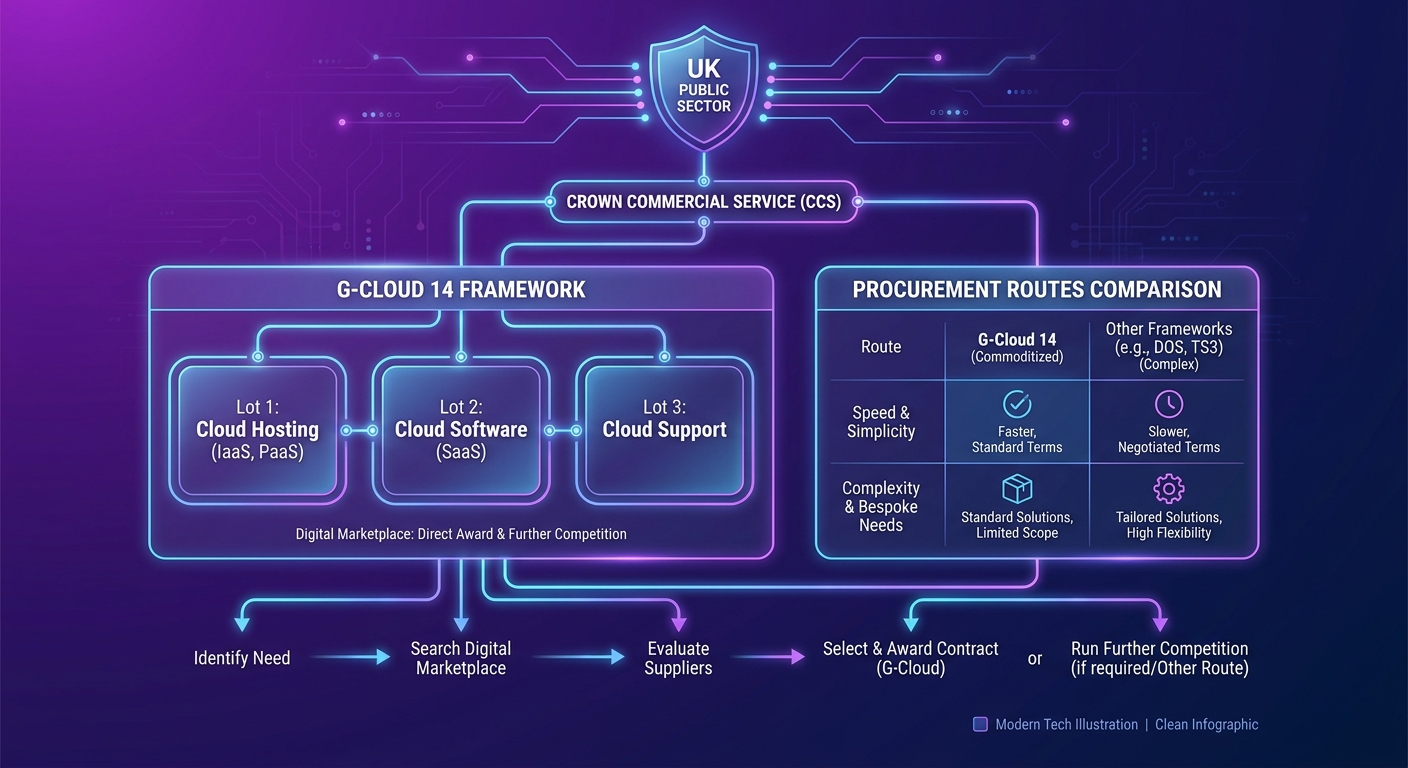
Cloud Computing Public Sector Frameworks 2026
Cybersecurity: The Make-or-Break Requirement
No area of IT tender writing has changed more dramatically in the past three years than cybersecurity requirements. What was once a supplementary section has become the primary qualification gate — failing cybersecurity requirements means automatic disqualification regardless of technical capability or price.
Cyber Essentials and Cyber Essentials Plus
Cyber Essentials certification is now mandatory for the majority of government IT contracts. Introduced in 2014 but increasingly enforced from 2022 onwards, Cyber Essentials covers five technical controls: boundary firewalls and internet gateways, secure configuration, access control, malware protection, and patch management.Cyber Essentials Plus involves independent verification of these controls through vulnerability scanning and technical testing. Government contracts involving handling of personal data, network access to government systems, or processing of sensitive information typically require Cyber Essentials Plus rather than the basic certification.
What this means for your bid: You must hold current, valid Cyber Essentials or Cyber Essentials Plus certification before submitting most government IT tenders. You cannot apply for certification after receiving a tender — the process takes 4-8 weeks minimum and your certificate must be current at bid submission date. Certification costs range from £300 for basic Cyber Essentials to £1,500-3,000 for Plus, depending on your organisation size.If you don't currently hold Cyber Essentials certification and you're serious about public sector IT business, getting certified is your single highest-priority action. Include your certificate number and expiry date prominently in tender submissions.
ISO 27001 and Enterprise Security Standards
For larger contracts — typically above £500,000 — buyers frequently require ISO 27001 certification, the international standard for information security management systems. ISO 27001 demonstrates systematic, risk-based approaches to information security rather than just meeting minimum technical controls.
The certification process is significantly more demanding than Cyber Essentials: it requires documentation of your entire information security management system, internal audits, and third-party certification body assessment. Implementation typically takes 6-18 months for organisations without existing security management frameworks. The investment is substantial, but it unlocks a category of contracts unavailable to non-certified suppliers.
Some contracts specify ISO 27001 as a "preferred" rather than mandatory requirement. In these cases, not holding certification doesn't disqualify you, but you must credibly explain how your security management practices achieve equivalent outcomes. This is a difficult argument to make convincingly — buyers choosing between ISO 27001-certified and non-certified suppliers will almost always prefer the certified option.
GDPR and Data Protection by Design
Every government IT contract involves processing personal data to some degree. Your tender must demonstrate mature data protection practices, not just compliance with minimum GDPR requirements.
What winning bids include: A clear data processing register identifying all personal data your system processes, purposes, legal bases, and retention periods. Technical and organisational measures (TOMs) that show data protection by design — encryption in transit and at rest, access controls, audit logging, breach detection and response procedures. A named Data Protection Officer or named data protection lead with demonstrable competence. Privacy impact assessment processes for new features or processing activities. What losing bids include: Generic statements that "we comply with GDPR." Vague references to "appropriate security measures." No specific technical controls named. No evidence of having actually run a DPIA process.The evaluators reading your data protection response are not naive. They've read hundreds of these sections. Boilerplate compliance language stands out immediately and scores poorly. Specific, evidenced, technical responses to data protection requirements are what separate strong bids from weak ones.
Government Security Classifications
Contracts involving handling of government data are subject to the Government Security Classification Policy (GSCP). Understanding whether your contract involves OFFICIAL, OFFICIAL-SENSITIVE, SECRET, or TOP SECRET data, and demonstrating appropriate controls for each level, is essential for central government bids.
Most local government and NHS contracts involve OFFICIAL-level data only. This doesn't mean security requirements are lax — it means the focus is on appropriate access controls, audit trails, and breach response rather than the physical and personnel security requirements for higher classifications.
For contracts at SECRET or above, you'll need National Cyber Security Centre guidance compliance and potentially NCSC-approved products. These represent a specialist market requiring security clearances and significant investment in accredited solutions.
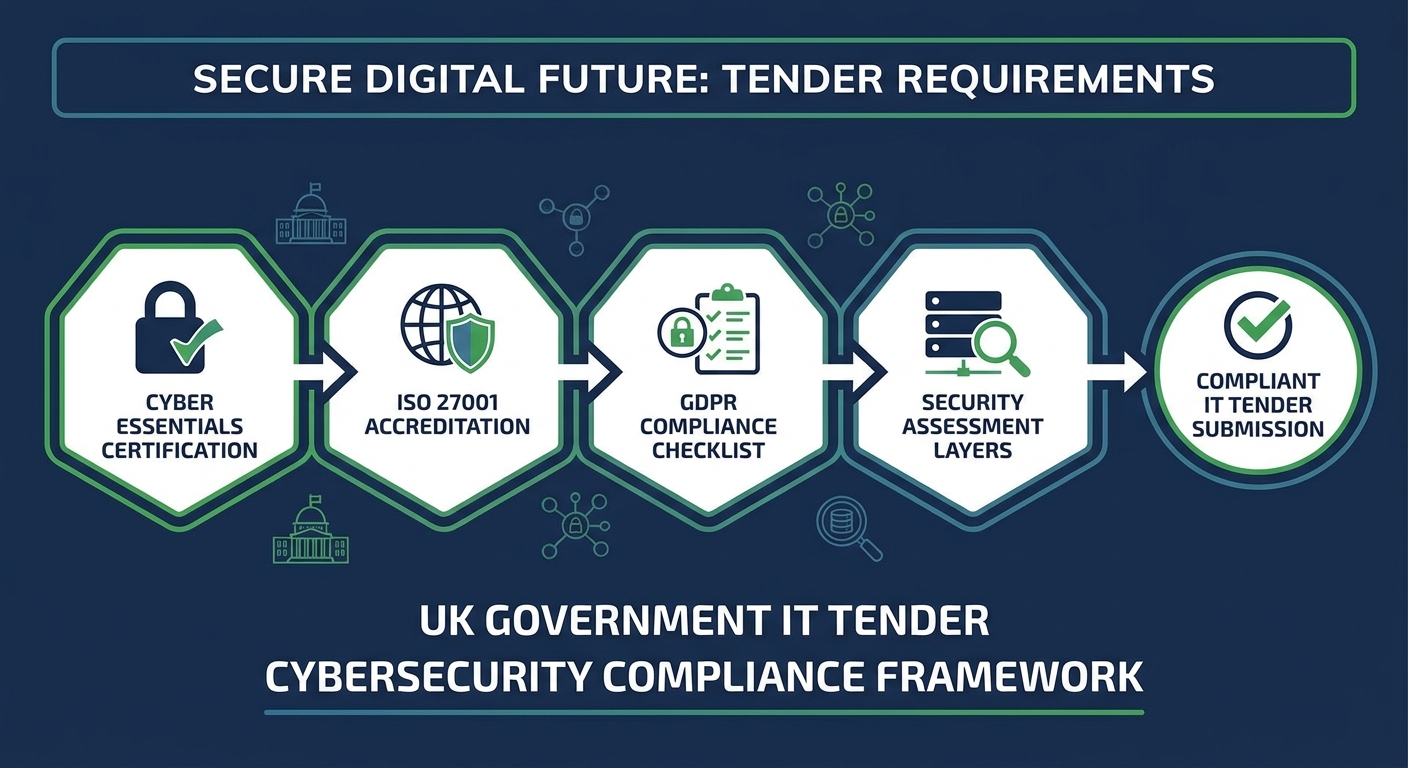
Cybersecurity Compliance Framework IT Tenders 2026
Technical Architecture and Service Design
After cybersecurity, the second major area where technology bids win or lose is the quality of technical architecture and service design responses. Public sector buyers have become significantly more sophisticated in their technical evaluation — they know what good looks like and can identify superficial responses.
Cloud Architecture Requirements
Government cloud procurement follows the "cloud first" policy — buyers default to cloud solutions unless there's a compelling reason to use on-premise infrastructure. Your technical architecture responses should therefore default to explaining your cloud approach rather than defending on-premise options.
What buyers want to see in cloud architecture responses: Resilience and availability: Your architecture should demonstrably achieve the availability SLA required (typically 99.9% or 99.95% for operational systems). Explain your redundancy approach — active-active vs active-passive, geographic distribution, data replication. Named cloud regions matter — buyers increasingly specify that data must remain in UK/EEA jurisdiction, so "UK South and UK West" is more compelling than "global availability." Scalability: Government systems have highly variable load patterns — HMRC at tax return season, DWP at benefit payment processing cycles, NHS appointment booking systems during pandemic surges. Your architecture must handle 10x normal load without service degradation. Explain your auto-scaling approach, load balancing, and how you've stress-tested capacity. Security architecture: Zero-trust network architecture has moved from aspirational to expected in central government bids. Explain how you implement identity-based access control, microsegmentation, and continuous authentication. Include your approach to privileged access management and how you prevent lateral movement in the event of a compromise. Disaster recovery: Define your Recovery Time Objective (RTO) and Recovery Point Objective (RPO) clearly and explain how your architecture achieves them. Buyers will test these claims in due diligence — if you claim 4-hour RTO, have the evidence to support it.Integration and Interoperability
Government systems don't exist in isolation — they must integrate with existing infrastructure, other digital services, and government data platforms. Your technical response must address integration architecture explicitly.
Legacy integration is a particular pain point in public sector IT. Most departments run a mixture of modern cloud services and legacy applications that cannot easily be replaced. Your solution must integrate with existing ERP systems (often Oracle or SAP), HR systems, finance systems, and operational databases. Explain your integration approach — REST APIs, event streaming, ETL processes, middleware — and provide examples of similar legacy integration you've delivered successfully. Government standards compliance is non-negotiable. The Technology Code of Practice (TCoP) sets out 13 criteria that all government technology projects must follow. Your technical architecture should explicitly reference TCoP alignment. Key requirements include using open standards, making things accessible, designing for security, and making source code open where possible. API-first design is expected in modern government services. Your application should expose well-documented APIs that allow integration with other services and future extensibility. Government buyers increasingly require API documentation published to government API catalogues as a contract deliverable.Accessibility and Inclusive Design
The Public Sector Bodies Accessibility Regulations 2018 require all public sector websites and apps to meet WCAG 2.1 Level AA accessibility standards. This isn't aspirational — it's a legal requirement, and your tender must demonstrate how you meet it.
What strong responses include: Evidence of accessibility testing methodology — automated testing tools (axe, Lighthouse) plus manual testing with assistive technologies (screen readers, switch access, magnification). Named team members with accessibility expertise. Examples of accessibility audits from previous similar projects. Commitment to ongoing accessibility monitoring as part of your service. What weak responses include: Generic statements that "we build accessible services." No specific WCAG 2.1 criteria referenced. No evidence of having actually tested with disabled users. Treating accessibility as a compliance checkbox rather than a design principle.Accessibility failures after contract award are embarrassing for the buyer and create legal liability. Buyers increasingly pre-qualify on accessibility competence precisely because post-award remediation is expensive and disruptive.
Service Management and Support
Technical capability wins you the evaluation stage. Service management quality determines whether you build a long-term public sector client base or win once and struggle to renew.
ITIL and Service Management Frameworks
Most significant IT contracts require evidence of service management maturity, with ITIL (Information Technology Infrastructure Library) being the dominant framework. ITIL 4, the current version, emphasises value co-creation, agility, and continual improvement — language that resonates strongly with public sector digital teams.
What buyers evaluate: Your incident management processes — how do you classify, prioritise, and resolve incidents? Your problem management approach — how do you identify root causes and prevent recurrence? Your change management procedures — how do you minimise disruption when updating live services? Your service level management — how do you monitor, report, and improve SLA performance? Evidence beats assertion. Don't just state that you follow ITIL processes — show your incident management workflow, provide your P1/P2/P3 classification matrix, share anonymised examples of problem records from previous engagements. Buyers who've been burned by suppliers claiming ITIL maturity and delivering chaotic support know how to test whether your processes are real.Service Level Agreements
Every managed service and support contract specifies SLAs. Your tender must respond to the buyer's required SLAs while demonstrating the operational capability to deliver them consistently.
Critical SLA considerations for IT tenders: Response vs resolution: Buyers specify both response times (how quickly you acknowledge an issue) and resolution times (how quickly you fix it). These are different obligations — a 15-minute response SLA and 4-hour resolution SLA for Priority 1 incidents is typical for operational government systems. Make sure your bid correctly distinguishes between them. Availability SLAs: Monthly availability targets of 99.9% (8.7 hours downtime annually) or 99.95% (4.4 hours downtime annually) are standard for operational systems. Critically, understand how availability is calculated — most contracts exclude planned maintenance windows from availability calculations, but emergency maintenance, deployment failures, and infrastructure outages are included. Your architecture must genuinely achieve the stated availability target. Support hours: Government contracts vary from standard business hours (9-5 Monday to Friday) to 24/7/365 for critical systems. 24/7 support requires investment in shift patterns, on-call arrangements, and second-line escalation — make sure your pricing reflects this before committing. SLA credits and remedies: Most contracts include financial remedies for SLA failures — typically credits against future invoices proportional to the severity and duration of the failure. Understand the financial exposure before signing and ensure your operations team knows SLA monitoring is a commercial priority.Transition and Mobilisation
One of the most commonly underweighted sections in IT tenders is the transition and mobilisation plan. Buyers are acutely aware that IT transitions are high-risk — poor transitions cause operational disruption, data loss, and political embarrassment. A credible, detailed mobilisation plan significantly differentiates winning bids.
What excellent mobilisation plans include: A day-by-day Gantt chart for the first 90 days, with clearly named milestones and dependencies. A named mobilisation lead with relevant transition experience. Your approach to knowledge transfer from the incumbent supplier, including how you'll handle uncooperative incumbents. Data migration methodology including validation, testing, and rollback procedures. Stakeholder communication plans covering both technical and end-user audiences. A go-live criteria checklist that must be passed before cutover. Clear escalation routes if mobilisation falls behind schedule. The incumbent supplier problem: In competitive re-tenders, the incumbent supplier knows the system and the client. Your transition plan must credibly address how you'll build equivalent knowledge within the mobilisation period. This is where discovery sprints, parallel running periods, and structured knowledge handover workshops add concrete weight to your narrative.Commercial and Pricing Strategy
Technology tender pricing is consistently mishandled — either too high and obviously non-competitive, or too low and triggering questions about delivery viability. Getting commercial strategy right is as important as technical quality.
Total Cost of Ownership vs Day Rate
The instinct of many technology suppliers is to compete on day rate. This is almost always wrong. Public sector buyers increasingly evaluate total cost of ownership over the contract lifetime, not headline day rates or licence fees.
A solution with a higher licence fee but lower integration costs, shorter implementation timeline, and lower ongoing support overhead can score better on commercial evaluation than a cheaper product with hidden complexity costs. Your pricing response should model full lifecycle costs, not just your invoice line items.
This is particularly relevant in software development tenders. A buyer comparing fixed-price delivery proposals cares about total project cost, not individual sprint costs. If you can demonstrate that your approach delivers the outcome in fewer sprints through experienced team composition and robust delivery methodology, a higher day rate can produce a lower total cost — and win the commercial evaluation.
Social Value and Economic Benefit
The Social Value Act 2012 and its 2021 reinforcement through government procurement policy notes requires public sector buyers to evaluate social value as a mandatory criterion in contracts above threshold. For IT contracts, social value typically accounts for 10-15% of total evaluation weighting.
What IT companies typically offer for social value:- Graduate and apprenticeship programmes creating digital skills opportunities
- Pro bono digital services to charities or community organisations
- Carbon reduction commitments and net zero alignment
- Local employment and supplier commitments
- Digital inclusion programmes supporting digitally excluded citizens
- STEM education engagement in local schools
Don't overclaim. A 20-person SME promising to "transform digital skills across the region" will be seen as hollow. Credible commitments sized to your organisation's realistic capacity are more persuasive than ambitious pledges that stretch credulity.
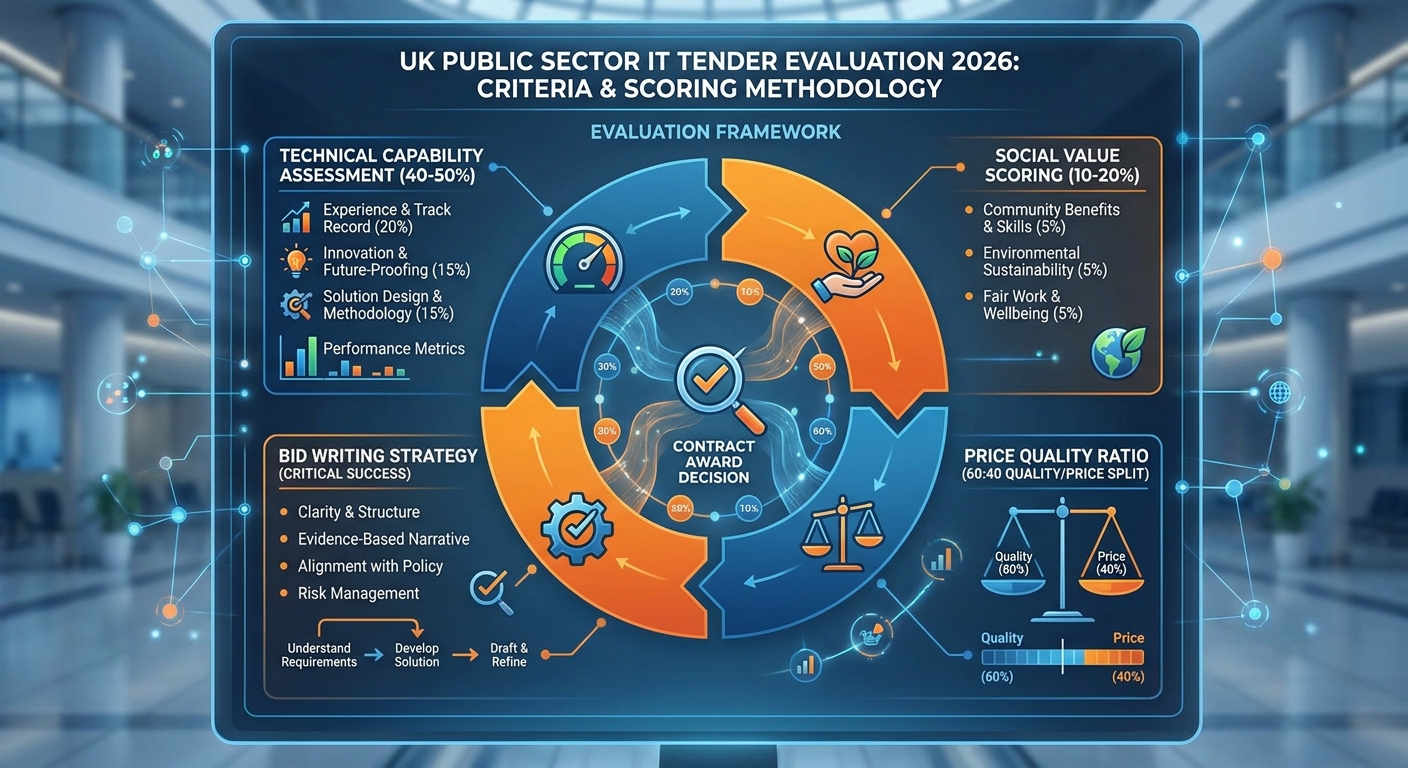
IT Tender Evaluation Scoring Criteria 2026
Demonstrating Past Performance
The most powerful section of any IT tender — and the one most commonly wasted — is past performance and case studies. Buyers are risk-averse, and evidence that you've successfully delivered comparable work is the most effective risk mitigation they can find.
Selecting the Right Case Studies
Most tender instructions specify that you provide two to four case studies from the past three to five years. Selecting strategically matters more than most suppliers realise.
Optimal case study selection criteria:- Comparable scale (contract value, team size, technical complexity)
- Similar sector or client type
- Matching technical requirements (if the tender is for cloud migration, choose your best cloud migration reference)
- Positive client relationship — the buyer may request references
- Outcome you're proud to describe in detail
SME Considerations
Small and medium enterprises face a specific challenge in case study evidence: you may have fewer relevant past projects, particularly for large-scale contracts. There are legitimate strategies for addressing this.
Consortium and subcontracting arrangements allow SMEs to demonstrate relevant experience through partnerships. If your SME partnered with a larger organisation to deliver a major programme, that experience is legitimate even if you weren't the prime contractor — describe your specific role, contributions, and outcomes clearly. Staff biography substitution: Where project-level experience is thin, strong individual biographies from team members with directly relevant experience at previous employers can partially compensate. "Our delivery lead, [name], led the [comparable programme] at [previous employer], delivering X outcome" adds credibility even if your company as an entity hasn't delivered at that scale. Government's commitment to SMEs: There is genuine political will to grow SME participation in public sector IT. The Crown Commercial Service's SME participation targets, and the requirement in the Procurement Act 2023 to consider SME economic benefit, mean buyers are increasingly open to SMEs with strong technical teams even where project-level track record is thinner than large system integrators.The Digital Marketplace: Practical Optimisation
For technology companies targeting public sector contracts, the Digital Marketplace (now incorporated into Find a Tender Service and the G-Cloud catalogue) is your shop window. Optimising your presence there is marketing, not procurement — but it drives significant contract awards.
G-Cloud Listing Optimisation
G-Cloud listings succeed or fail based on discovery. Buyers search for specific capabilities — "managed SOC service," "cloud-hosted housing management system," "user research for NHS" — and your listing must appear in those searches.
Optimisation tactics that work: Keyword research: Before writing your service description, identify the exact phrases buyers use when searching for services like yours. Government procurement terminology differs from commercial language — "managed security operations centre" vs "cybersecurity monitoring service." Use the language buyers use, not the language you use internally. Service description quality: The first 200 characters of your service description appear in search results. Lead with the most specific, differentiated description of what you do. Don't start with your company name or generic capability — start with the specific service. "NCSC Certified Cloud Security Monitoring with 15-minute incident response SLA for public sector organisations" outperforms "ABC Ltd provides cybersecurity services to help organisations stay secure." Pricing transparency: Buyers can filter by price range. If your pricing is unclear or requires contact before quoting, you'll be filtered out before buyers even read your description. List specific starting prices or pricing tiers — even if final pricing is bespoke, a clear starting point keeps you in the filtered search results. Features and benefits vs marketing language: Describe specific features and quantified benefits. "Reduces mean time to detect from industry average of 206 days to under 4 hours" beats "industry-leading threat detection capabilities."Digital Marketplace Opportunity Monitoring
The Opportunities section of the Digital Marketplace lists DOS/DTO requirements actively seeking suppliers. Monitoring this for relevant opportunities requires a systematic approach — opportunities can close within days of publication, and missing the window means missing the contract.
Set up email alerts for relevant categories and review new opportunities daily during active bidding periods. When you identify a relevant opportunity, immediately assess fit against the essential and nice-to-have criteria before investing time in a full response. Opportunities with essential criteria you can't credibly meet are worth passing on — poor-fit applications damage your reputation with that buyer for future competitions.
AI and the Future of IT Procurement
The procurement landscape for AI and machine learning solutions deserves specific attention given the pace of market development and the genuine uncertainty around AI regulation and governance.
Public sector AI procurement is maturing rapidly. The Government AI Strategy, NHS AI Lab, and individual departmental AI strategies are driving substantial investment in AI-powered services. But buyers are navigating genuine uncertainty — AI regulation is evolving, and no one wants to procure a solution that becomes non-compliant under incoming EU AI Act provisions or UK domestic regulation.
What sophisticated AI bids include in 2026: Explainability and transparency: How does your AI make decisions? For AI systems that affect individuals — benefits eligibility, clinical decision support, risk scoring — buyers need to understand how they'd explain algorithmic decisions to affected citizens. "Black box" AI is increasingly unacceptable in public sector contexts. Explain your explainability approach — feature importance, LIME, SHAP, or model-specific interpretability tools — in terms appropriate to your buyer's technical sophistication. Bias assessment and fairness: Have you tested your model for differential performance across protected characteristics? Can you demonstrate that your AI doesn't produce systematically worse outcomes for particular demographic groups? The Equality Act 2010 applies to AI-assisted decisions in the same way as human decisions — buyers need to know you've thought about this rigorously. Human oversight provisions: Every AI-assisted decision in public sector contexts should include human review capabilities. Your system design should make it easy for human professionals to review, override, and audit AI recommendations. Describe these controls explicitly. Model governance: How do you manage model drift? How do you retrain and update models? What's your approach to monitoring for degraded performance over time? Static AI models in production are a governance failure waiting to happen — describe your ongoing model management procedures.AI procurement in 2026 is a genuine opportunity for well-prepared technology suppliers. Buyers need AI solutions, but they need suppliers they can trust to manage the risk responsibly. Demonstrating sophisticated understanding of AI governance differentiates you from suppliers who treat AI as just another feature.
Bid Management: The Process That Determines Success
Technical capability and commercial competitiveness only matter if your bid process is professional enough to capture them effectively. The mechanics of bid management — timeline discipline, review processes, and submission quality — account for a significant proportion of the gap between companies that win consistently and those that don't.
The Bid/No-Bid Decision
The single most valuable habit for improving win rates is disciplined bid/no-bid assessment before committing resource to any opportunity. Pursuing every opportunity sounds like maximising revenue potential — it actually dilutes quality across all bids and produces consistently mediocre scores on all of them.
Bid/no-bid factors for IT tenders: Do you meet the essential criteria? If the tender specifies ISO 27001 certification and you don't have it, no bid. If it requires five years of experience delivering comparable systems and you have two, no bid. Essential criteria are pass/fail — you either meet them or you don't. Do you have relevant experience to evidence? Can you point to comparable case studies? If the opportunity requires healthcare sector experience and your portfolio is entirely financial services, your case studies won't resonate with evaluators even if your technical capability is sound. Is the relationship warm or cold? Public sector buyers frequently know who they want before publishing a tender. If this is your first contact with this buyer and you have no relationship at all, you're at a significant disadvantage to suppliers who've invested in pre-procurement engagement. Not disqualifying — but factor it into your win probability assessment. Can you deliver profitably? Fixed-price IT tenders are a graveyard for suppliers who underestimate scope. If the requirements are ambiguous, the scope is large, and the timeline is aggressive, the probability of delivery within bid pricing is low. A contract win that turns into a delivery loss harms your reputation as much as losing the bid.Timeline Management
Tender deadlines are absolute. Late submissions are automatically disqualified — there are no extensions for IT problems, staff illness, or underestimating the writing time required. A submitted bid that's 80% of where you wanted it to be is infinitely better than a perfect bid submitted an hour after deadline.
Practical timeline management for IT tenders:Work backwards from the submission deadline. If submission closes at 12:00 on Friday, your internal deadline for all content is Wednesday noon — that gives you time for a quality review, senior sign-off, and the administrative process of compiling and uploading the submission.
Divide content between authors by expertise. The cybersecurity sections should be written by someone who actually understands your security architecture. The commercial sections need someone with pricing authority. The case studies should be written or at minimum reviewed by someone who actually delivered the work.
Run at least one structured review before submission. Read each response against the question asked — many bid failures come from technically accurate responses that don't actually answer the question. Evaluators score against what was asked, not what you said.
Presentation and Quality
Evaluation panels read hundreds of tender responses. Presentation quality — clarity of structure, appropriate use of visuals, absence of jargon, readable prose — affects evaluation outcome even when evaluators don't consciously score for it.
Practical quality markers: Page and word limit discipline: When instructions specify word limits, treat them as hard caps, not suggestions. Evaluators are instructed to stop reading at the word limit — content beyond the limit doesn't score. Edit ruthlessly to keep within limits while maximising information density. Avoid technical jargon with non-technical evaluators: Central government IT tenders are frequently evaluated by a mixed panel including commercial leads, IT professionals, and policy officials. Write for the least technical reader — explain acronyms on first use, avoid vendor-specific terminology, use plain English for concept explanations. The technical evaluators will understand; the non-technical evaluators will be grateful. Evidence over assertion: "We have extensive experience in healthcare IT" scores lower than "We have delivered seven NHS digital programmes since 2020, including [Project A] for [NHS Trust] and [Project B] for [ICS], with a combined value of £12.4 million and average client satisfaction scores of 8.9/10." Make every assertion concrete.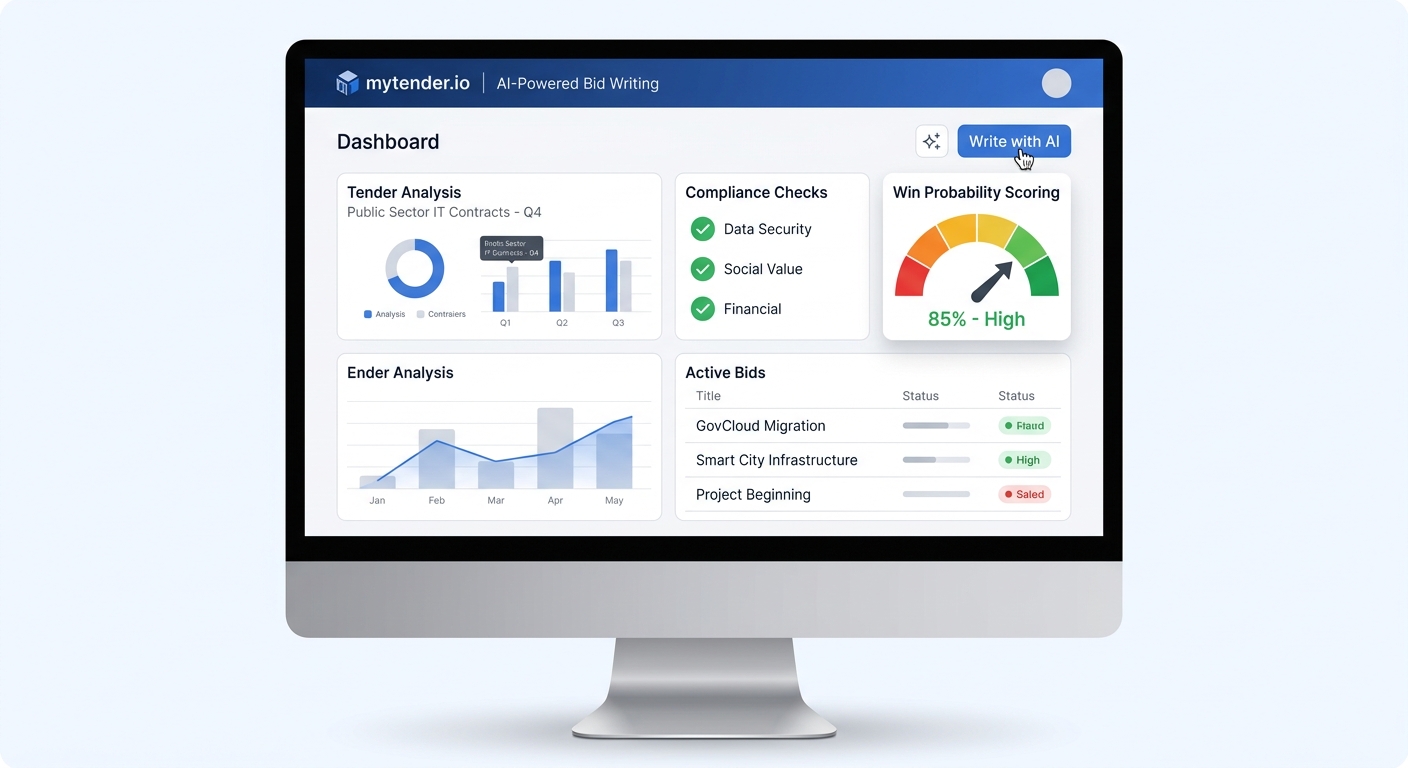
AI Bid Writing for IT Tenders - mytender.io
How mytender.io Transforms IT Tender Success
The analysis, structure, and content requirements described in this guide represent hundreds of hours of work per bid for technology companies doing it manually. Most IT companies — even large ones — don't have dedicated bid teams. They rely on technical staff to write tenders alongside their delivery roles, producing bids that are technically sound but poorly presented, missing key evidence, or simply incomplete.
mytender.io is purpose-built for exactly this problem. Our AI platform analyses tender requirements, identifies the evidence your submission needs to include, generates structured first drafts based on your company's past performance and case study library, and flags compliance gaps before you submit.
For IT companies specifically, mytender.io delivers: Compliance checklist generation: The platform reads your tender documents and automatically generates a compliance matrix — every question mapped to the correct response section, cybersecurity requirements flagged, certification needs identified. You know immediately what evidence gaps you need to address rather than discovering them the night before the deadline. Case study library management: Upload your past project evidence once. The platform learns your portfolio and automatically surfaces the most relevant case studies for each new tender, drafting STAR-structured responses tailored to the specific requirements. Framework monitoring: mytender.io monitors G-Cloud, DOS/DTO, and sector-specific frameworks for relevant opportunities, alerting you to new procurements matching your capability profile before your competitors even notice them. Collaboration tools: Multi-author bid workflows with review tracking, version control, and approvals — so your bid manager, technical lead, and commercial director can work on sections simultaneously without version conflict.Companies using mytender.io report average bid writing time reductions of 65% and win rate improvements of 35% within six months. For IT companies with technical capability but limited bid resource, that's the difference between winning the contracts your technology deserves and consistently losing to less capable but better-presented competitors.
Action Plan: Getting Started with IT Tenders
Whether you're new to public sector IT bidding or looking to improve on an existing pipeline, here's a practical sequence to follow.
Immediate actions (this week): If you don't have Cyber Essentials certification, start the application process today. It costs a few hundred pounds and takes four to six weeks — every week you delay is a week you can't bid on government IT contracts. Find a certification body at the IASME consortium website.Review your relevant frameworks and ensure you have active listings. Check your G-Cloud listing if you have one — when did you last update your service descriptions? G-Cloud listings that haven't been updated in 12 months tend to perform poorly in searches.
Short term (this month): Conduct a case study audit. List your five most relevant past projects and assess whether you have sufficient evidence — quantified outcomes, client reference contacts, technical detail — to write convincing tender responses from each. Identify gaps and plan how to address them.Set up monitoring for relevant procurement portals. Find a Tender Service (replace EU's Ojeu TED), Contracts Finder, NHS Shared Business Services portal, and the Digital Marketplace should all be part of your weekly monitoring routine.
Medium term (this quarter): If you're serious about central government contracts, consider ISO 27001 implementation planning. The investment is significant, but the contract value it unlocks — and the competitive advantage it provides — typically generates positive ROI within 12-18 months for IT companies with genuine central government ambitions.Build pre-procurement relationships with target buyers. Attend government technology conferences, respond to market engagement events, and request informal supplier briefings before formal procurement launches. Buyers share intelligence in pre-procurement engagement that you can legitimately use to sharpen your bid.
Start using mytender.io to build your company knowledge base. Upload your case studies, certifications, policies, and team biographies. The more your company knowledge base contains, the better the platform performs — and you'll have structured everything you need before the deadline pressure arrives.
Conclusion
The UK public sector IT market offers substantial, sustainable revenue for technology companies that understand how to compete. The £22 billion annual spend is growing — digital transformation investment is accelerating, not slowing, across every part of government. The opportunity is real.
The barrier is not technical capability — the public sector is full of companies with technically excellent solutions losing bids to less capable competitors who present better. The barrier is understanding how public sector IT procurement works, what evaluators actually want to see, and how to build and maintain the compliance foundations that let you bid in the first place.
Cyber Essentials certification, framework presence, credible case studies, mature service management evidence, and rigorous bid process management are the foundations. Layer in deep technical architecture responses, sophisticated cybersecurity and data protection content, and credible social value commitments, and you have a bid that can genuinely compete.
The companies that win public sector IT contracts consistently aren't necessarily the best technology companies. They're the best-prepared bidders with the best-evidenced submissions. That's a learnable skill — and mytender.io exists to make it dramatically faster and more effective.
---
Want to see how mytender.io can improve your IT tender win rate? Start your free trial and upload your first tender opportunity today.Tags
Ready to Transform Your Tender Writing?
See how MyTender's AI can help you write winning tenders in a fraction of the time.