
Integrated FM vs Single-Service Bidding: Choosing the Right Lot Strategy
Integrated FM looks attractive, but it is not always the right lot strategy. Learn when to bid the full bundle, when to specialise, and how to write the rationale evaluators trust.
mytender.io Research Team
Tender Writing & Bid Management Specialists
Integrated FM vs Single-Service Bidding: Choosing the Right Lot Strategy
The most tempting lot in an FM tender is usually the biggest one.
Integrated FM. Total facilities management. Hard and soft services under one contract. One mobilisation, one account team, one chance to land a contract that changes the year.
It is also the lot that can quietly wreck a bid team's judgement.
A supplier that is brilliant at cleaning, security, M&E, grounds maintenance, or catering can talk itself into bidding an integrated package because the contract value looks too good to ignore. The problem is simple: evaluators are not scoring ambition. They are scoring evidence.

Facilities management bid team reviewing integrated FM and single-service lot strategy
If your evidence supports the full bundle, integrated FM can be the right move. If your evidence supports one service line, a single-service lot may give you a better chance of winning, mobilising cleanly, and protecting margin.
This guide is about making that call properly.
Why Lot Strategy Matters More in FM Than Most Sectors
Facilities management tenders are rarely just one service.
A local authority might tender cleaning, caretaking, M&E, compliance testing, helpdesk, grounds, pest control, security, waste, and minor works in the same procurement. A university might split hard FM from soft FM. An NHS trust might invite bids for an integrated estates partner but reserve specialist lots for high-risk services.
The structure matters because it tells you what the buyer values.
If the buyer creates one integrated lot, they are probably looking for fewer suppliers, stronger contract management, clearer accountability, and reduced internal administration. If they split the tender into service-specific lots, they may want best-of-breed suppliers, local SMEs, specialist quality, or lower risk during mobilisation.
The wrong bidding strategy sends the wrong signal.
Bid the integrated lot without enough breadth and you look overextended. Bid only the single-service lot when the buyer clearly wants a partner to coordinate multiple services and you may look too narrow.
The best FM bidders do not start with contract value. They start with fit.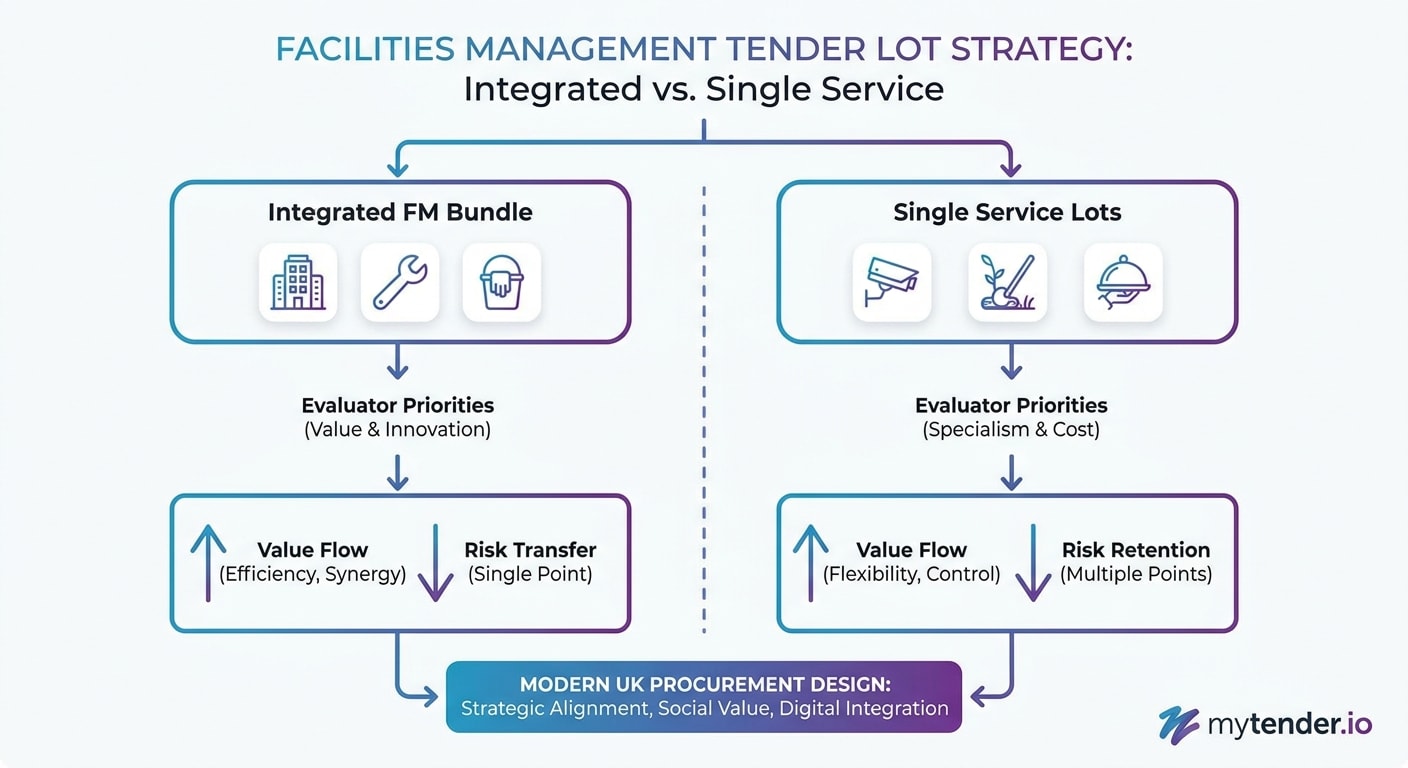
Framework comparing integrated FM, bundled service lots, and single-service FM bidding strategies
The Three Lot Strategies You Actually Have
Most FM bid decisions fall into one of three shapes.
1. Bid the Integrated FM Lot
This is the full-service approach. You bid as the prime contractor for the whole FM bundle, either using your own teams across all services or managing a supply chain for specialist elements.
It works when you can prove:
- multi-service delivery at similar scale
- mature contract management
- strong helpdesk and CAFM capability
- credible mobilisation across several service lines
- robust subcontractor governance
- consistent KPI reporting across the full estate
Integrated FM is not just a bigger cleaning contract with a few subcontractors attached. It is a different operating model.
The evaluator wants confidence that you can coordinate the moving parts without creating more work for the client.
2. Bid a Bundled Service Lot
Sometimes the smart play sits between full integration and single service.
You might bid soft FM only, cleaning plus caretaking, hard FM plus statutory compliance, or grounds plus winter maintenance. This works when the services naturally share labour, management, geography, systems, or reporting.
Bundled lots are often underrated. They let you show breadth without pretending to be something you are not.
A cleaning contractor with strong caretaking experience may have a compelling soft FM story. The same contractor bidding hard FM, M&E, security, pest control, and waste through a patchwork of partners may not.
3. Bid the Single-Service Lot
This is the specialist route.
You focus on the lot where your evidence is strongest and write a response that says, implicitly: "Do not average us into a generalist bundle. Score us on the thing we do exceptionally well."
Single-service bidding works when:
- the scoring rewards technical depth
- mobilisation risk is high
- local delivery knowledge matters
- the buyer has split the lots deliberately
- you have stronger case studies than integrated competitors
- your price model is sharper because you control the service directly
For many SMEs, this is the highest-win-rate strategy. It may not be the biggest contract, but it is often the best bid.
The Decision Test: Evidence Before Ambition
Before you choose a lot, ask one blunt question.
Can we evidence this operating model, or are we just describing it?That question cuts through most internal politics.
A bid team can write a beautiful integrated FM model on paper. Evaluators have seen hundreds. What they need is proof that the model has worked elsewhere.
Use this test:
- Scale: Have we delivered a contract of similar size, estate complexity, and geography?
- Scope: Have we delivered the same service mix, not just one part of it?
- Integration: Can we show one management structure, one reporting rhythm, and one escalation route?
- Mobilisation: Have we taken on a comparable service transfer, including TUPE if relevant?
- Supply chain: If we rely on partners, can we prove governance rather than just name them?
- Performance: Can we show KPI trends across multiple services, not isolated wins?
If the answer is yes across most of those, integrated FM may be credible.
If the answer is no, the single-service lot is not a retreat. It is discipline.
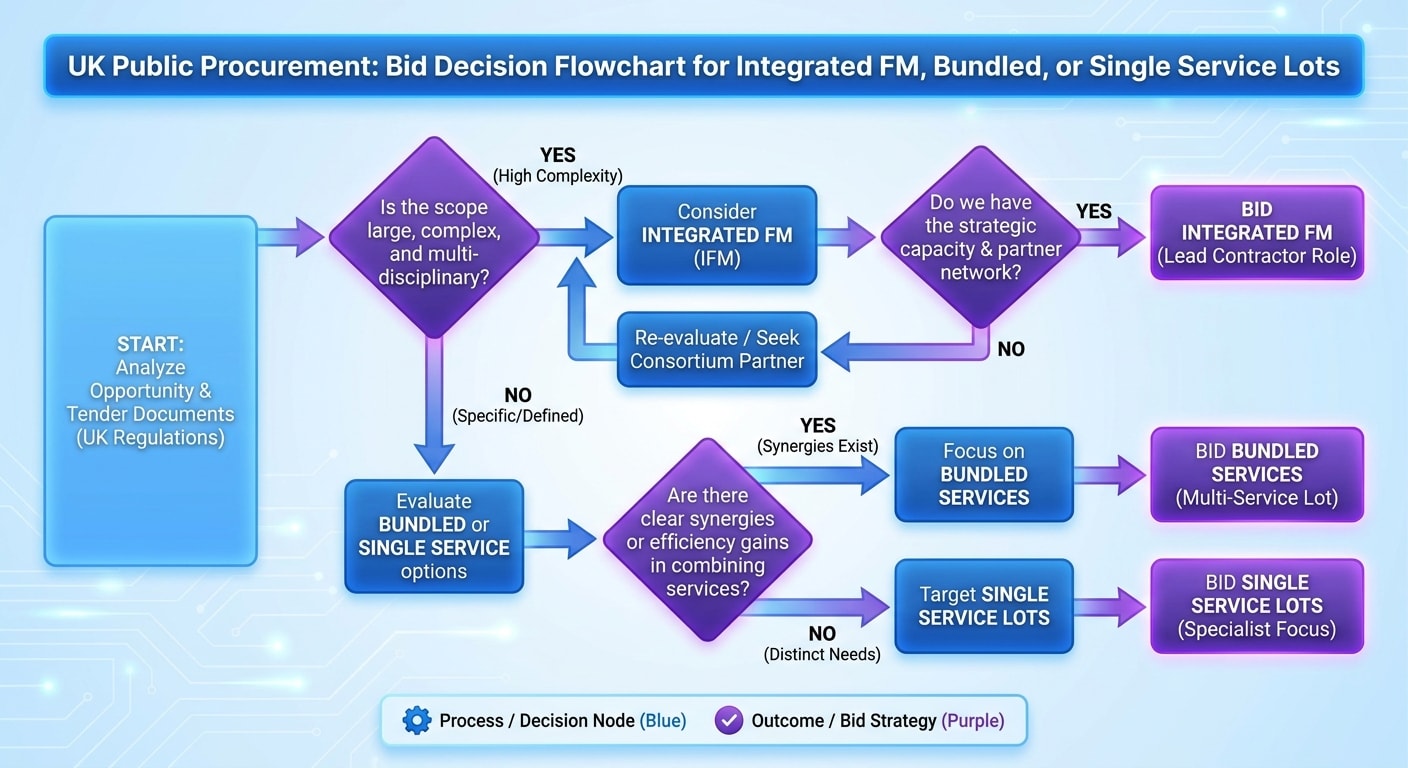
Decision flowchart for choosing integrated FM, bundled service, or single-service lot strategy
When Integrated FM Is the Right Move
Integrated FM is strongest when the buyer's pain is coordination.
You see this in tenders where the client complains about fragmented suppliers, inconsistent reporting, unclear accountability, service gaps between contractors, or too much internal contract management effort.
The buyer is not just buying cleaning or maintenance. They are buying control.
Your response should therefore focus on the operating model, not a list of services.
A good integrated FM answer explains:
- how the account director owns the full service
- how site managers coordinate across hard and soft FM
- how the helpdesk routes jobs and escalations
- how planned and reactive work is prioritised
- how KPIs are reported consistently
- how subcontractors are managed under one governance system
- how the client gets fewer meetings, not more
Notice what is missing from that list: generic service descriptions.
Evaluators do not need 500 words explaining that cleaning includes periodic deep cleans. They need to know how cleaning data, maintenance visits, helpdesk tickets, compliance records, and customer complaints join up into one managed service.
That is what integration means.
When Single-Service Bidding Wins
Single-service lots win when the buyer cares more about technical quality than supplier consolidation.
This is common in cleaning, security, statutory compliance, lifts, specialist M&E, asbestos, fire safety, grounds, and waste. The client may not want one prime contractor standing between them and the people doing the work.
A single-service bid should lean into depth.
For example, a cleaning tender should show service density, productivity assumptions, supervision ratios, quality audit methods, consumables control, cover arrangements, and site-specific task planning. A generic integrated FM bidder may struggle to match that level of operational detail.
A security tender should show rostering resilience, vetting, incident escalation, lone working controls, and local threat awareness.
A statutory compliance tender should show competence, certification, asset data discipline, remedial workflow, and audit trail quality.
The point is not to sound smaller. It is to sound sharper.
Specialist does not mean limited. It means credible where it counts.The Risk Profile Changes Completely
Integrated FM and single-service lots carry different risks. Your bid needs to show you understand that.
Integrated FM risk is mainly coordination risk. Can you join the services together? Can you avoid interface gaps? Can you keep subcontractors aligned? Can you report consistently? Can you stop the client being dragged into operational detail?
Single-service risk is mainly delivery depth risk. Can you deliver the specific service safely, consistently, and at the right quality level? Can you resource it? Can you supervise it? Can you respond quickly when something goes wrong?
Bundled service risk sits somewhere in the middle.
This distinction matters because evaluators are often scoring risk management explicitly. A risk register copied from another tender will miss the point.
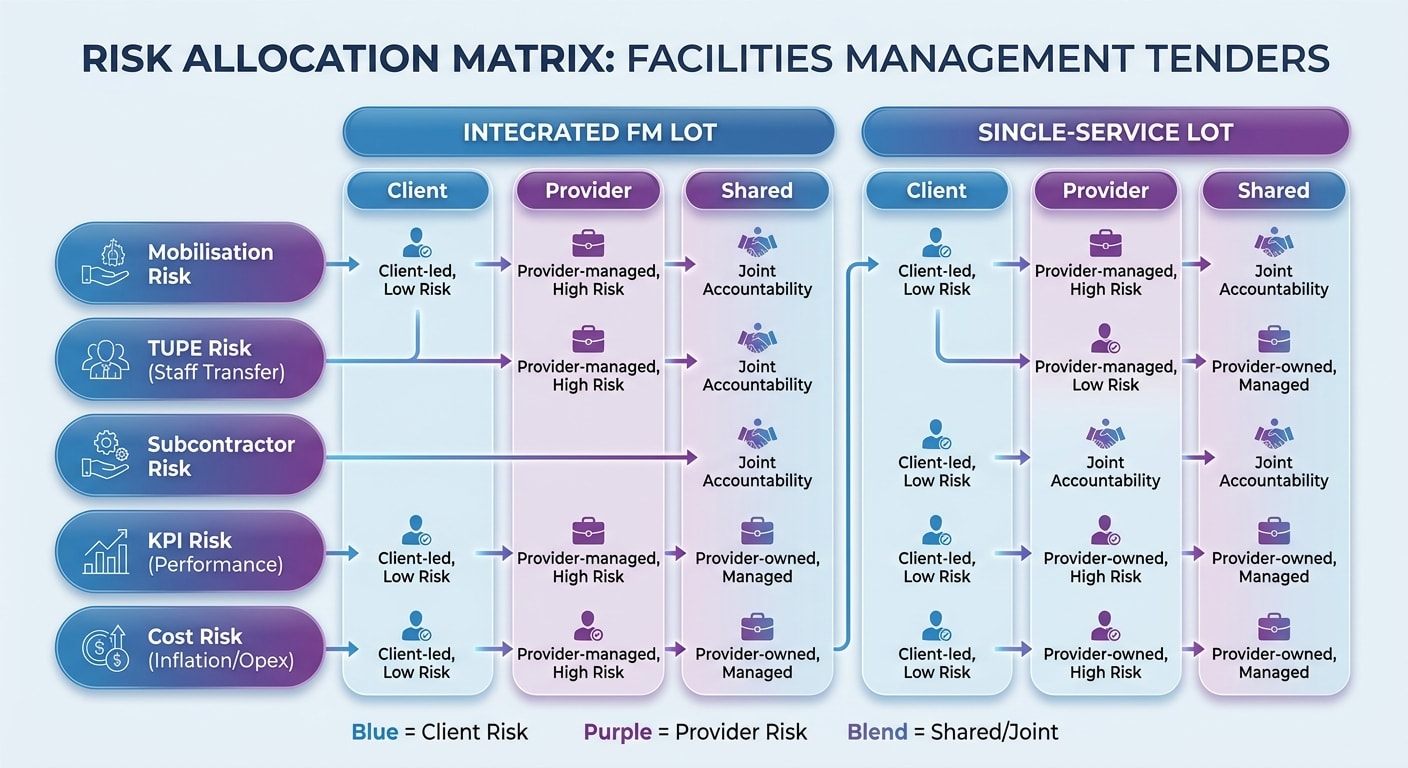
Risk allocation matrix for integrated FM, bundled services, and single-service FM tender lots
For an integrated FM lot, your risk section should include:
- interface failures between services
- weak subcontractor performance
- inconsistent KPI definitions
- helpdesk triage errors
- mobilisation sequencing across workstreams
- diluted accountability between site and central teams
For a single-service lot, your risk section should include:
- labour availability
- absence cover
- quality drift
- site-specific compliance gaps
- supervisor span of control
- TUPE accuracy and workforce engagement
- equipment or consumables availability
If your risk section looks the same for both strategies, it is not specific enough.
TUPE Can Decide the Strategy
In FM tenders, TUPE is often the hidden lot-strategy issue.
An integrated FM lot may involve several transferring workforces from several incumbent suppliers. Different pay rates. Different shift patterns. Different terms. Different cultures. Sometimes incomplete employee liability information.
That is a heavy mobilisation burden.
If you have delivered multi-service TUPE before, it can become a strength. You can show a proven consultation plan, workforce mapping, union engagement, payroll cutover, training, and day-one continuity.
If you have not, be careful. A single-service lot with one workforce group may be far more manageable.
The smartest bid teams treat TUPE as part of bid/no-bid, not something HR sorts out after award.
Ask:
- How many transferring staff are likely?
- Are they spread across several services?
- Are terms aligned or fragmented?
- Is there union involvement?
- Are there known vacancies or absence issues?
- Do we have enough mobilisation capacity to handle this properly?
If the TUPE picture is messy and your integrated FM evidence is thin, the bigger lot may be a trap.
How to Write the Lot Strategy Rationale
Some tenders ask directly: "Explain your proposed lot strategy" or "Describe why your organisation is bidding for these lots."
Most do not. You still need the rationale to come through.
The response should make the evaluator feel that your choice is deliberate.
A strong rationale has four parts.
1. Link to the Buyer's Objectives
Start with what the buyer seems to want.
If they want one accountable supplier, say how your integrated model reduces hand-offs and gives one performance view. If they want specialist quality, say how your single-service model gives direct management control and technical depth.
Do not start with your company history. Start with their problem.
2. Prove the Model
Use evidence that matches the lot.
For integrated FM, cite contracts where you coordinated multiple services across comparable sites. For single service, cite technical performance, audit scores, retention, mobilisation success, or sector-specific outcomes.
The evidence has to fit the claim.
3. Explain Governance
This is especially important for integrated or bundled bids.
Who owns the service? Who chairs performance meetings? How does information flow from frontline staff to the client? How are subcontractors held to the same standards? What happens when two service lines touch the same issue?
Governance is where integration becomes real.
4. Show Why the Strategy Reduces Risk
The evaluator is always asking: "Will this be harder to manage after award?"
Answer that question directly.
If you bid integrated FM, explain how the buyer gets simpler management, clearer accountability, and fewer service gaps. If you bid single service, explain how they get specialist control, faster decision-making, and lower mobilisation complexity.
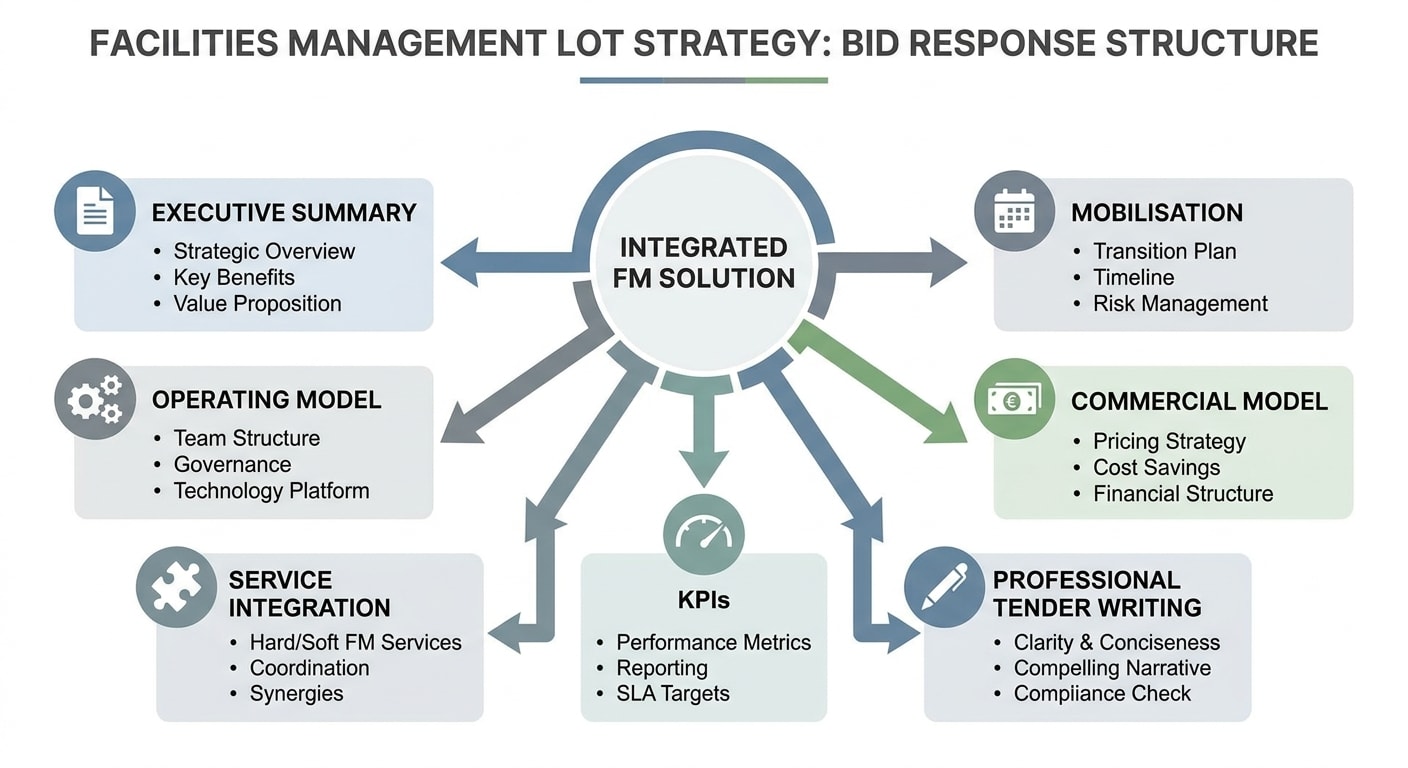
Bid response map for explaining FM lot strategy in a tender submission
The Subcontractor Question
Many integrated FM bids depend on subcontractors. That is fine. Pretending otherwise is not.
Evaluators are not automatically against subcontracting. They are against unmanaged subcontracting.
If you use partners, write about the management system:
- why each partner has been selected
- where they have delivered similar work
- how SLAs flow down into their contracts
- how performance data is captured
- how client complaints are handled
- how poor performance is escalated
- how replacement suppliers are managed if needed
Do not write "we have a trusted supply chain" and leave it there. Everyone writes that. It means almost nothing.
A credible subcontractor section names the control points. It shows the buyer that you remain accountable even when someone else delivers part of the service.
Pricing: The Quiet Lot Strategy Signal
Your pricing model tells evaluators whether your strategy is real.
Integrated FM pricing should show where integration creates value. Shared management. Shared helpdesk. Reduced duplication. Better scheduling. Consolidated reporting. If the integrated price is simply the sum of several service lines with a management fee on top, the value story is weak.
Single-service pricing should show technical confidence. Clear productivity assumptions. Realistic supervision. Sensible contingency. Transparent consumables, equipment, and training costs. No heroic underpricing that makes mobilisation look impossible.
The commercial model and method statement need to agree.
If your quality response promises senior management time, enhanced audits, dedicated mobilisation support, and specialist systems, the pricing schedule needs to support that. Evaluators may not formally cross-score price and quality, but they notice when the two do not match.
Red Flags That Say "Do Not Bid the Integrated Lot"
Here is the uncomfortable bit.
You should probably avoid the integrated lot if:
- you would subcontract most of the service and have limited prime contractor evidence
- your largest comparable contract is less than half the size
- you cannot explain the helpdesk and reporting model clearly
- TUPE spans several services and you have not managed that before
- your case studies only prove one service line
- you do not know who the specialist partners would be
- the tender heavily scores integration, transformation, or strategic partnership and you only have operational evidence
- winning would stretch management capacity across the business
That last one matters.
A bad integrated FM win can damage the business more than a good single-service loss. You can end up under-resourced, overcommitted, and stuck in a contract where every service failure becomes your problem.
This is where bid/no-bid discipline protects the company.
Red Flags That Say "Do Not Hide in the Single-Service Lot"
The opposite mistake also happens.
A supplier has the capability to bid the broader package but retreats into a smaller lot because it feels safer. That can leave money and strategic positioning on the table.
Consider the integrated or bundled lot if:
- you already deliver most services for similar clients
- the buyer clearly wants fewer suppliers
- the scoring rewards coordination and account management
- your systems can give one performance dashboard
- your supply chain is proven and contracted
- your mobilisation team has capacity
- the single-service lot is likely to be crowded and price-led
Sometimes the bigger lot is not vanity. It is the correct strategic move.
What the Procurement Act Changes
The Procurement Act 2023 has made lot strategy more visible.
Buyers are under more pressure to think about SME access, proportionality, transparency, and how contracts are structured. Pipeline notices and preliminary market engagement also give suppliers more chances to spot upcoming FM procurements before the ITT lands.
For FM bidders, that means two things.
First, you should monitor pipelines earlier. If a large integrated FM contract is due in six months, you have time to build partnerships, gather case studies, and influence the market engagement conversation.
Second, you should expect buyers to justify lotting decisions more carefully. If they bundle everything into one large contract, they may need to show they have considered SME participation and whether lots would be appropriate. If they split the services, they may be deliberately inviting specialists.
Your strategy should read those signals.
Do not wait until the tender drops. By then, lot strategy becomes a rushed decision made under deadline pressure.
Where AI Helps With Lot Strategy
AI will not choose your strategy for you. It should not. This is a commercial judgement.
What it can do is make the evidence easier to see.
A good bid platform can compare the tender requirements against your past bids, case studies, policies, TUPE plans, mobilisation examples, and KPI data. It can show where your evidence is strongest and where the integrated story is thin.
That matters because lot strategy often gets distorted by optimism.
At mytender.io, we see this pattern regularly. Teams think they have enough evidence for the bigger lot until the platform surfaces the actual source material: three strong cleaning examples, one partial security example, no hard FM evidence, and no comparable integrated mobilisation.
That is not a failure. It is useful truth.
The earlier you see the evidence gap, the better your decision becomes.
A Practical Lot Strategy Checklist
Before committing to a lot, run this short checklist.
Buyer intent- What does the lot structure say the buyer values?
- Are they trying to consolidate suppliers or attract specialists?
- What pain points appear in the specification?
- Do our case studies match the lot scope?
- Can we evidence similar scale and geography?
- Can we prove mobilisation, not just steady-state delivery?
- Do we have the management capacity?
- Do we control the service directly or rely on partners?
- Can our systems report the KPIs the buyer wants?
- Can we price the model honestly?
- Does integration create genuine value?
- Is the margin worth the mobilisation and delivery risk?
- Are we likely to be top three on this lot?
- Is the lot crowded with stronger incumbents?
- Would a smaller lot give us a clearer route to first place?
If you cannot answer these clearly, pause. The problem is not the tender. The problem is that your strategy is not ready.
The Best Lot Strategy Is Usually the Honest One
FM tendering rewards confidence, but it punishes fantasy.
The best bid is not always the biggest bid. It is the bid where your operating model, evidence, mobilisation plan, risk approach, and pricing all tell the same story.
If that story is integrated FM, go after the full lot properly. Show the buyer how you will simplify their world.
If that story is single service, own it. Show the buyer why specialist depth will outperform a generalist bundle.
Both strategies can win. The mistake is pretending they are the same.
If you want to see live FM tender opportunities and decide which lots match your real strengths, the Tender Finder is free to use. Use it to spot upcoming contracts by service, region, and value, then put your bid effort where you can actually win.
Tags
Ready to Transform Your Tender Writing?
See how MyTender's AI can help you write winning tenders in a fraction of the time.