
Insurance Requirements in Public Sector Tenders: How to Evidence Cover Without Over-Committing
A practical 2027 guide for UK suppliers on public liability, employers’ liability, professional indemnity, cyber insurance and proportionate tender evidence under the Procurement Act.
mytender.io Research Team
Tender Writing & Procurement Specialists
Insurance Requirements in Public Sector Tenders: How to Evidence Cover Without Over-Committing
Insurance is one of the least glamorous parts of tendering, which is exactly why it causes so many avoidable problems.
Bid teams spend days polishing methodology, social value, mobilisation, risk and pricing. Then, right at the selection stage, a pass/fail insurance question threatens to stop the whole bid before evaluators even read the quality response. The question looks simple: confirm whether you hold a stated level of public liability, employers' liability, professional indemnity, cyber cover or another policy. The trap is that the commercial answer is not always the same as the administrative answer.
If you already hold the exact cover, fine. Upload the schedule, check the dates, move on. But many suppliers, especially SMEs, growing consultancies, specialist subcontractors and companies moving into larger public sector work, face requirements that sit above their current policy limits. A buyer might ask for £10 million public liability on a facilities management contract, £5 million professional indemnity on a design-led project, or cyber insurance on an IT or data-heavy service.
That does not automatically mean you should buy the uplift before submitting the tender. It also does not mean you should ignore the question, hope nobody checks, or tick a box you cannot support.
The right approach is more controlled: understand what the buyer is asking for, separate current cover from cover obtainable on award, challenge disproportionate requirements where appropriate, and build an evidence pack that gives the authority confidence without creating unnecessary cost or risk.

Public sector tender insurance evidence review
This guide explains how to handle insurance requirements in UK public sector tenders in 2027. It is written for bid managers, commercial directors, finance leads and SME founders who need practical answers, not insurance jargon.
Why Insurance Questions Matter More Than They Look
Insurance rarely wins a tender. It can absolutely lose one.
Most insurance questions sit in the selection, qualification or conditions of participation stage. They are usually pass/fail. The buyer is not normally awarding marks for an elegant explanation of your public liability policy. They are checking whether your organisation can carry the financial risk of delivering the contract.
That means insurance is a gate. If you fail the gate, your quality response may never be evaluated.
The danger is that many teams treat insurance as a late-stage admin task. They leave it to the person uploading portal documents the night before submission. That creates four common problems.
First, the team discovers too late that the policy limit is lower than the tender requires. There is no time to speak to the broker, obtain a letter, ask a clarification question or agree the internal commercial position.
Second, someone uploads an old schedule. The renewal date has passed, the insured entity name does not match the bidding entity, or the policy excludes a service that is central to the contract.
Third, the business promises to obtain cover without understanding the cost. If the tender is won, the margin is immediately hit by an unplanned premium increase.
Fourth, the team over-buys insurance for bids it may never win. That is especially painful for SMEs chasing public sector work, where one oversized requirement can create a real barrier to entry.
Insurance should therefore be handled as part of bid qualification, not bid upload. The question is not just Can we tick the box? The better question is What level of contractual risk are we accepting if we bid, and what evidence do we need to prove we can accept it?
The Procurement Act Point Suppliers Need to Know
Under the Procurement Act 2023, conditions of participation must be connected to a supplier's legal, financial or technical capacity to perform the contract. They must also be proportionate, taking account of the nature, complexity and cost of the contract.
That matters because insurance requirements are a classic condition of participation. A buyer can set insurance requirements, but they should not use blanket, excessive limits that restrict competition without a sensible risk basis.
There is another important point: contract-specific insurance should not have to be in place before award. In practice, suppliers may be asked to show that they hold current baseline cover, and that they can obtain the required contract level if successful. The exact portal wording varies, but many public sector tenders include an option along the lines of: we do not currently hold this level of cover, but we commit to obtaining it before contract award or commencement.
That distinction is commercially important.
If a tender asks for £10 million professional indemnity and you currently hold £2 million, the correct response is not necessarily to buy £10 million immediately. The better route may be to speak to your broker, confirm the uplift is available, understand the premium impact, and include a broker letter or written undertaking where the tender permits it.
The bid should make the buyer feel safe. It should not make your business spend money prematurely.
This is where good tender management beats box-ticking. A strong bid team will identify insurance gaps during qualification, agree whether the opportunity justifies the cover, and prepare defensible evidence before submission. A weak bid team will discover the issue after the tender has been drafted, when every option is more stressful.
The Main Insurance Types Buyers Ask For
Public sector tenders usually ask for some combination of public liability, employers' liability, professional indemnity and sometimes product liability, cyber insurance, motor fleet cover, environmental impairment insurance, medical malpractice or sector-specific policies.
The required mix depends on what is being bought.
A consultancy contract may focus on professional indemnity because the main risk is financial loss caused by advice, analysis or design. A cleaning, security, maintenance or construction contract may focus on public liability because staff and subcontractors will be working on buyer premises. An IT, SaaS or managed service contract may include cyber insurance because data security and service continuity are central risks. A product supply contract may include product liability because faulty goods could cause injury, damage or operational disruption.
The mistake is to treat every insurance line as the same. Evaluators and procurement officers are looking for different types of assurance from each one.
Public liability insurance
Public liability insurance covers claims from third parties for injury or property damage connected to your work. In tender terms, it is about the risk your activities create for the buyer, the public, service users, visitors, tenants, patients, pupils or other contractors.
For low-risk office-based services, buyers may ask for £1 million or £2 million. For standard public sector service contracts, £5 million is common. For higher-risk site-based work, construction, FM, highways, waste, security or maintenance activity, £10 million is common.
The level should still make sense. A remote advisory contract and a multi-site hard FM contract should not automatically carry the same public liability requirement.
Employers' liability insurance
Employers' liability insurance covers claims from employees who are injured or become ill because of their work. In the UK, most employers are legally required to hold employers' liability insurance with a minimum level of cover.
Public sector buyers often ask for evidence of £5 million or £10 million employers' liability. This is usually less controversial than professional indemnity because the statutory baseline already exists for most employers. The key tender issue is whether the policy schedule is current, whether the legal entity matches the bidder, and whether the policy covers the type of workforce used on the contract.
If you rely heavily on subcontractors, agency labour or consortium partners, do not assume your own employers' liability policy answers every question. The buyer may want to know how you verify the insurance held by the wider delivery chain.
Professional indemnity insurance
Professional indemnity insurance covers financial loss caused by professional negligence, error, omission, design failure, advice or breach of professional duty. It is central in consultancy, architecture, engineering, project management, IT implementation, software, data services, legal support, surveying and many professional services bids.
PI questions deserve close attention because the wording matters. A tender may ask for cover on each and every claim, or in the aggregate. It may require run-off cover for several years after contract completion. It may include exclusions that conflict with your policy. It may ask for a level that is disproportionate to the fee value, but not obviously disproportionate to the potential impact of a failure.
For example, a £75,000 consultancy assignment could theoretically influence decisions worth millions. Equally, a low-risk discovery project may not justify an excessive PI limit. This is why the team needs commercial judgement, not just a policy schedule.
Cyber and data protection insurance
Cyber insurance is increasingly appearing in tenders for IT, SaaS, managed services, outsourced operations, health, education, financial processing, customer contact, document management and any contract involving sensitive data.
Buyers may not always understand cyber insurance in depth. Some ask for it because the organisation's template includes it. Others ask for it because the service genuinely creates data breach, ransomware, system outage or business interruption risk.
If cyber cover is requested, do not answer in isolation. Align it with the wider cyber section of the bid: Cyber Essentials or Cyber Essentials Plus, ISO 27001 where relevant, incident response, backup strategy, access control, data processing, supplier assurance, penetration testing, secure development and breach reporting. Insurance reassures the buyer that financial protection exists. It does not replace operational security evidence.

Insurance requirements mapped across public sector tender risks
What Counts as Good Insurance Evidence
The evidence requirement will usually be set out in the tender pack or portal question. It may ask for a policy schedule, certificate, broker letter, self-declaration or commitment to obtain cover on award.
Good evidence has five qualities.
It is current. The policy dates cover the tender period and, where requested, the expected contract commencement date. If renewal falls before award, explain how renewal will be maintained.
It matches the bidding entity. If the tender is submitted by a subsidiary, joint venture, trading name or consortium lead, check the insured name carefully. A mismatch between the bidder and the policyholder can trigger clarification or rejection.
It shows the required limit clearly. Evaluators should not have to hunt through a 40-page policy wording to find the cover level. A schedule or certificate is usually better than a full policy document, unless the buyer explicitly asks for the full wording.
It covers the relevant activity. A generic policy schedule is weaker if exclusions remove the activity being tendered. This is particularly important in higher-risk sectors, professional services, design responsibility, care, security, construction and technology.
It is supported by a clear commitment where the required level is not yet held. If you need to increase cover on award, a broker letter is often the cleanest evidence. It should state your current cover, the required cover, and whether the broker expects the uplift to be available if you win.
A strong broker letter does not need to be theatrical. It should be precise. For example:
We confirm that [Supplier] currently holds public liability insurance of £5 million. We understand the tender requires £10 million for the contract. Based on current underwriting information, we foresee no issue in arranging an increase to £10 million prior to contract commencement, subject to final underwriting and acceptance of terms.
That kind of wording gives the authority comfort without pretending the upgraded policy already exists.
The Bid Qualification Checklist
Insurance should be checked before the team commits serious writing time. Add it to your bid/no-bid process alongside deadline, fit, incumbent position, pricing risk, resource availability, mobilisation demands and contract terms.
The qualification conversation should cover six questions.
First, what insurance levels are required? Capture each policy type, the required limit, whether the limit is per claim or aggregate, and whether the buyer requires the cover at submission, award or contract start.
Second, what do we currently hold? Pull the latest policy schedules from the controlled source, not last year's bid folder.
Third, what is the gap? Separate no gap, minor uplift, major uplift, new policy type and unclear wording.
Fourth, can we obtain the cover? Ask the broker early. Do not guess.
Fifth, what will it cost? If a policy uplift changes the commercial case, the pricing model needs to know before submission.
Sixth, is the requirement proportionate? If the answer is no, consider a clarification question. Do not wait until after losing to complain that the requirement was unfair.
This checklist is especially useful for SMEs. Larger suppliers may already carry high limits across most policy types. Smaller suppliers often operate with sensible cover for their current work, but face higher thresholds when stepping into larger public contracts. The Procurement Act is intended to reduce unnecessary barriers, but suppliers still need to be proactive when a requirement looks excessive.
How to Challenge Disproportionate Insurance Requirements
Challenging a requirement does not mean being difficult. It means using the clarification process properly.
If an insurance requirement appears disproportionate, ask a focused clarification question before the deadline. Keep the tone respectful, commercial and evidence-led. The buyer may simply have used a template. Give them a reason to review it.
A useful clarification question might say:
Could the Authority confirm whether the required £10 million professional indemnity limit has been set following a contract-specific risk assessment? Given the estimated contract value of £[X], the advisory nature of the services and the absence of design responsibility, would the Authority consider accepting £2 million professional indemnity at tender stage with a commitment to review cover before award if required?
That is better than saying the requirement is unfair. It points to value, risk profile and an alternative that still protects the buyer.
Sometimes the authority will reduce the requirement. Sometimes it will explain why the risk justifies the limit. Sometimes it will refuse to change. All three outcomes help you make a better bid/no-bid decision.
Do not use clarification questions to negotiate your own exception privately. In most public procurements, answers are shared with all bidders. Write the question in a way you would be comfortable seeing published on the portal.
How to Answer When You Do Not Yet Hold the Required Cover
This is where many bid teams get nervous. They see a yes/no insurance question and assume anything other than full current cover is fatal.
Read the exact wording. If the portal gives an option to commit to obtaining cover before award or commencement, use it honestly. Then upload supporting evidence where allowed.
A strong response usually has three elements.
First, state your current position. For example: We currently hold public liability insurance of £5 million and employers' liability insurance of £10 million.
Second, state your commitment. For example: If awarded the contract, we will increase public liability cover to the required £10 million before contract commencement.
Third, evidence the commitment. For example: Our broker has confirmed that the increased cover is obtainable and has provided the attached letter of intent.
Avoid vague statements such as We will arrange appropriate insurance if required. That sounds like you have not checked. Also avoid over-promising beyond broker advice. If the broker has caveated the quote, do not remove the caveat in your response.
The safest answer is honest, specific and commercially verified.

Bid manager checking broker letter and tender portal evidence
Insurance Evidence for Subcontractors and Consortium Bids
Insurance becomes more complicated when delivery involves subcontractors, consortium members or special purpose vehicles.
The buyer wants assurance that the whole delivery model is covered, not just the lead bidder's head office. If your bid relies on other organisations, check who carries which risk.
For subcontractors, the key questions are: do they hold their own insurance, are their policy limits sufficient, does your policy cover subcontracted activity, and how will you monitor insurance throughout the contract? A good bid does not simply say subcontractors will be required to hold appropriate insurance. It explains how insurance will be checked at onboarding, annually, and before any high-risk activity begins.
For consortium bids, the issue is whether each member holds cover for its role, or whether a lead policy wraps the delivery. The answer depends on the structure. Do not assume the authority will accept a loose statement that the consortium is collectively insured. They may need evidence for each named party.
For joint ventures or new contracting vehicles, insurance can be particularly sensitive because the legal entity may not yet have trading history or its own policy schedule. Raise this early with the broker and, where needed, ask the buyer how it expects evidence to be provided.
This is also where principals' indemnity, joint names, waiver of subrogation and other endorsements can appear. If the tender includes these terms, involve your broker or legal adviser. They can materially change who is protected and how claims are handled.
Sector Examples: What Buyers Are Really Trying to Protect
Insurance requirements make more sense when viewed through the buyer's risk lens.
In FM and property maintenance, buyers worry about injury, property damage, unsafe work, interruption to public services, subcontractor control and high footfall sites. Public liability and employers' liability are usually prominent. If there is design, statutory compliance or technical advice, professional indemnity may also appear.
In construction, buyers worry about site safety, defects, design responsibility, product failure, latent damage, delay and interface risk. Insurance questions may sit alongside CDM compliance, building safety competence, warranties, bonds and parent company guarantees.
In IT and SaaS, buyers worry about data breach, service outage, cyber attack, failed implementation, intellectual property, confidentiality and business continuity. Cyber insurance may be relevant, but it will not compensate for weak security evidence.
In professional services, buyers worry about negligent advice, flawed analysis, poor project management, missed deadlines and financial loss. PI is often more important than public liability, but the required limit should still be tied to the actual risk.
In care, education, housing and health-related services, buyers worry about vulnerable people, safeguarding, clinical or personal care risk, data sensitivity and reputational impact. Insurance evidence must align with safeguarding, training, quality assurance and incident management content.
In waste, logistics and environmental services, buyers worry about vehicles, environmental harm, site incidents, service continuity, permits and public disruption. Motor fleet, environmental liability or pollution cover may appear alongside the standard policies.
The practical lesson is simple: do not answer insurance questions in a vacuum. Tie them to the delivery model and risk story of the bid.
The Hidden Commercial Risk of Over-Committing
Over-committing on insurance can hurt in several ways.
The obvious cost is premium uplift. A higher limit, broader wording or additional policy can reduce margin. If the bid price was built before the insurance cost was known, the contract may be less profitable from day one.
The less obvious risk is precedent. If your business starts carrying cover for one bid, that limit can become the new assumed baseline for future tenders, even where it is not commercially justified. Over time, the bid team stops asking whether the requirement makes sense.
There is also delivery risk. Insurance is not a substitute for controls. If a tender requires high cover because the contract is genuinely risky, the business should also be asking whether it has the operational systems, people, supervision and governance to deliver safely.
Finally, there is contractual risk. Some contracts include indemnities, liability caps and insurance clauses that do not line up neatly. A policy limit does not automatically cap your liability. Before accepting unusual contract terms, check whether the insurance and contract position work together.
Bid teams do not need to become insurance lawyers. They do need a trigger point for escalation. If the contract value is high, the service risk is material, or the insurance wording looks unusual, involve finance, legal and the broker early.
How mytender.io Helps Bid Teams Control Insurance Responses
Insurance evidence is exactly the kind of bid content that benefits from structure.
The answer itself may be short, but the data behind it sits across finance, operations, legal, compliance, subcontractor management and old bid folders. Without a controlled bid library, teams waste time chasing policy schedules, reusing outdated statements and rewriting the same commitment from scratch.
mytender.io helps by giving bid teams a central place to store approved insurance narratives, policy evidence, broker letter templates, compliance commitments and previous clarification responses. Instead of starting from a blank portal question, teams can pull the latest approved content, tailor it to the contract and keep a record of what was promised.
That matters because insurance commitments are not just submission content. They can become award conditions and contract obligations. If your bid says you will increase cover before commencement, someone needs to track that promise after the submission is made.
A good AI bid writing platform should not invent insurance claims. It should help your team find the right evidence, identify gaps, draft clear responses and flag commitments that need human approval. That is the difference between useful AI and risky automation.
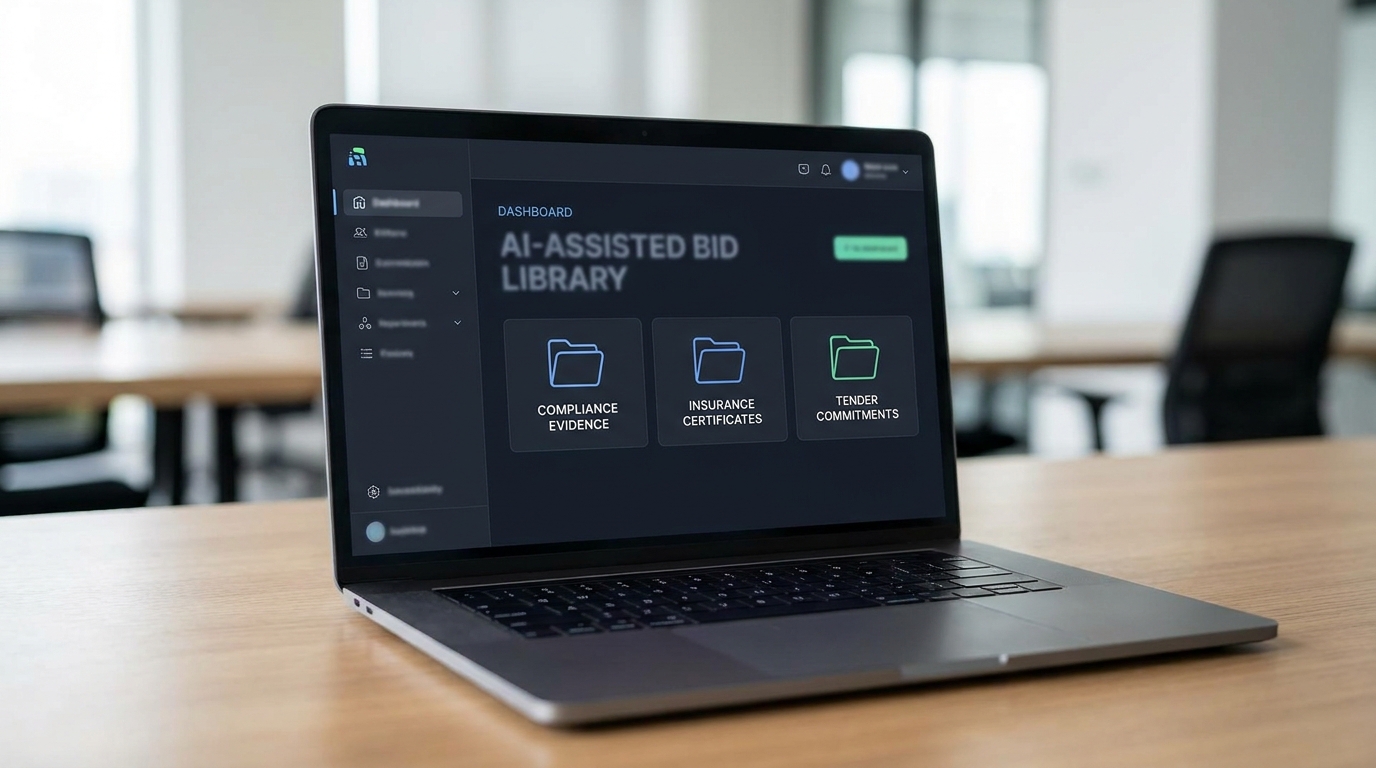
AI-assisted bid library organising insurance evidence and commitments
A Practical Insurance Evidence Pack
Every supplier that regularly bids for public sector work should maintain a tender-ready insurance evidence pack. It does not need to be complicated. It does need to be current.
The pack should include:
- Current policy schedules for public liability, employers' liability, professional indemnity, cyber and any sector-specific cover
- Renewal dates and internal owners for each policy
- Named insured entities, including subsidiaries and trading names
- Standard wording for current cover statements
- Broker contact details and agreed turnaround times for letters of intent
- A template broker letter request
- A record of maximum available uplift levels and indicative costs where known
- Standard subcontractor insurance requirements
- A register of insurance commitments made in live tenders
- Clarification question templates for disproportionate requirements
The register of commitments is particularly important. If a bid promises to obtain £10 million cover before contract commencement, that promise should not disappear into the submitted PDF. It should be visible in mobilisation planning, contract review and handover.
This is where many organisations lose control. Bid promises are made in one system, contract mobilisation happens in another, and insurance renewal is owned by someone who never saw the tender. The fix is not heroic effort. It is a better process.
Red Flags in Tender Insurance Questions
Some insurance requirements deserve extra scrutiny.
A red flag does not always mean you should not bid. It means you should slow down and check.
Look closely if the tender demands very high PI for a low-value or low-risk service. That may be disproportionate, or it may indicate the buyer sees risk you have not understood.
Look closely if the tender requires cover at submission rather than before award. The wording may need clarification under the Procurement Act.
Look closely if the buyer asks for each and every claim PI and your policy is aggregate. That difference can be material.
Look closely if the contract requires unlimited liability but the tender focuses only on insurance levels. Insurance may not protect you from the full contractual exposure.
Look closely if the tender requires cyber insurance but gives no clear data processing scope. You may need to understand what personal data, sensitive data or system dependency is actually involved.
Look closely if subcontractor insurance obligations are vague. If you win, vague obligations become operational headaches.
Look closely if the buyer asks for unusual endorsements, joint names, principals' indemnity, environmental impairment cover, product recall cover or long run-off periods.
The best bid teams are not alarmist. They are disciplined. They know which questions are routine and which ones need escalation.
The Best Way to Write the Insurance Section
Most insurance sections should be concise. Evaluators do not want a lecture. They want confidence.
A strong answer might follow this structure:
- Confirm the current cover held.
- Confirm the cover required by the tender.
- Identify any uplift needed.
- Commit to obtaining the required cover before award or commencement, if applicable.
- Reference the evidence attached.
- Explain how cover will be maintained during the contract.
- Explain how subcontractor cover will be checked, if relevant.
Here is a plain-English example:
We currently hold public liability insurance of £5 million, employers' liability insurance of £10 million and professional indemnity insurance of £2 million. The tender requires public liability insurance of £10 million. Our broker has confirmed that an uplift to £10 million is obtainable before contract commencement, subject to final underwriting, and we have included a broker letter with this response. If awarded the contract, we will put the increased cover in place before commencement and maintain it throughout the contract term. Subcontractor insurance will be checked during onboarding and annually through our supplier assurance process.
That is enough for many tenders. It is specific, honest and evidence-led.
Do not bury the answer under generic risk management content. If the buyer asks for insurance evidence, answer the insurance question directly. If you want to strengthen the response, connect it briefly to governance: policy renewal tracking, subcontractor checks, contract mobilisation and annual review.

Tender insurance response checklist for bid teams
Final Checklist Before Submission
Before submitting, run a final insurance check:
- Are all required policy types identified?
- Do the limits match the tender wording?
- Is the cover current?
- Does the insured entity match the bidder?
- Are any policy exclusions relevant to the contract?
- If cover is not currently held, is there a clear commitment to obtain it?
- Has the broker confirmed the uplift is available?
- Have premium impacts been reflected in pricing?
- Are subcontractor and consortium arrangements covered?
- Has any disproportionate requirement been challenged through clarification?
- Are post-award commitments recorded for mobilisation?
If the answer to any of these is unclear, fix it before submission. Insurance is not the place for optimistic guessing.
The Bottom Line
Insurance requirements in public sector tenders are not just admin. They are risk, compliance and commercial strategy compressed into a few portal questions.
The best suppliers do three things well. They understand the buyer's risk. They evidence current and obtainable cover clearly. And they refuse to let insurance requirements become either a hidden margin leak or an avoidable disqualification.
For SMEs, the key message is encouraging: you should not assume that a higher insurance requirement automatically prices you out of public sector work. Under the Procurement Act, requirements should be proportionate, and contract-specific cover should usually be obtainable for award rather than already held at submission. But you do need to manage the evidence professionally.
For established suppliers, the opportunity is operational discipline. Keep insurance evidence current, connect it to your bid library, track commitments after submission, and challenge template requirements where they do not fit the contract.
Tendering is hard enough without losing on a policy schedule. Treat insurance as part of your bid strategy, and it becomes one more area where a controlled, evidence-led supplier looks safer than the competition.
With mytender.io, bid teams can keep approved compliance evidence, broker commitments, subcontractor checks and tender promises in one place, then use AI to draft faster without losing control of the facts. That is how insurance stops being a last-minute scramble and becomes a quiet advantage.
Tags
Ready to Transform Your Tender Writing?
See how MyTender's AI can help you write winning tenders in a fraction of the time.