
Why Heads of Marketing End Up Writing Tender Responses (And How to Survive It)
You were hired to build the brand, run campaigns, and make the company look good. Nobody mentioned 3,000-word method statements. Yet here you are. Here's why it keeps happening and what to do about it.
mytender.io Research Team
Bid Writing & Bid Capacity Specialists
Why Heads of Marketing End Up Writing Tender Responses (And How to Survive It)
It's a Wednesday afternoon. You're mid-way through a campaign brief when your MD drops into your calendar with a message that starts "Quick chat about a tender opportunity."
Forty-five minutes later, you're the lead on a 60-page procurement response due in three weeks.
You were hired to run campaigns. Nobody mentioned OJEU notices.

Head of Marketing looking overwhelmed surrounded by tender documents and a procurement portal
If this sounds familiar, you're not alone. Across UK SMEs and mid-market companies, marketing professionals are regularly pulled into tender responses with little warning and no formal bid training. It's frustrating, it derails other priorities, and it often falls to marketing because of a set of very specific organisational reasons that most people don't fully understand.
This guide unpacks why it keeps happening. Then it gives you a practical process to get through the bid without losing your mind or your evenings.
Why Marketing Keeps Getting the Bid
The pattern is so consistent it's almost predictable. Here's why your name keeps ending up on it.
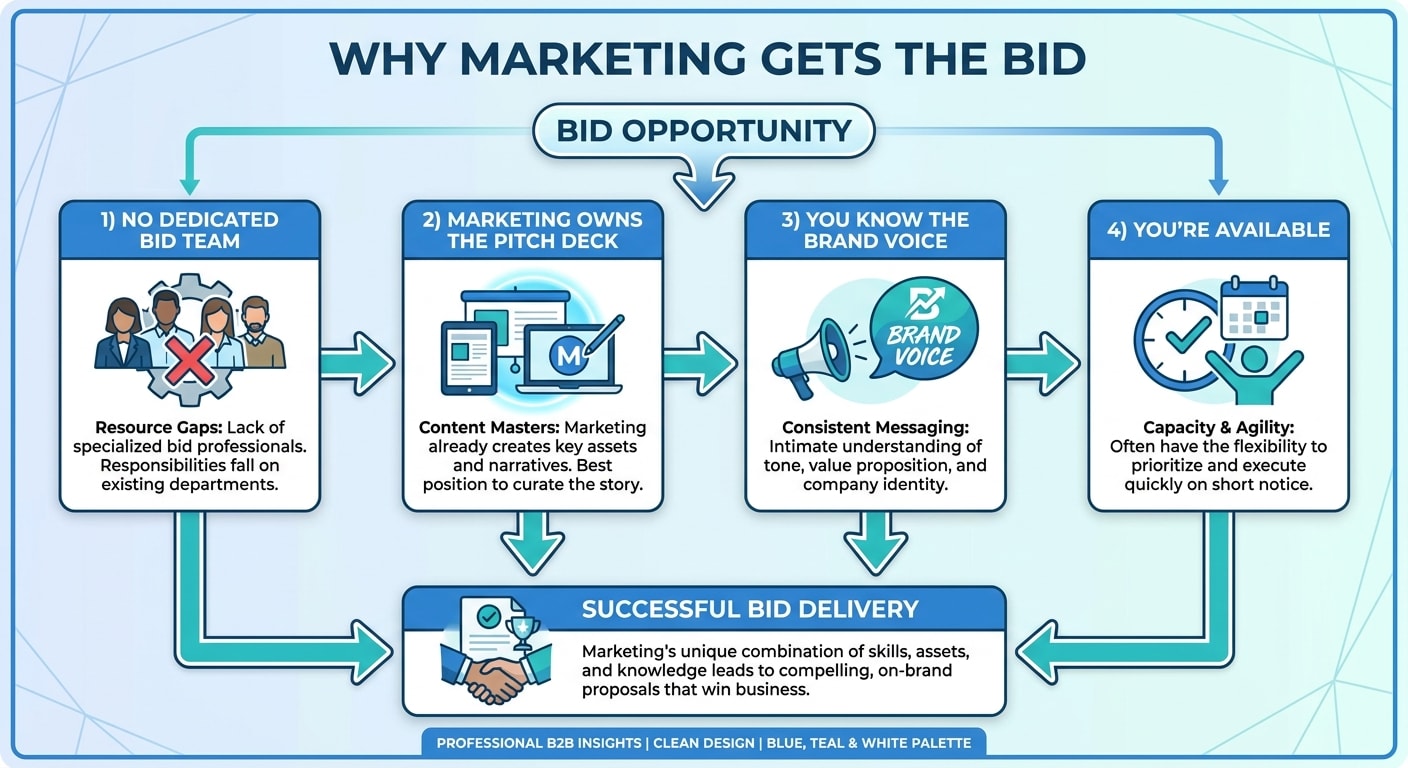
Flowchart showing four reasons why Heads of Marketing get assigned tender responses
None of these reasons are wrong, exactly. They just put you in a position you weren't prepared for.
What's Different About a Tender Response
This is the bit that catches most marketing professionals off guard. Writing for procurement is a different discipline.
Everything scores against fixed criteria. There is no such thing as "impressed them with the presentation." The evaluator has a marking sheet. Every question has a weighting. Your answer either addresses the criteria or it doesn't. Compelling prose that doesn't hit the marking criteria gets no marks. Word counts are hard limits, not guidelines. A 500-word limit means 500 words. If the portal cuts you off, the last 200 words of your answer simply disappear. Put your strongest points first, always. Evidence trumps claims. In marketing, "award-winning" and "market-leading" are acceptable shorthand. In procurement, evaluators want contract values, named clients, measurable outcomes, and dates. Unsupported claims score as zero in many frameworks. The buyer's language matters more than yours. In marketing, you define the narrative. In procurement, you map your answer to the buyer's specification, priorities, and terminology. The buyer wrote the questions. Mirror their language back to them. Compliance is a threshold, not a ceiling. Before your content is even scored, it passes through a compliance check. Missing an appendix, exceeding a page limit, or submitting in the wrong format can get a response excluded entirely. Compliance first.The Skills That Transfer (And the Ones That Don't)
Not everything you know as a marketer is wasted. Some of it is genuinely valuable.
What transfers:- Audience awareness. You understand how to write for a specific reader. That's a real bid skill.
- Structural thinking. You know how to open with impact and guide someone through a narrative.
- Brand consistency. Evaluators notice when a response has five different authors and no coherent voice.
- Deadline management. You already know how to run projects under time pressure.
- Briefing others. Getting input from technical colleagues and making it readable is exactly what bid managers do all day.
- Persuasion for its own sake. Procurement responses aren't meant to dazzle. They're meant to score.
- Campaign-style messaging. "Transform your facilities experience" is a great brand line. It doesn't answer "describe your mobilisation plan."
- Visual-first thinking. Most portals are text-only. Your instinct to lead with design won't help here.
- Vagueness as strategy. "We'll tailor our approach to your specific requirements" sounds reasonable in a proposal. In a scored response, it reads as "we don't have a methodology."
The marketing brain is adaptable. The trick is knowing which mode you're in.
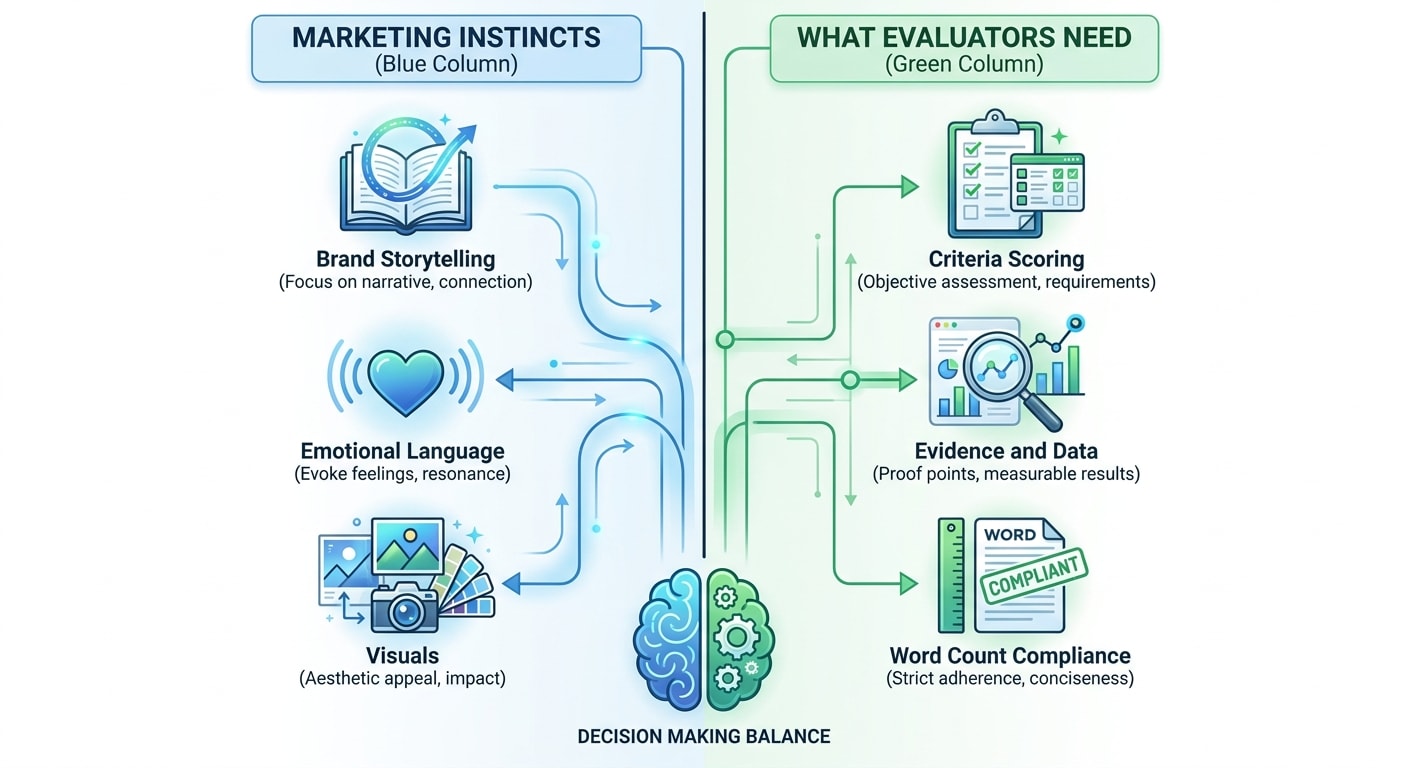
Infographic comparing marketing instincts with what procurement evaluators actually need
The Five Mistakes Non-Bid Writers Make Most Often
Before we get to the process, here's what to avoid. These are the patterns evaluators see again and again.
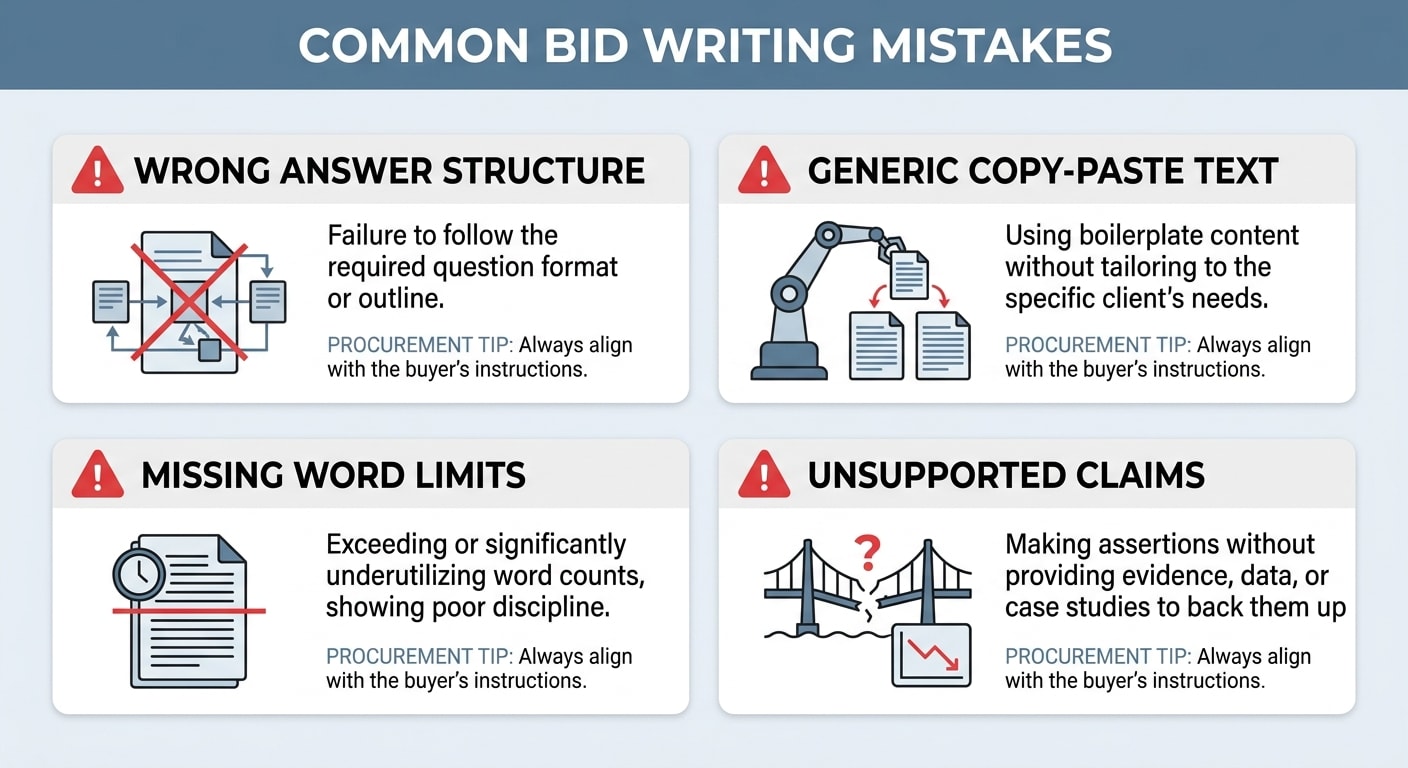
Common bid writing mistakes infographic: wrong answer focus, generic case studies, missing evidence, wrong tone, poor structure
You skim the question. You see two words you recognise. You write 900 words on your favourite topic. The actual question asked something else. Read every word of every question. Then read it again. Write only to what was asked.
2. Pasting in generic copy.The company overview from the website. The case study you've used for every pitch in the last two years. The standard methodology slide. Evaluators can spot recycled content. It reads as effortless, which scores as uncommitted. Tailor everything to the specific contract.
3. Ignoring the marking criteria.Most tender documents include a scoring guide. It tells you exactly what a top-scoring answer looks like. Many non-specialists skip it entirely. Read it, annotate it, and use it to plan your answer structure.
4. Leading with the company rather than the buyer's need.Marketing instincts say "lead with who we are." Procurement instincts say "lead with how you'll solve my problem." The buyer doesn't care about your 20-year history in the first sentence. They care whether you can deliver their contract.
5. No peer review.You've spent three days writing it. You're too close to it. Get someone who knows the contract (operations, delivery) and someone who doesn't (a colleague, a director) to read it before it goes. Fresh eyes catch the gaps.
A Five-Step Process That Actually Works
You're not going to become a bid professional by Friday. But you can produce a credible, competitive response by following a structured approach.
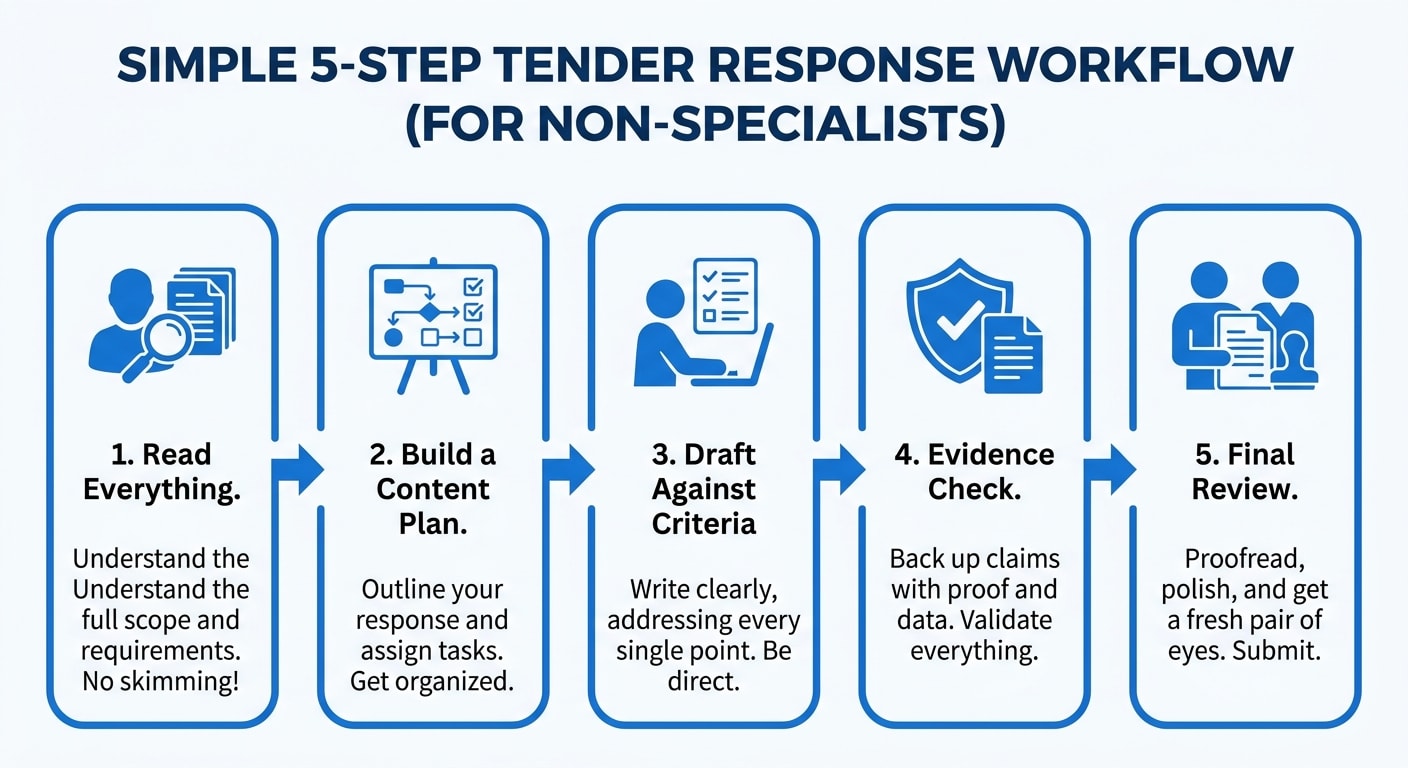
Five-step tender response process diagram for non-specialist bid writers
Block a half-day at the start. Read everything. Specification, evaluation criteria, terms and conditions, appendices. Highlight anything you don't understand. Flag compliance requirements immediately (format, font size, page limits, mandatory attachments). Don't start writing until you've read it all.
Step 2: Build a content plan, not a blank document.For each scored question, create a simple plan:
- What exactly is being asked?
- What weighting does it carry?
- What evidence do we have that's relevant?
- Who in the business has the information I need?
Do this before writing a single word of the response. It takes two hours and saves you from the worst structural mistakes.
Step 3: Get the technical input early.You are not the subject matter expert. The Operations Director, the site manager, the Finance team, or the SHEQ lead probably is. Brief them clearly on what you need and by when. Give them the question, the word limit, the marking criteria, and a deadline that's earlier than yours. Then write their input into coherent prose.
Step 4: Draft against the criteria, not against the question.Write your answer to satisfy the marking criteria first. Then check it answers the question as written. It sounds backwards, but it works. The question is the prompt. The marking scheme is the scoring grid. You're writing to the grid.
Step 5: Evidence everything and cut anything you can't back.Go through your draft and highlight every claim. For each one, check: is there a number, a date, a client name, or a KPI behind it? If not, either find the evidence or rewrite the sentence to remove the claim. "We have an excellent track record" with no evidence scores nothing. "We delivered X contract for Y client at Z% KPI achievement for three consecutive years" scores something.
Managing the Rest of Your Job While Bidding
The bid won't pause your other responsibilities. Here's how to stay functional.
Block the time. A bid is a project with a deadline. Put it in your calendar like one. The time it takes doesn't materialise from nowhere. Something has to move. Tell your stakeholders early. If your campaigns are about to get less attention, tell the relevant people now. A late heads-up creates more disruption than an early one. Use a shared tracker. If you're pulling in input from five different people, a simple spreadsheet with owners and deadlines is worth its weight. Without it, you'll spend half your time chasing. Set your own internal deadline. The submission deadline is not your deadline. Your deadline is 48 hours before, minimum. You need time for review, upload, and technical issues with the portal. Know when to escalate. If you're two weeks in and genuinely short on capacity, say so now, not at 11pm the night before submission. Leadership would rather know early.When the Accidental Bid Writer Model Breaks Down
There's a ceiling to what one non-specialist can produce under time pressure with a full calendar.
If any of these are true, you're probably past the point where the DIY model is the right call:
- The bid is worth more than £500k and has 15+ scored questions.
- You're already running another tender at the same time.
- The technical requirements go significantly beyond your knowledge and you can't get sufficient input from colleagues.
- Your pass rate on previous bids has been low and you don't know why.
In those cases, the conversation isn't "how do I write this better." It's "should we be bidding for this without proper bid support?"
That's a conversation worth having with the MD before submission day, not after the rejection letter.
What Actually Helps
The things that make the biggest difference for non-specialists are:
A content library you can pull from. If the company has done this before, there should be somewhere the previous responses live. Even a shared drive folder beats starting from scratch every time. If it doesn't exist, you're building it now. Previous responses, win or lose. Reading a past bid response gives you a feel for length, structure, and tone faster than any guidance document. If there are feedback letters from previous losses, read those too. A bid management tool that handles the structure. Software like mytender.io is built for exactly this situation. It gives you a structured workspace, AI-assisted drafting against the questions, and a content library that gets better every time you use it. You're still writing the bid. You're just not starting from a blank page each time.The Longer-Term Question
If you've found yourself writing bids three times in the last 12 months, something structural is going on. Either the company is winning enough contracts from tenders to justify a dedicated bid function, or it isn't winning enough because bids are being produced without one.
Either way, "the Head of Marketing handles it when it comes up" is not a strategy.
The conversation to have isn't about this specific bid. It's about what the right bid capacity looks like for the size of opportunity the company is pursuing. A freelance bid writer for specific submissions. A dedicated bid manager if the volume justifies it. AI-assisted tools that let non-specialists produce specialist-quality output at scale.
None of those conversations will happen if the current situation keeps working just well enough to avoid the question.
The Takeaway
You didn't sign up for this. But you're going to get through it.
Read everything before you write anything. Plan against the criteria, not the questions. Get technical input early. Evidence every claim. And build a review into your timeline before the deadline.
And if you're bidding regularly enough that this feels like a second job, that's worth surfacing. The companies that win the most tenders aren't the ones with the best accidental bid writers. They're the ones that treat bid capacity as a business-critical function.
---
If you want to see what's live in the market, the Tender Finder is free to use and surfaces public sector opportunities filtered to your sector and contract value. Worth knowing what's out there before the next one lands in your inbox unexpectedly.
Tags
Ready to Transform Your Tender Writing?
See how MyTender's AI can help you write winning tenders in a fraction of the time.