
How to Win Government IT Contracts: The Complete Tender Writing Guide for Technology Companies (2026)
A comprehensive guide for technology companies bidding on UK government IT contracts in 2026. Covers G-Cloud, DOS, Crown Commercial Service frameworks, security requirements, social value, and AI-assisted bid writing strategies.
mytender.io Team
Procurement Specialists
The UK government spends over £20 billion on technology every year, making it one of the world's largest buyers of IT products and services. From cloud infrastructure to cybersecurity platforms, managed services to bespoke software development, the opportunities for technology companies are enormous—and largely underexploited by businesses that don't understand how public sector procurement works.
Many technology firms that excel at selling to enterprise clients find government procurement baffling. The procurement cycles are longer, the evaluation criteria are unfamiliar, the compliance requirements feel alien, and the documentation demands are relentless. But for companies willing to learn the rules of the game, the rewards are exceptional: long-term contracts, reliable revenue streams, and access to some of the most complex and interesting technology challenges in the world.
This guide is for technology company founders, sales directors, bid managers, and anyone responsible for winning government IT contracts in the UK in 2026. We cover the full landscape—from navigating frameworks like G-Cloud and DOS to writing compelling tender responses, meeting security requirements, and using modern AI-assisted tools to compete more efficiently. Whether you're new to public sector bidding or looking to sharpen an existing approach, this guide will help you win.
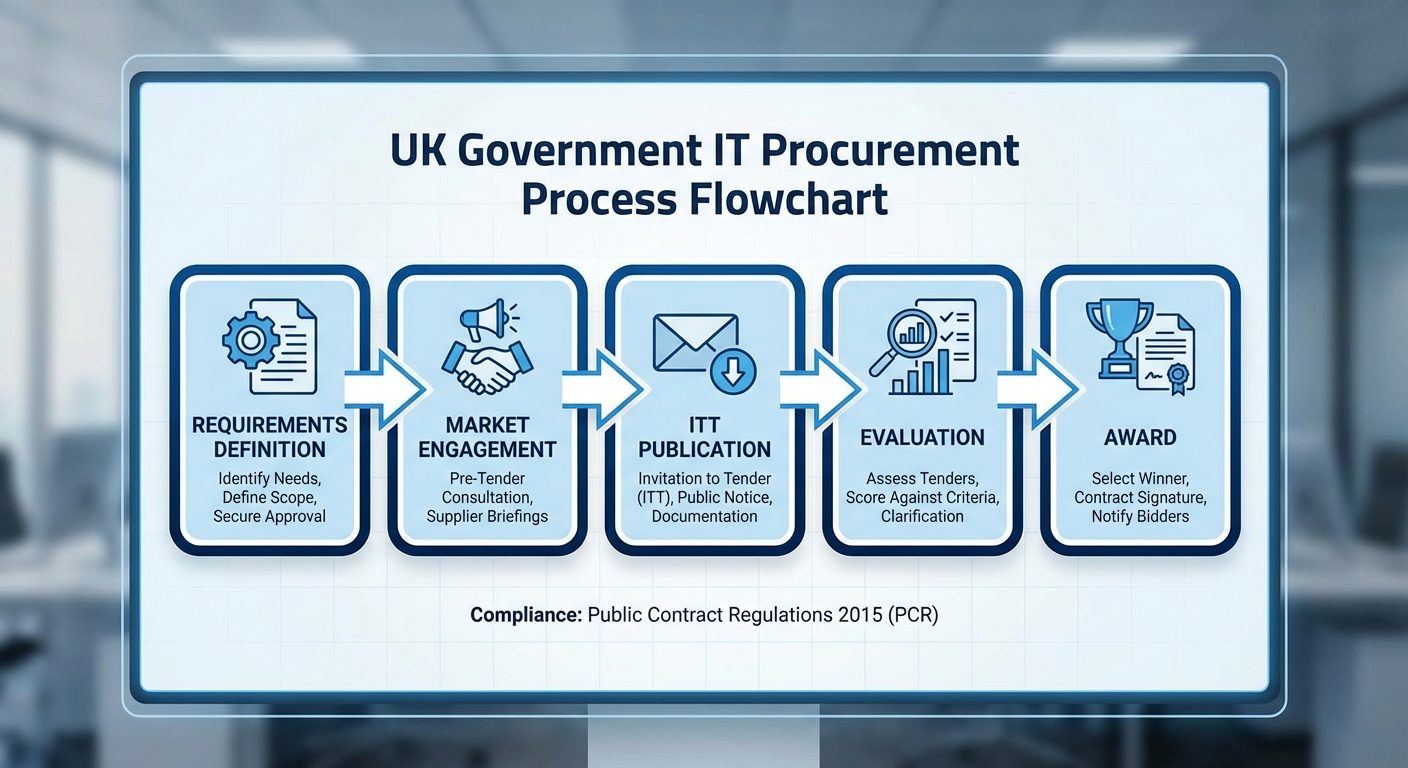
UK government IT procurement process flowchart showing stages from requirements to contract award
Understanding the UK Government IT Procurement Landscape in 2026
Before you can win government IT contracts, you need to understand how the procurement system is structured. Unlike commercial clients—where a well-crafted sales pitch and strong relationships often carry the day—government buyers operate within a strict legal framework designed to ensure fairness, transparency, and value for money.
The Scale of the Opportunity
The UK government's technology spend is immense and growing. Central government departments, NHS trusts, local authorities, emergency services, and arm's-length bodies collectively represent one of Europe's largest technology markets. The Government Digital Service (GDS) has driven significant investment in digital transformation since its inception, and that mandate has only accelerated. Projects around legacy system modernisation, cloud migration, data analytics, AI integration, and cybersecurity are generating billions in contract opportunities every year.
Most of this spending flows through frameworks—pre-negotiated agreements that allow public sector buyers to procure directly from approved supplier lists without running full tender competitions each time. Understanding these frameworks is the single most important thing a technology company can do to access government contracts efficiently.
The Frameworks You Need to Know
G-Cloud is the primary route for cloud technology suppliers. Managed by Crown Commercial Service (CCS), G-Cloud allows suppliers to list their cloud services—software (SaaS), platform (PaaS), and infrastructure (IaaS)—on the Digital Marketplace. Public sector buyers can then search, compare, and directly award contracts without running a full tender process. G-Cloud is renewed regularly (currently on iteration 14), and each round requires suppliers to re-apply or update their listings. G-Cloud is ideal for software products, cloud platforms, and anything delivered "as a service." Digital Outcomes and Specialists (DOS), now rebranded as the Digital Marketplace, is the route for technology services—consultancy, development teams, user research, and specialist technical roles. Unlike G-Cloud (which lists predefined products), DOS works through mini-competitions where approved suppliers respond to specific buyer requirements. If your business delivers IT projects rather than products, DOS is your primary route. Technology Products and Associated Services (TePAS) is the CCS framework for physical technology products and related services—hardware, software licences, and on-premise solutions. It's structured into multiple lots covering different technology categories. Network Services 3 covers connectivity, networks, and related managed services—vital for telcos, networking specialists, and managed service providers working in government. Cyber Security Services 4 (CSS4) is the specialist framework for cybersecurity suppliers, covering everything from penetration testing to security operations centre (SOC) services and threat intelligence. If your business is in cybersecurity, this is the framework that matters most.Beyond CCS frameworks, many buyers also use sector-specific frameworks. The NHS has its own procurement bodies (NHS Shared Business Services, Health Systems Support Framework), local government has multiple consortia (ESPO, YPO, NEPO, Eastern Shires), and Scottish, Welsh, and Northern Irish governments run their own procurement organisations.
The Procurement Act 2023 Changes Everything
For technology companies bidding on government contracts in 2026, the Procurement Act 2023—which came into force in February 2025—is reshaping the rules. The shift from Most Economically Advantageous Tender (MEAT) to Most Advantageous Tender (MAT) has significant implications for how IT tenders are evaluated.
Under MAT, contracting authorities have greater flexibility to weight factors beyond price. This means your technical quality, innovation, social value commitments, and environmental credentials can carry more weight in evaluation—good news for technology companies that can demonstrate genuine differentiation. However, it also means generic, price-led responses that worked under older procurement rules are even less effective in 2026.
The Act also introduces new transparency requirements: suppliers must register on the Central Digital Platform, and performance KPIs on contracts above £5 million will be publicly reported. For technology companies, this means your delivery track record becomes a public asset (or liability)—making excellent contract performance more important than ever.
How G-Cloud Works: A Supplier's Complete Guide
For software companies, SaaS businesses, and cloud service providers, G-Cloud is often the fastest path to government revenue. The framework is genuinely accessible to small and medium technology businesses—many G-Cloud suppliers are startups or specialist firms with fewer than 50 employees.
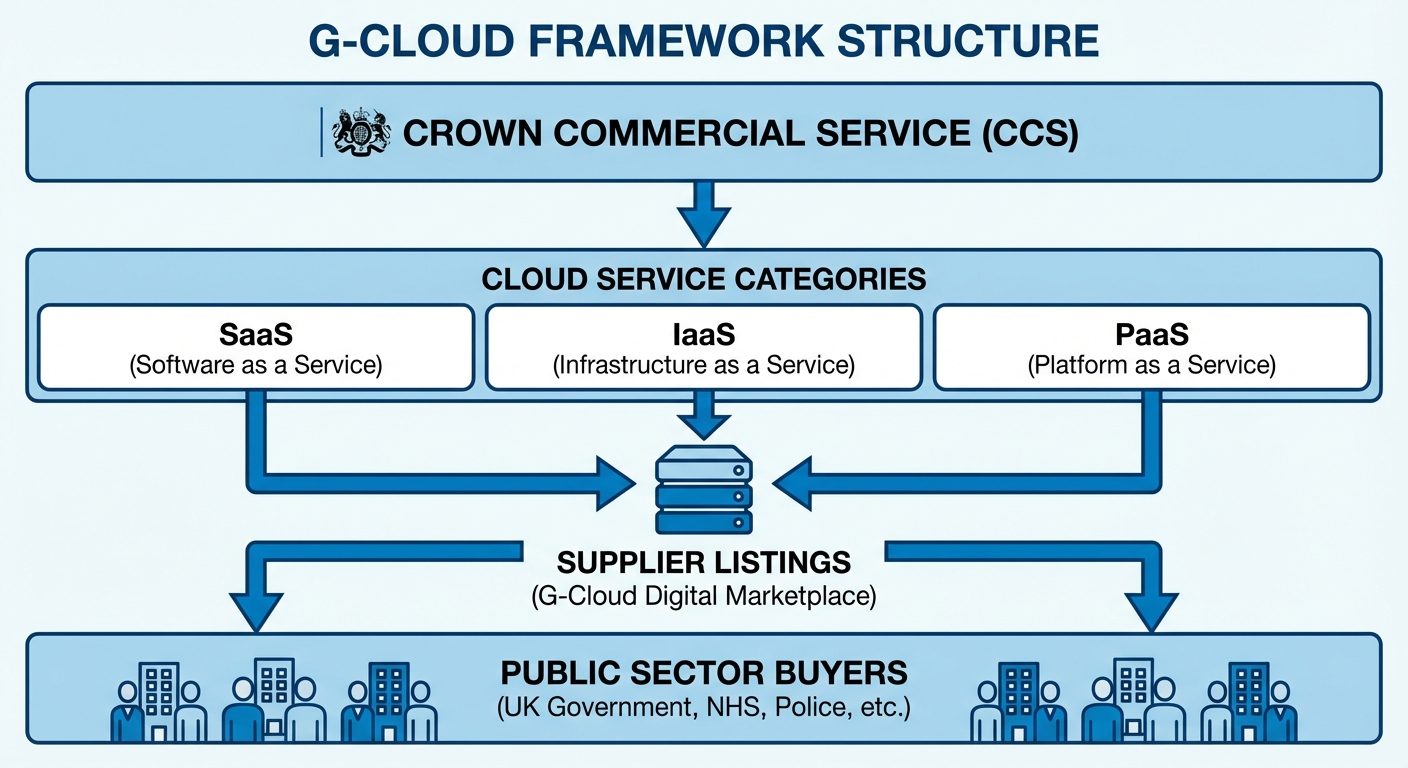
G-Cloud framework structure diagram showing Crown Commercial Service, service categories, and buyer flow
Getting onto G-Cloud
The application process for each G-Cloud iteration runs over a defined window, typically lasting 4–6 weeks. Applications are made through the Digital Marketplace Supplier Portal and require you to:
Define your service clearly. Each service listed on G-Cloud must have a clear, searchable description that accurately reflects what you offer. Buyers search for services using keywords, so your service name and description must match how procurement teams actually search. Too many suppliers write descriptions in marketing language rather than procurement language—use the terminology buyers use, not the terminology your sales team prefers. Complete mandatory questions accurately. G-Cloud applications include standard questions around your service's technical specifications, security certifications, data handling practices, and commercial terms. Mistakes or omissions here can get your listing removed. Read the buyer information carefully—G-Cloud has specific requirements around how pricing is expressed, how GDPR compliance is documented, and how security controls are described. Meet security requirements. All G-Cloud services must be assessed against the NCSC Cloud Security Principles. You'll need to document how your service addresses each principle, covering areas like data in transit, asset protection, separation between users, governance, and personnel security. For services handling official government data, this assessment is non-negotiable. Set pricing that works. G-Cloud pricing must be transparent and published. Many suppliers make the mistake of pricing too high because they expect to negotiate—but government buyers on G-Cloud often award without any negotiation, choosing the best-value option they can see. Your pricing needs to be competitive from the outset.Making Your G-Cloud Listing Work
Getting onto G-Cloud is only half the battle. Many suppliers list their services and then wonder why they receive no enquiries. The Digital Marketplace is a competitive catalogue—buyers have thousands of options. Making your listing visible and compelling requires the same effort you'd put into any marketing channel.
Optimise your keywords. Research how buyers search on the Digital Marketplace. Common search terms include the technology category (data analytics, cloud hosting, identity management), the problem being solved (legacy modernisation, remote working, patient records), and specific technologies (AWS, Azure, Salesforce, Microsoft 365). Include these terms naturally in your service description. Write for procurement teams, not technical evaluators. The people searching G-Cloud are often procurement officers or programme managers, not technical architects. Your description needs to clearly explain what the service does, what problems it solves, and why it represents good value—in language that non-technical buyers can evaluate. Keep your listing current. G-Cloud listings that appear stale—no recent updates, outdated pricing, references to superseded products—lose credibility. Review your listing regularly and update it when your service evolves. Build a strong supporting narrative. Your G-Cloud listing includes space for case studies, certifications, and supporting information. Use this fully. Government buyers are risk-averse—evidence that you have successfully delivered the same service to similar public sector organisations is enormously persuasive.Winning DOS Mini-Competitions: How Technology Services Firms Succeed
For technology companies that deliver projects and services rather than products, the Digital Outcomes and Specialists (DOS) framework is where the action is. DOS works differently from G-Cloud: rather than a static catalogue, it involves responding to specific buyer requirements through mini-competitions.
How Mini-Competitions Work
A buyer—say, a government department needing a development team to build a new citizen-facing digital service—publishes a requirement on the Digital Marketplace. All approved DOS suppliers can see the requirement and choose whether to apply. The buyer receives applications and selects a shortlist, typically 3–5 suppliers, who are then invited to submit a full proposal. The buyer evaluates proposals against criteria published in the original requirement and awards the contract to the highest-scoring supplier.
The key challenge is that you're competing against other capable technology companies, often including large systems integrators and established public sector consultancies. Winning consistently requires both strong capability and strong proposal writing.
Crafting Winning DOS Responses
Read the requirement carefully—then read it again. Government buyers are specific about what they need, and proposals that miss or misinterpret requirements score poorly regardless of technical quality. Before writing a word, map every requirement in the brief to a specific section of your response. Identify any areas where the brief is ambiguous and address them explicitly. Lead with understanding, not capability. A common mistake is to open proposals with a company profile and capability overview. Experienced evaluators find this tedious—they want to see immediately that you understand their problem. Open your response by demonstrating that you understand the buyer's context, constraints, and objectives. Show them you've read their business case, their technology strategy, and their organisational context. Be specific about your approach. Government evaluators are trained to spot generic responses—and they score them down accordingly. Where a generic response says "we will use agile methodology," a winning response describes the specific ceremonies, artefacts, and cadences you would use for this project, with your justification for each choice given the buyer's context. Demonstrate relevant experience with evidence. Case studies are the most persuasive element of most DOS responses. Choose examples that are genuinely similar to the requirement—similar technology, similar scale, similar organisational context. For each case study, describe the problem, your approach, and the measurable outcomes. Specific numbers—response times improved by 40%, deployment frequency increased from monthly to daily, user satisfaction scored 4.8/5—are far more persuasive than general assertions. Address security proactively. Government buyers are acutely sensitive to security risk. Even when security isn't a heavily weighted criterion, addressing it thoroughly signals professionalism and reduces buyer anxiety. Cover your approach to secure development practices, how you handle access to government systems, your approach to vulnerability management, and your relevant certifications (Cyber Essentials Plus, ISO 27001, etc.).Security and Compliance Requirements: What Technology Companies Must Know
Security is where many technology companies—especially those new to government procurement—get tripped up. Government buyers have requirements that go significantly beyond typical enterprise clients, and failing to meet them can mean disqualification regardless of how strong the rest of your proposal is.
Cyber Essentials and Cyber Essentials Plus
Cyber Essentials is the UK government's baseline cybersecurity certification scheme, and it's mandatory for most government IT contracts. The certification verifies that your organisation has implemented basic cybersecurity controls covering five key areas: firewalls, secure configuration, access control, malware protection, and software update management.
Cyber Essentials Plus goes further—rather than self-assessment, it involves independent technical verification of your controls. Many government contracts, particularly those involving handling official or sensitive data, require Cyber Essentials Plus as a minimum. If your organisation doesn't hold the certification, obtaining it should be your first priority before bidding on government work.
The certifications must be renewed annually, so keep your certificates current. Lapses are visible during due diligence and can raise concerns about your organisation's security governance.
ISO 27001 and Other Standards
For larger or more sensitive government contracts, buyers often require or prefer ISO 27001 certification, which demonstrates a comprehensive information security management system (ISMS). While not universally required, ISO 27001 signals maturity in security governance and can be decisive in competitive evaluations.
Other relevant certifications include ISO 9001 (quality management), SOC 2 (particularly for US-headquartered suppliers), and sector-specific standards such as NHS DSPT (Data Security and Protection Toolkit) for healthcare technology suppliers.
Government Security Classifications
Understanding the Government Security Classification (GSC) scheme is essential for any technology supplier working with government data. The three tiers—OFFICIAL, SECRET, and TOP SECRET—have very different requirements, and most commercial technology companies will only handle OFFICIAL-classified information (which itself has a sensitive sub-tier, OFFICIAL-SENSITIVE).
Even for OFFICIAL data, your systems must implement appropriate controls: encryption at rest and in transit, access controls, audit logging, and incident response capabilities. Your tender response should demonstrate understanding of the classification system and describe clearly how your service or approach handles government data appropriately.
GDPR and Data Protection
All government technology contracts involve handling personal data to some degree, and the UK GDPR (as retained in UK law post-Brexit) applies with full force. Your proposal should address:
Data minimisation: what personal data you collect and why you need it Data residency: where data is stored and processed, with UK/EEA residency typically preferred Third-party processors: which sub-processors you use and your contractual controls over them Breach response: how you would detect, contain, and notify a data breach Data retention and deletion: how you ensure data is appropriately retained and securely deleted at end of contractGovernment procurement teams are increasingly sophisticated about data protection, and vague answers ("we take data protection seriously") will not score well. Be specific, be evidenced, and reference your policies and procedures concretely.
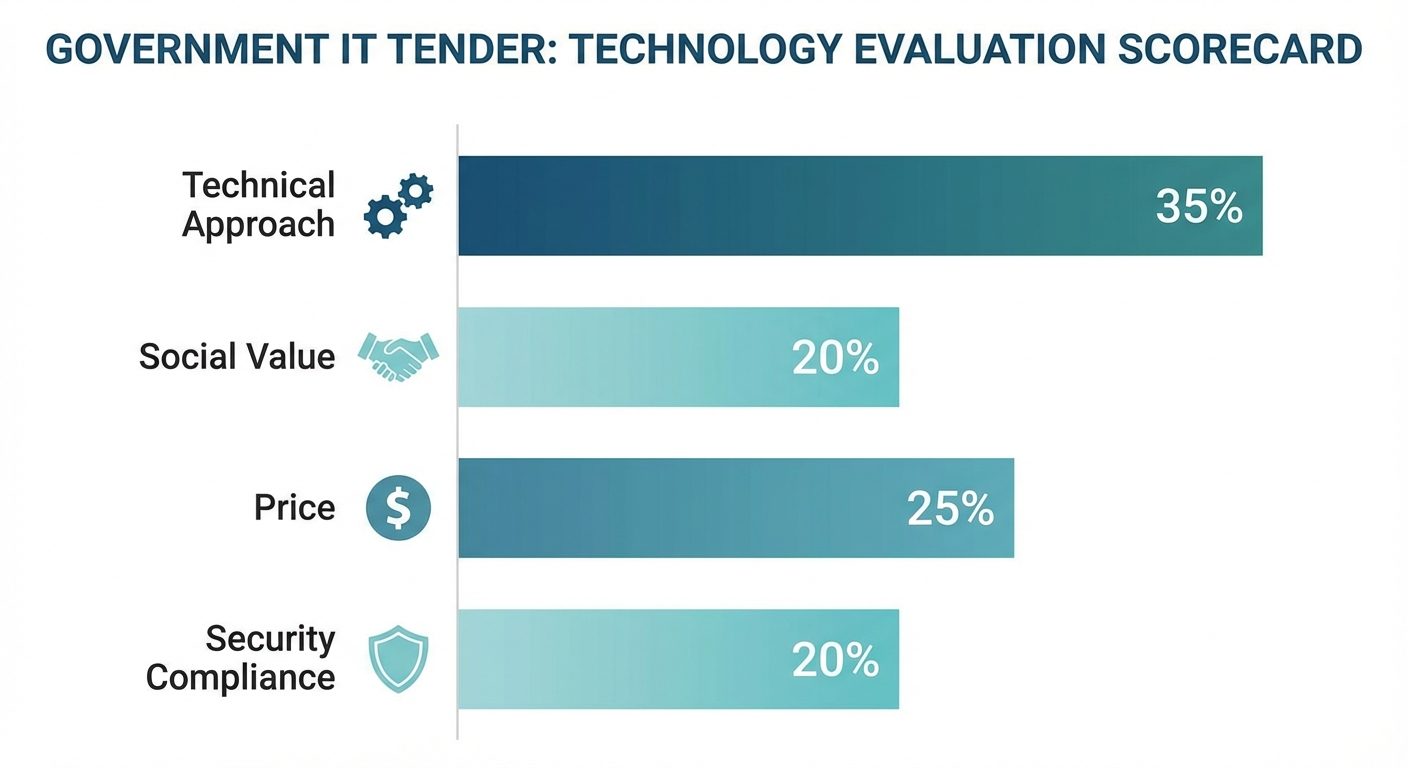
Technology evaluation criteria scorecard showing weighted scoring for government IT tenders
Writing Compelling Technical Responses: Scoring Top Marks
The technical response is usually the largest section of a government IT tender and the area where the biggest marks differences emerge. Here's how to approach it systematically to maximise your score.
Understanding How Technical Questions Are Scored
Most government IT evaluations use a scoring model where each question has a maximum score (often 10 or 20 points) and evaluators use a defined marking scheme. Responses that fully address every aspect of the question, provide concrete evidence, and go beyond minimum requirements score in the top band. Responses that address most requirements but with limited evidence score in the middle. Responses with significant gaps, errors, or unsubstantiated claims score poorly.
The practical implication: long, comprehensive responses that address everything score better than concise responses that miss elements. There's no penalty for length in government tenders (within defined page limits)—only for missing requirements or weak evidence.
The Structure That Wins
For complex technical questions, a proven structure is:
Understanding — demonstrate you understand the requirement and its context Approach — describe your methodology, process, or technical solution Evidence — provide concrete proof that your approach works (case studies, metrics, references) Benefit — articulate the specific outcome for this buyerThis structure works because it mirrors how evaluators think: they want to know you understand the problem, have a credible plan to solve it, have done it before, and will deliver value. Responses that skip directly to approach (without demonstrating understanding) or focus heavily on capabilities without evidence consistently score below those that follow this pattern.
Common Technical Response Mistakes
Using marketing language. Phrases like "industry-leading," "best-in-class," and "cutting-edge" mean nothing to evaluators. Replace every superlative with a specific, evidenced claim. Instead of "our industry-leading security platform," write "our security platform, which holds ISO 27001 certification and achieved zero critical vulnerabilities in our last penetration test." Not answering the question asked. Reading comprehension sounds basic, but many proposals fail at it. Government questions are often multi-part: "Describe your approach to [X] and explain how you would handle [Y]. Include evidence of where you have done this previously." Proposals that describe the approach but omit the evidence, or that address [X] but not [Y], leave easy marks on the table. Generic methodology descriptions. Every agile development firm says they use sprints and stand-ups. What differentiates winners is explaining how they would apply their methodology to this specific context—this buyer's constraints, this project's risks, this delivery timeline. Underselling your team. Government buyers care deeply about the people delivering work. If you have exceptional staff with relevant government or technical backgrounds, don't bury their credentials in an appendix—surface the most compelling people early in your technical response.Social Value: The Increasingly Critical Factor in Government IT Tenders
Social value has gone from a compliance checkbox to a meaningful competitive differentiator in UK government technology procurement. Under the Procurement Act 2023, contracting authorities must now actively maximise public benefit—and social value weightings in IT tenders have risen significantly, often reaching 20% or more.
What Government Buyers Look for in Technology Suppliers
The key social value themes that resonate with government technology buyers in 2026 are:
Digital skills and employment. Government is acutely aware of the digital skills gap. Commitments to apprenticeships, graduate schemes, retraining programmes, and partnerships with educational institutions are highly valued. If your company employs people from under-represented groups in technology or runs programmes to widen participation in tech careers, make this visible in your bid. Supply chain diversity. Commitments to working with SMEs, diverse suppliers, and local businesses resonate with the broader policy agenda around supply chain inclusion. If you use sub-contractors, describe your approach to ensuring diversity and fair treatment across your supply chain. Environmental impact. Net-zero commitments are increasingly expected, not just desirable. Buyers want to understand your carbon footprint, your reduction trajectory, and specifically how your service contributes to their own sustainability goals. Cloud-based technology can genuinely claim environmental benefits over on-premise alternatives—quantify these where you can. Wellbeing and fair employment. Commitments to paying the Real Living Wage, providing good working conditions, and supporting employee wellbeing score well with buyers who take corporate responsibility seriously.Making Social Value Commitments Credible
The shift in 2026 is that social value is increasingly evaluated for delivery quality, not just aspiration. Buyers want specific, measurable commitments—"we will provide 50 apprenticeship hours to local secondary school students during the contract period"—not vague promises ("we are committed to supporting skills development in the community").
For each commitment, be prepared to describe:
- What you will do, specifically
- How it will be measured and reported
- What baseline you're measuring against
- How the commitment is attributable to this contract (not general business-as-usual)
Generic social value templates that are cut and pasted across bids are increasingly recognisable and score poorly. The best responses are specific to the buyer's location, demographics, and stated social priorities—which requires reading their social value strategy before you write your response.
Pricing Government IT Contracts: Winning on Value, Not Just Cost
Pricing government IT contracts is an art that many technology companies get wrong. Bidding too low wins the contract but destroys margin; bidding too high loses to competitors. Understanding how price is evaluated in government IT tenders helps you price more strategically.
How Price is Typically Evaluated
Most government IT tenders evaluate price using a relative scoring model—the lowest price receives the maximum score for price, and other bidders receive a proportion of that score based on how much more expensive they are. In a tender where price is weighted at 25%, a bidder who is 10% more expensive than the cheapest option might score 22.5/25 rather than 25/25—a meaningful but not catastrophic difference.
This model has an important implication: if your technical score is significantly higher than a cheaper competitor, you can still win even with a higher price. Many technology companies race to the bottom on price when the smarter strategy is to focus on maximising technical and social value scores, which allows you to maintain healthy margins while still winning.
Constructing Your Commercial Response
Government buyers appreciate clear, well-structured pricing. Avoid complex pricing models with too many variables—buyers need to be able to compare prices across bidders. Price transparency is valued: explain your pricing model, what's included, what's excluded, and how prices would change under different volume scenarios.
For services that will develop over a long contract term, consider how you present ongoing costs. Buyers are often more concerned about total contract value and value for money over the term than day-one price. If your pricing model delivers cost savings or efficiencies over time, model this out explicitly.
If you're using subcontractors, include their costs in your pricing with clear attribution—government buyers are increasingly alert to headline prices that balloon when subcontractor costs are added.
Using AI to Win More Government IT Tenders
The use of AI in bid writing has transformed the competitive landscape for government IT tenders. Technology companies that adopt AI-assisted approaches are completing bids faster, producing more consistent quality, and winning at higher rates than those relying on manual processes alone.
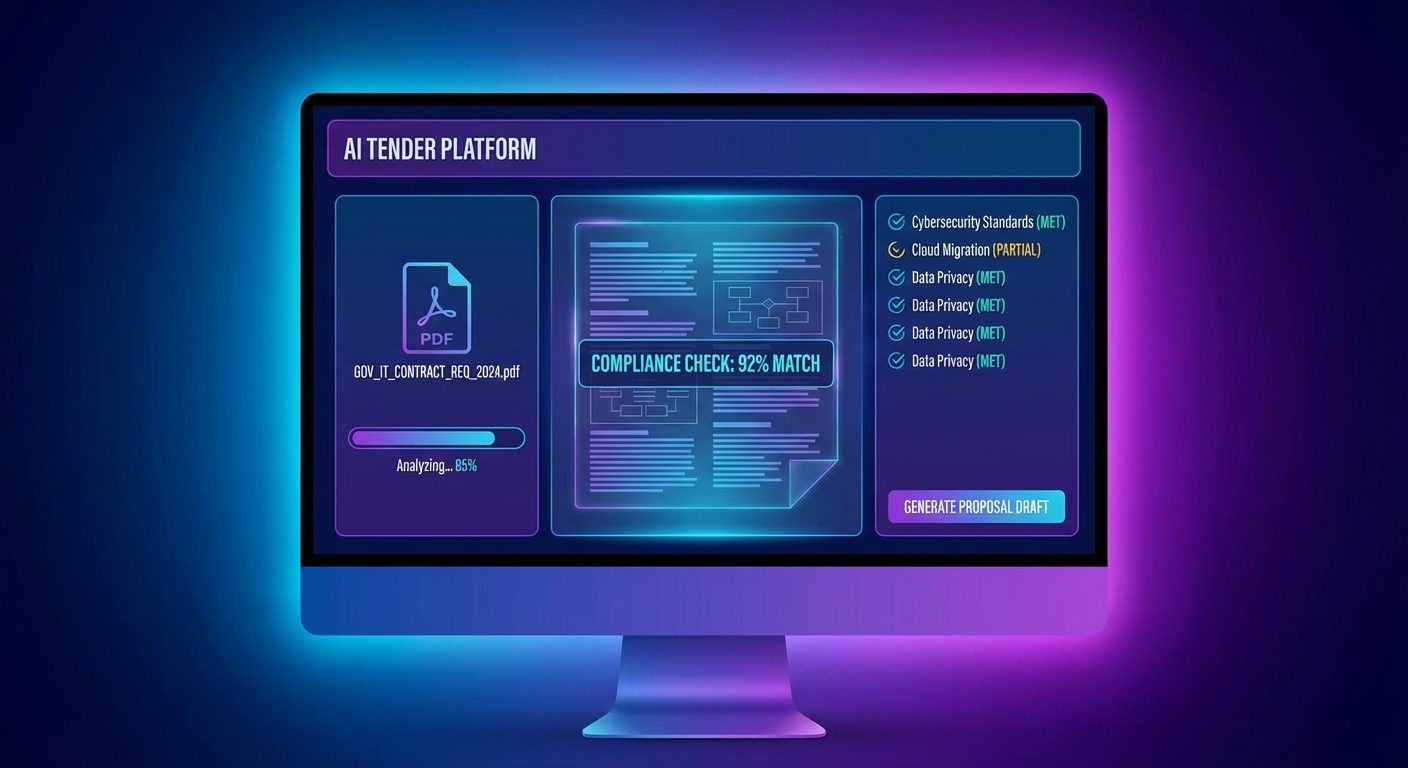
AI-powered tender writing platform for government IT contracts
How AI Changes the Bid Writing Process
Modern AI-assisted bid writing platforms like mytender.io analyse tender documents to extract key requirements, match them to your existing capability statements and case studies, draft responses that address evaluation criteria, and flag gaps that require additional evidence. For technology companies bidding on multiple government opportunities simultaneously, this automation is transformative.
The time saved is substantial. Government IT tenders often require responses to 20–30 detailed questions, many drawing on similar underlying information—your methodology, your team, your security credentials, your relevant experience. AI can draft these responses in a fraction of the time, allowing your bid team to focus on quality review and personalisation rather than starting from a blank page each time.
More importantly, AI systems trained on winning government bids understand what language, structure, and evidence resonates with evaluators. They can help you avoid the generic marketing language that scores poorly and ensure each response addresses every part of a multi-part question.
The Limits of AI in Government IT Bids
AI assistance is powerful, but it has important limitations that technology company bid managers need to understand. AI can draft and structure content, but it cannot substitute for genuine evidence. If your company hasn't delivered relevant government contracts before, no AI can conjure the case studies evaluators want to see. Building your evidence base—through delivering excellent work and documenting outcomes rigorously—remains essential.
AI also cannot replace the strategic thinking required for complex bids. Deciding how to position your approach, which aspects of your service to emphasise for a particular buyer, or how to address a challenging question where your experience is limited requires human judgement and market knowledge.
The winning approach combines AI efficiency with human expertise: use AI to draft, structure, and quality-check your responses at speed, while your bid managers apply strategic insight, personalisation, and evidence-based refinement.
Building a Government IT Bid Library
One of the highest-ROI investments a technology company can make is building a well-organised library of bid content. Government IT tenders ask similar questions across different opportunities—methodology, security approach, team CVs, case studies, social value commitments. A well-maintained bid library means each new tender starts from high-quality existing content rather than from scratch.
AI-assisted bid management platforms make this practical at scale. Content libraries can store hundreds of capability statements, case studies, and methodology descriptions, tagged by theme, sector, and technology. When a new tender arrives, the system retrieves the most relevant content and presents it as a starting point. Bid teams refine rather than write from scratch, dramatically improving both speed and quality.
Managing Your Government IT Sales Pipeline
Winning government IT contracts requires more than great proposals—it requires a systematic approach to pipeline management, market intelligence, and relationship development.
Finding Opportunities Before They're Tendered
The most competitive government IT tenders are ones where buyers have done extensive pre-market engagement. By the time an ITT is published, buyers often have strong views about what good looks like, sometimes influenced by suppliers who participated in earlier market engagement. Getting involved early—through responding to Prior Information Notices (PINs), attending supplier briefing events, and engaging with procurement teams through official channels—helps you shape requirements in your favour.
Contracts Finder and Find a Tender Service (FTS) are the mandatory publication portals for government opportunities, but by the time an opportunity appears there, the pre-engagement phase is usually over. Building relationships with government technology buyers, attending events like GovTech Summit, Digital Leaders Week, and public sector technology conferences, and monitoring public sector technology strategies puts you in conversations before procurement begins.
Qualifying Opportunities Rigorously
Not every government IT opportunity is worth pursuing. The cost of a competitive tender response is significant—typically several thousand pounds in staff time even for straightforward opportunities. Before committing to a bid, evaluate:
Fit: Does the requirement genuinely match your capabilities? Bidding on the periphery of your expertise is inefficient and usually unsuccessful. Competitive position: Who else is likely to be bidding? If established framework holders with deep relationships are almost certain to win, your resources may be better deployed elsewhere. Margin potential: Is the pricing model one where you can deliver profitably? Government tenders that are too prescriptive about delivery approach or too price-sensitive to value technical quality often produce poor-margin contracts. Strategic value: Even if a contract has modest immediate value, does winning it open doors—a new sector, a new reference client, a new framework position—that justify the investment?Applying these filters rigorously and only bidding when you have a realistic path to winning dramatically improves your win rate and reduces wasted bid investment.
Working with Tender Portals
Government buyers publish requirements across multiple portals, and managing them efficiently is a practical challenge. Key portals include:
Find a Tender Service (FTS): For contracts above £135,018 (central government) or £214,904 (local authorities and other public bodies) from 1 January 2026 Contracts Finder: For contracts above £12,000 with central government, mandatory transparency publication Digital Marketplace: For G-Cloud and DOS opportunities Sector-specific portals: NHS eSourcing, Defence Contracts Online, Local Government portalsMost technology companies focused on government IT benefit from using a tender monitoring service that aggregates opportunities across portals and delivers relevant matches. This reduces the risk of missing opportunities and saves time that would otherwise be spent manually searching multiple platforms.
Relationship Building and Account Development in Government IT
Government technology procurement is relationship-intensive despite operating within strict fair competition rules. Understanding how relationships legitimately support winning requires navigating some nuances.
What's Legitimate
Government procurement rules prohibit buyers from favouring suppliers based on prior relationships when running formal competitive procurements. But relationships legitimately influence what's procured, how requirements are written, and which suppliers are included in pre-market engagement. A supplier with strong relationships in a government organisation is more likely to know about upcoming opportunities, to participate in pre-market engagement, and to have their capabilities understood by the buyer—all of which legitimately improves their competitive position.
Building these relationships requires engaging with government through official channels: responding to consultations, participating in supplier briefing events, attending technology conferences where civil servants speak and network, and working with intermediaries like GDS, techUK, and sector-specific bodies.
Delivering Excellently on Existing Contracts
The single most powerful relationship-building activity is excellent contract delivery. Government buyers talk to each other. A technology company known for delivering outstanding work on existing contracts—meeting milestones, communicating proactively, resolving issues quickly—develops a reputation that significantly improves its competitive position across the market.
Under the Procurement Act 2023, contract performance KPIs on larger contracts will be publicly reported, making your delivery track record a genuinely public asset. Technology companies that invest in strong delivery governance, clear client communication, and rigorous outcome measurement are building competitive advantage that compounds over time.
Building a Winning Government IT Practice
For technology companies serious about the public sector market, the question isn't just how to win individual tenders—it's how to build a practice that wins consistently.
Dedicated Public Sector Expertise
Government IT is a specialist market. The terminology, the procurement processes, the policy context, the buyer mindset, and the regulatory framework are all distinct from commercial technology markets. Companies that win consistently in this market typically have dedicated public sector specialists—sales people who speak the language of digital transformation and value for money, bid managers who understand evaluation criteria, delivery leads who understand government governance requirements.
Trying to win government IT contracts with purely commercial expertise—strong salespeople and great technologists who have never worked in or with government—is an uphill struggle. Building or hiring public sector expertise is an investment that pays dividends in win rates and margin quality.
Framework Positioning as a Strategic Asset
Being on the right frameworks is a long-term strategic asset. G-Cloud presence builds market visibility; DOS approval opens project competition; sector-specific frameworks (NHS, Defence, education) open routes to concentrated spend in those sectors. Technology companies that invest in comprehensive framework coverage reduce their cost of sale, increase their pipeline coverage, and reduce their dependence on any single route to market.
Framework applications require investment—time to write them well, effort to maintain certifications, resource to monitor and respond to mini-competitions. But the return on that investment, for a technology company serious about government, is substantial.
Measuring and Improving Your Win Rate
Most technology companies bidding on government contracts don't track their win rate systematically enough to improve it. A rigorous approach to bid performance measurement includes:
Bid/no-bid decisions: Are you making good decisions about what to pursue? A poor win rate often reflects poor qualifying as much as poor bidding. Win rate by opportunity type: Are you winning more on G-Cloud, DOS, or open competition? More in some sectors than others? Understanding where you win focuses investment in the right areas. Score breakdowns on losses: Government buyers are required to provide feedback on unsuccessful bids. Use this systematically—identify the sections where you consistently underperform and invest in improving them. Win rate trend: Is your win rate improving? Flat or declining win rates despite significant bid investment are a signal that your approach needs systematic review.mytender.io's analytics dashboard gives bid teams real-time visibility into these metrics, helping technology companies make smarter bid decisions and continuously improve their approach based on actual outcome data.
Practical Next Steps for Technology Companies
If you're new to government IT procurement or looking to improve your current approach, here's a practical sequence:
First month: Obtain Cyber Essentials certification if you don't have it. Register on the Digital Marketplace as a supplier. Identify two or three relevant frameworks to apply for. First quarter: Apply for G-Cloud if you have cloud services. Review the DOS framework and apply for relevant lots. Set up tender monitoring for your target sectors. First six months: Build your bid library—case studies, methodology descriptions, team CVs, security documentation. Attend two or three government technology events to begin relationship development. Submit your first three bids. First year: Review your bid performance systematically. Identify patterns in what wins and what doesn't. Invest in AI-assisted bid writing to improve efficiency. Begin pursuing pre-market engagement on upcoming opportunities you've identified.The government IT market rewards persistence and continuous improvement. Companies that commit to this market seriously—investing in the right capabilities, frameworks, and processes—consistently grow their public sector revenue year on year.

Professional working on government IT tender documents with digital technology overlay
How mytender.io Helps Technology Companies Win Government IT Contracts
mytender.io is purpose-built for organisations competing for UK public sector contracts. For technology companies targeting government IT, the platform offers several specific advantages.
Intelligent requirement analysis. Upload a tender document and mytender.io instantly analyses it, extracting every evaluation criterion, weighting, and question. The platform maps requirements to your existing capability library and identifies gaps before you start writing—so you never miss a question or underweight a high-scoring section. Government-specific content library. mytender.io's content engine is trained on government procurement language. It understands what evaluators are looking for and generates draft responses that use the right terminology, structure, and evidential approach from the start. Technology-specific templates cover security responses, methodology descriptions, cloud architecture explanations, and social value commitments tailored for IT tender contexts. Win rate analytics. The platform tracks your bid performance across opportunities, helping you understand where you win, where you lose, and why. For technology companies building a government practice, these insights are invaluable for focusing investment and improving approach over time. Team collaboration. Government IT tenders often require input from multiple team members—solution architects, security specialists, delivery leads, commercial directors. mytender.io's collaboration tools allow multiple contributors to work on the same tender simultaneously, with clear ownership, version control, and review workflows.Whether you're submitting your first government IT tender or running a mature public sector practice, mytender.io helps you produce better bids faster—improving your win rate and reducing the cost of your bid process.
Conclusion: The Technology Company's Path to Government Contract Success
Winning government IT contracts in 2026 requires more than great technology. It demands fluency in procurement processes, mastery of compliance requirements, compelling tender writing, and consistent delivery performance. The market is large, the opportunities are compelling, and the barriers—while real—are navigable for technology companies willing to invest in understanding the rules.
The Procurement Act 2023 has created a more transparent, more flexible, and more outcomes-focused procurement environment. For technology companies that genuinely deliver value—on social outcomes, on environmental commitments, on technical excellence—this shift is an opportunity. The era of winning on price alone is fading; the era of winning on demonstrated value is here.
Start by understanding the frameworks, building your compliance credentials, and investing in bid capability. Apply systematically, improve continuously, and focus on excellent delivery on every contract you win. The technology companies that crack the government market build revenue streams that compound over years—and that's a competitive advantage worth the investment.
Ready to transform your government IT bid process? Book a demo with mytender.io and see how AI-assisted bid writing can improve your win rate and reduce your bid costs.
Tags
Ready to Transform Your Tender Writing?
See how MyTender's AI can help you write winning tenders in a fraction of the time.