
G-Cloud and Digital Marketplace 2026: The Complete Guide to Winning Public Sector IT Contracts
Master G-Cloud 14 and the Crown Commercial Service Digital Marketplace with our comprehensive 2026 guide. Learn how to get listed, craft compelling service descriptions, and win more public sector IT contracts in cloud hosting, software, and support categories.
Evie
PA & Office Admin at mytender.io
The UK public sector spends over £4 billion annually through the Crown Commercial Service's Digital Marketplace, making it one of the most significant procurement channels for technology suppliers of any size. G-Cloud—the framework at the heart of this marketplace—has transformed how government buys cloud services, enabling thousands of suppliers from one-person startups to global technology giants to sell directly to councils, NHS trusts, central government departments, and public bodies without the traditional barriers of lengthy procurement processes.
Yet despite this accessibility, most suppliers who join the marketplace see little to no revenue from it. Their service descriptions sit buried among 5,000-plus competitors, their pricing lacks clarity, and their value propositions fail to connect with the public sector buyers who matter. The opportunity is real, but capitalising on it requires a strategic approach that goes far beyond simply getting listed.
This comprehensive guide covers everything technology suppliers need to know in 2026: how G-Cloud works, how to build a compelling presence on the Digital Marketplace, how to write service descriptions that generate genuine buyer interest, and how to position your offering to win consistently in a crowded, competitive environment.
What Is G-Cloud and Why Does It Matter?
G-Cloud is a framework agreement managed by the Crown Commercial Service (CCS) that allows pre-vetted technology suppliers to offer cloud-based services to UK public sector organisations. Rather than running individual procurement exercises for each contract—a process that can take six to twelve months and cost tens of thousands of pounds in bid preparation—public sector buyers can simply search the Digital Marketplace catalogue, compare services, and purchase directly from approved suppliers. For contracts below £1 million, buyers can select and award without any further competitive tender process.
This call-off mechanism makes G-Cloud one of the most buyer-friendly procurement vehicles in government, and consequently one of the most commercially attractive for suppliers who achieve quality listings. A well-positioned service on the Digital Marketplace generates inbound enquiries, direct awards, and steady contract revenue with relatively low ongoing sales cost once the initial listing work is done.
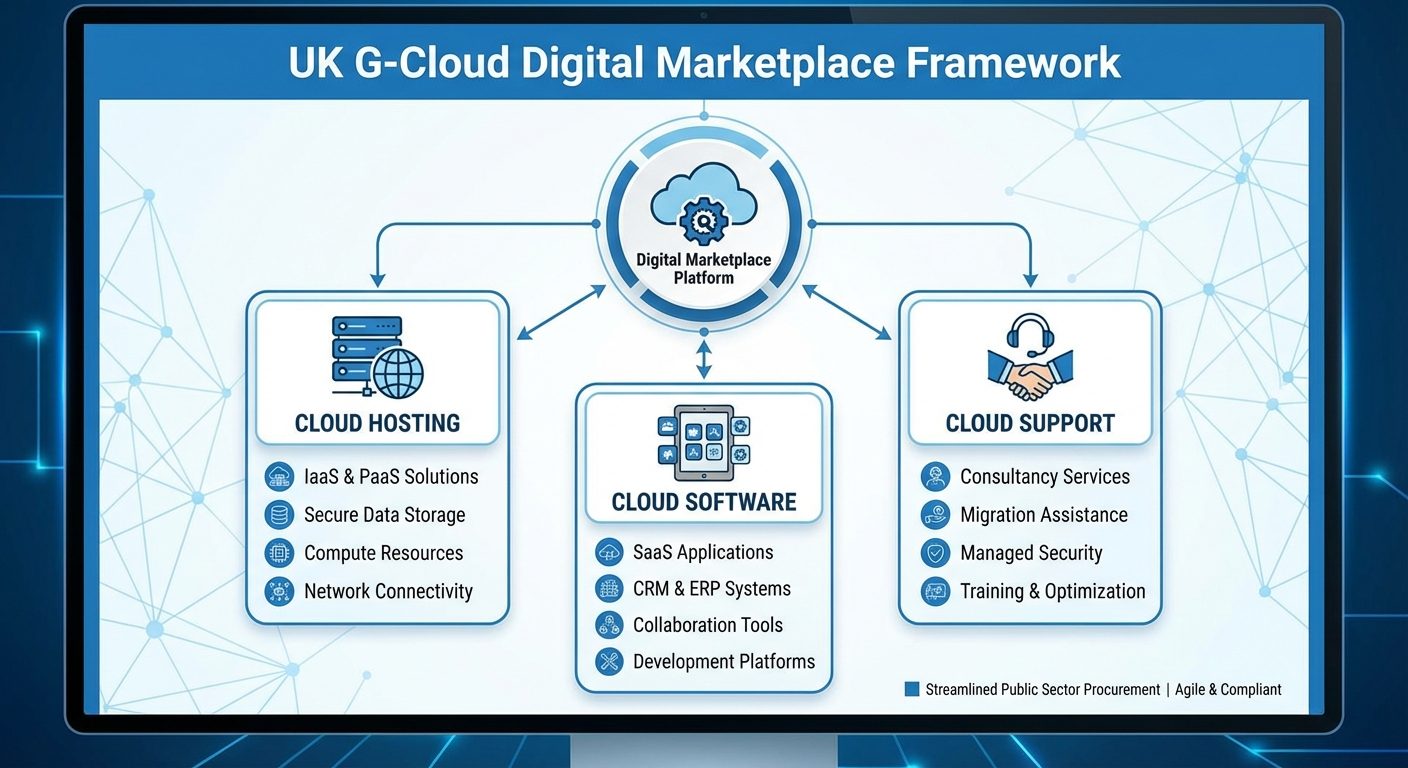
G-Cloud Digital Marketplace framework structure and categories
The Three Lots That Define G-Cloud
G-Cloud organises services into three lots, each targeting distinct buyer needs:
Lot 1: Cloud Hosting covers infrastructure-as-a-service (IaaS), platform-as-a-service (PaaS), and related hosting services. This lot includes virtual machines, managed databases, container orchestration platforms, content delivery networks, object storage, and any infrastructure that supports the development, testing, or deployment of digital services. Government cloud hosting procurement increasingly focuses on sovereignty, data residency, and UK OFFICIAL and OFFICIAL-SENSITIVE security classifications. Lot 2: Cloud Software is the largest and most active lot, covering software-as-a-service (SaaS) applications across every imaginable category: financial management, HR and payroll, case management, document management, cybersecurity tools, data analytics platforms, collaboration software, and thousands of other applications. This lot also includes purpose-built solutions for specific public sector verticals—social care management systems, planning portals, blue light dispatch software, and similar specialist tools. Lot 3: Cloud Support encompasses the professional services that help public sector organisations adopt, implement, and optimise cloud services. This includes cloud migration consultancy, managed services, training and change management, integration services, security testing, and ongoing technical support. Support services under this lot are frequently purchased alongside Lot 1 or Lot 2 services as buyers recognise they need help getting value from technology investments.Understanding which lot—or lots—your services fit requires honest assessment of what you're actually selling. Many suppliers offer services that span multiple lots, and where genuine overlap exists, applying to multiple lots makes sense. But spreading thinly across all three with generic descriptions rarely generates results; focus and specificity within each lot drives success.
The Scale and Reach of Digital Marketplace Procurement
The numbers paint a compelling picture for technology suppliers. Since G-Cloud launched in 2012, the framework has generated more than £15 billion in sales. Annual spend has grown steadily, with the most recent frameworks each generating over £3 billion. NHS organisations collectively represent the largest buyer segment, spending over £800 million annually on cloud services through the framework. Local government follows at around £600 million, with central government departments, police and fire services, education institutions, and devolved administrations making up the remainder.
Critically, small and medium-sized enterprises consistently win a higher proportion of G-Cloud business than through traditional procurement routes. In recent framework iterations, SMEs have accounted for over 50% of supplier registrations and between 30-40% of total sales value—a remarkable figure given that large enterprises dominate most other public sector procurement channels. G-Cloud's design deliberately creates opportunities for specialist, innovative, and smaller suppliers to compete effectively against incumbents.
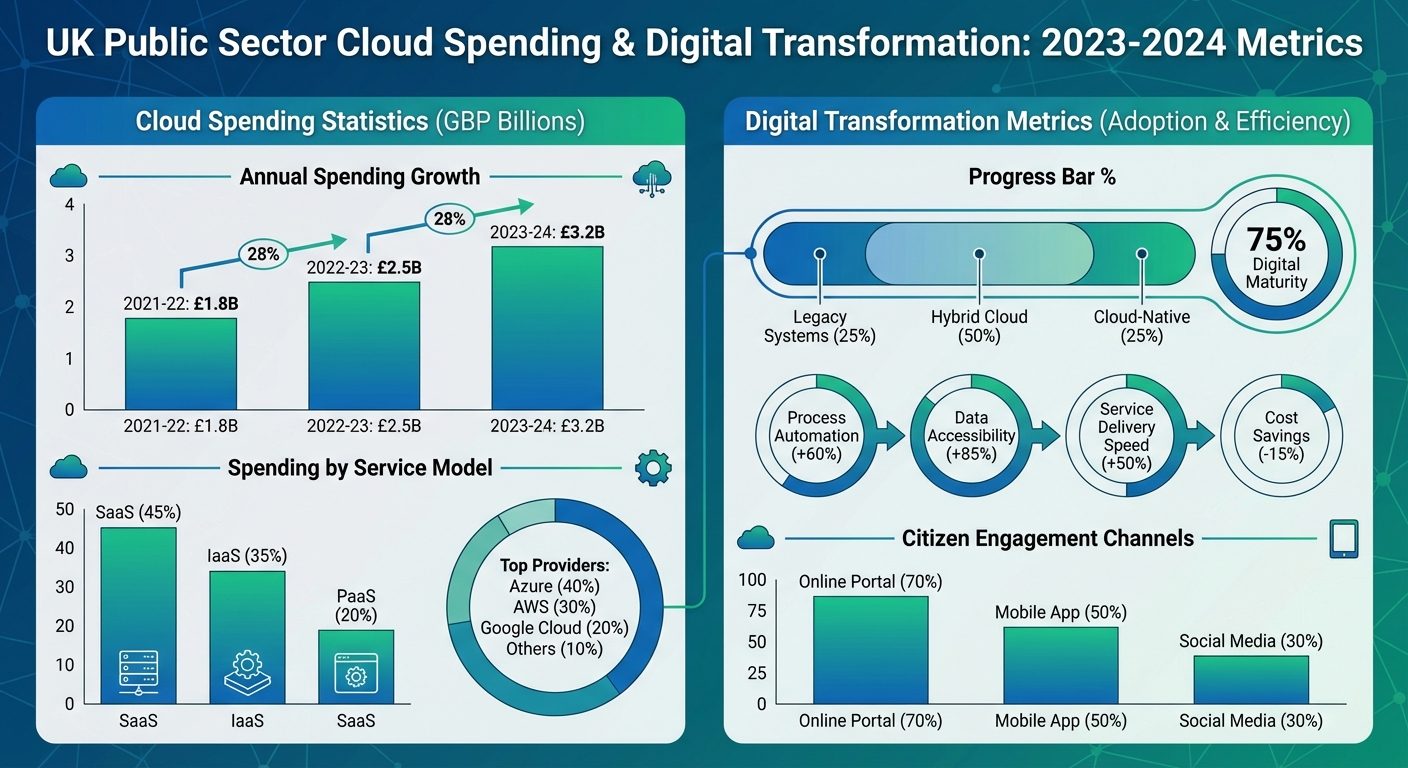
UK public sector cloud spending and Digital Marketplace statistics
How G-Cloud Applications Work
G-Cloud operates on an ongoing open framework model, meaning Crown Commercial Service periodically opens application windows for new suppliers and refreshes to existing listings. Unlike traditional framework competitions where a fixed number of suppliers secure four-year exclusivity, G-Cloud continuously adds qualified suppliers, making entry possible for companies that weren't previously listed or who have developed new services since the last iteration.
The Application Process Step by Step
The application process requires working through the Digital Marketplace's supplier administration portal, completing service entry forms for each service you wish to list, and submitting supporting documentation evidencing your compliance with framework requirements. Here's how the process unfolds:
Account setup and company registration starts with creating a supplier account on the Digital Marketplace. You'll need your Companies House registration number, VAT registration (if applicable), and key contact details. This step also involves setting up your company's profile information—a brief description of who you are, your company size, and the types of services you offer. This profile information helps buyers find you in initial searches, so clarity and keyword relevance matter even at this stage. Framework agreement acceptance requires you to read, understand, and accept the G-Cloud Framework Agreement. This is not merely administrative—the framework agreement sets out your obligations as a supplier, including pricing transparency requirements, service level commitments, subcontracting rules, and compliance with public sector standards. Reviewing this document thoroughly and ensuring your organisation can genuinely meet its requirements is essential before proceeding. Service entry creation is where most of the work happens. For each service you want to list, you'll complete a structured entry form covering service description, features and benefits, pricing information, technical specifications, service levels, support arrangements, and compliance evidence. The form is extensive and designed to generate comparable, searchable catalogue entries—which means following the structure carefully and providing complete responses to every field. Security and compliance documentation requires suppliers to complete a Cyber Essentials questionnaire at minimum, with Cloud Hosting suppliers typically needing to demonstrate higher-level security assurance appropriate to the UK OFFICIAL classification. The NCSC's Cloud Security Principles provide the framework against which hosting and software services are assessed, and Lot 2 suppliers handling personal or sensitive data need to evidence appropriate data protection controls. Submission and review involves uploading your completed service entries for CCS review. Reviewers check that entries meet minimum standards, contain accurate information, and comply with framework requirements. Common rejection reasons include vague service descriptions that don't clearly explain what the service does, pricing information that is incomplete or unclear, and compliance sections that make assertions without supporting evidence.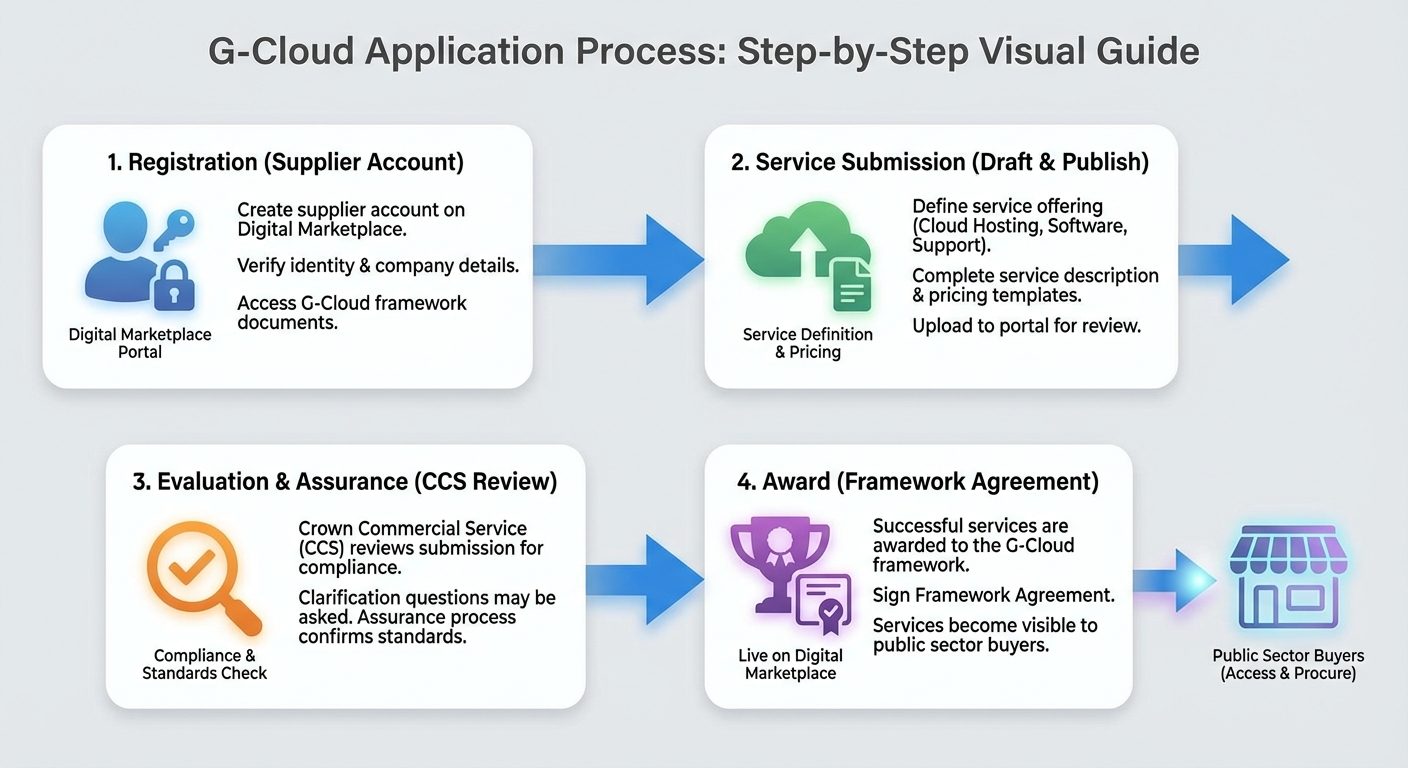
Step-by-step G-Cloud application and listing process
What Gets You Approved Versus Rejected
Understanding what CCS reviewers look for—and what causes rejection—saves significant time and frustration during the application process. Suppliers are often surprised to find that the bar for initial acceptance is lower than they expect: CCS is primarily checking for completeness and basic compliance, not evaluating service quality or commercial competitiveness. However, this means that acceptance alone says nothing about whether your listing will generate revenue.
Services that get through quickly tend to share common characteristics. They describe exactly what the service does in plain, accessible language without jargon or marketing spin. They present pricing information clearly, either through fixed pricing, a transparent pricing model, or an explicit explanation of how pricing is calculated. They make specific, verifiable compliance claims rather than generic statements about taking security seriously. And they align clearly with the lot definition rather than attempting to fit a service into a lot where it doesn't naturally belong.
Services that get rejected or returned for amendment typically suffer from one of several issues: descriptions so vague that neither reviewers nor buyers can determine what the service actually provides; pricing information that says "contact us for pricing" without any indication of pricing model or scale; compliance sections copied from marketing materials rather than addressing the specific questions asked; or services that appear to be professional services listed in Lot 2 rather than genuine cloud software.
Writing Service Descriptions That Win Contracts
Getting listed is the beginning, not the end. With over 5,000 suppliers and tens of thousands of service entries on the Digital Marketplace, the difference between services that generate consistent revenue and those that attract zero interest lies almost entirely in how effectively the service is described and positioned. This is where the tender writing principles that drive success across all procurement channels apply directly to G-Cloud.
Understanding How Buyers Search and Evaluate
Public sector buyers approach the Digital Marketplace with varying levels of sophistication and urgency. Some arrive with precise technical requirements and conduct structured comparisons across multiple services before making a decision. Others have a problem to solve and search somewhat exploratorily, evaluating services they encounter against their emerging understanding of what they need. A third group arrives with a specific budget approval and a timeframe, looking for a service that demonstrably meets requirements and comes from a credible supplier they feel comfortable selecting.
Your service description needs to work for all three types. This means being discoverable through relevant keyword searches, immediately clear about what the service does and who it's for, compelling in communicating value and differentiation, and credible in evidencing your capability to deliver. These are not competing objectives—a well-crafted service entry addresses all four simultaneously.
The service title is your first and most important element. It appears in search results and carries significant weight in the Digital Marketplace's search algorithm. Effective titles are specific rather than generic (not just "Document Management Software" but "Cloud Document Management for Local Government and Housing Associations"), include the primary search term buyers would use, and hint at differentiation or key capabilities. Avoid packing titles with marketing language that says nothing; buyers skim titles quickly and reward clarity. The service description summary gives you the equivalent of an elevator pitch: one paragraph to explain what the service does, who it's for, and why it's worth looking at. This summary appears in search results alongside the title, so it needs to earn the click. Open with a direct statement of what the service does—not with company history, not with mission statements, not with vague claims about transformation. State the problem you solve, the mechanism by which you solve it, and the outcome buyers can expect. The full service description has more space to work with and should use it purposefully. Structure this section to flow logically: start with a clear explanation of the service and its core functionality, progress to the specific features and capabilities, then move to the benefits and outcomes, and close with deployment, support, and implementation information. Use subheadings to aid navigation, especially since buyers often skim looking for specific information rather than reading sequentially.Translating Technical Capability into Buyer Language
Technology suppliers consistently make the mistake of writing service descriptions in the language of their engineering teams rather than the language of their buyers. Public sector IT buyers—procurement officers, IT managers, digital leads, and service managers—often have technical backgrounds, but they make purchasing decisions based on outcomes, risk, cost, and fit with organisational priorities rather than architectural elegance or technical sophistication.
This means translating your technical capabilities into the buyer outcomes they enable. If your platform processes transactions at 50,000 per second with 99.99% uptime, translate that into what it means for a busy council paying portal during council tax billing season—not a single missed payment, no call centre spike from residents unable to pay online, no headlines about system outages. If your software uses AI to automate document categorisation, translate that into how many staff hours it saves in a medium-sized housing association's document management team annually.
The most effective translations are specific and quantified. "Reduces processing time by 60%" beats "reduces processing time significantly." "Supports deployments across all 13 central government cloud regions with UK data residency" beats "fully compliant with government data requirements." "Used by 47 NHS trusts and 120 local authorities" beats "trusted by public sector organisations." Specificity signals that you know your market and have genuine evidence of delivery—both of which build buyer confidence.

Supplier evaluation and buyer decision process on Digital Marketplace
Pricing Strategy on G-Cloud
Pricing transparency is a fundamental requirement and a genuine differentiator on the Digital Marketplace. Buyers can filter services by price range, and many begin their evaluation process by establishing a shortlist based on approximate cost-fit before diving into service description evaluation.
Fixed pricing works best for clearly defined, standardised services where usage is predictable: a per-user-per-month licence for a SaaS application with defined feature tiers, a fixed monthly fee for a managed hosting environment of specified capacity, a day rate for specific support service types. Fixed pricing removes buyer uncertainty and simplifies the comparison process—both of which favour conversion. Metric-based pricing suits services with variable consumption: storage pricing per gigabyte, compute pricing per virtual CPU hour, transaction-based pricing for payment or messaging services. When using metric-based pricing, provide worked examples at realistic usage levels for your target customers—this helps buyers assess affordability without requiring them to conduct detailed modelling of their own usage patterns. Tiered pricing allows you to serve different sizes of organisation with appropriate feature sets and price points, but the tiers need to be clearly differentiated. Buyers find it frustrating when tier descriptions are vague, when the jump between tiers is difficult to justify, or when key features appear to be deliberately held back from lower tiers to force upgrades. Transparent, logical tiering builds trust; opaque or manipulative tiering creates friction.What you must avoid on the Digital Marketplace is "pricing available on request" or any formulation that requires buyers to contact you before understanding cost. Buyers using the Digital Marketplace value its efficiency—the ability to research, compare, and shortlist without engaging every supplier in a sales conversation. Refusing to publish pricing removes your service from buyer consideration during the shortlisting phase, significantly reducing your opportunity pipeline.
Compliance and Security: Non-Negotiable Foundations
Government buyers, and particularly central government, have rigorous requirements around the security, resilience, and compliance of cloud services. The NCSC's Cloud Security Principles remain the benchmark framework, and demonstrating alignment with these principles—across the 14 principles covering data-in-transit protection, asset protection, separation between users, governance, operational security, personnel security, secure development, and supplier relationships—is essential for credibility in security-sensitive procurement.
Cyber Essentials and Beyond
Cyber Essentials certification is the minimum security baseline for G-Cloud suppliers, providing assurance that you have basic protections against common cyber attacks in place. Certification covers five technical controls: boundary firewalls and internet gateways, secure configuration, user access control, malware protection, and patch management. Achieving Cyber Essentials Plus, which involves external verification testing rather than self-assessment, provides meaningfully stronger assurance and is increasingly expected by sophisticated buyers.
For suppliers handling more sensitive data or supporting critical services, ISO 27001 certification demonstrates a comprehensive information security management system and is often listed as a selection requirement in buyers' supplementary evaluation criteria. SOC 2 Type II reports, widely used by US-originating cloud services, are increasingly recognised in UK public sector procurement though remain less familiar than ISO standards.
Data Protection Act 2018 and UK GDPR compliance goes without saying for any service handling personal data, but suppliers need to be specific and substantive in how they evidence this—not just assert compliance. Data processing agreements, data residency commitments, breach notification procedures, data subject rights mechanisms, and sub-processor management all form part of a credible data protection posture that buyers will scrutinise, particularly post-procurement as data protection officers review contracts.
Accessibility Requirements
Public sector digital services must meet the Web Content Accessibility Guidelines (WCAG) 2.1 at AA standard, making accessibility compliance a genuine requirement rather than a nice-to-have. For SaaS services listed on Lot 2, buyers will increasingly require evidence of accessibility testing, accessibility statements, and committed roadmaps for addressing any identified gaps. Services that can demonstrate full WCAG 2.1 AA compliance, ideally verified by independent accessibility audits, gain competitive advantage with buyers who prioritise inclusive digital service delivery.
The Government Digital Service's Design System and Service Standard provide additional context for what public sector digital services should look and feel like, and aligning your service's user experience with these principles—clear navigation, plain language, minimal cognitive burden—helps your service feel familiar and trustworthy to public sector buyers who may evaluate dozens of options.
Standing Out in a Crowded Marketplace
With thousands of service entries spanning every technology category, differentiation is the central challenge for G-Cloud suppliers. Generic listings that describe services competently but without distinctive positioning generate little traction regardless of technical quality. The suppliers who win consistently on the Digital Marketplace have developed clear differentiation strategies that make their services stand out from the crowd.
Vertical Specialisation
Positioning your service specifically for a public sector vertical—rather than as a generic solution suitable for any industry—dramatically reduces your competition pool and increases your relevance score with buyers in that vertical. An HR platform described as "flexible human capital management for any organisation" competes with hundreds of generalist HR solutions. The same platform described as "HR and workforce management built specifically for NHS trusts, with built-in bank staff management, rota compliance, and ESR integration" competes with far fewer alternatives and resonates immediately with NHS HR buyers.
Vertical specialisation requires genuine investment in understanding your target market's specific requirements, workflows, terminology, and pain points—and then building or configuring your service to genuinely address them. Superficial rebadging without underlying product or service adaptation rarely fools buyers with deep domain expertise. But authentic specialisation, backed by relevant case studies and references, builds the credibility that converts search visibility into actual contracts.
Case Studies and Reference Customers
Nothing builds buyer confidence in a G-Cloud service like relevant, verifiable case studies from comparable public sector organisations. A healthcare commissioner evaluating a data analytics platform who reads a detailed case study about how a similar NHS trust used the platform to reduce delayed discharges by 23% is far more likely to proceed to a direct award conversation than one reading generic capability descriptions.
Effective case studies for G-Cloud follow a consistent structure: the challenge or problem the organisation faced, why they selected your service over alternatives, how implementation was approached, what outcomes they achieved with quantification wherever possible, and an endorsement from a named contact willing to serve as a reference. The specificity and authenticity of the case study matters—buyers in the same vertical recognise real experiences and are sceptical of sanitised marketing narratives.
Building your case study library requires proactive effort during and after implementations. Identify your most successful deployments, particularly those in public sector or highly regulated environments. Gather outcome data systematically throughout the contract. Secure reference permissions while relationships are warm. Invest in well-produced case study documentation that presents the story compellingly. This library then powers not just your G-Cloud listing but your wider sales and marketing efforts.

SME technology company winning public sector IT contracts
Responding to Further Competition
For contracts above £1 million, or where buyers choose to run a further competition among G-Cloud suppliers rather than direct award, you'll need to respond to a request for further information or a mini-competition specification. This is where tender writing quality becomes the decisive differentiator—and where the skills required parallel those for any competitive procurement process.
Further competition responses on G-Cloud require all the same disciplines as broader tender writing: clear understanding of the buyer's specific requirements, a compelling executive summary that makes the case for selection, detailed technical response demonstrating how your service addresses each requirement, evidence-based quality and performance claims, realistic pricing that remains competitive while maintaining margins, and a credible implementation approach.
The advantage G-Cloud suppliers have in further competitions is that buyers have already broadly pre-qualified their shortlist through the marketplace search process. They've seen your service description, noted your compliance certifications, and formed an initial view of your positioning. Your further competition response builds on this foundation rather than starting from scratch—making the quality of your baseline listing critical to the quality of further competition opportunities you receive.
Using AI to Strengthen Your G-Cloud Position
The integration of AI-powered tools into public sector procurement is changing how both buyers and suppliers approach the Digital Marketplace. Buyers increasingly use AI to analyse service descriptions, compare technical specifications, and identify supplier risk profiles. Suppliers who understand how AI procurement tools work can optimise their service descriptions accordingly.
For G-Cloud suppliers, this means writing service descriptions that are structured, specific, and data-rich rather than flowing marketing prose. AI procurement tools extract structured information—features, security certifications, pricing models, case study references—more effectively from well-organised content than from unstructured narrative. Using clear section headers, bulleted feature lists with brief explanations, and explicit compliance certification statements improves both human readability and AI-assisted evaluation.
On the supplier side, AI tools like mytender.io are transforming how technology companies manage their procurement content—not just for G-Cloud listings but across the full range of tender opportunities including public sector RFPs, framework applications, and direct award responses. mytender.io allows suppliers to build and maintain a central library of content assets—capability statements, case studies, security documentation, pricing methodologies, team credentials—that can be rapidly assembled and tailored for specific opportunities.
This matters particularly for G-Cloud suppliers who operate across multiple lots or serve multiple verticals. Rather than rewriting capability content from scratch for each service entry or further competition response, mytender.io users can draw on their curated content library to produce highly tailored, evidence-rich responses in a fraction of the time. The platform's AI understands the specific requirements of public sector procurement language and helps ensure responses address evaluation criteria systematically rather than missing critical elements.
For companies managing multiple G-Cloud service entries while simultaneously responding to standalone RFPs, framework applications, and direct tenders from public bodies, AI-assisted content management is increasingly the differentiator between organisations that can maintain quality across all channels and those who sacrifice quality in some channels due to resource constraints.
Common Mistakes That Kill G-Cloud Revenue
Even well-intentioned suppliers frequently make mistakes that undermine their Digital Marketplace performance. Understanding these common failure modes helps you avoid them from the outset.
Listing and forgetting is perhaps the most widespread mistake. G-Cloud listings require active maintenance to remain competitive and compliant. Service capabilities evolve, pricing models change, security certifications are renewed or upgraded, and new case studies become available. Suppliers who treat their listing as a one-time administrative task see their entries gradually become outdated and less competitive relative to suppliers who invest in ongoing optimisation. Inconsistent or confusing pricing creates hesitation in buyer minds at exactly the point where you want confidence and clarity. If your pricing information requires interpretation, contains unclear conditions, or appears to offer something for free that is actually chargeable, buyers will move on to clearer alternatives rather than seek clarification. Review your pricing section through a buyer's eyes: could a procurement officer accurately estimate the cost of your service for a defined use case without contacting you? If not, simplify. Ignoring the buyer journey beyond the listing treats the Digital Marketplace as the end of the process rather than the beginning of a relationship. Buyers who select your service and make a direct award are beginning a contract relationship that requires responsive account management, effective mobilisation, ongoing service delivery, and proactive problem-solving. Suppliers who invest in brilliant listings but underinvest in actual delivery generate negative reference customers who actively dissuade their peers from selecting the same service—a devastating reputation dynamic in the interconnected world of public sector procurement. Missing framework refresh windows means staying on outdated framework iterations while competitors benefit from updated listings on the latest framework. G-Cloud versions have moved from G-Cloud 7 through to G-Cloud 14 and beyond, with each iteration introducing updated terms, revised compliance requirements, and opportunities to refresh and improve your service descriptions. Suppliers who miss refresh windows can find themselves unable to bid for further competitions that specify the latest framework version. Neglecting buyer feedback and questions from Direct Award conversations is a missed optimisation opportunity. When buyers contact you with questions before making a selection decision, their questions reveal gaps in your service description—information they needed that wasn't immediately apparent from your listing. Systematically incorporating this feedback into future listing updates creates a continuously improving service entry that better serves subsequent buyers asking similar questions.Building a Sustainable G-Cloud Revenue Stream
Successful G-Cloud suppliers think beyond individual contract wins to building sustainable, growing revenue streams from the Digital Marketplace. This requires a different mindset than transaction-focused sales approaches—one oriented around building marketplace presence, generating buyer trust, and creating the conditions for recurring revenue and referral growth.
The foundation of sustainable G-Cloud revenue is delivery quality. Public sector buyers talk to each other through formal channels (central government communities of practice, local government networks, NHS procurement collaboration groups) and informal ones (professional associations, LinkedIn, conferences). Organisations that consistently deliver what their G-Cloud listing promises, respond promptly to buyer enquiries, and go beyond contractual minimums to help buyers succeed generate the reference customers and word-of-mouth recommendations that drive inbound pipeline growth.
Building on this foundation, proactive relationship development with central and regional procurement teams, digital teams, and key buyer organisations accelerates marketplace visibility. Participating in Crown Commercial Service buyer events, responding to market engagement consultations for new framework iterations, contributing to government technology communities, and building relationships with systems integrators who recommend specialist services all create awareness beyond what the Digital Marketplace catalogue alone generates.
Long-term success on G-Cloud also requires honest portfolio assessment and strategic focus. Spreading thinly across fifteen service entries in different lots with generic positioning rarely outperforms maintaining three to five tightly positioned, deeply evidenced entries in markets where you have genuine expertise and verifiable delivery track records. The depth of your positioning in specific verticals or use cases determines your conversion rate; the quality of your delivery determines your retention and referral rates. Both together determine your long-term marketplace performance.
The Procurement Act 2023 and Its Implications for G-Cloud
The Procurement Act 2023, fully implemented from February 2025, has introduced changes that affect how public sector organisations use the Digital Marketplace and how G-Cloud operates within the wider public procurement landscape. Understanding these changes helps suppliers adapt their approach appropriately.
The Act's emphasis on transparency extends to call-off contracts made under framework agreements including G-Cloud. Buyers must publish contract award notices within specific timeframes even for direct awards under £25,000 in certain circumstances, creating greater visibility of marketplace activity than existed previously. For suppliers, this transparency enables better market intelligence—tracking competitor win patterns, understanding which organisations are actively buying, and identifying buyer segments where your service categories are underrepresented.
The Act's new approaches to supplier assessment and the Central Digital Platform for supplier registration will, once fully operational, streamline the compliance documentation burden for suppliers active across multiple frameworks. Rather than maintaining separate compliance portfolios for G-Cloud, other Crown Commercial Service frameworks, and individual buyer qualification exercises, suppliers will be able to maintain a single verified profile on the Central Digital Platform that satisfies common requirements across multiple procurement routes.
The Act's innovation-friendly provisions—including greater flexibility for pre-market engagement, competitive flexible procedures, and payment terms—create opportunities for technology suppliers willing to engage early in buyer requirement development. Suppliers who position themselves as thought leaders in their technology domains, engage with government digital strategy consultations, and participate in pre-procurement market engagement exercises gain insights and relationships that translate into stronger positions when formal procurement processes commence.
Getting Started: Your 90-Day G-Cloud Action Plan
For technology companies not yet listed on the Digital Marketplace, or those looking to significantly improve their existing presence, a structured 90-day action plan provides a practical roadmap from where you are today to generating meaningful pipeline from the framework.
Days 1-30: Foundation and ResearchBegin with thorough market research on the Digital Marketplace itself. Search for services in your category and analyse how your strongest competitors position themselves: what titles do they use, how do they structure their descriptions, what case studies do they feature, how is their pricing presented? Identify the top performers in your category and understand what makes their listings effective—then plan how to differentiate from rather than replicate their approach.
Simultaneously, gather and organise the content assets you'll need: case studies with quantified outcomes and reference permissions, security certifications and compliance documentation, pricing models and worked examples, technical specifications, team credentials, and any third-party validations or awards. Assess gaps and develop plans to fill them before the application window.
Review your service portfolio against G-Cloud lot definitions and decide which services to list and in which lots. For each service, articulate your target buyer (which types of public sector organisations, in what verticals, with what specific needs), your differentiation (what you offer that comparable services don't), and your evidence base (what case studies, certifications, and references support your claims). This positioning work is the foundation of effective service description writing.
Days 31-60: Application and Content DevelopmentWith research complete and content assets organised, work through the Digital Marketplace application process. Prioritise service description quality over speed—a thoroughly written entry that takes two weeks longer to submit will dramatically outperform a rushed entry that gets listed quickly but fails to connect with buyers.
For each service entry, write your service description across all required fields, then review it against the key questions: Would a buyer in my target market immediately understand what this service does and who it's for? Can they assess cost-fit without contacting me? Can they verify my compliance and security claims? Are there specific, verifiable case studies that build confidence in my delivery capability? If any answer is no, revise before submitting.
Days 61-90: Optimisation and OutreachOnce listed, begin active optimisation. Monitor your listing's search position for key terms, track enquiry volumes, and note any questions from buyers that reveal gaps in your descriptions. Begin engaging with public sector communities and events relevant to your target verticals. Reach out to existing public sector customers to request case study permissions and reference engagement. Set up monitoring for relevant contract award notices that reveal active buyers in your target categories.
Establish a cadence for regular listing review—quarterly at minimum—to keep service descriptions current, add new case studies as they become available, update pricing to reflect any changes, and align compliance documentation with renewed certifications. The suppliers who generate sustained G-Cloud revenue treat their marketplace presence as a living sales asset requiring ongoing investment, not a one-time administrative task.
Conclusion
G-Cloud and the Digital Marketplace represent a genuinely accessible route to public sector IT contracts for technology suppliers of all sizes, but accessibility is not the same as ease. The marketplace has become sophisticated, the competition is substantial, and buyers have developed the knowledge and tools to distinguish substantive propositions from superficial ones. Suppliers who invest seriously in their positioning—writing service descriptions that are specific, evidence-rich, and buyer-centric; maintaining compliance credentials at the level the market expects; and building delivery reputations that generate referrals and repeat business—find the Digital Marketplace a highly productive commercial channel.
The principles that drive success on G-Cloud are ultimately the same principles that drive success across all procurement channels: deep understanding of your buyer's needs and priorities, clear and compelling communication of your value proposition, credible evidence of your ability to deliver, and genuine commitment to the outcomes your customers are trying to achieve. The Digital Marketplace simply makes it possible to apply these principles at scale, reaching thousands of potential buyers with a well-crafted presence that works continuously on your behalf.
For technology companies serious about growing their public sector revenue in 2026 and beyond, there has never been a more important time to invest in G-Cloud presence quality. As AI procurement tools become more widely adopted by buyers, as transparency requirements create greater market intelligence for all participants, and as the Procurement Act's streamlining measures take full effect, the Digital Marketplace will only grow in importance as a commercial channel. The question is whether you'll be positioned to capitalise on it.
mytender.io helps technology suppliers manage their procurement content more effectively—from G-Cloud service descriptions and Digital Marketplace positioning to full tender responses and framework applications. Our AI-powered platform gives suppliers a content management system specifically designed for public sector procurement, with tools to store, refine, and deploy capability content across every channel where government buyers are looking. Find out how mytender.io can strengthen your G-Cloud presence and public sector pipeline at mytender.io.
Tags
Ready to Transform Your Tender Writing?
See how MyTender's AI can help you write winning tenders in a fraction of the time.