
Management Information in FM Tenders: How to Prove Control With KPI Reporting in 2026
Management information is becoming a scoring issue in public sector FM tenders. Learn how to write stronger MI, dashboard and KPI reporting responses that prove control, transparency and contract confidence.
mytender.io Research Team
Tender Writing & Bid Management Specialists
Management Information in FM Tenders: How to Prove Control With KPI Reporting in 2026
Most facilities management bids promise control.
The better ones prove it.
That proof is increasingly found in the management information section: the dashboards, reports, KPI packs, exception logs, trend analysis and meeting rhythms that show a buyer how the contract will actually be managed after award.

Facilities management team reviewing a management information dashboard for a public sector tender
For years, MI was treated as a back-office appendix. Bid teams would attach a sample report, mention monthly contract meetings, list a few KPIs and move on to the more visible sections: mobilisation, staffing, social value, sustainability and price.
That approach is getting risky.
Public sector FM buyers are under pressure to show that outsourced contracts deliver what they promised. The Procurement Act 2023 has put more attention on published KPIs, contract performance notices and measurable delivery. At the same time, buyers are dealing with ageing estates, PFI expiry, tighter budgets, labour shortages, energy targets and more scrutiny over whether services should be outsourced at all.
In that world, management information is not admin. It is confidence.
This guide is for bid managers, FM operations leads and commercial teams who need to write stronger MI responses in 2026.
The short version: do not describe reports. Explain how information changes decisions.
Why management information is now a scoring issue
Facilities management is full of promises that sound good at bid stage.
We will reduce reactive maintenance. We will improve first-time fix. We will lower energy consumption. We will protect statutory compliance. We will maintain high cleaning standards. We will respond faster. We will keep users informed. We will deliver social value. We will provide transparent reporting.
The evaluator's question is simple: how will anyone know?
That is where MI matters.
A good management information response shows the buyer how performance will be measured, reviewed and improved. It turns the contract from a set of written commitments into a working control system.
This matters even more under the Procurement Act. For larger public contracts, buyers must think harder about KPIs and contract performance information. Poor delivery can become more visible. Strong delivery can become stronger evidence. Either way, the direction is clear: public contracts are moving away from trust-us narratives and towards measurable performance.
FM sits right in the middle of that shift.
Hard FM buyers want assurance that compliance, PPM, asset condition, remedials, helpdesk activity and lifecycle risks are visible before they become failures. Soft FM buyers want to see quality audits, staffing, attendance, complaints, customer satisfaction and service standards in a format that helps them act.
Integrated FM buyers want both. They also want a supplier who can connect service data to cost, carbon, risk and user experience.
If your MI answer looks like a monthly PDF report and a dashboard screenshot, it will feel thin.
The common mistake: listing reports instead of proving control
Many MI tender responses are technically correct and still weak.
They say the supplier will provide:
- monthly performance reports
- KPI dashboards
- service review packs
- helpdesk statistics
- exception reporting
- trend analysis
- contract meeting minutes
- action trackers
- continuous improvement logs
None of that is wrong. It is just incomplete.
A report list tells the evaluator what documents will exist. It does not tell them whether the contract will be under control.
The stronger answer explains five things:
- What data will be captured and where it comes from.
- How data quality will be protected so the buyer can trust it.
- Which decisions the information supports at operational, tactical and strategic level.
- How exceptions are escalated before they become contract failures.
- How reporting drives improvement rather than sitting in a meeting pack.
That is the difference between administration and management.
A buyer does not need another beautiful dashboard that nobody uses. They need information that helps them make better decisions about service, risk, cost and public accountability.
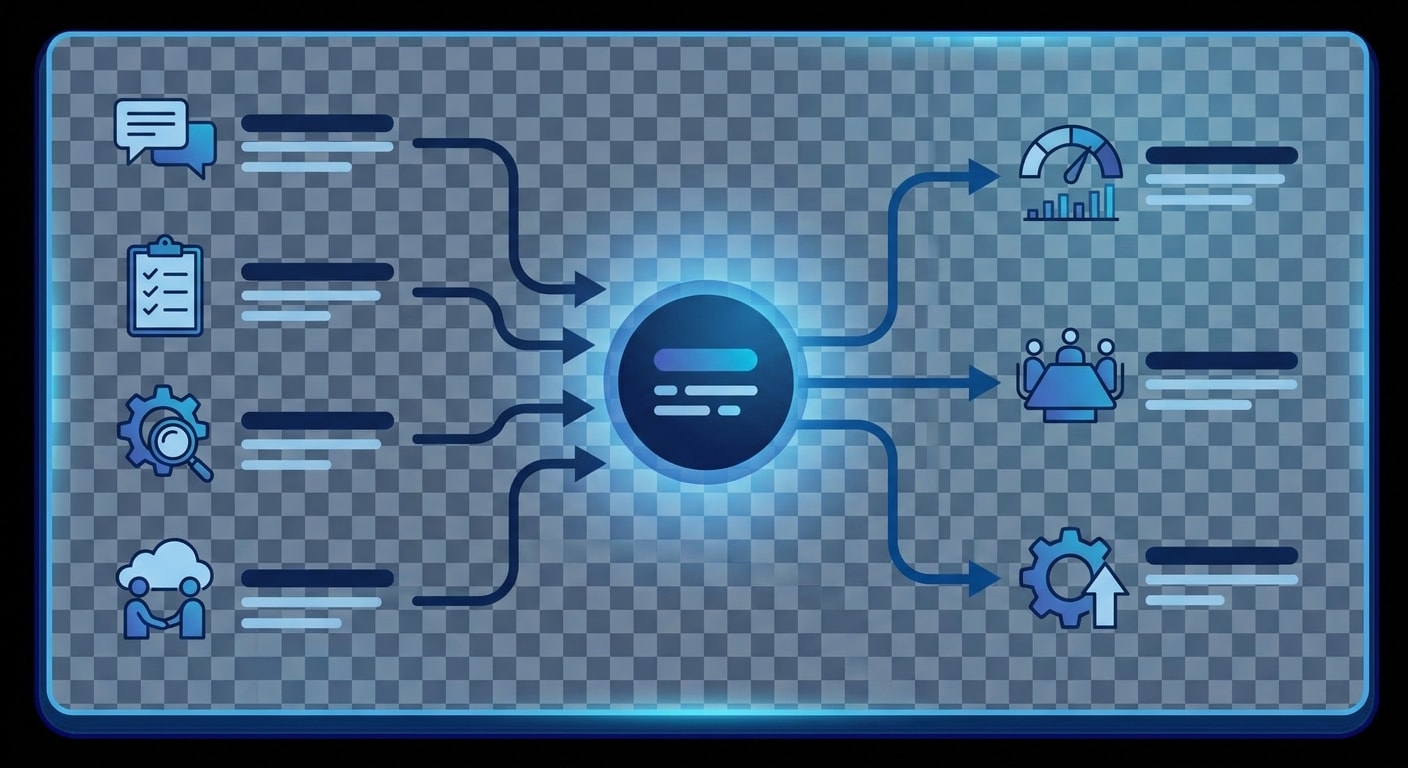
Flow diagram showing FM data moving from helpdesk, audits and asset systems into dashboards, review meetings and improvement actions
Start with the buyer's real anxiety
Before writing the MI section, ask what the buyer is nervous about.
In a school estate, they may worry about safeguarding, statutory compliance, reactive repairs disrupting lessons, cleaning standards and whether urgent issues are visible to the right people.
In healthcare, the anxiety may be uptime, infection control, critical assets, water safety, fire systems, engineering response times and patient-facing disruption.
In local government, it may be budget control, public complaints, councillor visibility, contract leakage, carbon reporting and whether small issues become political problems.
In social housing, it may be resident communication, damp and mould workflows, repairs backlogs, access failures, subcontractor control and evidence for regulators.
In corporate civic buildings, it may be hybrid occupancy, energy use, security, reception standards, supplier attendance and user satisfaction.
That context changes the MI answer.
A generic dashboard with red, amber and green boxes will not be enough. The evaluator wants to see that your reporting model reflects the service risk.
So open the section by naming the purpose of MI for this contract.
For example:
- For a hard FM tender, MI should prove statutory compliance, asset reliability, backlog control and risk escalation.
- For a cleaning tender, MI should prove quality consistency, labour coverage, audit outcomes and rapid corrective action.
- For an integrated FM contract, MI should connect operational performance to cost, energy, user experience and strategic estate decisions.
- For a PFI expiry contract, MI should prove inherited risk is being turned into accurate asset knowledge and governed service delivery.
That framing immediately feels more tailored than a recycled report list.
The four levels of a strong FM MI model
The easiest way to structure a management information response is to split it into four levels.
Each level has a different audience and a different decision rhythm.
1. Operational control
This is the day-to-day layer.
It covers helpdesk tickets, response times, PPM completion, missed tasks, open remedials, audit failures, complaints, attendance, subcontractor visits, permits, incidents and urgent risks.
The audience is usually the contract manager, helpdesk, supervisors, engineers, cleaners, site leads and buyer-side operational contacts.
The rhythm is daily or weekly.
Your bid should show how this layer prevents drift. If a statutory task is overdue, who sees it? If a cleaning audit fails, how quickly is the corrective action logged? If a reactive job is approaching breach, what alert is triggered? If a subcontractor misses attendance, how is the risk escalated?
Operational MI is not about polished slides. It is about live control.
2. Tactical contract management
This is the monthly service review layer.
It covers KPI performance, recurring issues, trend analysis, complaints, planned works, resource levels, risk registers, change control, customer satisfaction, savings, social value, sustainability and improvement actions.
The audience is usually the buyer's contract manager, supplier contract lead and service owners.
The rhythm is monthly.
Your bid should show how this layer turns raw data into management action. The monthly pack should not simply report that 91% of reactive jobs were completed on time. It should explain what drove the 9% that missed, what has changed since, and whether the issue is capacity, access, parts, asset condition, scope ambiguity or subcontractor performance.
That is what evaluators mean when they ask for meaningful MI.
3. Strategic estate insight
This is the quarterly or board-level layer.
It covers lifecycle trends, cost drivers, asset reliability, energy and carbon, major risks, investment priorities, contract value, innovation, user experience and forward planning.
The audience is usually senior estates leaders, finance, procurement, sustainability leads and directors.
The rhythm is quarterly, six-monthly or annual.
This is where many FM suppliers underwrite their value badly. They have useful data, but they only present it as contract performance. A stronger supplier turns it into estate intelligence.
For example, repeated reactive calls on the same air handling unit are not just helpdesk noise. They may show a lifecycle risk, an energy penalty, a comfort issue and a capital planning priority.
If your MI response shows that you can spot those patterns, you become more than a service provider. You become a better-informed partner.
4. Public accountability and audit
This is the transparency layer.
It covers evidence the buyer may need for internal audit, external audit, contract performance reporting, Procurement Act obligations, councillor questions, regulator enquiries, FOI responses, ESG reporting or board assurance.
The audience may not be in the room during the tender, but the buyer knows they exist.
Your response should show that reporting is not only designed for meetings. It is designed to leave a clear evidence trail.
That means version-controlled reports, action logs, KPI definitions, audit trails, data retention rules, named owners and consistent calculation methods.
When a buyer asks what happened six months ago, your MI model should answer without a panic search through emails.
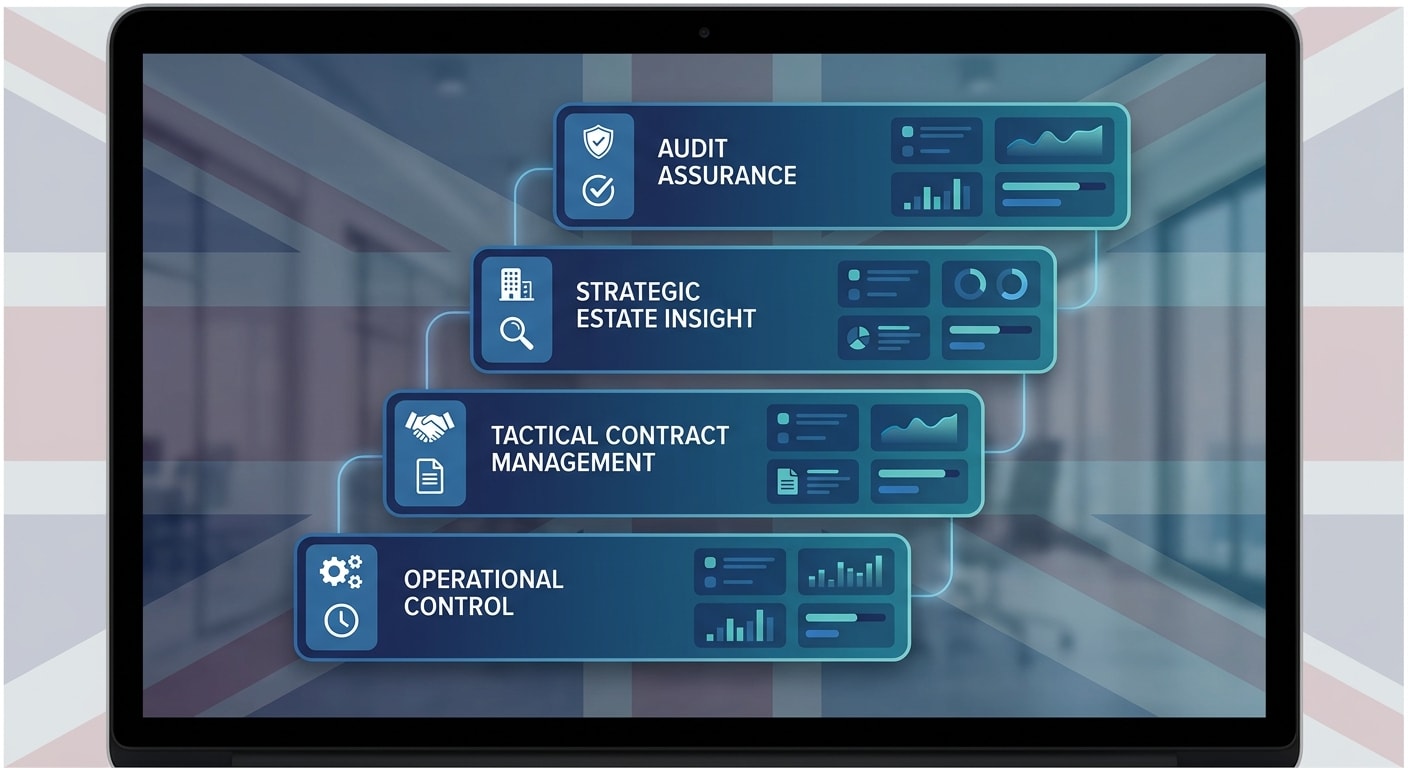
Four-level FM management information model covering operational control, contract management, estate insight and audit assurance
What to include in a facilities management dashboard
A dashboard should not be a wall of numbers.
The best dashboards make the important things obvious. They help the buyer understand what is on track, what is deteriorating, what needs a decision and what is being improved.
For most FM tenders, your dashboard evidence should cover eight areas.
1. Core KPI performance
Show the contracted KPIs clearly. Include targets, actual performance, trend direction and exceptions.
Do not stop at red, amber and green. Explain the rule behind each status. If a KPI is amber, what does that trigger? If it is red, who is accountable for recovery?
A dashboard without triggers is decoration.
2. Compliance and statutory assurance
For hard FM, this is usually the most sensitive section.
Include statutory PPM completion, overdue compliance tasks, remedial actions, water hygiene, fire safety systems, gas, electrical testing, lifts, pressure systems, asbestos management, permits and critical asset checks where relevant.
The buyer needs to see that compliance exceptions cannot hide inside normal work orders.
Separate them visually. Escalate them faster. Give them named owners.
3. Helpdesk and reactive performance
Include tickets opened, tickets closed, response times, completion times, first-time fix, repeat visits, ageing jobs, access issues, parts delays and priority categories.
The valuable part is not the volume. It is the pattern.
Are repeat calls rising in one building? Are urgent tasks clustering around a particular system? Are access failures causing SLA misses? Is a low-value repair creating a high-volume nuisance for users?
Your MI answer should show that you look for causes, not just counts.
4. Planned maintenance and resource control
Show PPM completion, missed visits, future workload, engineer allocation, cleaning attendance, supervisor coverage, training compliance and subcontractor attendance.
This helps the buyer see whether the service is being delivered as planned.
It also gives you evidence when something needs to change. If the scope has grown, occupancy has shifted or asset condition is worse than expected, resource MI can support a controlled conversation rather than a dispute.
5. Quality audits and customer experience
For soft FM, include audit scores, failed areas, corrective action closure, complaints, compliments, user satisfaction and service perception.
Quality scores should be linked to action. A cleaning score that drops from 94% to 87% is not useful unless the report explains why, who fixed it and whether the issue returned.
For public buildings, user experience matters because complaints rarely stay private. A good MI model helps the buyer respond before dissatisfaction becomes noise.
6. Financial and commercial visibility
Include spend against budget, variations, quoted works, approved works, open purchase orders, lifecycle spend, savings and cost avoidance.
Be careful here. Buyers do not want a supplier who hides behind complexity. They want clear commercial visibility.
If you can show how MI prevents cost surprises, your answer will feel more credible.
7. Sustainability and social value
Include energy use, carbon actions, waste, recycling, water consumption, local spend, apprenticeships, training, community activity and agreed social value commitments.
The key is to connect commitments to evidence. If the tender asks for carbon reduction, show the data that will prove reduction. If it asks for local employment, show how that will be tracked and reported.
This is especially important because social value and sustainability commitments are easy to promise and harder to evidence.
8. Risk, issues and improvement
Every dashboard should include risk and action visibility.
Show open risks, new risks, ageing actions, overdue actions, root cause themes, improvement initiatives and decisions needed from the buyer.
This is the part that separates a reporting pack from a management system.
If the MI pack only tells the buyer what happened, it is late. If it tells them what needs attention next, it is useful.
The KPI problem: fewer measures, better definitions
Many FM bids try to impress by offering too many KPIs.
That usually backfires.
A buyer does not need 60 measures that create a reporting burden and confuse the contract meeting. They need a focused set of indicators that reflect the contract's real risks.
In a tender response, explain how you will define KPIs before you report them.
For each important KPI, include:
- the purpose of the measure
- the calculation method
- the data source
- the reporting frequency
- the owner
- the target
- the tolerance range
- the escalation trigger
- the improvement action if performance drops
This matters because badly defined KPIs create arguments.
If response time starts when a ticket is raised in the helpdesk but the buyer thinks it starts when a user first calls reception, you have a problem. If completion means temporary repair to you but permanent fix to the buyer, you have another problem. If excluded events are not agreed, performance reporting becomes negotiation instead of control.
A strong MI response says how you will avoid that.
For example:
Before go-live, we will agree a KPI dictionary covering definitions, inclusions, exclusions, source systems, reporting cut-off dates and escalation routes. The dictionary will be reviewed at mobilisation, confirmed at the first contract board and controlled through change governance.
That sounds boring. It scores because it prevents pain.
Data quality is the bit evaluators quietly care about
Dashboards are only as good as the data underneath them.
If engineers close jobs with vague notes, the trend analysis will be weak. If cleaning audits are scored inconsistently, the buyer will not trust the figures. If asset registers are out of date, PPM reporting becomes unreliable. If subcontractor updates arrive late, the report is already stale.
So write about data quality.
This is often where you can gain easy marks because many competitors skip it.
Explain:
- who enters the data
- what validation rules apply
- which fields are mandatory
- how missing information is chased
- how audit samples are checked
- how data errors are corrected
- how system access is controlled
- how duplicate records are avoided
- how asset and location naming is standardised
- how the buyer can challenge a report
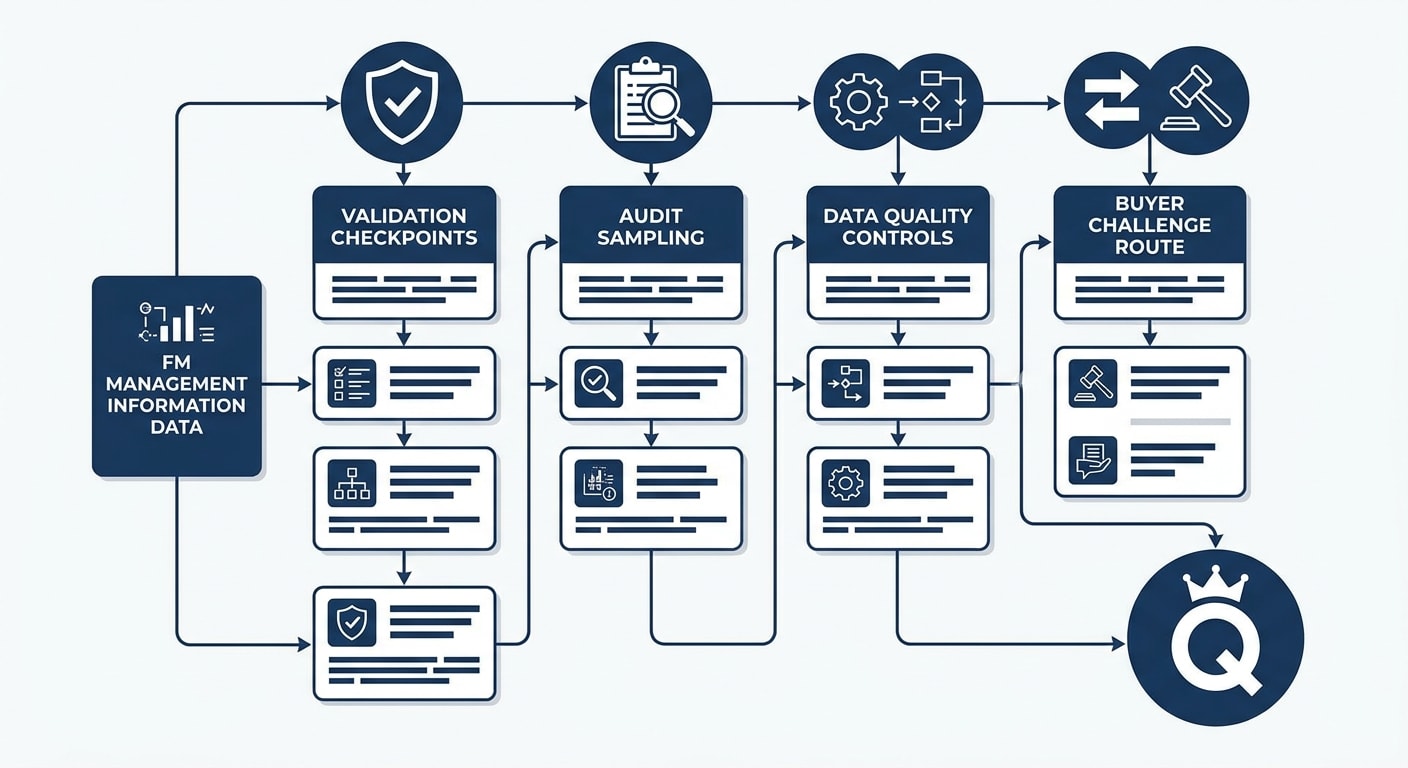
Quality assurance checklist for FM management information data showing validation, audit sampling and buyer challenge routes
For hard FM, data quality should be linked to asset hierarchy. If locations, assets and tasks are not structured properly, reporting will not tell the buyer where risk sits.
For soft FM, data quality should be linked to audit consistency. If supervisors score differently across sites, the buyer cannot compare performance fairly.
For integrated FM, data quality should be linked to governance. Different service lines need shared definitions, otherwise the monthly report becomes a collage of incompatible numbers.
You do not need to overcomplicate it. Just show that you understand the weak point: MI fails when the data is not trusted.
How to write the tender answer
A good MI response should have a clear structure.
Here is a practical order that works for most FM tenders.
1. Open with the purpose
Start by stating what MI will do for this buyer.
For example:
Our MI model will give the authority daily operational control, monthly contract assurance and quarterly estate insight. It will show performance against agreed KPIs, highlight exceptions early, evidence statutory compliance and convert recurring issues into corrective actions.
That is stronger than opening with your software.
Software matters, but purpose comes first.
2. Map information to decision levels
Use the four-level model: operational, tactical, strategic and audit.
This shows the evaluator that different audiences get different information. The site supervisor does not need the same pack as the estates director. The finance lead does not need the same view as the helpdesk manager.
3. Define the reporting rhythm
Explain what the buyer receives daily, weekly, monthly, quarterly and annually.
A simple rhythm might be:
- Daily: live exception view for urgent jobs, statutory risks and service failures.
- Weekly: operational summary, open actions, complaints, resource gaps and upcoming PPM risk.
- Monthly: contract review pack with KPIs, trends, root causes, risks, financials and improvement actions.
- Quarterly: strategic review covering asset performance, cost drivers, carbon, lifecycle risk and innovation.
- Annual: performance summary aligned to contract objectives, audit requirements and forward planning.
The point is not to drown the buyer in reports. The point is to show controlled cadence.
4. Explain escalation
Every MI section needs escalation logic.
If a KPI drops, what happens? If an action is overdue, who intervenes? If a compliance task is missed, how fast is it escalated? If complaints rise, who reviews the cause?
Be specific.
Weak answer: issues will be escalated to senior management where required.
Strong answer: red KPI exceptions are reviewed within one working day by the contract manager, assigned a corrective owner, logged in the action tracker and reviewed at the next operational call. Statutory compliance exceptions are escalated immediately to the account director and buyer contract lead with a recovery plan and target closure date.
The second answer shows control.
5. Link MI to continuous improvement
Continuous improvement sections often feel detached from reporting. Bring them together.
Explain how MI identifies improvement opportunities:
- repeat defects
- high-cost assets
- recurring complaints
- avoidable reactive work
- access problems
- repeated audit failures
- energy hotspots
- training gaps
- supplier delays
- scope mismatch
Then explain how those insights become actions.
This can be simple: root cause review, action owner, benefit estimate, implementation date, measured outcome.
The buyer wants to know that MI does not just describe yesterday's problem. It improves tomorrow's service.

Bid team turning FM reporting requirements into a scored tender response structure
How to make the answer feel specific
The quickest way to weaken an MI response is to write as if every buyer wants the same report. They do not.
A university estate, a council depot, a hospital wing, a leisure portfolio and a police headquarters may all ask for management information. The scoring logic behind the question will be different.
So adapt the evidence around three things: service risk, buyer role and contract maturity.
Service risk means the consequences of poor visibility. In hard FM, poor visibility can mean missed statutory tasks, plant failure or avoidable disruption. In soft FM, it can mean inconsistent standards, public complaints or workforce gaps. In security, it can mean incident escalation and audit trails. In waste, it can mean missed collections, contamination, recycling performance and customer contact.
Buyer role means who will use the information. A contract manager needs exceptions, actions and evidence. A finance lead needs cost movement and variation control. An estates director needs trends, risks and investment priorities. A sustainability lead needs carbon, waste and energy data they can defend.
Contract maturity means whether the buyer already has good information. Some tenders will come with clean asset registers and mature KPIs. Others will come with inherited uncertainty, disputed baselines and poor historic reporting. In the second case, your MI answer should explain how you will build the baseline, not pretend perfect reporting starts on day one.
That honesty helps. Evaluators trust suppliers who can distinguish between a steady-state contract and a messy transition.
Examples of stronger wording
Here are a few examples you can adapt.
For hard FM:
We will separate statutory compliance reporting from general work order reporting so that overdue compliance tasks cannot be masked by strong overall SLA performance. The dashboard will show statutory PPM completion, open remedials, overdue actions, responsible owners and target closure dates. Any statutory exception will trigger same-day escalation to the contract manager and buyer representative, supported by a recovery note and evidence upload once closed.
For soft FM:
Cleaning quality audits will be reported by building, floor and functional area so the authority can see patterns rather than average scores. Failed audit items will generate corrective actions with photo evidence, owner, due date and closure confirmation. Monthly reports will show repeat failure themes, labour coverage, complaints and user feedback so that quality issues are addressed before they become persistent dissatisfaction.
For integrated FM:
The monthly report will combine service KPIs, financial position, risk, energy, asset performance, user feedback and social value delivery into one contract pack. This gives the authority a single view of service health and removes the need to reconcile separate hard FM, soft FM and commercial updates.
For PFI expiry or inherited estates:
During mobilisation, MI will focus on inherited risk: asset data gaps, handback issues, open remedials, compliance records, lifecycle priorities and service continuity. The first 90 days will include a weekly transition dashboard so the authority can see how legacy uncertainty is being converted into verified contract data.
What evidence to attach or describe
If the tender allows appendices, include sample evidence.
Good examples include:
- a sample monthly contract report
- a dashboard mock-up
- a KPI dictionary extract
- a sample action tracker
- a compliance exception report
- a root cause analysis template
- a quarterly business review agenda
- a continuous improvement log
- an asset risk heatmap
- a mobilisation reporting pack
Do not attach everything. Choose evidence that supports the scoring criteria.
If the buyer asks about compliance, show the compliance exception report. If they ask about innovation, show how MI identifies and tracks improvements. If they ask about governance, show the meeting rhythm and action tracker.
The appendix should make your written answer feel real.
How mytender.io helps bid teams write better MI answers
Most bid teams already have the ingredients for a strong MI response. The problem is finding them quickly.
The useful evidence is usually scattered across previous monthly reports, mobilisation packs, contract review decks, helpdesk exports, audit templates, improvement logs and old tender responses.
That is exactly where a bid platform helps. With mytender.io, teams can organise proven MI content, reuse the best examples, check whether the answer actually addresses the question and build first drafts from evidence rather than starting with generic reporting language.
The product is not a substitute for operational judgement. It is a way to stop good evidence getting lost.
That matters because MI sections are often written late. By then, the bid team is tired, the dashboard owner is busy and someone reaches for an old paragraph about transparent reporting.
A stronger process brings the evidence forward.
A practical MI response checklist
Before you submit, check the answer against these questions.
- Have we explained the purpose of MI for this contract?
- Have we tailored the dashboard to the buyer's service risks?
- Have we shown operational, tactical, strategic and audit reporting levels?
- Have we defined the reporting rhythm?
- Have we explained KPI definitions and data sources?
- Have we shown how data quality is protected?
- Have we separated statutory compliance from general service performance?
- Have we explained exception escalation?
- Have we linked reporting to continuous improvement?
- Have we included sample evidence if allowed?
- Have we avoided vague phrases like transparent reporting without proof?
- Have we shown what the buyer can do with the information?
If the answer only says what reports will be issued, rewrite it.
If it shows how MI protects service, cost, compliance and confidence, you are much closer.
The final point: MI is where delivery credibility shows up
Tender evaluators know that anyone can promise good performance.
Management information is where that promise becomes testable.
In 2026, that matters more than ever. Public sector buyers need contracts they can defend, measure and improve. FM suppliers need to show they can operate in a world where KPIs, performance, transparency and public value are not just contract management topics. They are bid-winning topics.
The winning MI response does not say, we will provide monthly reports.
It says: here is how we will know what is happening, how we will act when performance moves, and how you will have the evidence to trust the service.
That is the story evaluators want to hear.
If you want to find live FM and public sector opportunities to practise this against, the Tender Finder is free to use. Search by sector, buyer or service line, then use the tender documents to pressure-test whether your MI evidence is ready before the deadline arrives.
Tags
Ready to Transform Your Tender Writing?
See how MyTender's AI can help you write winning tenders in a fraction of the time.