
Five Signs Your Bid Function Is Under-Performing (and What to Do About It)
Your bid team is busy. But busy isn't the same as effective. Here are the five clearest signs your bid function is costing you contracts — and the fixes that actually move the dial.
mytender.io Research Team
Tender Writing & Bid Management Specialists
Five Signs Your Bid Function Is Under-Performing (and What to Do About It)
You have people writing bids. You're submitting regularly. But the contract wins aren't coming through at the rate you need.
Sound familiar? You're not alone. Most businesses with an established bid function still leave significant revenue on the table — not because they lack talent, but because the function itself has structural problems nobody's had time to address.
Here are the five signs that tell you something's wrong, and what to actually do about it.
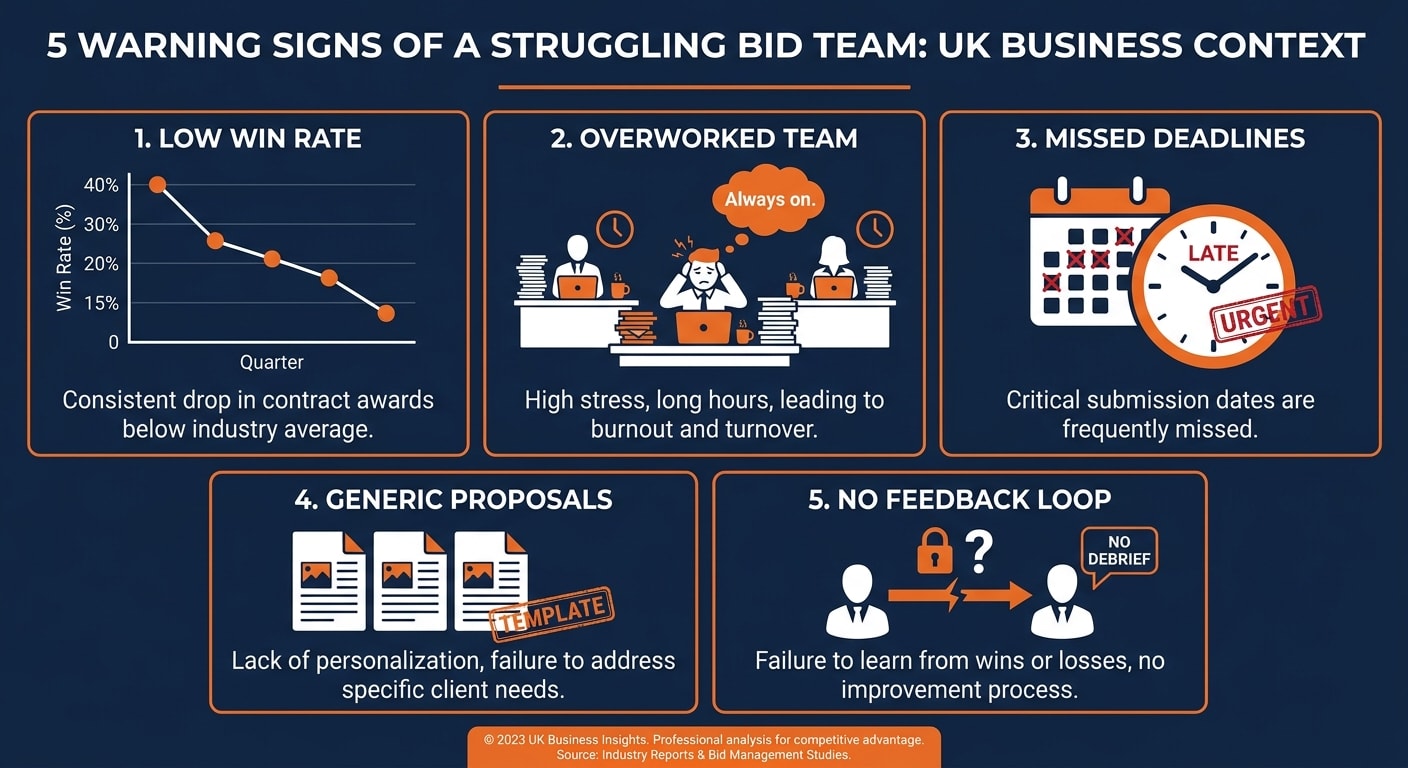
Warning signs of an under-performing bid team
Sign 1: Your Win Rate Hasn't Moved in 12 Months
A healthy bid function gets better over time. You learn what evaluators reward. You refine your responses. Your win rate climbs.
If yours has been flat — or you don't actually know what it is — that's a problem.
What's really going on: Without a systematic debrief process, each bid is effectively a one-off. You're putting in the same effort and getting the same results because nothing is feeding back into the next submission.Average UK tender win rates sit around 25–30% for established bidders. High-performing teams push above 40%. If you're consistently below 20%, the issue isn't luck.
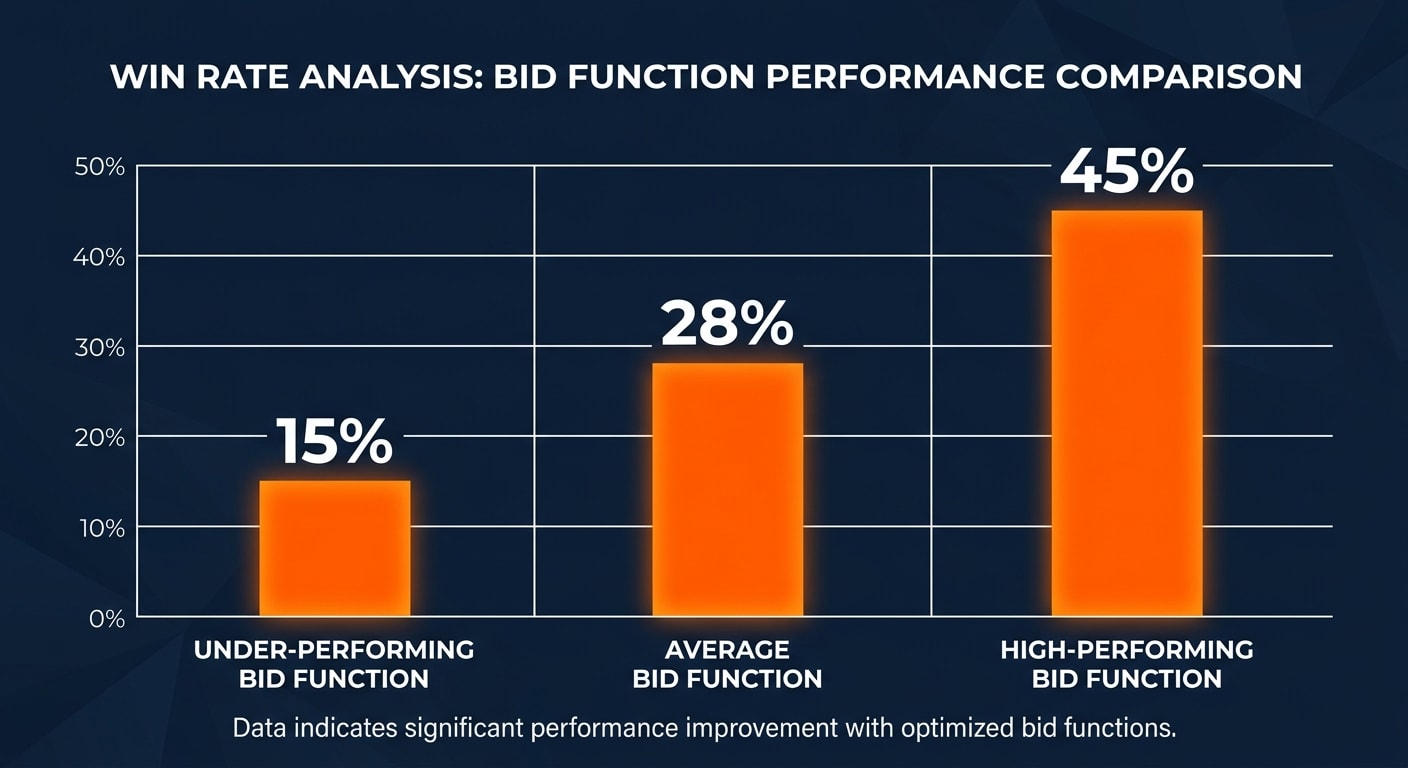
Win rate comparison: under-performing vs average vs high-performing bid functions
If you're not requesting debriefs, you're throwing money away. Evaluator feedback is the most direct intelligence you'll ever get on what's working and what isn't.
Sign 2: Your Writers Are Constantly Scrambling
You can tell a lot about a bid function by how calm it is the week before submission.
If the answer is "not very," that's not a sign your team works hard. It's a sign of poor pipeline management and insufficient lead time.
What's really going on: Most bid teams get proper sight of an opportunity far too late. By the time the ITT lands, there are three weeks to deadline and everyone is reactive. The writing is rushed, the quality shows, and the evaluator can tell.The better bid functions have already mapped out the requirement six months before tender. They know the client. They've shaped the content. When the ITT drops, they're polishing rather than starting.
The fix: Enforce a minimum qualifying lead time. If a live opportunity has less than four weeks to ITT return and you don't already have quality material prepared, that's a bid to walk away from.It sounds counterintuitive, but turning down poorly timed opportunities frees up capacity for the ones you can actually win. Submitting a rushed bid costs you the same time as a good one — but costs you the contract too.
Sign 3: Every Bid Starts From Scratch
Open your last five tender responses. How much of the content is genuinely new versus recycled from previous submissions?
If the answer is "almost all of it is new every time," your bid library isn't doing its job.
What's really going on: Writers default to the blank page because the existing material either doesn't exist, is hard to find, or is out of date. So they write the same TUPE summary, the same quality management section, the same health and safety narrative — every single time.That's not just wasteful. It introduces inconsistency. Different writers produce different answers to the same questions, and quality varies unpredictably.
The fix: Build a structured content library and commit to maintaining it. This means:- Standard sections for the questions that appear in every tender (quality, H&S, sustainability, social value, TUPE)
- A live bank of case studies, refreshed after every delivered contract
- CV templates for key personnel, kept current
- A review cycle (quarterly minimum) so nothing sits stale for more than three months
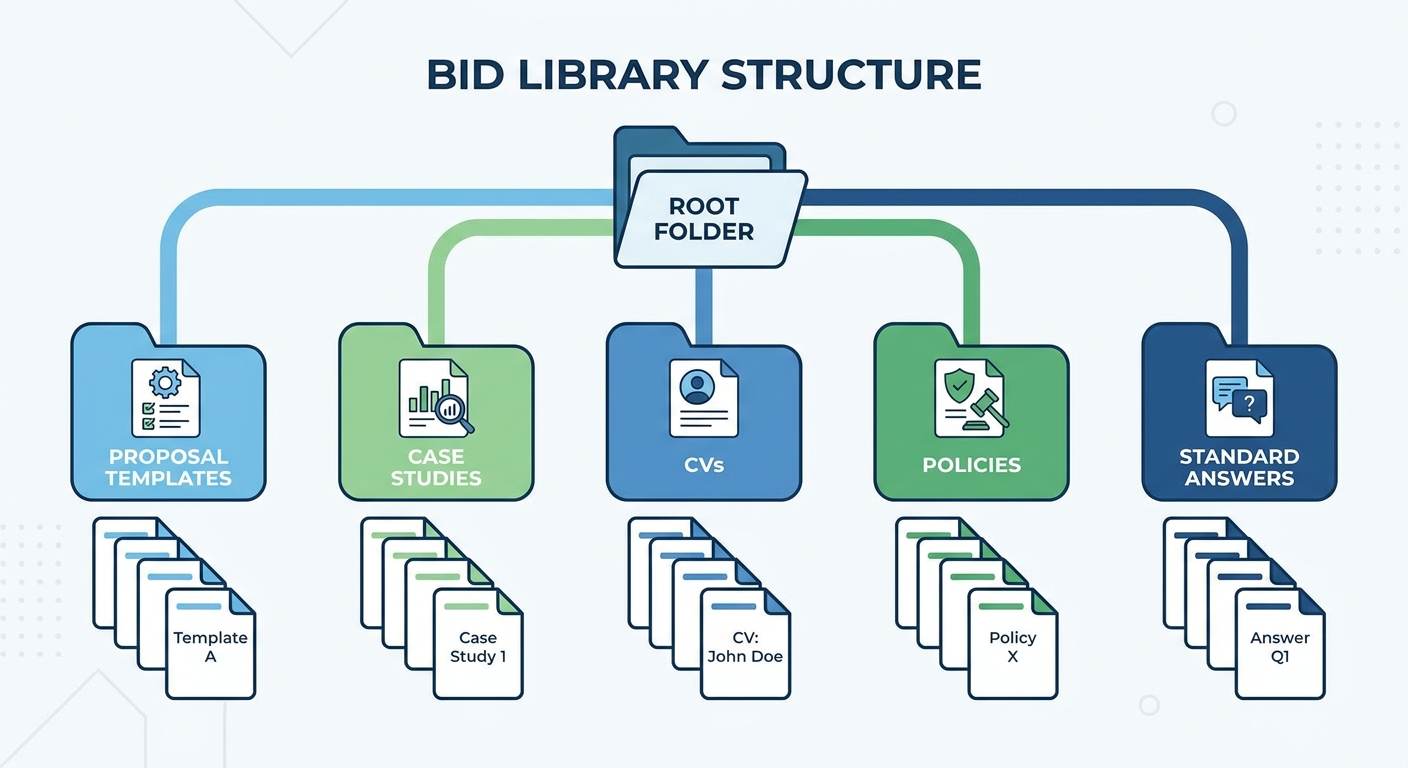
A well-structured bid content library with organised templates, case studies and policies
A good bid library doesn't eliminate writing. It means your writers spend time on the 30% that needs to be bespoke, not the 70% that's been answered competently before.
Sign 4: You're Bidding for Everything
If your bid team is working flat out but your pipeline doesn't seem to be filling up, the problem might be volume rather than output.
A function that bids for 40 opportunities a year and wins 10 is often less effective than one that bids for 20 and wins 9. Less volume, similar revenue, and significantly less burn.
What's really going on: Without a formal bid/no-bid process, the default answer to most opportunities is yes. The team is too busy to pause and properly assess whether an opportunity is actually winnable. So they submit, lose, and repeat.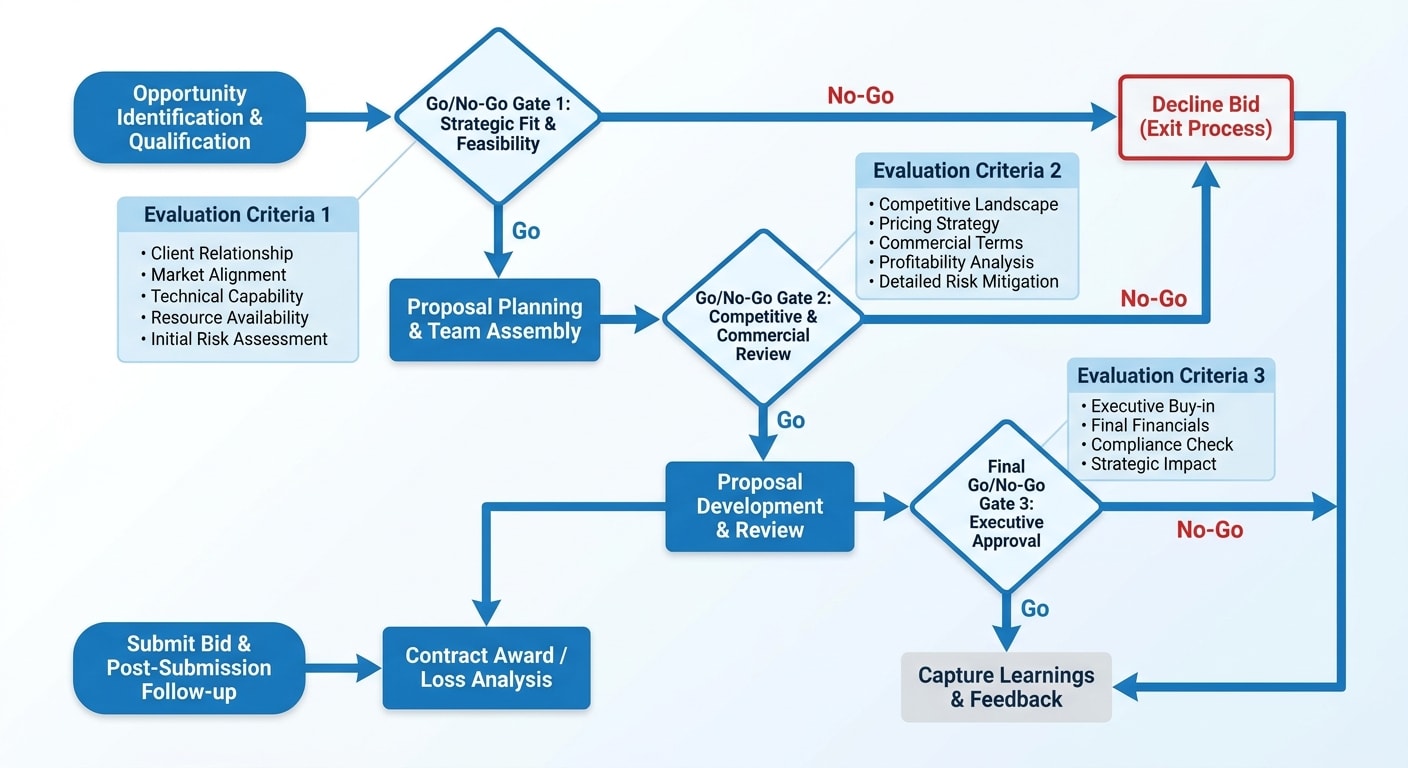
Bid/no-bid decision process with evaluation gates and go/no-go criteria
- Relationship with the client (have you spoken to them? Do they know you?)
- Relevant experience (can you evidence it directly?)
- Commercial fit (is the contract value worth the bid cost?)
- Competition (who else is likely bidding? Do you have a credible edge?)
- Timing (is there enough lead time to bid well?)
A score below a defined threshold should trigger a no-bid decision, not an override. The framework only works if you enforce it.
This is one of the most uncomfortable conversations in any commercial team because no-bid feels like leaving money on the table. It isn't. It's protecting the capacity to win the bids you should be going for.
Sign 5: You Don't Know Your True Bid Cost
If you were asked right now what it costs you to submit a tender response, could you answer accurately?
Most businesses can't. And that matters, because if you don't know the cost, you can't assess whether the function is generating a return.
What's really going on: Bid costs are largely invisible because they sit in people's time, not a visible budget line. The bid writer's salary is a fixed cost whether they're working on tenders or something else. So the opportunity cost of bid writing gets ignored.But consider a mid-complexity public sector bid: a bid manager, a bid writer, subject matter experts reviewing drafts, a commercial person pricing it, someone proofreading. You're realistically looking at 150–250 hours of staff time. At average UK professional salaries, that's £6,000–£12,000 per bid.
If you're submitting 30 bids a year and winning 6, you're spending roughly £270,000 in staff time to win £60,000 worth of successful bids. The maths only work if the contract values are large enough.
The fix: Start tracking bid cost per submission. You need three numbers: hours invested, win rate, and average contract value. With those, you can calculate your cost per win and your return on bid investment.Most teams that do this for the first time are surprised how quickly it makes the case for better tools, more capacity, or a stricter no-bid process.
The Common Thread
Every one of these signs has the same root cause: the bid function is reactive rather than strategic.
Reactive bid functions respond to opportunities. Strategic bid functions shape them. They're involved in client relationships before tenders are published. They're building the evidence base for the questions they know will come. They're using data to decide where to compete and where to step back.
The shift from reactive to strategic doesn't require a headcount increase. It requires process, discipline, and the right tools.
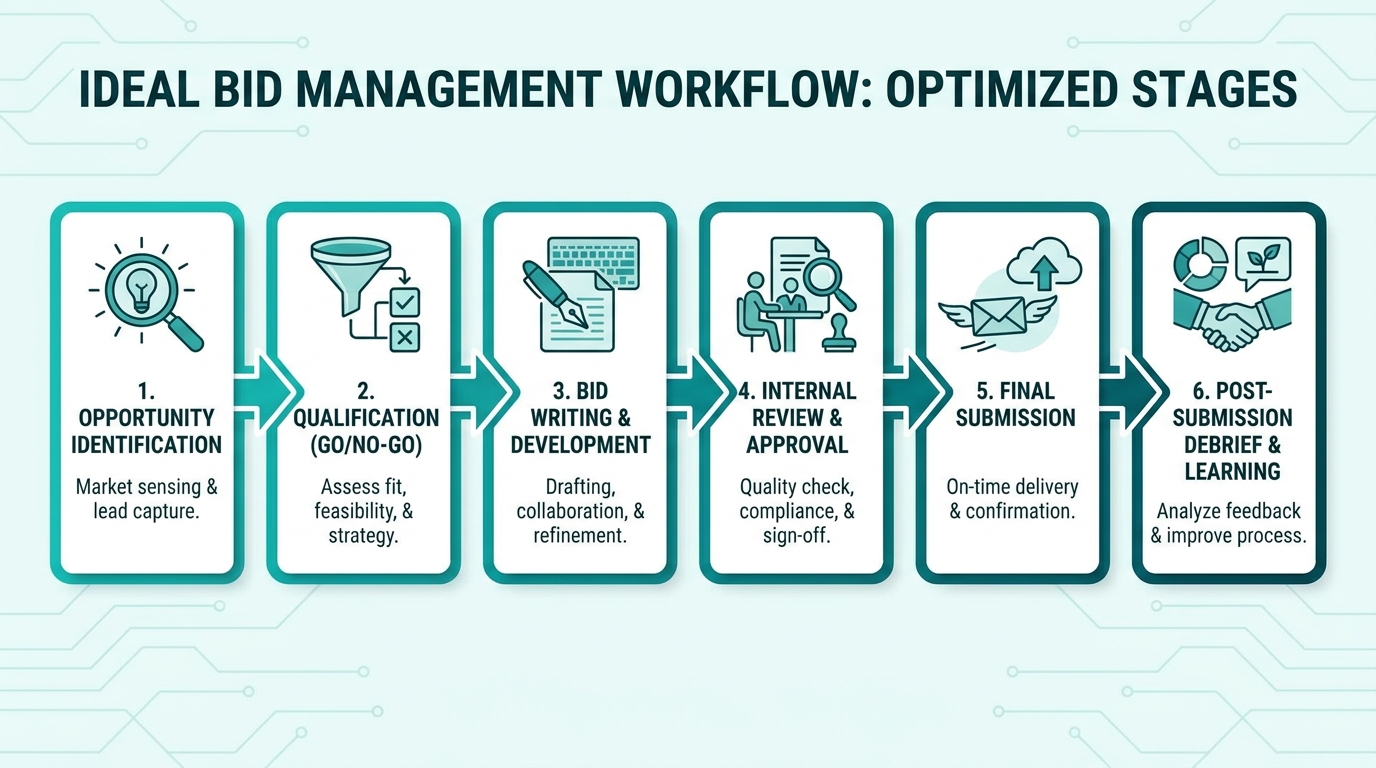
The ideal bid management workflow from opportunity identification through to debrief
Where to Start
If more than two of these signs apply to your function, don't try to fix everything at once. Pick the one that's costing you the most and start there.
For most teams, that's the debrief process. It costs almost nothing to implement, it's systematic, and it starts feeding intelligence into every subsequent bid immediately.
The second highest-impact move is usually the bid/no-bid framework. The time you stop spending on unwinnable bids goes straight into the ones you can actually convert.
If you want to see what live opportunities are out there that match your sector and capabilities, the Tender Finder is free to use and updated daily. It won't fix your bid function overnight, but having the right pipeline to work from is the first step.
The businesses winning contracts consistently aren't the ones with the most resource. They're the ones who've made the bid function work properly.
Tags
Ready to Transform Your Tender Writing?
See how MyTender's AI can help you write winning tenders in a fraction of the time.