
Evidencing Relevant Project Experience Without Recycling the Same Three Case Studies
A practical guide for construction bid managers on how to evidence project experience that genuinely matches the tender, build a richer case study library, and stop relying on the same three trusted projects every time.
mytender.io Research Team
Tender Writing & Bid Management Specialists
Evidencing Relevant Project Experience Without Recycling the Same Three Case Studies
It is Tuesday afternoon, the deadline is Friday, and the bid manager is staring at the relevant experience question for the fourth time this quarter. Three case studies sit in a folder on the shared drive. They are the safe ones. The school refurb in Leeds, the leisure centre in Bristol, the social housing scheme in Manchester. Every bid, every framework, every PQQ. The same three projects, lightly reformatted. The same metrics, the same client quotes, the same outcome paragraph.
Everyone in the bid team knows the truth nobody wants to say out loud: those three case studies are doing too much work. They were great projects, but they are not always the right projects for the tender on the desk. Some of the time they are barely a match at all. The bid manager knows it. The bid writer knows it. The technical lead probably knows it too. The evaluator definitely knows it.
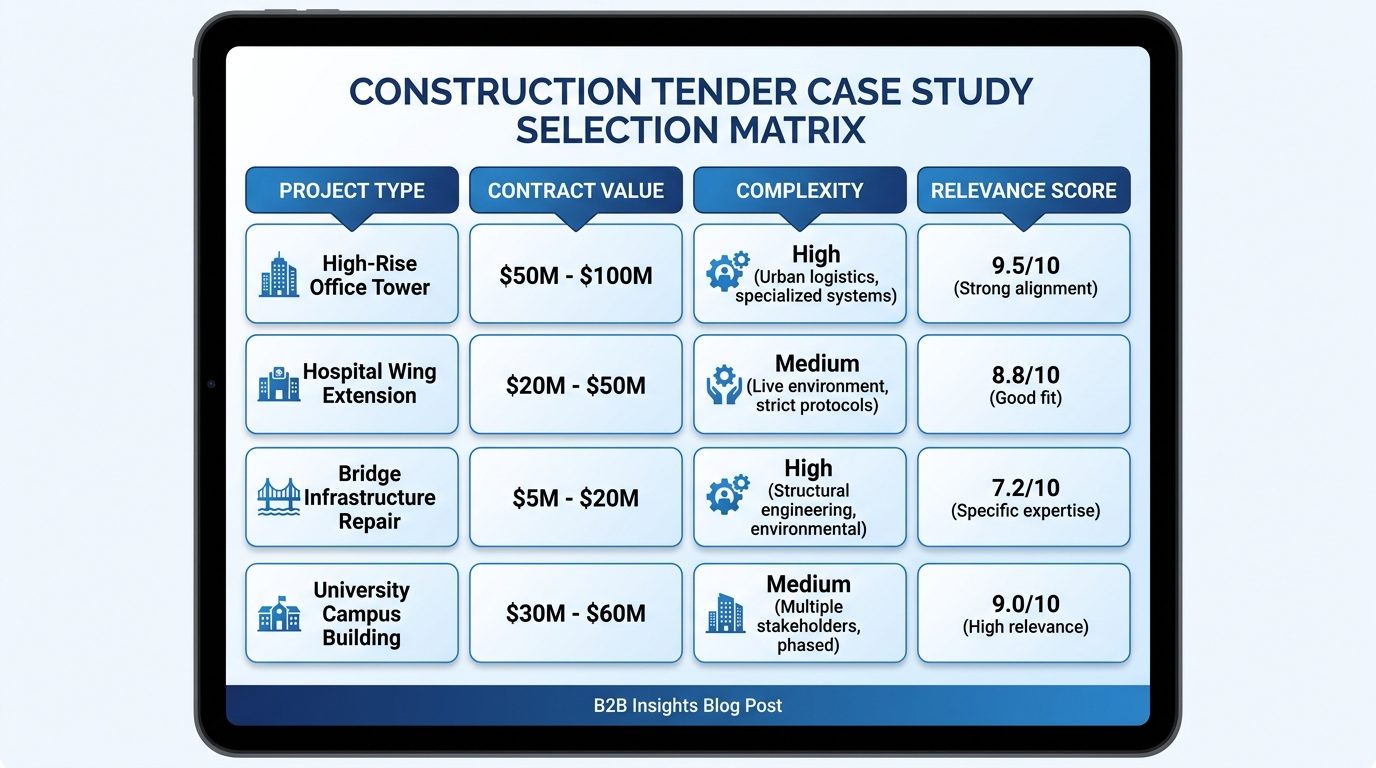
Construction case study selection matrix for tenders
If that scene feels familiar, this guide is for you. Recycling the same case studies is one of the most common scoring leaks in UK construction bids, and it is also one of the most fixable. The fix is not "find better projects". The fix is structural: a case study library that is broad enough to match almost any tender, a selection process that is honest about relevance, and a writing technique that makes each case study feel specific to the contract in front of you, not pulled from a folder. This piece walks through all three.
Why Recycling the Same Case Studies Costs You Marks
The reason most bid teams recycle case studies is rational. The trusted three are written, signed off, image-cleared, and reference-approved. Every other project on the books is a half-finished draft, an outdated paragraph in last year's bid, or worse, nothing on file at all. When the deadline closes in, the safe option wins. The same three projects go in again.
The problem is that public sector evaluators read a lot of bids. On a busy framework, an evaluator might read forty relevant experience submissions in a fortnight. They notice patterns. They notice when a contractor's case studies do not move with the question. They notice when a project from 2019 is still being held up as the best evidence in 2026. They notice when the social value section references a project with no social value commitments, or when the net zero question is answered with a case study from before the decarbonisation strategy existed. None of this is conscious scepticism. It is the natural calibration that any experienced evaluator does as they work through a pile.
The scoring impact comes through three mechanisms. First, relevance scoring. Most modern tenders explicitly score how closely the example matches the contract in question, not just whether the example is competently described. A perfectly written case study about a sports hall scores poorly when the tender is for hospital decant works. Second, freshness. Several frameworks now require examples completed within the last three to five years, and even where they do not, evaluators notice when the most recent project on offer is half a decade old. Third, breadth. When the same three case studies appear across different question themes (technical, social value, sustainability, mobilisation), the response loses depth. The evaluator concludes the bidder has only one or two flagship projects, not a portfolio.
The result is the same response that scores 70 percent on the technical question scoring 50 percent on the experience question, because the case study choice was wrong. That ten or twenty point gap is the difference between making the shortlist and not.
What Evaluators Are Actually Looking For in Project Experience Sections
Before fixing the library, it helps to be clear on what evaluators are scoring. The evaluation criteria are usually published in the ITT, but the wording is generic ("provide three case studies of relevant experience completed in the last five years"). The actual mental model the evaluator applies is more specific.
Evaluators are testing four things at once when they read a project experience section.
Relevance to the contract. Does the case study match the contract in scope, value, sector, geography, and complexity? A six-storey new build does not evidence experience for an occupied refurbishment. A 5 million pound contract does not evidence delivery at the 50 million pound level. Public sector evaluators are increasingly explicit about wanting like-for-like evidence, and they will flag a mismatch even when the case study is well-written. Recency. When was the project completed? Recent work demonstrates current capability, current supply chain relationships, and current operational systems. A project from 2018 is technically within most five-year windows in 2026, but it sits at the edge. Where you have a choice, choose the more recent example. If you must use older work, explain why (a unique scope match, a flagship outcome that has not been replicated since), so the evaluator does not have to guess. Outcomes, not just deliverables. A case study that says "we built a 200-unit housing scheme on time and on budget" describes deliverables. A case study that says "we built a 200-unit housing scheme, achieved 22 percent fabric energy efficiency improvement against benchmark, secured 14 percent local labour spend, and the tenant satisfaction survey at handover scored 92 percent" describes outcomes. Evaluators score outcomes much higher because they evidence what good looks like, not just what you did. The story of how it was achieved. The strongest case studies do not just present results. They explain the mechanism: the design choice, the planning move, the supply chain decision, the early stakeholder engagement that produced the result. This is what separates a Level 3 case study from a Level 4. The Level 4 case study tells the evaluator something they could apply to their own contract.A case study that ticks all four (relevant, recent, outcome-rich, mechanism-explained) is in scoring band 4. A case study that is well-written but not relevant is in band 2 or 3 regardless of how good the writing is. Selecting the right project matters more than polishing the wrong one.
Building a Diverse Case Study Library
The structural fix is to build a case study library that is broad enough that you almost never have to compromise on relevance. This sounds like a six-month project. It is not. With the right system, a small bid team can move from three case studies to thirty in a quarter, and from thirty to a working library that covers most tender scenarios within a year.
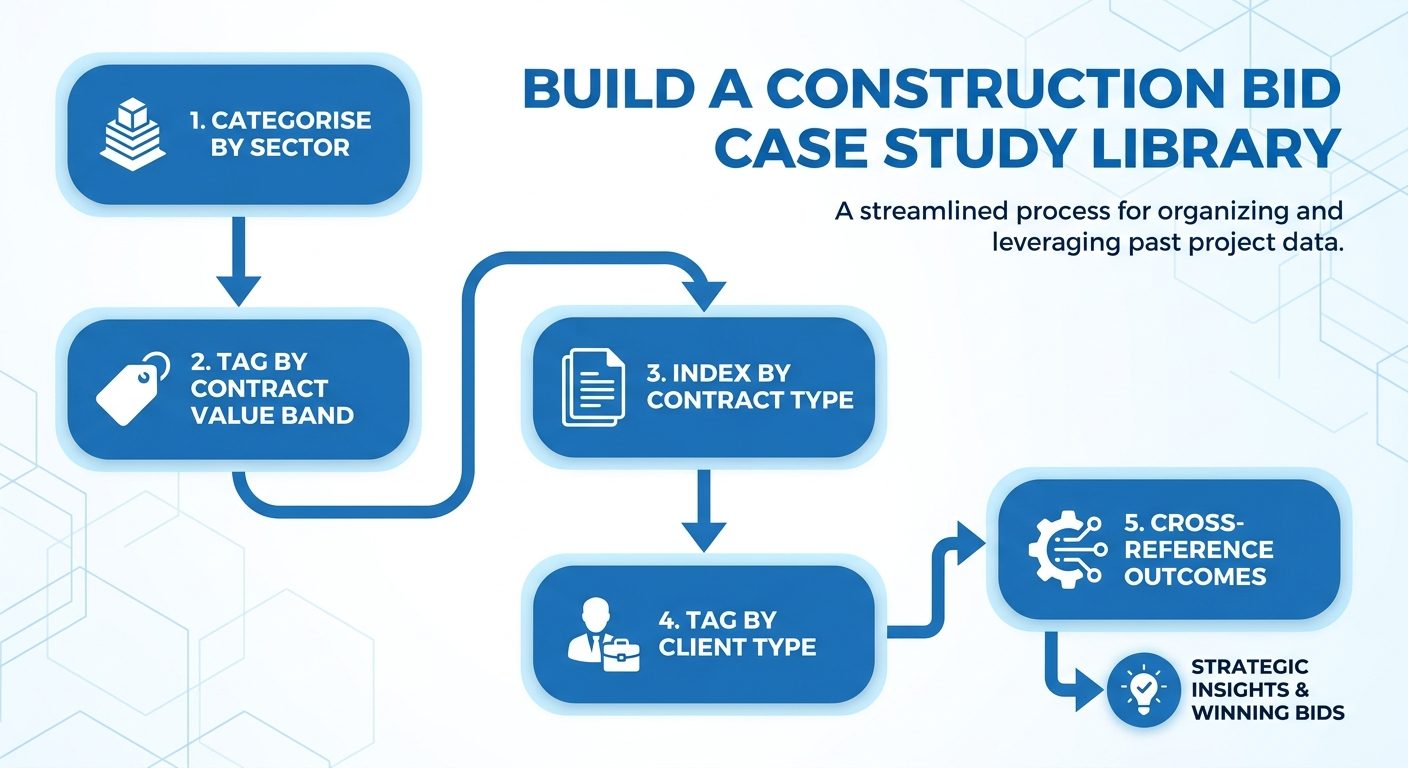
Building a construction bid case study library
The principle is to index every project the business has delivered in the last five years across multiple dimensions, so that any tender can be matched to several candidate case studies, not just the trusted three. The dimensions that matter most for UK construction tenders are:
Sector. Education (primary, secondary, FE, HE), healthcare (acute, community, mental health), housing (social, PRS, affordable, mixed tenure), commercial, leisure, defence, blue light, industrial, heritage, civic. Tenders almost always score sector match, and within sector, sub-sector match (a primary school is not always strong evidence for a sixth form college, depending on the question). Contract value band. Sub 1 million, 1 to 5 million, 5 to 20 million, 20 to 50 million, 50 to 100 million, 100 million plus. Many tenders explicitly require examples within a value band, and even where they do not, like-for-like value is a strong relevance signal. Contract type. Traditional, design and build (single stage and two stage), management contracting, construction management, ECI, framework call-off, JCT vs NEC. The risk profile of the contract type maps directly to several common evaluation themes (risk management, cost certainty, programme certainty). Client type. Local authority, NHS trust, housing association, central government, MoD, education trust, private developer, charity, university. Public sector evaluators favour examples with comparable client types because they evidence familiarity with their procurement and approval rhythms. Delivery context. New build, refurbishment, fit-out, extension, alteration, demolition, restoration, mixed. Occupied versus vacant. Live operational environment versus closed site. Phased versus single phase. Themed evidence flags. Tag each project for the themed responses it can support: social value (with quantified outcomes), modern slavery, BSA-relevant work, CDM compliance, net zero and embodied carbon, MMC and offsite, BIM Level 2 or ISO 19650, lifecycle costing, TUPE on transition, supply chain SME spend, apprenticeship outcomes, design for manufacture, heritage and listed status. A single project might be tagged for five or six themes, which is what allows the same project to feed multiple bid sections without recycling the same paragraphs. Outcomes. Quantified results across cost, time, quality, safety, social value, and sustainability. The case study library should capture the actual numbers (variation account, programme delivered, defects at handover, RIDDOR rate, social value metrics, embodied carbon outcome, energy in use), not just adjectives.The mechanic for building the library is to run a 30 to 45 minute structured interview with the project manager or commercial lead for each completed project, capture the answers in a standard template, and then progressively enrich each entry as new themes become important. Most construction firms have project closeout meetings already; embedding the case study capture into that ritual takes the workload away from the bid team and puts it where the knowledge lives.
The single highest-value habit a bid function can build is making case study capture part of project closeout, not a panic activity at bid time.
A Case Study Selection Matrix
Once the library exists, the next problem is selection. Faced with thirty candidate case studies and a tender asking for three, which three? The answer is not "the most recent" or "the highest value" or "the ones the technical lead likes". It is a structured match against the question, scored on the same dimensions the evaluator will use.
The simplest tool is a 1 to 5 scoring matrix across four columns: sector match, value match, contract type match, and theme match for the specific question. Each candidate case study scores 1 to 5 in each column, total out of 20, and the top three (or two and a wildcard) go into the bid. The wildcard is sometimes worth using; a case study that scores 12 on the matrix but contains a single uniquely strong outcome story can outperform a 16-scorer that is solid but unmemorable. Use judgement, not just the numbers.
The discipline this matrix imposes is honesty. When a bid team writes "this is the best example we have" without comparing it against the rest of the library, the answer is usually wrong. When the library and the matrix exist together, "best" becomes a measurable claim, and the trusted three stop dominating by default.
A second test, once the three case studies are selected, is the substitution test. Could the contracting authority's name be swapped into any of the case studies and the case study still read as relevant? If yes, the case study is too close to the question and probably the right pick. If the substitution makes the case study look absurd (because it is for a completely different scope, sector, or value), the case study is wrong and another one needs to come up the list.
Writing Technique: Making Each Case Study Feel Fresh and Specific
Even with the right case studies selected, the writing has to do work. Evaluators read case studies that are technically a fit but feel generic, and they score them down. The same three sentences that introduced the leisure centre project last year cannot introduce the same project this year for a different question.
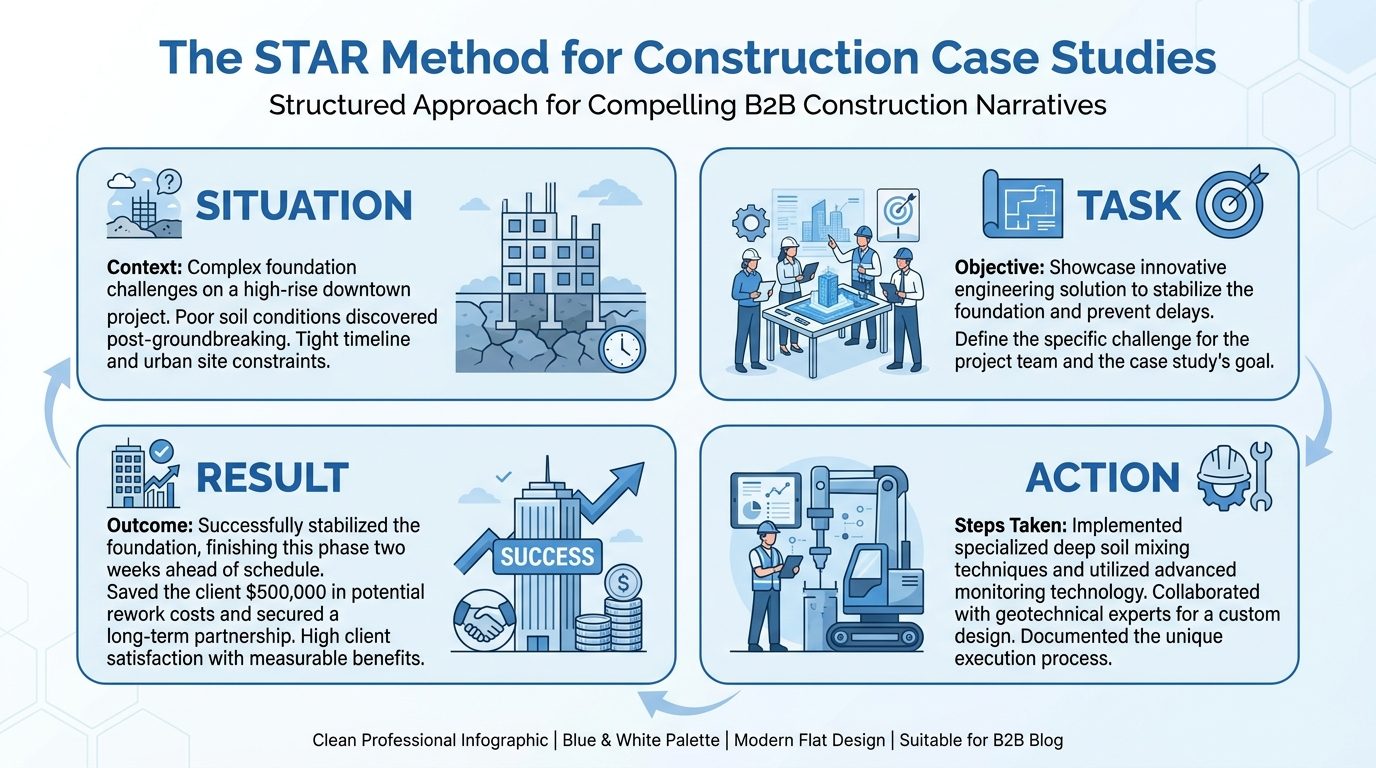
STAR method applied to construction case studies
The single most useful structural device is the STAR method, adapted for construction tenders. Situation establishes the project context (client, scope, value, contract type, key constraints). Task defines the specific challenge or requirement that connects the case study to the tender question. Action describes what the contractor specifically did, with a focus on the choices made and why. Result presents quantified outcomes against the original task.
The lift comes from how Task is framed. The same project, used for a social value question, opens with a Task framed around community engagement and local labour. The same project, used for a programme certainty question, opens with a Task framed around early contractor involvement and supply chain mobilisation. The same project, used for a sustainability question, opens with a Task framed around embodied carbon reduction and operational energy performance. The Situation is identical, the Action is the same set of facts, the Result includes only the relevant metrics. That is how one project supports five different bid sections without ever feeling recycled.
A second technique is contract-specific reasoning. After the case study, include a paragraph that explicitly maps the case study to the tender. "This project is directly relevant to the [contract name] requirement because [specific scope, geography, complexity, theme] is comparable, and the lessons learned in [specific area] translate to [specific aspect of the new contract]." This is the move that turns a Level 3 response into a Level 4 response. It tells the evaluator the contractor has thought about the new contract, not just retrieved a folder.
A third technique is fresh evidence. Even on a project the team has used many times, there is almost always new data, a new outcome, a new client testimonial, a new commendation, an updated post-occupancy result. The first thing to ask before reusing a case study is "what new evidence has emerged since the last time we used this one?" If the answer is nothing, that is a flag that the case study is being held up too long without enrichment.
The Anatomy of a Strong Construction Case Study
A high-scoring construction case study has nine elements. Not all are needed every time, but the strongest examples include most of them.
1. Project header. Client name (with permission), project title, scope summary, contract value, contract type, programme dates, location, role on the project. Half a dozen lines, scannable. 2. The challenge. Two or three sentences that frame the central difficulty of the project in language that connects to the tender question. Not a generic challenge ("delivering on time"), a specific one ("decanting a 200-bed acute medical ward into temporary accommodation while continuous live clinical operations continued in adjacent wards"). 3. Approach. The mechanism. The design choice, the procurement decision, the planning move, the supply chain strategy. This is the answer to "how did you actually do it?" and is the section evaluators read most carefully. 4. Quantified outcomes. Numbers, not adjectives. Programme variance against contract baseline, cost certainty against contract sum, defects at handover, RIDDOR rate, social value metrics, embodied carbon, energy performance gap, occupant satisfaction. If the project has the data, use it. 5. Client testimonial. A single sentence quote from a named individual at the client organisation, with permission. Skip if not available; do not invent. 6. Lessons applied. What the project taught the contractor that has been embedded into the operating model since. This evidences continuous improvement and is increasingly scored under quality management criteria. 7. Relevance paragraph. The contract-specific mapping described above. Why this project, for this question, in this tender. 8. References. Named individuals at the client (with consent), available on request. Some PQQs require references explicitly; even where they do not, having them ready signals confidence. 9. Visuals. A single photograph, a programme extract, a social value dashboard screenshot, a sustainability outcome graph. Visuals lift readability and evidence transparency. Public sector tenders sometimes restrict images, so check the ITT.A case study that runs to one and a half pages and includes seven of these nine elements outperforms a three-page narrative case study almost every time. Density matters. Evaluators are working through stacks of bids, and a tightly structured case study is easier to score generously than a sprawling one.
Common Mistakes and How to Avoid Them
A handful of patterns recur across construction bid teams. None are catastrophic in isolation; together they are the difference between scoring well and scoring brilliantly on relevant experience questions.
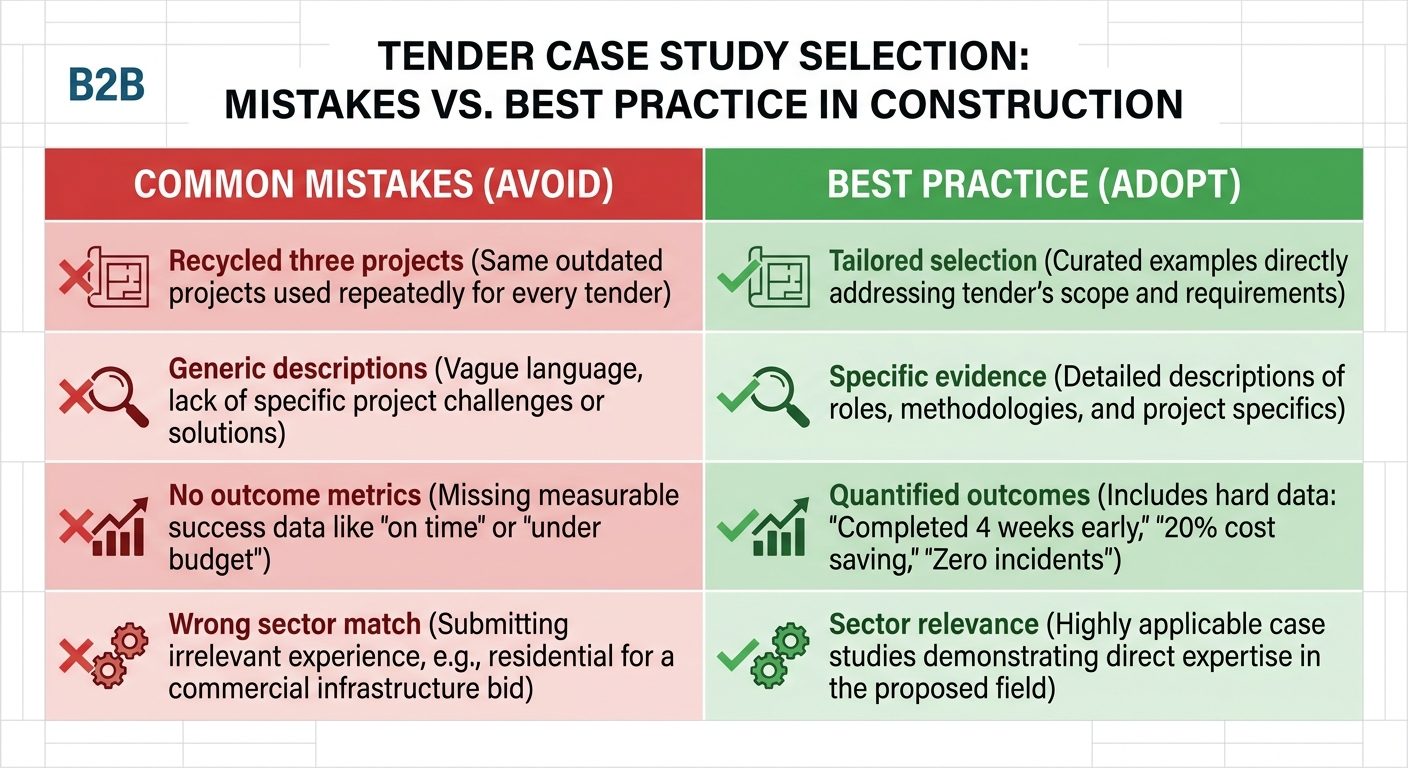
Common mistakes vs best practice for tender case studies
How AI Tools Are Changing Construction Case Study Management
This is where modern bid tooling earns its place in a construction firm. The slow, manual work of building and maintaining a case study library has historically been the reason it does not get done. A senior bid writer cannot personally interview every project manager every quarter and keep thirty case studies up to date alongside live bids.
AI-supported bid platforms remove most of the manual lift. The case study library lives as structured records, with each project tagged across the dimensions described above (sector, value band, contract type, client type, delivery context, theme flags, outcomes). When a new tender opens, the platform surfaces the highest-relevance candidates against the question prompt automatically. The bid writer still selects and shapes the response, but the matching step that used to take an hour now takes minutes, and the trusted three lose their default-selection advantage.
This is one of the practical things mytender.io is built to do. The platform indexes a contractor's historical projects, applies the relevance scoring across multiple dimensions, drafts an initial version of the case study against the specific question, and lets the bid writer focus on the parts that matter most: the contract-specific reasoning, the fresh evidence, and the outcomes that connect this project to the new contract. The trusted three become one of thirty options, not the only realistic choice.
It is worth saying clearly: the platform does not replace the bid writer. A construction case study still needs human judgement on which project, which framing, which outcomes to emphasise. What the platform does is remove the structural reason teams default to recycling: the time cost of doing it differently.
Tying Case Study Strategy to Tender Evaluation Criteria
The final point worth making is that case study strategy is not a separate exercise from the rest of the bid. The same project, framed through the right lens, evidences technical capability, social value, sustainability, and quality management at once. A library built with this in mind is a strategic asset, not an admin task.
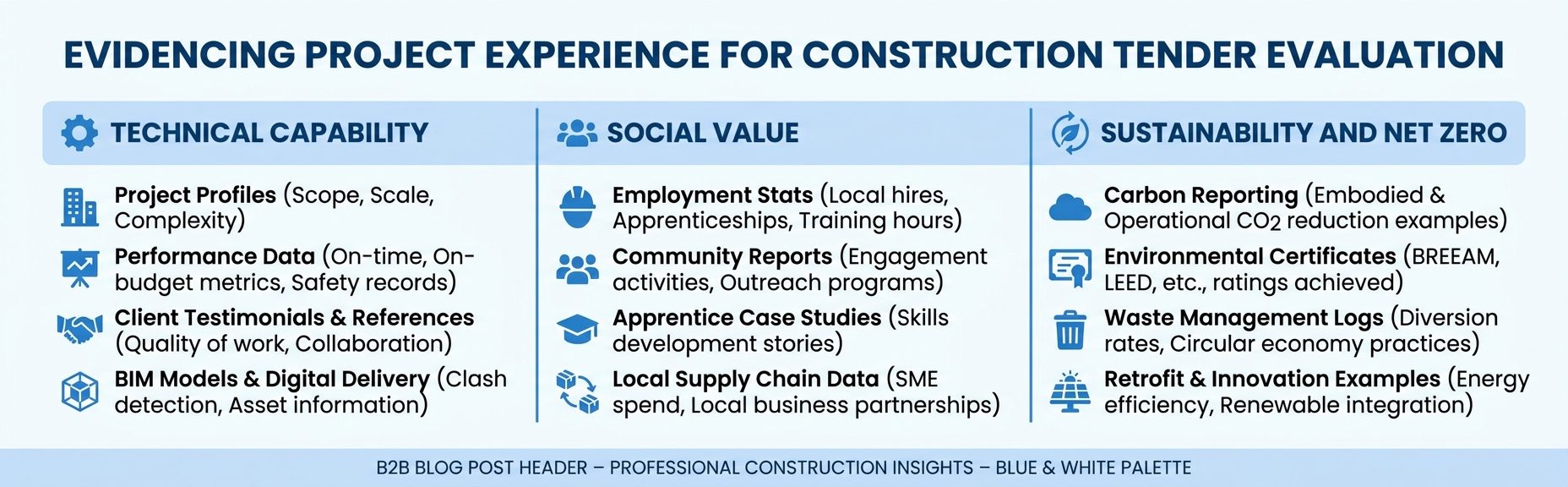
Case study evidence across construction tender evaluation criteria
Most modern UK construction tenders weight relevant experience between 15 and 30 percent of the total quality score. Adjacent themes (social value, sustainability, supply chain) often draw heavily on case study evidence too. A typical 60 percent quality, 40 percent price evaluation might see 40 of the 60 quality marks influenced directly or indirectly by case study selection and case study writing. That is significantly more than most bid teams realise.
A bid function that takes the case study library seriously, indexes it well, selects against a matrix, and writes for relevance, is competing for a different slice of marks than one that reaches for the trusted three. Over a year, the difference compounds. Win rates shift, framework call-offs land more often, and the firm's contract book starts to reflect the depth of experience the case study library captures.
Conclusion
The bid manager with three trusted case studies is not lazy. They are time-poor, and the safe option is rational under deadline pressure. The fix is structural, not motivational. Build the library, build the selection matrix, build the writing technique, and the trusted three quietly stop being the default. The same projects keep appearing where they fit, and a much larger cast of projects starts appearing where they fit better.
If you want to see how mytender.io can help index your historical projects into a usable case study library, the Tender Finder is free to use and shows live opportunities matched to your sector. It is a sensible next step for any construction bid team that wants to stop leaving marks on the table.
The next time the relevant experience question lands on a Tuesday with a Friday deadline, the bid manager who has done this work has thirty options and a matrix. The bid manager who has not has three.
Tags
Ready to Transform Your Tender Writing?
See how MyTender's AI can help you write winning tenders in a fraction of the time.