

Environmental Services and Sustainability Tenders: Complete Guide 2026
Master environmental services and sustainability tenders with our comprehensive 2026 guide. Learn winning strategies, compliance requirements, social value scoring, and how AI accelerates green procurement responses.
mytender.io Research Team
Environmental Procurement Specialists
Environmental Services and Sustainability Tenders: Complete Guide 2026
The environmental services sector is experiencing unprecedented growth in procurement opportunities. With global net zero commitments, circular economy initiatives, and stringent environmental regulations driving demand, public and private sector organizations are investing billions in green infrastructure, waste management, recycling, energy efficiency, and sustainability consulting services.
Winning environmental services tenders requires more than technical competence. Procurement teams evaluate your carbon credentials, circular economy strategies, social value contributions, and ability to deliver measurable sustainability outcomes. Whether you're bidding for waste management contracts, environmental consulting frameworks, renewable energy projects, or carbon reduction initiatives, this guide provides the strategic framework and practical insights you need to succeed.
Understanding the Environmental Services Tender Landscape
Environmental services procurement has evolved dramatically. What was once a cost-focused exercise now incorporates complex sustainability metrics, social value requirements, and long-term environmental impact assessments.
The UK public sector alone spends over £8 billion annually on environmental services. Local authorities, NHS trusts, educational institutions, and central government departments all procure environmental services through competitive tenders. Framework agreements like the Crown Commercial Service's Energy and Utilities framework, Yorkshire Purchasing Organisation's environmental services frameworks, and sector-specific arrangements provide structured procurement routes.
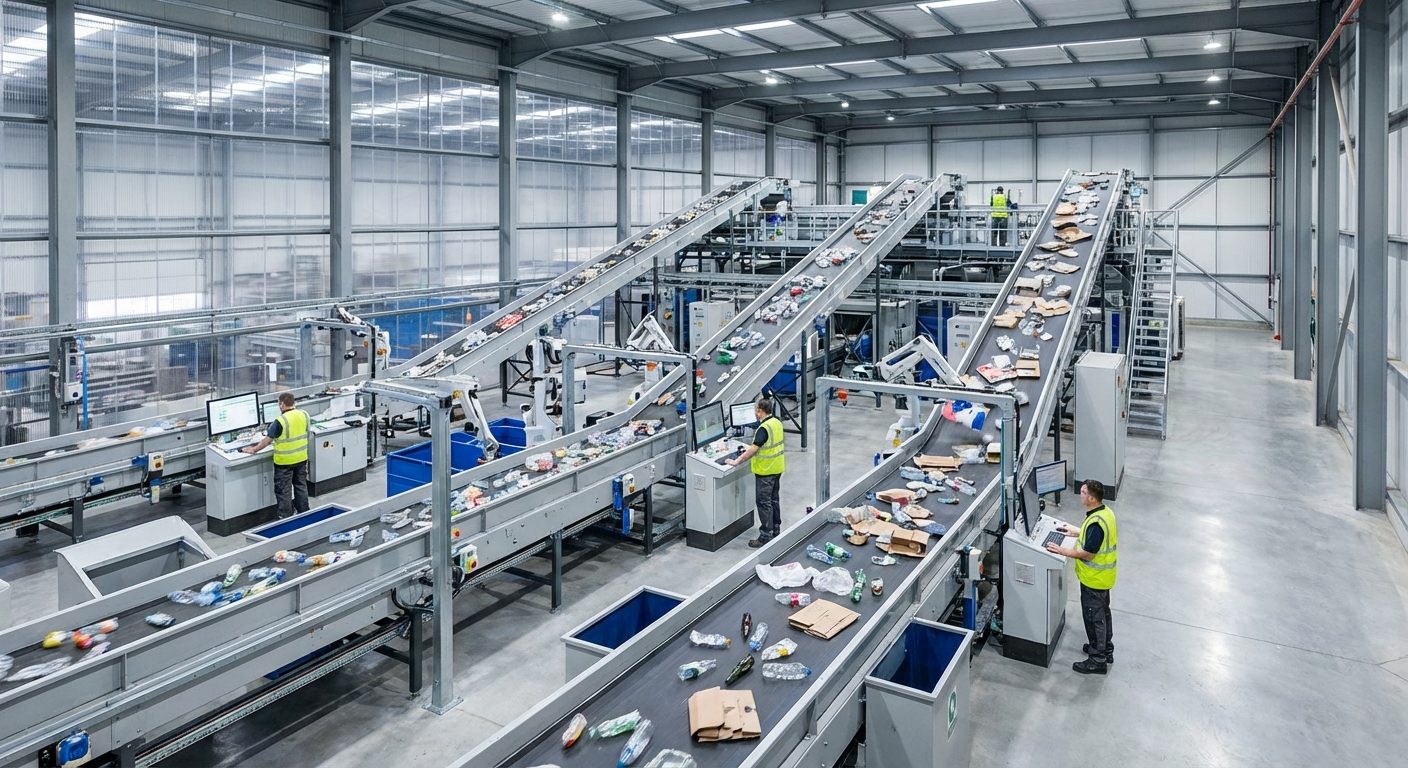
Modern waste management facility with advanced recycling sorting systems
Private sector demand is accelerating even faster. Corporate sustainability commitments, supply chain carbon reduction requirements, and stakeholder pressure are driving companies to seek specialist environmental services. From FTSE 100 organizations implementing net zero strategies to SMEs pursuing ISO 14001 certification, the market is expanding rapidly.
The tender landscape encompasses diverse service categories. Waste management and recycling services remain the largest category, but rapid growth areas include carbon accounting and reduction consulting, environmental impact assessments, renewable energy installation and maintenance, circular economy implementation, biodiversity net gain services, and environmental monitoring and reporting.
Each category has specific technical requirements, regulatory frameworks, and evaluation criteria. Understanding these nuances is essential for crafting competitive responses.
Key Evaluation Criteria in Environmental Tenders
Environmental services tenders employ sophisticated evaluation frameworks that go beyond traditional quality and cost assessments. Understanding these criteria and how evaluators weight them is fundamental to winning bids.
Environmental Performance and Track RecordMost environmental tenders allocate 20-30% of total marks to your environmental credentials. Evaluators assess your carbon footprint, waste diversion rates, environmental management systems (ISO 14001), previous project environmental outcomes, and environmental incident history.
You need quantifiable evidence. A waste management company claiming "industry-leading recycling rates" without data will score poorly against a competitor presenting "94.7% waste diversion from landfill across 47 contracts over the past 24 months, verified through independent audits."
Environmental certifications matter significantly. ISO 14001 environmental management certification is often mandatory. Additional certifications like ISO 50001 (energy management), PAS 2060 (carbon neutrality), or sector-specific accreditations strengthen your position. If you lack key certifications, address this gap honestly and outline your certification roadmap.

Sustainability tender proposal showing environmental performance metrics and carbon reduction data
With public sector organizations pursuing net zero by 2040-2050, carbon considerations now influence 15-25% of tender scores. Evaluators examine your organizational carbon footprint and reduction trajectory, service delivery carbon emissions (Scope 1, 2, and 3), carbon reduction methodology and measurement systems, and contribution to client net zero targets.
Sophisticated buyers expect lifecycle carbon assessments. A facility management tender might require detailed carbon calculations comparing different cleaning products, energy usage across proposed equipment, transportation emissions for service delivery, and embodied carbon in materials and supplies.
Decarbonization roadmaps demonstrate commitment. Present clear targets, interim milestones, and governance structures. "We achieved 42% carbon reduction from 2019 baseline and are on track for 75% reduction by 2030 through renewable energy transition, fleet electrification, and supply chain engagement" tells a compelling story.
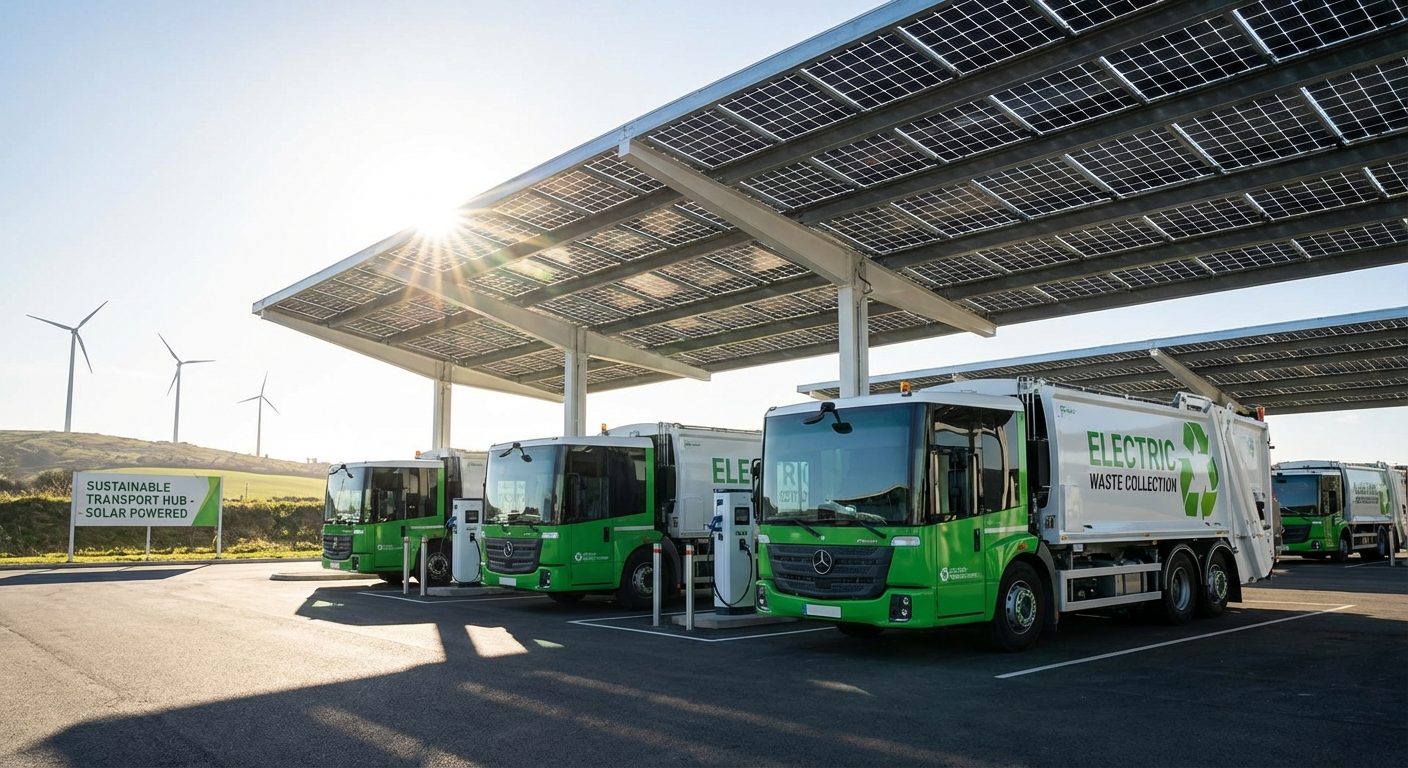
Electric waste collection vehicle fleet charging at solar-powered depot
The Public Services (Social Value) Act 2012 requires public bodies to consider social value in procurement. Environmental tenders typically allocate 10-20% of scores to social value, with specific focus on local employment and training opportunities, support for disadvantaged groups, community engagement and education, and economic benefits to local supply chains.
Environmental services offer natural social value opportunities. Community engagement through school education programs on recycling and sustainability, local employment commitments for waste collection and environmental services, partnerships with social enterprises for equipment refurbishment, and green space improvements benefiting local communities all score well.
Quantify your commitments. "We will create 12 local jobs, provide 200 hours of environmental education to local schools, and partner with 2 local social enterprises for vehicle maintenance" is substantially stronger than vague promises of "community engagement and local benefit."
Technical Methodology and InnovationTechnical approach typically commands 25-35% of tender scores. Evaluators assess your service delivery methodology and quality systems, innovative approaches to environmental challenges, technology and equipment specifications, monitoring and reporting frameworks, and risk management and contingency planning.
Environmental tenders reward innovation. Demonstrating cutting-edge approaches to waste sorting using AI and robotics, real-time environmental monitoring using IoT sensors, circular economy solutions maximizing material recovery, or renewable energy integration reducing operational carbon can differentiate your bid.
Case studies provide powerful evidence. Detail specific examples where your methodology delivered superior environmental outcomes. Quantify improvements: "Our AI-powered sorting system increased recyclable recovery by 23% compared to traditional methods, diverting an additional 1,847 tonnes from landfill annually."
Compliance and Risk ManagementEnvironmental services operate within complex regulatory frameworks. Tenders allocate 10-15% of marks to compliance and risk management, evaluating your understanding of relevant environmental regulations, environmental permitting and licensing, incident management and emergency response procedures, insurance and liability coverage, and health and safety systems.
Demonstrate regulatory expertise. Reference specific legislation applicable to the contract—Environmental Protection Act 1990, Waste (England and Wales) Regulations 2011, Climate Change Act 2008, Environment Act 2021. Explain how your systems ensure ongoing compliance.
Risk registers should be comprehensive and specific. Generic risks like "equipment failure" with basic mitigation strategies score poorly. "Risk: Contaminated waste stream disrupting recycling facility operations. Likelihood: Medium. Impact: High. Mitigation: Pre-acceptance waste audits, contamination monitoring at collection point, segregated storage protocols, alternative processing arrangements with [Facility X]" demonstrates sophistication.
Building a Winning Environmental Services Proposal
Exceptional environmental tender responses combine technical excellence, clear evidence of environmental performance, and compelling social value narratives. Each section of your proposal must be strategically crafted to maximize evaluation scores.
Executive Summary: Your Strategic OverviewThe executive summary is often the first—and sometimes only—section evaluators read carefully. It must encapsulate your entire value proposition in 2-3 pages.
Start with contract understanding. Demonstrate you comprehend the client's environmental challenges, sustainability objectives, and strategic context. "We understand [Authority] is pursuing net zero by 2040, has committed to 75% waste diversion from landfill by 2028, and seeks a partner who can deliver environmental services while creating local employment opportunities."
Articulate your core differentiators. What makes your approach superior? "Our proposal delivers 89% waste diversion through advanced sorting technology, reduces service delivery carbon by 34% compared to current operations, and creates 18 local jobs including 6 apprenticeships—all within budget."
Provide evidence upfront. Reference key case studies, certifications, and performance data that support your claims. The executive summary should make evaluators want to read further while also serving as a standalone document that could justify your selection.
Technical Methodology: Demonstrating ExcellenceThe technical section is where you prove you can deliver. Environmental services tenders require detailed operational plans covering every aspect of service delivery.
Structure this section around the client's service requirements. If the tender specifies 15 service elements, ensure you address each explicitly. Use the same terminology and reference numbers from the specification to make evaluation easier.
Describe your operational approach with precision. For waste collection services, detail collection routes and scheduling optimization, vehicle specifications and environmental credentials, waste segregation protocols at collection point, contamination identification and management procedures, and customer communication and service issue resolution.
Incorporate visual elements. Maps showing collection routes, flowcharts illustrating waste processing procedures, and diagrams of recycling facility layouts help evaluators understand your approach. Complex operations become clearer with visual representation.
Explain your quality systems. How do you ensure consistent service delivery? Describe monitoring mechanisms, performance reporting, continuous improvement processes, and customer feedback systems. ISO 9001 quality management certification provides framework credibility.
Address innovation thoughtfully. Environmental services buyers value innovation that delivers better outcomes, not technology for its own sake. Connect innovations to specific benefits: "Our IoT-enabled bin sensors optimize collection routes, reducing vehicle miles by 18%, cutting carbon emissions by 12 tonnes annually, and lowering operational costs by £47,000."
Environmental Performance: Proving Your CredentialsThis section validates your environmental expertise through evidence, data, and demonstrated track record.
Present your environmental management system. Describe how ISO 14001 or equivalent frameworks structure your environmental commitments. Detail your environmental policy, objectives, legal compliance processes, environmental aspects and impacts register, and performance monitoring and reporting.
Quantify your environmental performance. Use data from recent operations: "Across our current contracts we achieved 92.3% average waste diversion from landfill, processed 147,000 tonnes of recyclable materials, reduced contamination rates by 31% through customer education programs, and maintained zero environmental incidents."
Carbon data is crucial. Present your organizational carbon footprint with Scope 1, 2, and 3 emissions. Show your reduction trajectory. For this specific contract, calculate expected service delivery emissions and compare them to current operations or industry benchmarks: "Our proposed operations will generate 487 tonnes CO2e annually, representing a 34% reduction compared to the current contract baseline of 738 tonnes CO2e."
Address lifecycle environmental impacts. For equipment and materials procurement, discuss environmental considerations in supplier selection, preference for recycled and recyclable materials, energy efficiency of proposed equipment, and end-of-life disposal and recycling plans.
Case studies bring environmental performance to life. Select 3-4 examples relevant to this contract where you delivered exceptional environmental outcomes. Use the STAR format (Situation, Task, Action, Result) and quantify results wherever possible.
Social Value: Maximizing Community ImpactSocial value has transformed from tender tick-box to genuine evaluation differentiator. Environmental services offer exceptional social value opportunities that align naturally with sustainability objectives.
Structure social value responses around the buyer's priorities. Most public sector tenders reference the National TOMs (Themes, Outcomes, Measures) framework. Common priority themes include fighting climate change, creating good jobs and growth opportunities, strengthening community resilience, and improving equality and wellbeing.
Develop specific, measurable commitments. Vague promises score poorly. Instead: "We commit to creating 18 FTE local jobs within 6 months of contract start, recruiting 6 apprentices from local schools and colleges with guaranteed employment upon qualification, delivering 40 school workshops reaching 1,200 students on recycling and sustainability, partnering with [Local Social Enterprise] for vehicle maintenance generating £85,000 annual revenue, and volunteering 200 employee hours for local environmental improvement projects."
Calculate social value using TOMs methodology if specified. Assign monetary values to outcomes using the National TOMs framework rates. This allows direct comparison between bidders and contributes to overall evaluation scores.
Connect social value to your service delivery. Environmental services provide natural opportunities: environmental education programs as part of waste collection services, employment opportunities particularly accessible to those facing barriers, local supply chain spending through facility operations, and community environmental improvement projects.
Evidence your capability. Detail previous social value delivery with quantified outcomes: "In our current contract with [Authority], we delivered 89% of social value commitments including 23 apprenticeships, 67 school workshops, and £340,000 local supply chain spending."
Pricing and Commercial ModelEnvironmental services pricing requires careful balancing of competitiveness with realistic cost recovery and margin. Many environmental contracts are long-term (5-10 years) with significant capital investment requirements, making financial sustainability crucial.
Understand the pricing model specified. Environmental contracts may use fixed price arrangements, price per tonne or unit-based models, risk-share mechanisms with performance incentives, or hybrid models combining elements.
Build your pricing from bottom-up cost analysis. Account for all operational costs: labor, vehicles and equipment, facility operations, disposal and processing, compliance and permitting, insurance and contingencies, and management and overhead allocation.
Price inflation mechanisms matter significantly in long-term contracts. Specify indices clearly (e.g., ONS Services Producer Price Index, fuel price indices, wage inflation rates) and explain adjustment methodology. Environmental commodity prices (recyclable material values, disposal costs) fluctuate substantially; ensure contract terms address this risk fairly.
Efficiency improvements can support competitive pricing. If your innovative approach genuinely reduces operational costs, you can price more competitively while maintaining margins. Quantify efficiency savings: "Our route optimization reduces vehicle miles by 9,500 annually, saving £18,400 in fuel costs and reducing carbon emissions by 23 tonnes."
Provide pricing transparency. Break down costs by service element to help evaluators understand your pricing structure. This transparency builds trust and makes price evaluation easier.
Consider value-added elements. Can you offer additional services, enhanced reporting, community engagement programs, or environmental improvements beyond minimum requirements? These strengthen your value proposition, particularly if they align with buyer priorities.
Regulatory Compliance and Permitting
Environmental services operate within extensive regulatory frameworks. Demonstrating compliance competence builds buyer confidence and is often a mandatory requirement for tender qualification.
Essential Environmental Permits and LicensesMost environmental service providers require multiple permits depending on service scope. Waste management operations need Environment Agency waste carrier licenses, waste treatment facility permits (for processing and transfer stations), and waste export licenses (if applicable for specific waste streams).
Verify your permits are current and appropriate for contract requirements. If the tender requires services your permits don't cover, either exclude those elements or outline how you'll obtain necessary authorization. Never claim capability without proper permitting.
Environmental consulting services may require specific accreditations—environmental impact assessment qualifications, ecological survey licenses, contaminated land assessment certifications. Professional memberships (IEMA, CIEEM) demonstrate competence.
Present permit and licensing information clearly. Include permit numbers, issuing authorities, expiry dates, and scope. Attach copies as appendices if required.
Key Environmental LegislationEnvironmental services are governed by extensive UK and European legislation. Your tender response should demonstrate understanding of applicable regulations and how your operations ensure compliance.
For waste management and recycling services, key regulations include the Environmental Protection Act 1990, Waste (England and Wales) Regulations 2011, Hazardous Waste Regulations 2005, Landfill Tax Regulations, Producer Responsibility Obligations (packaging, WEEE), and Duty of Care requirements.
For environmental impact and sustainability consulting, relevant legislation includes the Environment Act 2021, Climate Change Act 2008, Environmental Impact Assessment Regulations 2017, Biodiversity Net Gain requirements, and various sector-specific environmental protection regulations.
Don't just list legislation. Explain how you comply. For example: "We maintain comprehensive Duty of Care documentation for all waste transfers, using digital waste tracking systems ensuring full traceability from collection through final disposal, with documentation retained for minimum 3 years in compliance with Waste Regulations 2011."
Health and Safety in Environmental ServicesEnvironmental services carry inherent health and safety risks. Robust H&S systems are essential and typically required for tender qualification.
Most buyers require ISO 45001 or equivalent occupational health and safety management certification. Detail your H&S management system including policy and leadership commitment, risk assessment methodologies, safe systems of work and procedures, training and competence assurance, incident investigation and learning processes, and health surveillance and occupational health support.
Environmental services present specific hazards: waste handling and contamination risks, vehicle operations and driver safety, equipment operation (processing machinery, lifting equipment), confined spaces in waste facilities, and biological and chemical exposure risks.
Address these hazards specifically. Describe control measures, personal protective equipment requirements, training provisions, emergency procedures, and monitoring arrangements.
Present your H&S performance data. Include RIDDOR reportable incident rates, lost time accident frequency rates, days lost to injury statistics, and comparison to industry benchmarks. Improving trends demonstrate commitment: "Our LTIFR reduced from 2.3 to 0.7 over three years through enhanced training, improved equipment guarding, and behavioral safety programs."
Technology and Innovation in Environmental Services
Technology is transforming environmental services delivery. From AI-powered waste sorting to IoT monitoring and blockchain traceability, innovation can significantly enhance service quality and environmental outcomes.
Digital Waste Management SystemsModern waste management increasingly relies on digital systems for optimization and transparency. Route optimization software uses AI and real-time data to minimize vehicle miles, reduce fuel consumption, improve collection efficiency, and respond dynamically to service variations.
IoT sensors in bins and containers provide real-time fill level data, enabling demand-responsive collection scheduling that reduces unnecessary journeys and optimizes vehicle utilization. Some authorities achieve 20-30% reduction in collection vehicle miles through smart bin technology.
Digital waste tracking systems provide full chain of custody visibility from collection through processing to final disposal or recovery. Customers can access real-time dashboards showing waste volumes, recycling rates, carbon impact, and compliance documentation. This transparency increasingly differentiates service providers.
Mobile apps for residents and businesses improve service interaction—collection schedule reminders, contamination education, service issue reporting, recycling information and guidance. Enhanced communication reduces contamination and improves customer satisfaction.
Advanced Sorting and Processing TechnologyRecycling facility technology directly impacts waste diversion rates and material quality. AI-powered robotic sorting systems identify and separate materials with greater accuracy and speed than manual or traditional mechanical sorting, achieving contamination rates below 2% and improving recovery of high-value materials.
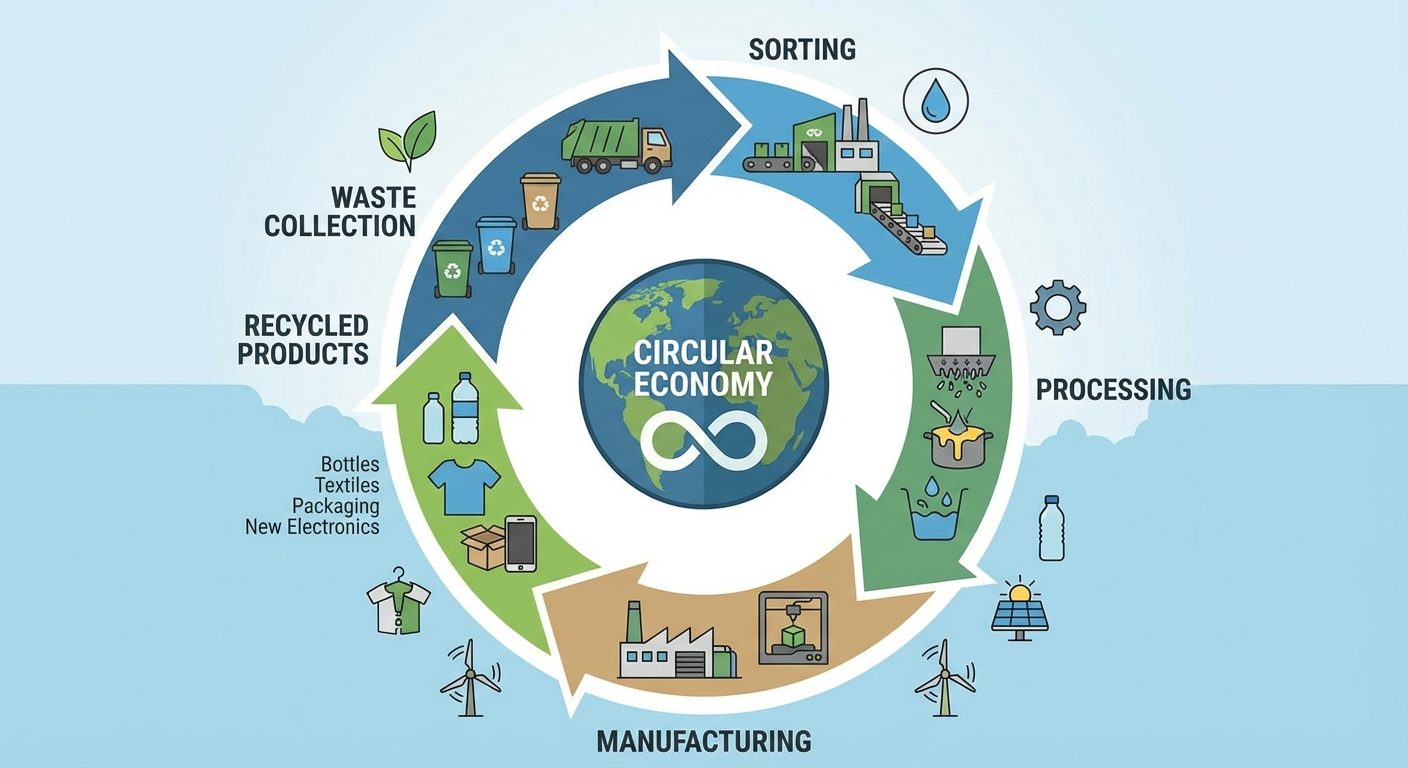
Circular economy recycling flow showing material journey from waste to recycled products
Optical sorting technology using NIR (near-infrared) sensors distinguishes between different polymer types, enabling more refined plastic recycling. This technology is essential for circular economy approaches requiring high-quality recycled materials.
Anaerobic digestion and composting technologies process organic waste, diverting it from landfill while generating renewable energy and soil improvers. For contracts including food waste or green waste management, demonstrating advanced processing capability is crucial.
Environmental Monitoring and Reporting SystemsBuyers increasingly demand sophisticated environmental monitoring and reporting. Automated systems collect, analyze, and report environmental data including waste volumes and composition, recycling and recovery rates, carbon emissions from operations, contamination incidents and rates, and environmental compliance metrics.
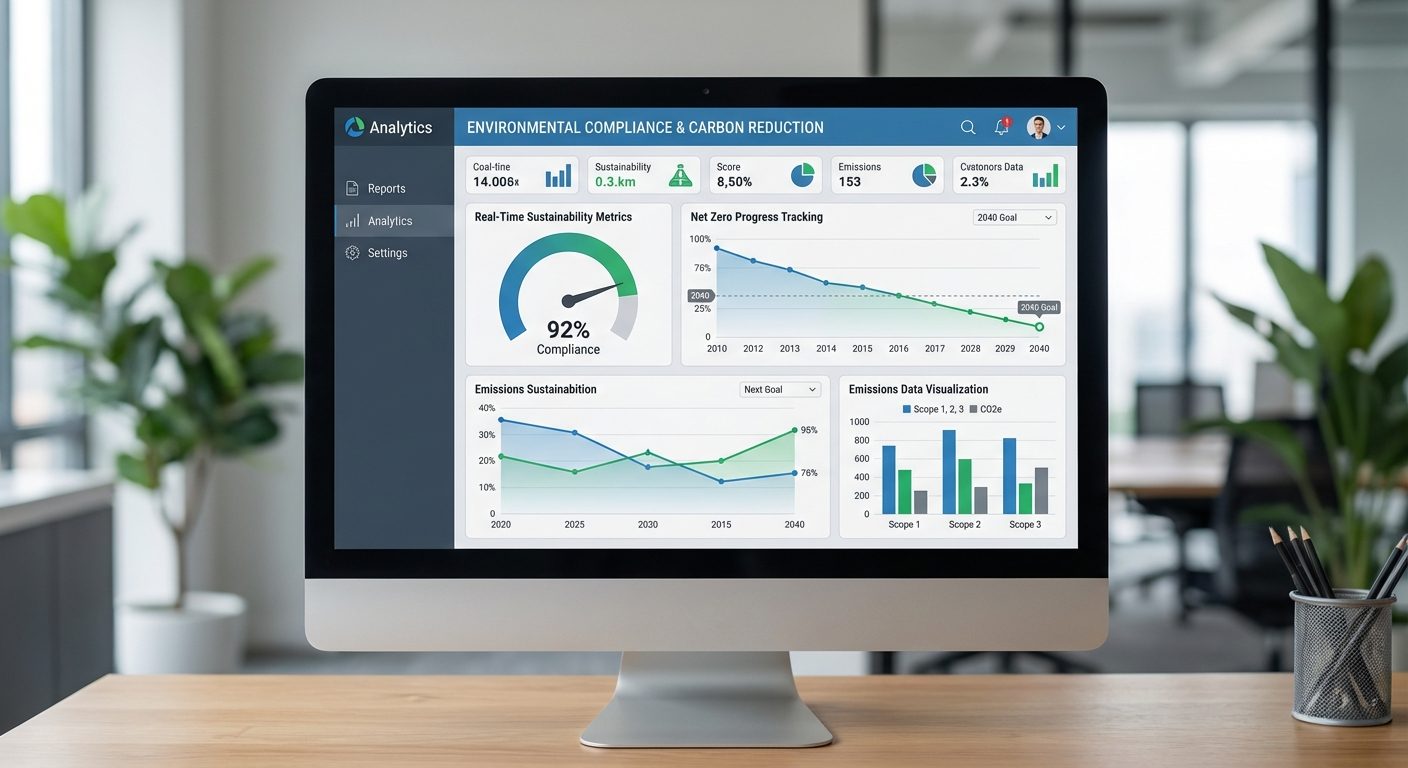
Environmental compliance dashboard showing real-time sustainability metrics and carbon tracking
Real-time dashboards provide buyers with immediate visibility of contract performance. Rather than waiting for monthly reports, contract managers can access current data, identify trends, and address issues promptly.
Blockchain technology is emerging for waste tracking, providing immutable records of waste movement from generation through disposal. While still early-stage, some contracts now specify blockchain traceability for hazardous waste streams or international waste movements.
Carbon Measurement and ManagementSophisticated carbon accounting systems measure, monitor, and manage emissions across environmental services operations. These systems track Scope 1 emissions (direct vehicle and facility emissions), Scope 2 emissions (purchased energy), and Scope 3 emissions (supply chain, waste processing downstream impacts, employee commuting).
Integration with operational systems provides granular carbon data—emissions per collection route, carbon impact per tonne of waste processed, lifecycle emissions for different disposal methods. This data enables informed decision-making and continuous improvement.
Carbon reduction simulation tools model the impact of operational changes. What carbon savings result from fleet electrification? How much do route optimizations reduce emissions? Scenario modeling supports business cases for carbon reduction investments.
Sector-Specific Considerations
Environmental services procurement varies significantly across sectors. Understanding sector-specific requirements, priorities, and evaluation approaches improves bid competitiveness.
Local Government Environmental ServicesLocal authorities represent the largest environmental services market. Contracts typically cover residential waste collection and street cleansing, recycling collection and processing, green waste and food waste services, household waste recycling centers, and commercial waste services.
Local government environmental tenders emphasize service reliability and public satisfaction (missed collections generate significant resident complaints and political pressure), recycling performance against statutory targets, social value and local employment, cost management within constrained budgets, and public engagement and education.
Resident satisfaction metrics often influence contract payment mechanisms. High complaint rates may trigger service credits while excellent performance earns bonuses. Understand the council's current performance and resident satisfaction levels; demonstrate how your approach improves outcomes.
Local political context matters. Councils face significant public scrutiny of environmental services. Demonstrate understanding of local priorities—some areas emphasize recycling rates, others focus on service frequency, waste crime prevention, or local employment.
Partnership working is increasingly valued. Councils seek contractors who engage proactively with local communities, support council policy objectives (waste reduction campaigns, climate action plans), share data and insights enabling evidence-based policy, and demonstrate flexibility as requirements evolve.
NHS and Healthcare Environmental ServicesHealthcare environmental services require specialist approaches due to infection control requirements, hazardous waste management, and regulatory frameworks specific to healthcare environments.
Clinical waste management is highly regulated. Demonstrate understanding of HTM 07-01 guidance (safe management of healthcare waste), Environment Agency healthcare waste regulations, specialist waste streams (cytotoxic, pharmaceutical, anatomical), and secure waste tracking and destruction protocols.
Infection prevention and control standards are non-negotiable. Healthcare cleaning and waste services must comply with National Infection Prevention and Control guidance, cleaning standards and audit systems, and isolation and containment procedures for infectious waste.
Sustainability in healthcare is a growing priority. NHS Net Zero commitments create demand for reusable sharps containers reducing single-use plastic, segregation improvements reducing clinical waste misclassification, circular economy approaches for medical equipment, and carbon reduction across supply chains.
Evidence healthcare sector experience. Generic environmental services experience is insufficient. Detail specific healthcare contracts, clinical waste volumes managed, infection control track record, and Care Quality Commission inspection outcomes if relevant.
Corporate and Private Sector Environmental ServicesPrivate sector environmental services procurement is diverse, spanning office buildings, retail operations, manufacturing, logistics and distribution, and food service and hospitality.
Corporate sustainability commitments drive demand. Companies increasingly seek environmental service providers who contribute to corporate ESG targets, provide detailed sustainability reporting, offer carbon reduction solutions, and support circular economy initiatives.
Supply chain sustainability requirements cascade through tiers. A major retailer's net zero commitment creates requirements for their suppliers, which cascade to service providers. Understanding these supply chain dynamics positions you advantageously.
Innovation appetite is often higher in private sector procurement. Companies may embrace emerging technologies, pilot novel approaches, or implement circular economy models more readily than public sector organizations.
Commercial flexibility matters. Private sector buyers often value customized solutions, scalability as operations grow, integration with existing systems and processes, and responsive account management.
Leveraging AI for Environmental Tender Success
Environmental services tenders are comprehensive, technically detailed, and increasingly complex. AI-powered tender writing tools like mytender.io can significantly accelerate response development while improving quality and competitiveness.
Accelerating Response DevelopmentEnvironmental tenders frequently comprise 100+ questions covering technical methodology, environmental performance, social value, commercial terms, and compliance. Drafting comprehensive responses manually is time-intensive, often requiring 80-120 hours for major framework tenders.
AI tender writing technology dramatically reduces this burden. mytender.io analyzes tender requirements, structures responses according to evaluation criteria, generates initial content drafts from your previous responses and company data, and maintains consistency across sections while adapting content to specific requirements.
What traditionally took weeks can be compressed to days. Your team focuses on strategic review, technical customization, and evidence compilation rather than basic drafting.
Improving Response Quality and ConsistencyEnvironmental tenders reward consistent, well-structured responses that directly address evaluation criteria. AI ensures every question is answered comprehensively, evaluation criteria are explicitly addressed, corporate terminology and branding are consistent throughout, and technical accuracy is maintained across complex specifications.
mytender.io learns from your successful bids, incorporating language, structure, and approaches that have proven effective. Your win themes and differentiators are consistently reinforced rather than variably applied depending on which team member drafts each section.
Quality improves through AI's ability to analyze multiple previous responses, identify best-performing content, synthesize approaches from different sources, and adapt successful strategies to new contexts.
Optimizing for Evaluation CriteriaEnvironmental tenders use sophisticated evaluation methodologies—weighted scoring matrices, threshold requirements, technical and commercial envelopes, and method statements scored against detailed criteria.
AI can be trained to optimize responses for evaluation approaches. mytender.io analyzes evaluation criteria and weightings, prioritizes content and detail for high-scoring sections, ensures threshold requirements are clearly demonstrated, and structures responses for easy evaluator navigation.
For example, if carbon reduction accounts for 20% of technical scores, AI ensures carbon considerations are thoroughly addressed with quantified data, explicitly linked to the buyer's net zero objectives, and supported by credible methodology and governance.
Maintaining Competitive Advantage Through Continuous LearningEnvironmental services procurement evolves continuously—new regulations, emerging technologies, shifting buyer priorities. AI systems that learn from each tender continuously improve.
mytender.io's learning systems adapt to industry trends (increasing emphasis on circular economy, growing importance of biodiversity net gain), buyer-specific preferences (some authorities prioritize local employment, others emphasize innovation), regulatory changes (Environment Act 2021 implications for environmental services), and competitive intelligence (understanding what differentiates winning bids).
This continuous learning creates compounding advantages. Each tender makes your next response stronger, your win themes clearer, and your competitive positioning sharper.
Common Pitfalls and How to Avoid Them
Even experienced environmental service providers make avoidable mistakes in tender responses. Understanding common pitfalls helps you sidestep them.
Generic Environmental Claims Without EvidenceEnvironmental services tenders attract claims of "industry-leading recycling rates," "commitment to sustainability," and "innovative environmental practices." Evaluators discount unsupported claims.
Avoid: "We are committed to environmental excellence and achieving the highest possible recycling rates."
Instead: "We achieved 94.2% average waste diversion from landfill across our 17 current local authority contracts in 2025, exceeding the national average of 86.1%. Our contamination rate of 2.3% is less than half the industry average of 5.7%, resulting from our systematic contamination monitoring program and targeted resident education."
Every environmental claim requires supporting data, third-party verification, or concrete evidence. If you can't substantiate a claim, don't make it.
Focusing on Your Service Rather Than Client OutcomesMany tender responses focus excessively on describing their own operations rather than articulating how they deliver buyer objectives.
Avoid: "We operate a state-of-the-art recycling facility with advanced optical sorting technology and 15 processing lines capable of handling 250,000 tonnes annually."
Instead: "Our advanced recycling facility will enable [Council] to achieve its 75% waste diversion target by 2028, two years ahead of schedule, through 96% processing efficiency, contamination rates below 3%, and recovery of 23 material types supporting circular economy objectives."
Frame everything around buyer outcomes. Your capabilities are means to their ends.
Underestimating Social Value RequirementsSome environmental service providers treat social value as an afterthought, providing generic commitments disconnected from their core operations.
Social value typically accounts for 10-20% of tender scores. Weak social value submissions directly reduce your competitive position. Moreover, social value commitments become contractual obligations—unfulfilled commitments risk contract performance failures.
Develop genuine, deliverable social value proposals integrated with service delivery. Commit to specific, measurable outcomes. Budget adequately for social value delivery. Evidence your track record of social value achievement.
Inadequate Risk ManagementEnvironmental services involve significant operational risks—equipment failures, contamination incidents, extreme weather impacts, regulatory changes. Superficial risk assessments with generic mitigation strategies score poorly.
Develop comprehensive, specific risk registers. Identify risks particular to this contract and location. Describe detailed mitigation strategies with responsible parties, timelines, and contingency plans. Include evidence of effective risk management from previous contracts.
Overlooking Carbon Impact of Proposed SolutionsWith net zero commitments driving procurement, carbon-intensive solutions are increasingly uncompetitive. A waste collection proposal using older diesel vehicles will lose to an electric vehicle alternative even if slightly cheaper initially.
Calculate and present the carbon footprint of your proposed solution. Compare it to current operations or alternatives. If your approach has higher initial carbon impact but better long-term performance, explain the lifecycle carbon calculation justifying your approach.
Preparing for Post-Award Implementation
Winning the tender is only the beginning. Successful mobilization and contract delivery require careful preparation and planning.
Mobilization PlanningEnvironmental services contracts often have complex mobilization requirements—procurement and deployment of vehicles and equipment, facility setup or modifications, staff recruitment and training, IT systems integration, and community engagement and communications.
Develop detailed mobilization plans as part of your tender response. Specify timelines for key mobilization activities, resource requirements and dependencies, risk management and contingencies, and governance and reporting during mobilization.
Many contracts specify mobilization periods (often 3-6 months for major contracts) with milestones and performance requirements. Ensure your mobilization plan is realistic and achievable within contract timelines.
Performance Monitoring and ReportingEnvironmental contracts typically include extensive performance monitoring regimes. Key Performance Indicators (KPIs) might include service delivery metrics (missed collections, response times), environmental performance (recycling rates, contamination levels), carbon emissions, customer satisfaction scores, and social value delivery.
Establish robust monitoring systems before contract start. Many environmental tenders now require real-time performance dashboards accessible to client contract managers. Ensure your systems can provide required data at specified frequencies.
Contract Management and Relationship BuildingStrong client relationships underpin successful long-term environmental contracts. Invest in contract management resources, establish regular governance meetings at operational and strategic levels, proactively communicate issues and solutions, and seek continuous improvement opportunities.
Many environmental contracts include gainshare mechanisms—cost savings or performance improvements are shared between provider and client. These arrangements align incentives and encourage innovation.
Continuous Improvement and InnovationEnvironmental services technology and practices evolve rapidly. Successful contractors continuously improve through adoption of emerging technologies, process optimization using operational data, sharing of best practices across contracts, and engagement with industry innovation initiatives.
Build continuous improvement into contract delivery. Establish innovation budgets, pilot new approaches, engage staff in improvement suggestions, and share successes with clients.
Conclusion: Positioning for Environmental Services Success
Environmental services procurement is at an inflection point. Net zero commitments, circular economy priorities, and evolving regulatory frameworks are transforming the sector. Organizations that master the environmental services tender landscape—understanding buyer priorities, demonstrating environmental excellence, delivering genuine social value, and leveraging technology for efficiency—will capture growing market opportunities.
Success requires strategic approach to tender responses. Generic, capability-focused submissions no longer suffice. Buyers seek partners who understand their environmental challenges, deliver measurable sustainability outcomes, contribute to their net zero journeys, create social value in local communities, and bring innovation to traditionally staid services.
Environmental credentials are table stakes. ISO 14001 certification, carbon accounting, and compliance systems are minimum requirements. Differentiation comes from demonstrable environmental performance, innovative technology and approaches, integration of sustainability across operations, genuine social value delivery, and partnership approach to client challenges.
Technology is reshaping both environmental services delivery and procurement processes. AI-powered tender writing tools, digital waste management systems, advanced recycling technology, and carbon measurement platforms enable capabilities impossible a decade ago. Organizations that embrace these technologies gain significant competitive advantages.
The environmental services market will continue growing as sustainability becomes embedded in every organization's operations. Procurement opportunities will expand across waste management, environmental consulting, renewable energy, circular economy services, biodiversity enhancement, and carbon reduction initiatives.
Those who invest in tender capability—understanding buyer needs, evidencing environmental performance, articulating clear value propositions, leveraging AI for efficiency and quality—will win their share of this growing market. The tools, strategies, and insights presented in this guide provide the foundation for environmental services tender success in 2026 and beyond.
Start implementing these approaches today. Review your environmental performance data, develop your social value framework, audit your tender response processes, and explore how AI tools like mytender.io can accelerate your tender success. The opportunities are substantial for organizations positioned to seize them.
Tags
Ready to Transform Your Tender Writing?
See how MyTender's AI can help you write winning tenders in a fraction of the time.