
Early Contractor Involvement in Construction Tenders: Bid Writing Guide 2026
Early contractor involvement is becoming more common in UK construction procurement. Learn how to write ECI tender responses that prove buildability, cost control, risk ownership and delivery confidence.
mytender.io Research Team
Tender Writing & Bid Management Specialists
Early Contractor Involvement in Construction Tenders: Bid Writing Guide 2026
Early contractor involvement sounds friendly. It is not.
For construction bidders, ECI is a test of whether you can improve the project before the main works begin. Buyers want evidence that you can spot risk early, challenge assumptions sensibly, protect the budget and turn a concept into something buildable.

Construction bid team reviewing early contractor involvement tender documents
That is a very different writing job from a standard construction method statement.
A normal tender often asks: can you deliver this defined scope? An ECI tender asks something sharper: can you help us define the right scope, de-risk it and still be the supplier we trust when the hard choices arrive?
This guide is for bid managers, pre-construction leads, commercial directors and construction teams writing ECI responses in 2026.
The short version: do not write about collaboration as a personality trait. Prove it as a working method.
Why ECI is getting more attention in 2026
Construction buyers are under pressure from every side.
Budgets are tighter. Programmes are exposed. Design risk is harder to hide. Building safety, carbon, social value, supply chain resilience and whole-life cost are now scoring issues, not nice extras.
At the same time, the Procurement Act 2023 gives public buyers more room to design procedures that fit the contract. The Competitive Flexible Procedure is part of that shift. It lets authorities build more dialogue, presentations, workshops, negotiations and staged evaluation into the procurement.
For construction, that matters.
A buyer does not always want a fully designed tender pack thrown over the wall. On complex, risky or politically visible projects, they may want supplier insight earlier. They want to know what the market thinks before committing to a solution that is expensive, fragile or hard to deliver.
That creates more space for ECI, two-stage contracting, pre-construction services agreements, alliance-style behaviours and framework call-offs where buildability is tested before the main works price is locked.
It also changes the bid response.
You are not only selling delivery. You are selling judgement.
What ECI actually means in a tender response
Early contractor involvement is not one thing.
Sometimes it means a formal two-stage process. Sometimes it means a pre-construction services agreement before a main works contract. Sometimes it means a framework mini competition where the buyer wants design development, risk review and price certainty before award. Sometimes it appears inside a Competitive Flexible Procedure with dialogue or presentation stages.
Do not assume the label tells you the model.
Before writing, identify what the buyer is really asking for:
- Are they appointing a contractor for pre-construction only, with a later route to main works?
- Are they asking for design development and cost advice before final award?
- Are they testing buildability through a scored workshop?
- Are they using ECI to reduce planning, utilities, decant, access or phasing risk?
- Are they trying to hold competitive tension while suppliers shape the solution?
- Are they asking for open-book pricing, target cost, pain/gain share or another commercial model?
- Are they expecting the contractor to bring designers, specialist subcontractors or supply chain partners into the process?
Your answer needs to match that model.
A generic paragraph about partnership working will not survive a detailed ECI evaluation. Evaluators will look for structure, governance, decision routes, evidence and commercial discipline.
The topic selection logic for this post
This post was selected because the current procurement conversation is moving towards three linked themes.
First, public procurement is becoming more flexible. Buyers have more freedom to build procurement routes around dialogue, stages and market input. Construction is one of the sectors most likely to use that freedom because project risk is rarely solved by a static written answer.
Second, performance transparency is raising the cost of overpromising. If suppliers make unrealistic programme, cost or KPI commitments, the consequences can follow them into future bids. ECI gives bidders a chance to show disciplined risk management before those promises are fixed.
Third, existing construction content often covers compliance topics such as CDM, building safety, carbon and social value. There is a gap around the practical bid craft of ECI: how to write the answer, what evidence to show and how to avoid sounding vague.
That makes ECI a strong evergreen topic. It sits under the construction sector pillar, supports long-tail searches and connects neatly to Procurement Act changes without becoming another generic reform article.
The scoring trap: ECI is not judged on friendliness
Many ECI responses fail because they confuse collaboration with warmth.
They say things like:
- we will work in partnership with the client
- we will adopt a collaborative approach
- we will maintain open communication
- we will add value through early engagement
- we will align all stakeholders around shared goals
None of that is wrong. It is just not enough.
Evaluators score how collaboration changes outcomes. They want to see how your early involvement will reduce risk, improve design, protect cost certainty and make delivery smoother.
So replace soft claims with operational proof.
Instead of saying you will collaborate, explain:
- how you will run design review meetings
- who attends the risk workshops
- what information is needed before each gateway
- how assumptions are recorded
- how cost options are compared
- how buildability issues are escalated
- how the client makes decisions without losing programme
- how specialist subcontractors are brought in without losing control
- how lessons from similar schemes will be used
- how outputs become tenderable, buildable and auditable documents
That is the difference between sounding cooperative and proving capability.
The ECI process map bid teams should write around
A strong ECI answer usually follows a simple operating loop.
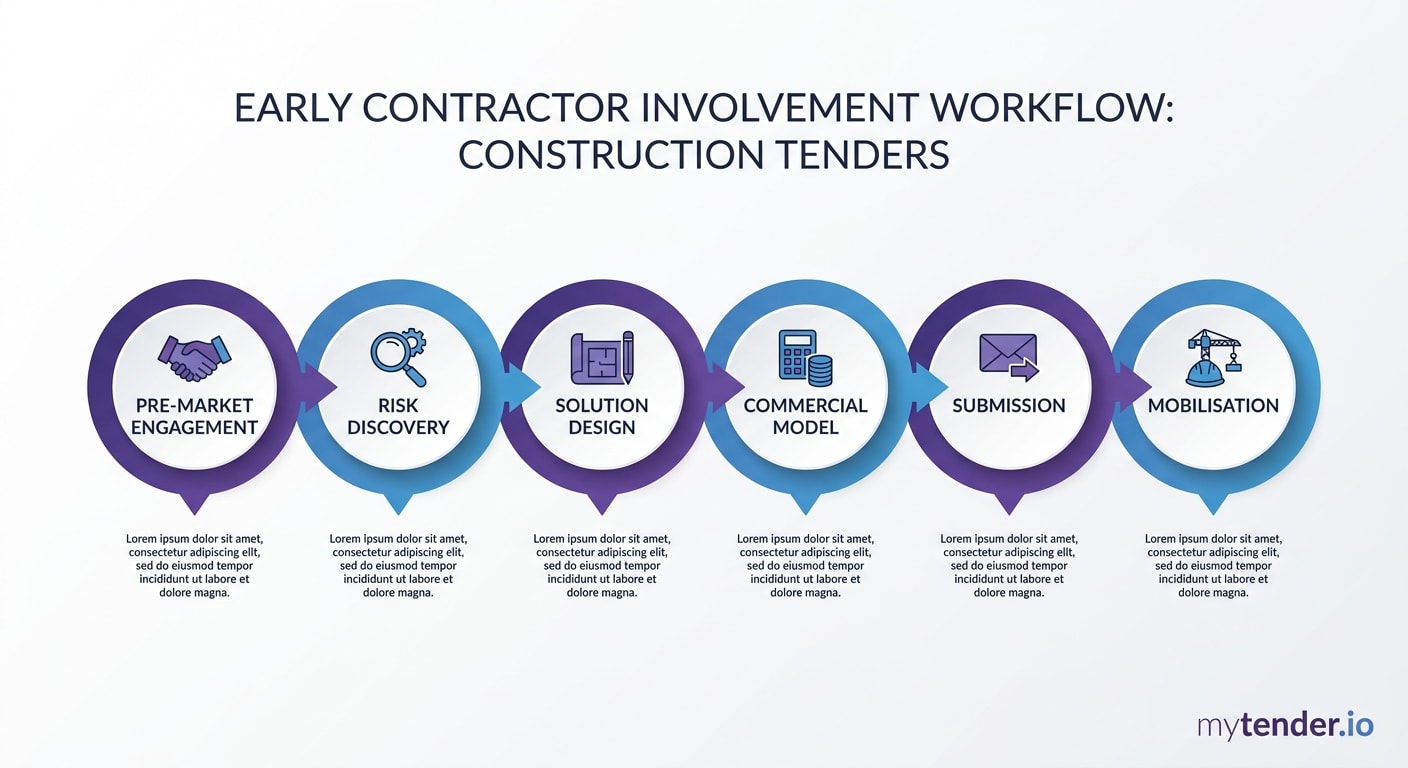
Early contractor involvement process map for construction tenders
It starts with understanding the buyer's drivers. Not just the scope, but the reason behind it. Is the priority cost certainty, decanting live services, net zero, planning risk, community disruption, funding deadlines, safety, speed, resident confidence or long-term asset value?
Then you test the design and delivery assumptions. You review drawings, surveys, access constraints, ground information, utilities, planning requirements, phasing, temporary works, logistics, interfaces and long-lead items.
Next, you shape options. That might include alternative materials, revised sequencing, modular elements, different access strategies, earlier surveys, enabling works, package splitting, supplier engagement or value engineering.
Then you quantify the options. ECI without commercial discipline is just a workshop. Each option needs a cost, risk, programme and quality impact.
After that, you agree recommendations and record decisions. The buyer needs a clean audit trail showing why a route was chosen, what assumptions underpin it and what risks remain.
Finally, you transfer the outputs into the delivery phase. The main works team should not rediscover the same risks during mobilisation. The value of ECI is partly speed, but mostly continuity.
Your tender response should make that loop visible.
How to open an ECI tender response
The opening should not be grand.
Do not start with a lecture on your company history or the importance of collaboration in modern construction. The evaluator knows collaboration matters. They want to know whether you understand their project.
A better opening does three things.
First, name the buyer's risk. If the brief mentions live occupation, say so. If it mentions an ambitious completion date, say so. If it mentions planning, heritage, decarbonisation or stakeholder sensitivity, say so.
Second, state your ECI objective. For example: our role during ECI will be to convert the preferred design into a buildable, affordable and safely sequenced delivery plan before the main works commitment is made.
Third, preview the method. Show that your answer will cover governance, risk, cost, programme, design, supply chain, social value and handover into delivery.
That kind of opening tells the evaluator you are not here to recycle a framework answer.
Build your answer around decision points
ECI is only useful if it improves decisions.
A weak response describes meetings. A strong response describes decisions those meetings enable.
For example, do not write: we will hold weekly design meetings with the client and design team.
Write: weekly design meetings will close specific decisions against a shared decision log, including specification choices, survey actions, statutory approvals, buildability changes, package interfaces and costed options. Each decision will show owner, deadline, cost impact, programme impact and residual risk.
That is much stronger because it turns a meeting into a control mechanism.
Useful ECI decision points include:
- whether further surveys are required before price lock
- whether the proposed phasing protects live operations
- whether the design can be built safely within the site constraints
- whether alternative materials improve cost, carbon or programme
- whether long-lead items threaten the funding or occupation date
- whether utilities and enabling works need separate treatment
- whether temporary works assumptions are realistic
- whether social value commitments are deliverable within the project location
- whether subcontractor input changes the risk allocation
- whether the main works price can be fixed with confidence
If your response is organised around these points, it will feel practical.
The evidence matrix evaluators expect
ECI answers need evidence from several parts of the business. The bid writer cannot make this up from a boilerplate folder.
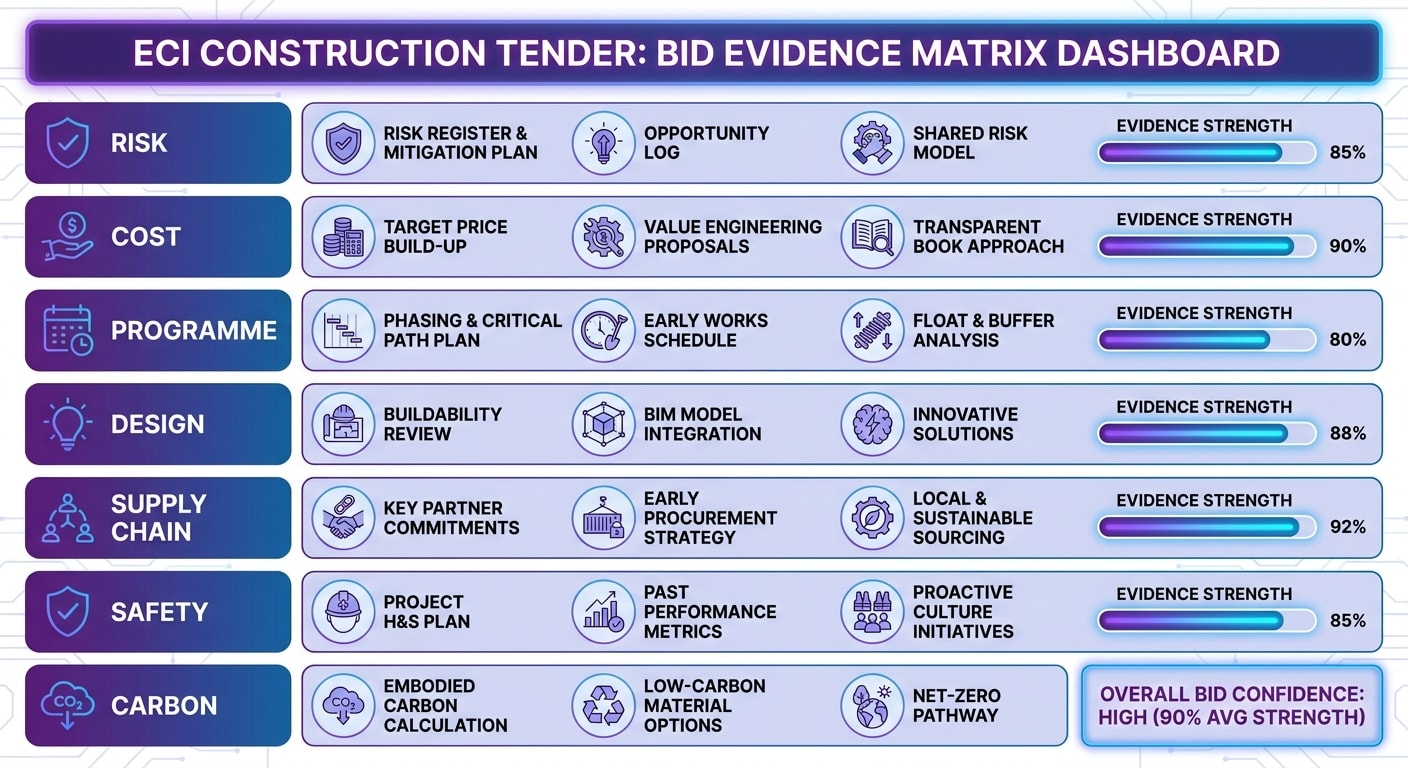
Evidence matrix for early contractor involvement construction bids
The best evidence usually includes:
- a previous two-stage or pre-construction project
- examples of design risks identified before construction
- cost plans showing option appraisal, not just final price
- risk registers that changed during pre-construction
- programme examples showing phasing, possession planning or live-site logistics
- supply chain engagement records
- evidence of specialist subcontractor input
- examples of value engineering that protected outcomes rather than just cutting scope
- carbon or whole-life cost comparisons
- lessons learned from mobilisation into delivery
- client feedback on pre-construction performance
The phrase protected outcomes matters.
Some buyers are sceptical of value engineering because they have seen it used as a polite word for stripping quality. Your response should separate intelligent option appraisal from crude cost cutting.
Good ECI value work asks: can we achieve the same or better outcome with a lower risk route?
Bad value engineering asks: what can we remove?
Evaluators know the difference.
How to write about risk without sounding negative
Construction tenders reward confidence, but ECI requires honesty.
That creates a tension. Bid teams sometimes avoid naming risks because they worry it will make them look uncertain. In ECI, the opposite is usually true.
A bidder who can name the real risks early looks more credible than one who pretends everything is under control.

Construction team running an early contractor involvement risk workshop
The key is to pair every risk with a management action.
Do not write: access may be constrained during term time.
Write: access during term time is a key ECI workstream. During weeks one and two, our logistics lead will map delivery routes, pupil and staff movements, emergency access, peak-hour restrictions and neighbour interfaces. The output will be a scored logistics option appraisal with cost, programme and safeguarding impacts for client approval.
That does not sound negative. It sounds controlled.
Use the same pattern for common construction ECI risks:
- survey gaps
- ground conditions
- utilities
- asbestos
- live building operations
- resident or service user disruption
- planning conditions
- Building Safety Act requirements
- fire strategy interfaces
- temporary works
- long-lead materials
- specialist labour shortages
- design coordination
- price inflation
- decarbonisation options
- funding deadlines
- sectional completion
Every risk should lead to an action, owner, output and decision.
Cost certainty is where many ECI bids win or lose
Buyers use ECI because they want better cost certainty before committing to delivery.
That does not mean they want the cheapest promise. They want the most reliable route to an affordable outcome.
Your response should show how cost information matures during ECI.
Set out a clear cost plan rhythm:
- baseline review of the tender information
- early identification of missing information and assumptions
- package-level cost checks with supply chain input
- option appraisals for major design choices
- inflation and long-lead item review
- risk allowance review
- open-book reconciliation where required
- affordability workshops with the client
- final price build-up with assumptions and exclusions clearly stated
Do not hide behind phrases like commercial transparency. Explain what the buyer will actually see.
Will they see subcontractor returns? Will they see labour, plant and materials? Will they see risk allowances separately? Will they see option comparison tables? Will they see the commercial impact of acceleration, phasing or out-of-hours working?
If the tender asks for open-book working, be precise.
Open-book does not mean dumping spreadsheets at the client. It means giving the client usable commercial information at the right moments, with enough context to make decisions.
Programme advice must be more than a Gantt chart
In ECI, programme advice is not just a bar chart.
It is a method for testing whether the project can actually happen.
A strong response explains how the programme will be built from constraints, not optimism. It should cover:
- survey and investigation windows
- planning, approvals and statutory interfaces
- design freeze dates
- procurement lead times
- enabling works
- temporary works design
- logistics and access constraints
- live-site phasing
- decant or possession requirements
- commissioning, handover and training
- client decision dates
- float and recovery options
The client decision dates are easy to miss. They are also crucial.
If the buyer needs to choose between two design options by week five to protect a funding deadline, say so. If a late decision will push main works into a school term, winter period or major operational event, say so.
Good ECI programme writing helps the buyer understand the consequences of delay before delay happens.
Supply chain involvement needs careful handling
Construction buyers want supply chain insight, but they also want control.
Your answer should show how you will bring specialist knowledge into ECI without creating confusion, commercial leakage or premature commitments.
Explain which packages need early input. Common examples include:
- MEP systems
- cladding and envelope
- lifts
- roofing
- groundworks
- steelwork
- modular components
- fire stopping
- specialist fit-out
- low-carbon materials
- temporary works
- utilities
Then explain how that input is managed.
For example: selected specialists will be engaged through structured technical workshops, option reviews and budget quotations. Outputs will be recorded in the design risk register and cost plan. Any recommendation that affects specification, cost, programme or risk will be presented to the client with alternatives and a clear decision point.
That is better than simply saying your trusted supply chain will be involved.
Also be careful with exclusivity. If the procurement model requires competitive package tendering later, do not imply that early suppliers are automatically locked in. Evaluators will notice.
Design management: do not overstep, but do not hide
ECI often sits in an awkward space between contractor, designer and client.
Your response should be clear about your role. You are not taking over the design unless the contract says so. But you are not passively waiting for drawings either.
A practical design management answer covers:
- constructability reviews
- design coordination workshops
- clash and interface checks
- temporary works input
- safety and maintenance access reviews
- material availability checks
- carbon and whole-life cost review
- sequencing and logistics implications
- design freeze governance
- change control
The best tone is constructive challenge.
You are helping the design team reduce delivery risk. You are not criticising their work. You are not asking the buyer to redesign everything. You are identifying the points where early contractor input can save time, cost or trouble.
One useful phrase is buildability evidence.
Do not only say that something is buildable. Show why: sequence, access, temporary works, supplier availability, installation tolerances, safety controls, inspection points and handover requirements.
Social value and carbon still matter in ECI
Construction teams sometimes treat ECI as a technical and commercial exercise. That is a mistake.
Social value and carbon often become more deliverable when they are considered early.
For social value, ECI can help test:
- local labour availability
- apprenticeship timing
- school or college engagement windows
- local supply chain capacity
- community disruption risks
- volunteering or training opportunities
- commitments that align with the construction programme
For carbon, ECI can help test:
- material alternatives
- logistics and consolidation options
- waste reduction
- reuse opportunities
- embodied carbon trade-offs
- energy performance implications
- maintenance access and whole-life cost
The important point is realism.
Do not promise social value activities that cannot happen because the programme is too short or the site is too constrained. Do not promise low-carbon alternatives without checking cost, lead time, warranty and specification acceptance.
ECI is the right place to make those promises stronger because you can test them before they become contractual commitments.
Writing for Competitive Flexible Procedure stages
If the procurement uses the Competitive Flexible Procedure, the written response may not be the whole competition.
There may be dialogue, negotiation, site visits, workshops, presentations, revised submissions or clarifications.
That means the bid team needs a stage strategy.
Do not treat each stage as a separate event. Build a thread.
The first submission should establish your understanding, method and evidence. A workshop should prove the people behind the method can think clearly. A presentation should make the evaluator confident in delivery leadership. A revised submission should show that you listened and improved the offer without losing control.
Your written response can support this by naming the governance structure you will use through procurement and ECI:
- bid director or pre-construction lead
- commercial lead
- design manager
- planner
- construction manager
- social value lead
- sustainability lead
- key specialist subcontractors
- quality or compliance lead
If these people will attend workshops or presentations, say why.
Buyers are not only evaluating documents. They are evaluating whether the team can work with them under pressure.
A practical structure for the ECI tender response
Most ECI responses benefit from a clear structure. Do not bury the method inside long paragraphs.
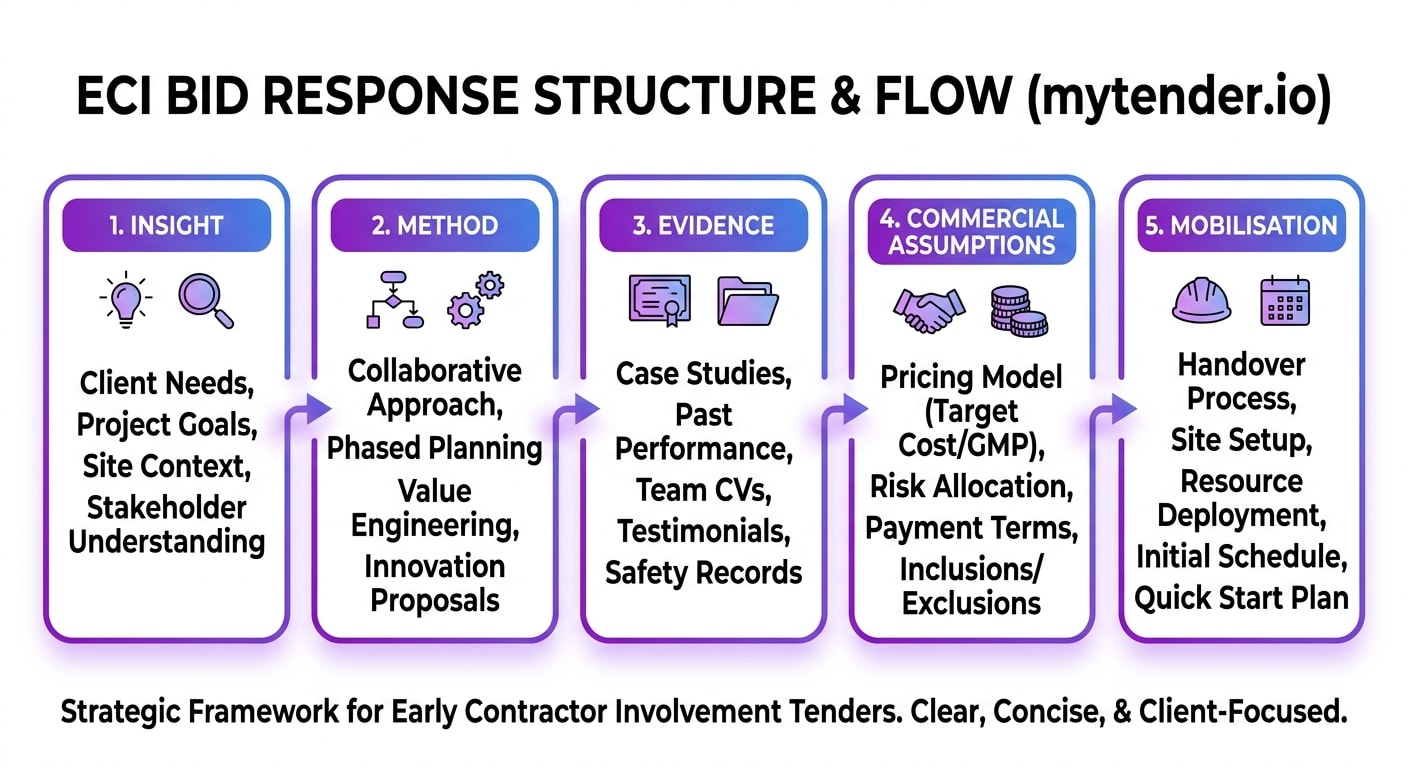
Bid response structure for early contractor involvement in construction tenders
Use a structure like this.
1. Project understanding
Open with the buyer's objectives and constraints. Keep it specific. Mention the live environment, funding deadline, phasing challenge, technical risk, stakeholder sensitivity or sustainability target that matters most.
2. ECI objectives
State what your early involvement will achieve. Examples: cost certainty, buildability, design coordination, risk reduction, supply chain validation, programme confidence, carbon improvement and mobilisation readiness.
3. Governance and people
Show who will do the work. Include roles, responsibilities, meeting rhythm, escalation routes and decision logs. If named people have relevant ECI experience, summarise it.
4. Risk and opportunity method
Explain how risks and opportunities will be identified, scored, costed, owned and closed. Include workshops, registers, option appraisals and client decisions.
5. Cost and commercial control
Set out the cost plan rhythm, open-book arrangements, supply chain pricing, assumptions, exclusions, risk allowances and affordability checks.
6. Programme and buildability
Explain how the programme will be developed, tested and updated. Cover phasing, access, live operations, long-lead items, approvals and recovery options.
7. Design and technical input
Show how you will support the design team, review buildability, manage interfaces and turn technical choices into clear recommendations.
8. Social value, carbon and local impact
Make these commitments practical and tied to the project programme. Explain how ECI improves them before the main works start.
9. Outputs and transition to delivery
List the tangible outputs the buyer will receive: risk register, decision log, cost plan, programme, design review notes, supply chain feedback, mobilisation plan, social value plan and handover pack.
10. Evidence
Use case studies, examples and client feedback to prove you have done this before.
This structure works because it mirrors what the evaluator needs: confidence that your early involvement has a method, not just good intentions.
Case study writing for ECI bids
A standard construction case study may not be enough.
For ECI, the case study should focus on what changed because you were involved early.
Use this pattern:
- the buyer's problem
- the early risk or opportunity identified
- the action you took
- the decision the client made
- the measurable outcome
- the lesson applied to this tender
For example, do not just write that you delivered a school refurbishment on time.
Write that during pre-construction you identified a phasing conflict between safeguarding routes and deliveries, redesigned the logistics plan, moved noisy works into holiday windows, reduced temporary accommodation requirements and protected the opening date.
That is much more relevant to ECI scoring.
The best ECI case studies often involve prevention. That can make them harder to write because the success is something that did not go wrong.
Make the avoided problem visible.
If you prevented a delay, quantify the risk. If you avoided a redesign, explain the interface. If you protected a budget, show the cost movement. If you improved safety, explain the control.
Common ECI bid writing mistakes
The first mistake is writing too generally. ECI depends on context. If the answer could apply to any construction project, it is too weak.
The second mistake is focusing only on meetings. Meetings are not outcomes. Explain the decisions, outputs and controls.
The third mistake is overpromising cost certainty too early. If information is missing, say how you will close the gap. Do not pretend uncertainty has disappeared.
The fourth mistake is treating supply chain input as a slogan. Name the packages, explain the process and show how recommendations are controlled.
The fifth mistake is making value engineering sound like scope reduction. Keep the focus on outcomes, risk and whole-life value.
The sixth mistake is ignoring the transition from ECI to delivery. Buyers want confidence that early insight will not be lost when the main works team mobilises.
The seventh mistake is using the wrong evidence. A case study that proves delivery is helpful. A case study that proves early risk reduction is better.
The eighth mistake is letting the bid writer carry the answer alone. ECI needs input from pre-construction, commercial, planning, design management, operations, sustainability and supply chain.
The role of AI in ECI tender responses
AI can help construction bid teams move faster, but only if it is grounded in real project evidence.
Useful AI tasks include:
- breaking down the tender pack into ECI workstreams
- extracting risk, programme and commercial requirements
- building a compliance matrix
- matching questions to previous case studies
- summarising survey gaps and assumptions
- drafting first-pass answers from approved evidence
- checking whether responses answer the scoring criteria
- identifying vague claims that need proof
Risky AI tasks include:
- inventing buildability insight
- writing generic collaboration language
- creating cost or programme claims without evidence
- overstating experience with two-stage projects
- recycling a method from a different sector without adapting it
- missing commercial assumptions hidden in the tender pack
For ECI, the danger is not that AI writes badly. The danger is that it writes confidently about things the project team has not validated.
That is why the knowledge source matters.
A tool like mytender.io can help bid teams retrieve previous evidence, structure first drafts, check compliance and keep answers tied to real organisational knowledge. That is valuable in ECI because the strongest response is not the fanciest wording. It is the clearest link between evidence, judgement and the buyer's project risk.
What to do before writing the next ECI bid
If an ECI tender lands tomorrow, do not open a blank document first.
Do this instead.
First, run a 45-minute capture session with pre-construction, commercial, planning and operations. Ask: what are the three biggest risks, what decisions does the buyer need to make early and what evidence proves we can help?
Second, build a project-specific risk and opportunity table. Include action, owner, output, decision date and evidence source.
Third, identify which case studies show early involvement, not just final delivery. Pull out the change you made before construction began.
Fourth, agree the commercial story. How will cost information mature? What will be open-book? What assumptions must be visible?
Fifth, map the buyer's decision points. Your answer should help the buyer see how decisions will be made, not just how meetings will be held.
Sixth, check the transition into delivery. Show how ECI outputs become the mobilisation plan, construction phase plan, package procurement plan, programme and governance routine.
Seventh, remove every sentence that says collaboration without proving it.
That last step is brutal, but useful.
The bottom line
Early contractor involvement is attractive because it promises better decisions before the expensive part begins.
But buyers have heard the word collaboration too many times. They do not need another bidder saying they will be proactive, transparent and partnership-focused.
They need a contractor who can make uncertainty manageable.
That means naming the risks, structuring the decisions, bringing the right people in early, showing commercial discipline and carrying the learning into delivery.
If your ECI response does that, it will stand out.
If it only says you are collaborative, it will disappear into the pile.
For construction bid teams, the practical next step is simple: build an evidence library around early risk reduction, not just project completion. Capture the moments where your pre-construction input changed a design, protected a budget, improved a programme or avoided a delivery problem.
That evidence is what wins ECI work.
If you want to find live construction tender opportunities and start matching them to your evidence, the Tender Finder is free to use.
Tags
Ready to Transform Your Tender Writing?
See how MyTender's AI can help you write winning tenders in a fraction of the time.